UNIVERSIDADE FEDERAL DE SÃO CARLOS
CENTRO DE CIÊNCIAS EXATAS E TECNOLOGIA DEPARTAMENTO DE ENGENHARIA DE PRODUÇÃO
PROGRAMA DE PÓS-GRADUAÇÃO EM ENGENHARIA DE PRODUÇÃO
RESILIENCE ELEMENTS TO COMBAT COUNTERFEIT
MEDICINES IN SUPPLY CHAIN
FLÁVIA RENATA PINHO DE LIMA
UNIVERSIDADE FEDERAL DE SÃO CARLOS
CENTRO DE CIÊNCIAS EXATAS E TECNOLOGIA DEPARTAMENTO DE ENGENHARIA DE PRODUÇÃO
PROGRAMA DE PÓS-GRADUAÇÃO EM ENGENHARIA DE PRODUÇÃO
RESILIENCE ELEMENTS TO COMBAT COUNTERFEIT
MEDICINES IN SUPPLY CHAIN
FLÁVIA RENATA PINHO DE LIMA
Dissertação apresentada ao Programa de Pós- Graduação em Engenharia de Produção da Universidade Federal de São Carlos, como parte dos requisitos para a obtenção do título de Mestre em Engenharia de Produção.
Orientadora: Profª. Drª. Andrea Lago da Silva
SÃO CARLOS - SP
Programa de Pós-Graduação em Engenharia de Produção
Folha de Aprovação
Assinaturas dos membros da comissão examinadora que avaliou e aprovou a Defesa de Dissertação de Mestrado da candidata Flavia Renata Pinho de Lima, realizada em 23/02/2018:
Dedico este projeto a todos aqueles que acreditam na importância de um modelo de gestão capaz de equilibrar eficiência, qualidade e mitigação de riscos para a
ACNOWLEDGMENTS
Agradeço, em primeiro lugar, à minha família e namorado, por todo o amor e companheirismo dedicados, sempre e de forma incondicional.
À minha orientadora, Andrea Lago da Silva, por todos os desafios propostos e
ensinamentos durante esta jornada, que me transformaram em uma pessoa e profissional mais completa. Assim como aos seus orientados e ex-orientados na UFSCar, que
compartilham comigo o interesse em desvendar os segredos de cadeias de suprimentos mais resilientes.
Aos meus professores, Moacir Godinho Filho e Eduardo Mario Dias, pelos conselhos e direcionamentos em momentos críticos, que foram fundamentais para a conclusão deste projeto.
Aos meus colegas do Grupo de Pesquisa da USP, que me incentivaram a estudar um tema tão desafiante e perturbador, que é a contrafação de medicamentos. Em especial à Maria Lidia Dias, que me acompanhou em grande parte desta jornada.
To my Ohio State University’s friends at Baker Systems Engineering, who taught me to investigate resilience from a different and challenging perspective.
À Visagio, que me ensina e desafia a ser melhor a cada dia.
ABSTRACT
RESUMO
Cadeias de suprimentos estão se tornando cada vez mais complexas e vulneráveis a cenários específicos de perturbações, críticos para a continuidade do negócio. Contrafação é um destes cenários, especialmente em mercados onde produtos contrafeitos afetam diretamente a saúde do consumidor, como comida, bebida e medicamentos. Porém, poucos autores têm investigado como analisar esta perturbação por uma perspectiva de gestão. Este estudo sugere que a resiliência na cadeia de suprimentos é uma solução dinâmica aplicável a combater perturbações em constante crescimento e inovação, como a contrafação. Para suprir esta lacuna que é a falta de entendimento em como aumentar a resiliência à contrafação, o estudo visa entender como os elementos de resiliência influenciam o combate aos medicamentos contrafeitos. Para isso, uma revisão sistemática de literatura foi desenvolvida, com auxílio do software QDA Miner para a análise de conteúdo. Após um cuidadoso processo de análise, 84 artigos entre 2002 e out/2016 foram selecionados. A revisão sistemática revelou 13 elementos de resiliência e 16 medidas anti-contrafação. Além disso, reengenharia, colaboração, visibilidade, inovação, cultura de resiliência na cadeia de suprimentos e confiança apareceram como os seis elementos mais relevantes para o combate à contrafação. Após a revisão de literatura, foi conduzida uma pesquisa empírica – estudo de caso, para suportar o objetivo exploratório da pesquisa. O estudo de caso contou com duas cadeias de medicamentos, sendo duas farmacêuticas (empresas focais) e elos à jusante, e agências e associações que atuam em toda a cadeia para combater a contrafação. A pesquisa empírica possibilitou uma investigação mais profunda dos elementos de resiliência e anti-medidas aplicadas. Os resultados mostram que, em linha com a literatura, colaboração, confiança e visibilidade são elementos cruciais para fortalecer a resiliência à contrafação. Além disso, diferente do que foi observado na revisão da literatura, compartilhamento de informações e antecipação (sensing) apareceram como elementos muito associados às anti-medidas, impulsionados pela existência de uma enorme quantidade de dados e a possibilidade de melhorar o processo de tomada de decisão das empresas. Dessa forma, este estudo contribui para o tema ao: (i) propor um framework para aumentar a resiliência à contrafação na cadeia de medicamentos, o qual caracteriza a dinâmica entre os elementos de resiliência e as anti-medidas e discute o papel de colaboração e compartilhamento de informações como barreiras; (ii) sugerir novas linhas de pesquisa, como a exploração dos
tradeoffs entre as literaturas de resiliência e contrafação, a investigação da efetividade da
FIGURE LIST
Figure 1: Supply chain resilience framework ... 21
Figure 2: Global risks and interconnections ... 22
Figure 3: Scheme of medicines supply chain ... 28
Figure 4: Dissertation structure ... 30
Figure 5: Research focus ... 40
Figure 6: Research design... 41
Figure 7: Phases of SLR ... 42
Figure 8: Status of articles’ assessment ... 46
Figure 9: Medicines supply chain links and case studies selected ... 55
Figure 10: Results of SLR ... 59
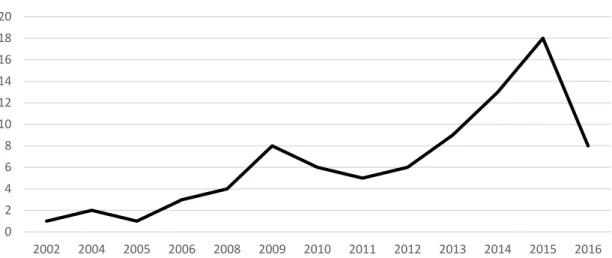
Figure 11: Articles distribution per year... 61
Figure 12: Summary of inter-organizational processes and policies counterfeit anti-measures ... 67
Figure 13: Summary of intra-organizational processes and policies counterfeit anti-measures ... 70
Figure 14: Summary of behavioral counterfeit anti-measures ... 72
Figure 15: Summary of technologies counterfeit anti-measures ... 75
Figure 16: Proximity plot - resilience elements most often associated with counterfeit anti-measures ... 87
Figure 17: Association of collaboration and counterfeit anti-measures ... 89
Figure 18: Agents involved in increasing resilience collaboration to counterfeit medicines ... 91
Figure 19: Association of reengineering and counterfeit anti-measures ... 92
Figure 20: Association of trust and counterfeit anti-measures ... 94
TABLES LIST
Table 1: Definition of counterfeit medicine ... 34
Table 2: Definition of SCR ... 38
Table 3: SLR Protocol ... 43
Table 4: SLR constructs, key words and strings ... 44
Table 5: Inclusion and exclusion criteria ... 45
Table 6: Characteristics of CASE 1 and CASE 2 ... 51
Table 7: Characteristics of studied entities that affect both cases ... 52
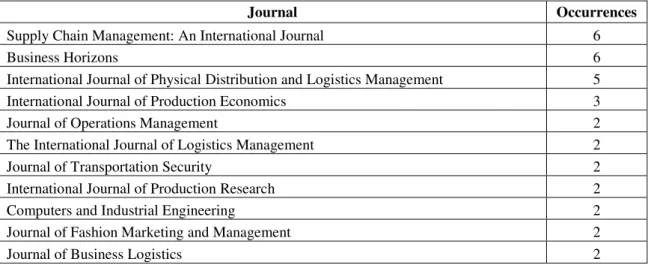
Table 8: Articles distribution per Journal (> 1occurence) ... 60
Table 9: Studied regions and origin of authors... 61
Table 10: Definition of counterfeit anti-measures identified in the present literature review ... 63
Table 11: Definition of resilience elements identified in the present literature review . 77 Table 12: Counterfeit anti-measures identified in CASE 1 ... 108
DEFINITION AND STANDARDIZATION OF TERMS
LIST OF ABBREVIATIONS
AIPrep1 - Association’s Representative of CROSSASS1 AIPrep2 - Association’s Representative of CROSSASS2 ANVISA - Agência Nacional de Vigilância Sanitária
ANVrep - Representative of products controlling of ANVISA B2C - Business to Consumer
CROSSASS1 - Association Focused on IP Rights and Counterfeit Combat CROSSASS2 - Association Focused on IP Rights and Counterfeit Combat CROSSORG1 - Organization Focused on Traceability and Standard Definition CROSSORG2 - Organization Focused on Traceability and Standard Definition DISTRIBUTOR 1 - Distributor from CASE 1
DISTRIBUTOR 2 - Distributor from CASE 2 DMgen2 - General Manager of DISTRIBUTOR2 DMlog1 - Logistics Manager of DISTRIBUTOR1 EDI - Electronic Data Interchange
GPS - Global Positioning System
HMpurlog12 - Logistics Manager of HOSPITAL1/2 HOSPITAL1/2 - Hospital from CASE 1 and 2 IP - Intellectual Property
MCNS - Medicines Control National System OPL 1 - Logistics Provider from CASE 1
Orep1 - Organization’s Representative of CROSSORG1 OTRACrep1 - Traceability Representative of CROSSORG1 OTRACrep2 - Traceability Representative of CROSSORG2 PArep1 - Association’s Representative of PHARMAASS1
PArep2 - Association’s Representative of PHARMAASS2 PHARMA 1 - focal Company of CASE 1
PHARMA 2 - focal Company of CASE 2 PHARMAASS1 -Pharmaceutical Association PHARMAASS2 -Pharmaceutical Association
PMgenlatam1 - General Manager of Latin America of PHARMA1 PMlog2 - Logistics Manager of PHARMA2
PMqualsec2 - Quality and Security Manager of PHARMA2 PMrisk2 - Risk Manager of PHARMA2
PMtec1 - Technology Manager of PHARMA1 PSI - Pharmaceutical Security Institute
PSlog1 - Logistics Specialist of PHARMA1 R&D - Research and Development
RFID - Radio-frequency identification SCR - Supply Chain Resilience
SCRM - Supply Chain Risk Management
SETRM - Technology Seminar for Medicines Traceability SLR - Systematic Literature Review
TMS - Transportation Management System TMsec1 - Security Manager of OPL1 TMsec2 - Security Manager of OPL1 TOcoord - Coordinator of TECORG1
TOcoordtec - Technical Coordinator of TECORG1 TODoper - Director of Operations of TECORG2
LIST OF ABBREVIATIONS (cont.)
TOres1 - Researcher of TECORG1 USA - United States of America
TABLE OF CONTENT
1 INTRODUCTION ... 18
1.1 Theme Presentation ... 18
1.2 Research Problem and Questions ... 21
1.3 Objective and Expected Contributions... 24
1.4 Justification ... 25
1.5 Dissertation Structure ... 30
2 SCOPE REVIEW ... 31
2.1 Illegal Products in Supply Chain ... 31
2.2 Counterfeit... 32
2.3 Counterfeit Medicines ... 33
2.4 Resilience ... 35
2.4.1 Introduction to Supply Chain Risk Management (SCRM) ... 35
2.4.2 Supply Chain Resilience (SCR) ... 37
3 RESEARCH METHODOLOGY ... 40
3.1 Approach and Research Method ... 40
3.2 Literature Review ... 41
3.3 Empirical Research ... 47
3.4 Research Findings and Conclusions ... 56
4 SYSTEMATIC LITERATURE REVIEW (SLR) ... 58
4.2 Counterfeit Anti-measures in Supply Chain ... 62
4.2.1 Inter-organizational processes and policies ... 65
4.2.2 Intra-organizational processes and policies ... 67
4.2.3 Behavioral ... 70
4.2.4 Technologies ... 73
4.3 Resilience Elements in Supply Chain ... 75
4.4 The Role of Resilience Elements in Combating Counterfeits in the Medicine Supply Chain ... 86
4.4.1 Resilience elements most often associated with counterfeit anti-measures ... 88
4.4.2 Resilience elements less often associated with counterfeit anti-measures ... 101
4.5 Conclusion of SLR ... 102
5 RESULTS AND DATA ANALYSIS OF CASE STUDY ... 105
5.1 Data Analysis and General Results from CASE 1 ... 106
5.1.1 CASE 1 presentation ... 106
5.1.2 Counterfeit anti-measures identified in CASE 1 ... 107
5.1.3 Resilience elements in CASE 1 ... 114
5.1.4 Role of resilience elements in combating counterfeit medicines in CASE 1 ... 117
5.1.4.1 Associations from CASE 1 often observed in SLR ... 119
5.2 Data Analysis and General Results from CASE 2 ... 123
5.2.1 CASE 2 presentation ... 124
5.2.2 Counterfeit anti-measures identified in CASE 2 ... 125
5.2.3 Resilience elements in CASE 2 ... 132
5.2.4 Role of resilience elements in combating counterfeit medicines in CASE 2 ... 135
5.2.4.1 Associations from CASE 2 often observed in SLR ... 137
5.2.4.2 Associations from CASE 2 not often observed in SLR ... 140
5.3 General Results from Cross-Case Analysis ... 141
6 CONCLUSIONS ... 146
6.1 Results from Theoretical and Empirical Research ... 147
6.2 Managerial and Theoretical Implications... 152
6.3 Limitations ... 155
1 INTRODUCTION
This section introduces concepts, justifications and objectives of this research. Firstly, item 1.1 presents the theme, followed by the research problem and questions raised (item 1.2). Then, item 1.3 specifies the main objectives and expected contributions, and item 1.4 justifies the relevance of this study.
1.1 Theme Presentation
Intellectual property (IP) is an intangible and valuable asset used by organizations to leverage competitivity and, therefore, has become a key-factor in organization evaluation (GREEN; SMITH, 2002; STAAKE; THIESSE; FLEISCH, 2009). One of the threats to IP are counterfeits, which means trade products that bear reference to a brand or organization without authorization and could be confused with an original one (STAAKE; THIESSE; FLEISCH, 2009). The number of counterfeit incidents reported has grown, especially in markets focused on research, development and innovation (STEVESTON; BUSBY, 2015). This may be explained by: (i) Asian market growth, where control of intangible assets, such as trademark and IP, is complex; (ii) global trend to eliminate borders and promote international trade; (iii) global organizations interaction (STAAKE; THIESSE; FLEISCH, 2009); (iv) use of more complex channels and methods by counterfeiters (WHO, 2006); and (v) growth of Business to Consumer (B2C) market and consequently internet shopping popularization (LYBECKER, 2008; WHO, 2010). Moreover, it may be especially critical in environments with strong concerns about consumer safety (RINGSBERG, 2014), such as food, electronics and medicines.
Almuzaini, Choonara and Sammons (2013) presented a Systematic Literature Review (SLR) about counterfeit medicines focused on assessing the quality of studies about drug analysis; (ii) technologies– e.g.: Kwok et al. (2010); Coustasse, Arvidson and Rutsohn (2010); Li (2013); Taylor (2014) and Dimase et al. (2016) provided technological solutions to address the issue; (iii) consumers role– e.g: Cesareo and Stöttinger (2015) developed a survey in luxury industry to propose anti-measures directed at consumers. Most articles on this subject do not focus on managerial perspectives of supply chains. Hoecht and Trott (2014) presented a broad review of such anti-measures, e.g. co-opt offenders, educating stakeholders at the source, aggressive advertising and internal and external guanxi (China), but focusing on Chinese scenarios. Focusing on the pharmaceutical industry, Chaudhry and Stumpf (2013) delineate the problem by presenting incidents and possible triggers to counterfeits. Cohn et al. (2012) describes an event of falsified medicines in Kenya and makes recommendations.
(CHRISTOPHER; PECK, 2004; FIKSEL et al., 2015; ALI; MAHFOUZ; ARISHA, 2017).
In recent years, academics have been developing a vast body of literature involving SCR. Essentially, they are related to (a) generic mechanisms or frameworks to increase organizational or supply chain resilience (e.g. theoretical: Ehrenhuber et al., 2015; Hohenstein et al., 2015; Kilubi and Haasis, 2015; Tukamuhabwa et al., 2015; and Kamalahmadi and Parast, 2016; and empirical: Sheffi, 2005; Blackhurst, Dunn and Craighead, 2011; and Pettit; Croxton; Fiksel, 2013); (b) specific elements (e.g. theoretical: Christopher and Lee, 2004; Sheffi and Rice, 2005; Kache and Seuring, 2014; Chang, Ellinger and Blackhurst, 2015; and empirical: Christopher and Lee, 2004; Kache and Seuring, 2014; and Scholten and Schilder, 2015); (c) organizational functions or processes to increase organizational or supply chain resilience e.g. theoretical: Khan, Christopher and Creazza, 2012; and empirical: Khan, Christopher and Creazza, 2012; Pereira, Christopher and Silva, 2014, and Wang, Jie and Abareshi, 2015); and (d) analysis of specific disturbance scenarios and how resilience could contribute (e.g. empirical: Rashid, Loke and Ooi, 2014; Scholten, Scott and Fynes, 2014; and Stevenson and Busby, 2015).
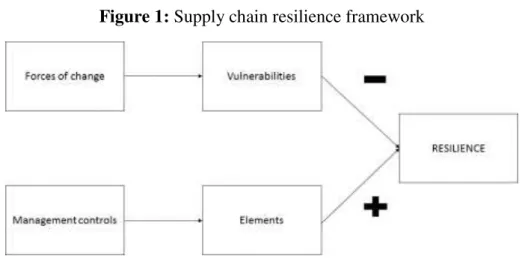
Figure 1: Supply chain resilience framework
Source: adapted from Pettit, Fiksel and Croxton (2010, p.8)
Figure 1, developed by Pettit, Fiksel and Croxton (2010), represents that forces of change cause vulnerabilities, responsible for reducing resilience. Exposure to geopolitical disruptions, terrorism, piracy, theft, and disintegration of supply chain are examples of vulnerabilities to be addressed (CHOWDHURY; QUADDUS, 2015).
On the other hand, creating management controls help to develop resilience elements that increase SCR.
1.2 Research Problem and Questions
The complexity of supply chains and increased interconnection among organizations have raised supply chains’ vulnerabilities. Therefore, organizations have become more interested in learning how to deal with specific disturbances (BLACKHURST; WU, 2009; PUNNIYAMOORTHY; THAMARAISELVAN; MANIKANDAN, 2013). Understanding supply chain risk sources and the severity of their impact is the first step in the design of efficient and resilient supply chain networks (PUNNIYAMOORTHY; THAMARAISELVAN; MANIKANDAN, 2013). Risk sources are classified as “the environmental, organizational or supply chain-related variables that cannot be predicted with certainty and that impact on the supply chain outcome variables”
Manikandan (2013), have identified and classified the main risk sources (see Lavastre, Gunasekaran and Spalanzani, 2012 for further discussion).
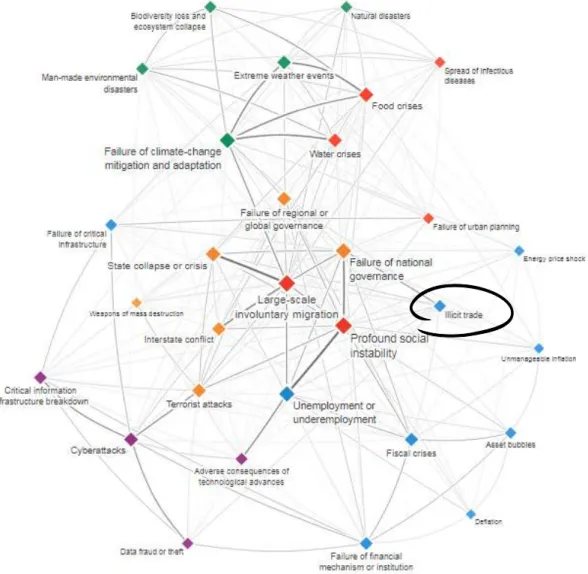
Tang and Tomlin (2008) present six types of supply chain risks: supply, process, demand, behavioral, political/social, and IP. Speier et al. (2011) state that supply chain disruptions may result from unintentional and intentional sources. While the first relates to accidents or natural disasters, the second refers to theft, contamination/sabotage, or terrorist attack. Moreover, the World Economic Forum (2017) released a report about Global Risk presenting the main global risks and its interconnections, as observed in figure 2.
Figure 2: Global risks and interconnections
Figure 2, therefore, represents how interconnected the risks are nowadays that supply chains are exposed to. Survey respondents were asked to identify between global risks they believe to be most interconnected. The bigger rhombus highlights the number and strength of interconnections. Blue rhombus represents economic risks, green environmental risks, orange geopolitical risks, red societal risks and purple technological risks. As highlighted, illicit trade appears as one of the global risks, and very interconnected among other global risks, which means it is likely to cause great impacts along globalized networks. More specifically, Donadoni et al. (2016) and Tukamuhabwa, Stevenson and Busby, (2017) presented counterfeit as one of the main types of supply chain disturbances.
Authors claim that the more resilient the supply chain, the greater the trend of better response to disturbances (SHEFFI, 2005; BRUSSET; TELLER, 2017). Thus, one opportunity to mitigate counterfeit risk is the development of resilience into organizations. Organization resilience, for the purpose of this study, is defined as
“the adaptative capability of an enterprise, which is highly dependent on its
individuals, groups, and subsystems, to face immediate and unexpected changes in the environment with proactive attitude and thought and adapt and
respond to these changes by developing flexible and innovative solutions”
(KAMALAHMADI; PARAST, 2016, p.121).
increase resilience. Hence, the study analyzed the theme from the counterfeiter perspective.
More studies are needed within this context to understand the role of resilience elements to combat counterfeit in supply chain. Stevenson and Busby (2015) demonstrated the importance of including counterfeit risk perspective during supplier selection process. Although criteria such as trust and risk of future competition with the supplier by market are found in literature, little is reported on the risk of the supplier using the organization's trademark improperly.
There is a gap in the literature, once few authors present managerial tools and practices to deal with counterfeit disruptions. Although some counterfeit anti-measures are similar in different industries (MACHADO; PAIVA; SILVA, 2018), it is clear that a counterfeit anti-measure found to be useful to one product may not work for another (QIAN, 2014). Anti-measures might need to be tailored to specific products (CHO; FANG; TAYUR, 2015). This study focuses on counterfeit of medicines, because its supply chain is one of the most threatened, due to the amount of existing counterfeited medicines, the direct impact on consumer health, and the difficulty to identify counterfeit products (COCKBURN et al., 2005; BERGER; BLIND; CUNTZ, 2012; STEVENSON; BUSBY, 2015). Hence, this study aims at answering the following question:
How do resilience elements influence the combat of counterfeit medicines in the supply
chain?
1.3 Objective and Expected Contributions
The general objective is to understand how resilience elements influence the combat of counterfeit medicines.
identify and characterize SCR elements;
evaluate the resilience elements most and less often associated with counterfeit anti-measures;
empirically explore how organizations in medicines supply chain might increase resilience to counterfeits.
This study provides managerial and academic contribution by (i) characterizing resilience elements to support counterfeit combat into medicines supply chain, by comparing the data obtained from the theoretical and empirical research; and (ii) proposing a set of actions to support medicines supply chain managers to strengthen organizations’ resilience to counterfeit and, thus, be more prepared to deal with
disturbances triggered by counterfeit incidents.
1.4 Justification
The capacity to recover and evolve to a new state of operation after a disturbance in product and/or information flow has proven to be a significant competitive advantage for organizations (FIKSEL et al., 2015). Bhatia, Lane and Wain (2016) corroborate with this statement, as they verified that more than 80% of organizations are worried on how to increase resilience. Deeper studies are being conducted to support organizations on how to develop resilience elements (FIKSEL et al., 2015; KAMALAHMADI; PARAST, 2016).
has been an expansion of counterfeited goods from luxury items to health and safety products, such as pharmaceutical, food and drinks, medical equipment, personal care items, toys, tobacco and automotive parts.
Counterfeit affects more severely developing countries (COCKBURN et al., 2005; LYBECKER, 2008). However, the product flow might be found anywhere and therefore represents global issues (COUSTASSE; ARVIDSON; RUTSOHN, 2010; WHO, 2010), as illustrated in the incidents:
epidemics linked to the consumption of contaminated diethylene glycol. First epidemic known took place in the USA (1937) and resulted in 105 deaths; the problem re-emerged in eight other situations, killing hundreds of people in developing countries like Haiti and Panama (WHO, 2008);
in 2004, investigators discovered counterfeited versions of popular medicines being distributed to patients in the United Kingdom (COUSTASSE; ARVIDSON; RUTSOHN, 2010);
investigators in the United Kingdom discovered counterfeit versions of the popular drugs Lipitor R (for cholesterol reduction); Cialis R (for erectile dysfunction); and Reducil R (for treatment of obesity) being distributed to patients (WYLD, 2008);
in 2008, 150 people went to Singapore Hospital after taking counterfeited erectile dysfunction medicines – 4 of them died and 7 suffered brain damage (OSSOLA, 2015);
such as São Paulo, Paraná, Santa Catarina, Rio Grande do Norte, Distrito Federal, Rio Grande do Sul and Amazonas (AMES; SOUZA, 2012);
in 2011, USA patients reported to FDA (Food and Drug Administration) that they
required emergency treatment after taking medicines such as Ambien, Xanax and Lexapro bought online (OSSOLA, 2015);
in 2012, a falsified tuberculosis medicine killed approximately 100 patients in a local Pakistan hospital (OSSOLA, 2015);
more than 8.000 patients died in a hospital located in a remote region from the Himalayas after taking counterfeit antibiotics for surgery infection prevention (OSSOLA, 2015).
Moreover, counterfeit medicines might harm or be inefficient to patient’s
health and diminish brand image (COCKBURN et al., 2005; EVERTS, 2010). Hence, we selected the medicines supply chain for this study because of its criticality, global scope and potential negative effects.
Because of the general stimulus in 1960 to the establishment of foreign factories in Brazil, most medicines are produced in Brazil with imported raw materials, (PALMEIRA FILHO; PAN, 2003). According to a survey from IMS Health, ordered from Associação Brasileira das Indústrias de Medicamentos Genéricos (PróGenéricos), from January to September/2015, the sector handled R$ 55.89 billion in Brazil, which means 2.53 billion medicine packages (MELO, 2015). The increasing flow of medicines in Brazil resulted in a complex network composed of more than 400 manufacturers, 300 wholesalers, 50.000 pharmacies, and 5.000 hospitals, besides other players (PWC, 2016). Moreover, specific regulators and supervisory agents work to monitor different aspects of the supply chain. Figure 3 illustrates a simplified scheme.
Figure 3: Scheme of medicines supply chain
Source: created by the author
This high complexity degree, added to the large contribution that actions may represent to the population, increase the relevancy of project development in healthcare (FERREIRA; MATOS; LEAL, 2015; AGARWAL et al., 2016).
criticality of threats in healthcare: consumption of falsified medicines may potentially cause death by absorption of illegal substances or by not consuming what the patient really needs (COCKBURN et al., 2005);
counterfeiters broad operation: Cockburn et al. (2005) identified counterfeit incidents in almost all continents and different countries around the world – Southeast Asia, China, North America, Haiti, Nigeria, Bangladesh, India, Argentina, Niger and Central Africa;
increased amount of incidents in healthcare: although there is no trustable database with all counterfeit incidents, Stevenson and Busby (2015) reported that 37% of incidents in CBI (International Chamber of Commerce division), FBI (US Federal Bureau of Investigation), and Nexis database were related to the pharmaceutical industry.
Moreover, another fact that called attention to the Brazilian medicines supply chain is that Brazil approved the Legislation 11.903/2009, modified in 2016 by 13.410/2016, which introduced the Medicines Control National System (MCNS). It aims at controlling medicines by means of a unique identification system and employment of available technologies to capture, storage and electronic data transmission (PAES, 2009; NOGUEIRA; VECINA NETO, 2011). MCNS is an example of Brazilian Government efforts to ensure greater safety to the medicine consumer. Mechanisms to combat sales and consumption of counterfeit medicines have been discussed and implemented all over the world (COCKBURN et al., 2005; LIMA et al., 2016).
1.5 Dissertation Structure
Figure 4 presents the sections of the final dissertation and the scope designed.
Figure 4: Dissertation structure
2 SCOPE REVIEW
This section aims at presenting initial concepts that allowed deeper exploration of resilience and counterfeit themes in supply chain management, focused on medicines. The results from SLR are detailed in section 4.
2.1 Illegal Products in Supply Chain
Trafficking uncontrolled substances, stolen and smuggled goods, and trade
products without IP rights are examples of illicit trade within the supply chain (STAAKE; THIESSE; FLEISCH, 2009). The growing emergence of such issues in the supply chain may be explained by increased globalization, dispersed value chains, distribution of goods in the international market (BERGER; BLIND; CUNTZ, 2012), challenging economic conditions and popularity of the Internet combined with privacy legislation (WILCOCK; BOYS, 2014).
Pharmaceutical Security Institute (PSI) defines three types of crimes related to illicit trade in the supply chain: illegal diversion, thefts, and counterfeit trade. Illegal diversion happens when a produced and approved genuine product is intercepted and sold in a different region. Thefts are products illegally obtained at any point of the supply chain, either by burglary, robbery, or at an embezzlement of goods. It is common to read about such incidents in magazines and newspapers of products with different value, from snacks (G1, 2016) to pumps (R7, 2016). Finally, counterfeit trade is the
[…] trade in goods that, be it due to their design, trademark, logo, or company name, bear without authorization a reference to a brand, a manufacturer, or any organization that warrants for the quality or standard conformity of the goods in such a way that the counterfeit merchandise could, potentially, be confused with goods that rightfully use this reference. (STAAKE; THIESSE; FLEISCH, 2009, p.322)
2.2 Counterfeit
IP is an intangible and valuable asset used by organizations to leverage business and, therefore, has become a key-factor in organization evaluation (GREEN; SMITH, 2002; STAAKE; THIESSE; FLEISCH, 2009; LAU; KONG; BAARK, 2012). To protect IP, organizations apply formal methods, such as patents and trademarks, and informal ones, such as confidentiality agreements (LAU; KONG; BAARK, 2012). However, despite the efforts, the number of counterfeit incidents reported has grown, especially in markets focused on research and development and innovation, such as pharmaceutical, automotive, electronic, and aviation (STEVENSON; BUSBY, 2015), driven by increased globalization, and complex and fragmented supply chains (EVERTS, 2010). Unfortunately, there is no reason to believe that this reality is going to change soon (CESAREO; STÖTTINGER, 2015), and organizations have to prepare to deal with this threat.
products are authentic (WILCOCK; BOYS, 2014). Deceptive counterfeits are potentially harmful to health and safety and represent losses in government operations (due to taxes not collected) and brand loss of sales and/or equity (GREEN; SMITH, 2002). These products tend to receive more enthusiastic responses from local authorities for requests for IP protection (GREEN; SMITH, 2002).
On the other hand, nondeceptive counterfeiting consumers know or strongly suspect when they purchase not original products. They distinguish fakes from legitimates and deliberately chose to buy counterfeits. Although in practice markets for counterfeit may not be entirely deceptive or nondeceptive, distinguishing them may help studies on the subject (GROSSMAN; SHAPIRO, 1988a). Nondeceptive counterfeits usually encompass designer brands, audio and video products, and software (GREEN; SMITH, 2002). Regardless of the type of market, the purchase of counterfeiting may cause severe damages to the consumer. In medicines supply chain, for example, counterfeit products may include the incorrect quantity of ingredients, be composed by the wrong formula, or contain non-active or even toxic additives (OECD, 2008). Thus, they may be toxic, resulting in treatment failure or death, and contribute to a growing resistance to medicines (e.g. antimalarial drugs) (COUSTASSE; ARVIDSON; RUTSOHN, 2010).
2.3 Counterfeit Medicines
Table 1: Definition of counterfeit medicine Author(s) Definition
WHO (2009)
One which is deliberately and fraudulently mislabeled with respect to identify and/or source. Counterfeiting can apply to both branded and generic products and counterfeit products may include products with the correct ingredients or the wrong ingredients, without active ingredients, with insufficient active ingredients or with fake packaging.
CDC (2013)
Manufactured using incorrect or harmful ingredients. These medicines are then packaged and labeled to look like real brand-name and generic drugs. Counterfeit medicines are unsafe because they may not be effective or may even harm you.
FDA (2016)
Those sold under a product name without proper authorization. Counterfeiting can apply to both brand name and generic products, where the identity of the source is mislabeled in a way that suggests that it is the authentic approved product. Counterfeit products may include products without the active ingredient, with an insufficient or excessive quantity of the active ingredient, with the wrong active ingredient, or with fake packaging
Source: created by the author
However, its definition in the medicine supply chain is reason for ongoing debate and influences country’s perspective in its fight. Kenya, for example, has more
inclusive counterfeit law definition, which may imply in generic medicines being considered as counterfeits (CHATTERJEE, 2010; MACKEY; LIANG, 2011).
Medicines are high-value products, easy to transport, in high demand, and with large margins, which makes it a susceptible industry for counterfeiters (LYBECKER, 2008). Furthermore, counterfeiting is facilitated in weak regulatory control and enforcement, unregulated market, and where there is a scarce and/or erratic supply (LYBECKER, 2008; WHO, 2010). Therefore, despite the risks associated with intensification of risk awareness to counterfeiting, such as negative publicity and loss of brand equity (COCKBURN et al., 2005), organizations and governments are increasingly acknowledging counterfeit medicines as an actual threat and discussing elements to support its combat (LYBECKER, 2008).
However, literature on the theme rely on managerial findings that date back to 1980, - Grossman and Shapiro (1988a, 1988b) - despite the dynamism and advances of counterfeiters techniques, and focus on specific countermeasures such as awareness campaigns (STAAKE; THIESSE; FLEISCH, 2012) and traceability (BENDAVID; BOECK; PHILIPPE, 2012).To reduce vulnerability of medicines supply chain and make them more prepared to respond and react to disturbance in a dynamic environment, studying the role of resilience elements in combating counterfeits in medicines supply chain should be an interesting avenue of research.
2.4 Resilience
This section presents the main differences between Supply Chain Risk Management (SCRM) and Supply Chain Resilience (SCR) and discusses how different authors characterize SCR.
2.4.1 Introduction to Supply Chain Risk Management (SCRM)
Time and Lean Manufacturing (FIKSEL et al., 2015). While enhancing efficiency in stable environments, they make organizations more vulnerable to risks and disturbances (JÜTTNER; PECK; CHRISTOPHER, 2003; PETTIT; CROXTON; FIKSEL, 2013; FIKSEL et al., 2015; KAMALAHMADI; PARAST, 2016). As a result, managing risks of supply chain has been on the agenda of many researchers and executives.
Supply chain risk management (SCRM) is the identification and management of several risks in the supply chain, through a coordinated action among all chain members to reduce its vulnerabilities (JÜTTNER; PECK; CHRISTOPHER, 2003). Hence, the traditional risk management methods are based on the notion of stability as a “normal” state (FIKSEL et al., 2015). Fiksel et al. (2015) suggest that despite the effort to develop an integrated risk management approach, such as (i) enterprise risk management, which brings details and insights associated with business activities; and (ii) business continuity management, which incorporates crisis management practices to disasters recovery, they have relevant deficiencies. Both approaches focus heavily on risk identification. However, many risks are unpredictable or dependent of information that may not exist, not be available, or not be trustable (FIKSEL et al., 2015). Thus, applying them in every case and every link of the global supply chain may be too costly (PETTIT; FIKSEL; CROXTON, 2010). Moreover, these approaches are not seen as strategic initiatives directed to all employees, but local practices developed by security professionals (SHEFFI; RICE, 2005).
and evolve. (JÜTTNER; PECK; CHRISTOPHER, 2003; JÜTTNER; MAKLAN, 2011; FIKSEL et al., 2015).
This approach is known as resilience. It goes beyond risk mitigation by supporting the achievement of competitive advantage and migration to a new state of equilibrium (FIKSEL et al., 2015).
2.4.2 Supply Chain Resilience (SCR)
As discussed above, organizations are being challenged to develop more resilient supply chains, by creating elements that enables management and mitigation of vulnerabilities (CHRISTOPHER; PECK, 2004). These vulnerabilities are boosted by trends such as supply chain globalization (NORRMAN; JANSSON, 2004; AMBULKAR; BLACKHURST; GRAWE, 2015), outsourcing, and reduction of supplier’s base, buffers and life cycle (NORRMAN; JANSSON, 2004).
Table 2: Definition of SCR Author(s) Definition
Fiksel (2006) The ability to survive, adapt and grow in the face of turbulent change Ponomarov and
Holcomb (2009)
The adaptive capability of the supply chain to prepare for unexpected events, respond to disruptions, and recover from them by maintaining continuity of operations at the desired level of connectedness and control over structure and function.
Ponis and Koronis (2012)
The ability to proactively plan and design the Supply Chain network for anticipating unexpected disruptive (negative) events, respond adaptively to disruptions while maintaining control over structure and function and transcending to a post-event robust state of operations, if possible, more favorable than the one prior to the event, thus gaining competitive advantage. Chowdhury and
Quaddus (2015)
The capability of a supply chain to reduce the impact of vulnerabilities (due to disruptions) through developing required level of readiness, quick response and recovery ability.
Hohenstein et al. (2015)
SCR is the supply chain's ability to be prepared for unexpected risk events, responding and recovering quickly to potential disruptions to return to its original situation or grow by moving to a new, more desirable state in order to increase customer service, market share and financial performance.
Tukamuhabwa et al. (2015)
The adaptive capability of a supply chain to prepare for and/or respond to disruptions, to make a timely and cost-effective recovery, and therefore progress to a post-disruption state of operations – ideally, a better state than prior to the disruption.
Kamalahmadi and Parast (2016)
The adaptive capability of a supply chain to reduce the probability of facing sudden disturbances, resist the spread of disturbances by maintaining control over structures and functions, and recover and respond by immediate and effective reactive plans to transcend the disturbance and restore the supply
chain to a robust state of operations”.
Source: created by the author
Thus, for the purpose of this study, resilience supply chain presents adaptative capability to prepare and adapt to positively answer changes and disturbances in its operations (PONOMAROV; HOLCOMB, 2009; KAMALAHMADI; PARAST, 2016), seek competitive advantage (HOHENSTEIN et al., 2015), learn with facts and evolve to a new operating state (CHRISTOPHER; PECK, 2004; FIKSEL et al., 2015).
(CHRISTOPHER; PECK, 2004; PEREIRA, 2014; SCAVARDA et al., 2015). Hence, elements are attributes to support anticipation and overcoming of disturbances (PETTIT; FIKSEL; CROXTON, 2010; ALI; MAHFOUZ; ARISHA, 2017). Fourth, it underscores the importance of all resilience phases comprised in SCR definition.
3 RESEARCH METHODOLOGY
This section discusses the choices made involving research method and research protocol planning, to ensure external and internal validity, respectively. As illustrated in figure 5, the study focuses on characterizing the resilience elements, which contribute to medicines supply chain counterfeit combat.
Figure 5: Research focus
Source: created by the author
3.1 Approach and Research Method
Figure 6: Research design
Source: created by the author
The following sections detail each step overcome during research conduction and the deliverables defined for each phase. This practice helps to ensure the expected rigor required for a scientific research (VOSS, 2009).
3.2 Literature Review
Literature review enables the identification and organization of relevant concepts (ROWLY; SLACK, 2004), and the understanding of the explored theme, and relevant and emergent key-problems not solved (BADGER et al., 2000; FAWCETT et al., 2014). Thus, this study initiated with research scope and objective definition. Jesson, Matheson and Lacey (2011) claim that scope review is a fundamental step to SLR. The main deliverables of this step were the research scope established, and the SLR research questions formulated.
The SLR started with two questions from a broader perspective: (Q1)
“What are the counterfeit anti-measures in the supply chain?” and (Q2) “What are
the resilience elements associated with these anti-measures?” Question 1 provided a wider overview of anti-measures applied by different sectors and supply chains to mitigate counterfeit risks. Literature from specific sectors, such as shoes (QIAN; XIE, 2014), fashion (MERAVIGLIA, 2015), construction (NADERPAJOUH et al., 2015) and electronics (DIMASE et al., 2016) were selected, as the ones presenting generic anti-measures (MACKEY; LIANG, 2011; LI, 2013; QIAN, 2014; and CHO; FANG; TAYUR, 2015). Question 2 also enabled the analysis of both theoretical (KAMALAHMADI; PARAST, 2016) and empirical (SPEIER et al., 2011) articles, focused on several supply chains. It supported the map and characterization of resilience elements and the understanding of how these elements may be associated with the counterfeit anti-measures raised in Question 1. After investigating the first two questions in depth, the SLR focused on articles that deal specifically with the medicine supply chain by addressing question 3: (Q3) “How do resilience elements influence to combat counterfeit medicines in the supply chain?” Question 3 enabled us to analyze peculiarities of the medicine supply chain and suggest new avenues of research.
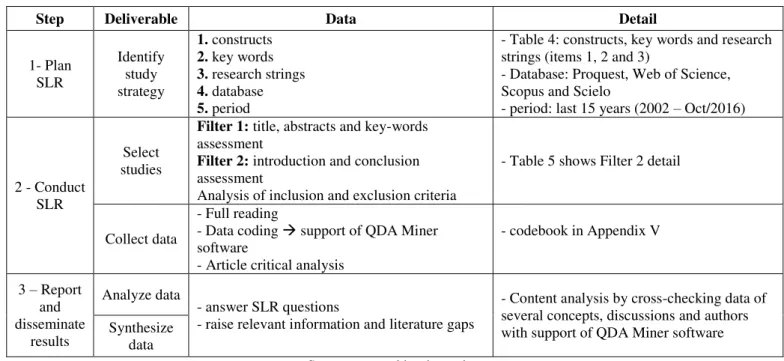
We divided the SLR in three phases, as observed in figure 7.
Figure 7: Phases of SLR
The rigorous performance of these phases allowed the following outputs: (i) definition of gap analysis through clarification of objectives (DENYER; TRANFIELD, 2009; COSTA, 2016) and delimitation of study area (TRANFIELD; DENYER; SMART, 2003); (ii) establishment of criteria and materials to be studied (WEBSTER; WATSON, 2002; GUARDIA et al., 2013; TRANFIELD; DENYER; SMART, 2003); e (iii) development of research protocol, with rules, steps to be overcome (GUARDIA et al., 2013), recommendations (TRANFIELD; DENYER; SMART, 2003) and description of acquired knowledge (WEBSTER; WATSON, 2002).
Phase 1 develops the SLR Protocol, as Table 3 shows, aimed at protecting research objectivity by providing an explicit description of activities to be performed (TRANFIELD; DENYER; SMART, 2003 The SLR Protocol provides an explicit description of activities to be performed (DENYER; TRANFIELD, 2009; COLICCHIA; STROZZI, 2012). Its development enables the assurance of SLR transparency, validation of review method, and guidance of research (DENYER; TRANFIELD, 2009).
Table 3: SLR Protocol
Step Deliverable Data Detail
1- Plan SLR
Identify study strategy
1. constructs
2. key words
3. research strings
4. database
5. period
- Table 4: constructs, key words and research strings (items 1, 2 and 3)
- Database: Proquest, Web of Science, Scopus and Scielo
- period: last 15 years (2002 – Oct/2016)
2 - Conduct SLR
Select studies
Filter 1: title, abstracts and key-words assessment
Filter 2: introduction and conclusion assessment
Analysis of inclusion and exclusion criteria
- Table 5 shows Filter 2 detail
Collect data
- Full reading
- Data coding support of QDA Miner software
- Article critical analysis
- codebook in Appendix V
3 – Report and disseminate
results
Analyze data
- answer SLR questions
- raise relevant information and literature gaps
- Content analysis by cross-checking data of several concepts, discussions and authors with support of QDA Miner software Synthesize
data
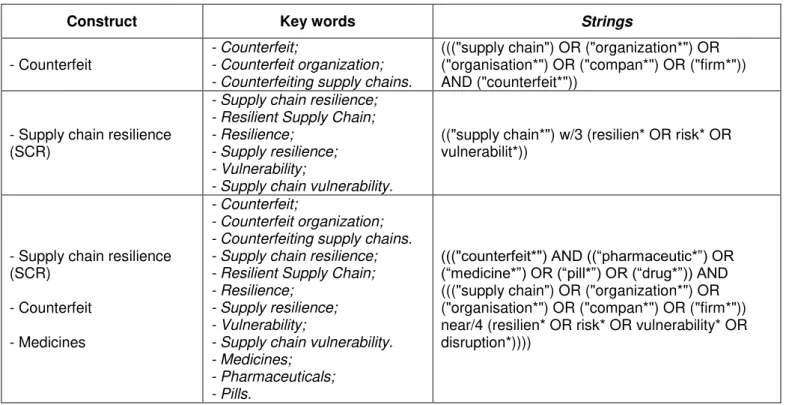
The SLR Protocol details the method applied in each of the three phases from Figure 7. Plan SLR encompasses constructs, key words, and string definition through information collected during Scope Review. First, for each question, the constructs were established. Second, we raise the most common words found in articles related to the constructs in Scope Review, with support of the website http://www.wordclouds.com. English dictionaries such as Cambridge Dictionary and Thesaurus were consulted for synonyms identification. Table 4 details the constructs, key words and strings used.
Table 4: SLR constructs, key words and strings
Construct Key words Strings
- Counterfeit
- Counterfeit;
- Counterfeit organization; - Counterfeiting supply chains.
((("supply chain") OR ("organization*") OR ("organisation*") OR ("compan*") OR ("firm*")) AND ("counterfeit*"))
- Supply chain resilience (SCR)
- Supply chain resilience; - Resilient Supply Chain; - Resilience;
- Supply resilience; - Vulnerability;
- Supply chain vulnerability.
(("supply chain*") w/3 (resilien* OR risk* OR vulnerabilit*))
- Supply chain resilience (SCR)
- Counterfeit
- Medicines
- Counterfeit;
- Counterfeit organization; - Counterfeiting supply chains. - Supply chain resilience; - Resilient Supply Chain; - Resilience;
- Supply resilience; - Vulnerability;
- Supply chain vulnerability. - Medicines;
- Pharmaceuticals; - Pills.
((("counterfeit*") AND ((“pharmaceutic*”) OR (“medicine*”) OR (“pill*”) OR (“drug*”)) AND
((("supply chain") OR ("organization*") OR ("organisation*") OR ("compan*") OR ("firm*")) near/4 (resilien* OR risk* OR vulnerability* OR disruption*))))
Source: created by the author
tools, researchers advocate that combining them may provide better research results (CHADEGANI et al., 2013). Furthermore, ProQuest ABI/INFORM databases were considered because of their coverage of publications in the management field (RÜLING, 2005). In addition, Scielo was considered for Brazilian studies, which discusses Brazil´s reality and sometimes are not published in worldwide peer-reviewed journals.
The study considered articles published in last 15 years, from 2002 to Oct/2016, because counterfeit and resilience themes have significantly grown in recent years (LYBECKER, 2008; PEREIRA; CHRISTOPHER; SILVA, 2014; KAMALAHMADI; PARAST, 2016; LINNENLUECKE, 2017), especially in the medicine supply chain (LYBECKER, 2008). Furthermore, anti-measures to combat counterfeiters are changing with technology advances, more access to medicines, and new counterfeit techniques (LYBECKER, 2008; STAAKE; THIESSE; FLEISCH, 2012).
Then, a two-step screening process was followed to assess the relevance of the remaining papers according to pre-stipulated inclusion and exclusion criteria, as observed in Table 5.
Table 5: Inclusion and exclusion criteria
Criteria Inclusion Exclusion
Journal Quality Scientific periodic peer-reviewed Business magazines, conference, books, and notes
Access Full content written in English or Portuguese Full content not written in English or Portuguese
Objective Alignment Resilience and/or counterfeit concept within the scope of Operations Management Resilience and/or counterfeit concept within the scope of other research areas such as materials engineering, pharmacology and medicine
SLR
Unit of Analysis Organizations or supply chains Communities Focus Deal directly with resilience elements in organizations or supply chains or with
counterfeit anti-measures
Not deal directly with resilience elements or
with counterfeit anti-measures under organizations or supply chains perspective
Clarity Clearly define resilience elements or counterfeit anti-measures Not define clearly resilience elements or counterfeit anti-measures
Source: created by the author
determine the relevance of articles’ inferences (CONFORTO; AMARAL; SILVA, 2011;
TRANFIELD et al., 2004). Phases 2 refer to execution of SLR, by selecting the articles raised important to answer the research questions Q1, Q2 e Q3.
Based on the key words, 3.341 articles were returned and 1.289 were duplicated. Then, a two-step screening process was followed to assess the relevance of the remaining articles according to pre-stipulated inclusion and exclusion criteria, such as objective alignment, focus, unit of analysis and clarity (Table 5). The aim was to ensure that the focus was on resilience elements and/or counterfeit anti-measures in the context of organizations or supply chains. Articles which meet all inclusion criteria and, consequently, violate all exclusion criteria were considered in the SLR to ensure quality of the selected materials (TRANFIELD; DENYER; SMART, 2003). The review was limited to articles published in peer-reviewed journal articles in order to ensure the high quality of this project (DENYER; TRANFIELD, 2009). It resulted in 84 articles for further analysis, as illustrated in Figure 8.
Figure 8: Status of articles’ assessment
Source: created by the author
for facilitating the rigorous exploration of complex issues in the management field (Duriau et al., 2007). Thus, after reading the full texts, the chosen articles were uploaded in QDA Miner for more in-depth investigation (QDA, 2017). First, the study categorized the available data following the basic requirements proposed by Krippendorff (2013), which are mutually exclusive and exhaustive categories. Categorization is crucial to support the identification of relationships and establishment of connections among the different authors studied that write about the same constructs (Gibbs, 2009).
QDA Miner enabled us to better understand the frequency and potential clusters and relationships of both resilience enablers and counterfeit anti-measures. Results are presented in a proximity plot graph (Figure 3) as it can be observed better which key enablers are most often associated with counterfeit anti-measures (QDA, 2017). The coefficient of co-occurrence is calculated based on Jaccard's coefficient, which gives equal weight to cases where co-occurrence is identified (a) and cases where one item is found but not the other (b and c). Thus, it is calculated from a fourfold table as a/(a+b+c) (QDA, 2009). Finally, the conclusion summarizes the results and sheds light on recommendations of future research, as well as policies and practices (Denyer and Tranfield, 2009).
3.3 Empirical Research
study has specifically focused on the medicines supply chain, despite the increased focus on combating counterfeit medicines.
The empirical research method chosen was case study, often used in Operations Management (VOSS; TSIKIRKTSI; FROHLICH, 2002) to pursue an explanatory purpose (YIN, 2001) and deal with questions that the researcher has little or no control (YIN, 2015). In addition, the method enables the phenomenon study in its real context, the deep understanding of phenomenon complexity and nature, the investigation of cause and effect relationships, and expansion of research horizons (PEDROSA; NÄSLUND; JASMAND, 2012; FAWCETT et al., 2014). Therefore, the empirical study investigates how resilience elements influence the combat of counterfeit medicines.
The first step to conduct a case study is to determine the unit of analysis. The research question should address it, which is generally a bounded entity – e.g. organization, person, behavioral condition (YIN, 2015). Therefore, to determine the unit, one has to understand what the study is going to investigate (BAXTER; JACK, 2008). Thus, the unit of analysis addressed in this study is the set of resilience elements that combat counterfeit within the pharmaceutical focal company and key supply chain links from the downstream product flow. These supply chain links are specific agents of medicines supply chain that obtain possession of the unit before final consumer: wholesalers, distribution centers (logistics operator), pharmacies and hospitals.
To define the pharmaceutical focal company and its downstream key supply chain links, specific criteria for focal organizations’ selection were established:
medium or large organizations, where practices of risk management and counterfeit mitigation should be more well-developed than in small organizations; organizations involved in traceability discussion forums, where risks of practices
organizations located in Brazil, not just because of researcher location, but also due to lack of studies in Brazilian medicines supply chain;
logistic providers, pharmacists and/or hospitals responsible for the custody of the medicine from focal organization, with the objective of analyze the downstream flow and practices established among the organizations to mitigate counterfeit risks.
We made contacts by e-mail, telephone and with the help of the research group with which the author interacts, where the study objective and methods of data gathering were presented. In addition, a formal letter (Appendix II) was attached to the e-mail providing all research and confidentiality details. However, due to the criticality and secrecy of the theme exposed, many organizations did not accept participating in this scientific research. Other researchers expose the same problem.
Medicine piracy is directly related to the institutional image of the company and involves the national and international investigation area, which makes discussions on the subject even more secretive and restricted in regard to obtaining information, which hinders scientific research. (MACHADO, 2011)
We overcame this limitation with the identification of two relevant pharmaceutical focal companies and four members from downstream flow in the supply chain that accepted to participate in this empirical study. Although authors such as Eisenhardt (1989) suggests the necessity of a sample of four to ten units of analysis, other current studies (e.g. Blackhurst, Dunn and Craighead, 2011 and Scholten, Scott and Fynes, 2014) have been successful in using up to three cases. Moreover, the objective of this study is not to build theory but deduce testable hypothesis in general theory (KETOKIVI; CHOI, 2014).
cases are relevant because: (a) the two pharmaceutical companies are engaged in discussions about traceability and its implementation, which demonstrates the interest in reducing counterfeit risks; (b) one pharmaceutical (PHARMA1) is a multinational, working in most of the countries around the world, while the other pharmaceutical (PHARMA2) is a big national organization – this factor impacts on how they deal with counterfeit incidents, locally or globally; (c) both pharmaceutical companies influence its supply chain links downstream to increase security; and (d) although both cases are engaged in mitigating counterfeit medicines, the approaches adopted by the organizations are different in several ways.
Table 6: Characteristics of CASE 1 and CASE 2
Case Pharmaceutical company Third-party logistics company Medicines distributor Hospital Interviewees and Roles
CASE1
PHARMA1 is a multinational organization with approximately 100 thousand employees working in more than 150 countries.
OPL1 is the single-medicine logistics provider of PHARMA 1. The organization is a large American company with operations in most of countries around the globe.
DISTRIBUTOR1 is one of the main clients of
PHARMA 1. The organization is one of the biggest Brazilian distributors focused on pharmaceutical sector.
HOSPITAL1/2 has a history of purchases from DISTRIBUTOR 1 and DISTRIBUTOR 2. The organization is a famous public hospital in São Paulo State.
- PHARMA1: PMgenlatam1 (General Manager of Latin America), PSlog1 (Logistics Specialist) and PMtec1 (Technology Manager)
- OPL1: TMsec1 (Security Manager) and TMsec2 (Security Manager)
- DISTRIBUTOR 1: DMlog1 (Logistics Manager)
- HOSPITAL 1/2: HMpurlog12 (Logistics Manager)
CASE 2
PHARMA2 is a well-known national pharmaceutical company with more than 2.000 employees and a large medicines portfolio
-
DISTRIBUTOR 2 is one of the organizations
responsible for distributing the products of PHARMA 2. The organization is highly respected in healthcare sector and operates throughout the national territory.
- PHARMA 2: PMlog2 (Logistics Manager), PMqualsec2 (Quality and Security Manager) and PMrisk2 (Risk Manager)
- DISTRIBUTOR 2: DMgen2 (General Manager)
- HOSPITAL 1/2: HMpurlog12 (Logistics Manager)
Table 7: Characteristics of studied entities that affect both cases
Entity Objective Regarding
Counterfeit/ Resilience Main characteristics Interviewees and Roles
Association Focused on IP Rights and Counterfeit Combat
CROSSASS1 aims at developing the economy and strength business. One of its goals is
improve enforcement of IP rights in Brazil AIPrep1 (Association’s Representative) CROSSASS2 is an association of companies that aims at fighting illegal activities that
harms Brazilian business AIPrep2 (Association’s Representative) Organization Focused on
Traceability and Standard Definition
CROSSORG1 focus on developing and disseminating best practices to improve
Logistics Orep1 (Organization’s Representative) and OTRACrep1 (Traceability Representative) CROSSORG2 is responsible for developing and disseminating best practices involving
medicines OTRACrep2 (Traceability Representative) Pharmaceutical Association PHARMAASS1 is an association of pharmaceutical companies in São Paulo State PArep1 (Association’s Representative)
PHARMAASS2 is an association of national and international pharmaceutical
companies PArep2 (Association’s Representative)
Health and Regulatory Authorities ANVISA is a federal health regulatory body of the Brazilian government ANVrep (Representative of products controlling)
Technology Organizations
TECORG1 is a group of researchers that works in the areas of research and
development of automation and process redesign TOcoord (Coordinator), TOcoordtec (Technical Coordinator) and TOres1 (Researcher) TECORG2 is an automation engineering company, responsible for studying innovative
solutions to integrate and promote communication between traceability systems
TODoper (Director of Operations) and TODred (Director of R&D)
Semi-structured interviews were conducted with individuals of the organizations involved in CASE 1 and CASE 2. The interviewees were selected after a conversation with one of the knowledgeable managers or specialists from the organization involved in traceability implementation discussion (see appendix III), because of the person’s background on the subject and to mitigate problems with different
structure names. Thus, all the interviewees are involved in mitigating counterfeiting risks in different areas, according to their functions (Logistics, Technology, Quality, Purchase and Security). Regarding downstream organizations, this study prioritized individuals that have direct contact with the previous supply chain link, to understand the anti-measures applied. Unstructured interviews were also conducted with individuals from entities, governmental or not, involved in combating counterfeit threat.
about the anti-measures adopted, the researcher asked about the relevance to the company of each counterfeit anti-measures and resilience elements raised from SLR. Moreover, during the two years of this study, we conducted several discussions with 13 individuals from other entities that work cross supply chain. A follow up with e-mails and telephone calls helped to understand questions originated during the analysis and increased data gather reliability (VOSS, 2009).
Besides interviews, the case study analysis involved data triangulation by combining varied data collection sources, which increases research validity (VOSS; TSIKIRKTSI; FROHLICH, 2002; VOSS, 2009). The other sources of data collection were:
participation in seminars, congresses and other events related to counterfeit anti-measures and risk management practices. For example, the author attended national and international seminars focused on medicines traceability - SETRM (Technology Seminar for Medicines Traceability) and security in pharmaceutical supply chain – Pharma Supply Chain & Health Brazil – International Forum of Security in Pharmaceutical Logistics;
group discussions about traceability implementation and data sharing challenges with managers on the field;
analysis of primary and secondary data, with the objective of analyzing reports containing counterfeit incidents description, risk management information, and tender decisions. Further information about the organization’s history and other
general data were collected from it or through other websites;
Figure 9: Medicines supply chain links and case studies selected
Source: created by the author
The data collected, was transcript and documented to support the content analysis. The method enables the evaluation and inference of the implicit and explicit content collected (BARRATT; CHOI; LI, 2011; PEDROSA; NÄSLUND; JASMAND, 2012). As in SLR, we performed the qualitative data analysis with support of QDA Miner
software, following the approach proposed by Bringer (2006), Johnston (2006) and Krippendorff (2013): categorization based on dimensions and categories identified in advance and revised during the codification process. The analysis started from the codes identified in SLR and added new ones by means of inductive analysis (BARDIN, 2008).
3.4 Research Findings and Conclusions
The last and most complex step of this study encompasses analyze, synthetize and communicate results. A clear and concise process is necessary to support relevant data presentation of the extensive material collected in the previous stage (TRANFIELD; DENYER; SMART, 2003). Finally, the conclusion summarizes the empirical and theoretical findings and sheds light on recommendations of future researches and policies and practices (DENYER; TRANFIELD, 2009). This study applies content analysis, following Bringer (2006), Johnston (2006) and Krippendorff (2013) methodology. It is recommended for facilitating the rigorous exploration of complex issues in the management field (DURIAU; REGER; PFARRER, 2007; BARRATT; CHOI; LI, 2011; PEDROSA; NÄSLUND; JASMAND, 2012).
For both theoretical and empirical parts, the relevant documents were uploaded in QDA Miner for deeper investigation. QDA Miner is a qualitative data analysis tool, which provides accessibility and flexibility to analyze texts and relate its content to structured information (QDA, 2017). First, the study categorized the available data following the basic requirements proposed by Krippendorff (2013), mutually exclusive and exhaustive categories. Categorization is crucial to support the identification of relationships and establishment of connections among different authors studied that write about the same constructs (GIBBS, 2009). Thus, the approach enabled a co-occurrence analysis, applied to explore the potential association among the categories (QDA, 2017). It allowed a better understanding of which key elements are most often associated with counterfeit anti-measures and, therefore, might better prepare the medicine supply chain to increase resilience to counterfeit.
have to distinguish between quantifications that lead to the testing of a statistical hypothesis and quantifications that indicate something other than what is measured. In light of this suggestion, the research approach adopts two bases defined by Ketokivi and Choi (2014). First, a quantitative portion to examine concepts in terms of frequency; second, a qualitative portion in terms of their meaning and interpretation in specific
4 SYSTEMATIC LITERATURE REVIEW (SLR)
The SLR enabled synthesizing the highly fragmented literature involving how to combat counterfeit and provided a better understanding of current literature gaps about elements most and less often associated with counterfeit anti-measures. Moreover, it evidenced that only limited research has been conducted into choosing and implementing practices for improving resilience to counterfeit.
Anti-counterfeit literature explores a range of anti-measures. However, it is highly fragmented. Almuzaini, Choonara and Sammons (2013) present a SLR in counterfeit medicines focused on assessing the quality of studies about drug analysis Coustasse, Arvidson and Rutsohn (2010), Li (2013), Taylor (2014), and Dimase et al. (2016) provide technological solutions to address the issue. Most articles on the theme do not focus on managerial perspective of supply chains. Hoecht and Trott (2014) present a broad review of such anti-measures but focused on Chinese scenario. Lybecker (2008) presents managerial mechanisms specific to pharmaceutical industry.
An alternative path to study measures to combat counterfeit is to see it as a disruption in the supply chain. Therefore, SCR may be an effective way to prevent and combat counterfeiting. In recent years, academics have been developing a vast literature involving SCR. Essentially, they are related to (a) generic mechanisms or frameworks to increase organizational or SCR (e.g. theoretical: Ehrenhuber et al., 2015; Hohenstein et al., 2015; Kilubi and Haasis, 2015; Tukamuhabwa et al., 2015; Kamalahmadi and Parast, 2016 and Ali, Mahfouz and Arisha, 2017; and empirical: Sheffi, 2005; Blackhurst, Dunn and Craighead, 2011; Pettit; Croxton; Fiksel, 2013 and Brusset and Teller, 2017);