http://dx.doi.org/10.1590/1413-70542017411018716
Agronomic characteristics and macronutrient export of grain
sorghum hybrids from different sowing dates
Características agronômicas e exportação de macronutrientes em híbridos de sorgo granífero em diferentes épocas de semeadura
César Henrique Souza Zandonadi¹*, Carlos Juliano Brant Albuquerque², Rogério Soares de Freitas³, Alyne Dantas Mendes de Paula1, Marina Alves Clemente1
1Universidade Federal de Uberlândia/UFU, Instituto de Ciências Agrárias, Uberlândia, MG, Brasil 2Universidade Federal de Minas Gerais/UFMG, Montes Claros, MG, Brasil
3Agência Paulista de Tecnologia Agropecuária/APTA, Votuporanga, SP, Brasil *Corresponding author: [email protected]
Received in May 3, 2016 and approved in November 29, 2016
ABSTRACT
Brazilian off-season cropping is increasing the production of cereals, particularly in the Brazilian savannah. Sorghum has been widely used for its grain production capacity and dry matter. Several hybrids are commercially available, each with its own peculiar nutrient absorption capacity. Thus, this study analyzed the agronomic characteristics and nutrient exportation in grain sorghum hybrids sown on different dates. The experiment was conducted at the Paulista Agency Regional Center of Agricultural Technology (APTA) in the city of Votuporanga, São Paulo. The experiment was conducted in a randomized block design with four replications and 4 hybrids. Sorghum hybrids (50A10, 50A50, BUSTER and 1G282) were the different treatments sown on four different dates, beginning with February 26, 2013, with the other dates 17, 30 and 41 days after the first sowing (DAFS). Each sowing date was considered an individual experiment and, subsequently, grouped for analysis to compare characteristics. Macronutrient content in the grain, one thousand grain weight, productivity and exportation of macronutrients (kg ha-1) by grains in the area were evaluated. The productivity of the sorghum hybrids varied depending on the sowing dates. The one
thousand grain mass of the sorghum hybrids varied depending on the sowing dates. The average exportation of macronutrients by sorghum grains is as follows, in decreasing order: N> K> P>Ca> Mg> S. The mean values of macronutrient accumulation needed to produce one ton of sorghum grains are as follows: 20.05 kg N, 3.33 kg P, 3.70 kg K, 3.49 kg Ca, 1.77 kg Mg, and 0.72 kg S.
Index terms: Sorghum bicolor L.; production system; grain; nutrient content.
RESUMO
A produção brasileira na entressafra vem aumentado a cada safra de grãos, principalmente na região do cerrado. O sorgo granífero tem sido bastante utilizado pela sua capacidade de produção de grãos e massa seca nessas condições. Vários são os híbridos disponíveis no mercado, sendo cada um com sua capacidade de absorção de nutrientes. Sendo assim o objetivo desse trabalho foi analisar as características agronômicas e exportação de macronutrientes pelos grãos dos híbridos de sorgo granífero em diferentes épocas de semeadura. O experimento foi conduzido no Pólo Regional da Agência Paulista de Tecnologia agropecuária (APTA), no município de Votuporanga, São Paulo. O experimento foi realizado em delineamento de blocos casualizados, com 4 híbridos e quatro repetições. Os híbridos de sorgo (50A10, 50A50, BUSTER e 1G282) constituem os diferentes tratamentos, dentro das quatro diferentes épocas de semeadura, sendo a primeira realizada em 26/02 de 2013 e as demais aos 17, 30 e 41 dias após a primeira semeadura - DAFS. Cada época de semeadura foi considerada como experimento individual, sendo realizada posteriormente a análise conjunta para comparação das características avaliadas. Foram avaliados os teores de macronutrientes nos grãos, massa de mil grãos, produtividade e a exportação desses macronutrientes (kg ha-1) pelos grãos na
área. A produtividade dos híbridos de sorgo granífero variam em função das épocas de semeadura. A massa de mil grãos dos híbridos de sorgo granífero variam em função das épocas de semeadura. A exportação média de macronutrientes pelos grãos de sorgo segue a ordem decrescente: N > K > P > Ca >Mg> S. Os valores médios de acúmulo de macronutrientes para produção de uma tonelada de grãos de sorgo granífero são: 20,05 kg de N; 3,33 kg de P; 3,70 kg de K; 3,49 kg de Ca; 1,77 kg de Mg e 0,72 kg de S.
Termos de indexação: Sorghum bicolor L.; sistema de produção; grão; teor de nutrientes.
INTRODUCTION
Grain sorghum is known for showing better tolerance for water scarcity and a large production of biomass for various uses, which include use of the grain for animal feed or plant cuttings or shoots for grazing animals.
(Albuquerque et al., 2011).
With the expansion of grain sorghum’s production areas and the rising costs of agricultural inputs, labor and equipment, suitable cultivation practices are needed to minimize the negative impacts of agricultural activities and optimize productivity. Productivity is related to many factors, such as good quality genetic material, correct phytosanitary treatments and soil fertility and nutritional supplementation (Fornasieri Filho; Fornasieri, 2009).
Grain sorghum plants are extremely efficient in absorbing nutrients from the ground and have very fibrous
and well-developed root systems, which facilitate great fertilization (Leal et al., 2013; Marin et al., 2006).
To determine the fertilizer application needed for the crop to achieve the highest productive potential, we need to know the absorption and accumulation rate of nutrients and the best date for sowing (Santos et al., 2014; Fornasieri Filho; Fornasieri, 2009).
The aim of this work was to evaluate the agronomic features and the macronutrient exportation in grain sorghum hybrids from different sowing dates.
MATERIAL AND METHODS
The experiments were conducted in the Regional Pole of the Technological Agropecuary Paulista Agence
(APTA), in the city of Votuporanga, São Paulo (20º28′ S and 50º04′ W) and at an altitude of 440 m. The ground is
Table 1: Chemical attributes of the soil in the profile 0-0.2 m, Votuporanga, 2013.
Camada pH H2O P K Al Ca Mg H+Al SB t T V m MO
m (1:2.5) mg dm-3 ---cmolcdm-3--- % dag kg-1
0-0.2 5.2 30 20 0 17 8 16 25.05 25.05 41.05 61 0 13
P, K = (HCl 0.05 mol L-1 + H
2SO4 0.0125 mol L-1) P available (extractor Mehlich-1); Ca, Mg, Al, (KCl 1 mol L-1); H + Al = (Tampon solution - SMP at pH 7.5); SB = Sum of basis; t = cation-exchange capacity (CEC) effective; T = CEC in pH 7.0; V = Saturation for basis; m = Saturation for aluminum (Embrapa, 2009).
experimental period are indicated in Figure 1.
In the experiment, 4 sorghum hybrids were used; these hybrids were adapted to the northwest region of São Paulo state. The hybrids used were BUSTER and 50A10, which were developed for early planting, and 1G282 and 50A70, which were developed for late planting. The experiment was conducted in a conventional cultivation system, which required plowing and disking. The sowing and coverage fertilization were the same for all the sowing dates. The sowing fertilization was carried out with 300 kg ha-1 of the formulated 08-28-16, and the coverage was carried
out with 300 kg ha-1 of ammonium sulfate. The plants
received this fertilization in the same phenological stages (5 leaves completed expanded), independently of the sowing date, approximately 18 days after the emergence (Table 2).
The following characteristics were evaluated: one thousand grain mass (g) and productivity (kg ha-1). For this determination, parcels of grain were picked and measured for their humidity, after which the weight was corrected for the grain humidity degree to 13%, according to the formula Mc = {[Mo(100 - u0)]/87}; where Mc and Mo were the corrected and observed mass, respectively; u0 was the observed humidity; and the macronutrients content in the grain is indicated in g kg-1. Based on the nutrient content and productivity,
the exportation of each macronutrient was quantified
Figure 1: Variation in medium temperature (°C) and accumulated precipitation (mm) for 10-day periods from February to August 2013 in Votuporanga, SP.
Table 2: Dates of sowing, emergence and coverage fertilization for the different sowings.
Date Sowing Days after the first sowing (DAFS) Emergence Coverage fertilizaton
1 26/02/2013 0 02/03/2013 20/03/2013
2 15/03/2013 17 20/03/2013 09/04/2013
3 28/03/2013 30 01/04/2013 18/04/2013
4 08/04/2013 41 12/04/2013 30/04/2013
Before determination of the nutrient content in the grains, the grains were separated for measurement of the one thousand grain mass. Afterward, the samples were transported to the Earth laboratory in the Federal University of Uberlândia, according to the methods of Malavolta, Vitti and Oliveira (1997). Nitrogen content was determined by the semimicro-Kjeldahl distillation method, and other nutrients were extracted in a nitric-perchloric solution. From the extracted solution, the Ca and Mg contents are determined with spectrophotometry of the atomic absorption; P and S,
from spectrophotometry; and K, from flame photometry.
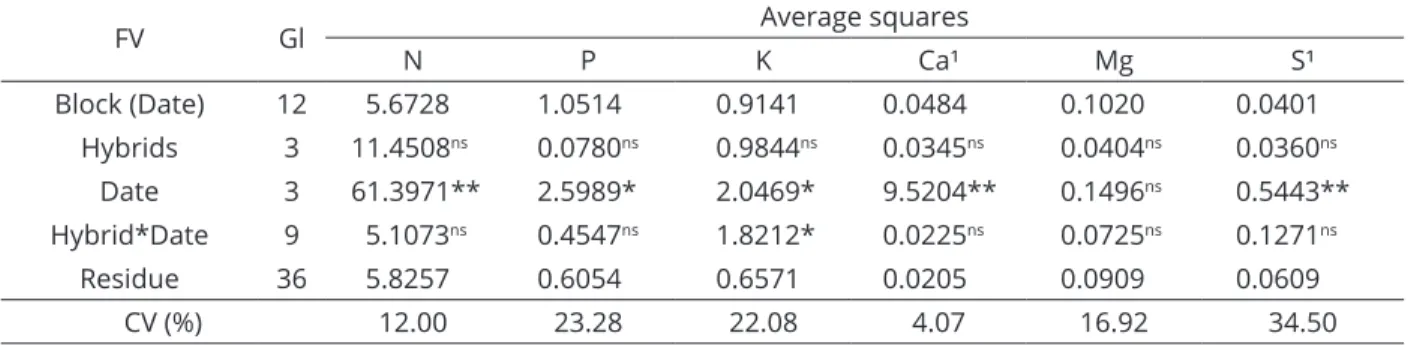
The experiment was conducted in casually delineated blocks, with four treatments and four repetitions. The portions were designated with 4 lines, 5 meters in length, and the two central lines were considered as the useful areas. Four grain sorghum hybrids were evaluated, constituting the different treatments, for each of the different sowing dates. Each date was considered an individual experiment. All features were analyzed relative to the different sowing dates, and afterward, a joint analysis of the data (Tables 3, 4 and 5) was performed. Those data where the medium square ratio of each analysis of variance
did not exceed the relation 7:1 were used. When the ratio was higher than this relation, the degrees of liberty were adjusted according to Cochran’s methodology (1954).
The “F” test was performed to determine levels of
significance of 0.05 and 0.01 for the analysis of variance. When these tests were significant, the averages were
compared with the Scott-Knott test at the 0,05 level of probability.
RESULTS AND DISCUSSION
Analysis of the interaction between hybrids and sowing dates revealed that the K contents did not vary between hybrids when these were sowed on 17, 30 and 41
DAFS. When sown on the first date (26/02), the hybrids
1G282 and 50A10 showed a higher concentration of K in the grain. The hybrids 50A10, 50A70 and BUSTER did
not show any significant difference in K content among
the sowing dates evaluated.
The hybrids 50A10 and 1G282 showed a higher
concentration of this nutrient when sown on the first date,
Hybrids 3 11.4508ns 0.0780ns 0.9844ns 0.0345ns 0.0404ns 0.0360ns
Date 3 61.3971** 2.5989* 2.0469* 9.5204** 0.1496ns 0.5443**
Hybrid*Date 9 5.1073ns 0.4547ns 1.8212* 0.0225ns 0.0725ns 0.1271ns
Residue 36 5.8257 0.6054 0.6571 0.0205 0.0909 0.0609
CV (%) 12.00 23.28 22.08 4.07 16.92 34.50
ns; *; ** Not significant, significant at the 0,05 and 0,01 levels of significance according to the F test. 1Degrees of liberty adjusted by the method proposed by Cochran (1954).
Table 4: Summary of the analysis of the joint variance (average squares) for the one thousand grain mass (g) and productivity (kg ha-1) of grain sorghum hybrids from different sowing dates.
FV GL Average squares
P10001 Productivity
Block (Date) 12 1.9388 266820.2002
Hybrid 3 52.2213ns 2281211.5625**
Date 3 394.5312ns 4203837.4657**
Hybrid*Date 9 11.7798** 1804363.8777**
Residue 36 5.0675 317622.3010
CV (%) 9.72 12.92
ns; *; ** Not significant, significant at the 0,05 and 0,01 levels of significance according to the F test. 1Degrees of liberty adjusted for the method proposed by Cochran (1954).
Table 5: Summary of the analysis of joint variance (average squares) for the average of nutrient exportation (kg ha-1) for the grains of grain sorghum hybrids from different sowing dates.
FV Gl Average squares
N P K Ca Mg S
Block (Date) 12 128.8457 19.9827 18.6765 2.1348 2.8572 1.1106
Hybrid 3 606.9718* 17.9690ns 87.5862** 31.2744** 3.8967ns 1.5173ns
Date 3 3125.0665** 78.3296* 175.6857** 154.6600** 14.3986** 16.1116**
Hybrid*Date 9 811.3124** 25.0680ns 56.5062* 25.4339** 5.2566ns 3.6641**
Residue 36 167.1238 14.2227 19.6488 3.2043 2.8919 1.0518
CV (%) 14.79 26.00 27.48 11.75 21.97 32.30
contents were noticeably higher at 30 DAFS than at 0 and 17 DAFS.
Magnesium contents were determined to be
approximately 1.78 g kg-1. These contents were low,
suggesting that this element had little significance when
evaluating the value of this nutrient according to the hybrid or the date of sowing.
Regarding the one thousand grain mass (g), the hybrids 1G282 and 50A70 showed lower averages when
they were sown on the first date (0 DAFS), whereas there were no significant differences among the averages for the
other sowing dates (Table 8).
These values vary between 14.60 and 23.87 g for 1G282, 16.06 to 26.42 g for 50A10 and 12.86 to 26.89 g for 50A70. The hybrid BUSTER showed a higher average (29.78 g) with sowing at 30 DAFS. As with the other grain sorghum hybrids, a lower average was
observed when the sowing occurred on the first date (0
DAFS). When the sowing occurred at 0 and 30 DAFS, the grain characteristics of the hybrids were similar, with BUSTER exhibiting the highest thousand grain mass. For
the 17 DAFS sowing, however, there was no significant
difference among the hybrids. For the 41 DAFS sowing, the highest masses were the BUSTER, 50A10 and 50A70 hybrids, followed by 1G282.
According to Silva et al. (2009), evaluations of the one thousand grain mass in the harvests of different grain sorghum hybrids and places in the west-central region revealed on average 17.97 g. With regard to the productivity, they noticed that the 50A10 and 50A70
hybrids did not show significant differences among the
sowing dates evaluated. The 1G282 hybrid showed a lower average productivity only when the sowing occurred at 17 DAFS. In turn, the BUSTER hybrid showed a higher
average productivity when sown on the first sowing date
(Table 8).
When the hybrids were sown at 0 DAFS, higher productivity was exhibited by the BUSTER hybrid. At
17 DAFS, there was no significant difference among the
hybrids. At 30 DAFS, the BUSTER hybrid exhibited the lowest production, whereas the other evaluated hybrids showed higher productivity. When sown at 41 DAFS, the hybrid that was most productive was 1G282. The average productivity of the grain sorghum hybrids varied from 3178.39 to 6186.10 kg ha-1, with an experiment average of 3490.05 kg ha-1.
In their studies, Almeida Filho et al. (2010), Silva et al. (2013) and Silva et al. (2009) observed productivity values that varied from 2267.00 to 5009.00 kg ha-1 when they evaluated grain sorghum hybrids at harvest.
Table 6: Contents of potassium in hybrid sorghum grain (g kg-1) from four different sowing dates.
Hybrids Dates
0 DAFS 17 DAFS 30 DAFS 41 DAFS 1G282 5.12 Aa 4.37 aA 2.62 aB 3.62 Ab 50A10 4.62 Aa 3.75 aA 3.25 aA 3.37 Aa 50A70 2.75 bA 3.25 aA 3.87 aA 3.50 aA BUSTER 3.75 Ba 3.87 aA 3.12 aA 3.87 Aa Uppercase letters in same row and lowercase letters in same column indicate differences according to the Scott-Knott test at a 0.05 level of significance.
Table 7: Contents of nitrogen, phosphorus, calcium and sulfur in the grain (g kg-1) from four different sowing dates.
Date N P Ca S
(g kg-1)
0 DAFS 21.95 A 3.35 B 2.88 C 0.92 A 17 DAFS 22.74 A 3.22 B 2.84 C 0.90 A 30 DAFS 18.48 B 2.99 B 4.06 B 0.53 B 41 DAFS 19.78 B 3.88 A 4.30 A 0.62 B Different uppercase letters in a column indicated differences according to the Scott-Knott test at a 0.05 level of significance.
With regard to the contents of N and S, the absorption of N and S for the grain was higher with the earlier sowing dates (0 and 17 DAFS) than for the other sowing dates. The later sowing dates likely suffered hydric deficiency, causing lower contents of these nutrients (Table 7).
The contents of N and S in the grain sorghum varied from 18.48 to 22.74 g kg-1 for the first and 0.53 to 0.92 g kg-1 for the second sowing dates. Similar contents of N and S were reported by Albuquerque, Camargo and Sousa (2013), who reported approximately 17.00 g kg-1 N and 2.00 g kg-1 S for the grain sorghum hybrids in their study.
Fince the plants had similar amino acid structural components, their functions were similar, and more N than S was required for the plant, which explained the similar behavior that was observed for these two nutrients (Taiz; Zeiger, 2013; Epstein; Bloom, 2006).
50A70 4237.97 bA 3621.96 aA 4450.11 aA 3874.29 bA
BUSTER 6186.10 aA 3892.74 aB 3178.39 bB 3448.78 bB
Uppercase letters in same row and lowercase letters in same column indicate differences according to the Scott-Knott test at a 0.05 level of significance.
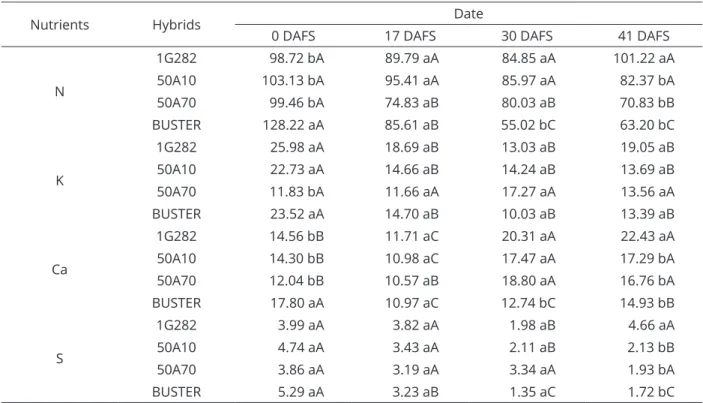
Analysis of possible interactions between hybrids and sowing dates indicates that the hybrids 1G282 and 50A10 did not show variation in N exportation among the sowing dates evaluated. The hybrids 50A70 and BUSTER showed higher exportation of this nutrient when sown on
the first sowing date (0 DAFS) (Table 9).
When sown at 0 DAFS, the hybrid that exported the most N was BUSTER, followed by the others. When
sown at 17 DAFS, the hybrids did not show a significant
difference in the average exportation of N. For those sown at 30 DAFS, there was no difference in the exportation
average (kg ha-1) among the hybrids 1G282, 50A10 and
50A70, but exportation of N by BUSTER was different from the other three. When sown at 41 DAFS, the hybrid that showed the higher exportation of N was 1G282. The exportation average of N varied between 55.02 to 128.22 kg ha-1.
Similar results were obtained by Calil et al. (2013) when evaluating the productivity and exportation of grain sorghum nutrients in an “agro-forestry” system where the cultivation reached a productivity of 3417.4 kg ha-1 and showed an average N exportation of approximately 172.4 kg ha-1.
Analysis of the K exportation revealed that the
50A70 hybrid did not show significant differences in
the extraction average (kg ha-1) among the sowing dates evaluated. The hybrids 1G282, 50A10 and BUSTER
exported a greater quantity of K when sown on the first
date (Table 9).
For Ca, the BUSTER hybrid showed more exportation when sown on the first date. The other hybrids exported greater quantities of Ca when the sowing
occurred on 30 and 41 DAFS. At 0 DAFS, the BUSTER hybrid was the hybrid that exported the most Ca. For
sowing that occurred 17 DAFS, no significant difference
was observed among the hybrids for the exported Ca, and the CA content exported for the hybrid grains sown at 41 DAFS was highest for 1G282 (Table 9). The Ca quantity exported varied between 10.57 and 22.43 kg ha-1.
Related to the S quantity exported, the 50A70 hybrid did not show a difference in the exportation of this nutrient among the evaluated dates. The BUSTER hybrid showed higher average exportation when sown
on the first sowing date. The hybrids 50A10 and 1G282
showed higher extraction when sown on 0 and 17 DAFS and lower extraction at 30 and 41 DAFS, except for 1G282, which showed lower content when sown on 30 DAFS. No
significant difference existed among the hybrids when the
sowing occurred at 0, 17 and 30 DAFS. When the sowing happened at 41 DAFS, the hybrid 1G282 exported the greatest quantity of S. The quantity of exported S by the hybrids varied between 1.35 and 5.29 kg ha-1 of S.
The average contents of nutrient exportation (kg ha-1) were similar to those reported by Calil et al. (2013) for grain sorghum cultivation, which were 172.40 kg ha-1 N, 24.10 kg ha-1 P, 54.20 kg ha-1 K, 5.30 kg ha-1 Ca, 7.30 kg ha-1 Mg, and 2.30 kg ha-1 S.
Table 9: Exportation (kg ha-1) of nitrogen, potassium, calcium and sulfur in grain sorghum hybrids from different sowing dates.
Nutrients Hybrids Date
0 DAFS 17 DAFS 30 DAFS 41 DAFS
N
1G282 98.72 bA 89.79 aA 84.85 aA 101.22 aA
50A10 103.13 bA 95.41 aA 85.97 aA 82.37 bA
50A70 99.46 bA 74.83 aB 80.03 aB 70.83 bB
BUSTER 128.22 aA 85.61 aB 55.02 bC 63.20 bC
K
1G282 25.98 aA 18.69 aB 13.03 aB 19.05 aB
50A10 22.73 aA 14.66 aB 14.24 aB 13.69 aB
50A70 11.83 bA 11.66 aA 17.27 aA 13.56 aA
BUSTER 23.52 aA 14.70 aB 10.03 aB 13.39 aB
Ca
1G282 14.56 bB 11.71 aC 20.31 aA 22.43 aA
50A10 14.30 bB 10.98 aC 17.47 aA 17.29 bA
50A70 12.04 bB 10.57 aB 18.80 aA 16.76 bA
BUSTER 17.80 aA 10.97 aC 12.74 bC 14.93 bB
S
1G282 3.99 aA 3.82 aA 1.98 aB 4.66 aA
50A10 4.74 aA 3.43 aA 2.11 aB 2.13 bB
50A70 3.86 aA 3.19 aA 3.34 aA 1.93 bA
BUSTER 5.29 aA 3.23 aB 1.35 aC 1.72 bC
Uppercase letters in same row and lowercase letters in same column indicate differences according to the Scott-Knott test at a 0.05 level of significance.
Table 10: Phosphorus and magnesium exportation by hybrid grain sorghums (g kg-1) from different sowing dates.
Date P (g kg-1) Mg
0 DAFS 16.57 A 8.95 A
17 DAFS 12.42 B 6.75 B
30 DAFS 12.76 B 7.30 B
41 DAFS 16.25 A 7.96 A
Uppercase letters in same column indicate differences according to the Scott-Knott test at a 0.05 level of significance.
The plant nutritional status is determined by the quantity of nutrients extracted. The quantity extracted depends on the productivity achieved and the nutrient contents in the aboveground portion of the plant and the grains (Fornasieri Filho; Fornasieri, 2009).
Fertilization recommendations for the plants should consider the expected productivity such that the application of nutrients is in the right quantities, which makes the knowledge about the nutritional extraction by the sorghum during the production of
1 ton of grains important (Santos et al., 2014). The extract information reported should be used as a reference when planning soil fertility management to achieve the full productive potential of the hybrids. Thus, in this work, the average accumulation of macronutrients for the production of 1 t ha-1 of grain sorghum is reported (Table 11).
Table 11: Accumulation of macronutrients for the production of 1 t ha-1 of grain sorghum.
N P K Ca Mg S
---kg t-1
---20.05 3.33 3.70 3.49 1.77 0.72
The authors thank FAPEMIG, CNPq and CAPES
for the financial support.
REFERENCES
ALBUQUERQUE, C. J. B.; CAMARGO, R. de; SOUZA, M. F. de. Extração de macronutrientes no sorgo granífero em diferentes arranjos de plantas. Revista Brasileira de Milho e Sorgo. 12(1):10-20, 2013.
ALBUQUERQUE, C. J. B. et al. Espaçamento e densidade de semeadura para cultivares de sorgo granífero no semiárido. Bragantia. 70(2):278-285, 2011.
ALMEIDA FILHO, J. E. de. et al. Avaliação agronômica de híbridos de sorgo granífero em diferentes regiões produtoras do Brasil. Revista Brasileira de Milho e Sorgo. 13(1):82-95, 2014.
ALMEIDA FILHO, J. E. de. et al. Desempenho agronômico e estabilidade fenotípica de híbridos de sorgo granífero. Revista Brasileira de Milho e Sorgo. 9(1):54-64, 2010.
CALIL, F. N. et al. Biomassa e nutrientes em sistemas agrossilvicultural no extremo sul do Brasil. Ecologia e nutrição florestal. 1(2):80-88, 2013.
COCHRAN, W. G. The combination of estimates from different experiments. Biometrics. 10:101-129, 1954.
EMPRESA BRASILEIRA DE PESQUISA AGROPECUÁRIA – EMBRAPA. Manual de análises químicas de solos, plantas e fertilizantes. 2.ed. Brasília, Distrito Federal: Embrapa informaçõestecnológicas, 2009, 627p.
EPSTEIN, E. E.; BLOOM, A. J. Nutrição mineral de plantas: Princípios e perspectivas. 2. ed. Londrina, 2006, 403p.
do sorgo no Estado de São Paulo. Bragantia. 65(1):157-162, 2006.
MARCELO, A. V.; CORÁ, J. E.; FERNANDES, C. Sequências de culturas em sistema de semeadura direta I - produção de matérias seca e acúmulo de nutrientes. Revista Brasileira de Ciências do Solo. 36:1553-1567, 2012.
PARRELLA, R. A. da C. et al. Cultivares In: BOREM, A.; PIMENTEL, L. D.; PARRELLA, R. A. C. (eds). Sorgo do plantio à colheita. Viçosa, MG: UFV, 2014 p.169-187.
PRADO, H.; JORGE, J. A.; MENK, J. R. F. Levantamento pedológico detalhado e caracterização físico-hídrico dos solos da estação experimental de agronomia de Votuporanga (SP). Campinas: IAC, 1999. 24p. Boletim científico, 42.
SANTOS, F. C. et al. Correção do solo e adubação na cultura do sorgo. Informe Agropecuário. 35(278):76-88, 2014. SILVA, A. G. et al. Avaliação de cultivares de sorgo granífero
no Sudoeste do Estado de Goiás. Pesquisa Agropecuária Tropical. 39(2):168 -174, 2009.
SILVA, K. J. et al. Seleção de híbridos de sorgo granífero cultivados no verão em três localidades. Revista Brasileira de Milho e Sorgo. 12(1):44-53, 2013.
TAIZ, L.; ZEIGER, E. Fisiologia vegetal. 5.ed. Porto Alegre: Artmed, 2013. 918p.
TOLK, J. A.; HOWELL, T. A.; MILLER, F. R. Yield component analysis of grain sorghum grown under water stress. Field Crops Research. 145:44-51, 2013.