Effective selection criteria for assessing the resistance of stink bugs
complex in soybean
Fabiani da Rocha1, Felipe Bermudez1, Mônica Christina Ferreira1, Kênia Carvalho de Oliveira1 and José Baldin Pinheiro1
Received 22 February 2013 Accepted 07 June 2014
Abstract – Soybeanplants with resistance to the stink bug complex are currently selected by extremely labor-intensive methods, which limit the evaluation of a large number of genotypes. Thus, this paper proposed the use of an alternative trait underlying the selection of resistant genotypes under field conditions with natural infestation: the weight of healthy seeds (WHS). To this end, 24 genotypes were evaluated under two management systems: with systematic chemical control of insects (management I), and without control (management II). Different indices were calculated using grain weight (YP) of management I and WHS of management II (YS). The high correlation between YS and the indices mean productivity, stress tolerance and geometric mean productivity, plus the agreement in determining the groups of genotypes with resistance and high yield indicate that WHS is a useful character in simultaneous selection for these traits. Key words: Glycine max, Nezara viridula, Piezodorus guildinii, Euschistus heros.
Crop Breeding and Applied Biotechnology 14: 174-179, 2014 Brazilian Society of Plant Breeding. Printed in Brazil
ARTICLE
http://dx.doi.org/10.1590/1984-70332014 v14n3a26
1 Universidade de São Paulo, Escola Superior de Agricultura "Luiz de Queiroz", Departamento de Genética, Avenida Pádua Dias, 11, 13.418-900, Piracicaba, SP, Brazil.
*E-mail: [email protected]
INTRODUCTION
Soybean is a legume of great worldwide importance, however its production can be affected by a number of both biotic and abiotic stresses. In this scenario, insect
pests are influential, causing both direct (when attacking the marketable plant parts) and indirect damage to crops, and
may also act on pathogen transmission (Gallo et al. 2002).
Phytophagous pentatomids (sucking bugs) are among the
main pests of soybean (Godoi and Pinheiro 2009, Guedes et
al. 2012). Known as stink bug complex, the species Nezara viridula (L.), Piezodorus guildinii (West.) and Euschistus heros (Fabr.) attack mainly during pod formation and
maturation (Panizzi and Slansky Junior 1985, Godoi et al.
2002). The damage is caused basically by larger nymphs, from the 3rd to the 5th instars, and adults that feed directly on soybean seeds, piercing the pods and extracting nutrients from
the seed with their piercing-sucking mouthpart (McPherson
and McPherson 2000), resulting in losses in grain yield and quality. Plant maturation can also be delayed when the seeds
are significantly injured (Leonard et al. 2011).
As a means to mitigate the effects of these insect pests on crops, insecticides have been intensively applied. However, this control method is harmful to the environment, leaving
waste and promoting the selection of resistant populations (Maia et al. 2009). In 2000, decreased susceptibility of Euschistus heros (Fabr.) to the insecticide methamidophos (Sosa-Gómez et al 2001) was found in the State of São Paulo; and more recently a higher number of resistant genotypes was observed in the State of Paraná (Sosa-Gómez and Silva 2010). Moreover, there is a trend in the current Brazilian scenario to reduce the number of active
ingredients available for stink bug control, prohibition of some organophosphate insecticides in addition to the lack
of innovation and introduction of new insecticides (Guedes et al. 2012).
Thus, the development of soybean cultivars resistant
to the stink bug complex is extremely meaningful for the
soybean genotypes resistant to the stink bug complex and
with high yield potential.
MATERIAL AND METHODS
The study was carried out in the 2011/12 growing season in Piracicaba, São Paulo, at the Experimental Station Anhumas. The reaction resistance of 24 genotypes (two of
which are transgenic cultivars) to the stink bug complex was evaluated in two experiments, in a randomized block design with five replications under two management systems:
with chemical insect control (management I), and without control measures (management II). Among the genotypes, cultivar IAC 100, developed by the Agronomic Institute
of Campinas - IAC, is known to be moderately resistant to sucking (stink bug complex) and chewing insects (caterpillars
and beetles) (Veiga et al. 1999). Other lines included in this research, denominated “LQ” (lines of soybean plant breeding program at the "Luiz de Queiroz" College of Agriculture),
are also resistant to stink bug.
In management I, systematic and preventive spraying
was applied five times while no insect control measures were
used in management II. The experimental plot consisted of four 5-m long rows, spaced 0.5 m apart. The insects were sampled in the experimental area by a drop cloth (two meters of a row), with 20 droppings per experiment and daily assessment. The characters grain yield (GY) and weight of healthy seeds (WHS) were evaluated, both in
kg plot-1. The WHS was determined by discarding empty, green and malformed grains, with the use of a spiral, in which the seeds are separated by the action of gravity and centrifugal forces.
To evaluate the resistance of the different genotypes
to the stink bug complex, indices were used, based on the
GY of management I representing the potential yield of the genotype (YP), i.e., yield in the absence of stress (no stink bug damage), and WHS of management II, representing the yield of genotypes under stress (YS).
The resistance indices of genotypes to the stink bug
complex were estimated by the equations proposed by Fernandez (1992):
Stress susceptibility index (SSI):
1 1 S i Pi i S P Y Y SSI Y Y − = − Tolerance (TOL): TOLi = YPi – YSi
Mean productivity (MP):
2
S i Pi i
Y Y
MP= +
Stress tolerance index (STI):
Geometric mean productivity (GMP): 2
i Pi S i
GMP= Y ×Y
where YSi represents the yield of the ith genotype under stress (WHS management II), YPi the yield potential of the ith genotype in the absence of stress (GY under management I), YS and YP the genotype means in both environments, with and without stress, respectively.
Analyses of individual variance, F-test and Pearson correlation for the traits YS, YP and for the indices estimated from these were performed. When the F test detected
significant differences, tests of treatment means (Scott-Knott
probability level of 0.05) were performed.
RESULTS AND DISCUSSION
As expected in the experiment without chemical insect
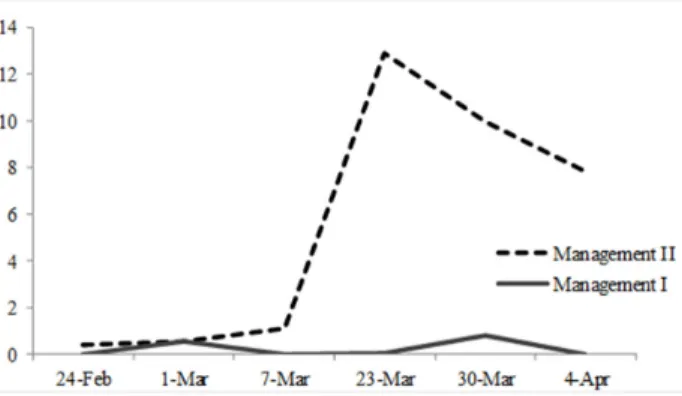
control, there was a significant increase in the population of stink bugs at the end of the crop cycle (Figure 1). This
can be explained by the presence of pods on the plants,
which is directly related to the presence of stink bugs in
the crop, and insect migration from already harvested neighboring areas (Panizzi et al. 2000). The average number of bugs ranged from 0 to 1 in the experiment with chemical insect control (Management I), and reached 13 in management II. According to Corrêa-Ferreira and Panizzi (1999), the control should be performed when the population reaches four bugs (nymphs of the third instar or adults) per drop cloth (in two meters of a row).
Thus, stink bug infestation in management II was high
enough to evaluate the reaction of genotypes, allowing a discrimination among them.
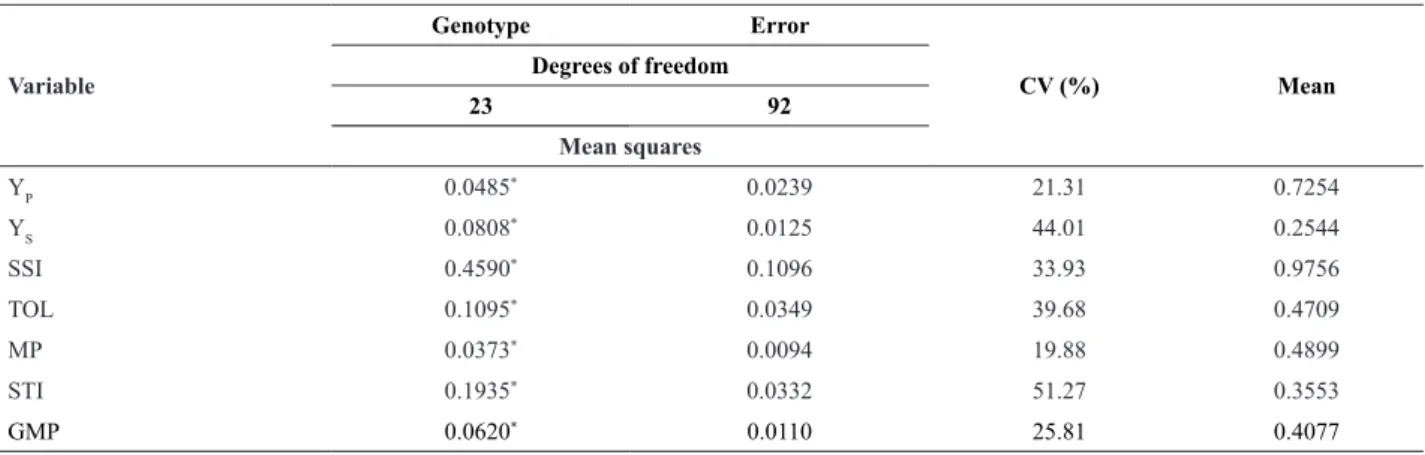
The analysis of variance for grain yield potential (YPi), weight of healthy seeds (YSi) and the indices estimated from these (Table 1) demonstrates the variability among
genotypes, allowing an identification of those with ability
to support stink bug attack. The coefficients of variation
(CV) ranged from 19.88 to 51.27%. High CV values can be explained because some genotypes are more affected
than others by the stink bug attack.
Among all evaluated genotypes, BRS 133, BRS Invernada, LQ1043, LQ1194, LQ1413, LQ1421, LQ1505, JAB 00-05-6/763D, and JAB 00-02-2/2J3D had the highest yields in the environment without stress (management I) (Table 2), whereas in the environment with stress (management II) the genotypes BRS 133, LQ1050, LQ1421 and LQ1505 had the highest YS values. These results show
that selection for GY cannot ensure the identification of those
with higher resistance. This is the case of BRS Invernada, LQ1043, LQ1194, LQ1413, JAB 00-05-6/763D, and JAB 00-02-2/2J3D, which despite the high yield potential, were extremely stress-sensitive, with reduction in YS values (Table 2).
Considering the SSI index, three groups were formed.
For this index, LQ1050 was classified as the most resistant genotype to the stink bug complex (Table 2). By the TOL
index however, apart from LQ1050, genotypes BRS 133, LQ1421, LQ1505, LQ1402, LQ1504, IAC 100, LQ1519, L1-1-55, IAC 23, LQ1078, IAC 17, and BMX Potência RR
had higher resistance to stink bugs than the others. Soybean cultivar IAC 100 was characterized as resistant to the stink bug complex, based on at least five mechanisms: shorter grain filling period, more seeds, abscission of damaged
pods and replacement by regrowth, normal senescence with leaf fall at maturity and resistance to yeast Eremothecium coryli (Peglion) (Rossetto et al. 1995). The evaluated LQ lines were derived from IAC 100, and therefore expected
to be grouped together.
However, both indexes, SSI and TOL, may favor the selection of genotypes with high values under stress conditions (YS) but with low yield potential in the absence of stress (Fernandes 1992). This was the case with LQ1050,
which was classified as resistant by these two indices, but is
not in the group of highest YP values. These indices consider a proportion (SSI) or a difference (TOL) between the YS and YP values. Therefore, the smaller the amplitude of these values, the stronger the genotype resistance. Thus, if a genotype is low-yielding in the absence of stress and maintains these levels under stress, the difference between yields will be reduced and the genotype is considered resistant.
By index MP, the genotypes BRS 133, LQ1421, LQ1050, LQ1413, LQ1421, and LQ1505 performed best. By the indices STI and GMP, the genotypes BRS 133, LQ1421, and LQ1505 performed extremely well. Selection based on these indices favors genotypes with high yield under both management conditions (Abarshahr et al. 2011). However, GMP is less sensitive to extreme values (widely discrepant YS and YP), making this index more suitable for the distinction of genotype groups (Fernandes 1992). According to Talebi et al. (2009), the correlation between GMP and STI is approximately one, as similarly found in this study (0.98). This explains why the groupings by both indices were the same.
High and significant correlations were found, considering
YS and the indices (Table 3). Correlations of de YS with SSI and TOL were negative, since higher YS indicate genotypes
with greater ability to withstand the insect attack, while for
Table 1. Summary of analysis of variance and estimated resistance indices of soybean to the stink bug complex, for 24 genotypes evaluated under two management systems: systematic chemical control of insects (Management I), and absence of control measures (management II)
Variable
Genotype Error
CV (%) Mean
Degrees of freedom
23 92
Mean squares
YP 0.0485* 0.0239 21.31 0.7254
YS 0.0808
* 0.0125 44.01 0.2544
SSI 0.4590* 0.1096 33.93 0.9756
TOL 0.1095* 0.0349 39.68 0.4709
MP 0.0373* 0.0094 19.88 0.4899
STI 0.1935* 0.0332 51.27 0.3553
GMP 0.0620* 0.0110 25.81 0.4077
YS: genotype yield (kg plot
-1) under stress (management II – absence of control measures); Y
P: genotype yield (kg plot
-1) in absence of stress (management I – with chemical control of insects); SSI: stress susceptibility index; TOL: tolerance; MP: mean productivity; STI: stress tolerance index; GMP: mean geometric productivity (kg plot-1).
TOL and SSI higher values indicate greater susceptibility of a genotype.
Conversely, correlations of YS with MP, STI and GMP were positive, since higher values of YS and these indices indicate increased resistance of the genotype (Table 3). The high correlations of YS with these indices show that YS can be used as an effective parameter in the selection of genotypes
with resistance to the stink bug complex and high-yielding in
the presence or absence of stress. The selection of genotypes with this performance is admittedly a challenge for plant breeders, while the yield in favorable environments was successfully increased (Richards et al. 2002).
The selected genotypes based on YS or MP, SSI and GMP indices agree, with some exceptions. YS is easy to estimate under stress, thus the selection based on this parameter facilitates the assessment for a high number of genotypes,
Table 3. Pearson correlation coefficient (r) between the yield of genotypes under stress (YS) (management II: no insect control) and the stress resistance
indices (stink bug damage)
SSI TOL MP STI GMP
YS -0.8281 -0.6574 0.7244 0.9294 0.9234
Prob <0.0001 <0.0001 <0.0001 <0.0001 <0.0001
SSI: stress susceptibility index; TOL: tolerance; MP: mean productivity; STI: stress tolerance index; GMP: geometric mean productivity.
Table 2. Mean soybean yield of genotypes in the absence (YP) (management I: systematic chemical insect control) and presence of stress (YS)
(manage-ment II: no insect control), and different resistance indices to the stink bug complex1
Genotype Y
S YP SSI TOL MP STI GMP
BRS 133 0.52 a 0.82 a 0.54 b 0.30 b 0.67 a 0.81 a 0.64 a
IAC 100 0.37 b 0.63 b 0.59 b 0.26 b 0.50 b 0.43 c 0.47 b
IAC 17 0.20 c 0.67 b 1.05 a 0.46 b 0.44 b 0.26 d 0.37 c
IAC 23 0.21 c 0.51 b 0.90 b 0.29 b 0.36 b 0.21 d 0.33 c
IAC 24 0.10 c 0.65 b 1.31 a 0.55 a 0.37 b 0.12 d 0.24 c
BRS Invernada 0.18 c 0.84 a 1.20 a 0.66 a 0.51 b 0.29 d 0.38 c
L1-1-55 0.27 c 0.67 b 0.88 b 0.40 b 0.47 b 0.35 c 0.41 c
LQ1043 0.21 c 0.86 a 1.14 a 0.64 a 0.53 b 0.33 c 0.41 c
LQ1050 0.47 a 0.65 b 0.13 c 0.18 b 0.56 a 0.58 b 0.54 b
LQ1078 0.21 c 0.64 b 0.94 b 0.42 b 0.43 b 0.24 d 0.34 c
LQ1119 0.14 c 0.74 b 1.26 a 0.60 a 0.44 b 0.20 d 0.31 c
LQ1124 0.12 c 0.73 b 1.30 a 0.61 a 0.43 b 0.17 d 0.29 c
LQ1188 0.15 c 0.69 b 1.21 a 0.54 a 0.42 b 0.19 d 0.32 c
LQ1194 0.20 c 0.84 a 1.18 a 0.64 a 0.52 b 0.33 c 0.41 c
LQ1402 0.31 b 0.69 b 0.84 b 0.38 b 0.50 b 0.41 c 0.45 b
LQ1413 0.31 b 0.85 a 0.96 b 0.53 a 0.58 a 0.50 b 0.51 b
LQ1421 0.47 a 0.86 a 0.66 b 0.38 b 0.67 a 0.76 a 0.60 a
LQ1504 0.34 b 0.65 b 0.76 b 0.30 b 0.50 b 0.45 c 0.46 b
LQ1505 0.44 a 0.87 a 0.77 b 0.43 b 0.65 a 0.72 a 0.61 a
LQ1519 0.31 b 0.67 b 0.81 b 0.35 b 0.49 b 0.40 c 0.46 b
BMX Potência RR 0.20 c 0.64 b 1.06 a 0.44 b 0.42 b 0.26 d 0.35 c
JAB 00-05-6/763D 0.12 c 0.76 a 1.31 a 0.64 a 0.44 b 0.17 d 0.29 c
JAB 00-02-2/2J3D 0.12 c 0.84 a 1.33 a 0.73 a 0.48 b 0.18 d 0.30 c
V-MAX RR 0.13 c 0.67 b 1.26 a 0.55 a 0.40 b 0.17 d 0.29 c
YS: genotype yield (kg plot-1) under stress (management II – no insect control); Y
P: genotype yield (kg plot
-1) in the absence of stress (management I – with : systematic
chemical insect control); SSI: stress susceptibility index; TOL: tolerance; MP: mean productivity; STI: stress tolerance index; GMP: geometric mean productivity.
allowing an increase in the number of repetitions and experimental locations, with no need for testing different management types (with and without insect control). The results also indicate that WHS is a useful character in simultaneous selection for high yield and resistance to
the stink bug complex. This fact is highly relevant, since
farmers will only accept a new resistant cultivar if it is also
high-yielding in the presence or absence of stink bug attack.
Moreover, plant resistance is a very promising strategy
because it generates no adoption cost while being compatible with the other forms of insect control.
ACKNOWLEDGEMENTS
The authors thank the National Council for Scientific
and Technological Development (CNPq), Brazilian Federal Agency for Support and Evaluation of Graduate Education (CAPES) and São Paulo Research Foundation (FAPESP) for granting a scholarship and funding this study.
Critério efetivo de seleção para avaliar a resistência ao complexo de percevejos
em soja
Resumo – A seleção de plantas em soja com resistência ao complexo de percevejos é feita atualmente com base em métodos labori-osos, o que limita a avaliação de um grande número de genótipos. Assim, este trabalho propôs uma nova alternativa para a seleção de genótipos resistentes, em condição de campo com infestação natural: a massa de sementes boas (MSB). Para isto, 24 genótipos de soja foram avaliados sob dois sistemas de manejo: com controle químico sistemático de insetos (manejo I), e sem nenhum con -trole (manejo II). Diferentes índices foram estimados utilizando a massa de grãos (YP) do manejo I e o MSB do manejo II (YS ). A alta correlação entre YS e os índices de produtividade média, tolerância ao estresse e média geométrica, aliada à concordância na determinação dos grupos de genótipos com resistência e alto rendimento indicam que a MSB é um caráter útil na seleção simultânea para estas características.
Palavras-chave: Glycine max, Nezara viridula, Piezodorus guildinii, Euschistus heros.
REFERENCES
Abarshahr M, Rabiei B and Samizadeh HL (2011) Assessing genetic diversity of rice varieties under drought stress. Notulae Scientia Biologicae 3: 114-123.
Corrêa-Ferreira BS and Panizzi AR (1999) Percevejos da soja e seu manejo. EMBRAPA-CNPSo, Londrina, 45p.
Fernandez GCJ (1992) Effective selection criteria for assessing stress tolerance. In Kuo CG (ed.) Proceedings of the international symposium on adaptation of vegetables and other food crops in temperature and water stress. AVRDC Publication, Tainan, p. 257-270.
Gallo D, Nakano O, Silveira Neto S, Carvalho RPL, Baptista GC, BERTI
Filho E, Parra JRP, ZucchI RA, Alves SB, Vendramin JD, Marchini LC, Lopes JRS and Omoto C (2002) Entomologia agrícola. FEALQ, Piracicaba, 920p.
Godoi CRC, Pereira FS, Umeno F, Ázara NA, Lima PMS, Silva RP, Oliveira AB, Araújo IM, Zucchi MI and Pinheiro JB (2002) Resistência a insetos em populações de soja com diferentes proporções gênicas de genitores resistentes. Revista Agropecuária Tropical 1: 47-55.
Godoi CRC and Pinheiro JB (2009) Genetic parameters and selection
strategies of soybean genotypes resistant to stink bug complex.
Genetics and Molecular Biology 32: 328-336.
Guedes JVC, Arnemann JA, Stürmer GR, Melo AA, Bigolin M, Perini CR and Sari BG (2012)Percevejos da soja: novos cenários, novo manejo. Revista Plantio Direto 127: 24-30.
Hoffmann-Campo CB, Martins CS, Toledo JFF, Kiihl RAS, Mazzarin RM and Oliveira MCN (1988) Estudos de metodologia para avaliação de linhagens de soja resistentes a insetos-pragas. In Empresa de Pesquisa Agropecuária – Centro Nacional de pesquisa da soja (eds.) Resultados de Pesquisa da Soja 1986/87. Embrapa-CNPSo, Londrina, p. 93-102.
Leonard BR, Boquet DJ, Padgett B, Davis JA, Schneider R, Griffin JL,
Valverde RA and Levy Jr RJ (2011) Soybean green plant malady contributing factors and mitigation. Louisiana Agriculture Magazine 54: 32-34.
Maia MCC, Vello NA, Rocha MM, Fonseca Júnior NS, Lavorante OJ, Pinheiro JB, Dias CTS and Assis GML (2009) Seleção de linhagens experimentais de soja para características agronômicas e tolerância a insetos. Bragantia 68: 85-97.
McPherson JE and McPherson RM (2000) Stink bugs of economic importance in America north of Mexico. CRC, Boca Raton, 272p.
Nagai V, Rossetto CJ and Lourenção AL (1987) Resistência de soja a insetos: IX. Amostragem para avaliação de dano de percevejo. Bragantia 46: 365-370.
Panizzi AR and Slansky Júnior F (1985) Review of phytophagous pentatomids (Hemiptera: Pentatomidae) associated with soybean in the Americas. Florida Entomologist68: 184-214.
Panizzi, AR, McPherson JE, James, DG, Javahery, M and McPherson
RM (2000) Stink bugs (Pentatomidae). In Schaefer CW and Panizzi
AR (eds.) Heteroptera of economic importance. CRC, Boca Raton, p. 432-434.
crop yield in temperate cereals. Crop Science 42: 111-121.
Rossetto CJ, Igue T, Miranda MAC and Lourenção AL (1986) Resistência de soja a insetos: VI. Comportamento de genótipos em relação a percevejos. Bragantia 45: 323-335.
Rossetto CJ, Gallo PB, Razera LF, Bortoletto N, Igue T, Medina PF, Tisseli Filho O, Aquilera V, Veiga RFA and Pinheiro JB (1995) Mechanisms
of resistance to stink bug complex in the soybean cultivar IAC-100. Anais da Sociedade Entomológica do Brasil 24: 517-522.
Sosa-Gómez DR, Corso IC and Morales L (2001) Insecticide resistance to endosulfan, monocrotophos and metamidophos in the neotropical
brown stink bug, Euschistus heros (F.). Neotropical Entomology
30: 317-320.
Sosa-Gómez DR and Silva JJ (2010) Neotropical brown stink bug
(Euschistus heros) resistance to methamidophos in Paraná, Brazil. Pesquisa Agropecuária Brasileira 45: 767-769.
Talebi R, Fayaz F and Naji AM (2009) Effective selection criteria for assessing drought stress tolerance in durum wheat (Triticum durum Desf.). General and Applied Plant Physiology 35: 64-74.