Neonicotinoid insecticide systemicity
in soybean plants and its effect on brown stink bugs
1Claudir José Basso2, Cassiano Carlos Kuss3,
Osmar Henrique de Castro Pias4, Dionei Schmidt Muraro2, Luan Cutti4
INTRODUCTION
The neotropical Euschistus heros (Heteroptera: Pentatomidae) is the most abundant stink bug species in Brazil (Sosa-Gómez et al. 2009). Given its high potential for crop damage, high population
density, difficulty of control and wide geographical
distribution, this species is one of the main soybean [Glycine max (L.) Merrill] pests (Sosa-Gómez & Silva 2010).
Difficulty in controlling stink bugs is related,
among other aspects, to the insect greater tolerance to insecticides, in relation to other species. Moreover, there are variations in susceptibility to the insecticide among
ABSTRACT
RESUMO
populations, with some of them showing tolerance levels up to sixteen times higher, when compared to susceptible populations (Sosa-Gómez at al. 2001 and 2009, Sosa-Gómez & Silva 2010). This tolerance has caused an increase in the use of neonicotinoid insecticides, which are among the most used globally (Girolami et al. 2009) and are characterized as highly toxic to insects and by having low toxicity to other
living organisms (Maienfisch et al. 2001).
The systemicity of an insecticide can be understood as the ability of the product to be translocated to other plant tissues which have not received the
product directly, at least not in sufficient amounts to be
lethal to insects (Faria 2009, Reetz et al. 2011).
1. Manuscript received in Dec./2015 and accepted for publication in Mar./2016 (http://dx.doi.org/10.1590/1983-40632016v4638908). 2. Universidade Federal de Santa Maria, Departamento de Ciências Agronômicas e Ambientais, Frederico Westphalen, RS,
Brasil. E-mails: [email protected], [email protected].
3. Cotrijui - Cooperativa Agropecuária & Industrial, Ijuí, RS, Brasil. E-mail: [email protected]. During the application of pesticides on soybean
fields, a vertical deposition gradient of the product can occur throughout the canopy, resulting in difficulties for controlling stink bugs that are in the middle and lower thirds of plants. This study aimed at evaluating the systemicity of thiamethoxam insecticide in different soybean phenological stages, using brown stink bugs as bioindicators of the pesticide efficacy. The study combined product application sites (lower, middle and upper third) and stink bugs infestation areas at five soybean phenological stages (R2, R3, R4, R5.2 and R6). For the R2 and R5.2 stages, plants presented acropetal translocation of the product, being the effect more evident in the R2 stage. For the R3, R4 and R6 stages, the product translocation was not sufficient for controlling the stink bugs. In all stages, for treatments with direct exposure (same infestation and spraying place), stink bugs were satisfactorily controlled.
KEY-WORDS: Glycine max; Euchistus heros; thiamethoxam.
Sistemicidade de inseticida neonicotinoide em soja e seu efeito sobre o percevejo marrom
Durante a aplicação de inseticidas, na cultura da soja, forma-se um gradiente vertical de deposição do produto ao longo do
dossel, resultando em dificuldades no controle dos percevejos que se
encontram nos terços médio e inferior das plantas. Objetivou-se avaliar a sistematicidade do inseticida tiametoxam em diferentes estágios da cultura da soja, utilizando-se o percevejo marrom como bioindicador da ação do inseticida. O estudo combinou locais de aplicação do produto (terço inferior, médio e superior) e de infestação dos percevejos, em cinco fases do estágio fenológico (R2, R3, R4, R5.2 e R6) da cultura da soja. Nos estágios R2 e R5.2, as plantas apresentaram translocação acropetal do produto, sendo o efeito mais pronunciado no estágio R2. Nos estágios R3, R4 e R6,não houve translocação suficiente do produto para o controle dos percevejos. Em todos os estágios, nos tratamentos com exposição direta (mesmo local de infestação e pulverização), houve controle satisfatório dos percevejos.
Neonicotinoids are described as systemic insecticides. However, in the literature, the movement of these insecticides through soybean crops has not been characterized yet, and it is unknown whether
the translocated amounts are sufficient to control
stink bugs.
The use of neonicotinoid insecticides in crops
has been identified as one of the factors responsible
for the decline in the populations of pollinating insects (Brittain & Potts 2011). According to Blacquière et al. (2012), the systemic action of neonicotinoids makes this product to be translocated to all parts of the plant, eventually becoming infused within the plant nectar and pollen. It may have lethal or sublethal effects on pollinating insects (which are rarely detected), and
thus influence both the physiology and behavior of
bees, thereby undermining the social structure of the colony (Pham-Delègue et al. 2002).
Although the present study does not intend to investigate the environmental impact of neonicotinoids, the evaluation of the translocation of these products in soybean plants might indicate the degree at which
beneficial insects such as bees may be exposed. This
would contribute to neonicotinoid use strategies that
minimize its impact on beneficial insects, such as
those reported by Girolami et al. (2009).
Under ideal climatic conditions for insecticides application, it is expected that the drops of the product will pass through the upper layer of leaves and be distributed throughout the canopy. There are factors such as physical barriers, weather conditions and application technology that can hinder the homogeneous distribution of the product (Ferreira & Oliveira 2008). The large leaf area of soybean makes
it even more difficult to obtain uniformity in the
product distribution throughout the plant canopy.
This can result in low efficiency in the control of
stink bugs, which are more prevalent in the middle and lower thirds of plants (Navarini 2008).
T h i s s t u d y a i m e d a t e v a l u a t i n g t h e thiamethoxam insecticide systemicity in different soybean phenological development stages, besides determining the insecticide effectiveness in controlling neotropical brown stink bugs.
MATERIAL AND METHODS
The systematic nature of thiamethoxam in
soybean plants and its efficacy on the neotropical
brown stink bug were studied at different phenological
soybean stages (R2, R3, R4, R5.2 and R6). For each phenological stage, an isolated experiment was conducted. The treatments had different combinations of product application sites and stink bug infestation areas. In the experiments conducted at R2, R3, R4 and R5.2, plants were divided into two strata (lower and upper half), while, at R6, they were divided into three strata (lower, middle and upper third).
Experiments were carried out at 24 ºC, in a climate-controlled greenhouse, in Londrina, Paraná State, Brazil. Soybean plants were grown in containers with 5 L capacity, prepared with Hapludox soil collected at the 0.00-0.20 m depth layer, which was initially screened and homogenized. The soil pH correction with dolomitic limestone was applied thirty days before the experiment. Throughout the experiment, the soil was maintained with moisture
near the field capacity. The BRS 1001 ipro soybean
cultivar was used. Seeds were treated with inoculant (Brady rhizobium japonicum; 6 mL kg-1 of seeds)
before seeding. On January 13 (2014), five seeds
were placed in each pot. Fifteen days after seeding, germinated plants were thinned to only one seedling per container.
The thiamethoxam insecticide was prepared in suspension at a concentration of 0.235 g L-1 of active ingredient. The Actara 250 WG commercial product was selected for this study because it contains thiamethoxam in isolation with no other insecticides. The thiamethoxam dose was calculated to be equivalent to the amount of this substance present in the dose of 250 mL ha-1 of Engeo Pleno and from a spray volume of 150 L ha-1. The suspension was sprayed with a manual sprayer until the runoff point of
the spray mixture on the plant was reached. Specific
plant strata were sprayed in accordance with each treatment. The plant parts that were not supposed to be sprayed were protected with plastic bags as was the soil. Soybean plants were infested with stink bugs immediately after the spray solution had dried.
The stink bugs used in the studies were collected at a Embrapa farm (23º11’0.6’’S, 51º10’18.5’’W). For the acclimatization of these insects, they were kept for seven days in screened cages, inside a greenhouse, and fed with soybean plants at the R5 stage (grain filling). During the experiments, the bugs were
boundaries of the fabric layers were tied with a string to prevent insects from passing from one stratum to another.
For the experiments with the R2, R3, R4 and R5.2 stages, the experimental design was completely randomized, with six treatments: two application sites (upper and lower), two infested sites (upper and lower) and two control treatments with infestation in the two sites (upper and lower), but without insecticide application. Each treatment had ten replications and each plant was infested with four stink bugs per stratum. The evaluations were based on counting the number of living insects in each
stratum and were performed daily until the seventh day after spraying. The number of living stink bugs was initially subjected to the W test (Shapiro &
Wilk 1965), to confirm the normality hypothesis,
and, as the data showed normal behavior, they were
subjected to analysis of variance. When significant
results were obtained, they were compared by the Tukey test at 1 %.
The design of the R6 stage experiment was completely randomized, with 12 treatments: three pesticide application sites (lower, middle and upper), three stink bugs infestation sites (lower, middle and upper) and three control treatments, with no insecticide, with three infestation sites (lower, middle and upper). All treatments had ten replications. Each
plant was infested with five bugs per stratum. The evaluations were performed daily until the fourteenth day after spraying by counting the number of living insects. The number of living stink bugs was initially subjected to the W test (Shapiro & Wilk 1965), to
confirm the normality hypothesis, and, as the data
did not show normal behavior, they were analyzed by the non-parametric Kruskal-Wallis method (Campos 1979) and the treatment means compared by the chi-square test at 1 %.
RESULTS AND DISCUSSION
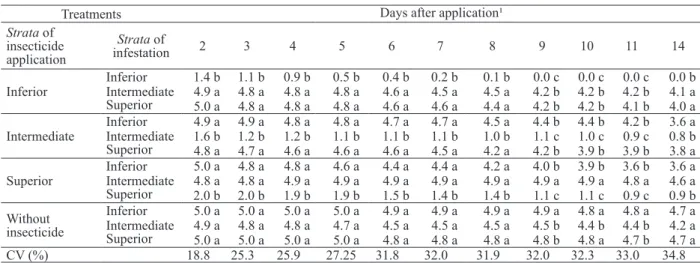
In all experiments, there was a low survival rate of bugs in the strata in which a direct spray was applied at the same site of stink bugs infestation (Tables 1 and 2). In the experiment conducted at the R5.2 stage, for treatments with direct exposure (same location of spraying and infestation of bugs), total mortality was achieved two days after spraying, indicating a fast acting toxic effect on the insects. This observation highlights the strong effect of
direct contact and absorption of the thiamethoxam insecticide, as already shown by Sosa-Gómez et al. (2009). These authors tested insecticides with different actions on the stink bug control and observed that the best results were obtained with thiamethoxam.
The susceptibility of stink bugs to commercial products containing thiamethoxam is widely known (Sosa-Gómez et al. 2009, Fiorin et al. 2011). The effect of these products is also known for other soybean pests species, such as Piezodorus guildinii
(Westwood) (Heteroptera: Pentatomidae) and Nezara viridula (L.) (Heteroptera: Pentatomidae) (Ramiro et al. 2005, Farias et al. 2006).
In the experiments with the R2 and R5.2 stages, intermediate survival results were observed for treatments with the application of insecticide in the lower stratum and infestation in the upper stratum. For R2, only 25 % of the stink bugs survived seven days after spraying. In the R5.2 stage experiment, the survival result at seven days after spraying was
70 %, which shows that translocation is more efficient
during the R2 stage. From this result it is possible to infer that there is a systemic acropetal effect (via xylem) of thiamethoxam. Cui et al. (2010) showed that this active substance has good mobility via xylem. Souza et al. 2006 observed that the greatest levels of the thiamethoxam insecticide in leaves were obtained 30 days after the application through irrigation water and can be found in the leaves up to 156 days of application, indicating a slow metabolism (degradation), as observed by Diez-Rodrigues et al. (2006).
When the application of thiamethoxam was held in the upper stratum of the plant and the infestation at the lower stratum, in all soybean stages, the survival of stink bugs was high and did not differ from the results obtained in the control treatment (without insecticide). Thus, it was observed that the basipetal movement of thiamethoxam did not occur
in a rate that would be sufficient to control the bugs.
Cui et al. (2010) studied the systemicity of IPP-10, which is a neonicotinoid product recently released in the market for wheat, and they observed that the product was translocated via xylem and phloem,
increasing the efficiency in controlling insects.
¹ Average number with the same letter in the column, within each stage, do not differ by the Tukey test at 1 %.
Treatments Days after application¹
Strata insecticide
application Strata infestation 1 2 3 4 5 6 7
R2
Inferior InferiorSuperior 0.1 c 0.0 c 0.0 c 0.0 c 0.0 d 0.0 c 0.0 b
2.9 b 2.8 b 2.4 b 1.9 b 1.7 c 1.3 b 1.0 b
Superior InferiorSuperior 3.9 a 3.8 ab 3.7 a 3.4 a 3.3 ab 2.6 ab 2.5 a
0.2 c 0.0 c 0.0 c 0.0 c 0.0 d 0.0 c 0.0 b
Without insecticide InferiorSuperior 4.0 a 4.0 a 4.0 a 4.0 a 3.8 a 3.4 a 3.0 a
4.0 a 3.8 ab 3.8 a 3.2 a 2.4 cb 2.4 ab 2.2 a
CV (%)2 21.6 21.54 23.3 23.3 23.6 28.6 29.9
R3
Inferior InferiorSuperior 0.8 b 0.7 b 0.7 b 0.6 b 0.1 b 0.1 b 0.1b
3.5 a 3.2 a 3.2 a 3.2 a 2.9 a 2.7 a 2.6 a
Superior InferiorSuperior 3.9 a 3.6 a 3.6 a 3.3 a 3.1 a 2.9 a 2.7 a
1.1 b 0.6 b 0.6 b 0.6 b 0.5 b 0.4 b 0.3 b
Without insecticide InferiorSuperior 4.0 a 4.0 a 4.0 a 4.0 a 3.8 a 3.6 a 3.0 a
4.0 a 4.0 a 4.0 a 3.8 a 3.3 a 3.0 a 3.0 a
CV (%)2 23.8 26.5 26.5 28.3 26.2 28.5 28.8
R4
Inferior InferiorSuperior 1.2 b 1.4 b 1.3 b 0.9 b 0.7 b 0.5 b 0.3 b
4.0 a 4.0 a 3.9 a 3.9 a 3.7 a 3.5 a 3.3 a
Superior InferiorSuperior 4.0 a 4.0 a 4.0 a 3.9 a 3.9 a 3.9 a 3.9 a
2.4 b 2.5 b 1.6 b 1.3 b 0.4 b 0.3 b 0.3 b
Without insecticide InferiorSuperior 4.0 a 3.8 a 3.8 a 3.8 a 3.8 a 3.8 a 3.8 a
4.0 a 4.0 a 4.0 a 4.0 a 4.0 a 4.0 a 4.0 a
CV (%)2 22.16 20.56 18.77 21.02 21.88 22.33 21.99
R5.2
Inferior InferiorSuperior 0.6 b 0.0 c 0.0 c 0.0 c 0.0 c 0.0 c 0.0 c
3.5 a 3.3 b 3.3 b 3.0 b 2.8 b 2.8 b 2.8 b
Superior InferiorSuperior 3.9 a 3.8 a 3.8 a 3.8 a 3.8 a 3.8 a 3.8 a
0.2 b 0.0 c 0.0 c 0.0 c 0.0 c 0.0 c 0.0 c
Without insecticide InferiorSuperior 3.8 a 3.8 a 3.8 a 3.8 a 3.8 a 3.8 a 3.8 a
4.0 a 4.0 a 4.0 a 4.0 a 4.0 a 4.0 a 4.0 a
CV (%)2 24.6 16.4 16.4 18.5 17.7 17.7 17.7
Table 1.Survival (average number of living bugs) of Euschistus heros, in response to the systemic effect of thiamethoxam applied in two different strata of soybean plants, at the R2, R3, R4 and R5.2 stages.
¹ Average number with the same letter in the column, within each stage, do not differ by the Kruskal-Wallis test and the treatment means compared by the chi-square test at 1 %.
Treatments Days after application¹
Strata of insecticide application
Strata of
infestation 2 3 4 5 6 7 8 9 10 11 14
Inferior
Inferior 1.4 b 1.1 b 0.9 b 0.5 b 0.4 b 0.2 b 0.1 b 0.0 c 0.0 c 0.0 c 0.0 b Intermediate 4.9 a 4.8 a 4.8 a 4.8 a 4.6 a 4.5 a 4.5 a 4.2 b 4.2 b 4.2 b 4.1 a Superior 5.0 a 4.8 a 4.8 a 4.8 a 4.6 a 4.6 a 4.4 a 4.2 b 4.2 b 4.1 b 4.0 a Intermediate
Inferior 4.9 a 4.9 a 4.8 a 4.8 a 4.7 a 4.7 a 4.5 a 4.4 b 4.4 b 4.2 b 3.6 a Intermediate 1.6 b 1.2 b 1.2 b 1.1 b 1.1 b 1.1 b 1.0 b 1.1 c 1.0 c 0.9 c 0.8 b Superior 4.8 a 4.7 a 4.6 a 4.6 a 4.6 a 4.5 a 4.2 a 4.2 b 3.9 b 3.9 b 3.8 a Superior
Inferior 5.0 a 4.8 a 4.8 a 4.6 a 4.4 a 4.4 a 4.2 a 4.0 b 3.9 b 3.6 b 3.6 a Intermediate 4.8 a 4.8 a 4.9 a 4.9 a 4.9 a 4.9 a 4.9 a 4.9 a 4.9 a 4.8 a 4.6 a Superior 2.0 b 2.0 b 1.9 b 1.9 b 1.5 b 1.4 b 1.4 b 1.1 c 1.1 c 0.9 c 0.9 b Without
insecticide
Inferior 5.0 a 5.0 a 5.0 a 5.0 a 4.9 a 4.9 a 4.9 a 4.9 a 4.8 a 4.8 a 4.7 a Intermediate 4.9 a 4.8 a 4.8 a 4.7 a 4.5 a 4.5 a 4.5 a 4.5 b 4.4 b 4.4 b 4.2 a Superior 5.0 a 5.0 a 5.0 a 5.0 a 4.8 a 4.8 a 4.8 a 4.8 b 4.8 a 4.7 b 4.7 a
CV (%) 18.8 25.3 25.9 27.25 31.8 32.0 31.9 32.0 32.3 33.0 34.8
is considered a polar substance and is therefore likely to translocate via xylem, with water and nutrients taken up by plants roots (Cui et al. 2010).
In the experiments conducted during the R3 and R4 stages, with indirect exposure treatments, there was no reduction in the survival rate of bugs, what indicates the absence of lethal doses through the translocation of thiamethoxam in plants. Considering the results of the experiments conducted at the R2 and R5.2 stages, it is evident that, in order to obtain a satisfactory control of this pest, it is important, besides a good coverage, spraying thiamethoxam preferably to the lower strata of the plants. Thus, this information highlights the importance of application technology regarding nozzles, pressure and environmental conditions. The biological
efficiency of a spray depends not only on the proven efficiency of the product, but also on the technology
used in its application.
In the experiment conducted at R6, the results obtained were similar to those at R3 and R4, with no evidence of systemic effects of thiamethoxam. In these plant development stages, treatments with
indirect exposure did not have a significant reduction
in the number of bugs, if compared to the control treatment (Table 2).
In the R6 stage, the mass of all vegetative structures of the plants (Ritchie et al. 1985), metabolic activity and water demand start to decrease (Souza et al. 2013). As the translocation of systemic pesticides occurs mainly through the xylem,
following the water flow, these physiological changes
may have contributed to reduce the systemic effects of thiamethoxam. In addition, it is possible that the conditions of the experiment (in a greenhouse) have accelerated the soybean maturation process, further
reducing the water flow in those plants.
CONCLUSIONS
1. Plants at the R2 and R5.2 soybean phenological stages present acropetal translocation of the active substance thiametoxam,with a more evident effect during the R2 stage.
2. In the R3, R4 and R6 stages, the product
translocation is not sufficient to control stink bugs
in plant parts not directly exposed to thiametoxam. 3. At every stage, treatments with direct exposure had a satisfactory control of stink bugs, what indicates
a good contact efficacy.
ACKNOWLEDGMENTS
The authors are thankful to the Coordenação de Aperfeiçoamento de Pessoal de Nível Superior (Capes), for granting a Master’s scholarship to the second author; Program of Graduate Studies in Agronomy, Agriculture and Environment of the Universidade Federal de Santa Maria, Campus Frederico Westphalen, and the laboratory teams of the Entomology Section of Embrapa Soja, for their support in conducting these studies; Dr. Samuel Roggia, for his support and assistance in the experiments; and Dr. Maria Cristina Neves de Oliveira, for helping us to interpret the statistical results.
REFERENCES
BLACQUIÈRE, T. et al. Neonicotinoids in bees: a review on concentration, side-effects and risk assessment.
Ecotoxicology, Amtsgericht Charlottenburg, v. 21, n. 4,
p. 973-992, 2012.
BRIGGS, G. G.; BROMILOW, R. H.; EVANS, A. A. Relationships between lipophilicity and root uptake and translocation of non-ionised chemicals by barley. Pesticide
Science, Tokyo, v. 13, n. 5, p. 495-504, 1982.
BRITTAIN, C.; POTTS, S. G. The potencial impacts of insecticides on the life-history traits of bees and the consequences for pollination. Basic and Applied Ecology, Jana, v. 12, n. 4, p. 321-331, 2011.
CAMPOS, H. de. Estatística experimental
não-paramétrica. 3. ed. Piracicaba: USP, 1979.
CUI, L. et al. Systemic action of novel neonicotinoid insecticide IPP-10 and its effect on the feeding behaviour
of Rhopalosiphum padion wheat. Pest Management
Science, New York, v. 66, n. 7, p. 779-785, 2010.
DIEZ-RODRÍGUEZ, G. I. et al. Resíduos de tiametoxam, aldicarbe e de seus metabólitos em folhas de cafeeiro e efeito no controle de Leucoptera coffeella (Guérin-Mèneville) (Lepidoptera: Lyonetiidae). Neotropical
Entomology, Londrina, v. 35, n. 2, p. 257-263, 2006.
FARIA, A. B. C. Revisão sobre alguns grupos de inseticidas utilizados no manejo integrado de pragas florestais. Ambiência, Guarapuava, v. 5, n. 2, p. 345-358, 2009.
FARIAS, J. R. et al. Eficiência de tiametoxam + lambda-cialotrina no controle do percevejo-verde-pequeno
Piezodorus guildinii (Westwood. 1837) (Hemiptera:
Pentatomidae) e seletividade para predadores na cultura da soja. Revista da FZVA, Uruguaiana,v. 13, n. 2, p. 10-19, 2006.
costal pressurizado e manual elétrico com bico rotativo para volume baixo: parte 1: cobertura. In: SIMPÓSIO INTERNACIONAL DE TECNOLOGIA DE APLICAÇÃO DE AGROTÓXICOS, 4., 2008, Ribeirão Preto. Anais...
Campinas: Instituto Agronômico, 2008.
FIORIN, R. A. et al. Método de aplicação de inseticida no controle de percevejo na cultura da soja. Semina: Ciência
Agrárias, Londrina, v. 32, n. 1, p. 139-146, 2011.
GIROLAMI, V. et al. Translocation of neonicotinoid insecticides from coated seeds to seedling guttation drops: a novel way of intoxication for bees. Journal of Economic
Entomology, Annapolis, v. 102, n. 5, p. 1808-1815, 2009.
HSU, F. C.; MARXMILLER, R. L; YANG, A. Y. S. Study of root uptake and xylem translocation of cinmethylin and related compounds in detopped soybean roots using a pressure chamber technique. Plant Physiology, Rockville, v. 93, n. 4, p.1573-1578, 1990.
MAIENFISCH, P. et al. Chemistry and biology of thiamethoxam: a second generation neonicotinoid. Pest
Management Science, New York , v. 57, n. 1, p. 906-913,
2001.
NAVARINI, L. Resposta de cultivares de soja ao controle
químico de ferrugem asiática. 74 f. 2008. Dissertação
(Mestrado em Produção Vegetal) - Universidade Federal de Santa Maria, Santa Maria, 2008.
PHAM-DELÈGUE, M. H. et al. Behavioral methods to assess the effects of pesticides on honey bees. Apidologie, Amtsgericht Charlottenburg, v. 33, n. 5, p. 425-432, 2002.
RAMIRO, Z. A.; BATISTA FILHO, A.; CINTRA, E. R. R. Eficiência do inseticida Actara Mix 110 + 220 CE (thiamethoxam + cipermetrina) no controle de
percevejos-pragas da soja. Arquivos do Instituto Biológico, São Paulo, v. 72, n. 2, p. 239-247, 2005.
REETZ, J. E. et al. Neonicotinoid insecticides translocated in guttated droplets of seed-treated maize and wheat: a threat to honeybees? Apidologie, Amtsgericht Charlottenburg, v. 42, n. 6, p. 596-606, 2011.
RITCHIE, S. W. et al. How a soybean plant develops. Ames: Iowa State University of Science and Technology Cooperative Extension Service, 1985.
SOSA-GÓMEZ, D. R. et al. Insecticide susceptibility of
Euschistusheros (Heteroptera: Pentatomidae) in Brazil.
Journal of Economic Entomology, Annapolis , v. 102, n. 3,
p. 1209-1216, 2009.
SOSA-GÓMEZ, D. R.; CORSO, I. C.; MORALES, L. Insecticide resistance to endosulfan: monocrotophos and metamidophos in the neotropical brown stink bug
Euschistus heros (Fabr.). Neotropical Entomology,
Londrina, v. 30, n. 2, p. 317-320, 2001.
SOSA-GÓMEZ, D. R.; SILVA, J. J. Neotropical brown stink bug (Euschistus heros) resistance to methamidophos in Paraná, Brazil. Pesquisa Agropecuária Brasileira, Brasília, DF, v. 45, n. 7, p. 767-769, 2010.
SOUZA , J. C. et al. Eficiência de thiamethoxan no controle do bicho-mineiro do cafeeiro: I - Influência da modalidade de aplicação. Coffe Science, Lavras, v. 1, n. 2, p. 143-149, 2006.
SOUZA, G. M. et al. Soybean under water deficit: physiological and yield responses. In: BOARD, J. E. (Ed.).
A comprehensive survey of international soybean research: