ISSN 0103-8478
Luciana de Paula NavesI* Angelita Duarte CorrêaII Antônio Gilberto BertechiniI
Elisangela Minati GomideI Celeste Maria Patto de AbreuII
Activity of fungal phytases stored in two ways in response to the period of storage
at room temperature
Atividade de fitases fúngicas armazenadas de duas maneiras em resposta ao período de armazenamento à temperatura ambiente
ABSTRACT
Two distinct experiments were conducted simultaneously with phytases of Aspergillus oryzae and A.niger
for determining enzyme activity in response to storage period (up to 180 days at room temperature - RT). In the first experiment, enzymes were stored as they were acquired (pure form) and the activity was measured periodically during 180 days of storage at RT. In the second experiment, the phytases were incorporated to a supplement containing vitamins, minerals, and amino acids; and then this supplement was stored at RT up to 180 days, so that every 30 days of storage was collected one aliquot from each replicate for determining enzymatic activity. In conclusion, the phytase activity is affected by storage duration. To ensure 80% of the initial activity, the phytases of A. oryzae and A.niger can be stored in the pure forms for up to 53 and 135 days at RT, respectively. However, if the phytases of A. oryzae and A.niger are incorporated to a supplement containing vitamins, minerals, and amino acids then the storage period at RT should not exceed 67 and 77 days, respectively.
Key words:Aspergillus niger, Aspergillus oryzae, enzyme, phytate, phytic acid.
RESUMO
Dois experimentos distintos foram realizados simultaneamente com fitases de Aspergillus oryzae e A. niger
para a determinação da atividade enzimática em resposta ao período de armazenamento (por até 180 dias em temperatura ambiente - TA). No primeiro experimento, as enzimas foram armazenadas como adquiridas (forma pura) e a atividade foi determinada periodicamente durante 180 dias de armazenamento em TA. No segundo experimento, as fitases foram incorporadas a um suplemento contendo vitaminas,
minerais e aminoácidos. Então este suplemento foi armazenado em TA por até 180 dias, de modo que, a cada 30 dias de armazenamento, uma alíquota de cada repetição foi coletada para a determinação da atividade enzimática. Conclui-se que a atividade da fitase é afetada pela duração do armazenamento. Para assegurar 80% da atividade inicial, as fitases de A. oryzae e A.niger podem ser armazenadas nas formas pura por até 53 e 135 dias em TA, respectivamente. Entretanto, se as fitases de A. oryzae e A.niger são incorporadas a um suplemento contendo vitaminas, minerais e aminoácidos, o período de armazenamento em TA não deve exceder 67 e 77 dias, respectivamente.
Palavras-chave:ácido fítico, Aspergillus niger, Aspergillus oryzae, enzima, fitato.
INTRODUCTION
Phytic acid (or phytate) is the major storage form of phosphorus (P) in both seeds and grains. It is commonly present in the broiler feed in the form of phytate P which is poorly available because of the low activity of phytase in the digestive tract of these animals. Phytic acid contained in the diet can also act as an antinutritional factor by decreasing the bioavailability of nutrients, particularly the divalent minerals. Moreover, there is also an environmental problem because the phytate P that is not absorbed is excreted into the environment and may cause eutrophication of rivers, lakes and reservoirs (LEI & PORRES, 2003). In order to minimize such problems,
IDepartamento de Zootecnia, Universidade Federal de Lavras (UFLA), Campus Universitário, CP 3037, 37200-000, Lavras, MG,
Brasil. E-mail: [email protected]. *Autor para correspondência.
Activity of fungal phytases stored in two ways in response to the period of storage at room temperature.
microbial phytases are added in broiler diets, because the phytase (myo-inositol hexakisphosphate phosphohydrolases) catalyzes the hydrolysis of phytic acid in a stepwise manner, releasing lower inositol phosphates and inorganic phosphate that can be used metabolically by the poultry (VATS & BANERJEE, 2004). The inclusion of phytases in broiler diets has become progressively more frequent because this enzyme increases the availability of P and other nutrients, and several studies have reported its positive effects on broilers performance (BRANDÃO et al., 2007; COSTA et al., 2007; SUREK et al., 2008; NAGATA et al., 2009).
There are several phytases available in the market; however, few scientific studies have been carried out to examine the influence of the manner and storage period on enzyme activity. This information is very important for broilers producers because the phytase needs to be stored, as well as the other ingredients of the feed. Normally phytases are marketed as pure form; however according to SULABO et al. (2010) the adding of phytase in products (premix or supplement) containing vitamins and mineral traces is becoming more popular in the industry, but there are doubts whether the interaction between phytase and the components of the supplement may affect phytase activity during its storage. Therefore, it is important to monitor the loss of phytase activity to recommend a maximum storage period that maintains a satisfactory enzymatic activity when the phytase is storaged in pure form or in supplement.
Thus, the present study was conducted with two phytases of different fungal origins to evaluate the effect of storage period on enzymatic activity when the phytases are storaged in two storage forms: (1) in the pure form or (2) after it has been incorporated to a supplement containing vitamins, minerals, and amino acids.
MATERIAL AND METHOD
Two independent experiments were conducted in the Biochemistry Laboratory of the Chemistry Department of the Federal University of Lavras with two powdered enzymes: a) 6-phytase EC 3.1.3.26 (synthesized by Aspergillus oryzae genetically modified by addition of the gene from the Peniophora lycii) and b) 3-phytase EC 3.1.3.8 (produced by A.niger genetically modified by gene encoding phytase from the A. ficuum). These phytases used were not coated or encapsulated.
Each phytase was stored in plastic containers at room temperature (RT) in two ways: pure form (experiment 1) and after incorporated to a
supplement containing vitamins, minerals, and amino acids (experiment 2). In both experiments, the enzyme activity was determined periodically during 180 days of storage to monitor the activity loss. The minimum and maximum temperatures and relative humidities of the storage place were recorded, every seven days, using a digital thermo-higrometer.
The determination of phytase activity consisted of three sequential steps: extraction of phytase, colorimetric analysis and calculation of enzyme activity using a standard curve. The phytase extraction was done in 0.25mol L-1 acetate buffer
[containing 0.05% Triton X-100 (w/v) and 0.05% bovine serum albumin (w/v)] at pH 5.0 under horizontal shaking for 30 minutes in the presence of ice. After extraction, the sample was centrifuged (2,000 x g for 10 minutes at 4°C) and the supernatant was collected. The enzyme activity was determined in the supernatant based on the reaction of phytase with substrate 7.5mmol L-1
sodium phytate (C6H6O24P6Na12- Sigma-Aldrich) in
buffered medium (0.25mol L-1 acetate buffer; pH 5.0) at
37°C for four different incubation times. The reaction was ended by adding a mixture of three solutions (21.67% nitric acid; 0.081mol L-1 ammonium molybdate;
and 0.02mol L-1 ammonium vanadate) at proportions of
2:1:1, respectively. The developed color was measured at 415nm. Standard solutions of potassium phosphate were used as a reference (ENGELEN et al., 1994). The activity was calculated using the slope of the straight line resulting from the assay with the sample (absorbance/minute) and the slope of the straight line arising from the standard curve (absorbance/µmol of phosphorus). One unit of phytase activity (FTU) was defined as the amount of enzyme which releases 1µmol of inorganic phosphate in 1 minute of reaction.
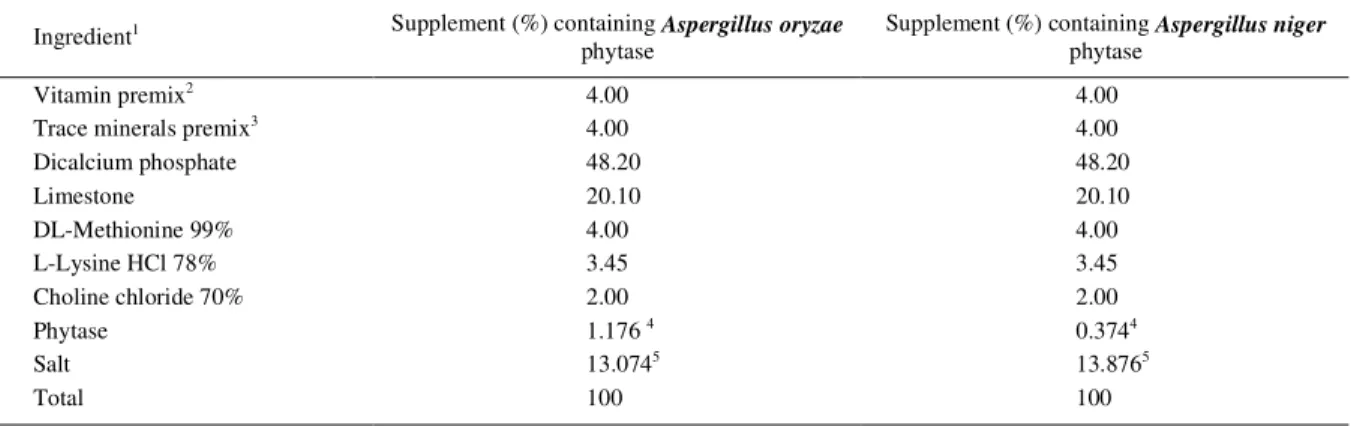
In the first experiment, the two powdered phytases were stored at RT within plastic containers in the pure form (as acquired), with four replicates of 250g of phytase. In the second experiment, also in four replicates, the phytases were incorporated to the supplement (40,000FTU kg-1 of supplement) composed
of vitamins, minerals, and amino acids (Table 1) and then the supplement was stored at RT. To ensure the same initial activity in all treatments (FTU kg-1 of
supplement), the activity of each phytase was determined once it was acquired and the result (in FTU g-1 of enzyme) was used to calculate the amount of
enzyme, whereas the activities of the phytases in the incorporated forms were determined after every 30 days up to 180 days at RT and were expressed in FTU kg-1 of
supplement.
The two experiments were conducted in a completely randomized design with four replicates each. There were six treatments for each phytase stored in the pure form (experiment 1) and seven treatments for the phytases incorporated into the supplement (experiment 2). The data obtained were submitted to ANOVA using the SISVAR software and regression models were employed to evaluate the storage period (FERREIRA, 2008).
RESULTS AND DISCUSSION
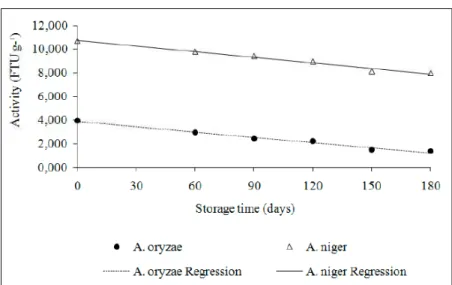
The minimum and maximum temperatures and relative humidities of the storage place were determined as 18±2°C and 26±2°C; and 42±11% and 75±8%, respectively. In the experiment 1, the activity of the phytases stored in the pure forms decreased (P<0.01) during the storage period, with maximal reduction (after 180 days of storage) of 64.8% for Aspergillus oryzae phytase and of 25.7% for A.niger phytase (Figure 1).
In this study, it was observed that the activity of A. niger phytase decreased linearly
(y=-15.959x+10,754; R2=0.9836) during the 180 days of
storage at room temperature (RT). Therefore, it was calculated a reduction of 16.6% in the activity of this enzyme during the first 112 days of storage, however, this value was bigger than the 7.7% reported by PIZZOLANTE et al. (2002) in a research with the same phytase stored for 112 days at RT, but the environmental conditions weren’t detailed by the authors and can be the cause of this variation. However, A. oryzae phytase lost 42.2% of its activity after 112 days of storage (y=-14.546x+3,864; R2=0.9811) demonstrating that the
reduction in the activity wasn’t the same for different phytases. Thus, it is evident that the phytase is denatured during storage at RT, indicating the importance in avoiding long storage periods in order to ensure a satisfactory catalytic activity.
The storage also reduces the activity of other enzymes. Recently, JIANG et al. (2009) measured the catalytic activity of the alcohol dehydrogenase from Saccharomyces cerevisiaeEC 1.1.1.1) storaged at 4°C during 30 days, and they concluded that this enzyme lost activity rapidly and completely at 30 storage days. Is clearly documented for enzymes, that maintenance of its proper folded structure is necessary for preserve its catalytic activity (COPELAND, 2000; NELSON & COX, 2005). According to ARAKAWA et al. (2001), the proteins can be denatured by various
Table 1 -Composition of the supplement in which phytase was added and then stored at room temperature so that the enzyme activity was determined periodically (experiment 2)
Ingredient1 Supplement (%) containing Aspergillus oryzae
phytase
Supplement (%) containing Aspergillus niger phytase
Vitamin premix2 4.00 4.00
Trace minerals premix3 4.00 4.00
Dicalcium phosphate 48.20 48.20
Limestone 20.10 20.10
DL-Methionine 99% 4.00 4.00
L-Lysine HCl 78% 3.45 3.45
Choline chloride 70% 2.00 2.00
Phytase 1.176 4 0.3744
Salt 13.0745 13.8765
Total 100 100
1Ingredients of the supplement were acquired separately and then mixed using plastic bags. 2Levels kg-1: Vitamin A, 12,000,000IU; vitamin D
3, 2,200,000IU; vitamin E, 30,000IU; vitamin K, 2,500mg; thiamin, 2,200mg; riboflavin,
6,000mg; pyridoxine, 3,300mg; vitamin B12, 16mg; niacin, 53,000mg; folic acid, 1,000mg; D-pantothenic acid, 13,000mg; biotin, 110mg;
BHT antioxidant, 3,500mg; inert vehicle (caulim).
3mg kg-1: Fe (as ferrous sulphate monohydrate), 50,000; Cu (as cupric sulfate monohydrate), 8,500; Zn (as zinc oxide), 70,000; Mn (as
manganese monoxide), 75,000; I (as calcium iodate), 1,500; Co (as cobalt sulphate), 200; Se (as sodium selenite), 250mg; inert vehicle (caulim).
4Rate of inclusion based in the activity of each phytase which was determined short time before the inclusion in the supplement to ensure the
same activity in all treatments (40,000FTU kg-1 of supplement).
5The rate of inclusion of salt varies with the inclusion of phytase, such that the final combined inclusion rate (phytase + salt) is equal to
Activity of fungal phytases stored in two ways in response to the period of storage at room temperature.
stresses encountered during its storage in solution, or in frozen or dried states. In other words, over time, the enzyme may undergo chemical changes, resulting in conformational changes (unfolding). For example, some of the side chains of amino acid residues of proteins are more reactive than others. Cysteinyl residues in proteins can occur as free sulfhydryl groups, or in disulfide linkages with other cysteinyl residues. Thus, during long term storage, free sulfhydryl groups may be oxidized to the disulfide form. Furthermore, methionyl residues can also compromise the long term storage of proteins, because this amino acid contains a sulfur moiety in a thio-ether linkage which, over time, can become oxidized to the sulfoxide. Thus, if these reactions affect the three-dimensional structure of the active site, the enzyme activity can be lower. However, is important to consider that these reactions are variables between different proteins, and that its effect on enzyme activity depends of the microenvironment in which these side chains reside.
So far, this research did not find any scientific study on the specific chemical changes that occurs during storage of powder phytase, which causes a decrease on its catalytic activity. Perhaps, further studies on the dried phytase conformation (eg. using the infrared spectroscopy) should provide some information on the conformational state during the storage.
Considering an activity loss of 20% as tolerable, it is found that the A. oryzae and A.niger phytases evaluated in this experiment can be stored at RT in the pure forms for up to 53 and 135 days, respectively.
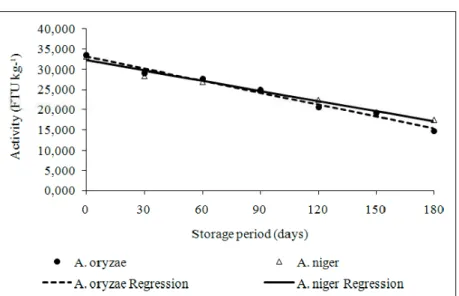
In the experiment 2, the duration of the storage also resulted in linear loss of activity (P<0.01) for both phytases incorporated to the supplement. It was found that after 180 days of storage, there were 56.1% and 47.5% reduction in the activity of A. oryzae and A.niger phytases, respectively (Figure 2).
At the begining of storage, the activity determined in the supplement was lower than expected (40,000FTU kg-1). This was probably due to the
interference of nutrients present in the supplement. It was found that the supplement reduced the initial activity by 16.7% and 17.1% for A. oryzae and A.niger phytases, respectively. Since the supplement contained several components, it was not possible to indicate those responsible for the decrease in activity. Also, the possibility of a summation of inhibitory effects among the components cannot be eliminated. However, it is probable that the reduction on the catalytic activity ocurred by formation (during the enzymatic assay) of complex phytic acid-nutrient unavailable for hydrolysis. WYSS et al. (1999) reported that cationic minerals may form complex with the phytic acid and reduce the eficiency of phytase. According to CHERYAN (1980),
Regression for Aspergillus oryzae (y=-14.546x+3,864; R2=0.9811).
Regression for Aspergillus niger (y=-15.959x+10,754; R2=0.9836).
the order corresponding to the decrease in the stability of the formed complex (phytic acid-mineral) for some minerals is as follows: Zn2+, Cu2+, Ni2+, Co2+, Mn2+, Ca2+,
and Fe2+. Of these seven cations, only Ni2+ is not
present in the supplement, and therefore, the remaining minerals can have complexed with phytic acid during the assay for determining the activity. Nevertheless, it is important to emphasize that inhibition observed in this study probably occurred due to the high component concentrations in the supplement.
Considering an activity loss of 20% as tolerable and based on the activity that was determined at the beginning of this experiment - day zero (33,139 and 32,206FTU kg-1 for A. oryzae and A. niger
phytases, respectively) (Figure 2) the A. oryzae and A. niger phytases could be stored at RT in the forms incorporated to the supplement for up to 67 and 77 days, respectively.
CONCLUSION
In conclusion, the phytase activity is affected by duration of storage. To ensure 80% of the initial activity, the phytases of Aspergillus oryzae and A.niger can be stored in the pure forms for up to 53 and 135 days at room temperature, respectively. However, if the phytases of Aspergillus oryzae and A. niger are incorporated to a supplement containing
vitamins, minerals, and amino acids then the storage period at room temperature should not exceed 67 and 77 days, respectively.
ACKNOWLEDGMENTS
To Fundação de Amparo à Pesquisa do Estado de Minas Gerais (FAPEMIG) and Coordenação de Aperfeiçoamento de Pessoal de Nível Superior (CAPES) for the financial support.
REFERENCES
ARAKAWA, T. et al. Factors affecting short-term and long-term stabilities of proteins. Advanced Drug Delivery Reviews, v.46, n.1-3, p.307-326, 2001. Available from: <http:// www.sciencedirect.com/science?_ob=MImg&_imagekey=B6T3R-42JYV9B-K-1S&_cdi=4953&_user=686380&_pii=S01694 09X00001447&_origin=browse&_zone=rslt_list_item&_coverD ate=03%2F01%2F2001&_sk=999539998&wchp=dGLbVlb-zSk zk&md5 =73 d4dcd2 4 6e2 ff1 6 39 f34 a70 d4c1 46 e4&ie=/ sdarticle.pdf>. Accessed: Jan. 21, 2011. doi: 10.1016/S0169-409X(00)00144-7.
BRANDÃO, P.A. et al. Effect of phytase addition in broiler rations, during grower and final phases. Ciência e Agrotecnologia, v.31, n.2, p.492-498, 2007. Available from: <ht tp:/ /www. sciel o.br /pdf/ cagro /v3 1 n2 /a3 3 v3 1 n 2 .pd f>. Accessed: Jan. 21, 2011. doi: 10.1590/S1413-70542007000200033.
CHERYAN, M. Phytic acid interactions in food systems.
Critical Reviews in Food Science and Nutrition, v.13, n.4, p.297-335, 1980.
Regression for Aspergillus oryzae (y=-98.923x+33,139; R2=0.9858).
Regression for Aspergillus niger (y=-84.112x+32,206; R2=0.9819).
Activity of fungal phytases stored in two ways in response to the period of storage at room temperature.
COPELAND, R.A. Enzymes: a practical introduction to structure, mechanism, and data analysis. 2.ed. New York: Wiley-VCH, 2000. 416p.
COSTA, F.G.P. et al. Effect of phytase enzyme in broilers rations, during pre-starter and starter phases. Ciência e Agrotecnologia, v.31, n.3, p.865-870, 2007. Available from: <ht tp:/ /www. sciel o.br /pdf/ cagro /v3 1 n3 /a3 7 v3 1 n 3 .pd f>. Accessed: Jan. 21, 2011. doi: 10.1590/S1413-70542007000300037.
ENGELEN, A.J. et al. Simple and rapid determination of phytase activity. Journal of AOAC International, v.77, n.3, p.760-764, 1994.
FERREIRA, D.F. Estatística multivariada. Lavras : UFLA, 2008. 672p.
JIANG, Y. et al. The improved stability of enzyme encapsulated in biomimetic titania particles. Materials Science and Engineering C, v.29, n.1, p.328-334, 2009. Available from: < h t t p : / / w w w . s c i e n c e d i r e c t . c o m / science? _ o b= MI mg &_ imag ek ey =B 6 T XG 4 T 0 WJ SN 2 -W & _ c d i = 5 5 9 0 & _ u s e r = 6 8 6 3 8 0 & _ p i i = S 0 928493108001513&_origin=browse&_zone=rslt_list_item&_cove rDate=01%2F01%2F2009&_sk=999709998&wchp=dGLzVtz-zSk zk &md5=4 5ff96 c4 1 d2 d0 a88 19 b1a8c2 bea16 5c6 &ie=/ sdarticle.pdf>. Accessed: Jan. 21, 2011. doi: 10.1016/ j.msec.2008.07.006.
LEI, X.G.; PORRES, J.M. Phytase enzymology, applications, and biotechnology. Biotechnology Letters, v.25, n.21, p.1787-1794, 2003. Available from: <http:// www. spr i n ger l in k .co m.w1 0 0 3 5 . do t l ib . co m. br / con t ent / p81r7443k1502056/fulltext.pdf>. Accessed: Jan. 21, 2011. doi: 10.1023/A:1026224101580.
NAGATA. A.K. et al. Use of the ideal protein concept in diets with different energy levels supplemented with phytase for broiler chickens of 1 to 21 days of age. Ciência e Agrotecnologia, v.33, n.2, p.599-605, 2009. Available from: <ht tp:/ /www. sciel o.br /pdf/ cagro /v3 3 n2 /v3 3 n2 a3 7 .pd f>.
Accessed: Jan. 21, 2011. doi: 10.1590/S1413-70542009000200037.
NELSON, D.L.; COX, M.M. Lehninger principles of biochemistry. 4.ed. New York: H.W. Freeman, 2005. 1119p. PIZZOLANTE, C.C. et al. The effect of forms and conditions of storage of pure phytase on its enzymic activity. Revista Veterinária e Zootecnia, v.11, p.69-79, 2002. (publicação anual).
SULABO, R.C. et al. Factors affecting storage stability of various commercial phytase sources. In: SWINE DAY CONFERENCE, 2010, Manhattan, KS. Conference paper…
Manhattan: Kansas State University, 2010. p.273-289. Captured in: Jan. 21, 2011. On line. Available from: <http:// krex.k-state.edu/dspace/bitstream/2097/6596/1/Swine10pg273-289.pdf>.
SUREK, D. et al. Phytase use in diet with different particle size for broiler chicken at initial stage. Ciência Rural, v.38, n.6, p.1725-1729, 2008. Available from: <http://www.scielo.br/pdf/ cr/v38n6/a36v38n6.pdf>. Accessed: Jan. 21, 2011. doi: 10.1590/S0103-84782008000600036.
VATS, P.; BANERJEE, U.C. Production studies and catalytic properties of phytases (myo-inositolhexakisphosphate phosphohydrolases): an overview. Enzyme and Microbial Technology, v.35, n.1, p.3-14, 2004. Available from: <http:/ / w w w . s c i e n c e d i r e c t . c o m / sci en ce? _ o b= M I mg &_ i ma g ek ey = B 6 T G 1 4 C D S 6 9 9 1 -2 & _ c d i = 5 -2 4 1 & _ u s e r = 6 8 6 3 8 0 & _ p i i = S 0 1 4 1 0 22904000870&_origin=browse&_zone=rslt_list_item&_cov erDate=07%2F06%2F2004&_sk=999649998&wchp=dGLzVzz-zSkzk &md5 =7 5a4 4 8 c8 3 7 21 7 cb17 d1 f0 2 ff3f2 3 c4e9 &ie=/ sdarticle.pdf>. Accessed: Jan. 21, 2011. doi: 10.1016/ j.enzmictec.2004.03.010.