Selection among and within full-sib families of
elephant grass for energy purposes
Verônica Brito da Silva
1*, Rogério Figueiredo Daher
1, Bruna
Rafaela da Silva Menezes
2, Geraldo de Amaral Gravina
1, Maria
do Socorro Bezerra De Araújo
1, Almir Ribeiro de Carvalho
Júnior
1, Derivaldo Pureza da Cruz
1, Brunno de Oliveira
Almeida
1and Flávio Dessaune Tardin
3Abstract: Pennisetum purpureum Schum. has been a key alternative as an energy source in Brazil because of its higher dry matter accumulation and fiber content. This research aimed to select superior individuals of P. purpureum for energy purposes using among-and-within family selection. The study was carried out in Campos dos Goytacazes- RJ (Brazil), using eight full-sib families. Plants were individually assessed during two pasture cuttings, one in 2014, and another in 2015. The dry matter production (DMP) was correlated with the number of tillers, stem diameter, plant height, and neutral detergent fiber content. Plant selection criteria in both cuts were through direct and indirect selections, and Smith and Hazel index. A joint analysis of variance showed significant differ-ences for all five traits assessed in both cuts. The results achieved with Smith and Hazel index were promising for simultaneous selection of the evaluated traits, favoring selection of superior families and individuals them.
Key words: Pennisetum purpureum Schum, biomass,selection gain, heritability, Smith and Hazel index.
Crop Breeding and Applied Biotechnology 18: 89-96, 2018 Brazilian Society of Plant Breeding. Printed in Brazil
http://dx.doi.org/10.1590/1984-70332018v18n1a12 ARTICLE
*Corresponding author: E-mail: [email protected]
Received: 08 February 2017 Accepted: 09 June 2017
1 Universidade Estadual do Norte
Flumin-ense Darcy Ribeiro (UENF), Avenida Alberto Lamego, 2000, 28.013-602, Campos dos Goytacazes, RJ, Brazil
2 Universidade Federal Rural do Rio de Janeiro
(UFRRJ), Instituto de Ciências Biológicas e da Saúde, Departamento de Genética, km 47, 23.897-970, Seropédica, RJ, Brazil
3 Empresa Brasileira de Pesquisa
Agro-pecuária, Embrapa Agrossilvipastoril, Rodovia MT 222, 78.550-970, Sinop, MT, Brazil INTRODUCTION
After the Paris COP 21 Climate Conference in 2015 (COP 21), efforts towards carbon emission and global warming reductions have been strengthened. In this sense, vegetal biomass has become a safe and sustainable energy alternative since it is renewable, and has low production cost. In addition, unlike other sources as oil or coal, this material has no contribution to the greenhouse effect as it reduces carbon dioxide emissions through absorption during photosynthesis (Anderson et al. 2008, Lee et al. 2010).
In Brazil, the interest of researchers was aroused by elephant grass. This
relevance comes from being highly efficient in fixing atmospheric CO2 during
photosynthesis (Azevedo et al. 2012, Flores et al. 2012, Rossi et al. 2014). This plant is African in origin and has traits benefiting biomass quality such as fast growth, small farm plots for cultivation, high dry matter accumulation, high fiber content, and high calorific power (Daher at al. 2014).
selection criteria (Pereira et al. 2008, Benin et al. 2013), exploring variability within species (Cavalcante and Lira 2010). Selection of superior phenotypes of individuals or families is an important practice in breeding programs, making it feasible since improved populations are generated from selection and recombination at individual and family levels (Cruz et al. 2014, Salgado et al. 2014). In this context, among-and-within-family selection becomes a great option, mainly for considering only one character of interest, being simple to be applied. Moreover, using selection indexes consists of providing a new trait, which is a linear combination of all traits involved, whose weighting coefficients are estimated so as to maximize the correlation between the index and a genotypic aggregate (true breeding values for selection candidates) (Cruz et al. 2012). However, to date, there have been no studies involving the selection of elephant grass full-sib families using such method.
This study had, therefore, the aim to estimate and compare the predicted genetic gains by means of direct and indirect selections, as well as through a classical selection index, thus selecting the most promising families and individuals within full-sib families of elephant grass for energy purposes.
MATERIAL AND METHODS
The experiment was conducted at the Rio de Janeiro State Research Unit for Agro-Energy and Waste Exploitation (PESAGRO) (lat 21° 19’ 23’’ S, long 41º 19’ 40’’ W and alt 20 m asl), in Campos dos Goytacazes, RJ, Brazil. According to the Köppen’s classification, the local climate is an Aw type, which stands for a hot and humid tropical climate with annual rainfall of around 1152 mm. The soil is classified as a dystrophic Argisol (Ultisol) (Santos et al. 2013).
Eight elephant grass accessions donated by the germplasm bank of the State University of North Rio de Janeiro were used in the experiment. The female parental plants were IJ7139, CPAC, and IAC-Campinas, while male parental ones were Cameroon, Cubano Pinda, BAG-86, Capim cana D´Africa, and Vrukwona. These accessions were directly crossed among each other for promising hybrid combinations, selecting parents for late flowering, high dry matter production, and thick stems (Lima et al. 2011).
Crossings were performed following the method described by Silva et al. (2011). It consisted of collecting pollen grains from elephant grass genotypes (male parents), in paper bags, and then taking them to the female flowers, when inflorescence stigmas (protected by a paper bag) were receptive. There was no need for emasculation because of flower protogyny (Passos et al. 2005). The crossings were carried out between 8 and 10 in the morning, in 2013. Afterwards, seeds were sown in 128-cell trays filled with forest substrate. Field transplanting was held when seedlings reached 20 cm in height, nearly 40 days after germination, in December 2013.
The experimental design was a randomized block design with three replications; each block consisted of eight full-sib families. Only 15 seeds were obtained for each family due to a loss of seed viability. Each plot was composed of five plants spaced in 1 m between and within planting rows, according to Silva et al. (2017). The evaluations were carried out in two periods (cuts), the first made after 12 months of sowing (2014), and the second 8 months after the first (2015). For Rengsirikul et al. (2011), elephant grass dry matter production decreases after a 12-month cutting interval.
The assessed traits were correlated to the dry matter production (Menezes et al. 2014): number of tillers - NT (of every individual prior to harvest), stem diameter - SD (in cm, using three plants from each individual clump, at 10 cm above the soil with a digital caliper), plant height - PH (in m, measuring three random plants from each individual clump with a graduated ruler). The biomass quality traits were assessed at the Laboratory of Animal Science, Darcy Ribeiro State University of North Rio de Janeiro (LZO/UENF). DMP was estimated using the percentage of dry matter and the weight of tillers from individual plants, as described by Daher et al. (2014). Yet the percentage of neutral detergent fiber
(%NDF) was determined as described by Mertens (2002), using a filter bag Technique (AnkomTM).
These data underwent individual analysis of variance, based on the following random model: Yijk = m + Gi + Bj +
Dij + Eijk; wherein: Yijk: observation in the kth individual of the ith full-sib family (FSF) assessed in the jth block; m: overall
average; Gi: random effect of the i
th FSF; B
j: effect of the jth block; Dij: random effect of the variation between plots; Eijk:
random effect of the variation between plants within the plot.
genotype as a random effect, as follows: Yiklm = m + bj
k
+ Gi + Ck + (GC)ik + eijk + dijkl , wherein, m: general mean; Gi: effect
of the j–th FSF; C
k: effect of the k–
th cut; (GC)
ik: interaction effect of the j–
th FSF with the k–th cut; e
ijk: effect of experimental
error of the plots, dijkl: deviation inherent to plant l of FSF i, in replication j at cut k. Considering the model for combined
analysis of randomized blocks, the expected mean squares [E (MS)] were based on Cruz et al. (2014).
To select the traits to be used in the selection index, a multicollinearity diagnosis was performed among them. For this, a matrix correlation method was used, resulting in a weak collinearity. All assessed traits had a condition number of 7 (CN - the ratio between the largest and smallest eigenvalue of the correlation matrix). According to Cruz et al. (2014), collinearity is classified as weak when CN < 100.
According to Cruz et al. (2014), gain estimates are seen in a direct selection based on the estimator: GSx = DSxh2x;
wherein: GSx is the direct gain predicted in the variable X; DSx is the selection variable differential X, and h2x is the
heritability coefficient of the variable X, in a broad sense. Selection gain rates were determined by the following
expression: [(GS)]↓x% = [(GS)] ↓x*100)/X↓0.
The gain estimates obtained by indirect selection were calculated according to the following estimator: GSy(x) = DSy(x)
he
y; wherein: GSy(x) is the selection gain in Y by selecting the variable X; DSy(x)is the differential of indirect selection, in
which the average of selected ones is obtained as a function of the progenies, which show superiority for the auxiliary variable X, and he
y is the heritability coefficient of the main variable Y. The rate of selection gain was estimated according
to the following expression: GSy(x)% = GSx(y)*100
□ X0.
We used the classical index proposed by Smith (1936) and Hazel (1943). In these indexes both the selection index (I) and the genotypic aggregate (H) are described by: I = b1x1 + b2x2 + ... + bnxn =
n
Σ
i=1bixi = b'x and H = a1g1 + a2g2 + ... + angn =
n
Σ
i=1aigi = a'g;
wherein: n is the number of evaluated traits; b' is the vector (1 x n) of the weighting coefficients of the selection index
to be estimated; x is the matrix (n x p) of trait means; a', is the vector (1 x n) of previously established economic weights;
and g is the matrix (n x p) of unknown genetic values of the n traits considered. The indexes were established by the
following equation system: Pb = Ga; wherein: P is the matrix of phenotypical covariance; G is the matrix of phenotypical
covariance; a is the vector of economic weights, and b is the vector of coefficients of the selection index.
When using a classical index, the genetic variation coefficient (CVg), genetic standard deviation (SD) and random weights of each trait were considered as economic weights. For both cuts, the random weights were 100, 90, 90, 80, and 100 for the variables DMP, NT, PH, SD, and NDF, respectively. The selection intensity applicable among individuals was 15%, corresponding to 18 selected individuals. All statistical analyses were performed using the Genes software (Cruz et al. 2013).
RESULTS AND DISCUSSION
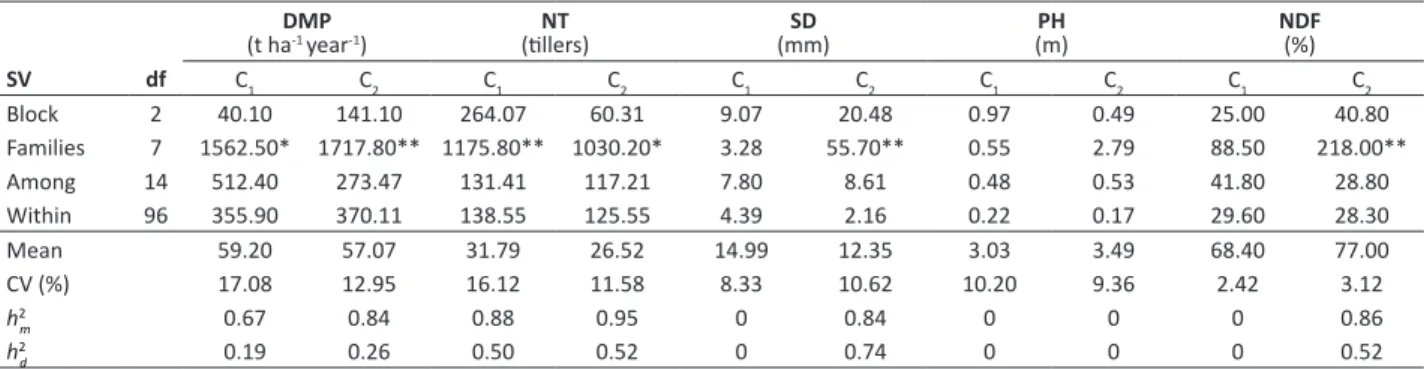
While DMP and NT presented significant differences among families in both cuts, SD and NDF showed significant differences only in the second cut (Table 1). Such difference points out to a genetic variability among FSFs, besides a potential for selection. This fact confirms this species diversity for biomass production. Likewise, Daher et al. (2014) had observed variability among 16 hybrids concerning the same agronomic traits related to energy purposes.
At the family level, the heritability coefficient exceeded those obtained at the individual level within a family for all measured traits (Table 1). The highest estimates were observed for traits in the second cut. These results can be explained by a great unevenness in the first cut evaluations, which decreases with the course of crop establishment in the field. NT and NDF reached estimates of 0.95 and 0.86, respectively, which indicates high perspectives of genetic gain by selection. However, the estimates for heritability within families ranged from 19 to 74%.
The joint analysis of variance showed significant differences among families for all traits (Table 2). These variations indicate good prospects for selections among families and for continuity in the elephant grass genetic breeding program. The effects of family x cut interactions and of the cut itself were significant for all traits except for DMP and SD, and DMP, respectively. Conversely, significant interactions indicate that the families showed distinct responses in the different sections. Such a result can be explained by the long periods through which evaluations were carried out; thus, the families were longer exposed to edaphic and climatic variations, especially irregular precipitation. Nevertheless, there were no significant differences for dry matter production, which had a greater participation in the genotype variance than did the environmental range.
Comparing Tables 3 and 4, we observed for most of the assessed traits that direct gains by selection among-and-within-family were greater than were the indirect ones. Direct selection among-and-among-and-within-family provided total gains as expected for the first cut concerning DMP (5.74), NT (5.27), and for the second cut for DMP (6.42) and NT (5.08). It is worthy highlighting that, in the present study, evaluations occurred at different plant ages; therefore, different sets of genes could be responsible for the phenotypic expression of genotype at each plant age.
Nevertheless, in certain cases, it must be highlighted here that indirect gains exceeded direct ones in both cuts, regarding SD (2.57 and 8.57) and NDF (11.7 and 15.5), as shown in Table 4. This finding becomes possible whether heritability of an auxiliary trait is greater than the target one (under selection), and when the genetic correlation between them is of major magnitude. In contrast, indirect gains for selection of PH were low, and for some other variables, were negative. Therefore, performing an indirect selection for one variable to obtain a gain in another one is unfeasible, since there might be a loss in the first one (Verardi et al. 2009).
Based on the classical index, predicted gains were maximized for all traits when it was used genetic variation coefficient, standard deviation, and heritability coefficient at the family level, as economic weights (Table 5). Teixeira et al. (2012) evaluated 25 progenies of açaí palm and observed small fruit production gains when the genetic variation
Table 1. Summary of the variance analysis of dry matter production (DMP), number of tillers (NT), stem diameter (SD), plant height (PH), and neutral detergent fiber (NDF) for full-sib families of elephant grass in two harvest cuts (C)
DMP
(t ha-1 year-1) (tillers)NT (mm)SD (m)PH NDF(%)
SV df C
1 C2 C1 C2 C1 C2 C1 C2 C1 C2
Block 2 40.10 141.10 264.07 60.31 9.07 20.48 0.97 0.49 25.00 40.80 Families 7 1562.50* 1717.80** 1175.80** 1030.20* 3.28 55.70** 0.55 2.79 88.50 218.00**
Among 14 512.40 273.47 131.41 117.21 7.80 8.61 0.48 0.53 41.80 28.80 Within 96 355.90 370.11 138.55 125.55 4.39 2.16 0.22 0.17 29.60 28.30 Mean 59.20 57.07 31.79 26.52 14.99 12.35 3.03 3.49 68.40 77.00 CV (%) 17.08 12.95 16.12 11.58 8.33 10.62 10.20 9.36 2.42 3.12
h2
m 0.67 0.84 0.88 0.95 0 0.84 0 0 0 0.86
h2d 0.19 0.26 0.50 0.52 0 0.74 0 0 0 0.52
** and * significant at 1 and 5% probability level by the F-test, respectively. Environmental variation coefficient (CV%), mean progeny heritability (h2m), heritability at plot level (among plants within families) (h2
d).
Table 2. Summary of the variance analysis of dry matter production (DMP), number of tillers (NT), stem diameter (SD), plant height (PH), and neutral detergent fiber (NDF) for full-sib families of elephant grass in two harvest cuts (C)
Mean Squares
SV df DMP (t ha-1 year-1) NT (tillers) PH (m) SD (mm) NDF (%)
Blocks 2 17.12 253.12 0.80 11.63 62.68
Families (F) 7 2958.10** 2119.24* 2.68* 40.80** 200.23*
Error A 14 642.12 136.68 0.83 6.85 51.20
Cut (C) 1 289.23 1664.37** 12.71** 419.44** 4427.11**
Error B 16 146.35 45.61 0.25 10.62 17.53
F x C 7 322.24 86.86** 0.660* 18.26 107.09*
Residue Within 192 363.03 132.05 0.20 3.28 19.00
coefficient and average progeny heritability were used as economic weights. By using selection intensity indexes of 15% within FSF, direct gains were observed only for DMP and NT in both cuts (Table 5). This result was already expected since the selection was carried out giving priority to traits with high heritability coefficients and genetic variance, which are considered most important.
Taking into account the Smith and Hazel index, in which standard deviation (SD) was used as an economic weight, we observed higher gains for NT in the first and second cuts (47.66% and 76.99%) (Table 5), being higher than those of direct and indirect selection for the same trait. Likewise, the same result was reported when using families of other crops such as popcorn (Amaral Junior et al. 2010, Freitas et al. 2013) and wheat (Cargnin et al. 2007). Moreover, Costa et al. (2008) reported high genetic gains by selection index in 32 soybean families using SD as economic weight.
In both cuts, advantageous results were provided to the selection process when it was used random weights (RA) as economic weight, reaching positive gains for SD (0.21% and 0.32%), also bringing superior results for NDF (2.16% and 2.38%) and PH (5.75% and 6.19%). Furthermore, selection index promoted most satisfactory estimates and greater genetic gains for SD, NDF, and PH if compared to direct and indirect selections (Table 5). Costa et al. (2008), performing an among-and-within-FSF selection in soybeans, observed direct gains similar to those obtained by selection indexes, as observed in our study.
Although poorly differentiated, the results attained using different economic weights for Smith and Hazel index showed to be advantageous if compared to direct and indirect selections, since the predicted gains reached by those were higher Table 3. Predicted gains by direct selection for dry matter production (DMP), number of tillers (NT), stem diameter (SD), plant height (PH), and neutral detergent fiber (NDF) in full-sib families of elephant grass in two harvest cuts (C)
DMP
(t ha-1 year-1) (tillers)NT (m)PH (mm)SD NDF(%)
Estimates C1 C2 C1 C2 C1 C2 C1 C2 C1 C2 Xo 59.2 57.07 31.79 26.52 3.03 3.49 14.49 12.35 68.42 77.01
Xs 67.8 64.71 37.73 31.85 3.17 3.74 15.02 12.95 69.6 78.81
h2 67.2 84.08 88.82 95.41 12.42 80.82 -137.9 84.56 52.67 86.79
SGt 5.74 6.42 5.27 5.08 0.01 0.2 -0.03 0.5 0.62 1.55
SG (%) 9.69 11.26 16.6 19.15 0.58 5.83 -0.25 4.08 0.91 2.02
Xo and Xs: original mean and mean of the selected individuals, heritability (h2), selection gains (SG).
Table 4. Predicted gains (SG %) by among (SGa) and within (SGw) selection criterion, and total gains (SGt) by indirect selection of dry matter production (DMP), number of tillers (NT), stem diameter (SD), plant height (PH), and neutral detergent fiber (NDF) for full-sib families of elephant grass in two harvest cuts (C)
Trait DMP (t ha-1 year-1) NT (tillers) PH (m) SD (mm) NDF (%)
SG (%) C
1 C2 C1 C2 C1 C2 C1 C2 C1 C2
DMP SGa - - 4.73 4.39 0.11 0.26 0.11 0.86 0.86 2.09
(t ha-1year-1) SG
w - - 5.64 5.46 0.13 0.32 0.13 5.07 1.02 2.6
SGt - - 10.4 9.85 0.24 0.58 0.24 5.93 1.88 4.69
NT SGa 4.52 5.37 - - 0.065 0.37 0.04 0.39 0.365 1.32
(tillers) SGw 5.92 9.6 - - 0.086 0.2 0.58 0.7 0.478 2.37
SGt 10.4 15 - - 0.151 0.57 0.62 1.09 0.843 3.69
PH SGa 5.92 5.34 3.49 3.5 - - -0.1 0.81 0.69 1.75
(m) SGw 0.96 5.62 0.56 3.68 - - 0 0.85 0.11 1.84
SGt 6.88 11 4.05 7.18 - - -0.1 1.66 0.8 3.59
SD SGa 2.17 3.58 0.89 11.3 -0.05 0.16 - - -0.19 1.64
(mm) SGw 0.4 4.99 0.16 1.86 -0.01 0.22 - - -0.03 2.29
SGt 2.57 8.57 1.05 13.2 -0.06 0.38 - - -0.22 3.93
NDF SGa 5.74 4.75 4.73 2.27 0.11 0.19 0.11 0.9 -
-(%) SGw 5.92 10.8 7.15 5.59 0.086 0.44 0.06 2.04 -
-than the latter for all assessed traits. The differences in all traits between cuttings can be explained by environmental changes from one year to the other, where the better conditions in the second year might have favored a larger tillering.
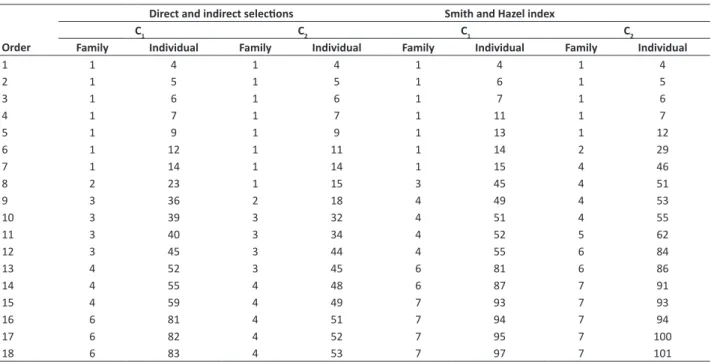
Among the evaluated families, family 1 (Table 6) stood out for its better genetic gains. Within this family, the individuals 4, 6, and 7 were considered the most thriving ones for both cuts. Hence, these individuals should be highlighted as promising in terms of biomass production for superior genotype selection.
CONCLUSIONS
The gains predicted by the classic index of Smith and Hazel were higher for all the assessed traits, especially for dry matter production.
Stem diameter showed major gains through indirect selection by means of dry matter production and the number of tillers.
Family 1 and its individuals 4, 6, and 7 were pointed out as the most promising ones for energy purposes when assessing selection among- and within-families using the Smith and Hazel index.
Table 6. Selection of families and individuals by direct and indirect selection methods and by Smith and Hazel index in two harvest cuts (C)
Direct and indirect selections Smith and Hazel index C
1 C2 C1 C2
Order Family Individual Family Individual Family Individual Family Individual
1 1 4 1 4 1 4 1 4
2 1 5 1 5 1 6 1 5
3 1 6 1 6 1 7 1 6
4 1 7 1 7 1 11 1 7
5 1 9 1 9 1 13 1 12
6 1 12 1 11 1 14 2 29
7 1 14 1 14 1 15 4 46
8 2 23 1 15 3 45 4 51
9 3 36 2 18 4 49 4 53
10 3 39 3 32 4 51 4 55
11 3 40 3 34 4 52 5 62
12 3 45 3 44 4 55 6 84
13 4 52 3 45 6 81 6 86
14 4 55 4 48 6 87 7 91
15 4 59 4 49 7 93 7 93
16 6 81 4 51 7 94 7 94
17 6 82 4 52 7 95 7 100
18 6 83 4 53 7 97 7 101
Table 5. Predicted selection gains (SG%) by the classical selection index of Smith & Hazel (SH) for dry matter production (DMP), number of tillers (NT), stem diameter (SD), plant height (PH), and neutral detergent fiber (NDF) in full-sib families of elephant grass in two harvest cuts (C)
SG C
1 SG C2
Trait SD CVg RW SD CVg RW
DMP (T ha-1year-1) 25.38 25.09 24.78 35.53 30.71 31.9
NT (tillers) 47.66 49.95 45.85 76.99 71.43 68.12
PH (m) 4.33 5.23 5.75 5.07 5.52 6.19
SD (mm) -0.52 -0.248 0.21 -0.89 -0.28 0.32
NDF (%) 1.71 1.69 2.16 2.04 1.76 2.38
REFERENCES
Amaral Júnior AT, Freitas Júnior SP, Rangel RM, Pena GF, Ribeiro RM, Morais RC and Schuelter AR (2010) Improvement of a popcorn population using selection indexes from a fourth cycle of recurrent selection program carried out in two different environments.
Genetics and Molecular Research9: 340-347.
Anderson WF, Dien BS, Brandon SK and Peterson JD (2008) Assessment of Bermuda grass and bunch grasses as feedstocks for conversion to
ethanol. Applied Biochemistry Biotechnology145: 13-2.
Azevedo ALS, Costa PP, Machado JC, Machado MA, Pereira AV and
Ledo FJS (2012) Cross species amplification of Pennisetum glaucum
microsatellite markers in Pennisetum purpureum and genetic diversity
of Napier grass accessions. CropScience52: 1776-1785.
Benin G, Storck L, Marchioro VS, Franco FA and Trevizan DVM (2013) Improving the precision of genotype selection in wheat performance
trials. Crop Breeding and Applied Biotechnology 13: 234-240.
Cargnin A, Souza MA, Machado CG and Pimentel AJB (2007) Genetic gain prediction for wheat with different selection criteria. Crop Breeding and Applied Biotechnology7: 334-339.
Cavalcante M and Lira MA (2010) Variabilidade genética em Pennisetum
purpureum Schumacher. Revista Caatinga23: 153-163.
Costa MM, Di Mauro AO, Unêda-Trevisoli SH, Arriel NHC, Bárbaro IM, Silveira GD and Muniz FRS (2008) Analysis of direct and indirect
selection and indices in soybean segregating populations. Crop
Breeding and Applied Biotechnology 8: 47-55.
Cruz CD (2013) Genes: a software package for analysis in experimental
statistics and quantitative genetics. Acta Scientiarum. Agronomy
35: 271-276.
Cruz CD, Carneiro PCS and Regazzi AJ (2014) Modelos biométricos
aplicados ao melhoramento genético. Editora UFV, Viçosa, 668p.
Cruz CD, Regazzi AJ and Carneiro PCS (2012) Modelos biométricos
aplicados ao melhoramento genético. Editora UFV, Viçosa, 514p. Cunha MV, Lira MA, Santos MVF, Dubeux Júnior JCB, Mello ACL and Freitas
EV(2013) Adaptabilidade e estabilidade da produção de forragem por
meio de diferentes metodologias na seleção de clones de Pennisetum
spp. Revista Brasileirade Ciências Agrárias8: 681-686.
Daher RF, Souza LB, Gravina GA, Machado JC, Ramos HCC, Silva VQR, Menezes BRS, Schneider LSA, Oliveira MLF and Gottardo RD (2014) Use of elephant grass for energy production in Campos
dos Goytacazes-RJ, Brazil. Genetics and MolecularResearch13:
10898-10908.
Flores RA, Urquiaga SS, Alves BJR, Collier LS and Boddey RM (2012) Yield and quality of elephant grass biomass produced in the Cerrados
region for bioenergy. Engenharia Agrícola32: 831-839.
Freitas ILJ, Amaral Junior AT, Viana AP, Pena GF, Cabral PS, Vittorazzi C and Silva TRC (2013) Ganho genético avaliado com índices de seleção e
com REML/BLUP em milho-pipoca. Pesquisa Agropecuária Brasileira
48: 1464-1471.
Hazel LN (1943) The genetic basis for constructing selection indexes.
Genetics 28: 476-490.
Jung MS, Vieira EA, Brancker A and Nodari RO (2008) Herdabilidade e ganho genético em caracteres do fruto do maracujazeiro-doce.
Revista Brasileira de Fruticultura 30: 209-214.
Lee MK, Tsai WT, Tsai YL and Lin SH (2010) Pyrolysis of Napier grass in
an induction-heating reactor. Journal of Analytical and Applied
Pyrolysis88: 110-116.
Lima RSN, Daher RF, Gonçalves LSA, Rossi DA, Amaral Júnior AT, Pereira MG and Lédo FJS (2011) RAPD and ISSR markers in the evaluation
of genetic divergence among accessions of elephant grass. Genetics
and Molecular Research 10: 1304-1313.
Menezes BRF, Daher RF, Gravina GA, Amaral Junior AT, Oliveira AV, Schneider LSA and Silva VB (2014) Correlações e análise de trilha
em capim-elefante para fins energéticos. Revista Brasileira Ciências
Agrárias9: 465-470.
Mertens DR (2002) Gravimetric determination of amylase-treated neutral detergent fiber in feeds with refluxing in beakers or crucibles:
collaborative study. Journal of AOAC International 85: 1217-1231.
Passos LP, Machado MA, Vidigal MC and Campos AL (2005) Molecular characterization of elephant-grass accessions through RAPD markers.
Ciência e Agrotecnologia29: 568-574.
Pereira AV, Lédo FJS and Machado MA (2017) BRS Kurumi and BRS Capiaçu - New elephant grass cultivars for grazing and cut-and-carry system.
Crop Breeding and Applied Biotechnology 17: 59-62.
Pereira AV, Machado MA, Azevedo ALS, Nascimento CS, Campos AL and Lédo FJS (2008) Diversidade genética entre acessos de capim-elefante
obtida com marcadores moleculares. Revista Brasileira de Zootecnia
37: 1216-1221.
Rengsirikul K, Ishii Y, Kangvansaichol K, Pripanapong P, Sripichitt P, Punsuvon V, Vaithanomsat P, Nakamanee G and Tudsri S (2011) Effects of inter-cutting interval on biomass yield, growth components
and chemical composition of napier grass (Pennisetum purpureum
Schumach) cultivars as bioenergy crops in Thailand. Grassland
Science 57: 135-141.
Rosado AM, Rosado TB, Júnior MFRR, Bhering LL and Cruz CD (2009) Ganhos genéticos preditos por diferentes métodos de seleção em progênies de Eucalyptus urophylla. Pesquisa Agropecuária Brasileira
44: 1653-1659.
Rossi DA, Menezes BRS, Daher RF, Gravina GA, Lima RSN, Lédo FJ S, Gottardo R D, Campostrini E and Souza CLM (2014) Canonical
correlations in elephant grass for energy purposes. African Journal
Biotechnology36: 3666-3671.
Salgado SML, Rezende JC and Nunes JAR (2014) Selection of coffee
progenies for resistance to nematode Meloidogyneparanaensis in
infested area. Crop Breeding and Applied Biotechnology 14: 94-10.
Santos HG, Jacomine PKT, Anjos LHC, Oliveira VÁ, Lumbreras JF, Coelho
de classificação de solos. 3rd edn, Embrapa, Brasília, 353p.
Silva FHL, Viana AP, Santos EA, Freitas JCO, Rodrigues DL and Amaral Júnior AT (2017) Prediction of genetic gains by selection indexes and REML/BLUP methodology in a population of sour passion fruit
under recurrent selection. Acta Scientiarum. Agronomy39: 183-190.
Silva VQR, Damer RF, Amaral Gravina G, Silva Ledo FJ, Tardin FD and Souza MC (2011) Capacidade combinatória de capim-elefante com
base em caracteres morfoagronômicos. Boletim de Indústria Animal
71: 63-70.
Smith HF (1936) A discriminant function for plant selection. Annals
Eugenics 7: 240-250.
Teixeira DHL, Oliveira MDSP, Gonçalves FMA and Nunes JAR (2012) Índices de seleção no aprimoramento simultâneo dos componentes da
produção de frutos em açaizeiro. Pesquisa Agropecuária Brasileira
47: 237-243.
Verardi CK, Resende MDZV, Costa RB and Gonçalves PS (2009) Adaptabilidade e estabilidade da produção de borracha e seleção
em progênies de seringueira. Pesquisa Agropecuária Brasileira44:
1277-1282.