WIT Transacti,ons on the Built Environment, Volume 117
Safely & Security Engineering, due lo ils special nalure, represenls an inlerdisciplinary area of research and applicalions lhal brings logelher, in a syslemic view, many disciplines of engineering, from lhe mosl lradllional lo lhe mosl advanced and novel. Safely & Securily Engineering is characlerized by a lolally new approach since il firsl analyzes lhe l1azard conlexl nol only by means of lradilional 10015 bul also by means of rlsk analysis lechniques and lhen manages lhe above menlioned conlext lhrough lechnical solulions, inslallalions, syslems, human resources and procedures lo preveni and face incidenlal evenls, nalural and volunlary, lhat could damage people or goods.
The purpose of the fourth Inlemalional Conference on Safety and Security Engineering (SAFE 2011) was lo conlinue lo provide a forum for the presentalion and discussion of the mosl recenl developments in the lheorelical and praclical aspecls of Safety and Security Engineering. The papers in lhis volume cover the following lopics: Infrastruclure Prol eclion; Risk Analysis, Assessment and Management; Public Safety and Securil.y; Modelling and Experimenls; Construcllon Safety and Security; Transportation and Road Safety; Safety of Users in Road Evacuation; Emergency and Disaster Managemenl; Process Safely and Security; Emerging Issues in Safety.
Titles af related Intengst:
Pervasive Syslerns and Ublquitous Compuling A. GENCO and S. SORCE
ISBN: 978-1-84564-482·6 eISBN: 978-1-84564- 483-3 Publlshed 2010 I 160pp Communicallon Systems
Theory and Applicatlons
J. ANATORV and N. THEETHAVI ISBN: 978-1 -84564-416-1 eISBN : 978-1-84564-417-8 Published 2010 I 192pp
ISBN; 978-1 -84564-522-9
ISSN (online): 1743-3509
ISSN (print): 1746-4498
.WITpRESS
Email;[email protected]www.wltpress.com
SAFETY ANO SECURITY
ENGINEERING
IV
WITpRESS
WIT Press publishes leading books in Sei.nee and Teehnology. Visit our website for new and curreot lisl oftiL1es.
www.witpress.com
WIT
eLibrary
Horne oftbe Transactions af the Wessex Institute.
Papers presented at SAFE IV are archivcd in lhe WIT eLibrary in volume 117 af WIT Transactions on Thc Built Envirorunent (lSSN 1743-3509).
TIlc WIT eLibrary provides the intemational scientific community with immediate and pf:rmanent access to individual papcrs prescnted at WIT conferences.
FOURTH INTERNATlONAL CONFERENCE ON SAFETY AND SECURlTY ENGINEERlNG
SAFEN
CONFERENCE CHAIRMEN
M. Guarascio
University of Rome 'La Sapienza', Italy
G. Rcoicrs
University Df Antwelp, Belgium
C.A. Brcbbia
Wessex Institute ofTecll11ology, UK
F. Garzia
University of Rome 'La Sapienza', Ita{v
INTERNATlONAL SCIENTIFIC ÁDVISORY COMMlTTEE
H. AI-Humaidi
S. Conway
E. DeWinne
E.M.M. Fonseca M. Holicky
G Janszen
F.X. Josset
F. Maestas
F. Santos
D. Santos-Reyes
T. Takahashi
V. Tesar
Sponsored
byWIT Transactions on the Built Envirolllnent International Joumal ofSafety and Security Engineering
Organised
byWessex Institute ofTechnology, UK University of AntlVerp, BelgiulI1 University of Rome 'La Sapienza', Italy
-Si\FETY
AND SECURITY
ENGINEERING
IV
Editors:
M. Guarascio
Ulliversity oJ Rome 'La Sapiellza ', llaly G. Reniers
Ulliversity oJ Alltwerp, Belgium
C.A. Brebbia
Wessex lllslilule oJTechllology, UK
F. Garzia
Ulliversity oJ ROllle 'La Sapiellza', llaly
Editors: M. Guarascio
Universify of Rome 'La Sapiellzo', 11a{y G. Rcnicrs
University of Antwerp, Be/giul1l
C.A. Brebbia
Wessex lnstitule ofTec/mology, UK
F. Garzia
Ul1iversUy of Rome 'La Sapiel1za I, lraly
Published by
WITPress
AshurSl Lodge, Ashurs~ Soulhamplon, S040 7AA, UI< Tel: 44 (O) 2380293223; Fax: 44 (O) 238 029 2853 E-Mail: [email protected]
http://www.witpress.com
For USA, Canatda and Mcxico
Computational Mechanics lnc
25 Bridge Slrect, Billerica, MA 01821, USA Tel: 978 667 5841; Fax: 978 667 7582 E-Mai!: [email protected] http://www.witprcss.com
British Library Cataloguing-in-Publication Data A Catalogue record for this book is availablc [rom the British Library
ISBN: 978-1-84564-522-9 ISSN: 1746-4498 (print) ISSN: 1743-3509 (on-line)
The texls o/lhe papers in 'bis volume were sei individuolly by file ol/ll1ors or ,mder Iheir
supervision. Ouly minor corrections to lhe /ex! may have been carried oul by file Pllblisher.
No responsibility is assumed by the Publisher, lhe Editars andAuthars for any injury am1/ar damage to pemons ar praperty as a matter af products liability, negligence ar atherwisc, ar fram any use or operatian af any melhads, praducts, instructians ar ideas cantained in the material hereÍll. The Publisher does oat necessarily endorse lhe ideas held, ar views exprcssed by the Editars or Authors ofthe material cantained in its publications.
lO WlT Press 2011
Printed in Great Britain by Quay Digital, Bristol.
Ali rights reserved. No part af this publication may be reproduced, stored in a retrieval system, or transmitted in any [anTI or by any means, eleclronic, mechanical, photocopying, recarding, ar otherwise, without the prior written permissian af the Publishcr.
-Contents
Section 1: Infrastructure protection
Collecting, archiving, and utilizing criticai infrastructure infonnation
S. C011lvay, R. Cameron, S. Hermanll & J. P. Nelson ... ... .... 3
Knowledge management for lhe protection of criticai infrastructures
N. Gronou, T. Rõcherl- Voigl & N. Proske ...... 13
Seismic vulnerability of masonry infilled reinforced concrete frame struetures
A. Madan ...... 23
A parsimonious model for lhe safety assessment ofhorizontal curves using data from rural roads
E. Matsoukis ... 35
Section 2: Risk analysis, assessment and managerncnt
Economic analysis of safety risks in construction
F. M. Almeida Santos, A. R. Costa & A. Soeira ... 51
Are cell phones safe?
H B. Waije ... 59
Lilhuanian energy seeurity levei assessment based on indieator dependenee
J. Augutis, R. KrikStolaitis & S. Peéiulyté ... 71
Probabilistic models for risk assessment of disasters
Optimal values of seismie design coeffieients considering
variations af indirect economic losses
J. Garcia-Pérez ..... ... ... 91
Section 3: Public safcty and security
The integrated security system ofthe Senate ofthe ltalian Republic
G. Contardi, F. Garzia & R. CIIsani ...... 103 Organisational Resilience: understanding and identifying the
essential eoncepts
B. M Braes & D. J. Brooks ...... .. ... 1 17 Local safety and security planning in Finland
R. Molarills, J. Keriinen, H. Kojo & J. Wallenius ... ... 129
Key drivers af customer value in business-to-business
security guard services
M Jiihi ...... 137 Oplimal grid pattem model for search and rescue operation in
dipterocarp forest research methodology
S. N AIsagoff ... ...... 149
Section 4: Modclling and experiments The larget reliability and design working life
M HolickY ... .. ... ... 161
High temperatures in parallel or perpendicular wood grain direction: a numerical and experimental study
E. M M Fonseca & L. M S. Barreira .. ... ... .. ... 171 A study for a fIre spread mechanism of residential buildings
with numerical modeling
C-S. Alm &J.-Y. Kim ...... 185 Consequenee modelling of a dust explosion
NA. Rahman & M S. Takriff. ...... 197
Customer orientatian as a driving force to build innovative networks
in seeurity business
Spatially modeled high detail population and climate prospects for a European transect: an outlook to future pattems of vulnerabilily
C. Aubrecht, K Steinllocher, 1vL K6st/, J Ziiger & W. Loib/ ... 219 A model for predieting THM presence in networks of
water supply systems
F. Osorio, D. Ribes, A. GOllzá/ez-Mortíllez, J 1vL Poyatos
& P. Garcia ... 233 Traffic safety: non-linear causation for injury severity
1vL Mougeot & R. Azellcoll ... 241
Ignition of cellulose fuel beds by hot metal particles
S. Seoll, R. Haddell, A. YUIl, C. Lautenberger & A. C. Fe/'l7alldez-Pello ... 253
Section 5: Construction safety and sccurity
Probabilistie and fuzzy fault-tree analyses for modelling cave-in accidents H. 1vL A/-Humaidi ... ... 267
Personal protection rails for strong impacts
J C. Pomares Torres, E. G. Segovia Eu/agia & R. Ir/es Más ... 277
Robustness: key property of modem struetures
1vL Sykora, 1vL Holidy & J Markova ... 289
Floor-to-ceiling vertical safety nets
S. Romero, P. Rique/me, R.Ir/es & E. Segovia ... 301
Temperature analysis on fire resistance experiments
of partially encased beams
P. A. G. Piloto, A. B. R. Gavi/á" & L.1vL R. Mesquita ... 313
Section 6: Transportation and road safcty
Security
01'
multimodal dangerous freight transport: lhe way forwardG. L. L. Reniers ...... 327
Development of outeomes based national road and rail safety perfonnance rneasures
!
Evaluation of two Countdown Pedestrian Signal displays for pedestrian safety
S. A. Arhin, E. C. Noel & M LakelV ... .. .. ... ... .. 349
Analysis af vessd traffie and safety assessment af lhe Soya Strait
N. SalVano, S. Hamada & T. Arola ... 361
Section 7: S.fety af users in r o.d ev.cu.tioo (Speci.l sessioo org.nised by Prof. F. Russo)
A statistical approach to analyze user behaviour io road evaeuatian
F. Russo & G. Chilà ... .. ... ... ... 377
Dynamic vehicle routing in road evacuation: route design experimentation
A. Po/imeni & A. Vi/etla ... ... 391
Wilhin-day traffie assignrnent and signa1 setting in road evacuatian: a procedure with explicit path enumeratian
F. A. Marcianà, G. Muso/ino & A. Vilel/a ... 403
The planning process and logieal framewark approach in road evacuation: a coherent vision
F. Russo & C. Rindone ... ... .. .. ... 415
Sectioo 8: Emergency and disaster m.nagement
Dynamics of comp1ex caardination during disease outbreak
F. Bdeir, L. Hossain, J. CralVford, C. Kewely & J. Car/er ... 429
Emergency actioo plaos: assessment aflhe m.in elemeots for dam break flood maps
A. P. Veról, M G. Miguez & F. C. B. Mascarenhas ... ... 441
GIS: a common operational pieture for public safety
and emergency management
J. Perdikaris ...... ... .. 455
Sectian 9: Pro"ess s.fety aod security
Fluidics: the answer to problems of handliog hazardous fluids
Influence af inerts 00 explosian limits af hybrid mixtures
J Serafin & J. Damec ...... 479
Section 10: Emcrging issucs in safcty
(Special scssioo argaoiscd by Dr. F. A. Macstas)
Madeling safety and security, state afthe art
F. A. Maes/as ... 487
Advanceml~nt s in simulations for evacuation, hazardous chemical exposure
and active shooter engagements
J L. Smifh ... 499
Safety aversight aflasers in the V .S. Air Force
M D. Gifford ...... 511
Safcty and Security Enginccring IV 313
Tempelrature analysis on fire resistance
experiments of partially encased beams
P. A. G. Piloto\ A. B. R. Gavilán
2&
L.
M. R. Mesquita!
lDepartment of Applied Mechanics, Polyteclmic InstÍ/lIte ofBragança, Bragança, Portugal
JDepartment of Mechanical Engilleering, University ofSalamallca, Zamora, Spaill
Abstract
Twelve fire resistance teslS, grouped in four series, were developed using partially encased beams (PEB) WitllOut concrete slob, for different load levei and shear connection. PEB were built witll standard bot rolled IPEJOO profile and reinforced concrete between flanges. Fire resistance was determined for standard 1S0834 nominal beating curve, using small fire resistance fumace and portal trame. Temperature was measured in Ihree differenl sections along PEB lengtll, for three differenl materiais (steel, concrete and reinforcemenl). Average temperature in each section and material was compared lo lhe average over length lemperature. Each series presented similar resuHs, wilh good reproducibility. Special focus was given to crilical temperature. The maximum temperature difference between sections SI, S2, S3 and lhe averoge elemen! lengtll temperature is smaller than 3.2% for tesl scries 1. For test series 2, 3 and 4 lhe maxirnum lemperature difference is smaller Ihan 5.1 %, 6.3% and 11.2%, respectively. Temperature is no! uniform in cross-section. Afler the ini!ial heating stag;e, temperature revealed a constan! difference ofapproximately IS0'C between temperatures measured inside and outside, defining two main temperature evolutions. Temperatures measured outside revealed a1ways higher temperature leveI.
Keywords: partial!;' encased beams,jire resislance, criticallemperalure.
WIT TrnnS3clions on U1C Buill Envimnment. Vol 117, 0 2011 WIT Pres5 \YWw.wilpress.com. ISSN 1743-3509 (on.linc)
314 Safety and Security Engineering IV
1 Introc:luction
Partially-encased beams are elemenls in which lhe web of lhe sleel seclion is encased by reinforced concrele. They are usually buill-up wilh I-Shape or H-shape sleel sections however tlley can also be construcled from thin-walled
built-up sections. 111ese elements are casted in the fioar, and once the concrete cured,
section behaves with composite action. Concrete between flanges provides
several advé:mtages over a steel beam, increasing tire-resistance. load bearing and
stiffuess, withoul enlarging the overall size of lhe cross seclion. These advanlages outweigh tlle increased self-weighl of tlle elemen!.
Partially encased beams (PEB) have been widely lested at room lemperature, but only a small number of experiments under fire condilions are reported.
Kindmann ef ai. [I] performed 13 tesls on PEB witll and witllout concrele slabs, proving the importance of the reinforced concrele between flanges for the ultimate bending momen!. This research adjusled Eurocode for the design of partially encased cOl11posile beams.
Hosser ef ai. [2], carried oul 4 experimental tesls on simply supported composile PEB, connected to reinforced concrete slabs, under fire conditions. The research developed three-dimensional analytical model, sufficiently reliable in accuracy, to estimale the effective slab width.
In 1995, Plurnier ef ai. [3] performed 12 full sized testjoint specimens under cyclic loading, consisting of PEC connected to PEB. AutlJOrs concluded Ihat neither the "onnection type (welded, bolted) nor the web thickness affected the performance of the specimen. AutlJOrs h.ve also observed that yielding took place in tlle beams and that be.m flanges alw.ys buckled outward due to the
presence af concrete.
Lateral instability was investigated at room temperature by Lindner and Budassis [4], using 22 full-scale PEB with two different steel sections. A new design proposal for lateral lorsional buckling was proposed, taking into account
the torsionaI stiffuess of concrete.
Maquoi ef ai. [5], improved and implemented the knowledge on lateral torsional bu"kling of beams, including PEB, and prepared design rules that were not satisfactory covered by the existing standards. The elastic criticaI moment and tlle ultimate lateral torsional buckling moment resistance were revised and improved.
Assi ef alo [6] developed a theoretical and experimental study on the ultimate moment capacity of PEB. AutlJOrs performed 12 tests to investigate tlle contribution of different types of concrete. According to autllors, normal concrete showed insignificant enhancement to flexural strength, when compared to Iightweight concrete.
More recently, Kodaira ef ai. [7], decide to determine fire resislance of 8 PEB. Authors demonstrale Ihat reinforcement is effective during fire. The numerical metlJOd did not well predicted experimental lemperature, even though lhe global thermo-mechanical behaviour seemed to present results in good agreemenl. The performance crileria are nol in accordance to the European
Safety and Sccurity Engineering IV 315
standard [8], because AutilOrs decided to use eilher defonnation criterion ar rate of defonnation criterion to detennine fire resistance.
In 2008, Elghazouli and Treadway [9] performed 10 full scale tests. The
experimental analysis was focused on lhe inelastic perfonnance or partially encased members. Aulhors discussed several parameters (strain hardening of steel, concrete confinement, extension of section yielding) related wilh capacity and ductility with relevance to design and assessment procedures.
Nardin an.d EI Debs [10] studied tile static behaviour of three composite PEB under flexuralloading at roam temperature, testing some alternative positions for shear studs, using mono-symmetric steel section. Experimental results confirmed tlmt studs are responsible for composite action and increase bending strength.
The purpose of tilis study is to analyse temperature in three different sections of each PEB during tire resistance tests and evaluate the unifonnity of heating inside fumace. The temperature of fumace environrnent was already been tested and nurnerically validated in a previous work [11], using sixteen plate Ihennocouples.
2 PartiaUy encased beams
PEB are constructed by tilling tile space between the flanges of a steel profile wilh reinforced concrete. Partially encased sections can achieve higher fire
resistance perfonnance when compared to bare 5teel sections. The increase in
fire resistance is due to tlle encased material, reducing the exposed steel surface area, introducing concrete which has a low thermal conductivity. Fire resistance can also be increased by reinforcement as reported in a previous work [12].
Partially encased bearns were designed according to figure 1, using different types ofmechanical connections to stirrups (welded and not welded).
~ ~1~
Z I"
Figure 1: Cross section dimensions for PEB.
PEB were built with IPEIOO steel S275 JR, using C20/25 encased concrete, wilh four longitudinal steel B500 rebars having a diameter of 8 mm. Stirrups were designed and built \Vilh B500 rebars having a diameter of 6 mm, distributed through the length, at a distance of 167 mm. PEB were casted in Iaboratory, Witllout lhe need of formwork and tested afler more Ihan 60 days, Witll respect to
316
Sarety and Security Engineering IVlhe tirst easting phase. The seeond easting phase was perfonned one week after lhe first. Surfllee of maleriaIs had nol speeiaI trealmenl and were eonsidered as delivered by manufaetures. SleeI elemenls were cul from Iong steeI bars, using traditionaI machinery. Slirrups were welded (W) lo tlle web of sleeI profile and nol welded (NW). Reinforcement was welded to stirrups for tlle W case and tied with wire rop" for lhe other case (NW).
3 Fire resistance tests
Partially encased be.ms were tested using to European standards [8], grouped in to four series, see table 1. Three series were used to analyse the dependence on Ioad leveI (40,60 and 80% ofplastic moment at room temperature, Mpl•Rd=13844
Nm); one series was prepared to compare the thennaI and mechanicaI behaviour of PEB withoul welded slirrups (NW). Table 1 refers lO lhe eondilions of each lest.
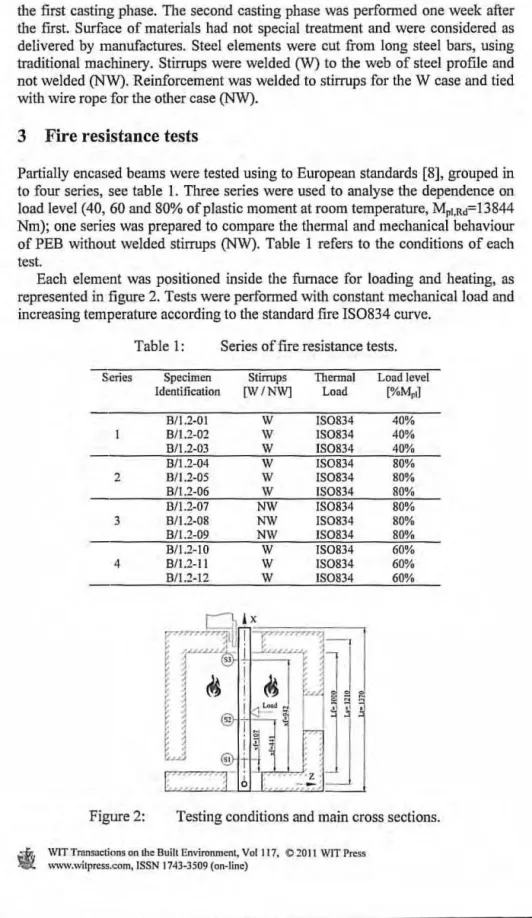
Each elemenl was posilioned inside lhe furnace for Ioading and healing, as represenled in figure 2. Tests were perfonned with eonslant mechaniealload and increasing temperature aecording to the slandard tire IS0834 curve.
Table 1: Series af fire resistance tests.
Series Spccimen Stirrups Thcrmal Load levei
Identification [W I N\V] Load {%Mpa
B11.2·01 \V IS0834 40%
BIt .2-02 W IS0834 40%
B11.2-03 W 150834 40%
B11.2-04 W 150834 80%
2 B11.2-05 \V 150834 80%
B11.2-06 IV 150834 80%
B11.2-07 N\V 150834 80%
3 B11.2-08 NW 150834 80%
B11.2-09 NIV 150834 80%
B11.2-10 IV 150834 60%
4 B11.2-11 \V 150834 60%
8 / 1.2-12 W 150834 60%
Figure 2: Testing cooditions and main cross sections.
WIT Tronsaclions on lhe Built Environmcnl. Vai 117, CI 1011 W1T Prcss
Safety and Security Engincering IV 317
The dislance between supports of each PEB was "Ls"=1.2\o m. Two different supports were applied; lhe lop support restrained ZN displacements and X rolalion, while the bottom support restrained ZN displacemenl and ZIX rolalÍons. The lalesl was buill wilh a shaft suiled inlo drilled web. The lenglh exposed lo fire "Lf' was equal lo 1.0 m, while lhe lolal length "LI" of e.ch specimen was defined lo 1.37 m.
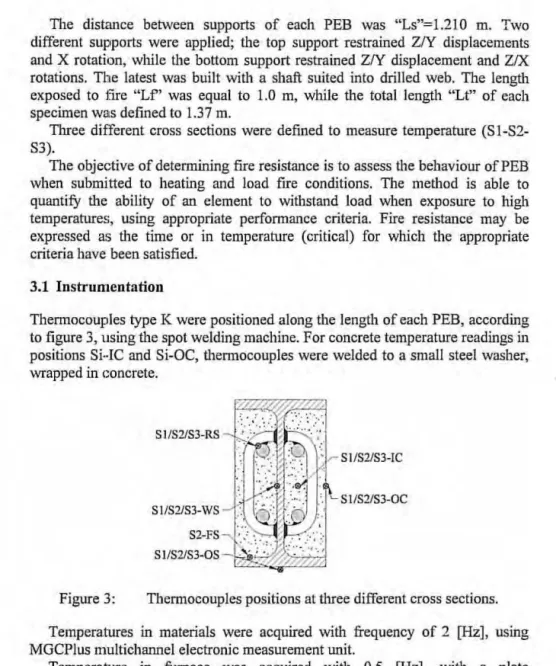
Three differenl cross sections were defined to measure lemperature (SI-S2-S3).
The objeclive of delermining fire resislance is lo assess tile behaviour ofPEB when submitted lo healing and load fire condilions. The melhod is able lO quanlity lhe ability of an elemenl to wilhstand load when exposure to high lemperatures, using appropriale performance crileria. Fire resislance may be expressed as the time or in temperature (criticai) for which lhe appropriate criteria have been satisfied.
3.1 Instrumentation
Thermocouples type K were positioned along lhe length of each PEB, according lO figure 3, lIsing lhe spot welding machine. For concrele lemperature readings in positions Si-IC and Si-OC, Ihermocouples were welded lo a small sleel washer, wrapped in "oncrele.
SI /S2IS3-RS ]0',,';,·_
'. ~ S I/S2/S3-QC
Figure 3: Thermocouples positions at three ditferent cross sections.
Temperatures in malerials were acquired with frequency of 2 [Hz], using MGCPlus mullichannel electronic measuremenl uni!.
Temperature in fumaee was acquired Witil 0.5 [Hz], with a plate Ihermocouple, whieh comprise an assembly of a folded sleel plale. The plale Ihermomeler has lhe ability lo measure lhe correel ralio of conveclive and radiative heal traosfer for a !lal surface.
3.2 Material properties
The mecha oi cal properties were determined by lensile lesting, aceording lo inlemalional standards for hol rolled and cold formed sleel, see lable 2. Three samples were collecled from lhe web of sleel boI rolIed profile and two more
3]8 Safety and Security Engineering IV
samples were collected from steel reinforcement material. Table 2 accounts for lhe modulus Df elasticity "E", the proof strength "Rp.o.",", maximum value of stress prior to the firsl decrease in force "REI,", lowest value Df stress during plastic yielding
"R"L",
tensile strength "Rm" and percentage Df total extension atfracture "AI'"
Table 2: Tensile tests for hot rolled and cold formed steel.
Properties
E lGPa] RfI.o.2~. [MJ'a]
RcH [MPa] (!Y) RcL [MP"]
Rm [MP.] (fu) At[%l Steel profile Avclõlge 197.901 300.738 302.466 300.856 431.252 41.584 Std. Deviation 2.948 6.720 5.749 4.028 5.020 0.231 Steel reinforcemcnt
Average Sld. Deviation
203.294 2.110
524.993 3.521
531.508 7.908
520.825 4.068
626.574 11.539
25.155 0.495
The tllermal properties were not measured but were assumed from ENI992-1.2 [13] and from ENI993-I-2 [14]. Particular .ttention was dedicated to thermal resistance Df interface between both materials. Authors verified Ihat thermal conductance equal to 80 kW/m' was acceptable for validation of experiments [15].
3.3 Performance eriteria
The performance criteria used for load bearing (rating R) are independent Df the ultimate limit state attained by each partially encased beam. Fire resistance time was defineel by the elapsed lime between lhe start of heating and the failure of load bearing capacity.
The loael bearing criteria or performance criteria were defmed according to testing slarldards [8], using the displacement parameter "D" and rate of displacement parameter "cID/dt" criteria. The ultimate limil state was considered when both parameters exeeeded limits, eqn. (l).
D=L'!400d [mm)
dDJdt =L'!9000d [mm / min) (if D?: L/30) (1)
The performance cri teria were used to determine criticaI temperature "8cr/ '
and fire resistance time. This is lhe time in completed minutes for which the tesl specimen was able to support the tesl load.
3.4 Temperature mensurements
The nominal fire healing curve 180834 was used for heating PEB elements. Temperature was regislered in three different sections, 81, 82 and 83 , to verify the homogeneity of heating produced by frre resistance fumace. The maximum temperature difference between sections 81, 82, 83 and the average elemenl temperature is smaller than 3.2% for tesl series I. For test series 2, 3 and 4 lhe
~, WITTrnnsaclions on lhe Built Environment. Vol t 17, O ::!Oll W1T Prcss
Safcty and Sccurity Enginccring IV 319
maximum temperature differenee is smaller than 5.1 %, 6.3% and 11.2%, respectively.
Temperature is not lUlifonn Qver the cross-section; after the initial heating
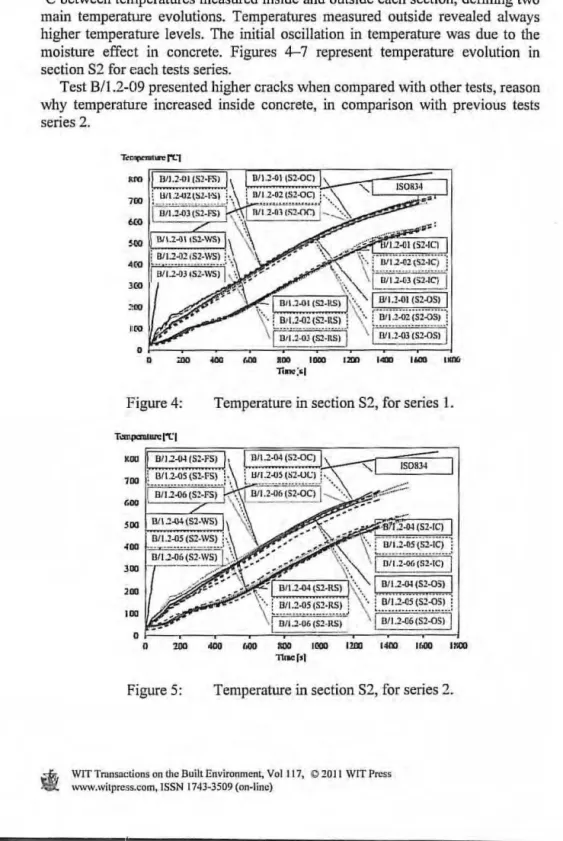
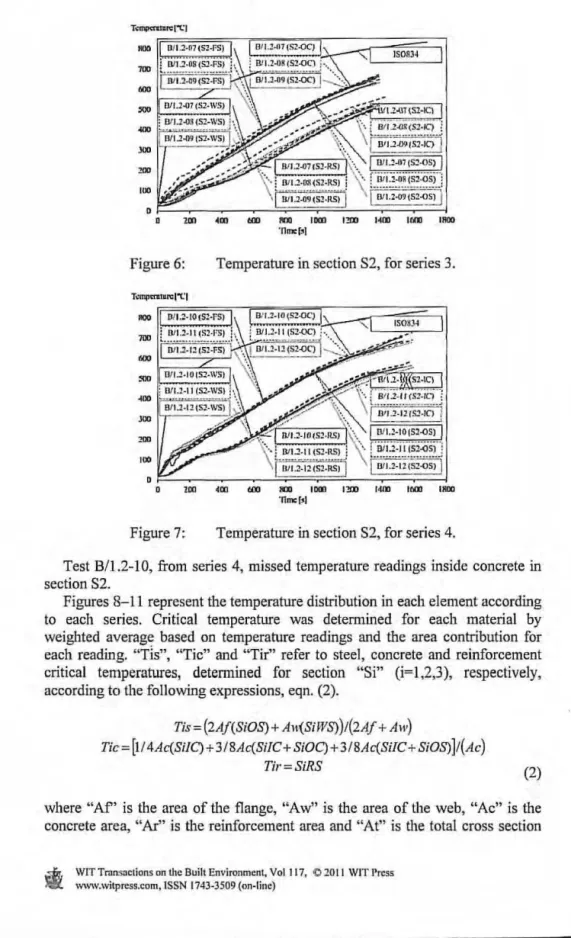
stage, temperature evolution revealed a eonstan! difference of approximately ISO 'C between tempcratures measured inside and outside each seetion, defining two main temperature evolutions. Temperatures measured outside revealed always higher temperature leveis. The initial oscillation in temperature was due to the moisture effee! in eonerete. Figures 4-7 represent temperature evolution in
section 82 for each tests senes.
Test 8 /1.2-09 presented higher cracks when compared with otller tests, reason
why temperature increased inside concrete, in comparison with previous tests series 2.
,ro
:00 ..ao (.no 100 lotO um IGJ IMIO IICI'Wi
n"::"1
Figure 4: Temperature in section 82, for series 1.
T.:mpaVWl:l"l'l
" L-..::IS::D:::"::'_..J
."'~~
\
500 BlI2-G4.(Sl.WS). \ ·S1Ii.04 (52·re)
--'''' r "':C~~';7.' 300
200
100
o~~~--~~~~ ~-=~~~
• ~ ~ ~ ~ - ~ ~ I~ I~
nr.cl'l
Figure 5: Temperature in section S2, for series 2.
320 Safety and Security Engincering IV
BII.!.fI71S2-OC) \
'-, ISOR3"
' - - -- ----'
""
w ~ _ _ ,~
= _
~_
'nllJ:['1
Figure 6: Temperature in section 82, for series 3.
T~mpu..III'CI"t:1
IlOO t DII . Z · IOlS~·FSI
I
(l.'I.2. 1l1tS2.()(')700 ! WI.::! . lI(S~·F:;) II i BJJ.2.11 (S:!-OCl i",
600
"n;;~ : ';:! ( S~ : ~s ;'" \ .I -w·i "i~ 2 is i~ c) 1 ~.ISOHJ4
""
''''
Figure 7: Temperature in section 82, for series 4.
Test B/1.2-10, from series 4, missed temperature readings inside concrete in section 82.
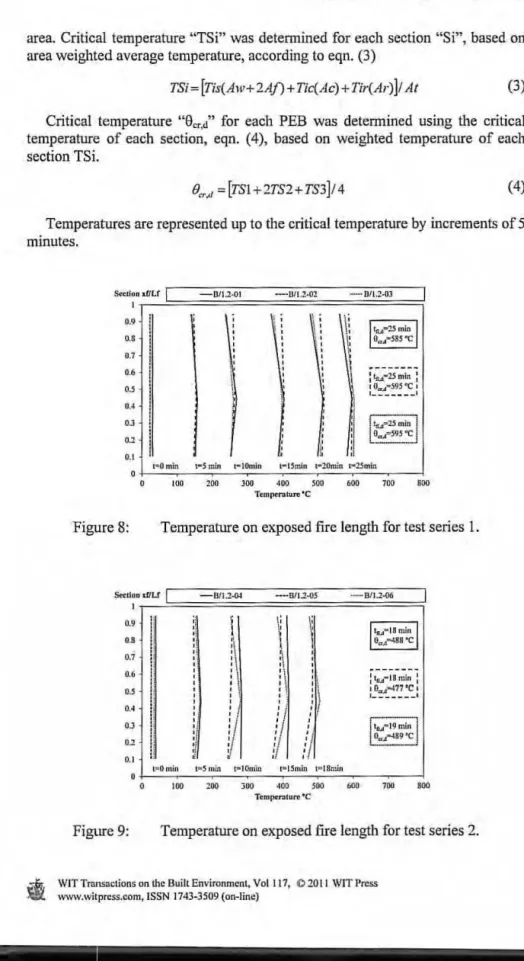
Figures 8-11 represent the temperature distribution in each element according to each series. CriticaI temperature was determined for each material by weighted average based on temperature readings and the area contribution for
each reading. "Tis", "Ti c" and ~'Tir" refer to 5teel. concrete and reinforcement
criticaI temperatures, detennined for section "Si" (i~1,2,3), respectively, according to the following expressions, eqn. (2).
Tis ~ (2AJ(SiOS) + AlI{SiWS»)/(2AJ + Ali')
Tic ~ [l f 4A c(Si/C) + 3f8Ac( Si/C + SiOC) + 3f8A c(SiIC + SiOS) ]f( Ac)
Tir;SiRS (2)
where "'Af' is the area af the flange, "Aw" is the area af the web, "Ac" is the concrete area, "Ar" is the reinforcement area and "At" is the total cross section
Safety and Security Engineering IV 321
area. CriticaI temperature "TSi" was deterrnined for each section "Si", based on
area weighted average temperature, according to eqn. (3)
TSi= [Tis(Aw+2Aj)+ Tic(Ac) + Tir(Ar)]/ AI (3)
CriticaI temperature "Ser,d" for each PEB was detenníned using the criticaI
temperature of each section, eqo. (4), based 00 weighted temperature of each
sectioo TSi.
IJ ~ ." = [TSl+2TS2+TS3]/ 4 (4) Temperatures are represenled up lo the criticaI lemperature by increments of 5
rninutes.
SKllooaUU
I
I o .• 0.8 0.7 O •• O., 0.< OJ 0.2 i
!
I
I
I
0.1o ,-O min o 100
DI'" OI -' DI11 . ~. Ir.!
-
DI1.. 1-03 , I' ;11:
\\
, ,
l ;u~-' m . :/
, , , , ,
\: 0",,- 585 "C
, ,
,
, , ,
~
, , ,
, , ,
!
p---_.~-, ,
\
, ,:ta.o-
25 mlrl :I O .. ...-!95"C I
11
,--- - - --,
,
l,,""m
"d
, , O",r 595 "'C,
i
~ s '"'" t- IOmin t- 15nún t- 21lmin 1"2Smin
200 300 400 '"o "'o 700 800
Telllpctn.lun: ' C
Figure 8: Temperature on exposed tire length for test series 1.
S«tloa d/LI ri --= 7. IlI~I~'~
-
"'''-- --' ::::; 8I ;;;C,-
'~ ~ ~' -- -C::=:;8I~1~ 2"'-;:: - -'I o., o., 0.7 o.,
o.,
0.4 OJ 02 0.1 o Figure 9: oI
i:í
I:\
o:
\
I
~...
- 1! miM: II;
",
,
a
0",,-188 'C, ,
:\
l
,
, ,
j: ,
:
\
, .- -- -.-.,
:i
,I , :lti .... 18min:
I
, ,,
:
,'
.:
, I \:.
, I ._---, 0 ....-1"
"C I, , , ,
,
,11
'.
, ,!/
, , ,~~~
"
,
'.
//
O .. r89 'C"
V
!I
'i
"
•
IDllmin ."5 mln r- lOmin ,- 15min \"' IHmin
'"
""
300 400 ' 00 700'"
Temperature on exposed frre length for lesl series 2.
322 Safety and Security Engineering IV
Sn:.lolI dlLr I
I o., O.B o., 0.6 o., o., OJ ' .1 .' \1
"
"fi
,,
,.
D/ 12-m,
.
1 '\
:\ 1 '\
\
I :
I : I ' . , , , , ::
I , f!~:i8-~i~1I O .. ,.!-501 "C ,
,-- - --_ . '
Figure lO: Temperature on exposed fire length for test series 3.
Sedloll Jfl U I DII.2-IO nlJ . ~· 1 ! 8 / 1.2_1 2
I
.,
o., o.,
'"
o.Jo ..
0.3 i
•
'I o,,
I :10. 1 I :/
t-Omin I~~min 1'" lOmin I " l~ml n '- 20",ln
o
o lO. ,"O 300 '00
"O
600 '00...
T'",pI'nlurc 'C
Figure 11: Temperature on exposed fire length for test series 4.
The deformation mode shape was the same for ali three lests on series L Ultimate limit stale was attained by plastie hinge formation; after 20 minutes, the rate of displaeement "dD/dt" exeeeded lhe limit eriterion but did nol verify lhe
condition. Fite resistance time agrees very wel1, for ali tests in 25 minutes.
Temperature distribution is almost eonstant over eaeh element.
The ultimate limit state for test series 2 was attained by instabiJity (lateral torsional buekling); after 13 minutes, lhe rale of displacement was exceeded as welt Fire resistance time did not agree for ali tests. 18 minutes were determined for tests B/I .2-04 and BIl.2-0S, while 19 minutes was determined for test B/I .2-06. Temperature distribution is almost constan! for each test, but different leveis were determined for each registered time.
Fire resist,mce was also determined for different stirrup conditions. Series 3 differed from series 2, because stirrups were not welded to the web of profile. Ultimate limi!: state was attained by lateral torsional buclding; after 13 minutes, lhe rate of displacement was exceeded, as welt Fire resistance time equals
WITTmnS:lctions on tllC Built Environmenl, Vol 117,
e
2011 WIT PrcssSafety and Secur;ty Engineering IV 323
18 minutes for ali tests in !bis series, although temperature distribution is nol the same for each tes!.
Test series 4 was performed using 60% load leveI, with stirrups welded to the web. The ultimate limit state was attained by the formation of a plastic hinge; afier 16 min.utes the rate of displacement was exceeded. Fire resistance time of 20 and 21 minules were determined for tests on this series. Temperature distribution was almosl equal for every tested beam.
Progressive damage of concrete was verified for each fire resistaoce tesl due to excessive deformation for longer fire exposure. Flexural cracking and debonding of concrete were observed at mid span. Encased concrete blocks presented expressive displacement outward of encasemenl (Y direclion), as expected dwing tests series 3.
4 Conclusions
Twelve bending tests were performed under fire standard IS0834 conditions to evaluate fire resistance and lo determine the behaviour of partially encased elements. Three different load leveIs were considered (40,60 and 80%) and two different bond conditions were tested (welded and not welded).
Fire resistance depends on load leveI, as expected. Fire resistance decreased
from 25 to 21 and 18 minutes, as load ratio increased from 40% to 60% and 80%, respectively.
There was no evidence of shear bond effec!. Tests in series 3 presented higher outward movement of conerete that was responsible for higher temperature
inside cross section, but fire resistance was the same determined on series 2.
Differences between temperatures along eaeh element length were smaller than 10%, respeet to the element average criticaI temperature. Temperature of reinforeemen! represented the lowest value in ali sections. Two different temperature evolutions were reeorded for experiments, proofmg that temperature was not uniform. Temperature distribution along eaeh exposed PEB was almost eonstant proofing the uniformity ofheating and the insulation at the supports.
Results provide esseotial data to the ealibration and validatioo of new simplified design methods, tabulated data and advanced numerical methods.
ReferenCtlS
[1] R. Kindmann, R. Bergmann, L. -G. Cajot, J. B. Scleich; "Effec! of reinforced concrete between the flanges of lhe steel profile of partially
encased composite beam"; Journal of ConstruclÍonal Sleel Research, 27,
pp. 107-122, 1993.
[2] D. Hosser, T. Dom, O. EI-Nesr, "Experimental and numerical studies of
composite beams exposed to fire", JOllrnal oIS/rue/lIral Engineering, VaI.
120, No.IO, pp. 2871-2892,1994.
[3] A. Plumier, A. Abed, B. Tiliouine, "Increase of buckling resistance and ductility ofH-sections by eocased concrete", Behaviollr Df S/eel S/rl/c/I/res
in Seislllic Areas, E & FN Spon, London, ISBN: 0419 198903, 1995.
324 Safety and Security Engincering IV
[4] Joachim Lindner, Nikos Budassis; "Lateral torsional buckling of partially
encased composite beams without concrete slab"; C011lposife conslruclÍol1
in sleel and concrele IV, conference proceedings, May 28th to June 2nd, Banff, Alberta, Canada, pp. 117-128,2000.
[5] R. Maquoi, C. Heek, V. Ville de Goyet, et aI, (European commission), "Lateral torsional buck1ing in steel and composite beams"; ISBN 92-894-6414-3 ; Book 1,2 and 3; Tec/mical sleel researchfinal reporl EUR 20888 EN; August 2002.
[6] LM. Assi, S.M. Abed, Y.M. Hunaiti, "Flexural strength of composite beams partially encased in Iightweight concrete", Pakislan Journal of Applied Seiences 2(3), pp. 320-323, 2002.
[7] Akio Kodaira, Hideo Fujinaka, Hirokazu Ohaslú and Toshihlko Nishimura; "Fire Resistance of Composite Beams Composed of Rolled Steel Profile Conereted Between Flanges"; Fire Seience and Technology Vo1.23 No.3, pp. 192-208,2004.
[8] CEN, EN 1363-[, "Fire resistance tests, part [- General requirements"; English version, European Slandard, 1999.
[9] A.Y. Elr)13zouli, 1. Treadway. "Inelastie behaviour of composite members under combined bending and axial loading", JOllrnal of Conslrllcliol1al Sleel Research, 64, pp. 1008-1019,2008.
[10] Silvana de Nardin, Ana Lucia H.C. EI Debs, "Study of partial1y encased composite beams with innovative position of stud bolts", JOllrnal of Consh·lIclional Sleel Research, Volume 65, Issue 2, pp. 342-350, February 2009.
[lI] Paulo A.G. Piloto, Luís M.R. Mesquita, Alexandre Pereira; "Thermal
Analysis in Fire-Resistance Furnace"; lnternationa/ wOl'kshop 011 Fite
Proleclion and Life Safety in BlIildings mld Transporlalion Syslems,
proeeedings ISBN 978-84-8102-559-0, pp 103-111, GIDAI - University of Cantabri", 15-17 October 2009.
[12] Piloto, P.A.G.; Gavilán, Ana Ramos; Mesquita, L.M.R.; "Advanced Numerical Method for Estimate Fire Resistanee of Partially Eneased
Beams"; proceedings of lhe inlernatiollal congress in Fire Safet)' in Tall
BlIildings; ISBN 84-8102-415-5; pp 79-91; 19th Oetober 2006, University of Cantabria, Santander, Spain.
[[3] CEN - EN 1992-1-2; "Euroeode 2: Design ofconerete slruetures - Part 1-2:
General mIes - Structural fire design", European standards; Brussels,
Deeembe:r 2004.
[14] CEN - EN 1993-1-2; "Eurocode 3: Design of steel Slruetures - Part [-2:
[15]
General rules - Struetural fire design", European slalldards; Brussels, April 2005.
Piloto, P.A.G.; Ramos Gavilán, A.B.; Mesquita, L.M.R.; "Numerical analysis for thermal conductance of the interface between steel and
concrete to composite structures at elevated temperatures", proceedings 01
the 2nd Portuguese conlerence on NlImerical metllods applied to
ThermodYllamics and Fluid Mechanics (in Portuguese), University af Aveiro, 8-9 May de 2008.