José Aires Gomes Camacho
Licenciado em Engenharia Informática
Genuine Phrase-Based
Statistical Machine Translation with Supervision
Dissertação para obtenção do Grau de Doutor em Engenharia Informática
Orientador: José Gabriel Pereira Lopes, Doutor, Universidade Nova de Lisboa
Júri:
Presidente: Prof. Doutor Luís Manuel Marques da Costa Caires
Arguentes: Prof. Doutor Pavel Bernard Brazdil
Prof. Doutora Maria Teresa Rijo da Fonseca Lino
Vogais: Prof. Doutor António Manuel Horta Branco
Prof. Doutora Belinda Mary Harper Sousa Maia
Prof. Doutora Irene Pimenta Rodrigues
Genuine Phrase-Based Statistical Machine Translation with Supervision Copyright © José Aires Gomes Camacho, Faculdade de Ciências e Tecnologia, Universidade Nova de Lisboa.
Acknowledgments
I want to thank my supervisor for his invaluable guidance, my university, Uni-versidade Nova de Lisboa, for providing the conditions to carry out my work, the foundation, FCT/MCTES, for supporting me with a Ph.D. grant, and my coleagues for believing in me.
Abstract
This thesis addresses mainly two issues that have not been addressed in Statis-tical Machine Translation. One issue is that even though research has been evolving from word-based approaches to phrase-based ones, because words were consistently found to be inappropriate translation units, the fact is that words are still considered in the composition of phrases, either to determine translation equivalents or to check language fluency. Such consideration might result in the attempt of establishing relations between words within a phrase translation equivalent even when sometimes its phrases should be considered as a whole. Attempts to further partition such phrases would produce incorrect translation units that would introduce unwanted noise in the translation pro-cess. Besides, the internal fluency of an identified multi-word phrase should not require checking. As such, phrases should indeed be considered units, avoiding incorrect translation equivalents that might be identified from their partition, as well as only considering the fluency of a phrase with other phrases and not within the phrase itself. The other issue is that supervision, in the form of trans-lation lexica, is generally overlooked, with SMT research focusing mainly on the identification of translation units without any human intervention and without considering already known translation units. As such, no importance has been attributed to the inclusion of verified lexica, with only some rarely used dic-tionaries to score translation candidates and not really as a source of translation units. Indeed, translation equivalents should be memorized, checked and used as a source of translation units, avoiding the need to keep identifying the same translation units, in particular if those are frequently used. This Thesis presents a truly Phrase-Based approach to SMT, using contiguous and non-contiguous phrases, along with Supervision, in which phrases are not divided and verified lexica is built, kept and used to propose translations of complete sentences.
Resumo
Esta Tese trata principalmente dois problemas que não foram devidamente tra-tados na Tradução Máquina Estatística. Um deles é que, apesar de a investiga-ção ter passado a considerar multi-palavras como unidades e não apenas pala-vras, por se constatar que as palavras não constituem unidades de tradução adequadas, o facto é que as palavras são ainda consideradas na composição de multi-palavras, quer em equivalentes de tradução, quer na verificação de fluên-cia de língua. Tal consideração pode resultar na tentativa de estabelecer rela-ções entre palavras mesmo quando por vezes as multi-palavras devem ser con-sideradas como um todo. Particionar tais multi-palavras produzirá unidades de tradução incorrectas que introduzirão ruído no processo de tradução. Além dis-so, a fluência interna dessas multi-palavras não deve ser verificada. Como tal, multi-palavras deverão ser consideradas unidades, evitando equivalentes de tradução incorrectos resultantes da sua partição, e considerando apenas a flu-ência de multi-palavras com outras e não a sua fluflu-ência interna. O outro pro-blema é que a supervisão, na forma de léxicos de tradução, é geralmente desva-lorizada, com a investigação em SMT a ser focada na identificação de unidades de tradução sem qualquer intervenção humana e sem considerar unidades de tradução já conhecidas, com apenas algumas utilizações de dicionários para atribuir valores a candidatos de tradução e não propriamente como fonte de unidades de tradução. Efectivamente, equivalentes de tradução devem ser me-morizados, verificados e utilizados como fonte de unidades de tradução, evi-tando a necessidade da sua repetida identificação, em particular os frequente-mente usados. Esta Tese apresenta uma abordagem de SMT verdadeirafrequente-mente baseada em multi-palavras, tanto contíguas como descontíguas, em conjugação com supervisão, na qual as multi-palavras não são divididas e o léxico verifica-do é construíverifica-do, mantiverifica-do e utilizaverifica-do para propor traduções de frases completas.
Contents
1 Introduction ... 1
1.1 Research Framework and Motivation ... 1
1.2 A Very Short Overview of Comparable Work ... 6
1.3 Innovative Contributions ... 8
1.4 Reading Plan ... 10
2 State of the Art ... 13
2.1 Statistical Machine Translation ... 13
2.1.1 Probability of a Translation ... 14
2.1.1.1 Noisy-Channel Approach ... 14
2.1.1.2 Log-Linear Approach ... 16
2.1.2 Alignment ... 16
2.1.2.1 Word-Based Alignment ... 17
2.1.2.2 Phrase-Based Alignment ... 20
2.1.2.3 Alignment Template ... 21
2.1.3 Translation Feature Models ... 21
2.1.3.1 Translation Model ... 22
2.1.3.2 Language Model ... 23
2.1.3.3 Reordering or Distortion Model ... 25
2.1.3.4 Penalty Models ... 25
2.1.4 Decoding ... 26
2.1.5 Tree-Based Approaches ... 27
2.1.5.1 Hierarchical Approach ... 28
2.2 Translation Evaluation ... 30
2.2.1 BLEU ... 31
2.3 FCT Alignment ... 33
2.4 Indexing Structures ... 38
2.4.1 Suffix Array ... 39
2.4.2 LCP Array ... 42
2.4.4 Term Array ... 45
2.5 Conclusions ... 47
3 Translation Process ... 51
3.1 Underlying Concepts ... 51
3.1.1 Phrase Translation Equivalents ... 51
3.1.1.1 Contiguous Phrase Translation Equivalents ... 51
3.1.1.2 Non-Contiguous Phrase Translation Equivalents ... 54
3.1.2 Verified Bilingual Phrase Lexicon ... 60
3.1.3 Adapted Indexing Structures ... 62
3.1.3.1 Adapted Suffix Array ... 63
3.1.3.2 Adapted LCP Array ... 65
3.1.3.3 Adapted Suffix Class Array ... 66
3.1.3.4 Adapted Term Array ... 68
3.1.3.5 Merging Process for the Indexing Structures ... 69
3.2 Pre-Processing ... 75
3.2.1 Text Normalization ... 76
3.2.1.1 Contractions Expansion ... 76
3.2.1.2 Tokenization ... 78
3.2.2 Number Replacement ... 79
3.3 Training Stage ... 80
3.3.1 Contiguous Phrase Translation Extraction from Aligned Parallel Corpora ... 80
3.3.1.1 Alignment Guidance ... 81
3.3.1.2 Phrase Identification Stage ... 85
3.3.1.3 Phrase Association Stage ... 86
3.3.2 Models Involved in Translation Scoring ... 90
3.3.2.1 Phrase Translation Model ... 90
3.3.2.2 Phrase Language Model ... 91
3.4 Translation Stage ... 95
3.4.1 Text Partitioning ... 95
3.4.2 Retrieval of Contiguous Phrase Translation Equivalents ... 98
3.4.4 Translation Graph ... 101
3.4.5 Including the Translation Pattern Feature ... 102
3.4.5.1 Matching a Translation Pattern to a Candidate Phrase ... 103
3.4.5.2 Validating a Matched Translation Pattern ... 103
3.4.5.3 Integrating a Validated Translation Pattern ... 104
3.4.6 Including the Translation and Language Models ... 107
3.4.6.1 Combining Several Sources for the Translation Model ... 107
3.4.6.2 Combining Several Sources for the Language Model ... 108
3.4.6.3 Adding the Language Model ... 108
3.4.7 Sentence Translation Model ... 109
3.4.8 Decoding through Graph Traversal ... 110
3.4.9 Non-Trivial Cases ... 112
3.4.9.1 Untranslatable Sections ... 112
3.4.9.2 Dangling Nodes ... 114
3.4.10 Presenting the Final Translation ... 114
3.5 Differences Between Transtor and Moses ... 115
3.5.1 Alignment and Phrase Translation Equivalents ... 115
3.5.2 Translation Model ... 116
3.5.3 Language Model ... 117
3.5.4 Penalty Model ... 118
3.5.5 Translation Probability Score ... 118
3.5.6 Decoding ... 121
4 Results ... 123
4.1 Description of Test Settings ... 124
4.1.1 Reference Documents... 125
4.1.2 Parallel Data ... 125
4.1.3 Tools Settings ... 127
4.2 Results of Training the Data ... 128
4.2.1 Data About Common Corpora ... 128
4.2.2 Data About Additional Corpora ... 130
4.3.1 OPUS EUCONST ... 131
4.3.2 DGT-TM ... 133
4.4 Transtor Additional Results and Analysis ... 135
4.4.1 Impact of Using Lexica and Translation Patterns ... 135
4.4.2 Additional Corpora ... 138
4.4.2.1 APERTIUM EURLEX ... 138
4.4.2.2 OPUS EMEA ... 139
4.4.2.3 OPUS EUROPARL ... 140
4.4.3 Corpora Influence on Transtor Results ... 141
4.5 Transtor Parameter Analysis ... 142
4.6 Results Analysis ... 147
5 Conclusions and Future Work ... 149
Bibliography ... 155
List of Tables
Table 1. Fragment of parallel texts. ... 34
Table 2. An alignment example ... 35
Table 3. Sample of a pair of parallel texts ... 36
Table 4. First iteration alignment ... 37
Table 5. Improved alignment after iteration ... 37
Table 6. Further alignment improvement ... 38
Table 7. Text T with its offsets ... 39
Table 8. Suffixes from T ... 40
Table 9. Suffix Array of T ... 41
Table 10. Character prefixes of the phrase to_be ... 41
Table 11. lcp values for some phrases ... 42
Table 12. LCP Array of Suffix Array from text T ... 43
Table 13. Suffix Class Array of Suffix Array from text T ... 44
Table 14. Prefixes represented by Suffix Class 18 ... 45
Table 15. Term Array (partial) ... 46
Table 16. Contiguous phrase translation equivalents ... 52
Table 17. Translation pattern examples ... 56
Table 18. Textual representation of numerical translation patterns ... 59
Table 19. Character-based Suffix Array from T ... 64
Table 20. Word-based Suffix Array of T ... 65
Table 21. Other LCP example ... 65
Table 22. Word-based LCP Array ... 66
Table 23. Limited word-based LCP Array ... 66
Table 24. Word-based Suffix Class Array ... 67
Table 25. Limited word-based Suffix Class Array ... 67
Table 26. Word-based Term Array ... 68
Table 27. Limited word-based Term Array ... 69
Table 28. Suffix Array from text T ... 74
Table 29. Suffix Array from text T, after a concatenation with no consequences ... 74
Table 30. Suffix Array from text T, after a concatenation with consequences .... 75
Table 31. Corrected Suffix Array from text T after the previous concatenation with consequences ... 75
Table 32. Examples of contractions in Portuguese ... 76
Table 34. Unexpanded Portuguese entries and their English translations ... 77
Table 35. Portuguese article and demonstrative adjectives and their English translations ... 78
Table 36. Phrase entries that can be considered units ... 78
Table 37. Tokenization examples ... 79
Table 38. Improved alignment example ... 82
Table 39. Some extracted phrase translation equivalents ... 83
Table 40. Examples surrounded by empty segments... 85
Table 41. Associations established for Portuguese phrase “casa” ... 88
Table 42. The ptm scores from an example aligned parallel corpus... 91
Table 43. Concatenation of adjacent phrases ... 93
Table 44. Context values ... 94
Table 45. The plm scores from the example ... 94
Table 46. Example of a text to be partitioned ... 96
Table 47. Term Array representing the partitioned text example ... 97
Table 48. Entries with scores ... 98
Table 49. Availability of phrase translations ... 112
Table 50. Data about the reference documents ... 125
Table 51. Data about the common parallel data ... 126
Table 52. Data about the additional parallel corpora ... 126
Table 53. Number of entries of verified bilingual phrase lexica ... 126
Table 54. Translation patterns count ... 127
Table 55. Parameters values from Transtor ... 127
Table 56. Parameter set from Moses ... 128
Table 57. Training data for OPUS EUCONST ... 128
Table 58. Translation times using OPUS EUCONST ... 129
Table 59. Training data for DGT-TM ... 129
Table 60. Translation times using DGT-TM ... 129
Table 61. Training data for the additional corpora ... 130
Table 62. Translation times using the additional corpora ... 130
Table 63. Moses results using OPUS EUCONST ... 131
Table 64. Transtor results using OPUS EUCONST ... 132
Table 65. Differences for OPUS EUCONST ... 132
Table 66. Moses results using DGT-TM ... 133
Table 67. Transtor results using DGT-TM ... 134
Table 68. Differences for DGT-TM ... 135
Table 69. OPUS EUCONST without patterns ... 136
Table 70. OPUS EUCONST without both patterns and lexicon ... 137
Table 72. DGT-TM without both patterns and lexicon ... 138
Table 73. Transtor results using APERTIUM EURLEX ... 139
Table 74. Transtor results using OPUS EMEA ... 140
Table 75. Transtor results using OPUS EUROPARL ... 141
Table 76. Results comparison by corpora ... 142
Table 77. Analysis with OPUS EUCONST for de-en ... 143
Table 78. Analysis with DGT-TM for de-en ... 143
Table 79. Analysis with OPUS EUCONST for en-pt ... 144
Table 80. Analysis with DGT-TM for en-pt ... 144
Table 81. Eurlex reference documents for en-pt language direction ... 145
Table 82. Eurlex reference documents for pt-en language direction ... 145
Table 83. Euconst reference documents for en-pt language direction ... 146
List of Figures
Figure 1. Example of word alignment ... 18
Figure 2. Example of symmetrization of IBM model alignments ... 19
Figure 3. Examples of consistency and inconsistency ... 20
Figure 4. Example of a translation pattern ... 55
Figure 5. Another example of a translation pattern ... 55
Figure 6. Matching of a candidate phrase ... 57
Figure 7. Application of a general translation pattern ... 58
Figure 8. Numerical translation correspondences ... 58
Figure 9. Numerical translation pattern ... 59
Figure 10. Example of number replacement on a text to be translated ... 79
Figure 11. Term Arrays from both languages ... 86
Figure 12. Some associated Term Arrays entries ... 87
Figure 13. Implementation for the association of Term Array entries ... 88
Figure 14. Original adjacent phrases with their translations ... 92
Figure 15. An example of a valid cover ... 99
Figure 16. A cover with a gap ... 99
Figure 17. A cover with an overlap ... 99
Figure 18. A cover graph example ... 100
Figure 19. The several stages for producing translation edges from a cover edge ... 101
Figure 20. Translation graph resulting from a cover graph ... 102
Figure 21. Matching a translation pattern to a candidate ... 103
Figure 22. Valid matched translation pattern ... 104
Figure 23. Cover graph integration ... 105
Figure 24. Translation and cover graphs ... 105
Figure 25. Translation graph from the variable ... 106
Figure 26. Translation graph integration ... 107
Figure 27. Translation sections ... 113
Figure 28. Translatable section covering the whole text ... 113
Figure 29. Translatable and untranslatable ranges ... 113
List of Equations
1
I
NTRODUCTION
The work underlying this thesis began mainly within the framework of project PATRAS (contract POSC/PLP/61520/2004) where the main goal was to devel-op methodologies supported on Suffix Arrays with the purpose of extracting phrase1 translations from aligned parallel texts2. The good results obtained pro-vided the motivation to use those extracted phrase translations to produce translations of complete texts, this way leading research towards a Machine Translation (MT) system, a research mainly carried out under project ISTRION (contract PTDC/EIA-EIA/114521/2009), improving the developed translation work and extensively experimenting it on both translation directions of eight language pairs. The resulting MT system received the name of Transtor and implements a semi-supervised, phrase-based, statistical approach to machine translation that, as it will be shown in this thesis, is clearly distinguished from existing Statistical Machine Translation (SMT) approaches mainly developed after 1990 (Brown et al., 1990).
1.1
R
ESEARCHF
RAMEWORK ANDM
OTIVATIONThe research carried out on earlier projects (DIXIT, contract PRAXIS 2/2.1/TIT/1670/95; PT, European contract MLIS-4005 TRADAUT-PT 26192; ASTROLABIUM, European contract MOBI-CT-2003-003344; PA-TRAS, contract POSC/PLP/61520/2004; and VIP-ACCESS, contract PTDC/PLP/72142/2006) led the research group I integrate to develop innova-tive, language independent, text mining procedures applied to raw text. Those developed procedures include:
alignment of parallel texts, breaking those texts into segments that should continue to be translations of each other (Ribeiro, Lopes and Mexia, 2000a), (Ribeiro, 2002), (Gomes, Aires and Lopes, 2009);
extraction of word and phrase translations (Ribeiro, Lopes and Mexia, 2000d), (Aires, Lopes and Gomes, 2009), (Gomes, Aires and Lopes, 2009);
extraction of multi-word terms (Silva et al., 1999), (Aires, Lopes and Silva, 2008);
clustering of documents (Silva et al., 2001), (Peleja, Silva and Lopes, 2011);
identification of the language in which a document is written (Silva and Lopes, 2006);
1 A phrase, as is usual in Machine Translation literature, is used as a string of words, independently of
being or not a phrase in linguistically precise terms. From here onwards this designation, “phrase” will be used as a string of words.
identification of phrases having similar meanings, because they occur in similar local lexical contexts (Gamallo, Agustini and Lopes, 2005), (Gamallo, Agustini and Lopes, 2008), (Casteleiro, Lopes and Silva, 2014); and
identification of key terms in documents (Silva and Lopes, 2009), (Teixeira, Lopes and Ribeiro, 2013).
As a result of this wide range of activities, Machine Translation was set in the ISTRION project (contract PTDC/EIA-EIA/114521/2009) as one of our research
group’s leading goals. I, myself, took on the task of building a new approach to
Machine Translation, following the preliminary results I had obtained in this area in the framework of PATRAS project, following a different and new ap-proach to Phrase-Based Statistical Machine Translation (PBSMT) regarding the state-of-the-art in this research area (Och and Ney, 2004).
A first difference was introduced by assuming that word and phrase transla-tions extracted from aligned parallel corpora should be validated, thus intro-ducing a first level of supervision. We verified that alignment precision im-proved when correctly acquired term translations were iteratively reused in subsequent parallel corpora alignment. Such precision improvement, for the alignment of parallel texts belonging to the Portuguese (PT) English (EN) pair, ranged from a maximum of 75.5% precision, when absolutely no translation knowledge was used (Darriba Bilbao, Lopes and Ildefonso, 2005), to 84.5% pre-cision (Gomes, Aires and Lopes, 2009) at a very early stage of the mentioned reuse iteration. The precision improvement of the alignment also contributes to the precision improvement of extracted unknown term translations, even for very low occurrence frequencies (Aires, Lopes and Gomes, 2009).
As a consequence of using this perspective, in which the automatic phrase translation extraction stage of the training process of a machine translation en-gine involves some remote supervision (prior to the realignment of the parallel corpora used to train our system), we managed to develop a competitive MT system capable of beating Moses3, which is the state-of-the-art system for Statis-tical Machine Translation. Such conclusion was drawn after training Transtor and Moses on the same parallel corpora and realizing that Transtor had an av-erage advantage of 12 BLEU points on both directions on the 8 analyzed lan-guage pairs between Portuguese, English, French, Spanish, and German (check Chapter 4 for a detailed analysis of results). The German-French and French-Spanish language pairs were not analyzed, but three very difficult language
pairs which comprise the German language (German-English, German-Spanish and German-Portuguese) were included in the tests.
The idea of introducing supervision on phrase translations extraction resulted from the fact that the SMT approach does not include a memory of what has been learned earlier, and always learns everything from scratch. Indeed, it be-haves as a ship commander who never knows where the borders/extremes of his ship are and needs some kind of device to measure/calculate from scratch where they are, whenever necessary. And this also applies to any frequently visited port. He never knows where wharf and piers are. He needs to recalcu-late everything prior to docking. Actually, it learns but everything is fuzzy. The importance of supervision is confirmed by the considerable improvement on translation quality produced by Transtor, our MT system.
A second difference is a direct consequence of our way of addressing align-ment. In SMT, the alignment of parallel corpora requires parallel texts to be aligned at the sentence level. Then, for each pair of parallel sentences, word fre-quencies are determined, as well as the number of co-occurrences of words in each parallel sentence, for the whole parallel corpora. Each word in one sen-tence can be the translation of any word of the parallel sensen-tence. This way the probability of each word being a translation of any word of the parallel corpora is determined. The alignment is then defined as the probability of a word being the translation of other words in the other language. This is the basis for word-based SMT. The evolution of word-word-based alignment into phrase-word-based align-ment is, in most approaches, still dependent on word-based alignalign-ment that is further refined to produce alignments at the phrase level (Tillmann, 2003), (Zhang, Vogel and Waibel, 2003), (Zhao and Vogel, 2005), (Zhang and Vogel, 2005), (Setiawan, Li and Zhang, 2005).
im-provement led to using bilingual lexica of phrase translations that were auto-matically extracted and manually validated (Gomes, Aires and Lopes, 2009), an approach that keeps improving, particularly in the extraction of high quality phrase translations.
The major difference between the two methods of addressing alignment is re-lated to the determination of word or phrase translation probabilities. SMT starts determining word translation probabilities for the whole parallel corpora. We start dividing the parallel corpora into candidates of parallel segments cur-rently using a bilingual phrase lexicon. The determination of word and phrase translation probabilities is made later, at a stage where phrase translations are spatially located and trapped, thus becoming much more focused and computa-tionally less heavy.
A third difference is a direct consequence of both differences mentioned above: the periodic supervision of term translation extraction enables us to take known phrase translation equivalents as possibly adequate anchors and filter out alignment outliers, this way reducing phrase realignment imprecision and ena-bling us to give more credit to obtained alignments. As a result, the extraction of new phrase translation equivalents with very low frequencies becomes more precise and its use in translation situations enables the achievement of better quality translations. It is not by chance that in SMT, either word-based or phrase-based, alignment is taken as a hidden variable because nothing is known for sure, since it is never assumed the existence of previous knowledge.
According to our understanding, another problem afflicting SMT is related to its intrinsic dependency on discovering word translations taken as words, even in their more recent evolutions towards Phrase-Based Statistical Machine Trans-lation (PBSMT). As a matter of fact, we all know that many words need to be translated by multi-words, as is the simple case of “penso”, in Portuguese, which requires two words to be translated into English (“I think”) or into
French (“je pense”). Other cases would be “from” <=> “a partir de”, not
to mention the case of “counterclockwise”, which needs many words to be translated into its Portuguese equivalent “no sentido contrário ao do
approach is clearly a phrase-based approach. Yet, within this topic, knowing that word order is not the same in the various languages, we distinguish two types of word order: local word order and long distance word order.
Local word order occurs inside linguistically motivated phrases. Some exam-ples are:
“social policy” <=> “política social”, where the adjective occurs
before the noun in English and after it in Portuguese;
“acp-eu council of ministers” <=> “conselho de ministros
acp-ue”, where the nominal part “council of ministers” <=>
“con-selho de ministros” may be translated without no order change, but,
as for the first example, the adjective part “acp-eu” <=> “acp-ue” occurs
in different positions in both languages;
but much more complex examples could be presented.
Some examples of long distance word order in sentences are:
“the decision of the council of ministers was taken into
account” <=> “considerou-se a decisão do conselho de
min-istros”, where the subject of the sentence in the passive voice may appear
after the passive verbal form in Portuguese.
Either SMT or PBSMT handle both problems by taking into consideration a word order model which determines the probabilities of word translations changing positions. Those movements are learned from parallel training corpo-ra, usually defining as a parameter the maximum moving distance allowed for word translations. In contrast, we are capable of handling both order types with translation patterns which implement an approach comparable to the Hierar-chical Phrase-Based Translation approach (Chiang, 2007). Local order patterns are mostly used for extracting phrase translations in the framework of the ongo-ing Ph.D. research of Luís Gomes and the result of this work is available in our validated bilingual phrase lexica. Longer distance patterns are mostly used for translation, as will be shown later in this thesis (Sub-Section 3.1.1.2).
In sum, our approach to Machine Translation can be classified as Semi-Supervised Phrase-Based Statistical Machine Translation (SSPBSMT). As ex-plained earlier, it diverges from main trends in PBSMT in several aspects, re-sulting from our own research background in the area. One of the main differ-ences results from the fact that Transtor considers phrases as the nuclear units used in every model and feature involved (namely the translation model4, the language model5 and the penalty feature6), something that is in contrast with other approaches claiming to be phrase-based even though their phrase transla-tion models are obtained from a word-based alignment and their language models are word-based. The mentioned differences led us towards a simpler translation process which enabled us reaching a BLEU translation scores (Papineni et al., 2002) higher on average than the ones obtained using MOSES, for several language pairs in both directions. In addition, the fact that we were using a much simpler translation machinery and did not consider any reorder-ing model along with many other aspects taken by SMT or PBSMT, makes our advantage yet more impressive.
1.2
A
V
ERYS
HORTO
VERVIEW OFC
OMPARABLEW
ORKIn the last few years, main trends in Statistical Machine Translation (SMT) have evolved from word-based (Brown et al., 1993) towards-phrase based (Och and Ney, 2004), (Lopez, 2008). This evolution aimed at rationalizing some of the cen-tral hypotheses in word-based SMT that mismatch reality, namely those hy-potheses related to translation correspondences between words in two lan-guages: not all words are translated by single words, there are words having no direct translation, some word translation correspondences are only valid in spe-cific lexical contexts, etc. By moving towards phrases (uninterrupted sequences of words) some of these translation correspondences were simplified, as well as local (in phrase) word order. Despite this evolution, the alignment procedure remained basically the same: texts continued to be aligned at sentence level and only then sentences are aligned at a word level (Brown, Lai and Mercer, 1991b), (Gale and Church, 1993), (Och and Ney, 2003) and word and phrase transla-tions are extracted together with their translation statistics. No supervision is made. As a consequence, a huge number of incorrect translations and corre-sponding statistics are extracted and used in the translation process, leaving the burden of selection to the search procedure of decoding (Germann et al., 2001),
4 A translation model is the probability that a source string is a translation of a target string.
5 A language model measures the fluency of the sequencing of translation phrases in the translation target
language.
6 The penalty feature tries to guarantee a balance between the number of words between a source
making the translation process heavier. This probably explains, according to our perspective, why some supervision improved our own translation results. Some proposals have appeared in the last few years to improve this state of af-fairs, in particular for filtering out unproductive phrase table entries (Deng, Xu and Gao, 2008).
Yet, no one still assumes the need for manual validation of extracted phrase translations, not only to be used directly in the production of new translations, but also to be used for improving future validations of extracted phrase transla-tions, something that could be accomplished by reusing the validated positive and negative examples to train good classifiers, implemented, for instance, with SVMs (Mahesh, Gomes and Lopes, 2011). Those classifiers would then be ap-plied on not yet known newly extracted translations from newly realigned par-allel corpora (Aires, Lopes and Gomes, 2009), having the results manually vali-dated, having the classifiers retrained on the newly augmented set of validated phrase translations, and iterating this process until no improvement is achieved, if this can ever be achieved.
In order to better tackle long distance reordering phenomena, resulting from the fact that there are words and phrases that translate as gapped phrases (dis-continuous patterns), (Chiang, 2007) proposed the use of hierarchical Phrase-Based SMT. In this thesis I will incorporate a similar proposal in our own trans-lation engine. According to our perspective and experience, a huge number of gapped patterns result from coordination (apart from other sources) (Silva et al., 1999) and its extraction may be improved by taking into account phrase meaning similarity (Gamallo, Agustini and Lopes, 2005), (Gamallo, Agustini and Lopes, 2008), (Casteleiro, Lopes and Silva, 2014) whose extraction may be aided by handling phrase alignment results if we improve our robust phrase-based alignment approach (Gomes, Aires and Lopes, 2009). (Carbonell et al., 2006) use a technique quite similar to the one we used for word sense disam-biguation (Gamallo, Agustini and Lopes, 2005), (Gamallo, Agustini and Lopes, 2008) for improving the extraction of translation equivalents from non-parallel corpora.
er-rors made by the system must be manually corrected and reused at the align-ment stage for new phrase translation extraction and validation. They may also be used for manual extraction of problematic gapped phrases translations.
Text Mining applied to raw text requires the use of huge quantities of text and data structures powerful enough for efficient string frequency counting, full text indexing, and efficient string matching and retrieval. Suffix Arrays are known to support these requirements. (Yamamoto and Church, 2001) are among the users of this data structure for Text Mining purposes. Results report-ed by (Abouelhoda, Kurtz and Ohlebush, 2004), relatreport-ed to the construction and use of compressed and succinct suffix arrays, lead us to prefer suffix arrays to suffix trees in the framework of PATRAS project. In the last few years, many authors have resorted to use these data structures for indexing and representing huge parallel corpora and the translation tables extracted from that corpora. Recently it was discovered that suffix trees can be represented with a suffix ar-ray plus a tree layer (Sadakane, 2007), (Russo, Navarro and Oliveira, 2008), (Fischer, Mäkinen and Navarro, 2008), this layer requires only marginal space. In essence this result is similar to the one obtained by (Abouelhoda, Kurtz and Ohlebush, 2004), only that the space requirements are much smaller, around 9 times for natural text, and it supports more operations. Hence it is nowadays possible to provide a functional suffix tree layer for translation software, which simplifies the resulting algorithms while being time and space efficient. Due to this evolution we will also explore suffix trees in this project in order to pare both structures in the same application area. Just recently results on com-pression by (Costa et al., 2013), obtained in the research group I integrate, ena-bled very competitive data structures occupying 0.4% of the original text while being very efficient for carrying out online queries. However, more work will be necessary to integrate them in a framework as the one that is explained in this thesis, as query time response is adequate for human users (i.e. using a con-cordancer) but are still too slow for being directly used by an MT system to translate text. Probably they will be adequate for implementing a full interactive machine translation engine of the kind proposed by (Barrachina et al., 2009).
1.3
I
NNOVATIVEC
ONTRIBUTIONSpre-sented in this thesis is truly phrase-based in the sense that phrases are first de-gree citizens: translation units consist of phrases, the language model considers phrases and the penalty model is also accounted for phrases. In sum, phrases are not divided.
In this approach, the translation model is capable of producing balanced scores to equally correct translations, leaving to the language model the task of select-ing the ones that compose the most fluent combinations of phrases. The lan-guage model does not produce an absolute model and does not use any tech-niques to model unseen data, only worrying about scoring the options available from observed data.
Both the translation model and the language model are supported by indexing structures based on Suffix Arrays which allow their efficient calculation. Those indexing structures also support the actual translation process as well, by iden-tifying every phrase from the original text to then be used to retrieve their cor-responding translations which will be then combined to produce a complete translation.
Producing either the translation model or the language model does not require the use of a whole set of available corpora in a single unit (taken as an indivisi-ble whole). Several different corpora can be processed and used separately, this way allowing the production of translations using the corpora sets considered to be the most relevant for the translation in question. This greatly simplifies the management of different models produced with different corpora.
Previously acquired knowledge is included in the form of phrase-based bilin-gual lexica (for both contiguous and non-contiguous phrases), containing vali-dated entries used as a source of phrase translations, with tests confirming their positive impact on translation results. Translation patterns are capable of mod-eling syntax supported in lexical evidence, constituting a serious alternative to using syntax supported by text tagging and avoiding the introduction of other errors that might result from the tagging procedure.
better dealing with such situations because of its implementation as an average of scores.
1.4
R
EADINGP
LANThis section provides a general overview of how this thesis is organized from now on. It continues with the chapter “State of the Art”, in which approaches to Statistical Machine Translation, most important and most relevant to the work proposed here, will be further analyzed under a critical point of view, along with the several concepts that support them. The chapter starts by introducing Statistical Machine Translation (Section 2.1) with its individual components and concepts. Translation evaluation (Section 2.2) is discussed for its importance in system comparison and improvement. The following sections will describe oth-er concepts supporting Transtor, namely: a diffoth-erent approach on alignment, the FCT Alignment (Section 2.3), used to guide the translation extraction pro-cess; and the indexing structures (Section 2.4), used to support phrase identifi-cation and retrieval operations. This chapter will end with some conclusions (Section 2.5) in order to provide an overview on how Transtor overcomes some limitations or uses alternative methods to solve common problems more effi-ciently.
The chapter “Translation Process” will describe the concepts, structures and
algorithms supporting Transtor in order to produce translations of complete texts. Section 3.1 is dedicated to the description of underlying concepts support-ing this approach, like the phrase translation equivalents and the adapted in-dexing structures, which support many of the operations required by Transtor; Section 3.2 explains the pre-processing stage, responsible for ensuring the texts involved in the process follow a structure that improves their analysis; Section 3.3 describes the training stage supporting the translation process, like the iden-tification of contiguous phrase translation equivalents from aligned parallel texts and the feature models involved in scoring translation candidates; Section 3.4 describes the translation stage, which integrates all the previous elements and concepts to produce the translations of full sentences; and Section 3.5 will highlight the main differences between Transtor and Moses.
The chapter “Results” will be dedicated to evaluate the results of the
will describe the data produced by each tool after training, another will show the results using common data, another will show additional evaluation scores for Transtor, and a final one will analyze and compare results from both sys-tems.
The final chapter “Conclusions and Future Work” will be dedicated to the
2
S
TATE OF THE
A
RT
This chapter is dedicated to the description of the state-of-the-art of the ele-ments most relevant to the work presented in this thesis. This chapter will start by introducing the main concepts of SMT in Section 2.1, then mention automat-ic translation evaluation in Section 2.2, present the FCT Alignment in Section 2.3, introduce the indexing structures in Section 2.4 and provide conclusions in Section 2.5 in order to provide a glimpse on how Transtor overcomes some limi-tations or uses alternative methods to solve more efficiently the same problems faced by others.
2.1
S
TATISTICALM
ACHINET
RANSLATIONIn 1949, at a time when computers were first being considered for the problem of natural language translation, Warren Weaver suggested the application of statistical and cryptanalytic techniques (Weaver, 1955), after their successful use in breaking the Enigma Code. However, computational limitations at the time kept this approach from being further explored.
It was only when such limitation began to fade, in the late 1980’s and early
1990’s, that Statistical Machine Translation (SMT), an approach to Machine
Translation (MT), appeared. Such an approach resulted from the back and forth movements in the research area of speech recognition, where the application of linguistic rules developed for phonetics led Frederick Jelinek to say “every time I fire a linguist, the performance of the speech recognizer goes up” because the use of Information Theory (Shannon, 1948) and statistics revealed to be more beneficial. Not only that, by the end of the eighties it was obvious that the logi-co-symbolic approach, heavily based on variations of Chomskian Linguistics, had failed to reveal Human Languages Code. SMT started to emerge as a new research paradigm based on Statistics and on unsupervised Machine Learning methods, producing results unthinkable until then (Brown et al., 1988), (Brown et al., 1990), (Brown et al., 1991a), (Brown, Lai and Mercer, 1991b), and (Brown et al., 1993).
do-main of the data, but there are many tasks for which even poor translation is useful (Lopez, 2008).
The groundbreaking approach, which resulted from the original work on SMT with the pioneer IBM Candide project, continues to influence SMT today, illus-trating many common modeling concepts (Koehn, 2009). In less than two dec-ades, SMT has come to dominate the academic MT research, and has gained an important share of the commercial MT market.
The following sections will describe the main principles and methods shared by the main SMT approaches that are known, in particular the probability of a translation in Sub-Section 2.1.1, the alignment in Sub-Section 2.1.2, the transla-tion feature models in Sectransla-tion 2.1.3, and the decoding process in Sub-Section 2.1.4. Finally, an introduction is presented for the tree-based approaches in Sub-Section 2.1.5.
2.1.1 PROBABILITY OF A TRANSLATION
The main concept supporting SMT is the definition of 𝑃(𝑒|𝑓) as the probability of a translation e given a foreign sentence f. Such probability is usually defined as the combination of the probability of smaller parts (words or phrases) that compose the given translation and its original sentence. This is because evi-dence to determine the probability of those smaller parts is more likely to be found than for the complete sentences. Following this, the purpose of SMT is then to find the combination of smaller parts that produce a translation of a complete original sentence for which the probability is the highest (or closest to the highest), a process that is called decoding (Sub-Section 2.1.4).
The following sub-sections will describe the main approaches developed to model a translation probability, first describing the pioneer noisy-channel ap-proach (Sub-Section 2.1.1.1), followed by its generalization into the log-linear approach (Sub-Section 2.1.1.2).
2.1.1.1 Noisy-Channel Approach
is to find the English string ê for which 𝑃(𝑒|𝑓) is greatest, illustrated in Equation 1.
ê = argmax
𝑒 𝑃(𝑒|𝑓)
Equation 1. Obtaining the English string with the greatest probability
Using Bayes' theorem, 𝑃(𝑒|𝑓) can be written as shown in Equation 2.
𝑃(𝑒|𝑓) = 𝑃(𝑒)𝑃(𝑓|𝑒)𝑃(𝑓)
Equation 2. Noisy-channel model
Considering that the denominator is independent of e, finding ê corresponds to finding the translation e for which the product 𝑃(𝑒)𝑃(𝑓|𝑒) is the largest. The resulting expression is the Fundamental Equation of Machine Translation, shown in Equation 3.
ê = argmax
𝑒 𝑃(𝑒)𝑃(𝑓|𝑒)
Equation 3. Fundamental equation of machine translation
The expression in Equation 3 benefits from the combination of the two factors. The translation model probability, 𝑃(𝑓|𝑒), is higher for English strings that have the necessary words in them to translate the French, but those are not necessari-ly well-formed. The language model probability, 𝑃(𝑒), is higher for well-formed English strings, but those might not correctly translate the French. Together, both models produce a large probability for well-formed English strings that account well for the French. The advantage of this approach over modeling
𝑃(𝑒|𝑓) directly is that two independent models can be applied to the disambig-uation of e (Brown et al., 1990), something that is beneficial because the
esti-mates of each model can contain errors. By applying them together it is hoped that the errors of each of the models are compensated by the other model.
This modeling approach follows the idea introduced by Weaver, who made the analogy to information theoretic work (Shannon, 1948), (Shannon, 1951) on sig-nal transmission over a physical medium, called the noisy channel problem, hence the noisy-channel designation of this approach. Weaver suggested the following.
As a result of the idea introduced by Weaver, the process to recover eis called
decoding, described in Sub-Section 2.1.4.
2.1.1.2 Log-Linear Approach
The log-linear approach (Berger, Pietra and Pietra, 1996), (Och and Ney, 2002) is a model structure that is well known in the machine learning community. It allows including several models (besides the translation and language models) for features that are suspected to contribute to the improvement of translation quality. The model is shown in Equation 4.
𝑃(𝑒|𝑓) = exp ∑ 𝜆𝑖ℎ𝑖(𝑒, 𝑓) 𝑛
𝑖=1
Equation 4. Log-linear model
More specifically, this approach determines the probability of a translation through the combination of n feature models ℎ𝑖, with each feature model being attributed a feature weight 𝜆𝑖 to express how much the feature contributes to the total translation probability score.
The log-linear model can be seen as a generalization from the earlier noisy-channel approach (Sub-Section 2.1.1.1), as shown by the following conditions
number of feature functions 𝑛 = 2;
𝜆1 = 𝜆2 = 1;
ℎ1(𝑒, 𝑓) = log(𝑃(𝑓|𝑒));
ℎ2(𝑒, 𝑓) = log(𝑃(𝑒)).
with which the expression in Equation 5 is produced.
𝑃(𝑒|𝑓) = exp[1 ∙ log(𝑃(𝑓|𝑒)) + 1 ∙ log(𝑃(𝑒))] = 𝑃(𝑓|𝑒)𝑃(𝑒)
Equation 5. Noisy-channel model expressed with the log-linear model
This model does not impose any limitation on the number of features nor on what those features are intended to model, which can range from the already mentioned translation and language models to morphologic, semantic or prag-matic models.
2.1.2 ALIGNMENT
texts have the same number of lines, with the mapping being carried out within each parallel pair of lines.
The main challenge of the alignment comes from the fact that it is not known which units from the source language correspond to which units from the tar-get language. For this reason, it is necessary to estimate the alignment model from incomplete data. As such, the alignment between translation units is “ hid-den from plain view” which is why the alignment is considered a hidden varia-ble. SMT approaches depend on the resulting mapped units to build their trans-lation lexica, which can then be used to produce transtrans-lations. Those corre-spondences can be scored according to a defined translation model (Sub-Section 2.1.3.1).
The first alignment approaches were word-based, meaning that the units to be mapped consisted of single words. The word-based approach is described be-low in Sub-Section 2.1.2.1. The limitations faced by word-based approaches led further research towards phrase-based alignment proposals, described in Sub-Section 2.1.2.2. Additionally, the description of a phrase-based approach using word categories instead of literal words, the alignment template approach, is included in Sub-Section 2.1.2.3.
2.1.2.1 Word-Based Alignment
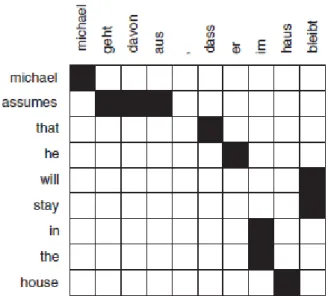
The purpose of word-based alignment is to map words from a sentence consid-ered to be the target to words from a sentence considconsid-ered to be the source (Brown et al., 1988), (Brown et al., 1990). Formally, given a sentence 𝑒1𝐼 with I words and a foreign sentence 𝑓1𝐽 with J words, the goal of word alignment is to establish word-to-word correspondences between those sentences. Those corre-spondences can be represented by a matrix A, such as 𝐴 ⊂ [1, 𝐼] × [1, 𝐽], where
(𝑖, 𝑗) ∈ 𝐴 if word 𝑒𝑖 is aligned with word 𝑓𝑗.
An example taken from (Koehn, 2009) is shown in Figure 1, where words in the English sentence (rows) are aligned to words in the German sentence (col-umns), as indicated by the filled points in the matrix.
The main challenge of this simple approach resides on the fact that a sentence expressed in different languages is not guaranteed to have the same number of words. This is not only because some words in one language can be translated by more than one word, but also because some words may have no direct
cor-respondence in the other language. The concepts of “empty word” (a word could remain unmapped) and “word fertility” (a word may be mapped to one
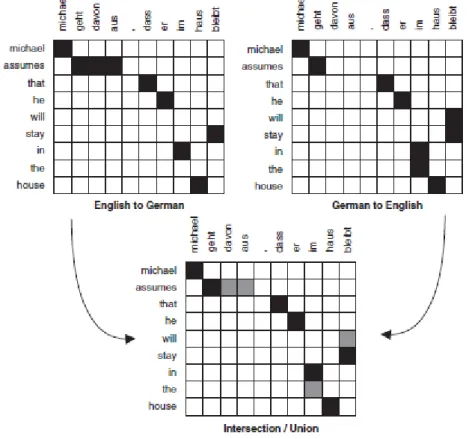
Further development of word-based alignment led to its symmetrization (Och, Tillman and Ney, 1999), (Koehn, Och and Marcu, 2003). It consists in taking a word-based alignment 𝐴0 in one direction (e to f) and a word-based alignment
𝐴1 in the other direction (f to e), producing a single symmetrized word-based
alignment A. Some simple criteria of symmetrization consist of the intersection (𝐴 = 𝐴0∩ 𝐴1), or the union (𝐴 = 𝐴0∪ 𝐴1) of the alignments in each direction. The intersection produces a higher precision with lower recall, while the union produces a higher recall with lower precision.
An example, taken from (Koehn, 2009) and shown in Figure 2, illustrates the intersection (in black) and union (in either black or gray) of a pair of alignments taken in each language direction.
Alternatively, a refined symmetrization method starts from the intersection be-tween alignments on each direction, iteratively extending the resulting align-ment by including neighbor elealign-ments. In a first step, the intersection 𝐴 = 𝐴0∩
𝐴1 is determined. Then, the alignment A is iteratively extended by adding
alignments (𝑖, 𝑗), occurring only in the alignment 𝐴0 or in the alignment 𝐴1, if neither 𝑒𝑖 nor 𝑓𝑗 have an alignment in A, or if the following conditions both hold:
The alignment (𝑖, 𝑗) has a horizontal neighbor (𝑖 − 1, 𝑗), (𝑖 + 1, 𝑗) or a vertical neighbor (𝑖, 𝑗 − 1), (𝑖, 𝑗 + 1) that is already in A.
The set 𝐴 ∪ {(𝑖, 𝑗)} does not contain alignments with both horizontal and ver-tical neighbors.
The refined method is often able to improve precision and recall when com-pared with the initial directed word alignments.
However, even with symmetrization, single words are still considered single units, something that can represent a problem because single words are not the best candidates for the smallest units of translation equivalence. In fact, there are cases in which contiguous sequences of words are commonly translated as a unit, with idiomatic expressions representing a typical example of such cases, in which possible word correspondences only make sense in the context of the expression being considered.
A particular example is the translation equivalent “de volta a a estaca
zero” <=> “back to square one”, which cannot be properly translated word by word (a more literal translation into English would be “back to
pillar zero”). In this case, the best option would be associating “de volta
a” with “back to”, which is correct, and “a estaca zero” with “square
one”, which is an association that should only happen within this context.
Another example is the translation equivalent “clockwise” <=> “em o sen-tido de os ponteiros de o relógio”, in which 9 words in Portuguese
correspond to one word in English, pose a challenge to the word-based
proach. Situations like these are better handled with phrases, inspiring the de-velopment of phrase-based alignment, described below (Sub-Section 2.1.2.2).
2.1.2.2 Phrase-Based Alignment
In phrase-based alignment, the units mapped now consist of phrases which, in turn, consist of one or more words, not necessarily following grammatical con-cerns. As mentioned in word-based alignment (Sub-Section 2.1.2.1), translating contiguous sequences of words, like idiomatic expressions, can be more natu-rally accomplished with phrases. Both the “empty word” translation and “word fertility” from word-based alignment are abandoned. Instead, phrases from a phrase translation equivalent are nonempty and can have a different number of words.
A typical way to produce phrase-based alignment is from the symmetrization of the previous word-based alignments of parallel corpora (Tillmann, 2003), (Zhang, Vogel and Waibel, 2003), (Zhao and Vogel, 2005), (Zhang and Vogel, 2005), (Setiawan, Li and Zhang, 2005). Groups of words that may constitute phrase translation equivalents are then identified using consistency rules. A phrase pair (𝑒1𝐼, 𝑓1𝐽) is said to be consistent with an alignment A if all words 𝑒𝑖
from e, that have alignment points in A, have those alignment points with
words 𝑓𝑗 from f, and vice versa. So, basically, any aligned words from a phrase will only align to one or more words from the other.
As shown in Figure 3, also taken from (Koehn, 2009), the first example is con-sistent because all aligned words are included in the phrase pair, the second example is not consistent because one alignment point in the second column is not included in the phrase pair, and the third example is consistent because the unaligned word on the right is allowed by the consistency rules.
However, obtaining phrase-based alignment from previous word-based align-ment can still face some challenges inherited from the limitations of word-based alignment. As noted before, idiomatic expressions, as well as other expressions, usually cannot be correctly aligned at a word level (as shown in the example
“de volta a a estaca zero” <=> “back to square one”), which can
consequently limit the quality of phrase-based alignment obtained from word-based alignment.
As an alternative to using word-aligned parallel corpus, phrase alignment may be done directly from sentence-aligned corpora using a probabilistic model (Shin, Han and Choi, 1996), pattern mining methods (Yamamoto et al., 2003), or matrix factorization (Goutte, Yamada and Gaussier, 2004). Still, as referred in (Koehn, 2009) results are generally no better than learning phrases from word-alignments.
In the end, as mentioned in (Lopez, 2008), Phrase-based models have quickly become standard, as results have consistently proven to be better than the ones obtained by word-based approaches.
2.1.2.3 Alignment Template
The alignment template approach (Och and Ney, 2004) is a particular imple-mentation of a phrase-based model. Instead of using explicit phrase-to-phrase translations, this approach associates phrases through an alignment template which consists of a reordering of the words composing the phrase. However, that reordering is based on word classes (or categories) rather than specific words. Those classes are automatically trained bilingual classes using the meth-od described in (Och, 1999) and constitute a partition of the vocabulary of the source and target languages.
Using classes instead of the actual words improves generalization because, for instance, if there are classes in the source and target languages that contain town names, it is possible for an alignment template learned using a specific town name to be generalized to other town names. Once the words in the phrase have been assigned to classes, the words can then be translated using word-to-word translation, with the alignment templates being reordered as in phrase-based models.
In sum, the alignment templates are a generalization capability of a bilingual phrase lexicon in which words are replaced by word classes and contain the alignment information for each phrase pair. However, such alignment infor-mation is still word-based (or word-class-based, to be more precise), so it will still inherit limitations from word-based approaches, in particular when dealing with idiomatic expressions.
2.1.3 TRANSLATION FEATURE MODELS
quality of different specific features that might contribute to the overall quality of a translation to be produced. Some feature examples include language fluen-cy, translation relevance, or even the likeliness of occurrence of a specific word.
In the case of the noisy-channel approach (Sub-Section 2.1.1.1), only two trans-lation feature models were considered (the transtrans-lation model and the language model), unlike the log-linear approach (Sub-Section 2.1.1.2), which allows for any number of translation feature models. Particularly considering the wide-spread use of the log-linear approach, the identification of the features that pro-vide the most significant information about translation quality (feature selec-tion) is an open problem in SMT, as mentioned in (Lopez, 2008). In fact, as stat-ed in (Koehn, 2009), millions of features can be introducstat-ed to score a translation candidate, such as features that can indicate the use of a specific phrase transla-tion.
The following sub-sections will describe the most relevant and the most com-monly used feature models, namely the translation model (Sub-Section 2.1.3.1), the language model (Sub-Section 2.1.3.2), the reordering or distortion model (Sub-Section 2.1.3.3), and the penalty models (Sub-Section 2.1.3.4).
2.1.3.1 Translation Model
The Translation Model (TM) is a statistical model developed with the purpose of scoring how likely a translation unit e in one language is to translate a given translation unit f in another language.
The most common approach, resulting from the initial work proposed in (Brown et al., 1988) and (Brown et al., 1990), considers the number of times each different translation e is associated with f, using the formula in Equation 6, in which the 𝑐𝑜𝑢𝑛𝑡(𝑒, 𝑓) function considers the number of associations established between e and f. The result is a non-null probability score, where the sum of the probabilities of every translation alternative is 1.0, this way constituting a prob-ability distribution.
𝑝𝑡𝑚(𝑒|𝑓) =∑ 𝑐𝑜𝑢𝑛𝑡(𝑒, 𝑓)𝑐𝑜𝑢𝑛𝑡(𝑒 𝑖, 𝑓) 𝑛
𝑖=1
Equation 6. Formula for the direct translation probability
cor-rect translation that is not so frequently used, and assigning a high score to a very frequent translation that might not be the most appropriate choice within a given context. One such example is represented by the Portuguese source
phrase (a single word) “casa”, which might be translated into English by
“house” or by “gets married”, with the first one generally being much
more frequent (depending on the texts being analyzed), even though the second one is also a perfectly valid translation.
Additionally, when phrases are the translation units being used, avoiding the overestimation of a rare phrase pair is accomplished by decomposing it into its word translations and checking how well they match up. The method is called lexical weighting, which is basically a smoothing method that uses the richer statistics provided by lexical translation to produce more reliable probability estimates. Either the direct lexical weighting 𝑙𝑒𝑥(𝑒|𝑓) or the inverse lexical weighting 𝑙𝑒𝑥(𝑓|𝑒), can be considered. However, the main problem with lexical
weighting is that it cannot be correctly applied to expressions like “clock-wise” <=> “em o sentido de os ponteiros de o relógio”.
From my point of view, the choice of a translation phrase, once its correction has been determined, should mainly depend on its context and not so much on how frequently it has been associated to an original phrase. The translation model proposed in this thesis minimizes such problem by admitting more than one source of phrase translations separately, as described in Section 3.3.2.1 ahead.
2.1.3.2 Language Model
The Language Model (LM) is a statistical model developed to score the fluency of a general sentence, initially proposed and inspired by (Brown et al., 1988) and (Brown et al., 1990), measuring how well a sequence of words might be fol-lowed by another word.
𝑝𝑙𝑚(𝑤1, 𝑤2, … , 𝑤𝑚) = ∏ 𝑝(𝑤𝑖|𝑤𝑖−𝑛+1, … , 𝑤𝑖−1) 𝑚
𝑖=1
Equation 7. Formula for the general language model
The model is named the n-gram history model, with the most common value of n being 3 for the tri-gram language model (Equation 8).
𝑝𝑙𝑚(𝑤1, 𝑤2, … , 𝑤𝑚) = ∏ 𝑝(𝑤𝑖|𝑤𝑖−2, 𝑤𝑖−1) 𝑚
𝑖=1
Equation 8. Formula for the tri-gram history language model
Such score reflects how frequently each word follows a set of previous n–1 words, according to the monolingual texts from which the model has been pro-duced.
The main challenge in language models is dealing with sparse data because it will make unclear the distinction between something that never occurs and something that simply has not been observed. In order to deal with the sparse-ness, methods such as add-one smoothing, deleted estimation or Good-Turing smoothing, for which an efficient implementation is presented by (Gale and Sampson, 1995), take probability mass from evident events and assign it to un-seen events, but this, in turn, prevents an impossible combination from getting its adequate probability of zero.
The main disadvantage of such model has to do with the fact that phrases have to be decomposed into their individual words to be checked for their language model, when very often those phrases should be considered as a single unit. The phrase “in spite of” is such an example, where the probability of “of” given the occurrence of the previous two words “in spite” (considering the tri-gram history model) is 1 in many texts, meaning that the word “of” is the only word that follows “in spite” in those texts. The phrase “in
accord-ance with” can be a similar example. Besides, when both the previous phrase examples come after two other words, for instance “the rules”, their contri-bution will be the same when their first word is analyzed, as both phrases begin by “in”. More specifically, the fluency of the phrase “the rules in” will be the same in both “the rules in accordance with” and in “the rules
in spite of”.
adjacent contiguous phrases according to other adjacent alternatives, as de-scribed in Section 3.3.2.2 ahead.
2.1.3.3 Reordering or Distortion Model
The purpose of the reordering or distortion feature, resulting from the original work by (Brown et al., 1988) and (Brown et al., 1990), is to model the likelihood of translation units changing places when translated. An example of such situa-tion is the equivalent “European Community” <=> “Comunidade
Europe-ia”, in which a word-by-word translation still requires the words to be swapped in order to obtain a correct translation equivalent.
Modeling such reordering is typically accomplished by a distance-based reor-dering cost which allows translation units to be moved from their original posi-tion to another posiposi-tion on the translaposi-tion. The model penalizes reordering in general, leaving to the language model (Sub-Section 2.1.3.2) the responsibility of justifying it. The movement of translation units is often limited to a maximum number of positions. However, translations between some language pairs may require large position movements that can easily exceed the generally small windows of words (usually three words) used by the language model. Given its limitations, disregarding the reordering model does not significantly affect translation quality, but reduces the complexity of the search problem from ex-ponential to polynomial, turning decoding much faster. Yet, including limited reordering still yields better translation results.
In sum, admitting moves within a window of a few words can be handled by the language model, often representing the best that can be done with reorder-ing. Larger reordering windows or completely unrestricted reordering, besides increasing complexity and execution time, often leads to worse results (Koehn, 2009).
The lexicalized reordering model (Tillmann, 2004) is an improvement over the one simply conditioned on movement distance described above. Such model intends to assign a translation unit with a score that will indicate how likely the translation unit is to be maintained, swapped with the previous, or placed dis-continuously.
2.1.3.4 Penalty Models