Three studies on institutional environment and the private equity continuum:
from early-stage venture capital investments to buyouts
Submitted in partial fulfillment of the requirements for
the degree of
Doctor of Philosophy
in
Technological Change and Entrepreneurship
Carlos Alexandre Contieri Kemeny
B.S., Mechanical Engineering, Purdue University
M.B.A., Technological Innovation and Entrepreneurship, Purdue University M.S., Engineering and Public Policy, Carnegie Mellon University
CATÓLICA-LISBON School of Business & Economics
iv
Acknowledgements
First and foremost, I must express my heartfelt gratitude and love for my dear wife, Alyse, who has always encouraged me to achieve my dreams. Throughout this journey, she has continued to be my best friend and has provided me with strength beyond my own. She has weathered the adventures across the ocean, magnificently mothered three heaven sent children during the doctoral program, and deserves a great deal of the credit for any redeeming qualities that I may have developed during my studies. I am grateful for our children – Gabriel, Charlotte and
Audrey – for joining our family and constantly reminding me of the privilege it is to be a father. I am grateful to my parents, Gabriel and Elizabeth, who have instilled in me a passion to learn and inspired me to accomplish hard things and not fear failure, as well as Alyse’s parents, Dale and Susan, for their loving support. For the rest of our family members (of which there are too many to list individually), we have felt humbled by their support and help along the way. While the pursuit of knowledge is a noble endeavor, I will leave this program with a more intimate conviction that family is what truly matters.
I am deeply indebted to my committee chair, Professor Francisco Veloso, and his
commitment to helping me grow and develop. His example and attitude has and will continue to inspire me to be a better professional and person throughout my life. I am grateful for Professors Francesco Castellaneta and Raffaele Conti, for their guidance, support, and patience. I will be forever thankful to them for showing me how to act as a researcher. I am also grateful to Professor David Hounshell, for his contributions and support as a member of my committee.
Before joining the program, one of my dreams was to develop close knit relationships with my peers. I could have never asked for a better cohort companion – Soheil Hooshangi –
v
who has been a great example of loyalty. I must thank Paul van der Boor, Caitlin Forschner, Qiwei Han, Ivonne Peña, Ryan Turner, and Leid Zejnilovic, as well as all of my other TCE and EPP family, for an abundance of great memories. They are lifelong friends.
I am grateful for the top-notch faculty at Carnegie Mellon, CATÓLICA-LISBON, and Instituto Superior Técnico, as well as the support staff from Carnegie Mellon’s EPP office staff – Barbara Bugosh, Vicki Finney, Steve Gradeck, Adam Loucks, and Jaime Montgomery – and the Carnegie Mellon | Portugal Program staff – João Barros, Sara Brandão, João Claro, Nicole Hillard, Lorrie Spears, and Alexandra Carvalho Vieira, and Ben Walfish. While their efforts are typically hidden behind the curtain, their support has been outstanding. I must also thank the people of Portugal for opening their arms to our family and importantly, for the Fundação para a Ciência e a Tecnologia (FCT) for providing the funding necessary to bring this research to pass.
Finally, I humbly give the most credit where that credit is due - to my Heavenly Father. I am grateful for His constant companionship and help during this program and throughout my life. I have witnessed many miracles over the course of these years, and I recognize it is by His hand that I have been blessed in all things.
vi
Abstract
This dissertation evaluates the effects of the institutional environment on investment and performance in the private equity industry. It provides insights on how trade secret protection can increase venture capital (VC) investment through a state court’s favorability toward the inevitable disclosure doctrine, the effect of anti-takeover regulation as it relates to private equity firm buyout performance, and the role that political context has in determining VC distributions to different states. Data analysis is based on Thomson Reuters’ VentureXpert for VC investment and geography, inevitable disclosure rulings gathered from multiple sources, a proprietary database on private equity firm buyout performance, and election results at the state and national levels of the United States. Three studies were conducted, which comprise this dissertation.
The first paper investigates how inevitable disclosure, a form of trade secret protection, affects the geography of VC investment in the United States. Results show that a rule in favor of inevitable disclosure increases the overall amount of VC inflows and the proportion of
investment by non-local VCs in a state more than an against or no rule. Mechanisms are addressed that can explain these findings by considering how a court decision on inevitable disclosure might increase the probability of obtaining a court injunction against a former employee departure and the predictability of that probability.
The second paper extends experiential learning theory by arguing that the degree of causal ambiguity in firm decisions likely differs not only across different settings (i.e.
operational vs. strategic), but also across different stages of the same strategic decision. With particular regard to acquisitions, the selection stage seems to be less causally ambiguous than the restructuring stage. Since experience translates into learning to a lesser extent when causal
vii
ambiguity is greater, acquisition experience translates more readily into learning to select than into learning to add value. Accordingly, results show that more experienced acquirers should perform better in scenarios when the focal acquisition is more selection (rather than
restructuring) oriented, such as when (1) the educational background of the acquiring firm’s top management is more finance (rather than business) oriented; and (2) the information
environment is less transparent. Results are largely consistent with the notion that correlation between acquisition experience and performance is more positive when the firm’s capacity to select target companies is more relevant.
The third paper attempts to uncover the effects of political context, as it relates to VC distributions to different states across the United States. The primary finding is that VC investment distributions increase when states that elect a Republican governor also vote for a Democratic presidential candidate (regardless if that candidate wins). Additionally, as the stability of a Republican gubernatorial regime increases, VC investment decreases. Finally, results show that policies improving the quality of financial institutions might help explain the political effect (through the number of IPOs), whereas tax policy (through capital gains tax rate) and pro-entrepreneurship policy (through the number of new firms) do not.
viii
Table of Contents
Acknowledgements ... iv
Abstract ... vi
Table of Contents ... viii
List of Tables ...x
List of Figures ... xii
1 Introduction ...1
2 Trade Secret Protection and the Geography of Venture Capital Investments: Evidence from the Inevitable Disclosure Doctrine ...4
Introduction ...4
Theoretical Framework and Hypothesis Development...7
IPR protection, inevitable disclosures and venture capital ...7
Inevitable disclosure rule and VC investments ...12
Data and Estimation ...17
Data collection ...17
Variables ...18
Methodology ...23
Results ...24
Discussion and Conclusion ...42
Appendix ...46
Measure of state inevitable disclosure rule ...46
3 Learning to Do What? How Acquisition Experience Affects Learning to Select and Add Value in Private Equity-Backed Buyouts ...50
Introduction ...50
Background ...54
The empirical context: acquisitions by private equity firms ...59
Theory and hypotheses ...61
The type of educational background possessed by the acquiring firm’s top management ...61
ix
Research Design ...66
Research setting and data ...66
Variables ...67 Empirical strategy ...72 Results ...73 Robustness checks ...77 Conclusions ...85 Appendix ...89
4 Political party orientation and its effect on VC investment ...90
Introduction ...90
Background ...91
Venture capital, institutional environment, and political context ...91
Political parties, elections, and venture capital ...93
Data and Estimation ...96
Data ...96
Variables ...97
Methodology ...99
Results ...102
Discussion and Conclusion ...113
5 Summary and Conclusions ...117
x
List of Tables
Table 2.1 Anticipated effect of inevitable disclosure court rulings on the expected value
and predictability of a court injunction against a former employee ... 15
Table 2.2 State rule (precedent) on inevitable disclosure ... 20
Table 2.3 Operationalization of variables ... 22
Table 2.4 Yearly average VC equity investment (in millions of USD), by state ... 26
Table 2.5 Descriptive statistics ... 27
Table 2.6 Correlations ... 28
Table 2.7 Impact of inevitable disclosure on all VC investment and investment by VC funds only ... 29
Table 2.8 Impact of inevitable disclosure: excluding California and restricting the sample to 1991-2013... 31
Table 2.9 Impact of inevitable disclosure on the number of new firms and VC controlling for new firmsa ... 32
Table 2.10 Impact of inevitable disclosure on VC investment with trade secret and non-compete indices ... 34
Table 2.11 Predictors of decisions in favor of or against inevitable disclosure ... 36
Table 2.12 Potential trends in the states in favor of inevitable disclosure ... 38
Table 2.13 Impact of inevitable disclosure on VC investment with high local VC and low VC state subsamples ... 39
Table 2.14 Impact of inevitable disclosure on VC investment using Png and Samila’s (2013) inevitable disclosure measure ... 41
Table 2.15 Inevitable disclosure precedent and rule measure ... 47
Table 2.16 Enactment of statutes conforming to UTSA ... 49
Table 3.1 Operationalization of variables ... 73
Table 3.2 Descriptive statistics ... 74
Table 3.3 Correlations ... 78
Table 3.4 The impact of experience on IRR: OLS regression ... 79
xi
Table 3.6 The impact of experience on IRR: OLS regression (only private firms in the
sample) ... 82
Table 3.7 The impact of experience on IRR: Experience discounting ... 84
Table 3.8 Antitakeover laws passed by state ... 89
Table 4.1 Operationalization of variables ... 100
Table 4.2 Descriptive statistics ... 103
Table 4.3 Correlations ... 103
Table 4.4 Impact of partisanship on VC investment ... 105
Table 4.5 Capital gains tax rate and partisanship ... 106
Table 4.6 Entrepreneurship and partisanship ... 108
Table 4.7 Initial public offerings and partisanship ... 109
Table 4.8 Impact of partisanship on VC investment: Excluding major VC states ... 110
Table 4.9 Impact of partisanship on VC investment: Excluding observations with independent governors and the 1992 election (with Ross Perot) ... 111
xii
List of Figures
Figure 4.1 Political contributions made by individuals and organizations to local, state, and national candidates from 1979 to 2012 ... 95
1 Introduction
Private equity, which includes venture capital (VC), has become an important source for developing and nurturing economic development and entrepreneurship (Samila & Sorenson, 2011a). In the first half of 2014, over $276 billion (USD) was invested by private equity firms in the United States (Private Equity Growth Capital Council, 2014). Considering only those companies with headquarters in the U.S., the private equity industry supports over 11,130 companies and 7.5 million employees. Globally, it is estimated that there is $465 billion (USD) in buyout fund dry powder.
Because of the potential impact that private equity investment can bring to a region, policymakers have taken great interest in creating an institutional environment conducive for private equity investment with the intent to spur economic growth and job creation (Lerner & Tåg, 2013). Using institutional theory (North, 1990; Scott, 1995), scholars have studied a broad range of topics concerning private equity and the institutional environment influenced by law makers and policymakers, such as intellectual property rights (IPRs) (Lerner and Tåg, 2013; Samila & Sorenson, 2011b), anti-takeover regulations (Armstrong, Balakrishnan, and Cohen, 2012) and the political context that helps define the institutional environment (Pe’er and Gottschalg, 2011). This dissertation outlines the following three research objectives that
contribute to the literature in each of the aforementioned topical areas and is aimed to provide a better understanding on how variations in the institutional environment affect the private equity industry.
The second chapter discusses how a particularly strong form of trade secret protection, the inevitable disclosure doctrine, affects the geography of venture capital investment. The main idea in this study is that states where the trade secret protection is strong might
experience two types of effects that can increase investment from VCs. If a state favors the inevitable disclosure doctrine, (1) it could reduce the possibility of employees from leaving investee firms to join a competing company and (2) it would increase the predictability of a subsequent court ruling on the doctrine. Because both of these factors affect a VCs willingness to invest, a state that favors the doctrine would be expected to attract more investment
compared to those states that are against the doctrine or have not ruled on it. While extant literature has predominantly shown that trade secret protection may have adverse effects on innovation and entrepreneurship, this result shows that there may be alternative forms of protection that can encourage and enhance investment rather than deter it.
The third chapter presents how private equity experience acquired from buyouts translates more into learning to select targets, rather than learning to add value, such that more experienced PE firms perform better when the educational background of top managers at the PE firm is more finance oriented. Conversely, performance is worse when the educational background of top managers are more business oriented and the information environment is more transparent. This study extends the literature on experience and strategic decisions, namely those that occur during the selection stage, by disentangling selection stage strategic decisions from those related to value addition.
The fourth chapter discusses how political party orientation influences venture capital investment. In the United States, elected officials of the state and national executive branch are affiliated with two major representative parties: the Republican Party (“Red”) and the
Democratic Party (“Blue”). Results show that states that have elected a Republican governor generate more VC investment when voting for a Democratic presidential candidate compared to a Republican candidate. Additionally, as the stability of a Republican gubernatorial regime
(the number of consecutive years any Republican sits in office) increases, the amount of VC investment decreases in a state. The balance achieved from voting for a Red Governor/Blue President configuration may be driven by the expectation for moderation in policymaking. While tax and pro-entrepreneurship policy do not seem to be explanatory mechanisms for the political effect on VC investment, policy affecting the quality of financial markets may help explain the results from a Red/Blue preference.
2 Trade Secret Protection and the Geography of Venture Capital
Investments: Evidence from the Inevitable Disclosure Doctrine
1Abstract
This study investigates how inevitable disclosure—a legal doctrine by which an employer can enjoin a former employee from working in a job that would inevitably result in trade secret disclosure—affects the geography of venture capital (VC) investment. Using a dataset of VC deals realized in the United States from 1981 to 2013, we find that a rule in favor of inevitable disclosure increases the overall amount of VC inflows and the
proportion of investment by non-local VCs in a state more than ruling against or no rule. We address mechanisms that can explain these findings by considering how a court decision on inevitable disclosure might increase the probability of obtaining a court injunction against a former employee and the predictability of that injunction. We also discuss managerial and policy implications of our findings.
Introduction
Venture capital (VC) plays a critical role in fostering regional entrepreneurship, innovation, and, ultimately, economic growth (Samila and Sorenson, 2011a). Given its importance,
scholars and policy makers have been trying to better understand the factors that may condition the development of VC in a region. Prior work has looked at a diverse set of issues, including the presence of a stock market (e.g., Michelacci and Suarez, 2004), tax rates (Poterba, 1989), and intellectual property rights (IPRs) (e.g., Lerner and Tåg, 2013).
With respect to the role of IPRs in VC, particular attention has been paid to the patent system (e.g., Hsu and Ziedonis, 2013; Mann and Sager, 2007), an important dimension of the IPR environment. Despite their role, patents are only part of IPRs. A further dimension of IPR
1 Submitted for review as: Kemeny, C., Castellaneta, F., Conti, R., and Veloso, F. Trade Secret Protection and the Geography of Venture Capital Investments: Evidence from the Inevitable Disclosure Doctrine.
policy and practice is represented by trade secrets, defined as any information that derives independent economic value, actual or potential, from not being generally known.2 Given the
breadth of knowledge potentially covered by the term, Halligan (2008: 3) argues that “the vast bulk of intangible assets are trade secret assets,” whereas Risch (2007: 656) notices that trade secrets are “the most important and most heavily litigated intellectual property rights.” Therefore, it appears significant to extend this line of inquiry into how legal protection associated with trade secrets might influence the presence and role of VC in a region.
To help fill this gap, we focus on the inevitable disclosure doctrine, whose rule determines whether the owner of a trade secret can (if the rule is in favor of the inevitable disclosure doctrine) or cannot (if the rule is against the inevitable disclosure doctrine) obtain a court injunction to prohibit a departing employee from working for a competitor or founding a rival firm, on the grounds that she could inevitably disclose trade secrets (Lowry, 1988). The inevitable disclosure doctrine can thus allow a company not only to protect its extant trade secrets but also to avoid the loss of valuable human capital at a competing firm’s advantage.
In the United States, where the inevitable disclosure doctrine has predominantly been developed, the extent to which a state jurisdiction embraces the inevitable disclosure doctrine varies. Through its court precedents, a state may in fact adopt (a) a rule clearly in favor of inevitable disclosure, (b) a rule clearly against, or (c) no clear rule. These scenarios could condition the decisions of venture capitalists (VCs) to invest in a region. In particular, we argue that a region embracing a rule clearly in favor of the inevitable disclosure doctrine should
2 More precisely, the U.S. Uniform Trade Secrets Act, §1.4, defines a trade secret to mean “information, including a formula, pattern, compilation, program device, method, technique, or process, that: (i) derives independent economic value, actual or potential, from not being generally known to, and not being readily ascertainable by proper means by, other persons who can obtain economic value from its disclosure or use, and (ii) is the subject of efforts that are reasonable under the circumstances to maintain its secrecy.”
attract VC investments more than any other possible scenario (against, or no clear rule), for reasons related to the likelihood of obtaining a court injunction to restrict employee mobility.
VC investors would generally prefer that key employees of an invested firm do not opportunistically leave the company to pursue opportunities in competition with the former employer (Baron, Hannan, and Burton, 2001). In this respect, a precedent in favor of inevitable disclosure increases the likelihood that a VC-backed firm obtains a court injunction against a former employee hired by a competitor (Png and Samila, 2013). Furthermore, given that a state court will tend to make decisions consistent with the precedent in any similar case at hand, a case clearly in favor of inevitable disclosure also enhances the predictability of this court injunction. Higher predictability is desired not only by risk-averse VC investors, who prefer a more stable institutional environment (Malesky and Samphantharak, 2008), but also by risk-neutral investors, who might otherwise prefer to wait and see how the regulatory environment evolves before making investments (Bloom, Bond, and Van Reenen, 2007).
Clear rulings in favor of inevitable disclosure should also be more significant for non-local investors than for non-local ones. A trustworthy relationship with key employees at an investee company can reduce their possible opportunistic behavior—including the risk that they leave to join a competitor or found a new company (Baker, Gibbons, and Murphy, 2002; Gans, Hsu, and Stern, 2008). This is harder to accomplish for VCs who are not local (e.g., Taussig and Delios, 2014), increasing for them the importance of a clear rule in favor of inevitable disclosure in the region.
To empirically assess whether and how rulings on inevitable disclosure stimulate investment from VCs, we exploit longitudinal variation in inevitable disclosure rule in U.S. states, as determined by court precedents (Kahnke, Bundy, and Liebman, 2008; Klasa et al.,
2014; Malsberger, 2011; Milgrim and Bensen, 2013b; Png and Samila, 2013; Quinto and Singer, 2009; Wiesner, 2012). We find that a favorable rule on inevitable disclosure stimulates VC investments (especially those involving non-local investors) more than any alternative rule. In particular, we show that a rule in favor of inevitable disclosure increases VC investment in a state by about 83 percent compared with where there is no rule, and by about 53 percent
compared with where the rule is against the inevitable disclosure. Additionally, having a rule in favor of inevitable disclosure increases the proportion of VC investments by non-local
investors within a state. In particular, considering those investments where at least one investor comes from a different state than the investee, a favorable rule increases their proportion by 6 percent compared with having no rule on the doctrine or having a rule against it.
Overall, this paper contributes to existing research in three ways. First, it extends the literature on the impact of the institutional environment on investments (e.g., Lerner and Tåg, 2013; Pe’er and Gottschalg, 2011; Taussig and Delios, 2014), showing how and to what extent the inevitable disclosure rule conditions VC investments. Second, it extends the literature on trade secrets as an important IPR protection mechanism that affects innovation and
entrepreneurship (e.g., Fosfuri and Rønde, 2004; Png, 2012a, 2012b). Third, we contribute to the literature on employer-friendly labor rules for innovation and entrepreneurship (e.g., Garmaise, 2011; Marx, Strumsky, and Fleming, 2009; Stuart and Sorenson, 2003).
Theoretical Framework and Hypothesis Development
IPR protection, inevitable disclosures and venture capitalIt is well established that VC plays a critical role in fostering entrepreneurship in a region (Samila and Sorenson, 2011a). Therefore, regions and countries have been seeking to increase
VC activity within their boundaries and are eager to identify policies and strategies that can have such an effect (Bottazzi and Da Rin, 2002). This has sparked a growing academic literature analyzing a variety of drivers of VC investments (Lerner and Tåg, 2013).
A first driver is the financial market, which has been shown to significantly impact VC investment. For example, previous work has demonstrated that the efficiency of a public stock market attracts VC investment by enhancing the likelihood of the investee company to be sold through an initial public offering (IPO) (Black and Gilson, 1998). In line with this idea, Jeng and Wells (2000) find that nations with more IPOs have greater VC investment. Studies have also shown that regulatory changes regarding financial markets can affect VC fundraising. For instance, the deregulation of VC investment by public pension funds introduced in 1979 led to a subsequent dramatic increase in the amount of funds flowing to the VC industry (Gompers and Lerner, 2004; Kortum and Lerner, 2000).
A second driver considered by prior research is the tax system. For example, VC activity is expected to increase when expected profits and returns increase as a result of lower capital gains tax rates (Keuschnigg and Nielsen, 2003). This was confirmed by Poterba (1989), as well as by Gompers and Lerner (1998), who found that reductions in capital gains tax rates in the United States during the 1970s and 1980s led to an increase in VC investment.
A third driver is the impact of IPR protection regulation on VC investment. The core idea is that IPRs play an important role in determining the extent to which VCs can secure investee knowledge assets (e.g., La Porta et al., 1997). Therefore, IPR protection regulation should have an important impact on VC investment. Most existing literature on IPR and VC has focused on patents, showing how they can solve uncertainty related to opportunistic
between investor and investee is signed. By requiring knowledge disclosure, patents make third parties better informed ex-ante about the value of a firm’s knowledge base. This reduces
information asymmetry between investors and investee and encourages the former to invest in the latter (Akerlof, 1970; Healy and Palepu, 2001). Ex-post, patent protection reduces the risk of unintended knowledge leakages to rivals, for instance those associated with key employees opportunistically leaving a company to pursue better opportunities. The mitigation of this risk makes VC investment more profitable (Baum and Silverman, 2004b; Cao and Hsu, 2011; Häussler, Harhoff, and Müller, 2009; Hsu and Ziedonis, 2013; Mann and Sager, 2007).
To enrich this growing literature on IPR and VC, we focus on trade secret protection, in particular on the inevitable disclosure doctrine, a particularly strong form of trade secret
protection. Trade secret protection is generally considered to be broader than protection granted by other IPRs, including patents, copyrights, and trademarks (Besen and Raskind, 1991). First, whereas patent and copyright protection require subject matter to be novel, trade secret protection requires only that the subject matter derive some commercial value from not being known (Kitch, 1980). Second, patents, copyrights, and trademarks protect only explicit knowledge—that is, knowledge already articulated and stored in certain media. In contrast, trade secrets protect any proprietary knowledge that is not known to others and that can provide a competitive advantage, be that explicit or tacit knowledge. For instance, trade secret protection may not only encompass chemical formulae and customer lists, both of which can be stored and represent explicit knowledge, but can also include ‘negative know-how’ obtained by previously attempted but failed techniques or procedures (Graves, 2006), which is
essentially tacit knowledge. Finally, unlike patent protection, trade secret protection is exempt from having an expiration date and may live as long as the knowledge is kept secret. The
economic importance of trade secret protection for firms and regions has been clearly demonstrated by prior work. For example, higher levels of trade secret protection have been shown to increase firm profits and to stimulate regional clusters (Fosfuri and Rønde, 2004), encourage more R&D investment (Png, 2014), and decrease labor mobility (Png, 2012).
A critical element associated with the role of trade secrets, as in all dimensions of IPR, is enforceability. Although several aspects contribute to the enforceability of trade secrets (David, 1993), the extent to which they are in fact protected may critically depend on whether a jurisdiction embraces the inevitable disclosure doctrine. This doctrine determines whether the owner of a trade secret can (if the rule is in favor of the inevitable disclosure doctrine) or cannot (if the rule is against the inevitable disclosure doctrine) obtain a court injunction to prohibit a departing employee from working for a competitor, on the grounds that he or she could inevitably disclose trade secrets (Lowry, 1988).
In the United States, where the inevitable disclosure doctrine has been predominantly developed, the rule is established through court precedents. This means that once the rule of law is established for the first time by a court for a particular case, it is thereafter referred to when similar cases are decided, effectively binding the future—which is the essence of the
stare decisis principle (Hart, 2012; Horwitz, 1977; Landes and Posner, 1976).3 Hence, when a
precedent in favor of inevitable disclosure is set, the doctrine can be used as an effective tool to prevent employees from working for other competing firms, based on the belief that they might unavoidably disclose and so misappropriate trade secrets (Godfrey, 2004).
3 While there is a possibility that individual courts might deviate from precedent, the appeals process to higher courts within each state lowers the probability that any disregard for precedent is systematic (Landes and Posner, 1976).
The modern form of the inevitable disclosure doctrine was defined in 1995 with the Seventh Circuit’s decision in PepsiCo, Inc. v. Redmond. Despite other decisions having embraced the inevitable disclosure doctrine as a further reason to enforce a non-compete agreement4 or to grant a limited injunction,5 PepsiCo, Inc. v. Redmond was the first court
decision to issue a very broad injunction, which prohibited de facto a departing employee who had not signed a non-compete agreement from working for a competitor, on the grounds that he or she would inevitably disclose trade secrets (Mulcahy and Tassin, 2003).6 The defendant
in that case was a high-level manager at PepsiCo who left to join a rival company. He had signed a confidentiality agreement with PepsiCo but had not entered into a covenant not to compete. The Seventh Circuit nonetheless affirmed a preliminary injunction restraining the new employment, explaining that a plaintiff may prove trade secret misappropriation by showing that defendant’s new employment will inevitably lead him to rely on the plaintiff’s trade secrets.
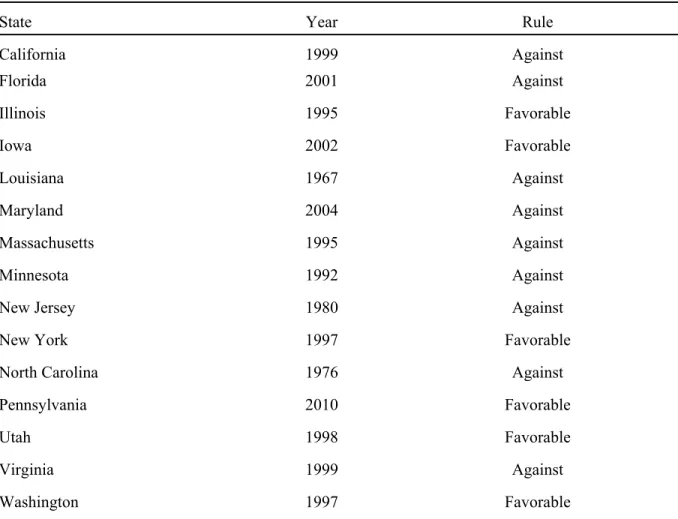
Since the PepsiCo case, six states (Illinois, Iowa, New York, Pennsylvania, Utah, and Washington) have embraced the PepsiCo interpretation of the doctrine, and five states
(California, Florida, Maryland, Massachusetts, and Virginia) have clearly rejected it. Another four states (Louisiana, Minnesota, New Jersey, and North Carolina) had, even before 1995, rejected inevitable disclosure as an independent claim under which a court might enjoin a former employee from working for a competitor. In the remaining states, there is still
4 Eastman Kodak Co. v. Powers Film Prod., 189 A.D. 556 (N.Y.A.D. 1919) 5 B. F. Goodrich Co. v. Wohlgemuth, 117 Ohio App. 493, 192 N.E.2d 99 (1963)
6 Furthermore, another important characteristic of PepsiCo, Inc. v. Redmond is that the trade secrets involved in the case were not of a technical nature, as was generally true in earlier cases considering inevitable disclosure.
uncertainty regarding a company’s ability to prevent an employee from moving to a competitor in the absence of a non-competition covenant.
Although a large body of law literature has been devoted to studying the inevitable disclosure doctrine (e.g., Edelstein, 1996; Lowry, 1988; Whaley, 1998), this issue has received far less attention in the fields of management and public policy. In these areas, research on inevitable disclosure has only started to emerge in the last decade (Graves and DiBoise, 2006; Hyde, 2003; Png and Samila, 2013), probably because most of the inevitable disclosure cases in the United States happened between 1995 and 2004. Furthermore, previous literature has mainly focused on how inevitable disclosure rule could limit employee mobility, showing that rulings in favor of inevitable disclosure were associated with substantially lower mobility of technical workers (Png and Samila, 2013). However, research has not considered whether the court rulings in a jurisdiction may condition VC investment decisions.
Inevitable disclosure rule and VC investments
In all firms, but especially in start-ups, performance outcomes depend on a few critical
employees, such as founders, who nurture the business (Campbell and Ganco, 2012; Colombo and Grilli, 2005; O’Boyle Jr. and Aguinis, 2012). Besides the loss of valuable human capital, departures of key employees can lead to knowledge leakage to competitors (Kaplan and Strömberg, 2003), thus reducing the competitive edge of the firm. The possibility of these departures might also mean that potentially profitable investments led by these employees will go unfinanced (Hart and Moore, 1994). Thus, the profit of a VC-backed firm—and the return of the VC investment—will crucially depend on the permanence of key employees (including founders), who might otherwise depart to join a competitor, or to establish a spinoff (Klepper,
2007). The ease with which key employees can move is therefore likely to be important for VC investors.
Given these concerns, it is not surprising to find that, at the time of investment, VCs often establish contractual clauses that make it difficult for key employees to depart from the financed company. For example, VC investors could ask founders to sign a vesting clause, that is, “a legal arrangement in which the entrepreneurs’ shares are originally held by the company” (Hellmann, 1998: 58) and awarded over a multiyear period (Gompers and Lerner, 2001). If entrepreneurs were to leave before being fully vested, they might lose shares or the company might be able to buy back earned shares at a discounted price. Frequently, VC investors also mandate that VC-backed firms use non-compete clauses, which prohibit key employees from joining a competitor for a specified period of time (Kaplan and Strömberg, 2003). Although those clauses might be effective for reducing outbound mobility, entrepreneurs or key employees may seek extra compensation in exchange for signing them, which would be reflected naturally in lower VC-backed firm profits and returns to VC investments. In contrast, once a jurisdiction has embraced the inevitable disclosure doctrine, VC-backed firms could limit employee mobility through a court injunction even in the absence of any specific contractual clause.
The extent to which U.S. state jurisdictions embrace the inevitable disclosure doctrine varies substantially according to court precedents. In particular, whereas some state courts have ruled clearly in favor of or against inevitable disclosure, others have reached unclear
decisions—that is, ambiguous decisions that do not clarify exactly the inevitable disclosure doctrine’s scope of application—or have yet to decide on the doctrine. This generates three
possible contexts for a given state: (a) a rule clearly in favor of inevitable disclosure, (b) a rule clearly against inevitable disclosure, (c) no clear rule.
With respect to the baseline case of having no clear rule, a rule in favor of inevitable disclosure should attract VC investors for two reasons related, respectively, to the expected value of obtaining a court injunction against a former employee hired by a competitor and to the predictability of that injunction. First, in the presence of a clear precedent embracing the inevitable disclosure doctrine, the likelihood of a court injunction increases (Png and Samila, 2013). This result would naturally attract VC investors, whose returns depend on the ability of the firms they invest in to retain their best employees. Second, with a clearly favorable
precedent, any court will most likely apply the inevitable disclosure doctrine to any similar case at hand in the same direction as previous cases. Higher predictability of court decisions in inevitable disclosure cases, compared with a scenario where there is no rule at all, should attract both risk-averse and risk-neutral investors.
On one hand, higher predictability is clearly beneficial for risk-averse investors, who naturally prefer to invest in more predictable institutional environments (Malesky and
Samphantharak, 2008). On the other hand, it might also be desirable for risk-neutral investors, who might otherwise prefer to wait and see how the regulatory environment evolves before making investments. When there is no clear precedent on the inevitable disclosure doctrine— such that it is not certain whether and to what extent might courts embrace the doctrine in future cases—VC investors may turn to non-compete clauses to prevent employee departure. Yet, money associated with drafting and negotiating these terms with key employees might be wasted if, at some point in the future, a court precedent in favor of inevitable disclosure is established. Hence, even risk-neutral investors facing an uncertain legal environment might
prefer to wait and see how the environment will evolve before making investments. In real option terms, uncertainty about the legal environment makes the “option to wait” more valuable (Bittlingmayer, 2000; Bloom et al., 2007; Dixit and Pindyck, 1994).
Different from a rule in favor of inevitable disclosure, it is not apparent whether a rule against is superior to the baseline scenario of no clear rule. For instance, a clear rule against inevitable disclosure increases the predictability of a court decision and, as a result, should attract VC investment. However, it also decreases the possibility of retaining employees, as state courts would most likely allow employees to leave for other opportunities, which should translate into a decrease in VC investment. Hence, whether a rule against the inevitable disclosure doctrine increases VC investment more than not having any rule is an empirical matter. In fact, it depends on whether the benefits due to the reduction in regulatory uncertainty prevail over the costs related to the possible loss of the investee firm’s key employees.
Table 2.1 summarizes the potential outcomes of having a clear rule in favor of or against inevitable disclosure, compared with the baseline scenario of having no rule, on the expected valued and the predictability of a court injunction against an employee deciding to leave for joining a competitor—and therefore on VC investments.
Table 2.1 Anticipated effect of inevitable disclosure court rulings on the expected value and predictability of a court injunction against a former employee
Court ruling on inevitable disclosure
With respect to having no rule
Expected value of a court Predictability of a court
Favorable rule Increase Increase
Compared with the baseline no-rule scenario, a rule in favor of the inevitable disclosure doctrine—different from no rule or a rule against inevitable disclosure—increases both the expected value and the predictability of a court injunction. Hence, VCs should be more attracted to jurisdictions where there exists a rule clearly in favor of inevitable disclosure than to jurisdictions with against or no rules. Accordingly, we formulate the following hypothesis:
Hypothesis 1: A rule in favor of inevitable disclosure increases venture capital investments more than a rule clearly against inevitable disclosure or the absence of a clear rule.
A favorable rule on inevitable disclosure should be more salient for a non-local investor than for a local investor. The former, compared with the latter, is more exposed to the risk of opportunistic behaviors by the investee firm’s key employees when formal rules safeguarding IPRs do not exist or are not enforced. In fact, a trustworthy transaction relationship—occurring when each party has no incentive to deviate from a correct behavior even in the absence of any safeguarding by formal institutions—is more likely to occur when the parties are
geographically close to each other, for at least two reasons. First, trust is enhanced by the anticipated continuity of the relationship because expectations of payoffs from future
cooperative behavior encourage cooperation in the present (Baker et al., 2002). In this respect, geographically proximate parties are more likely to transact again in the future. Second, trust is reinforced by face-to-face contact, which allows for information gathering and monitoring. For example, Bönte (2008) shows that geographical proximity between buyer and supplier in the aeronautical industry increased inter-firm trust.
Hence, formal institutions protecting property rights should be less valuable for local actors than for non-local actors. For example, Taussig and Delios (2014) argue that in
developing economies, where formal institutions are typically weak in safeguarding and enforcing property rights, local private-equity firms are better than non-local firms at
informally enforcing contracts. Similarly, Gans et al. (2008) found that the granting of a patent, a formal institution that protects IPRs, increases the probability of licensing, but this effect is muted when the patented innovation is produced in locations (such as Silicon Valley) where both the licensee and the licensor are predominantly local, such that trustworthy relationships have been built and substitute for the formal protection of IPRs.
The previous arguments suggest that a local investor’s localness might help to
informally prevent opportunism by a VC-backed company’s key employees, including the risk of those employees opportunistically leaving the investee company to join a competitor or to found a new company. Since non-local investors are more exposed to possible opportunistic behaviors by the investee company’s key employees, a favorable ruling on inevitable disclosure should be of greater relevance to them than to local investors. Hence, it should constitute a greater incentive to invest for non-local investors than for local investors. Accordingly, we formulate the following hypothesis:
Hypothesis 2: A rule in favor of inevitable disclosure increases the proportion of venture capital investments by non-local investors more than a rule clearly against inevitable disclosure or the absence of a clear rule.
Data and Estimation
Data collectionOur empirical analysis relies on a balanced panel of the 50 U.S. states and the District of Columbia from 1981 to 2013. Because variation in inevitable disclosure occurs at the state level, this is the most appropriate level of analysis. The time frame was chosen for two reasons.
First, the Thomson Reuters’ VentureXpert dataset, which was used to gather data on VC investment, has limited coverage of investments realized in the 1970s and is thus fully reliable only since the 1980s (Gompers and Lerner, 2004). Second, most of the changes in rules concerning inevitable disclosure occurred during this period.
From the VentureXpert database, we collected information about the amount of equity invested per deal, the investment date, and the location of both investee and investor.7 There
were 95,346 deals completed within the relevant period, from which we excluded 153 because investee location information was unknown. State-level rulings of inevitable disclosure were gathered from various sources (Kahnke et al., 2008; Klasa et al., 2014; Malsberger, 2011; Milgrim and Bensen, 2013b; Png and Samila, 2013; Quinto and Singer, 2009; Wiesner, 2012).8
Finally, we gathered state gross domestic product (GDP) data from the U.S. Department of Commerce’s Bureau of Economic Analysis (BEA). Overall, we constructed a balanced panel dataset of 1,683 state-year observations.
Variables
Dependent variables
Venture capital investment. Similar to Samila and Sorenson (2011a), we defined VC
investment as the equity investment associated with any VC deal at different stages of
financing: seed, early, later, or in balanced stages. Deal equity was aggregated into state-year observations (by investee headquarters location and investment year).
Proportion of VC investments by non-local investors. We defined an investment as
realized by non-local investors if the headquarters state (or country) of at least one VC investor
7 Data was collected from the VentureXpert database on November 3, 2014. 8 See Appendix: Table 2.A1.
firm differed from the headquarters state of the investee company (González-Uribe, 2014). We aggregated non-local and total investment totals into state-year observations and calculated the investments by non-local VCs. Observations with no investment amount were excluded
because of their undefined values. Independent variables
Inevitable disclosure rule. To measure inevitable disclosure rule, we first define the inevitable
disclosure doctrine consistent with PepsiCo, Inc. v. Redmond as a legal doctrine through which, even without a covenant not to compete, an employer can enjoin a former employee from working for a competitor or founding a rival firm by demonstrating that the employee’s new job duties will inevitably lead to trade secret misappropriation (Kahnke et al., 2008). Based on this definition, we created three dummy variables measuring the rule on inevitable disclosure in each U.S. state, as established by court precedents, in any given year from 1981 to 2013. In particular, the favorable dummy equals 1 if the state courts have clearly embraced a rule in favor of inevitable disclosure. Second, the against dummy equals 1 if the state courts have clearly embraced a rule against inevitable disclosure. Third, the no rule dummy equals 1 if (a) the state courts have not ruled on inevitable disclosure or (b) they have ruled but without clarifying whether the doctrine can be applied to block an employee who has not signed a covenant not to compete.
We also evaluated whether states experienced a precedent change due to new rulings that changed the state position on the doctrine by directly overruling the past precedent (Gennaioli and Shleifer, 2007). In every state that has clearly ruled on the doctrine, no higher court has directly struck down those rulings but has only distinguished them from precedential
rulings (Malsberger, 2011; Milgrim and Bensen, 2013b; Png and Samila, 2013; Quinto and Singer, 2009).
Details on the criteria we used for identifying and codifying the most important sentences on inevitable disclosure in any state are discussed in the appendix. The resulting measures of inevitable disclosure rule are presented in Table 2.2. A more detailed list of all the sentences we took into account for measuring state rule on inevitable disclosure is presented in Table 2.A1.
Table 2.2 State rule (precedent) on inevitable disclosure
State Year Rule
California 1999 Against Florida 2001 Against Illinois 1995 Favorable Iowa 2002 Favorable Louisiana 1967 Against Maryland 2004 Against Massachusetts 1995 Against Minnesota 1992 Against
New Jersey 1980 Against
New York 1997 Favorable
North Carolina 1976 Against
Pennsylvania 2010 Favorable
Utah 1998 Favorable
Virginia 1999 Against
Washington 1997 Favorable
Note. Sources: Kahnke et al., 2008; Klasa et al., 2014; Malsberger, 2011; Milgrim and Bensen, 2013;
Overall, our identification strategy relies on the arguably true assumption that case-specific court decisions are exogenous and so not driven by the willingness to attract VC investments or by the presence of an already active VC community. However, to verify the exogeneity assumption, we also check whether a ruling in favor or against inevitable disclosure is related to the state political orientation—which might be more or less prone to enact pro-VC policies (e.g., Pe’er and Gottschalg 2011)—and the past amount of VC investment in the state (cf. Table 2.11).
Control variables
Even though we consider the longitudinal changes in inevitable disclosure rule to be
exogenous, we include control variables in the regression to limit the possibility that our results are biased due to the omission of important confounding factors.
State GDP. Using BEA data, we control for state GDP, because it is a factor that could
possibly confound our results (Samila and Sorenson, 2011b). For instance, in richer states, due to a more active economic environment, it is more likely that a court will decide on cases involving the inevitable disclosure doctrine. Hence, the probability of having no rule is lower.
State fixed effects. We included state-specific fixed effects, in order to control for all
time-invariant factors for each state, such as state culture.
Year fixed effects. We included year dummies to account for variations in the economic
environment that might affect VC, such as annual changes in interest rates, inflation, and the national GDP.
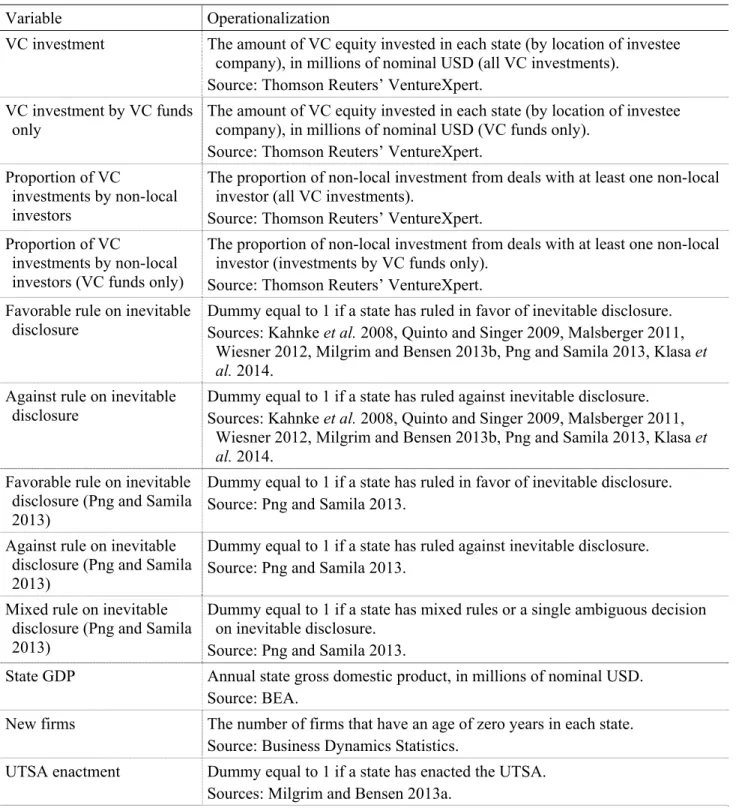
Table 2.3 Operationalization of variables
Variable Operationalization
VC investment The amount of VC equity invested in each state (by location of investee company), in millions of nominal USD (all VC investments).
Source: Thomson Reuters’ VentureXpert. VC investment by VC funds
only
The amount of VC equity invested in each state (by location of investee company), in millions of nominal USD (VC funds only).
Source: Thomson Reuters’ VentureXpert. Proportion of VC
investments by non-local investors
The proportion of non-local investment from deals with at least one non-local investor (all VC investments).
Source: Thomson Reuters’ VentureXpert. Proportion of VC
investments by non-local investors (VC funds only)
The proportion of non-local investment from deals with at least one non-local investor (investments by VC funds only).
Source: Thomson Reuters’ VentureXpert. Favorable rule on inevitable
disclosure
Dummy equal to 1 if a state has ruled in favor of inevitable disclosure. Sources: Kahnke et al. 2008, Quinto and Singer 2009, Malsberger 2011,
Wiesner 2012, Milgrim and Bensen 2013b, Png and Samila 2013, Klasa et
al. 2014.
Against rule on inevitable disclosure
Dummy equal to 1 if a state has ruled against inevitable disclosure. Sources: Kahnke et al. 2008, Quinto and Singer 2009, Malsberger 2011,
Wiesner 2012, Milgrim and Bensen 2013b, Png and Samila 2013, Klasa et
al. 2014.
Favorable rule on inevitable disclosure (Png and Samila 2013)
Dummy equal to 1 if a state has ruled in favor of inevitable disclosure. Source: Png and Samila 2013.
Against rule on inevitable disclosure (Png and Samila 2013)
Dummy equal to 1 if a state has ruled against inevitable disclosure. Source: Png and Samila 2013.
Mixed rule on inevitable disclosure (Png and Samila 2013)
Dummy equal to 1 if a state has mixed rules or a single ambiguous decision on inevitable disclosure.
Source: Png and Samila 2013.
State GDP Annual state gross domestic product, in millions of nominal USD. Source: BEA.
New firms The number of firms that have an age of zero years in each state. Source: Business Dynamics Statistics.
UTSA enactment Dummy equal to 1 if a state has enacted the UTSA. Sources: Milgrim and Bensen 2013a.
Non-compete enforceability index
Non-compete agreement enforceability index (on a scale from 0 to 1), where 0 equals no enforcement and 1 equals highest possible level of enforcement. Sources: Bishara 2010, Garmaise 2011, Bird and Knopf 2014.
Presidential Election (Red) Dummy equal to 1 if a state has voted for a Republican presidential candidate in the last presidential election. Source: www.uselectionatalas.org
Methodology
We evaluated the 33-year panel using a state fixed-effects model. Thus, our methodology resembles a typical difference-in-difference strategy, through which we compare, for instance, whether states that adopted a rule in favor of inevitable disclosure experience a change in VC investments, with the changes occurring in states where there has been no rule or there has been a rule against.
Our baseline model, which we used to test hypothesis 1 and which includes year dummies to capture idiosyncratic shocks, is as follows:
ln , , ,
ln , (2.1)
where i indexes the state and t indexes the year, β the unknown parameter vectors; VC
investmenti,t is the amount of money invested in a certain state and year in VC deals9; and FAVORABLEi,t−1, AGAINSTi,t−1, are the inevitable disclosure rule dummy variables equal to 1
if a rule clearly in favor or against inevitable disclosure was already enacted in the state and 0 otherwise. We assume that there exists a one-year lag from the time a court decision is made to when it actually has an effect on VC investments. STATEGDPi,t−1 is the log of the state GDP
control variable, represents the series of year fixed effects, represents state fixed effects, and is the error term. Regarding the error term, to account for the presence of serial
9 Since in some states and years the amount of VC investment is equal to 0, we added 1 before taking the
logarithm. As we use the log of the dependent variable and include year fixed effects, using nominal or real values of VC investment does not change our estimates.
correlation and to avoid inconsistent standard errors, we clustered observations at the state level—the state where companies that receive VC investment are located (Bertrand, Duflo, and Mullainathan, 2004). According to Hypothesis 1, we expect β1 to be significantly positive and
greater than β2, which means that a favorable rule on inevitable disclosure leads to more VC
investment, when compared with an against or no rule.
In our test of Hypothesis 2, the dependent variable is the proportion of VC investment by non-local investors. Hence, we adopted the method proposed by Papke and Wooldridge (1996) to deal with a regression in which the dependent variable is a fraction and its values are bound between 0 and 1. Specifically, they propose a quasi-maximum likelihood estimator based on the logistic distribution. This approach has several advantages over alternative solutions. First, a linear functional form of the conditional mean might miss important nonlinearities. Second, a log-odds transformation fails when the variable falls at the corners. Accordingly, we estimate the following model:
, f
, , ln , γ c ε (2.2)
We again expect that β1 is positive and greater than β2, which means that a favorable rule on
inevitable disclosure leads to a higher proportion of non-local VC investment when compared with an against or no rule.
Results
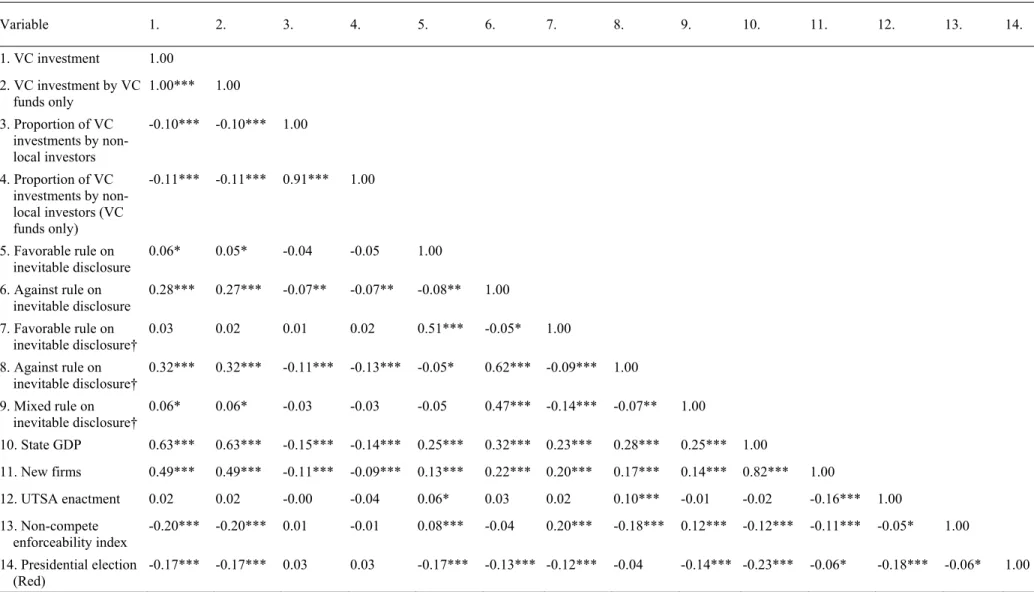
In Tables 2.4, 2.5, and 2.6, we present the summary statistics for the variables used in the empirical analysis and their pairwise correlations, respectively. First of all, we found that, as expected, equity investment is unevenly distributed across states: California, Massachusetts, New York, and Texas account for a large portion of VC investment each year, whereas Alaska
and Wyoming report almost no VC investment (Table 2.4). Furthermore, the majority (84%) of state-year observations had no rule on inevitable disclosure (Table 2.5). This is because most of the inevitable disclosure cases occurred in the mid-1990s to early 2000s, whereas our sample period starts in 1981.
Regression results are shown in Table 2.7. In Model 1, the dependent variable is the log of VC equity investment by state-year. In Model 2, the dependent variable is the proportion of equity investment by non-local investors in each state-year. Both models include inevitable disclosure dummy variables, as well as the GDP variable and state and year fixed effects.
In Model 1, favorable and against dummies are positive and significant (β1 = 0.605, p < 0.01; β2 = 0.266, p < 0.05). Given that the baseline case is represented by those states that
did not have a clear ruling on inevitable disclosure, we could thus conclude that both a favorable rule and a rule against inevitable disclosure increase VC investment compared with no rule on the doctrine. In particular, having a rule in favor of inevitable disclosure increases VC investment in a state by about 83 percent, whereas a rule against inevitable disclosure increases VC investment by 30 percent. A t-test shows that the impact of a favorable rule is statistically greater than the impact of a rule against (p < 0.10), which supports Hypothesis 1. In Model 2, we find that the decision in favor of inevitable disclosure dummy variable is positive and significant (Model 2: β1 = 0.746, p < 0.05), so a favorable rule on inevitable
disclosure increases the proportion of non-local VC investment. Moreover, a t-test on
difference in coefficients shows that the impact of a favorable rule is significantly greater than the impact of a rule against inevitable disclosure (p < 0.10), which supports Hypothesis 2. Since those coefficients were estimated using a non-linear model, we also calculated the average marginal effects. In particular, we found that having a rule in favor of inevitable
disclosure increases the proportion of VC investment in deals with at least one non-local investor by 6 percentage points compared with having no rule on the doctrine. In Models 3 and 4 we replicate the analyses restricting the sample to only VCs investments from VC funds. The results are substantially the same as the baseline models.
Table 2.4 Yearly average VC equity investment (in millions of USD), by state
State 1981–1990 1991–2000 2001–2013 State 1981–1990 1991–2000 2001–2013
Alabama 9.40 69.49 40.28 Montana 0.82 3.40 7.43
Alaska 0.35 0.35 0.00 Nebraska 0.40 33.78 16.44
Arizona 31.02 180.10 184.16 Nevada 1.46 17.85 25.91
Arkansas 0.15 10.03 11.14 New Hampshire 15.68 137.39 137.81
California 1,237.24 9,362.85 12,982.30 New Jersey 90.91 635.96 759.90
Colorado 92.08 859.64 649.96 New Mexico 4.48 9.47 41.12
Connecticut 81.64 374.98 243.98 New York 88.29 1,381.69 1,490.11
Delaware 1.56 19.09 22.97 North Carolina 21.07 401.15 404.52
District of Columbia 7.72 112.33 78.00 North Dakota 1.45 2.07 4.53
Florida 48.13 674.64 413.86 Ohio 37.74 250.54 215.09
Georgia 54.30 538.74 429.60 Oklahoma 7.48 32.01 27.55
Hawaii 0.01 24.20 11.85 Oregon 52.89 184.30 162.00
Idaho 1.53 7.83 14.58 Pennsylvania 67.69 684.92 657.04
Illinois 51.17 590.52 511.08 Rhode Island 9.28 22.38 62.57
Indiana 10.42 70.96 85.03 South Carolina 8.52 105.42 45.17
Iowa 2.49 11.13 23.85 South Dakota 0.23 0.10 3.60
Kansas 2.83 37.04 42.37 Tennessee 41.15 179.55 101.11 Kentucky 2.50 45.72 38.93 Texas 193.35 1,384.60 1,428.26 Louisiana 5.30 51.67 15.41 Utah 11.61 144.03 238.76 Maine 8.61 25.98 16.68 Vermont 3.54 8.03 21.83 Maryland 38.70 392.06 598.13 Virginia 39.48 706.37 485.39 Massachusetts 365.03 2,275.30 3,108.78 Washington 55.96 773.41 825.67
Michigan 32.61 114.24 146.75 West Virginia 1.54 3.03 8.97
Minnesota 42.84 273.79 321.26 Wisconsin 10.46 60.92 70.18
Missouri 6.02 206.32 93.15 Table 2.5 Descriptive statistics
Variable N Mean Std. Dev. Min. Max.
VC investment 1,683 368.18 1,767.76 0.00 43,017.95
VC investment by VC funds only 1,683 348.87 1,724.89 0.00 42,190.98 Proportion of VC investments by
non-local investors
1,483 0.91 0.16 0.00 1.00
Proportion of VC investments by non-local investors (VC funds only)
1,457 0.90 0.18 0.00 1.00
Favorable rule on inevitable disclosure
1,683 0.05 0.21 0.00 1.00
Against rule on inevitable disclosure
1,683 0.11 0.31 0.00 1.00
Favorable rule on inevitable disclosure (Png and Samila 2013)
1,683 0.15 0.35 0.00 1.00
Against rule on inevitable disclosure (Png and Samila 2013)
1,683 0.05 0.21 0.00 1.00
Mixed rule on inevitable disclosure (Png and Samila 2013)
1,683 0.10 0.30 0.00 1.00
State GDP 1,683 177,694.69 250,292.10 5,436.00 2,202,678.00
New firms 1,632 9,557.66 11,214.39 569.00 74,879.00
UTSA enactment 1,683 0.68 0.47 0.00 1.00
Non-compete enforceability index 1,683 0.36 0.15 0.00 0.75
Table 2.6 Correlations Variable 1. 2. 3. 4. 5. 6. 7. 8. 9. 10. 11. 12. 13. 14. 1. VC investment 1.00 2. VC investment by VC funds only 1.00*** 1.00 3. Proportion of VC investments by non-local investors -0.10*** -0.10*** 1.00 4. Proportion of VC investments by non-local investors (VC funds only) -0.11*** -0.11*** 0.91*** 1.00 5. Favorable rule on inevitable disclosure 0.06* 0.05* -0.04 -0.05 1.00 6. Against rule on inevitable disclosure 0.28*** 0.27*** -0.07** -0.07** -0.08** 1.00 7. Favorable rule on inevitable disclosure† 0.03 0.02 0.01 0.02 0.51*** -0.05* 1.00 8. Against rule on inevitable disclosure† 0.32*** 0.32*** -0.11*** -0.13*** -0.05* 0.62*** -0.09*** 1.00 9. Mixed rule on inevitable disclosure† 0.06* 0.06* -0.03 -0.03 -0.05 0.47*** -0.14*** -0.07** 1.00 10. State GDP 0.63*** 0.63*** -0.15*** -0.14*** 0.25*** 0.32*** 0.23*** 0.28*** 0.25*** 1.00 11. New firms 0.49*** 0.49*** -0.11*** -0.09*** 0.13*** 0.22*** 0.20*** 0.17*** 0.14*** 0.82*** 1.00 12. UTSA enactment 0.02 0.02 -0.00 -0.04 0.06* 0.03 0.02 0.10*** -0.01 -0.02 -0.16*** 1.00 13. Non-compete enforceability index -0.20*** -0.20*** 0.01 -0.01 0.08*** -0.04 0.20*** -0.18*** 0.12*** -0.12*** -0.11*** -0.05* 1.00 14. Presidential election (Red) -0.17*** -0.17*** 0.03 0.03 -0.17*** -0.13*** -0.12*** -0.04 -0.14*** -0.23*** -0.06* -0.18*** -0.06* 1.00 † Png and Samila 2013. *p < 0.1; **p < 0.05; ***p < 0.01.
Table 2.7 Impact of inevitable disclosure on all VC investment and investment by VC funds only
All VC Investment Investment by VC Funds Only
(1) (2) (3) (4) Variable ln VC investment Proportion of VC investments by non-local investors ln VC investment Proportion of VC investments by non-local investors Favorable 0.605*** 0.746** 0.565*** 0.594** (0.152) (0.312) (0.195) (0.266) Against 0.266** 0.082 0.261** 0.111 (0.125) (0.227) (0.129) (0.282) ln state GDP (t–1) 1.675*** 1.266 1.583*** 1.487* (0.326) (0.857) (0.342) (0.797) Constant -15.762*** -10.119 -14.813*** -12.236 (3.377) (8.879) (3.541) (8.264)
State fixed effects Yes Yes Yes Yes
Year fixed effects Yes Yes Yes Yes
Clusters 51 51 51 51
Observations 1,683 1,483 1,683 1,457
Adj. R-squared 0.648 − 0.638 −
Log Likelihood − -314.285 − -331.304
Notes. OLS regression results in columns (1) and (3), fractional logit regression results in columns (2) and
(4). Robust standard errors in parentheses. Disturbances are clustered by state. The unit of observation is the state-year, and the data cover the 50 U.S. states (and the District of Columbia) from 1981 to 2013. In models (1) and (3), the dependent variable is the log of 1 plus VC investment. In models (2) and (4), the dependent variable is proportion of VC investments with at least one non-local investor participating in the deal.
Beyond the hypotheses tested, another finding is of particular interest. As previously stated with regard to Model 1, the coefficient for a rule against inevitable disclosure was positive and significant. This suggests that for VC investors the predictability of court
decisions might obstruct investment decisions more than the possibility of employees leaving. However, note that the positive effect of a rule against inevitable disclosure on VC investments disappears both when we exclude from our sample California—which ruled against inevitable disclosure in 1999—and when we restrict our sample to the period 1991–2013, when in fact all decisions in favor of the inevitable disclosure were made (cf. Table 2.8, Models 1 and 3).
We performed a number of additional analyses to assess the robustness of our results. First, when considering the impact of inevitable disclosure ruling on the overall amount of VC investments, there could be a concern that the effect of a favorable rule is mediated by an increase in entrepreneurship, in that stronger trade secret protection might encourage the entry of new companies, which in turn attracts VC investors. To rule out this possible explanation, we collected data from the U.S. Census Bureau’s Business Dynamics Statistics dataset on the number of new firms created in each state from 1981 to 2012 (data on 2013 are not available).
Table 2.9 shows not only that rulings on inevitable disclosure have no significant effect on new firms (column 1) but also that the impact of a rule in favor of inevitable disclosure does not substantially change when including the number of new firms as an additional control (column 2). These findings support the idea that entrepreneurship does not mediate the effect of inevitable disclosure rulings on VC investment.
Some longitudinal changes in the institutional environment could confound the impact of inevitable disclosure rulings. For instance, variations in non-compete covenants might
Table 2.8 Impact of inevitable disclosure: excluding California and restricting the sample to 1991-2013 Excluding California 1991-2013 (1) (2) (3) (4) Variable ln VC investment Proportion of VC investments by non-local investors ln VC investment Proportion of VC investments by non-local investors Favorable 0.607*** 0.734** 0.437** 0.751** (0.151) (0.313) (0.179) (0.314) Against 0.220 0.122 0.143 0.111 (0.134) (0.315) (0.164) (0.315) ln state GDP (t–1) 1.686*** 1.345 0.839 2.269* (0.327) (0.862) (0.506) (1.372) Constant -15.887*** -10.966 -7.002 -22.650 (3.376) (8.945) (5.584) (15.318)
State fixed effects Yes Yes Yes Yes
Year fixed effects Yes Yes Yes Yes
Clusters 50 50 51 51
Observations 1,650 1,450 1,173 1,068
Adj. R-squared 0.642 − 0.504 −
Log Likelihood − -301.991 − -225.272
Notes. OLS regression results in columns (1) and (3), fractional logit regression results in columns (2) and
(4). Robust standard errors in parentheses. Disturbances are clustered by state. The unit of observation is the state-year, and the data cover all U.S. states but California in columns (1) and (2) and all U.S. states from 1991 to 2013 in column (3) and (4). In models (1) and (3), the dependent variable is the log of 1 plus VC investment. In models (2) and (4), the dependent variable is proportion of VC investments with at least one non-local investor participating in the deal.
*p < 0.1; **p < 0.05; ***p < 0.01.
influence the extent to which VC investors want to invest in a region and, at the same time, might be the extent to which VC investors want to invest in a region and, at the same time, might be correlated with variations in inevitable disclosure rulings. To address this issue, we also control for non-compete enforceability in each state by using the Garmaise Noncompetition Enforceability Index (Garmaise, 2011). Because the index is restricted to the period 1992–2004 , we combined it
Table 2.9 Impact of inevitable disclosure on the number of new firms and VC controlling for new firmsa
(1) (2)
Variable ln new firms ln VC investment
ln new firms 0.133 (0.363) Favorable 0.086 0.587*** (0.052) (0.147) Against 0.021 0.250* (0.032) (0.126) ln state GDP (t–1) 0.708*** 1.562*** (0.102) (0.515) Constant 1.244 -15.724*** (1.060) (3.288)
State fixed effects Yes Yes
Year fixed effects Yes Yes
Clusters 51 51
Observations 1,632 1,632
Adj. R-squared 0.667 0.653
a Data on the number of new firms are available until 2012.
Notes. OLS regression results are shown, with robust standard errors in parentheses. Disturbances are
clustered by state. The unit of observation is the state-year, and the data cover the 50 U.S. states (and the District of Columbia) from 1981 to 2012. In Model (1), the dependent variable is the log of new firms. In Model (2), the dependent variable is the log of 1 plus VC investment.
*p < 0.1; **p < 0.05; ***p < 0.01.
with the Bird Noncompetition Enforceability Index, which provides data for the period 1976– 1994 (Bird and Knopf, 2014).10 At the same time, the enactment of the Uniform Trade Secrets
Act (UTSA) in 47 states between 1981 and 2012 might also correlate with the state court position on the inevitable disclosure doctrine. To provides data for the period
10 Although the majority of state index scores matched in overlapping years (1992–1994), five states did not have matching values (Connecticut, Hawaii, Minnesota, South Dakota, and West Virginia). For each of these states, the Bird Index value was constant throughout the period 1976–1994. Therefore, we replaced the Bird Index value with the Garmaise Index value to provide consistency across data sets. Finally, based on Bishara (2010), we considered that no major changes in non-compete enforceability occurred over the last decade and extended the Garmaise Index values from 2004 to 2012, keeping each value constant for each state.