TAKING THE PULSE OF THE REAL ECONOMY USING FINANCIAL STATEMENT ANALYSIS: THE EUROPEAN PERSPECTIVE GREGORY LECHIEN, 3375 A Project carried out on the Master in Finance Program, under the supervision of: Rafael Zambrana FALL 2017
for the Award of a Master Degree in International Finance from the NOVA – School of Business and Economics
Abstract
This article shows that an analysis of aggregated changes in profitability and profitability drivers is useful to forecast European economic growth. Furthermore the predictive power contained in profitability ratios is incremental and thus complementary to that contained in stock returns. Although European professional forecasters tend to incorporate equity returns and accounting information in their revisions of output growth expectations, their prediction errors can be anticipated based on aggregate changes in Return on Equity, Net Profit Margin and on stock returns. It implies that macro experts do not fully rely on easily available information to forecast E.U real GDP growth.
Keywords: Financial statement analysis, profitability, GDP growth forecasting,
macroeconomics, European Union.
Outline 1. Introduction...………...………...………...………..4 2. Literature review and hypotheses development…...………7 2.1. The relation between firms and the aggregate economy...…...………...…….7 2.2. The DuPont profitability analysis...…...………..……....…...………..…...9 2.3. Stock market returns..…...………..……....…...………..…...10 2.4. Forecast accuracy and the Survey of Professional Forecasters…..……...12 3. Research Design..…...………..……....…...………..…...14 3.1. Research sample description..…...……...…...………..…...14 3.2. Data retrieval and transformation...……....…...………....…...15 4. Results and discussion....…...………..……....…...………..…...16 4.1. Descriptive statistics..…...………..……....…...………..…...16 4.2. Predicting real output growth in the E.U with Financial Statement Analysis...19 4.3. Predicting real output growth in the E.U with stock market returns...22 4.4. The incremental predictive content of changes in profitability drivers...23
4.5. Understanding revisions in GDP growth beliefs based on Financial Statement Analysis..…...……..………..……....…...………..…...24
4.6. Predicting professional macro forecasters’ errors based on Financial Statement Analysis..…...………..……....…...………..…...27 5. Conclusions, limitations and opportunities for future research...30 6. References..…...………..……...…...………..…...33 7. Appendix..…...………..……...…...………..…...37
1. Introduction
Predicting Gross Domestic Product (GDP) growth is among the most important tasks devoted to macroeconomic experts. GDP growth forecasts influence the decisions of an incredibly large group of people, ranging from managers who rely on them to predict demand and hence to adapt their production and wages, to governments who base their yearly budgets on growth assumptions. Other agents such as stock investors and individuals also use these forecasts to guide their investment and consumption choices. Most importantly, central bankers look at expectations of output growth as an indicator of the strength of the economy before developing their monetary policy. Their decisions ultimately impact everyone’s life through the interest rates. Hence it does not take long to understand why accurate and reliable projections of GDP growth are essential for the society, and even more considering the current economic situation in Europe. As a reaction to the successive financial and debt crises that hit the European Union (E.U) during the past decade, the European Central Bank (ECB) reduced its deposit facility rate to -0.40%, the lowest level ever reached since the creation of the E.U. The purpose was to foster credit in order to boost private investments and consumption. Rumours of a rise in interest rates during the course of 2018 or 2019 are now spreading, but the ECB will only act if it observes an improvement of the inflation and growth rates. In this context, being able to accurately predict economic growth has become crucial. The present research introduces a new method for forecasting economic growth in the E.U. It is inspired from a stream of literature created in 2013 by Konchitchki and Patatoukas (hereafter: KP) linking accounting and macroeconomics by forecasting subsequent nominal economic growth in the United States for the first time using patterns observed in aggregated firms’ earning growth data. KP (2014) then built upon their previous work by demonstrating the usefulness of companies’ profitability data to predict the subsequent real output growth of the U.S.A. However, there is currently no similar piece of evidence for other geographical settings. This study intends to partly fill this gap in the macro-accounting literature by investigating the potential existence of a relation between aggregate profitability data and subsequent real GDP growth in the E.U, based on KP’s pioneer studies. To do so, quarterly profitability data of the 50 companies part of the Euro Stoxx 50 index in 2017 have been retrieved for the 2000-2016 period. The choice of focusing on the
corporations present in the Euro Stoxx 50, thus including all the largest European companies in terms of market capitalisation, ensures the sample to be truly representative of the performances of the entire portfolio of firms listed in the E.U, while at the same time offering a cost-effective and time-saving way to get a clear picture of the European economic growth.
The research starts with hypothesis 1, conjecturing and confirming that aggregate changes in firms’ profitability and profitability drivers are useful predictors of the E.U real GDP growth. Specifically, results show that aggregate changes in Return on Equity (ROE), Net Profit Margin (Net PM), Asset Turnover (ATO) and Interest Burden contain significant predictive power of subsequent real E.U output growth, while the other variables under scrutiny (Leverage ratio, Tax Burden, Operating Margin (OM), OM before Depreciation and the ratio of Depreciation to Sales) do not. All explanatory variables have been carefully chosen based on the decomposition of the ROE according to the DuPont profitability analysis. Along similar lines, results from hypothesis 2.1 highlight the fact that seasonally-adjusted quarterly returns of the Euro Stoxx 50 index also contain significant predictive power of subsequent real GDP growth in the E.U, confirming past research in the field.
The first crucial point of this study is to be found in hypothesis 2.2. It conjectures and finds that, after controlling for the Euro Stoxx 50 returns, aggregate changes in firms’ profitability drivers (except for the Interest Burden) are still useful predictors of E.U output growth. This incremental usefulness of accounting data implies that firms’ financial statement analysis and stock returns are complementary. Hence a greater level of forecast accuracy can be achieved by relying on both, rather than solely on equity returns. It gives macro experts an incentive to incur the extra costs of retrieving and analysing companies’ profitability data.
This study then analyses comprehensively the predictions made by these macro experts in order to determine to what extent they were already aware of the analysis of financial statement as instrument of macro forecasting. To do so, their quarterly expectations of subsequent E.U GDP growth between 2000 and 2016 are retrieved from the Survey of Professional Forecasters (SPF), which is the most widely used consensus of economic growth forecasts and is published quarterly by the American and European central banks. The present research shows that the precision of the forecasts of the SPF panel can be improved by relying directly on firms’ fundamentals. Specifically, hypothesis 3.1 tests and finds that
professional forecasters already look at the direction of stock market returns and of some of the profitability measures (ROE and ATO), but neglect the predictive power of Net PM when they are asked to revise their expectations of GDP growth between two quarters. Hypothesis 3.2 then conjectures that, if professional forecasters rely more on stock returns than on profitability data to predict GDP growth, then their forecasting errors should be anticipatable based on these fundamentals but not based on equity returns. Results indicate that, in line with the evidence from hypothesis 3.1, professional forecasters’ prediction errors can be foreseen based on aggregate changes in ROE and even more based on changes in Net PM, but not based on changes in ATO. However, in contrary to all expectations based on existing literature, inaccurate predictions can also be forecasted by relying on the returns of the Euro Stoxx 50 index, indicating that experts do not fully rely on European stock markets to estimate the E.U output growth.
The objective of this study is to contribute to the macro-accounting literature by demonstrating for the first time the usefulness of financial statement analysis to forecast subsequent GDP growth in the E.U. It is also the first to investigate the predictive power of output growth contained in companies’ ROE, Leverage Ratio, Tax Burden and Interest Burden. From a practical perspective, the results will helpful to European professional forecasters, policy makers, central bankers or equity investors by providing them with a tool to improve the accuracy of their predictions. Furthermore, this tool is cost-effective as it allows to obtain insight into the performance of the entire E.U market with an analysis limited to the 50 largest European firms. Moreover, this insight is incremental and hence complementary to the picture one can get by studying the performances of stock markets.
The article is developed as follows. Section 2 provides a comprehensive review of the existing literature and introduces the hypotheses from a theoretical perspective. Afterwards, the research design in section 3 describes the sample as well as the process of data retrieval and transformation. Subsequently, section 4 presents all the empirical results and discusses the intuitions behind them. Finally section 5 provides some concluding remarks, summarizing the main points of the study as well as some of its limitations, and offers opportunities for future research in the fields of accounting and macroeconomics.
2. Literature review and hypotheses development
Is a country’s economy growing? At what rate? Providing accurate answers to these questions has been the main objective of macroeconomic experts for years. The most regarded measure of economic development is the GDP growth. Accurate GDP growth projections are essential as they are used by governments to prepare their budget or central banks to develop monetary policy, but they also influence stock investors, who rely on them as a barometer of the strength of the economy, and firms, that adapt their employment or earning forecasts based on GDP figures (Bureau of Economic Analysis, 2015). The relation between firms and the aggregate economy
Past researchers have investigated the link between firms’ accounting data and macroeconomic variables, such as inflation or GDP growth. Chordia and Shivakumar (2005) show that lagged inflation is a significant predictor of subsequent earnings growth up to four quarters, with an adjusted R2 reaching 45%. Basu et al. (2010) extend Chordia and Shivakumar’s research and find that not only lagged inflation but also inflation forecasts are useful to predict subsequent earnings growth. Konchitchki (2011) documents that although the effects of inflation are not reflected in companies’ nominal financial statement, unrecognized inflation gains, incorporated into nonmonetary assets, are useful to forecast future cash flows for the following four years. Li, Richardson and Tuna (2013) find that associating data about firms’ geographic exposure, proxied by sales per country, with predictions of real GDP growth yields improvements in terms of forecast accuracy of future performances, proxied by return on net operating assets (RNOA). Existing literature also examines the relation between financial statements and capital markets through fundamental analysis and accounting-based valuation (see Kothari, 2001, for a literature review). It has for instance been shown that performing a fundamental analysis of financial statements allowed to estimate earning changes (Ou and Penman, 1989; Abarbanell and Bushee, 1998) and to predict future stock returns (Penman and Zhang, 2002).
However, the potential existence of a direct influence of accounting data on macro variables has not been investigated extensively. KP (2013) are the first to explore that relation. They find that U.S firms’ aggregate earnings growth is a significant leading indicator of U.S nominal GDP growth and further contains predictive content that is incremental to that of current GDP growth or of other predictors such as Treasury yields, term spreads and
quarterly stock returns. They also show that professional macro forecasters do not use these aggregate earnings growth data to predict future GDP growth. KP (2014) build on their previous work by showing that data about U.S companies’ profitability drivers (including ATO, PM, OM and the ratio of depreciation to sales) contain predictive power of future real GDP growth, incremental to that contained in stock returns. The authors moreover prove that, by relying on financial statements, macro forecasters can significantly improve the accuracy of their GDP growth expectations and that their forecasting errors can be predicted. Finally, Gaertner, Kausar and Steele (2016) extend the articles of KP and demonstrate that negative aggregate changes in U.S firms’ earnings are significantly related to subsequent GDP growth up to three quarters ahead, whereas positive changes are not. No evidence is yet available for geographic regions other than America. This study intends to partly fill that gap by analysing the predictive content of E.U firms’ financial statements for subsequent E.U real GDP growth, based on the pioneer work of KP (2014). Along similar lines to their study, this research focuses on publicly traded corporations, which are obligated to publish quarterly financial statements. KP (2014) limit their sample to the 100 largest publicly traded American firms to reduce the costs of collecting and aggregating firms’ accounting data, estimating that their sample is a good proxy for the entire U.S stock market. In the same vein, the sample used for this research consists of the 50 firms included in the Euro Stoxx 50, the leading European Blue-chip index, in 2017. Hence it consists of the 50 largest firms of the E.U with regard to market capitalisation, including the leaders in all major industries1. Focusing on this index thus guarantees a comprehensive picture of the performances of the entire portfolio of listed E.U companies.
One can expect the existence of significant predictive content of GDP growth embedded in E.U companies’ aggregate profitability and profitability drivers, for two reasons. First, in the long term, listed firms’ earnings growth and aggregate output growth share common trends (ECB, 2007). Second, KP (2014) find that a similar relation holds in the U.S.A. The first hypothesis will test this relation empirically:
H.1: Aggregate changes in the Euro Stoxx 50 firms’ profitability and profitability drivers are significant predictors of subsequent real GDP growth in the E.U.
1 Stoxx.com, 2017
The DuPont profitability analysis
Besides the geographical setting, the main difference between KP’s work and the present research is about which profitability ratios are being analysed. While their main profitability measure is RNOA, the focus here is on ROE. Defined as Net Income over Shareholders’ Equity, ROE represents the net income available to shareholders per dollar invested (Bodie, Kane and Marcus, 2013). KP (2014) then follow the DuPont profitability analysis to break down RNOA into two profitability drivers (ATO and PM). The ROE can also be decomposed using the DuPont analysis, in the following way (1st level decomposition):
𝑅𝑂𝐸 = 𝑁𝑒𝑡 𝑃𝑀 × 𝐴𝑇𝑂 × 𝐿𝑒𝑣𝑒𝑟𝑎𝑔𝑒 𝑅𝑎𝑡𝑖𝑜 (𝐿𝐸𝑉) with: 𝑁𝑒𝑡 𝑃𝑀 =!"# !"#$%&!"#$% ; 𝐴𝑇𝑂 =!"#$% !""#$"!"#$% ; 𝐿𝐸𝑉 =!!!"#!!"#$%!!"#$% !""#$"!!"#$%&
The decomposition of the ROE is conceptually very similar to the breakdown of the RNOA used by KP. The advantage of focusing on the ROE is that its decomposition includes the Leverage Ratio, without altering the two other terms: both the ROE and the RNOA breakdowns allow to analyse the operating management through the PM and the asset management via the ATO. Specifically, the Net PM measures how much a firm manages to keep as profits for each euro of revenue, while the ATO reveals the company’s ability to generate revenues from its assets (Palepu, Healy and Peek 2016). Finally, the LEV, also referred to as Equity Multiplier, measures a firm’s debt to total capitalisation. Unlike the first two drivers, this ratio is affected by companies’ capital structure (Bodie, Kane and Marcus, 2013). While KP relied on the RNOA in order to abstract from firms’ leverage, this research uses ROE as primary explanatory variable precisely to investigate the predictive power of subsequent GDP growth contained in companies’ capital structure through the LEV.
Following the DuPont analysis, the PM can be further decomposed into three ratios (2nd level decomposition):
𝑅𝑂𝐸 = 𝑇𝑎𝑥 𝐵𝑢𝑟𝑑𝑒𝑛 × 𝐼𝑛𝑡𝑒𝑟𝑒𝑠𝑡 𝐵𝑢𝑟𝑑𝑒𝑛 × 𝑂𝑝𝑒𝑟𝑎𝑡𝑖𝑛𝑔 𝑀𝑎𝑟𝑔𝑖𝑛 𝑂𝑀 × 𝐴𝑇𝑂 × 𝐿𝐸𝑉 with:
𝑇𝑎𝑥 𝐵𝑢𝑟𝑑𝑒𝑛 =
!"#!!"# !"#$%&!"# !"#$%& ;𝐼𝑛𝑡𝑒𝑟𝑒𝑠𝑡 𝐵𝑢𝑟𝑑𝑒𝑛 =
!"#!!"# !"#$%&!"#$ ;𝑂𝑀 =
!"#$%!"#$The Tax Burden displays how much a firm keeps as profit after paying taxes. Its value depends on the country’s statutory rate as well as on specific policies implemented by each company in trying to minimize tax obligations. The Interest Burden, the second driver affected by the companies’ capital structure, reflects the degree of financial leverage: its
maximal value is 1, which occurs when a firm has no debt. Finally, the OM, also called EBIT margin, exhibits the operating profit per dollar of sale (Bodie, Kane and Marcus, 2013). In order to parallel KP’s paper, the OM can be disaggregated into two components: the ratio of Operating Margin before Depreciation to Sales (OM before Dep) and the ratio of Depreciation to Sales (DEP) (3rd level decomposition).
The DuPont analysis is very useful to perform fundamental analysis, as it allows to easily spot the strengths and weaknesses of firms in their process of converting raw revenue into net income and to quickly compare firms of various sizes. Over the years, researchers in the field of accounting have investigated extensively the usefulness of the DuPont profitability analysis, focusing primarily on the PM and ATO. Although general consensus is that the DuPont components are useful to predict corporations’ future profitability, there is contradicting evidence regarding which of the components has the most predictive content. On the one hand, some studies show that changes in ATO predict changes in future profitability, whereas changes in PM do not (Fairfield and Yohn, 2001; Soliman, 2008). Some authors argue, the reason is that ATO is much more persistent than PM. This is explained by the fact that ATO faces less pressure from competition than PM: it is more costly and difficult to replicate a rival’s efficient asset utilization than to enter a market driven by high PM (Soliman, 2008; Curtis et al. 2015). On the other hand, KP (2014) find that changes in RNOA are mainly due to changes in PM, while the coefficient on ATO is insignificant. A potential explanation to reconcile these contradictory results is that companies exhibiting significantly higher and more persistent ATO ratios have older assets than firms with lower ATO ratios. The ATO calculation, based on assets’ historical cost rather than current value, does not reflect appreciation in asset value over time. Hence, historical cost measurement leads to reduced asset value for firms with older assets and ultimately results in higher ATO, as total asset value is the denominator. Variations in ATO would then be the result not only of economic factors, but also of accounting measurements (Curtis et al. 2015). Stock market returns Another way to forecast macroeconomic variables is to look at stock returns. Fama (1981) supports that equity returns are a leading indicator of inflation, GDP, capital expenditures and the real rate of return on capital. Fischer and Merton (1984) further show that stock returns are a leading indicator of the business cycle and Gross National Product. However,
more recently, Ramraika (2016) provides evidence that the rate of GDP growth is not always correlated with stock returns. Investigating the Sensex, the Indian stock exchange, he finds that equity returns declined from a compounded annual rate of return of 26% for the period 1979-1991 to a rate of 11.8% from 1991 to 2015, while the country’s GDP growth rate remained relatively constant, with an annual rate of about 14% for the whole period. The author’s explanation is that in 1991, the implementation of economic liberalization policies in India limited barriers to entry for foreign companies and thus increased competition, leading to lower returns on capital, which was reflected in the Sensex returns. Coming back to the U.S setting, KP (2014) establish that stock market returns are useful to forecast economic growth: they prove that annual stock returns, with an adjusted R2 of 20%, is the single most effective predictor of subsequent real GDP growth.
However, once again evidence of such a relation outside the U.S.A is much more sparse. Verifying whether the link between equity returns, proxied by returns of the Euro Stoxx 50, and subsequent economic growth holds in the E.U is the subject of the second hypothesis:
H.2.1: Seasonally-adjusted quarterly returns of the Euro Stoxx 50 index contain predictive power of subsequent GDP growth in the E.U.
If this hypothesis is confirmed, then a new question arises: since stock returns are directly retrievable, why would one incur the additional costs of collecting firms’ profitability data to forecast economic growth? In other words, for this study to be useful to professional macro forecasters from a practical perspective, the following hypothesis has to be tested:
H.2.2: Aggregate changes in the Euro Stoxx 50 firms’ profitability and profitability drivers contain predictive power of subsequent E.U GDP growth that is incremental to that contained in the quarterly returns of the Euro Stoxx 50 index.
Previous research posits that, even though stock markets reflect companies’ financial performances (Fischer and Merton, 1984), they do not fully incorporate information contained in the financial statements. Ou and Penman (1989) perform fundamental analysis of annual financial statements between 1973 and 1983 and discover that the extracted intrinsic values of the companies are not reflected in stock prices. Based on this mismatch they develop trading strategies that earn abnormal returns. Abarbanell and Bushee (1998) create portfolios based on fundamental analysis generating abnormal returns of 13.2% over the subsequent year. Soliman (2008) shows that investing based on the information
contained the DuPont components (mainly ATO) would lead to annual abnormal returns of about 5%. These examples of trading strategies generating abnormal returns confirm the claim that market participants do not fully rely on financial statements, resulting in a mispricing of stocks. Konchitchki (2011) shows that unexpected inflation gains and losses impact financial statements through increases or decreases in future cash flows, but these cash flow changes are not reflected in stock prices, implying that investors at least do not fully consider accounting data. Moreover, Li, Richardson and Tuna (2013) observe that equity prices do not fully take geographic segment sales data into account, implying that stocks are mispriced based on companies’ country exposure. KP (2013, 2014) find that earning growth and profitability data contain predictive power of subsequent GDP growth that does not overlap with the predictive content of stock returns, once again implying that the stock market does not fully incorporate the information contained in financial statements, which suggests some market inefficiency. Hinging on these American-based works, a similar result can be expected to hold for the E.U.
Forecast accuracy and the Survey of Professional Forecasters
The subsequent part of the study is devoted to investigate to what extend its results will be helpful for professional macro forecasters. If, as expected, the investigations show that macro forecasters do not fully rely on accounting data to predict movements in GDP, then the results would suggest them to adjust their forecasting method in order to include these data in their calculations, as it would improve the accuracy of their predictions.
KP (2014) find that, since professional forecasters fully integrate stock returns but not aggregate firms’ profitability data in their GDP growth projections, errors in these forecasts can be anticipated based on accounting data but not based on equity returns. Their research is based on the set of forecasts known as the Survey of Professional Forecasters (SPF), as is the study of Gaertner et al. (2016), among others.
The SPF, published quarterly by the U.S Federal Reserve Bank, is the most credible and reliable set of macro forecasts. There are usually between 30 and 40 respondents, all being professional forecasters working for Wall Street financial firms and banks, consulting firms, universities or private companies, generally part of the Fortune 500 ranking (Croushore, 1993). If the SPF has become widely regarded over the years, it is because the respondents
report the same forecasts that they sell on the market. They have thus an economic incentive to be accurate, and the data are not subject to critics that participants have nothing to lose by reporting inaccurate estimates (Keane and Runkle, 1990). A second reason to rely on the SPF projections is that they tend to be more accurate than macroeconomic models such as those used by central banks (Wieland and Wolters, 2011).
In 1999 the European Central Bank (ECB) launched its own quarterly survey of forecasts, with the motivation to collect information regarding market participants’ expectations about the economic outlook of the E.U. The results of the surveys are publicly available and are used by the Governing Council of the ECB to evaluate the economic situation and formulate its monetary policy accordingly. The variables measured in the survey include the expected rates of real GDP growth, unemployment and inflation over the short, medium and long term (up to five years ahead). Expectations regarding all variables are requested for the E.U as a whole rather than for each respondent’s country of origin. The participants to the survey are selected by the ECB with the help of all the national central banks part of the European System of Central Banks. To ensure that they have sufficient technical skills regarding European macroeconomic developments, they are required to be experimented with forecasting and must produce estimate as part of their regular work. Moreover, each SPF member must represent a different institution, guaranteeing independence among the forecasts. The identity of the participants is not disclosed to encourage them to provide their true expectations, without worrying about potential consequences of inaccurate estimates. The objective of all these measures is to ensure a high level of forecast accuracy and reliability. Moreover, the European SPF panel is composed of about 75 (from 90 in 2003) respondents established within the E.U as well as in the United Kingdom, Sweden and Denmark. About 50% of the participants represent financial institutions, the other half comes from research institutes, employers’ associations and trade unions. There is a consequent amount of surveys exhibiting a response rate of more than 80%, which is seen as satisfactory (Garcia, 2003; Bowles et al. 2007; ECB, 2017).
The present study can contribute to improve the participation rate if it manages to help professional forecasters deliver quicker and more accurate GDP growth estimates based on firms’ profitability data.
To do so, the following hypotheses will be tested, based on the forecasts of E.U GDP growth published quarterly in the European version of the SPF on the ECB’s website.
H.3.1: When revising their estimates of subsequent E.U output growth, European professional macro forecasters tend to look at the direction of the stock market returns and of aggregate profitability drivers.
H.3.2: If aggregate profitability data contain predictive content incremental to that of stock returns and if European macro forecasters rely more extensively on stock returns than on accounting data to predict subsequent GDP growth, then their forecasting errors should be predictable based on these accounting data but not based on the stock returns.
3. Research design
Research sample description The sample consists of the firms part of the Euro Stoxx 50 index. This choice was made in order to ensure that an important part of the E.U market capitalisation is represented, while at the same time offering a cost-effective way for professional macro forecasters to predict the E.U subsequent real GDP growth: retrieving profitability data for the 50 largest European firms is much less time consuming than collecting the data of all publicly traded corporations in the E.U. Hence, this study, next to contributing to the macro-accounting literature, aspires to provide insights that are useful from a practical perspective. Although it is by definition limited, the sample of firms included in the Euro Stoxx 50 is very heterogeneous in terms of industries and countries covered, as Tables 1 illustrates. Table 1 Decomposition of the Euro Stoxx 50 firms by industry and country Banksaaa Banks Industrial Goods & Services Health Care Personal & Household Goods Utilities Automobile & Parts Chemicals Construction & Materials Insurance Technology Telecommunications Food & Beverage Oil & Gas Retail Media Real Estate 7 5 4 4 4 3 3 3 3 3 3 2 2 2 1 1 France Germany Spain The Netherlands Italy Belgium Ireland Finland 19 15 5 5 3 1 1 1
Data retrieval and transformation
The first step was to retrieve profitability data for the 50 firms. These data are supposed to be easily available as, according to the European Commission (EC) rules, all public companies have to disclose their consolidated financial statements following the International Financial Reporting Standards (IFRS). However the transparency requirements are not as strong as in the U.S.A, where the S.E.C (Securities and Exchange Commission) requires public firms to publish quarterly reports2. In the E.U, the EC only requires listed companies to publish their annual and semi-annual statements3. Hence for some firms quarterly data are not available. In such case, the data for quarters 1 and 3 are extrapolated from the semi-annual and annual values. The majority of the data has been downloaded from the WRDS Compustat Global database. Most of the data that were missing could be found on the FactSet database. However, some were still lacking. These data have been retrieved directly from the relevant companies’ financial reports. In the end a very comprehensive database was obtained, consisting of quarterly data about total assets, shareholders’ equity, revenues, EBIT, EBT, net income and depreciation for the 50 companies for the period 2000-2016. This time frame has been chosen to be in accordance with the European version of the SPF, which was published for the first time in 1999, but also because before 2000 not all companies had their financial statements published in euro. Moreover, data about stock prices and total shares outstanding for the 50 firms have also been downloaded quarterly from FactSet, as well as the quarterly returns of the Euro Stoxx 50 index. Only two issues could not be solved with regard to the firms’ data: for Koninklijke Philips, depreciation data are not available before 2006, while for ING Groep the financial statements are unavailable for the years earlier than 2005 (see the appendix for a full description of the data retrieval process for each firm). The second step was to collect data about the seasonally-adjusted E.U quarterly real GDP growth. They are produced by Eurostat and have been retrieved from the FactSet database for the period ranging from 2000Q1 to 2017Q1. The focus is on real, rather than nominal, GDP growth for two reasons. The first one is be consistent with the research of KP (2014), which this study intends to parallel. In their paper, the authors use the U.S real GDP growth 2 https://investor.gov/introduction-investing/basics/how-market-works/public-companies 3 https://ec.europa.eu/info/business-economy-euro/company-reporting-and-auditing/company-reporting/transparency-requirements-listed-companies_en
in order to abstract from the relation between firms’ aggregate profitability data and inflation. The second reason is that the professional forecasters’ expectations of GDP growth published in the SPF are expressed in real terms.
The third step of the data retrieval process was to collect these expectations of future quarterly E.U real GDP growth. They are published quarterly on the ECB’s website, as part of the SPF. The data have been retrieved for the same period as the E.U real GDP growth data. Once all accounting data for each individual firm were acquired, the necessary ratios could be constructed. Following the definitions outlined in section 2, the ROE, Net PM, ATO, LEV, Tax Burden, Interest Burden, OM, as well as the ratios of OM before depreciation to Sales and of Depreciation to Sales have been generated. For each of these ratios, the top and bottom 1% of all observations have been removed in order to limit the influence of potential outliers. Based on the stock prices and total shares outstanding data, the total market capitalisation per quarter could be built for all the companies. The market capitalisation data have then been used to weight each observation, generating value-weighted quarterly accounting ratios. Since the purpose is to predict aggregate output growth rather than level, year-over-year changes in these ratios have been computed, which also allows to abstract from the potentially misleading effects of seasonality. Finally, taking the sum of all these observations for each quarter resulted in an aggregate index per quarter for the ROE and each of its drivers and sub drivers.
4. Results and discussion
This section presents and analyses the results from a practical perspective, in order to provide professional macroeconomic forecasters with a clear method about how to improve their output growth forecasts. Furthermore, it also highlights the most significant differences in terms of results between the research of KP (2014) for the U.S.A and this one. Descriptive Statistics Table 2, Panel A reports summary statistics for all aggregate profitability ratios, seasonally-adjusted changes in these ratios as well as for subsequent real E.U GDP growth. The aggregate average ROE for the 2000-2016 period is 3.44%, with variations between 1.42% and 5.11%. The mean aggregate year-on-year change in ROE is -0.09%. It displays relatively
small time-series variations, the standard deviation being only 0.91%. The descriptive statistics also indicate that, of the three drivers of ROE (Net PM, ATO and LEV), ΔLEV exhibits the most substantial time-series variation, with values ranging between -291.25% and 173.13% and a standard deviation of 75.30%. Finally, it can be observed that the economy of the E.U has grown at an average annualized rate of 1.10% over the 2001-2017 (Q1) period, with a minimum growth rate of -5.5% and a maximum of 3.8%. Table 2 Descriptive Statistics Panel A: Empirical Distributions Panel B: Correlation Coefficients Matrix Values in bold indicate significance at the 95% confidence interval
Table 2, Panel B shows the pairwise correlations between the changes in the aggregate profitability ratios and subsequent E.U real GDP growth, with the values in bold indicating significance at the 5% level. Some variables are correlated simply because one is the driver of another, such as ΔROE with ΔNet PM, ΔATO and ΔLEV. Nevertheless it can already be
acknowledged that ΔROE is the strongest leading indicator of future output growth, with a correlation coefficient of 0.408. The other significant variables that contain leading indications of subsequent GDP growth are ΔNet PM and ΔInterest Burden, with correlation coefficients of 0.381 and 0.325, respectively, as displayed in the last row of Panel B.
In order to make sure multicollinearity between the explanatory variables is mainly due to their constructions, with different variables sharing common drivers, a second test has been performed by implementing Variance Inflation Factors (VIF). Its purpose is specifically to uncover multicollinearity issues. The risk with multicollinearity is that the standard errors of the coefficients of interest are inflated upward. A VIF of 1 implies no correlation at all between the independent variables. A general rule of thumb is that variables whose VIF values are above 4 should be inspected further, while VIF scores above 10 indicate high correlation and should be treated with concern4.
Table 3
Variance Inflation Factors
Results are displayed in Table 3. Tolerance values, defined as 1/VIF, have been omitted. Column 1 reports the VIF score of a regression including the ten explanatory variables. The first observation is that none of them has a score higher than 10, hence there should not be serious multicollinearity concerns. However ΔOM before Depreciation, ΔOM, ΔROE and ΔNet PM all reveal VIF values above 4. This level of multicollinearity was expected as three of them exhibit Revenues in their denominator, and two of them have Net Income in their numerator. Hence the variable with the highest VIF score, ΔOM before depreciation, has
been removed in Column 2, together with ΔDEP because those are the two components of the third-level decomposition of the DuPont Profitability Analysis. It can directly be observed than the mean VIF score experienced a decrease of more than 1 point, while only two variables still display a relatively high VIF score: ΔROE and ΔNet PM. Since the latter is a direct driver of the former, collinearity between the two makes sense. Eliminating ΔROE in Column 3 removes the last collinearity concerns. Overall, the Variance Inflation Factors confirm that multicollinearity between the explanatory variables is solely due to the fact that some are direct drivers of others and consequently is not worrisome. Predicting Real Output Growth in the E.U with Financial Statement Analysis The first hypothesis developed in this paper suggests that aggregate changes in profitability drivers contain significant leading indications about subsequent E.U real output growth. It is investigated through the following model5, in which the subsequent quarter real GDP growth is regressed against the different aggregate changes in accounting ratios: 𝑔!!!= 𝛼 + !𝛽! × ∆𝑃𝑟𝑜𝑓𝑖𝑡𝑎𝑏𝑖𝑙𝑖𝑡𝑦 𝑅𝑎𝑡𝑖𝑜!!+ 𝜀 !!! (1) The results of equation (1) are presented in Table 4. The first column confirms the insights provided by the pairwise correlations: ΔROE is a key leading indicator of the E.U real GDP growth, with a coefficient significant at the 1% level. In terms of economic significance, a one-standard-deviation increase in ΔROE results in a rise of subsequent GDP growth by 87%. As developed in Section 2, ΔROE can be decomposed into changes in Net PM, ATO and LEV. Columns 2 and 3 report that, separately, changes in Net PM and ATO are significant leading indicators of subsequent real GDP growth, with the predictive power of the former being much more important than the predictive power of the latter (higher t-statistics and adjusted R2). However column 4 documents that ΔLEV is not a significant predictor of subsequent real GDP growth. These observations imply that ΔROE is mainly driven by ΔNet PM and are consistent with the results of KP (2014) for the U.S setting. Decomposing ΔRNOA into ΔATO and ΔPM, they found that the latter was a much stronger predictor than the former. Moreover, these observations are confirmed when the three ratios are considered together (column 5). It is worthwhile noticing that the coefficient of ΔATO gains in significance compared to when this variable is analysed separately. Including the three ratios
together also leads to an improvement in terms of explanatory power compared to when each one is used alone, illustrated by a much higher adjusted R2. Looking at the economic magnitudes, a one-standard-deviation rise in ΔNet PM implies a 65.09% increase in subsequent real GDP growth, while a similar gain in ΔATO leads to an increase of 46.57%. Table 4 Predictive Content of Changes in Aggregate Profitability Ratios for Subsequent Real GDP Growth *** Significant at the 99% confidence interval ** Significance at the 95% confidence interval * Significance at the 90% confidence interval Considering the insignificance of ΔLEV, a regression similar to the one reported in column 5 has been run but excluding the ΔLEV variable, in order to focus on ΔNet PM and ΔATO. Compared to column 5, the outcome was not significantly altered: untabulated results
indicate that ΔNet PM remained significant at the 99% confidence interval and saw its coefficient increase to 32.913, while ΔATO experienced a small drop in coefficient (to 46.046) and in t-statistic (to 1.94), falling just short of being significant at the 5% level. Finally the adjusted R2 lost about 1%, to 16.11%. Because of the higher adjusted R2 with ΔLEV, this variable is nonetheless included in subsequent regressions.
Column 6 provides the results of the second-level decomposition of the DuPont profitability analysis, with the breaking down of ΔNet PM into changes in Tax Burden, Interest Burden and OM. It can be observed that only ΔInterest Burden is a significant predictor of subsequent GDP growth. Due to its high standard deviation, it has a consequent economic impact: a one-standard-deviation rise implies a real GDP growth increase of 47.16%. It should also be noted that the adjusted R2 has decreased compared to column 5.
Moreover, section 2 outlined the fact that a third-level decomposition was also possible, disaggregating ΔOM into the ratios of OM before Depreciation to Sales and Depreciation to Sales. However, since ΔOM is insignificant, the same could be expected for these last two ratios. Unreported results confirm this expectation.
Overall, hypothesis 1 is supported but not to a full extend, as only aggregate changes in ROE, Net PM, ATO and Interest Burden contain predictive content of subsequent E.U real GDP growth. ΔROE is the most useful predictor, explaining almost 18% of the time-series variation in subsequent year-on-year quarterly change in real GDP. The more decomposed the ROE, the lower the adjusted R2, even though ΔATO and ΔNet PM still contain significant predictive power. Hence, following the DuPont profitability analysis in order to predict European output growth is not really worth it. Interestingly, KP provide contradictory results: for the U.S.A, decomposing ΔRNOA is very useful since ΔPM is the strongest predictor of subsequent U.S GDP growth before ΔRNOA. However, unlike for the E.U, ΔATO turned to be insignificant once included together with ΔPM.
The literature review in section 2 suggests a potential reason to explain why ΔATO can be a useful predictor of subsequent GDP growth in some cases and not in others. ATO is defined as total sales divided by total value of assets, which is computed based on assets’ historical costs rather than current value. According to Curtis et al. (2015), this measurement using historical cost does not incorporate potential asset appreciations and hence results in a lower value of assets for companies with older assets, which translates into a higher ATO. All companies included in the sample used in this research are part of the Euro Stoxx 50,
implying that all are big, well established and most of them possess potentially relatively old assets. For example, the assets of firms active in the construction industry may be quite old but efficient. According to Curtis et al. (2015), it results in high ATO ratios, which in the aggregate is then a useful predictor of subsequent E.U GDP growth. On the contrary, the sample used by KP consists of the 100 largest U.S companies by market capitalisation. Hence, it is likely to include all the tech giants such as Facebook or Alphabet. Such companies are more recent and, being high-tech and ultramodern, may be required to possess brand new assets to generate sales, turning down the ATO ratio in the aggregate. This difference could be a potential reason to explain why ΔATO can be used as predictor of subsequent GDP growth for the E.U but not for the U.S. Regarding the insignificance of the Tax Burden, a potential explanation is that the 50 firms are headquartered in eight different countries, implying different tax rates. The lack of tax standardization in the E.U could prevent an aggregate ratio such as the Tax Burden to be a good predictor of the European output growth. Another possible explanation that holds for all drivers of Net PM may simply be found in the methodology: predictive power may be reduced when ratios, which are built upon each other, are too much decomposed.
Predicting Real Output Growth in the E.U with Stock Market Returns
The existing literature highlights the fact that stock market returns are accurate predictors of aggregate economic activity. As emphasized by hypothesis 2.1, it can hence be expected that year-over-year quarterly returns of the Euro Stoxx 50 index contain predictive power of subsequent E.U real GDP growth. The following model verifies this conjecture empirically:
𝑔!!! = 𝛼 + 𝛽×𝑟𝑒𝑡!!!"→!!"!" + 𝜀!!! (2)
Column 1 of Table 5 displays the outcome of equation 2. As expected, the quarterly returns of the Euro Stoxx 50 are a highly significant predictor of subsequent E.U real GDP growth, at the 1% confidence level, providing support for hypothesis 2.1. The adjusted R2 of 41.12 illustrates the fact that Euro Stoxx 50 investors anticipate an important part of the growth in the real economic output twelve months ahead. This result is in line with KP (2014), who reported an adjusted R2 of 20% for the one-year S&P 500 index returns. It also confirms the evidence found in previous studies (Fama 1981, Fischer & Merton 1984, KP 2013 among others) showing that equity returns contain leading information about the economy.
The Incremental Predictive Content of Aggregate Changes in Profitability Drivers
Hypothesis 2.2 predicts that aggregate changes in profitability ratios contain predictive power of subsequent E.U real GDP growth incremental to that contained in the returns of the Euro Stoxx 50 index. The validity of this prediction is tested using the following model: 𝑔!!! = 𝛼 + !𝛽! × ∆𝑃𝑟𝑜𝑓𝑖𝑡𝑎𝑏𝑖𝑙𝑖𝑡𝑦 𝑅𝑎𝑡𝑖𝑜!!+ 𝛽!!! × 𝑟𝑒𝑡!!!"→!!"!" + 𝜀!!! (3) In equation 3, subsequent real GDP growth is regressed against both the different changes in profitability drivers and the 12-months Euro Stoxx 50 returns. Table 5 provides the results. Table 5 Incremental Predictive Content of Euro Stoxx 50 Returns and Changes in Aggregate Profitability Ratios for Subsequent Real GDP growth
Column 2 informs that, even after controlling for the returns of the Euro Stoxx 50, ΔROE still contains incremental predictive content of subsequent E.U real GDP growth. The coefficient remains statistically significant but only at the 5% level, instead of 1%. In terms of economic magnitude, a one-standard-deviation rise in ΔROE is associated with a 45.99% increase in subsequent real output growth. Column 3 analyses the first-level decomposition of the DuPont analysis. After controlling for stock returns, ΔNet PM and ΔATO remain significant predictors of subsequent real GDP growth but only at the 10% level, instead of 1% and 5% respectively. The magnitudes of the coefficients indicate that a one-standard-deviation increase in ΔNet PM is related to a 35.48% rise in real economic activity in the following quarter, while a similar increase in ΔATO results in a subsequent real GDP growth rise of 31.59%. Finally, Column 4 suggests that, after controlling for the Euro Stoxx 50 index returns, decomposing Net PM into Tax Burden, Interest Burden and OM does not add any value for predicting subsequent E.U real GDP growth. None of the three estimated coefficients is significant at the 10% confidence level, while the Interest Burden was a significant predictor before including equity returns in the regression.
Overall, hypothesis 2.2 is almost fully supported: of all the tested profitability variables that are useful to forecast subsequent E.U GDP growth, only the Interest Burden does not contain incremental predictive power. In other words, the accuracy of the GDP growth forecasts can be improved if, next to stock returns, professional macro forecasters also rely on the direction of ΔROE, ΔNet PM and ΔATO. Indeed, using these aggregate profitability data together with the returns of the Euro Stoxx 50 index leads to a minor improvement in terms of explanatory power compared to when the stock returns are used as sole predictors: the adjusted R2 rises by almost 4%. It implies that a small part of the subsequent E.U real GDP growth that is not captured by equity returns can be forecasted based on the aggregate profitability variables. Hence, there exists as a small inefficiency in the stock market. Results also indicate that professional forecasters should focus on ΔROE. Decomposing ROE into Net PM and ATO is likely to be more time-consuming but does not add value in terms of explanatory power, compared to a model including only ΔROE next to stock market returns.
Understanding revisions in GDP growth beliefs based on Financial Statement Analysis
Hypothesis 3.1 analyses the revisions that professional macro forecasters make in their estimates of the subsequent E.U real GDP growth between two quarters and predicts that
they are influenced by the direction of stock returns and changes in aggregate profitability ratios. Testing this hypothesis empirically requires the use of the following model: Eq 𝑔!!! − 𝐸!!!(𝑔!!!) = 𝛼 + !𝛽!× ∆𝑃𝑟𝑜𝑓𝑖𝑡𝑎𝑏𝑖𝑙𝑖𝑡𝑦 𝑅𝑎𝑡𝑖𝑜!!+ 𝛽!!! × 𝑟𝑒𝑡!!!"→!!"!" + 𝜀!!! (4) In equation 4, the dependent variable represents the revisions in GDP growth expectations between the last and the current quarter. The explanatory variables include the aggregate changes in profitability ratios following the first-level decomposition of the DuPont profitability analysis, as well as the Euro Stoxx 50 seasonally-adjusted quarterly returns. The coefficient of ΔROE, ΔNet PM, ΔATO and of the stock returns variable are all anticipated to be significantly positive because, since they contain incremental predictive power of subsequent real GDP growth (evidence from Table 5), professional macro forecasters are expected to rely on them to revise their forecasts. A significantly positive coefficient on a variable would exactly indicate that professional forecasters are looking at the direction of that particular variable when adjusting their forecasts between two quarters. The coefficient of ΔLEV is not expected to be significantly different from zero, as ΔLEV does not contain any incremental predictive power and hence should not be regarded by professional forecasters. The results are reported in Table 6. Overall, they are in accordance with the suppositions. Column 1 shows that professional macro forecasters tend to look at ΔROE and Euro Stoxx 50 returns when revising their expectations. Both variables are highly significant at the 1% confidence level, and their coefficients indicate the anticipated direction.
After decomposing ΔROE into its three components, it can be observed in column 2 that the coefficient of ΔATO is highly significant at the 1% level and has the expected sign. It implies that professional forecasters rely extensively on ΔATO to revise their GDP growth estimates. As conjectured, the estimated coefficient of ΔLEV is not significantly different from zero. More surprisingly, while the coefficient of ΔNet PM goes in the expected direction, it falls just short of being significant at the 10% level. A potential reason to explain this disregard for ΔNet PM and not for ΔATO when revising expectations might be found in Soliman (2008). He points out that ATO is less subject to downward pressure from competitors than Net PM because replicating a firm’s asset utilisation is much more difficult than entering a market characterized by high profit margins. Hence ATO would be more persistent and thus more representative in the long-term. Professional forecasters surely are aware of that and
therefore are likely to favour the direction of ΔATO rather than ΔNet PM as basis to alter their GDP growth forecasts.
Overall, changes in aggregate profitability ratios and Euro Stoxx 50 index returns explain between 54 and 56% of the time-series variations of the professional forecasters’ revisions in estimates of subsequent E.U real economic activity. It also worth noticing that all the estimated intercepts are significantly negative, implying that the professional macro forecasters tend to revise their E.U real GDP growth estimates downward as the publication date of the GDP growth data approaches. Table 6 Revisions in GDP Growth Forecasts based on Changes in Aggregate Profitability Ratios and the Euro Stoxx 50 Index Returns
Analysing the evidence from hypothesis 2.2 and 3.1 together enables to draw a further conclusion. With stock returns, ΔROE is the most useful of the tested accounting variables to predict subsequent real GDP growth. But when the professional forecasters revise their expectations they attach slightly more importance to ΔATO than to ΔROE. Macro forecasters should take out from this that retrieving ATO data is not necessary if they already have data
about ROE. This would allow them to save time and to improve the accuracy both of their original forecasts and of their revisions between two quarters.
The evidence provided by hypothesis 3.1 differs from the results obtained by KP. Indeed, unlike European experts, American professional forecasters do not tend to revise their GDP growth expectations based on ΔATO, but based on changes in OM and depreciation ratios. This results is likely to be explained by the evidence developed above according to which ΔATO is more useful to predict subsequent E.U than U.S GDP growth.
Predicting professional macro forecasters’ errors based on Financial Statement Analysis
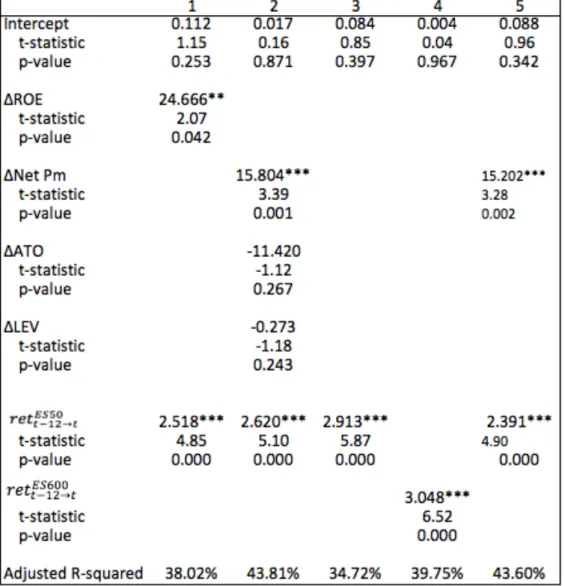
A review of the existing literature, summarized in hypothesis 3.2, suggests that professional macro forecasters take into account stock market returns but not profitability data in their GDP growth estimates. Hence, it can be expected that subsequent E.U real GDP growth forecast errors could be predicted based on aggregate profitability ratios but not based on the Euro Stoxx 50 returns. The following model tests this prediction empirically: 𝑔!!!− 𝐸!(𝑔!!!) = 𝛼 + !𝛽!× ∆𝑃𝑟𝑜𝑓𝑖𝑡𝑎𝑏𝑖𝑙𝑖𝑡𝑦 𝑅𝑎𝑡𝑖𝑜!!+ 𝛽 !!! × 𝑟𝑒𝑡!!!"→!!"!" + 𝜀!!! (5) The dependent variable of equation 5 represents the errors in prediction of real GDP growth, based on the difference between the realized and the forecasted values. The independent variables are similar to those of equation 4. The coefficient of ΔROE is anticipated to be significantly positive while that of stock returns should not be significantly different form zero. These expectations follow from the intuition that professional forecasters fully take into account equity returns but not ΔROE to forecast subsequent GDP growth. Therefore, it should not be possible to predict the forecasting errors based on the former but well based on the latter, hence the expected significantly positive sign for ΔROE but not for the stock returns variable. Along similar lines, the coefficients of ΔNet PM and ΔATO are expected to be significantly positive, while that of ΔLEV should not be significantly different from zero, as it does not contain any incremental predictive power (Table 5). The results of equation 5 are depicted in Table 7. Starting with Column 1, it can be observed that prediction errors of macro forecasters are foreseeable based on ΔROE. The estimated coefficient, significantly positive at the 5% confidence level, is consistent with the conjecture. Decomposing ROE into its main drivers in Column 2 informs that the professional
forecasters’ errors can be predicted based on ΔNet PM, at the 1% confidence level, and not based on ΔLEV, again as expected. Surprisingly however, looking at ΔATO is not useful to predict forecasters’ errors, the estimated coefficient being not significantly different from zero. The cause of the insignificance of ΔATO is to be found in Table 6, which shows that, of all the considered profitability variables, professional forecasters seem to rely the most on ΔATO to revise their GDP growth expectations between two quarters. If ΔATO is largely used by experts for their forecasting revisions, then it will be much less useful to predict their forecasting errors, hence the insignificance of the ΔATO variable.
The results reported in Column 1 and 2 regarding the stock return variable are even more surprising: they both display a statistically significantly positive coefficient at the 1% level, implying that the professional forecasters’ prediction errors are predictable based on the Euro Stoxx 50 returns. It suggests that macro forecasters do not fully incorporate equity returns when estimating GDP growth. In order to confirm this observation, in Column 3 the Euro Stoxx 50 returns are used as only predictor of the professional forecasters’ errors, with a similar result. This evidence is opposed to what KP (2014) show for the U.S setting. It could be hypothesised that macro forecasters base their E.U GDP growth predictions on the returns of a more comprehensive stock index than the Euro Stoxx 50. However Column 4 refutes this hypothesis. Regressing the errors in prediction of real GDP growth against the seasonally-adjusted quarterly returns of the Euro Stoxx 600, which contains 600 large, mid and small capitalisation firms from 17 European countries6, yields identical results: the Euro Stoxx 600 quarterly returns are significant at the 1% significance level and explain 39.75% of the prediction errors made by professional forecasters. Contrary to what was expected, the macro experts merely do not fully rely on European stock returns when they forecast the subsequent GDP growth of the European Union. One potential explanation for this unexpected result may be that European macro experts tend to rely more on a few stock indexes of some key individual countries such as France’s CAC 40 and Germany’s DAX 30 as proxies for the health of the European economy, rather than on higher-level indexes such as the Euro Stoxx 50. Further research in the field is however needed. The crucial thing to take out is that the European professional macro forecasters seem to attach less importance to stock returns than their American colleagues,
which might be detrimental to their forecast accuracy since this study shows that European indexes such as the Euro Stoxx 50 are highly significant predictors of output growth.
Overall, hypothesis 3.2 is only partly supported, since predicting errors of European macro forecasters can be anticipated based on some of the tested accounting variables (ΔROE and ΔNet PM) but can also be estimated by looking at equity returns, unlike what was prophesied. Based on this result, it would be wise for macro forecasters to rely more on stock market returns to predict E.U real GDP growth. This would improve their forecast accuracy, which would translate into a decrease in prediction errors. Table 7 Prediction of Real GDP Growth Forecast Errors based on Changes in Aggregate Profitability Ratios and the Euro Stoxx 50 Index Returns Table 7 further suggests a new and effective way to anticipate the errors in predictions of real GDP growth made by professional macro forecasters: looking only at ΔNet PM and the
Euro Stoxx 50 quarterly returns, hence leaving out ΔATO and ΔLEV, is sufficient as they explain almost 44% of the professional forecasters’ errors. This value is very similar to the one reported in Column 2, which includes the ΔATO and ΔLEV variables. In order to conclude the analysis of the results, a word about the Leverage Ratio, which was the main reason why the chosen main profitability variable was ROE rather than RNOA. ΔLEV proved to be insignificant in all of the regressions in which it was included throughout the paper. In light of these observations and assuming it would also hold for the U.S.A, KP (2014) were right not to investigate the predictive content of firms’ debt level. One can nevertheless ask why the ΔLEV is not useful to predict future output growth. Even though investigating this question would require a research on its own, a potential reason could be that the correlation goes the other way: the current economic environment, partly determined by the current growth of the GDP, probably affects the managers’ decisions with regard to their firm’s optimal capital structure and hence could help predict future average leverage ratios. Another possibility is that, for the ΔLEV to be significant, the sample of companies should be divided into sector subsamples. Indeed, differentiating between five broad industries (construction, food & beverage, oil & gas, chemicals, software) enables Talberg et al. (2008) to demonstrate that the capital structure, defined as the total long-term debt ratio, is significantly influenced by the industry in which a firm operates.
5. Conclusions, limitations and opportunities for future research
GDP growth is one of the most regarded barometers of the health of an economy. Directly or indirectly, output growth forecasts influence the decision making process of governments, public institutions, private companies, stock market investors and consumers. The most credible and reliable forecasts are published quarterly by the FED, and by the ECB since 1999, as part of the Survey of Professional Forecasters, representing the consensus expectations of professional macroeconomic experts.Building upon an novel stream of literature linking firms’ accounting data to the macro economy and more specifically upon the works of KP (2013, 2014) who inspect the case of the U.S.A, this article explores an innovative way of forecasting the aggregate output growth of the E.U: by investigating the predictive power contained in profitability data of corporations part of the Euro Stoxx 50 stock index. The sample, composed of the largest
European businesses representing 16 industries and 8 countries, offers a fair and realistic picture of the entire portfolio of companies in the E.U. Next to the geographical setting, the principal difference with KP (2014) lies in the main profitability variable used. Instead of the RNOA, the present study relies on the Return On Equity, which allows to investigate the impact of firms’ aggregate debt level. ROE is then decomposed into a variety of accounting ratios following the DuPont profitability analysis.
The results of the research first show that aggregate seasonally-adjusted quarterly changes in ROE, Net Profit Margin, Asset Turnover and Interest Burden are significant predictors of subsequent E.U GDP growth, while similar changes in Leverage Ratio, Tax Burden, Operating Margins before and after depreciation and in Depreciation ratio are not. The individual variable containing the most explanatory power is the stock return variable, in this case defined as the seasonally-adjusted quarterly returns of the Euro Stoxx 50 index. However, the crucial point is that, except for the Interest Burden, all the accounting variables that are useful to forecast GDP growth contain predictive power that is incremental to that contained in equity returns.
Results also demonstrate that, based on the E.U GDP growth consensus expectations of professional forecasters, these macro experts rely on the direction of stock returns but also of aggregate changes in ROE and ATO to revise their expectations between two quarters. However they disregard ΔNet PM. As a consequence, ΔNet PM is the most useful of the considered accounting variables to anticipate the forecasting errors of professional forecasters. ΔROE also helps estimate these errors, unlike ΔATO. Unexpectedly, relying on the returns of the Euro Stoxx 50 or the Euro Stoxx 600 is also very helpful to predict errors, since they explain respectively almost 35 and 40% of the forecasting inaccuracies, respectively. In other words, European professional macro forecasters do not seem to fully incorporate stock market returns when estimating the future growth of the economy of the E.U. This is opposed to the results found by KP (2014) in the U.S.A. Multiple reasons may explain this unexpected evidence. Does it have to do with the choice of the indexes under scrutiny? Or is there a characteristic inherent to the E.U at play? These questions represent potential topics for future research. Since the idea of linking profitability variables to macroeconomic performance has only been developed recently, literature on the subject is still limited. This article is the first to
investigate a geographical area different than the U.S.A. It also contributes to the macro-accounting literature by studying the predictive power for subsequent GDP growth contained in a profitability variable not examined before, the ROE. This variable was chosen mainly because its decomposition allows to analyse the predictive content of the companies’ cost of debt, through the Leverage Ratio.
Opportunities for future works emerge from the limitations of this study. To begin with, researchers could investigate the reasons why companies’ aggregate debt level is not useful to forecast future E.U GDP growth. This paper only speculates that the correlation might go in the opposite direction, with the GDP growth being an indicator of the choice of businesses regarding their future optimal capital structure, or that the Leverage Ratio might be a significant predictor only for some industries, and not for others. An important limitation of this research is that there is no control for industry. It is due to the sample, which, consisting of only the 50 biggest European companies in terms of market capitalisation, is too small to permit subsamples of specific countries or sectors. Hence, future research could base their work on a more extended sample. It would allow not only to base analyses on a higher number of observations, but also to separate the firms into subsamples, for example according to the 5-industry classification used by Talberg et al. (2008). Researchers would then be in position to investigate whether the capital structure of companies active in some specific industries can play a role in predicting aggregate output growth. There is also plenty of room for future investigation by analysing geographical areas different from the E.U or the U.S.A, or by exploring specifically some European countries. Another suggestion for future researchers would be to investigate the usefulness of financial statement analysis as predictor of other macroeconomic variables than output growth, such as the inflation or unemployment rates. A final limitation of the current study is that, being retrieved from the financial statements published by the companies, the accounting data are used in their nominal form. Interested researchers could try to adjust the data in order to take inflation into account.