UNIVERSIDADE DA BEIRA INTERIOR
Ciências
Biosynthesis, isolation and kinetic
characterization of recombinant human
catechol-O-methyltransferase from Pichia pastoris strains
Augusto Quaresma Henriques Pedro
Tese para a obtenção do grau de Doutor em
Bioquímica
(3º ciclo de estudos)
Orientador: Prof. Doutor Luís António Paulino Passarinha
Co-orientador: Prof. Doutor João António de Sampaio Rodrigues Queiroz
“If you can trust yourself when all men doubt you, … If you can meet with triumph and disaster and treat those two impostors just the same,
… If you can talk with crowds and keep your virtue Or walk with Kings – nor lose the common touch, … Yours is the Earth and everything that’s in it, And – which is more – you’ll be a Man, my son!”
This work was financed by the Portuguese Foundation for Science and Technology
(SFRH/BD/81222/2011) under the program QREN - POPH - Type 4.1 – Advanced
Training, cofounded by the European Social Fund and by national funds from the
MCTES. Moreover, this work was also supported in the framework of a research and
development project (EXPL/BBB478/0960/2012) and strategic programs
(PEst-C/SAU/UI0709/2011
and
Pest-OE/SAU/UI0709/2014) co-founded by the operational
program factors of competitiveness – COMPETE (FCOMP-01-0124-FEDER-041068 –
EXPL/QEQ-MED/1068/2013) and co-founded by FEDER funds
(FCOMP-01-0124-FEDER-027560) of COMPETE.
Acknowledgments
First and foremost, I'm deeply grateful to my supervisors, Professor Luís Passarinha and Professor João Queiroz for all the careful guidance throughout this thesis. Yours valuable scientific knowledge, dedication, motivation, support, professionalism and teachings during the last years were major determinants for successfully conducting this work. Also, I'm thankful for all the friendship and availability. It was a huge privilege working with you.
I’m deeply grateful to Fundação para a Ciência e Tecnologia (FCT) for the financial support through the PhD fellowship (SFRH/BD/81222/2011).
I’m thankful to all the people from University of Beira Interior and those involved in Health Sciences Research Centre which cooperated in the development of this work. In particular, a special acknowledgment to the laboratory technicians Margarida Carrilho and Sofia Duarte that really cooperated for the successful development of this work.
To all my teachers, specially Professor Eugenia Gallardo and Cláudio Maia, I’m grateful for their help and support, their scientific expertise and kind collaboration throughout this thesis.
To Professor Fani, I'm grateful for all the friendship, teachings, help and support.
To all my colleagues, specially PhD Ângela Sousa, Susana Ferreira, Filomena Silva, Rita Martins, Ana Martinho and Msc Luís Martins, David Oppolzer, Eduarda Coutinho, Fátima Santos and Margarida Gonçalves, I would like to acknowledge all the teachings, friendship, support and kind collaboration during the course of this thesis.
To Patrícia, thank you not only by all the friendship and love but also for the companionship and collaboration in the good and bad times. I'm sure that you own a piece of the success of this work.
To my father, for all you mean to me; my brother, my fellow always forever; my uncles, always there for me; my grandmother and my uncle, I will always be grateful for your love, friendship and support.
Resumo
A catecol-O-metiltransferase (COMT; EC 2.1.1.6) é uma enzima dependente de magnésio que cataliza a reação de metilação de diferentes substratos com estrutura catecólica, nomeadamente catecolaminas, catecóis xenobióticos e catecolestrogénios. Em humanos, esta enzima encontra-se presente sob duas isoformas, uma solúvel (SCOMT) e uma membranar (MBCOMT), esta última associada à membrana do retículo endoplasmático rugoso.
Após os primeiros estudos realizados com estas enzimas, estabeleceu-se que estas poderiam estar potencialmente envolvidas em diversas patologias humanas. Em particular, chegou-se à conclusão que a sua inibição origina grandes benefícios na doença de Parkinson onde leva a um aumento da biodisponibilidade da levodopa, administrada para colmatar a falta de dopamina causada pela degeneração dos neurónios dopaminérgicos. Assim, o desenvolvimento de moléculas com capacidade para inibir a atividade biológica da COMT com potência e seletividade aperfeiçoadas poderia melhorar o prognóstico destes doentes. O processo para o desenvolvimento destas moléculas geralmente inclui a realização de estudos estruturais baseados em estruturas previamente determinadas que dependem da obtenção de elevadas quantidades de proteínas purificadas.
A determinação de estruturas tridimensionais de proteínas é geralmente dificultada por vários obstáculos, principalmente devido ao fato de se encontrarem em quantidades reduzidas nas suas fontes naturais e à dificuldade em obter cristais cuja Difração de Raios-X produza resultados positivos. Além disso, uma vez que as proteínas membranares se encontram naturalmente embebidas numa bicamada lipídica, a determinação da sua estrutura enfrenta desafios adicionais.
Visto que do ponto de vista laboratorial é praticamente impossível purificar a maioria destes alvos proteicos diretamente a partir das suas fontes naturais, em biologia estrutural, geralmente utiliza-se a produção recombinante heteróloga de proteínas em hospedeiros procariotas ou eucariotas. Adicionalmente, para isolar as proteínas-alvo heterólogas dos restantes contaminantes do hospedeiro, é necessário o desenvolvimento e implementação de estratégias de purificação, principalmente através de procedimentos cromatográficos. Ao longo deste processo, também é relevante que a estratégia desenvolvida permita que as proteínas mantenham o seu estado nativo e, consequentemente, biologicamente ativo. Desta forma, é importante evitar que a proteína se acumule num estado desenrolado e não funcional durante a sua biossíntese ou, por outro lado, evitar a sua agregação após a sua recuperação e purificação. Assim sendo, o principal objetivo deste trabalho é o desenvolvimento de uma abordagem integrada, simples e eficiente para a biossíntese e purificação de ambas as isoformas da COMT numa forma biologicamente ativa, passíveis de posteriores aplicações em estudos estruturais.
Não existe um único hospedeiro que reúna todas as características desejadas para a biossíntese recombinante de proteínas. No entanto, encontra-se descrito que a Pichia pastoris é capaz de realizar muitas modificações pós-tradução necessárias para o correto enrolamento de algumas proteínas e obtêm-se elevadas densidades celulares em meios relativamente pouco dispendiosos. Assim, tendo em conta estas vantagens, este hospedeiro foi selecionado neste trabalho para a expressão de ambas as isoformas da COMT. Por outro lado, procurou-se explorar a elevada seletividade geralmente associada à cromatografia de afinidade, tendo-se por isso definido este tipo de cromatografia como o principal passo de isolamento e purificação da COMT.
A determinação da atividade enzimática da COMT apresenta elevada importância do ponto de vista científico em todas as investigações relacionadas com a COMT recombinante. Desta forma, tendo em vista a quantificação da metanefrina produzida em ensaios enzimáticos da COMT, desenvolveu-se e implementou-se um método analítico baseado em cromatografia líquida de elevada performance com deteção coulométrica. Além do tempo de corrida de cada ensaio ser inferior aos reportados anteriormente, as melhorias na razão sinal/ruído atingidas com a deteção coulométrica permitiram detetar e quantificar quantidades inferiores do analito em questão, levando a um aumento da sensibilidade deste método em comparação com métodos alternativos descritos na literatura.
De seguida, desenvolveu-se uma estratégia integrada para a biossíntese da SCOMT em Pichia pastoris e subsequente purificação por cromatografia de afinidade com iões metálicos imobilizados. Através da aplicação com sucesso desta estratégia, frações de SCOMT com elevada pureza foram obtidas. Estas frações foram ainda avaliadas por ionização por dessorção a laser assistida por matriz com deteção em dois analisadores do tipo tempo de vôo (em inglês, MALDI-TOF/TOF) e verificou-se que apresentavam uma estrutura primária idêntica à correspondente SCOMT nativa, indicando que foi corretamente processada pela maquinaria intracelular do hospedeiro. Também se determinou a sensibilidade (IC50 - Concentração de
composto necessária para inibir 50% da atividade enzimática máxima da enzima-alvo) da SCOMT para ser inibida por dois inibidores disponíveis comercialmente - entacapone e 3,5-dinitrocatecol - e obtiveram-se valores da mesma ordem de grandeza dos que foram reportados anteriormente. Em conjunto, estes resultados vêm corroborar que a proteína é idêntica à sua correspondente nativa. Perante o sucesso atingido com esta estratégia, como a expressão heteróloga de proteínas membranares é geralmente mais complexa do que a expressão de proteínas solúveis e visto que existem menos dados na literatura relativamente à MBCOMT quando comparada com a correspondente isoforma solúvel, as etapas subsequentes na dissertação tiveram como foco principal a MBCOMT.
No que diz respeito à expressão recombinante em Pichia pastoris da MBCOMT, desenvolveram-se e implementaram-se protocolos para a sua produção em pequena escala
produção da MBCOMT em erlenmeyer por duas estirpes de Pichia pastoris com fenótipos opostos e em condições experimentais distintas. Efetivamente, verificou-se que os níveis de produção da proteína-alvo foram superiores quando a indução foi realizada apenas com metanol, por contraposição aos ensaios onde se utilizou metanol juntamente com glicerol ou sorbitol em modo de alimentação mista. Apesar da performance das duas estirpes em sintetizar a MBCOMT ter sido semelhante, selecionou-se para ensaios posteriores a estirpe X33 (Mut+), em detrimento da KM71H (MutS). De fato, como a estirpe KM71H é mais influenciada
pela concentração de indutor utilizada, a eventual aplicação de uma concentração de metanol inadequada compromete os níveis de produção, o que não se verifica com a estirpe X33.
No entanto, os resultados mais promissores foram obtidos em mini-biorreatores onde a fase de indução foi otimizada e modelada através de uma rede neuronal artificial. Dos fatores otimizados, destaca-se a adição de dimetilsulfóxido, um agente que atua como um chaperone químico, melhorando a produção de proteínas recombinantes membranares. Além deste bioprocesso não interferir com a viabilidade celular, permitiu a obtenção de elevados níveis de MBCOMT enzimaticamente ativa.
Após a implementação de um processo eficiente para a produção recombinante da MBCOMT, desenvolveram-se estratégias para a sua purificação. Inicialmente, utilizou-se cromatografia de afinidade com arginina imobilizada para o isolamento da MBCOMT a partir de lisados de Pichia pastoris. Durante este processo, avaliou-se o efeito do pH, temperatura e a concentração da amostra injetada na adsorção e grau de purificação da enzima-alvo. Assim, a estratégia otimizada foi obtida a pH 7 e conduzida a 20ºC com uma amostra inicial mais concentrada, a partir da qual a MBCOMT foi recuperada num estado intermédio de purificação. Finalmente, desenvolveu-se uma metodologia para a purificação de uma forma recombinante da MBCOMT com um tag de 6 histidinas no terminal carboxilo por cromatografia de afinidade com iões metálicos imobilizados. Apesar deste trabalho ainda não estar concluído, o seu progresso permitiu avaliar o efeito do tag na atividade biológica da MBCOMT e verificou-se que a introdução de um local de clivagem para uma protease leva à perda total da atividade biológica, o que não se observou quando a enzima contém apenas o tag. Finalmente, testaram-se vários detergentes para a solubilização da MBCOMT e verificou-se que o dodecilmaltosídeo foi o mais adequado. De seguida, efetuaram-se vários ensaios para avaliar o comportamento cromatográfico da proteína-alvo com 6 histidinas em diferentes condições experimentais, nomeadamente com diferentes tampões cromatográficos e diferentes iões imobilizados na matriz, nomeadamente Níquel e Zinco. No entanto, para obter uma separação efetiva da enzima-alvo dos demais contaminantes, serão necessários testar gradientes por passos com diferentes concentrações de imidazol ou, alternativamente, testar outros métodos de eluição como a diminuição do pH e a competição com histidina.
O progresso atingido com a elaboração deste trabalho permitiu de certa forma atingir os requisitos altamente exigentes necessários para a realização de diversas técnicas biofísicas, particularmente no que diz respeito à fase de produção e estabilização da COMT. De fato, com as estratégias anteriormente reportadas, foram obtidas quantidades moderadas a elevadas de ambas as isoformas da COMT num estado cataliticamente ativo. A estratégia aqui reportada para a isoforma solúvel permite a obtenção da proteína num estado de elevada pureza que quando associada a um passo de cromatografia de exclusão molecular poderá efetivamente cumprir os requisitos necessários para realizar estudos estruturais ou estudos de bio-interação com ligandos ou inibidores já comercializados.
Em sentido inverso, as estratégias reportadas neste trabalho com sucesso para a purificação parcial da MBCOMT necessitam de ser melhoradas, particularmente para a cromatografia de afinidade com iões metálicos imobilizados. Visto que este tipo de cromatografia é geralmente caracterizado por apresentar elevada seletividade, é exequível que a realização de ensaios adicionais poderá levar à obtenção de frações com elevada pureza. Desta forma, com a elaboração destes ensaios adicionais, poder-se-á obter proteína-alvo em condições que cumpram os requisitos necessários para realizar estudos estruturais e de bio-interação utilizando a apoenzima ou a enzima complexada com diferentes ligandos tais como cofatores ou inibidores já disponíveis. Estes estudos poderão ser conduzidos por ressonância magnética nuclear, calorimetria de titulação isotérmica ou até experiências cristalográficas.
Relativamente às perspetivas futuras, poderá vir a revelar-se útil desenvolver sistemas de expressão sem células, principalmente para a isoforma membranar da COMT visto que se poderá acoplar a sua reconstituição em sistemas não micelares tais como nanodiscos ou lipossomas, que poderá contribuir para a sua estabilização. Adicionalmente, tendo em vista a obtenção de frações purificadas com estas enzimas numa forma nativa, isto é, sem introdução de tags de histidinas por exemplo, poderá explorar-se a cromatografia de imunoafinidade. Através da imobilização de um anticorpo que reconheça um epítopo comum a ambas as isoformas, esta matriz poderá demonstrar elevada versatilidade e ser aplicada tanto para a purificação da COMT solúvel como da membranar.
Palavras-chave
Abstract
Catechol-O-methyltransferase (COMT; EC 2.1.1.6) is a magnesium-dependent enzyme that catalyzes the methylation reaction of different catecholic substrates such as catecholamines, xenobiotic catechols and catecholestrogens. Following the initial characterizations of these enzymes, it was described that they are potentially involved in diverse human disorders. Specifically, as its inhibition has proven to be of great interest in neurologic disorders such as Parkinson's disease, developing inhibitor molecules with increased potency and selectivity may improve the outcome of these patients. These molecules are usually accomplished using structure-based drug design studies that rely on the attainment of highly purified protein quantities. Indeed, challenges in the determination of protein structures are mainly associated with their low natural abundance coupled with the difficulty of obtaining crystals amenable to X-Ray diffraction. In particular, as membrane proteins are naturally embedded in the lipid bilayer, the determination of their structure faces additional difficulties.
As it is unrealistic to purify all of these targets from their natural sources, structural biology of proteins usually focus on the recombinant heterologous expression of these proteins onto an expression host. In addition, to isolate the target proteins from the other major host contaminants, equally appropriated purification strategies need to be designed and implemented, mostly using chromatographic procedures. Throughout this entire process, is also important that the developed strategy is able to keep the proteins in a stable and functional active form, thus avoiding its misfolding during biosynthesis and aggregation after its recovery and isolation in the downstream processing. Therefore, the main scope of this work is the development of a straightforward approach that allows the biosynthesis, isolation and purification of recombinant human COMT isoforms in a biologically active form for further application in structural studies or to evaluate their role as potential therapeutic proteins. Specifically, although no single host can provide all the desired properties for recombinant protein biosynthesis, Pichia pastoris is able to perform many post-translational modifications and is cultivated at high cell-densities in moderately cheap media. Therefore, in this work, it was selected for expression of COMT enzymes. On the other hand, the high selectivity often provided by affinity chromatography prompted us to employ it as the main isolation and purification step.
The determination of COMT enzymatic activity is greatly important in COMT recombinant research, either to assess COMT activity from recombinant lysates or purified fractions, for detergent-solubilized or unsolubilized samples and for both isoforms. Therefore, a faster and more sensitive analytical method based on HPLC coupled with coulometric detection was developed for quantifying metanephrine in these assays. Then, an integrated strategy for recombinant soluble catechol-O-methyltransferase (SCOMT) biosynthesis onto P. pastoris and
purification using immobilized-metal affinity chromatography was implemented where highly purified fractions of this target enzyme were obtained.
On the other hand, as heterologous membrane protein overexpression is usually more challenging than soluble proteins and less reports are available in the literature with recombinant human membrane-bound catechol-O-methyltransferase (MBCOMT) than COMT soluble isoform, our work were mostly focused on MBCOMT. Here, we established protocols for MBCOMT expression in Pichia pastoris methanol-induced cultures in baffled shake-flasks and mini-bioreactors. In particular, the optimization of the induction phase using artificial neural networks in mini-biorreactors allowed achieving high levels of biologically active MBCOMT. Then, arginine-affinity chromatography was successfuly applied for the direct capture of MBCOMT from Pichia pastoris lysates and it was recovered in a moderate purified form. Finally, the ongoing work is related to the purification of a hexa-histidine tagged form of MBCOMT using immobilized-metal affinity chromatography. Indeed, despite significant achievements were made concerning the construction of a tagged form of MBCOMT solubilized with an appropriated detergent in a biologically active form, additional stepwise gradients are required to effectively separate MBCOMT from the other contaminants.
In conclusion, the progress achieved with this work meets the highly demanding requirements of biophysical techniques, mainly regarding the upstream stage as well as COMT stabilization where moderate to high quantities of catalitically active enzymes were obtained. In particular, coupling the strategy here reported for SCOMT with a final polishing step will probably allow performing structural or bio-interaction studies with this enzyme. Nonetheless, the strategies here described successfully for partial MBCOMT purification need to be improved, especially for immobilized-metal affinity chromatography once it is considered to be highly selective and, thus, it is feasible that after succesful optimization procedures, fractions with high purity will be obtained. Therefore, the strategies here reported with the intensification and optimization of some procedures would possible permit performing structural and bio-interaction studies using the apo-enzymes or complexed with different ligands (cofactors or inhibitors) by Nuclear Magnetic Ressonance, Isothermal Titration Calorimetry or even using Crystallographic experiments.
Keywords
Parkinson's Disease; Recombinant Proteins; Catecol-O-methyltransferase; Pichia pastoris; Bioreactor; Affinity Chromatography; Protein Purification.
Thesis Overview
This thesis is structured in four main chapters. The first chapter is divided into three sections. The first section presents an explanation concerning the importance and interest of the enzyme catechol-O-methyltransferase and its potential pathophysiological role in several human diseases, especially Parkinson’s disease. Also in this section, is highlighted the importance of developing systems for the recombinant expression of enzymes, particularly the catechol-O-methyltransferase as well as the implementation of chromatographic strategies in order to obtain pure samples in high quantity for structural and functional studies. This section results in a general introduction to the main issues/challenges presented in sections 2 and 3. The second section of the first chapter deals with the implementation and development of biosynthesis strategies in order to circumvent common problems associated to membrane protein structure determination (Paper 1 - From gene to structure: biosynthesis strategies to break the bottlenecks associated to membrane protein structure determination). Finally, the last section of chapter 1 adress the biosystem Pichia pastoris as a recombinant microfactory for the production of membrane proteins. In particular, are discussed Pichia pastoris morphological and biomolecular characteristics, biosynthesis strategies for protein production in Pichia pastoris and typical fermentation flowsheets usually applied for membrane proteins.
The second chapter includes the global as well as the intermediate aims established for the implementation and development of this study. Accordingly, the third chapter includes the presentation and discussion of the results obtained during this research work in the form of original research papers organized as follows:
Paper II – An improved HPLC method for quantification of metanephrine with coulometric detection.
Paper III – Biosynthesis and Purification of histidine-tagged human soluble catechol-O-methyltransferase.
Paper IV – Evaluation of MutS and Mut+ Pichia pastoris strains for membrane-bound
catechol-O-methyltransferase biosynthesis.
Paper V – An artificial neural network for membrane-bound catechol-O-methyltransferase biosynthesis with Pichia pastoris methanol-induced cultures.
Paper VI – Purification of membrane-bound catechol-O-methyltransferase by arginine-affinity chromatography.
Paper VII – Purification of histidine-tagged membrane-bound catechol-O-methyltransferase immobilized-metal affinity chromatography.
The fourth chapter summarizes the concluding remarks obtained during this research work, mostly concerning the application of Pichia pastoris for the small-scale and bioreactor production of recombinant catechol-O-methyltransferase isoforms as well as the novel chromatographic methods implemented in this work for its purification. Also, the impact of the findings here reported in developing structural and functional studies using both catechol-O-methyltransferase isoforms will also be addressed. Finally, it will be also presented the future trends of this thesis and additional research work beyond what has been performed here.
Table of Contents
List of Figures xxiii
List of Tables xxv
List of Abbreviations xxvii
List of Scientific Publications xxix
List of Scientific Communications xxxiii
Chapter 1
1. General aspects on the catechol-O-methyltransferase enzymes 3 1.1 The catechol-O-methyltransferase Valine/Methionine 108/158 polymorphism 4 1.2 Soluble vs membrane-bound COMT: relative distribution and proposed function 5 1.3 Catechol-O-methyltransferase pathophysiological role in human diseases 6 1.3.1 Catechol-O-methyltransferase inhibition in Parkinson’s disease 6 1.3.2 Catechol-O-methyltransferase as a therapeutic protein? 8 1.4 Recombinant human catechol-O-methyltransferase biosynthesis and
purification 9
1.5 Analytical methods in catechol-O-methyltransferase enzymatic assays 12 1.6 Catechol-O-methyltransferase three-dimensional structure 14
1.7 References 16
2. From gene to structure: biosynthesis strategies to break the bottlenecks
associated to membrane protein structure determination (Paper I) 23 3. Recombinant protein biosynthesis in Pichia pastoris 69 3.1 Pichia pastoris as a recombinant microfactory 69 3.2 Bioprocess design: medium formulation and operation conditions 70 3.3 Typical fermentation flowsheets for human membrane proteins 73
3.4 References 75
Chapter 2
Global aims 79
Chapter 3
Paper II. An improved HPLC method for quantification of metanephrine with
coulometric detection 85
Paper III. Biosynthesis and Purification of histidine-tagged-human soluble
catechol-O-methyltransferase 95
Paper IV. Evaluation of MutS and Mut+ Pichia pastoris strains for membrane-bound
catechol-O-methyltransferase 135
Paper V. An artificial neural network for membrane-bound
catechol-O-methyltransferase biosynthesis with Pichia pastoris methanol-induced cultures
Paper VI. Purification of membrane-bound catechol-O-methyltransferase by
arginine-affinity chromatography 173
Paper VII. Purification of histidine-tagged membrane-bound
catechol-O-methyltransferase by immobilized-metal affinity chromatography 185 Chapter 4
Concluding remarks 215
List of Figures
Figure 1 - Typical O-methylation reaction of different catechol substrates by COMT. 3
List of Tables
Table 1 - Relative quantification of soluble and MBCOMT proteins in rat and human
tissues expressed as % of total COMT in the immunoblot (adapted from [Bonifacio et al.,
2007]). 5
Table 2 - Characteristics and production levels for recombinant soluble and
membrane-bound human COMT biosynthesis using different expression systems. 9
Table 3 - Chromatographic methodologies previously reported for recombinant human
soluble and membrane-bound COMT isolation and purification. 11
Table 4 – HPLC-based analytical methods commonly applied as separation and
quantification technique in COMT enzymatic activity assays. 13
Table 5 – Summary of the 3D structures previously reported for human SCOMT. 14
Table 6 – Pichia pastoris alternative promoters to AOX1. 68
List of Abbreviations
3-MT 3-Methoxytyramine 3-OMD 3-O-methyldopa
AADC Aromatic Amino Acid Decarboxylase ANN Artificial Neural Network
AOX Alcohol Oxidase
BBB Blood-Brain Barrier BSM Basal Salts Medium
COMT Catechol-O-methyltransferase DDM n-dodecyl-β-D-maltopyranoside
DNC 3,5-dinitrocatechol
DOPAC Dihydroxyphenylacetic acid
EAE Experimental Autoimmune Encephalomyelitis E. coli Escherichia coli
GPCR G-Protein Coupled Receptor GRAS Generally Recognized As Safe
IC50 Half maximal inhibitory concentration
IMAC Immobilized-Metal Affinity Chromatography IPTG Isopropylthiogalactosidase
L-DOPA Levodopa
LB Lysogeny broth
MALDI-TOF/TOF Matrix Assisted Laser Desorption/Ionization with tandem Time Of Flight
MAO Monoamine oxidase
MBCOMT Membrane-bound Catechol-O-methyltransferase
MBCOMT-His6 Hexa-histidine tagged membrane-bound catechol-O-methyltransferase
MBCOMT-TEV-His6 Hexa-histidine tagged membrane-bound catechol-O-methyltransferase with a linker for Tobacco Etch Virus
MES 2-(N-morpholino)-ethanesulfonic acid
Met Methionine
MP Membrane Protein
MPD (4S)-2-methyl-2,4-pentanediol PD Parkinson’s Disease
P. pastoris Pichia pastoris
SAH S-adenosyl-L-homocysteine
SAM S-adenosyl-L-methionine
SCOMT Soluble Catechol-O-methyltransferase
SCOMT-His6 Hexa-histidine tagged soluble catechol-O-methyltransferase
Sf9 Spodoptera frugiperda TEV Tobacco Etch Virus
List of Scientific Publications
Papers related with this Thesis
I. From gene to structure: biosynthesis strategies to break the bottlenecks associated to membrane protein structure determination
A. Q. Pedro, M. J. Bonifacio, J. A. Queiroz, L. A. Passarinha Submitted for publication (2015)
II. An improved HPLC method for quantification of metanephrine with coulometric detection
A. Q. Pedro, R. F. Soares, D. Oppolzer, F. M. Santos, L. A. Rocha, A. M. Gonçalves, M. J. Bonifacio, J. A. Queiroz, E. Gallardo, L. A. Passarinha
Journal of Chromatography and Separation Techniques (2014) 5 (2): 217-224
III. Biosynthesis and Purification of histidine-tagged human soluble catechol-O-methyltransferase
A. Q. Pedro, F. F. Correia, F. M. Santos, G. Espírito-Santo, A. M. Gonçalves, M. J. Bonifacio, J. A. Queiroz, L. A. Passarinha
Submitted for publication (2015)
IV. Evaluation of MutS and Mut+ Pichia pastoris strains for membrane-bound
catechol-O-methyltransferase
A. Q. Pedro, D. Oppolzer, M. J. Bonifacio, J. A. Queiroz, L. A. Passarinha Applied Biochemistry and Biotechnology (2015) 175 (8): 3840-3855
V. An artificial neural network for membrane-bound catechol-O-methyltransferase biosynthesis with Pichia pastoris methanol-induced cultures
A. Q. Pedro, L. M. Martins, J. M. Dias, M. J. Bonifacio, J. A. Queiroz, L. A. Passarinha Microbial Cell Factories (2015) 14: 113-127
VI. Purification of membrane-bound catechol-O-methyltransferase by arginine-affinity chromatography
A. Q. Pedro, P. Pereira, M. J. Bonifacio, J. A. Queiroz, L. A. Passarinha Chromatographia (2015) 78 (21): 1339-1348
VII. Purification of histidine-tagged membrane-bound catechol-O-methyltransferase by immobilized-metal affinity chromatography
A. Q. Pedro, M. J. Bonifacio, J. A. Queiroz, L. A. Passarinha Ongoing work
Papers not related with this Thesis
I. A novel prokaryotic expression system for biosynthesis of recombinant human membrane-bound catechol-O-methyltransferase
A. Q. Pedro, M. J. Bonifacio, J. A. Queiroz, C. J. Maia, L. A. Passarinha Journal of Biotechnology (2011) 156 (2): 141-146
II. Performance of hydrophobic interaction ligands for human membrane-bound
catechol-O-methyltransferase purification
F. M. Santos, A. Q. Pedro, R. F. Soares, R. Martins, M. J. Bonifacio, J.A. Queiroz, L. A. Passarinha
Journal of Separation Science (2013) 36 (11): 1693-1702
III. Pichia pastoris: a recombinant microfactory for antibodies and human membrane proteins
A. M. Gonçalves, A. Q. Pedro, C. Maia, F. Sousa, J. A. Queiroz, L. A. Passarinha Journal of Microbiology and Biotechnology (2013) 23 (5): 587-601
IV. Recovery of biological active catechol-O-methyltransferase isoforms from Q-sepharose
F. F. Correia, F. M. Santos, A.Q. Pedro, M. J. Bonifácio, J. A. Queiroz, L.A. Passarinha Journal of Separation Science (2014) 37 (1-2): 20-29
V. Trends in protein-based biosensor assemblies for drug screening and pharmaceutical kinetic studies
A. M. Gonçalves, A.Q. Pedro, F. M. Santos, L. M. Martins, C. J. Maia, J.A. Queiroz, L.A. Passarinha
Molecules (2014) 19 (8): 12461-12485
VI. Development of fed-batch profiles for efficient biosynthesis of catechol-O-methyltransferase
G. M. Espírito Santo, A.Q. Pedro, D. Oppolzer, M. J. Bonifacio, J.A. Queiroz, F. Silva, L.A. Passarinha
Biotechnology Reports (2014) 3: 34-41
VII. Enhanced biosynthesis of plasmid DNA from Escherichia coli VH33 using Box-Behnken design associated to aromatic amino acids pathway
L. M. Martins, A. Q. Pedro, D. Oppolzer, F. Sousa, J. A. Queiroz, L. A. Passarinha Biochemical Engineering Journal (2015) 15: 117-126
VIII. Advances in time-course extracellular production of human pre-miR-29b from
Rhodovulum sulfidophilum
P. Pereira, A. Q. Pedro, J. Tomás, C. J. Maia, J. A. Queiroz, A. Figueiras, F. Sousa Submitted for publication (2015)
List of Scientific Communications
Poster Communications related with this Thesis
I. Strategies to improve recombinant human membrane protein overexpression for structural, functional and clinical studies
A. Q. Pedro, M. J. Bonifacio, C. J. Maia, J. A. Queiroz, L. A. Passarinha V Jornadas sobre Tecnologia e Saúde 2012. Guarda, Portugal
II. Evaluation of a MutS and Mut+ Pichia pastoris strains for membrane-bound COMT
biosynthesis
A. Q. Pedro, D. Oppolzer, M. J. Bonifacio, C. J. Maia, J. A. Queiroz, L. A. Passarinha
Portuguese Congress of Microbiology and Biotechnology – Microbiotec 2013. Aveiro, Portugal
III. Evaluation of a MutS and Mut+ Pichia pastoris strains for membrane-bound COMT
biosynthesis
A. Q. Pedro, D. Oppolzer, M. J. Bonifacio, C. J. Maia, J. A. Queiroz, L. A. Passarinha
Modern biophysical methods for protein-ligand interactions – EMBO practical course 2013. Oulu, Finland
IV. Biosynthesis, Purification and Biointeraction of human SCOMT with Parkinson’s disease inhibitors
F. F. Correia, A. Q. Pedro, D. Oliveira, J. A. Queiroz, L. A. Passarinha 16th European Congress on Biotechnology (ECB) 2014. Edinburgh, Scotland
V. Membrane-bound catechol-O-methyltransferase biosynthesis in Pichia pastoris: optimization of the induction phase using artificial neural networks
A. Q. Pedro, L. M. Martins, J. M. L. Dias, M. J. Bonifacio, J. A. Queiroz, L. A. Passarinha Protein & Antibody Engineering Summit (PEGS) Europe 2014. Lisboa, Portugal
VI. An artificial neural network for membrane-bound catechol-O-methyltransferase biosynthesis in mini-bioreactors with Pichia pastoris methanol-induced cultures networks
A. Q. Pedro, L. M. Martins, J. M. L. Dias, M. J. Bonifacio, J. A. Queiroz, L. A. Passarinha 8th Conference on Recombinant Protein Production (RPP) 2015. Mallorca, Spain
Oral Communications not related with this Thesis
I. Advances in time-course biosynthesis and solubilization of MBCOMT from
Brevibacillus cells
A. Q. Pedro, M. J. Bonifacio, J. A. Queiroz, C. J. Maia, L. A. Passarinha VI Anual CICS Symposium 2011. Covilhã, Portugal
II. Kinetics of a recombinant form of human membrane-bound Catechol-O-methyltransferase
Filipa Sousa, Maria João Bonifácio, Augusto Q. Pedro, Luís A. Passarinha, Lyndon Wright, Patrício Soares-da-Silva
XLII Reunião da Sociedade Portuguesa de Farmacologia 2012. Lisboa, Portugal
III. A novel prokaryotic expression system for biosynthesis of recombinant human membrane-bound catechol-O-methyltransferase
A. Q. Pedro, F. Sousa, M. J. Bonifacio, C. J. Maia, J. A. Queiroz, L. A. Passarinha
ESBES (9th European Symposium on Biochemical Engineering Science) 2012. Istanbul, Turkey
IV. Evaluation of human membrane-bound catechol-O-methyltransferase purification by hydrophobic interaction chromatography
F. M. Santos, A. Q. Pedro, R. Martins, C. J. Maia, M. J. Bonifacio, J. A. Queiroz, L. A. Passarinha
ISPPP (32nd International Symposium on the Separation of Proteins, Peptides and
Polynucleotides) 2012. Istanbul, Turkey
V. Purification of recombinant human membrane COMT by ionic-exchange chromatography
F. Correia, F. Santos, A. Q. Pedro, M. J. Bonifacio, J. A. Queiroz, L. A. Passarinha VIII Anual CICS Symposium 2013. Covilhã, Portugal
VI. Biosynthesis, purification and brain-targeted delivery of pre-miR-29b
biopharmaceuticals for Alzheimer’s disease therapy
P. Pereira, A. Q. Pedro, J. Tomás, C. Cruz, A. Sousa, C. Maia, J. A. Queiroz, A. Figueiras, F. Sousa
Poster Communications not related with this Thesis
I. Biosynthesis of human membrane-bound catechol-O-methyltransferase optimization using Plackett-Burman and central composite rotatable design
R. Soares, S. Ferreira, A. Q. Pedro, A. M. Gonçalves, C. J. Maia, M. J. Bonifacio, J. A. Queiroz, L. A. Passarinha
Section 1 - Introduction
1. General aspects on the catechol-O-methyltransferase enzymes
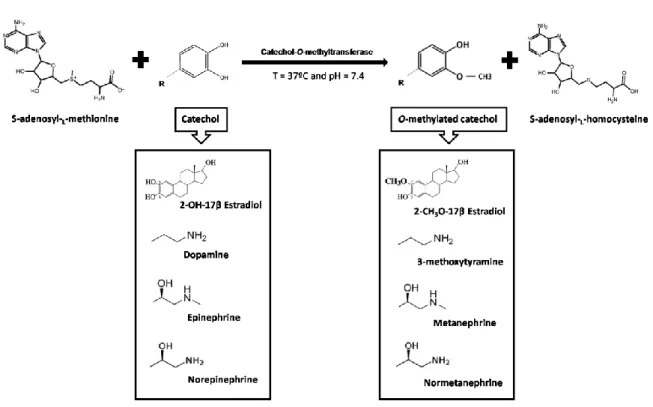
Catechol-O-methyltransferase (COMT; EC 2.1.1.6) is a magnesium-dependent enzyme that catalyzes the methylation reaction whereby a methyl group from S-adenosyl-L-methionine (SAM)
is transferred to one of the catecholic hydroxyls, according to Figure 1 [Bonifacio et al., 2007; Ma et al., 2014]. As reaction products, are obtained the O-methylated catechol and S-adenosyl-L
-homocysteine (SAH) [Bonifacio et al., 2007].
Figure 1 –Typical O-methylation reaction of different catechol substrates by COMT.
The methylation reaction by COMT occurs via a sequentially ordered mechanism where SAM firstly binds to the enzyme, followed by the Mg2+ ion and the substrate [Ma et al., 2014]. This
order is necessary because the binding of one changes the shape of the binding site so that the next can bind [Thomas and Potter, 2013]. Typically, the substrates of COMT (Please see Figure 1) in mammals include catecholestrogens and their metabolites, catecholamines with hormonal and neurotransmission activities such as dopamine, norepinephrine, epinephrine, ascorbic acids, some indolic intermediates of melanin metabolism and xenobiotic catechols like carcinogenic catechol-containing flavonoids [Bonifacio et al., 2007].
COMT exists as two molecular forms, a soluble (SCOMT) and a membrane-bound (MBCOMT) isoform, both encoded by the same gene located on chromosome 22 band q11.2 [Müller, 2015].
In humans, SCOMT is a 221 amino acid protein with 24.7 KDa while MBCOMT has 30 KDa since it contains an additional stretch of 50 amino acid, the signal sequence for membrane anchoring [Bonifacio et al., 2007; Ma et al., 2014]. MBCOMT is anchored to the rough endoplasmic reticulum membrane and is characterized as an integral membrane protein (MP) with the catalytic portion of the enzyme oriented toward the cytoplasmic side of the membrane [Bonifacio et al., 2007]. On the other hand, SCOMT is thought to be located in the cytosol [Bonifacio et al., 2007], although it has also been reported in the nucleus of rat transfected COS-7 cells [Lundtröm et al., 1995] as well as in mammary epithelial cells in the presence of increased levels of catecholestrogens [Weisz et al., 2000].
1.1. The catechol-O-methyltransferase Valine/Methionine 108/158
polymorphism
Two codominant alleles in exon 4 of the COMT gene influence the amino acid structure [Valine (Val) or Methionine (Met)] at codon 108/158, respectively for soluble and MBCOMT [Bonifacio et al., 2007; Hosak, 2007]. As a matter of fact, COMT enzymatic activity is genetically polymorphic with a trimodal activity distribution (High in Val/Val, intermediate in Val/Met and low in Met/Met genotypes) [Bonifacio et al., 2007; Hosak, 2007]. The Met 108/158 variant is associated with low enzymatic activity and decreased thermal stability [Bonifacio et al., 2007]. It was also reported that the Val158Met polymorphism appears to have pleiotropic effects on human behavior [Hosak, 2007] and recently it was demonstrated that the COMT inhibitor tolcapone-mediated cytotoxicity is influenced by the Val/Met genotypes [Chen et al., 2011]. Recently, it was demonstrated that the Val/Met polymorphism influence plasma total homocysteine levels [Tunbridge et al., 2008]. Indeed, it was observed that COMT Val158 individuals had significantly higher plasma total homocysteine levels than Met158 homozygotes [Tunbridge et al., 2008]. Another study revealed that this polymorphism is associated with incident cardiovascular disease and this association was modified by randomized allocation to aspirin, a commonly used cardiovascular prevention agent [Hall et al., 2014].
In several breast cancer in vitro models (MCF-7, MCF-10A and MCF-10F), it has been demonstrated that COMT plays an important role in the methylation of catechol estrogens, by blocking their oxidative metabolism to reactive quinones and the associated formation of reactive oxygen species [Yager, 2015]. Although with inconsistent results, the low activity polymorphism in COMT has been shown to cause a small but significant increased risk for developing breast cancer [Yager, 2012; Yager, 2015].
1.2. Soluble vs membrane-bound COMT: relative distribution and proposed
function
COMT gene codes for two separates enzymes, soluble and MBCOMT that share the basic kinetic mechanism (Ca2+ inhibition, Mg2+ requirement, pH optimum, similar K
m value for SAM and
recognition by SCOMT antiserum) [Myöhänen and Männistö, 2010]. As depicted in Table 1, in most human and rat tissues, the levels of SCOMT greatly exceed the levels of MBCOMT, except for the human brain where it only represents 30% of the total COMT [Bonifacio et al., 2007].
An important difference between COMT isoforms is that with exception of catechol estrogens, which possess similar Km values for both isoforms, all other catechol substrates including
catecholamines have lower Km values for MBCOMT [Roth, 1992]. Interestingly, the substrate
concentration seems to influence the kinetic parameters of both isoforms since at low concentrations of catecholamines, O-methylation by the low Km membrane-bound form of COMT
would predominate, and only when this enzyme becomes saturated with substrate, does the contribution of the high Km soluble form of COMT becomes significant [Roth, 1992].
Table 1 – Relative quantification of soluble and MBCOMT proteins in rat and human tissues
expressed as % of total COMT in the immunoblot (adapted from [Bonifacio et al., 2007]).
Rat Tissues
Tissue SCOMT MBCOMT
Liver 93 7 Kidney 75 25 Heart 79 21 Cerebellum 86 14 Telencephalon 69 31 Human Tissues
Tissue SCOMT MBCOMT
Liver 85 15 Kidney 77 23 Adrenal 74 26 Duodenum 89 11 Brain 30 70 HeLa-Cells 35 65 MCF7-Cells 92 8
In general, the two forms are proposed to have at least partially distinct roles: MBCOMT is believed to be primarily involved in the termination of dopaminergic and noradrenergic synaptic neurotransmission when there are physiologically relevant low concentrations of catecholamines [Myöhänen and Männistö, 2010], i. e., MBCOMT presents higher affinity but lower reaction velocity for catecholamines than SCOMT [Reenilä and Männistö, 2001]. On the other hand,
SCOMT is thought to be mainly responsible for the elimination of biologically active or toxic, particularly exogenous catechols, thus acting as an enzymatic destoxifying barrier between the blood and other tissues [Ma et al., 2014]. Although quite controversial, it was hypothesized that MBCOMT is the predominant enzyme form at dopamine concentrations below 10 µM and at noradrenaline concentrations below 300 µM [Myöhänen and Männistö, 2010; Roth, 1992].
More recently, it was demonstrated that MBCOMT is located in the cell body and in axons and dendrites of rat cortical neurons [Chen et al., 2011]. In addition, the analysis of MBCOMT orientation with computer simulations, flow cytometry and a cell surface enzyme assay revealed that the C-terminal catalytic domain of MBCOMT is in the extracellular space, which suggests that it can inactivate synaptic and extrasynaptic dopamine on the surface of presynaptic and postsynaptic neurons [Chen et al., 2011].
1.3. Catechol-O-methyltransferase pathophysiological role in human
diseases
During the last decades, COMT has been implicated in diverse human diseases including certain types of cancer [Yager, 2012; Yager, 2015; Wu et al., 2015], cardiovascular diseases [Hall et al., 2014; Voutilainen et al., 2007] or neurologic disorders (Parkinson’s disease, schizophrenia) [Apud and Weinberger, 2007; Bonifacio et al., 2007; Philippu et al., 1981], among others.
1.3.1. Catechol-O-methyltransferase inhibition in Parkinson’s disease
Parkinson’s disease (PD) is the most common chronic neurodegenerative disease that affects movement behavior [Müller, 2015] with characteristic symptoms such as tremor, rigidity, bradykinesia and postural instability [Bonifacio et al., 2007]. PD is characterized by dopaminergic neuronal loss in the substantia nigra and by striatal dopamine loss with accumulation of the protein α-synuclein [Müller, 2015]. Initially, the therapy applied to PD was the dopamine replacement using levodopa (L-DOPA) together with an Aromatic Amino Acid Decarboxylase (AADC) inhibitor such as carbidopa [Bonifacio et al., 2007]. However, the efficacy of this therapy decreases over time and most patients develop fluctuating responses and dyskinesias [Bonifacio et al., 2007]. Therefore, the chronic L-DOPA/AADC inhibitor application with concomitant inhibition of COMT and monoamine oxidase (MAO) (inhibitors, such as selegiline and rasagiline) is suggested as standard L-DOPA application in PD patients who need L-DOPA, if they will tolerate it, as depicted in Figure 2 [Bonifacio et al., 2007; Müller 2015].
Figure 2 – Sites of action of PD drugs.
Abbreviations: 3-MT, 3-methoxytyramine; 3-OMD, 3-O-methyldopa; AADC, aromatic amino acid
decarboxylase; COMT, catechol-O-methyltransferase; DOPAC, Dihydroxyphenylacetic acid; MAO, Monoamine oxidase. According to their relative distribution [Bonifácio et al., 2007], in brackets are shown the most abundant COMT isoform in each location (S for SCOMT and MB for MBCOMT).
In fact, COMT inhibitors are well established for the treatment of wearing-off phenomena in PD patients [Müller, 2015]. Recently, it has been described that new pharmacological therapies consisting in using central nervous system-penetrant COMT inhibitors such as tolcapone can also be applied for the treatment of prefrontal cortex dysfunction in schizophrenia patients [Apud and Weinberger, 2007].
The first-generation of COMT inhibitor molecules were typically competitive substrates [Bonifacio et al., 2007]. However, since these molecules were extremely toxic and ineffective in vivo, a new class of di-substituted catechols (such as tolcapone, entacapone and nitecapone) was described whose enhanced potency is due to the substitution with electron-withrawing groups at an ortho position to a hydroxyl group of the catechol moiety [Bonifacio et al., 2007]. Typically, these compounds show potency in a low nanomolar range and while tolcapone was described as centrally active, the entacapone and nitecapone were mainly peripheral [Palma et al., 2013]. More recently, the strictly peripheral BIA 9-1067 (Opicapone) inhibitor was developed by the Portuguese Pharmaceutical Company Bial – Portela & Cª, S.A. (Portugal) [Kiss et al., 2010]. This compound was found to be extremely potent with a low propensity to cause toxicity, presenting the highest duration of action ever reported, leading to stable and sustained plasma levodopa levels over a 24 h period [Kiss et al., 2010; Palma et al., 2013].
Recently, it was shown that tolcapone induces cell death via the mechanism of apoptosis, and its cytotoxicity is dependent on dosage and correlated with COMT Val/Met genotypes in human lymphoblastoid cells, suggesting that MBCOMT specific inhibitors can be developed and that tolcapone may be less hazardous at low doses and in specific genetic backgrounds [Chen et al., 2011]. It has also been suggested that the central nervous system levels of the endogenous neurotransmitter noradrenaline are decreased in multiple sclerosis patients as well as in its commonly used animal model Experimental Autoimmune Encephalomyelitis (EAE) [Polak et al., 2014]. In fact, mice immunized with myelin oligodendrocyte glycoprotein peptide, the blood-brain barrier (BBB)-permeable COMT inhibitor 3,5-dinitrocatechol (DNC) reduced clinical signs, while entacapone, a non BBB-permeable inhibitor, had no effect [Polak et al., 2014]. These results suggest that centrally active COMT inhibitors could provide benefit to multiple sclerosis patients [Polak et al., 2014].
1.3.2. Catechol-O-methyltransferase as a therapeutic protein?
Estrogen catechol metabolites are carcinogenic and it is probable that the mechanism involves both their estrogenicity and oxidative metabolism to genotoxic quinones [Yager, 2012]. As COMT is a gatekeeper phase II enzyme that O-methylates the catechols, it blocks their estrogenicity and further metabolism [Yager, 2012]. In fact, several studies reported that COMT can reduce the potential of DNA damage and increase the concentration of 2-methoxy-estradiol, an antiproliferative metabolite in human breast cancer and lung cancer [Lakhani et al., 2003; Michnovicz et al., 1986; Wu et al., 2015], although opposite results were obtained for breast cancer [Bergman-Jungestrom and Wingren, 2001]. Specifically, it has been reported that polymorphisms in COMT that affect its activity and expression have been extensively studied as risk factors for breast cancer [Yager, 2015]. However, as the penetrance of the phenotype encoded by these polymorphisms is low and their impact on breast cancer risk in different populations is not consistent, future investigations into the role of estrogen catechols are required in which samples should be collected for the measurement of specific biomarkers of metabolites hypothesized to be on the causative pathway [Yager, 2012].
Another study conducted with in vitro and in vivo models of colorectal cancer showed that COMT has tumor-supressive functions [Wu et al., 2015]. Specifically, in vitro experiments showed that COMT inhibited cell proliferation by regulating p-Akt, PTEN (phosphatase and tensin homologue) and inhibited G1 to S phase transition by regulating p53, p27 and cyclin D1 and inhibited invasion by regulating E-cadherin [Wu et al., 2015]. On the other hand, in vivo studies showed decrease tumor growth in COMT overexpressing cell line [Wu et al., 2015].
1.4. Recombinant human catechol-O-methyltransferase biosynthesis and
purification
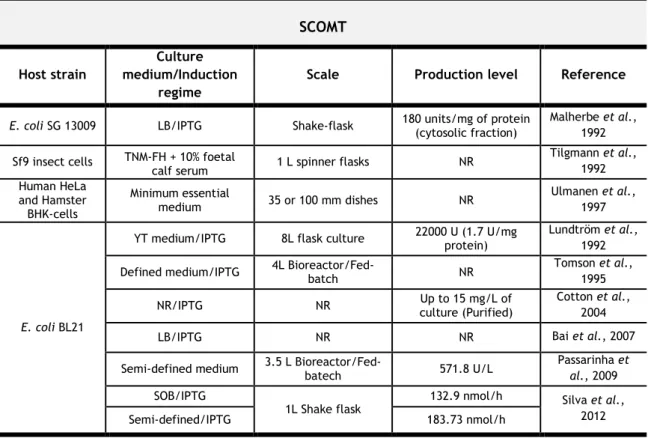
Since the discovery and preliminary characterization of COMT, there was interest in developing biotechnological strategies that allow its biosynthesis and/or isolation for further studies. During the last decades, several eukaryotic and prokaryotic systems including Escherichia coli (E. coli) reported efficiently the production of both COMT isoforms at different scales with different production levels. Indeed, though it is difficult to perform a proper comparison between the different reports due to the lack of data, this information was gathered and summarized in Table 2. In general, the firstly reported systems for recombinant SCOMT production were important to obtain preliminary biochemical characterizations and kinetic data. However, it was the E. coli-based system [Cotton et al., 2004] that allowed the target enzyme production in sufficient amounts for crystallographic studies that ended with the resolution of SCOMT Val/Met variants crystal structures. On the other hand, it was reported that E. coli wasn’t able to produce the MBCOMT since it was considered to be toxic to the host cells [Lundtröm et al., 1995]. Nevertheless, although enzymatically active MBCOMT was obtained from E. coli [Lundtröm et al., 1992] and other prokaryotic and eukaryotic hosts, less work had been performed with this isoform and its structure hasn’t been solved yet.
Table 2 – Characteristics and production levels for recombinant soluble and membrane-bound
human COMT biosynthesis using different expression systems.
Abbreviations – 108M – Variant methionine; 108V – Variant valine; E. coli – Escherichia coli; IPTG –
Isopropylthiogalactosidase; LB – Lysogeny Broth; NR – Not Reported; Sf9 – Spodoptera frugiperda.
SCOMT Host strain
Culture medium/Induction
regime
Scale Production level Reference
E. coli SG 13009 LB/IPTG Shake-flask 180 units/mg of protein (cytosolic fraction) Malherbe et al., 1992 Sf9 insect cells TNM-FH + 10% foetal
calf serum 1 L spinner flasks NR
Tilgmann et al., 1992 Human HeLa and Hamster BHK-cells Minimum essential medium 35 or 100 mm dishes NR Ulmanen et al., 1997 E. coli BL21
YT medium/IPTG 8L flask culture 22000 U (1.7 U/mg protein) Lundtröm et al., 1992 Defined medium/IPTG 4L Bioreactor/Fed-batch NR Tomson et al., 1995
NR/IPTG NR culture (Purified)Up to 15 mg/L of Cotton et al., 2004
LB/IPTG NR NR Bai et al., 2007
Semi-defined medium 3.5 L Bioreactor/Fed-batech 571.8 U/L Passarinha et al., 2009 SOB/IPTG
1L Shake flask 132.9 nmol/h Silva et al., 2012
MBCOMT Host strain
Culture medium/Induction
regime
Scale Production level Reference
Human embryonic kidney fibroblast cells (293 cells) Minimal essential medium + 8% fetal calf
serum 100-mm dishes 200U
1 Bertocci et al., 1991
Minimal essential medium + 8% fetal calf
serum NR
33 units/mg protein –
cytosolic fraction Malherbe et al., 1992 114 units/mg protein –
membrane fraction
E. coli SG 13009 LB/IPTG Shake-flask 57 units/mg protein (cytosolic fraction) Malherbe et al., 1992
Sf9 insect cells
TNM-FH + 10% fetal calf
serum 1 L spinner flasks NR
Tilgmann et al., 1992 NR NR NR Robinson et al., 2012 Human HeLa and Hamster BHK-cells Minimum essential medium 35 or 100 mm dishes NR Ulmanen et al., 1997
E. coli SG BL21 LB/IPTG Shake-flask NR Bai et al., 2007
Brevibacillus
choshinensis SP3 Semi-defined (2SY and MT)/Constitutive Shake-flask (62.5 mL) 50.5 nmol/h/mg of protein Pedro et al, 2011
1One unit of COMT activity was defined as the quantity of enzyme producing 1 nmol of guaiacol per hour at 37ºC.
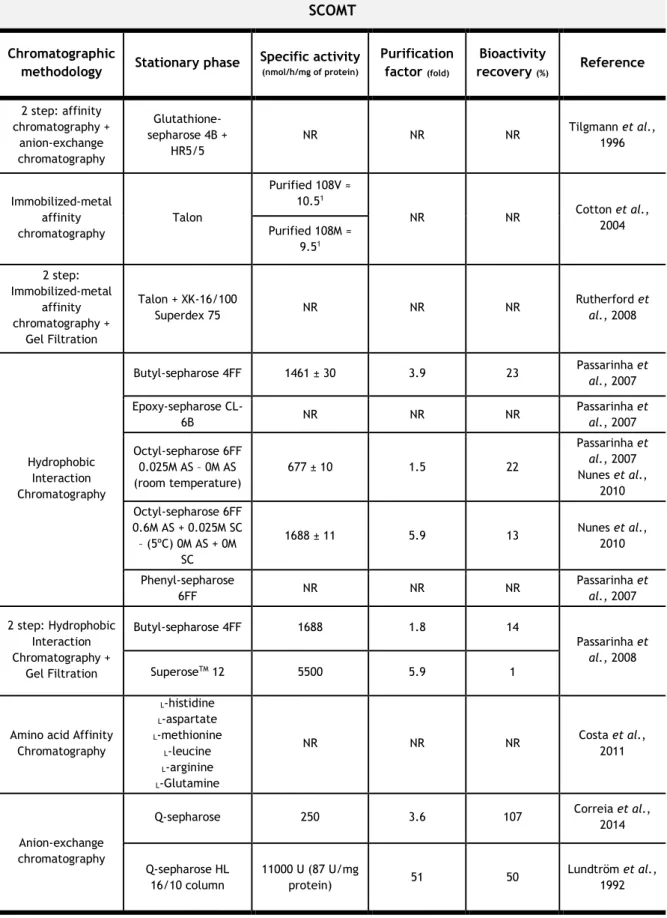
Over the years, from hydrophobic to ionic chromatography, through affinity chromatography, diverse methods were reported for human COMT isolation and purification from several biological and recombinant sources. In Table 3, we review the most important chromatographic methodologies previously reported for recombinant soluble and membrane bound COMT isolation and purification.
Table 3 –Chromatographic methodologies previously reported for recombinant human soluble
and membrane-bound COMT isolation and purification.
Abbreviations: AS – Ammonium Sulfate; NR – Not Reported; SC – Sodium Citrate.
SCOMT Chromatographic
methodology Stationary phase Specific activity (nmol/h/mg of protein)
Purification factor (fold) Bioactivity recovery (%) Reference 2 step: affinity chromatography + anion-exchange chromatography Glutathione-sepharose 4B + HR5/5 NR NR NR Tilgmann et al., 1996 Immobilized-metal affinity chromatography Talon Purified 108V ≈ 10.51 NR NR Cotton et al., 2004 Purified 108M ≈ 9.51 2 step: Immobilized-metal affinity chromatography + Gel Filtration Talon + XK-16/100 Superdex 75 NR NR NR Rutherford et al., 2008 Hydrophobic Interaction Chromatography Butyl-sepharose 4FF 1461 ± 30 3.9 23 Passarinha et al., 2007 Epoxy-sepharose CL-6B NR NR NR Passarinha et al., 2007 Octyl-sepharose 6FF 0.025M AS – 0M AS (room temperature) 677 ± 10 1.5 22 Passarinha et al., 2007 Nunes et al., 2010 Octyl-sepharose 6FF 0.6M AS + 0.025M SC – (5ºC) 0M AS + 0M SC 1688 ± 11 5.9 13 Nunes et al., 2010 Phenyl-sepharose 6FF NR NR NR Passarinha et al., 2007 2 step: Hydrophobic Interaction Chromatography + Gel Filtration Butyl-sepharose 4FF 1688 1.8 14 Passarinha et al., 2008 SuperoseTM 12 5500 5.9 1
Amino acid Affinity Chromatography L-histidine L-aspartate L-methionine L-leucine L-arginine L-Glutamine NR NR NR Costa et al., 2011 Anion-exchange chromatography
Q-sepharose 250 3.6 107 Correia et al.,
2014 Q-sepharose HL 16/10 column 11000 U (87 U/mg protein) 51 50 Lundtröm et al., 1992
MBCOMT Chromatographic
methodology Stationary phase
Specific activity (nmol/h/mg of protein) Purification factor (fold) Bioactivity recovery (%) Reference Immobilized-metal affinity chromatography
His trap FF NR NR NR Robinson et
al., 2012 Hydrophobic Interaction chromatography Butyl-sepharose 4FF NR NR NR Santos et al., 2013 Epoxy-sepharose CL-6B NR NR NR Octyl-sepharose 6FF NR NR NR Anion-exchange chromatography Q-sepharose 496 7 67 Correia et al., 2014 Q-sepharose (with 0.5% triton X-100) 331 4.3 91
1Enzymatic activities are expressed as µM methylated products formed/15 minutes/µM protein;
1.5. Analytical methods in catechol-O-methyltransferase enzymatic assays
As interest in COMT has increased, more reliable, sensitive and rapid analytical COMT assays are needed, either for measuring the activity of recombinant proteins, testing of in vitro efficacy of new COMT inhibitor candidates or for the determination of structure-activity relationships [Pihlavisto and Reenilä, 2002]. In a COMT enzymatic assay, three factors should be considered: 1) the detection method, which usually quantifies the reaction product derived from the 2) substrate, which has to be properly metabolized by the 3) enzyme source, the actual sample [Pihlavisto and Reenilä, 2002]. Also, the incubation conditions, including the required supplements, pH of the incubation mixture, temperature, incubation time and concentration of the enzyme during reaction have also to be optimized [Guldberg and Marsden, 1975; Pihlavisto and Reenilä, 2002].
Several analytical methods were described for COMT enzymatic assays. Some of these methods involve the direct quantification of the substrate or the product and don’t include a separation step between the O-methylated products and the substrate [Pihlavisto and Reenilä 2002] as for example the colorimetric detection of hydroxylamine complexed with ferric chloride in a catecholamine COMT-catalyzed methylation [Abdel-Latif, 1969]. During the last decades, more reliable and sensitive methods were developed. The first methods to separate an O-methylated metabolite from the catecholic compound were the liquid-liquid extraction with organic solvents [Pihlavisto and Reenilä, 2002] where the products were posteriorly assessed using fluorometric
initially paper or thin-layer chromatography [Axelrod and Tomchick, 1958] were applied as a separation method to identify the O-methylated products, more reliable and efficient chromatographic methods were implemented and developed. Indeed, gas chromatography have been applied for example for the separation and quantification of O-methylated catechols of 3,4-dihydroxybenzoic acid using flame ionization detection [Koh et al., 1991] or O-methylated catechols of catechol estrogens with mass spectrometry [Dawling et al., 2001].
In spite of the methods described above, High-Performance Liquid Chromatography (HPLC) is the most common technique used for COMT activity measurements. The general characteristics as well as information regarding the detection limits and sensitivity of HPLC coupled with different types of detection is presented in Table 4.
Table 4 – HPLC -based analytical methods commonly applied as separation and quantification
technique in COMT enzymatic activity assays (adapted from Pihlavisto and Reenilä, 2002).
Liquid chromatography separation techniques in COMT enzymatic assay Detection
mode Characteristics Sensitivity
Detection limit
(substrate: 3,4-dihydroxybenzoic acid)
Substrates Reference
UV Poor selectivity Moderate 1.8 pmol/injection dihydroxybenzoic 3,4-acid Pennings and Van Kempen, 1979 Brevitt and Tan, 1997 Fluorescence Metabolites must exhibit native fluorescence or be derivatized with fluorogenic reagents;
Can be high 0.2 pmol/injection
Catecholamines, 3,4-dihydroxybenzoic acid Okada et al., 1981 Jorga et al., 1998 Radiochemical Regioisomeric products may be separated from each other; restricted use due to the use of radioactive material; High 0.45 pmol 3H-labeled; 0.04 pmol 14C-labeled Dopamine, L-DOPA, 2-hydroxyestradiol Nissinen, 1985 Lautala et al., 2001 Electrochemical Can work in amperometric or coulometric mode with different sensitivities; High 0.5 pmol/injection catecholamines, L-DOPA, 3,4-dihydroxybenzoic acid Tuomainen et al., 1996 Passarinha et al., 2006
In particular, HPLC coupled with electrochemical detection are commonly applied to the detection of catechols and phenolic hydroxyls of the O-methylated products since these are easily oxidized [Pihlavisto and Reenilä, 2002]. These compounds are separated by reversed-phase HPLC systems with ion-pairing reagents and detected by their reversible oxidation by amperometric [Passarinha et al., 2006] or coulometric working electrodes [Achili et al., 1985;
Sabbioni et al., 2004]. In coulometric detectors, to reduce the noise in the analytical cell, a guard cell is installed prior the analytical cell [Pihlavisto and Reenilä, 2002]. Therefore, by using two analytical cells set at different potentials, interfering compounds may be oxidized or reduced before the cell that is recording, thereby improving the selectivity [Pihlavisto and Reenilä, 2002]. Specifically, in coulometric detection, all of the analyte in the column effluent is oxidized or reduced at the surface of an electrode at constant potential, contrasting with amperometric detection where only part of the analyte is converted [Matson et al., 1984].
1.6. Catechol-O-methyltransferase: three-dimensional structure
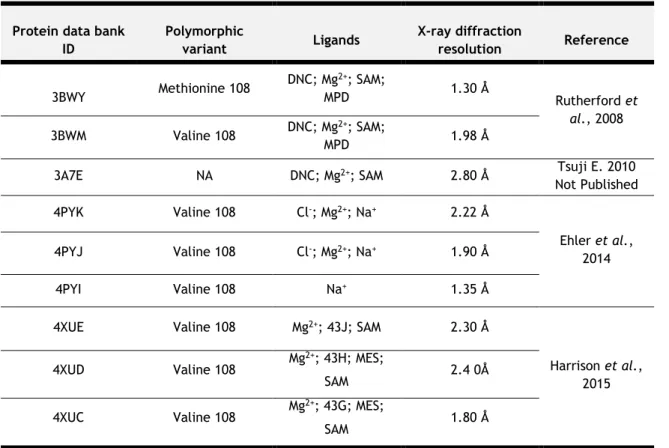
Actually, nine structures of human SCOMT were deposited in Protein Data Bank, either in the apo form [Ehler et al., 2014] or in complex with several substrates and/or inhibitors [Rutherford et al., 2008]. In Table 5, is presented a short summary of the different SCOMT structures already reported in Protein Data Bank as well as different characteristics of each X-ray experiments.
Table 5 – Summary of the 3D structures previously reported for human SCOMT.
Abbreviations: 43G - 1-(biphenyl-3-yl)-3-hydroxypyridin-4(1H)-one; 43J –
2-(biphenyl-3-yl)-5-hydroxy-3-methylpyrimidin-4(3H)-one; 43H – [1-(biphenyl-3-yl)-5-hydroxy-4-oxo-1,4-dihydropyridin-3-yl]boronic acid; Cl— - Chloride ion; DNC – 3,5-dinitrocatechol; MES – 2-(N-morpholino)-ethanesulfonic acid; Mg2+ - Magnesium ion; MPD – (4S)-2-methyl-2,4-pentanediol; NA – Not available; Na+ - Sodium ion; SAM –
S-adenosyl-L -methionine.
Protein data bank ID Polymorphic variant Ligands X-ray diffraction resolution Reference 3BWY Methionine 108 DNC; Mg2+; SAM; MPD 1.30 Å Rutherford et al., 2008 3BWM Valine 108 DNC; Mg2+; SAM; MPD 1.98 Å
3A7E NA DNC; Mg2+; SAM 2.80 Å Tsuji E. 2010
Not Published 4PYK Valine 108 Cl-; Mg2+; Na+ 2.22 Å Ehler et al., 2014 4PYJ Valine 108 Cl-; Mg2+; Na+ 1.90 Å 4PYI Valine 108 Na+ 1.35 Å
4XUE Valine 108 Mg2+; 43J; SAM 2.30 Å
Harrison et al., 2015 4XUD Valine 108 Mg 2+; 43H; MES; SAM 2.4 0Å 4XUC Valine 108 Mg 2+; 43G; MES; SAM 1.80 Å