Behavior of nitrate enzyme reductase in upland riceunder different doses and
sources of nitrogen
Comportamento da enzima redutase do nitrato em arroz de terras altas
sobdiferentes doses e fontes de nitrogênio
DOI:10.34117/bjdv6n4-004
Recebimento dos originais: 02/03/2020 Aceitação para publicação: 01/04/2020
Tácio Peres da Silva
Doutor em Fitotecnia
Instituição: Universidade Federal de Lavras.
Endereço: Rua Alvarez Cabral, 401, Três Pontas, Minas Gerais. e-mail: [email protected].
Douglas Goulart Castro
Doutor em Fitotecnia
Instituição: Universidade Federal de Lavras.
Endereço: Rua Souza Costa, 65, Uberlândia, Minas Gerais. E-mail: [email protected].
Natália Botega Alves
Doutora em Fitotecnia
Instituição: Universidade Federal de Lavras Departamento de Agricultura, Campus Universitário, Caixa Postal 3037, Lavras, Minas Gerais.
E-mail: [email protected]
Antônio Rosário Neto
Doutorando em Fitotecnia
Intituição: Universidade Federal de Lavras. Endereço: Rua Gilberto Vilela, 13 Lavras, Minas Gerais.
E-mail: [email protected].
Marco Renan Félix
Doutorando em Genética e Melhoramento de Plantas Insituição: Universidade Estadual Paulista,
Endereço: Via de Acesso Prof. Paulo Donato Castellane, Jaboticabal, São Paulo E-mail: [email protected].
Flávia Barbosa Silva Botelho
Professora/Doutora em Genética e Melhoramento de Plantas Instituição: Universidade Federal de Lavras. Departamento de Agricultura
Endereço: Caixa Postal 3037, Lavras, Minas Gerais. E-mail: [email protected].
ABSTRACT
(N.R). Given the complexity of understanding N.R in plants, more specific studies involving this enzyme are needed for each crop, with upland rice being a crop with great influence of this enzyme. Thus, the objective of this work was to evaluate the behavior of the nitrate reductase enzyme in response to different doses and nitrogen sources in upland rice. The experiments were conducted in an experimental area belonging to the Federal University of Lavras, in plots consisting of 4 lines of 3 linear meters, spaced between them with 0.35 m, totaling 4.2 m2 per plot. The experiments were conducted using the DBC, with three replications, in a factorial scheme (4x4), with the first factor being nitrogen doses (D.N) and the second factor being sources of nitrogen (S.N), constituting 16 treatments. The characteristic evaluated in the two harvests was the nitrate reductase activity, through the in vivo test in the laboratory. It can be concluded with the results obtained that there were gains in activity of nitrate reductase with the increase in D.N, as well as its greater activity in younger stages of upland rice plants. The different doses and sources of N did not statistically influence the activity of nitrate reductase in rice plants, probably due to the genotype of each cultivar varying in terms of its efficiency of absorption of N which, consequently, will influence the activity of nitrate reductase.
Key words: Oryza sativa, plant nutrition, nutrient assimilation. RESUMO
O nitrato (NO3-) é considerado a fonte mais importante de nitrogênio para o crescimento vegetal. Para se tornar disponível às plantas, é necessário que o nitrato seja reduzido através da enzima redutase do nitrato (RN). Visto a complexidade no entendimento da RN nos vegetais, são necessários mais estudos específicos envolvendo essa enzima para cada cultura, sendo o arroz de terras altas um cultivo com grande influência dessa enzima. Com isso, objetivo deste trabalho foi avaliar o comportamento da enzima redutase do nitrato em resposta a diferentes doses e fontes de nitrogênio em arroz de terras altas. Os experimentos foram conduzidos em área experimental pertencente a Universidade Federal de Lavras, em parcelas constituídas de 4 linhas de 3 metros lineares, espaçadas entre elas com 0,35 m, totalizando 4,2 m2 por parcela. Os experimentos foram conduzidos utilizando-se o DBC, com três repetições, em esquema de fatorial (4x4), sendo o primeiro fator as doses de nitrogênio (D.N) e o segundo fator as fontes de nitrogênio (F.N), constituindo 16 tratamentos. A característica avaliada nas duas safras foi a atividade da redutase do nitrato, através do teste in vivo no laboratório. Pode-se concluir com os resultados obtidos que houve ganhos de atividade da redutase do nitrato com o aumento das D.N, bem como sua maior atividade em estágios mais jovens das plantas de arroz de terras altas. As diferentes doses e fontes de N não influenciaram estatisticamente na atividade da redutase do nitrato nas plantas de arroz provavelmente devido ao genótipo de cada cultivar variar quanto a sua eficiência de absorção de N que, consequentemente, influenciará a atividade da redutase do nitrato.
Palavras-chave: Oryza sativa, nutrição de plantas, assimilação de nutrientes
1 INTRODUCTION
Enzymes are essential for living beings, being responsible for the transformations that help biological systems to make the most of the substrates offered to them. They are widely abundant in our ecosystems, mentioning RUBISCO, α - amylase, nitrite reductase and nitrate reductase as an example (FATIBELLO-FILHO; VIEIRA, 2002).
Nitrogen (N) can occur in different chemical forms in the environment, with nitrate (NO3-) and ammonium (NH4+) being the most abundant in the solution of agricultural soils. Due to a greater presence of cations (elements with positive charges) in the mineral fraction of the soil, N in the form of nitrate suffers less loss by leaching, since it tends to bind to these positive charges. Conversely, N in the form of ammonium is repelled, being percolated and thus leached more easily when available in the soil solution (EPSTEIN; BLOOM, 2006).
Nitrate is one of the main natural sources of N in brazilian soils, because, in addition to being lost with less intensity compared to ammonium, this is the first form that N presents after the transformation of organic N from organic matter, to N mineral, which can be absorbed by plants (GONÇALVES; CERETTA; BASSO, 2000).
Despite having advantages in the soil in the form of nitrate, once absorbed by plants, this N must be quickly converted to ammonium. This is due to the fact that N in the form of nitrate is toxic to plants, ammonium is also toxic to plants, however, in this form, it is quickly transformed into glutamate and glutamine by GOGAT. Due to its negative charge (NO3-), it reacts with O2 which has a positive charge, generating an oxidation reaction, which is harmful to plant cells, leading to degradation and, consequently, cell death that will cause senescence of plants. The enzyme responsible for initiating the transformation of N into the form of ammonium nitrate is nitrate reductase, with ammonium being used as a substrate of N for the most diverse needs of vegetables (TAIZ; ZEIGER, 2013).
The lowland rice had a peculiarity, which together with very few vegetables has the preference for N absorption in ammonical form, which predominates in anaerobic soils (LEMOS et al., 1999). This condition is completely inverse to that found by rice plants grown in upland systems, which absorb in greater quantity, the N in the form of nitrate, the N.R being of fundamental importance for the rice cultivated in this medium, thus it is tests in which treatments are applied that can improve the activity of the N.R are extremely necessary, aiming at gains in upland rice fields.
Thus, the objective of the work was to evaluate the efficiency of nitrate reductase enzyme activity in response to different doses and sources of nitrogen fertilizers in upland rice.
2 MATERIAL AND METHODS
The experiments were conducted during the 2015/2016 and 2016/2017 crops, in the experimental area of the Federal University of Lavras (UFLA), located at the geographical coordinates: Latitude 21º14'S, longitude 45º00'W and average altitude of 920 meters. The soil type of the experiment site is the Red-Yellow Latosol.
Prior to planting, conventional soil preparation was carried out in the two agricultural years. The line CMG 1509 was used, from the Value of Cultivation and Use (VCU) tests, from the upland rice breeding program at the Federal University of Lavras, which is highly homozygous, with no risk of influencing the results by factors genetic.
The sowing density used was 80 seeds per linear meter in the experiments of the two agricultural years, with the planting fertilization being made with 400 kg of 04-14-08 ha-1 aiming at a productivity of 4 t ha-1 of rice.
The experimental design used was randomized blocks (DRB) with three replications. Each plot consisted of 4 lines with 3 meters in length and 0.35 between lines, with the removal of material for analysis in the laboratory, only on the 2 central lines. The experiments were conducted in a 4x4 factorial scheme, totaling 16 treatments. The first factor was nitrogen doses (0, 50, 100 and 2000 kg N ha-1) with the second being nitrogen sources (urea (U), ammonium sulfate (AS), ammonium nitrate (AN) and polycote (PC)).
The treatments were applied at 25 days after emergence (DAE) and 29 DAE in the first and second agricultural years, respectively. Phytotechnical management carried out in the harvests were: weed control (chemical: pre-emergence: Pendimenthalin and post-emergence: Metsulfuron-methyl; physical: manual weeding).
Nitrate reductase activity in vivo in the 2015/2016 crop was evaluated in each plot at 7, 14, 30, 35 and 42 days after application of the treatment (DAA) and at 32, 39, 55, 60 and 67 days after the emergency (DAE). In the 2016/2017 crop, the assessments were at 11, 20 and 50 DAA, and at 30, 40, 50 and 60 DAE.
The evaluation of this enzyme was performed in vivo, in the laboratory, using the method described by Radin (1973), which is based on the amount of nitrite released by fragments of living tissues in a buffer in the presence of a permanent agent and the substrate reflects the potential activity of reductase in situ. The routine followed in the laboratory is described in the following steps: a) collection of plant material (leaves) in the field, between 9 am and 10 am, in full sun, reserving in cool boxes with ice until arriving in the laboratory; b) chop and weigh 500 mg of each parcel; c) insert stock solution (4.95 mL of 100mM potassium phosphate buffer pH 7.5; 0.05 mL of N-porpanol and 0.05g of 100 Mm KNO3); d) infiltrate the samples under vacuum for one minute and repeat the process once; e) incubate the samples in a water bath at 30 ºC for 40 minutes, in the dark; f) remove a 37 µL aliquot from the incubation medium and add to the reaction medium (75 µL of Sulfanilamide (1% in 1.5 N HCl), 75 µL of 0.02% N-2-naphthyl ethylene and 112 µL of distilled water) in a visible round-bottom plate. g) analyze in the ELISA; h) discount the blank and insert results in an Excel spreadsheet in which all the necessary transformations are made using a
standard sodium nitrite line in the spreadsheet, in order to obtain the final result of the analysis of the nitrate reductase activity, expressed in the unit mmol NO2 mg-1 MF hour-1.
The data were analyzed in Sisvar (Ferreira, 2011) by means of plots subdivided over time, as the evaluations occur on different days after the application of the treatment.
3 RESULTS AND DISCUSSION
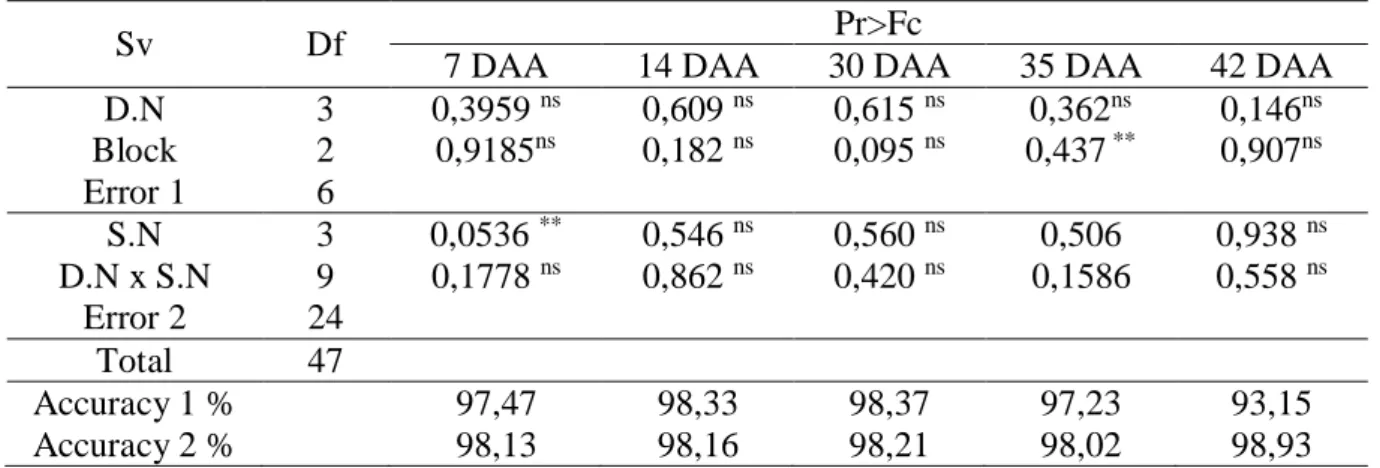
The first crop evaluations were made at 7 DAA; 14 DAA; 30 DAA; 35 DAA and 42 DAA. After data collection and analysis of each season, it was observed that there was no significant difference at 5% probability in the sources of variation: Dose of nitrogen (D.N); and D.N interaction with S.N (D.N x S.N) in any evaluation, however, it was found a significant source of nitrogen (S.N) at 7 DAA (Table 1).
Table 1 - Analysis of variance of nitrate reductase activity measured at 7, 14, 30, 35 and 42 DAA of treatments. 2015/2016crop. Federal Universityof Lavras (UFLA) 2020.
Sv Df Pr>Fc
7 DAA 14 DAA 30 DAA 35 DAA 42 DAA D.N 3 0,3959 ns 0,609 ns 0,615 ns 0,362ns 0,146ns Block 2 0,9185ns 0,182 ns 0,095 ns 0,437 ** 0,907ns Error 1 6 S.N 3 0,0536 ** 0,546 ns 0,560 ns 0,506 0,938 ns D.N x S.N 9 0,1778 ns 0,862 ns 0,420 ns 0,1586 0,558 ns Error 2 24 Total 47 Accuracy 1 % 97,47 98,33 98,37 97,23 93,15 Accuracy 2 % 98,13 98,16 98,21 98,02 98,93
Non-statistically significant results for N.R activity, containing treatments with N were also found in legumes (cowpea), data presented by Aragão et al. (2010). Similar results were presented in the work with grass (corn), which the authors did not obtain significant results with the isolated application of N, but good results were obtained when 100 kg ha-1 of N was applied together with 40 kg ha-1 of potassium (K) (SILVA et al., 2011).
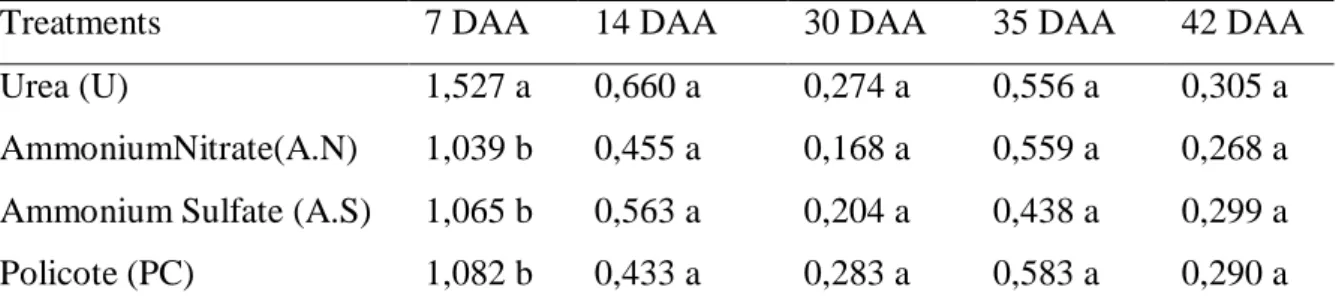
When evaluating the significant result for S.N, it was observed that urea stimulated a greater activity of nitrate reductase at 7 DAA when compared with the other sources (Table 2). This result may be linked to the form of N that urea presents, which is highly available for plant absorption and losses to the environment, such as volatilization and leaching. Fageria, Santos and Cutrim (2007) working with doses of N and rice cultivars, obtained positive results in productivity using urea as a source of N.
Table 2 - Averages referring to nitrate reductase activity at 7, 14, 30, 35 and 42 DAA by nitrogen types, 2015/2016 crop. Federal University of Lavras 2020.
Treatments 7 DAA 14 DAA 30 DAA 35 DAA 42 DAA
Urea (U) 1,527 a 0,660 a 0,274 a 0,556 a 0,305 a AmmoniumNitrate(A.N) 1,039 b 0,455 a 0,168 a 0,559 a 0,268 a Ammonium Sulfate (A.S) 1,065 b 0,563 a 0,204 a 0,438 a 0,299 a Policote (PC) 1,082 b 0,433 a 0,283 a 0,583 a 0,290 a
Averages followed by the same letter do not differ statistically at 5% probability by the Scott-Knott test.
In the 2016/2017 crop, when N.R activity was assessed at 11, 20 and 50 DAA, no significant results were obtained at 5% probability (Table 3). Toledo et al. (2010), working with the N.R in soybeans did not find any relationship between the activity of the enzyme with the N content accumulated by the plant, being an indication that the N.R has little influence on the characteristics of this culture, the same being possible for the rice culture highlands.
Published studies indicate that the efficiency of nitrate reductase activity may be associated with genetic factors, as Justino et al. (2006), working with two different rice cultivars, observed a higher efficiency of this enzyme in the cultivar Fernandes, when compared to Maravilha. Continuing, the author also explains that the cultivar Fernandes is more efficient at absorbing nitrogen than Maravilha. Comparing with the data from the present study, it can be argued that when using only one strain, it has, regardless of the dose applied and the source offered, the same N absorption rate as well as the same nitrate reductase activity, not responding treatments significantly after statistical analysis.
The work of the aforementioned authors, who associate the efficiency of N absorption of a rice cultivar, with the efficiency of nitrate reductase activity, together with the results obtained with the present work, which has no influence on doses and sources of N in the activity of nitrate reductase, leads to the physiological thought that the efficiency of the enzyme is associated with its work in the conversion of nitrate to nitrite, for later transformation to ammonium, in other words, it will only present high values in tests, if the plant is absorbing nitrate in large quantities, so that the enzyme performs the conversion.
The work of Fageria et al. (2007), who worked with five average doses of N, evaluating the productivity of 12 different cultivars. They obtained extreme values of productivity of 5,557 kg ha-1 in the cultivar BRS Guará and of 3,778 kg ha-1 in BRS Jaburu, placing in their discussion, that in the most productive, a higher percentage of absorption of N. Oliveira et al. (2013) working with corn, observed that N.R did not associate with a high utilization of N.
Table 3 - Analysis of variance of nitrate reductase activity measured at 11, 20 and 50 DAA of treatments and in rice flowering. The 2016/2017 Crop. Federal University of Lavras (UFLA) 2020.
Sv Df Pr>Fc (11 DAA) Pr>Fc (20 DAA) Pr>Fc (50 DAA)
D.N 3 0,678 ns 0,227 ns 0,711 ns Block 2 0,116 ns 0,447 ns 0,010 * Error 1 6 S.N 3 0,859 ns 0,633 ns 0,247ns D.N x S.N 9 0,522 ns 0,986 ns 0,778 ns Error 2 24 Total 47 Accuracy 1 98,52 95,59 98,59 Accuracy 2 98,83 98,42 95,95
In the literature, it is exposed that upland rice plants have low activity of N.R in its early stages, regardless of any treatment (ARAÚJO et al., 2012). Thus, in the present work, N.R activity was evaluated throughout the development of the rice plant, without any treatment.
In the first and second agricultural year, significant results were obtained at the source of variation days after emergence, with the greatest activities of N.R in the initial evaluations (juvenile periods), decreasing with the maturity of the rice plants (Table 4).
Continuing with the linear regression analysis for both crops, it is observed that the younger the rice plant, the greater the value of its activity of N.R, contrary to the classic work of Araújo et al. (2012) (Figure 1). Similar to the result obtained, Santos et al. (2014) working with sugarcane, observed greater activity of N.R analyzed in vivo in the most youthful phase of the sugarcane plants, when compared with the time of maturation of the same.
Table 4 - Analysis of variance of days after emergency (DAE), 2015/2016 crop and 2016/2017 crop. Federal University of Lavras (UFLA) 2020. 2015/2016Crop SV DF AS FC Pr>Fc DAE 4 2,582 44,978 0,000 ** Block 2 0,131 2,289 0,111 ns Error 53 0,057 Accuracy 82,11 2016/2017Crop DAE 3 0,002 6,160 0,001 ** Block 2 0,000 2,340 0,108 ns Error 42 0,000 Accuracy 83,28
Figure 1 - Nitrate Reductase Activity in mmol NO2 mg-1 MF hour-1 in days after emergence.
4 CONCLUSIONS
The different doses and sources of N did not statistically influence the activity of nitrate reductase in upland rice plants after in vivo laboratory tests.
The activity of nitrate reductase is higher in the juvenile period of upland rice plants, declining with the maturity of these plants.
REFERENCES
Aragão RM (2010) Absorção, fluxo no xilema e assimilação do nittrato em feijão-caupi submetido à salinidade. Ciência Agronômica, v. 41, n. 1, p. 100-106.
Araújo JL (2012) Crescimento e produção do arroz sob diferentes proporções de nitrato e de amônio. Revista Brasileira de Ciência do Solo, v. 36, n. 3.
Epstein E & Bloom AJ (2006) Nutrição mineral de plantas. Princípios e perspectivas. Londrina: Planta.
Fageria NK, Santos AB &Cutrim, V (2007) Produtividade de arroz irrigado e eficiência de uso do nitrogênio influenciados pela fertilização nitrogenada. Pesquisa Agropecuária Brasileira, Brasília, DF, v. 42, n. 7, p. 1029-1034.
Fatibello-Filho O &Vieira I (2002) Uso analítico de tecidos e de extratos brutos vegetais como fonte enzimática. Química Nova, v. 25, n. 3, p. 455-464.
y = -0,0249x + 1,5843 R² = 78,97 0 0.1 0.2 0.3 0.4 0.5 0.6 0.7 0.8 0.9 32 39 46 53 60 67 N R A c ti v ity
Days after of emergency
2015/2016 Crop
y = -0,0008x + 0,049 R² = 71,92 0 0.005 0.01 0.015 0.02 0.025 0.03 30 40 50 60 N R A c ti v ityDays after of emergency
2016/2017 Crop
Ferreira DF(2011) Sisvar: a computerstatisticalanalysis system. Ciência e Agrotecnologia, Lavras, v. 35, n. 6, p. 1039-1042.
Gonçalves CN, Ceretta CA & Basso CJ(2000) Sucessões de culturas com plantas de cobertura e milho em plantio direto e sua influência sobre o nitrogênio no solo. Revista Brasileira de Ciência do Solo, v. 24, n. 1.
Justino GC (2006) Uptakeandreductionofnitrate in two rice cultivars in thepresenceofaluminum. Pesquisa Agropecuária Brasileira, v. 41, n. 8, p. 1285-1290.
Lemos GB (1999) Atividade das enzimas de assimilação do nitrogênio em plantas jovens de seringueira cultivadas com diferentes relações de nitrato e amônio. Embrapa Milho e Sorgo-Artigo em periódico indexado (ALICE).
Oliveira LR (2013) Eficiência na absorção e utilização de nitrogênio e atividade enzimática em genótipos de milho. RevistaCiênciaAgronômica, Fortaleza, v. 44, n. 3, p. 614-621.
Radin JW (1973) In vivo assay of nitrate reductase in cotton leaf discs. Plant Physiology, v.51, n. 2, p. 332-336.
Santos CLR (2014) Otimização da análise da atividade da redutase do nitrato e sua caracterização em folhas de cana-de-açúcar. Pesquisa Agropecuária Brasileira, Brasília, v. 49, n. 5, p. 384-394.
Silva SM (2011) Atividade da enzima nitrato redutase em milho cultivado sob diferentes níveis de adubação nitrogenada e potássica. Ciência Rural, Santa Maria, v. 41, n. 11, p. 1931-1937.
Taiz L &Zeiger E (2013) Fisiologia vegetal. 5. ed. São Paulo, Artmed, 918 p.
Toledo MZ (2010) Nodulação e atividade redutase do nitrato em função da aplicação de molibdênio em soja. BioscienceJournal, Uberlândia, Universidade Federal de Uberlândia (UFU), v. 26, n. 6, p. 858-864.