Extending the range of differential
diagnosis of chronic traumatic
encephalopathy of the boxer
Insights from a case report
Leonardo Caixeta1, Iron Dangoni Filho2, Rafael Dias de Sousa2,
Pedro Paulo Dias Soares2, Andreia Costa Rabelo Mendonça2
ABSTRACT. Sports activities associated with repetitive cranial trauma have become a fad and are popular in gyms and even among children. It is important to consistently characterize the consequences of such sports activities in order to better advise society on the real risks to the central nervous system. We present the case of a former boxer reporting cognitive and behavioral symptoms that began six years after his retirement as a boxer, evolving progressively with parkinsonian and cerebellar features suggestive of probable chronic traumatic encephalopathy (CTE). Using our case as a paradigm, we extended the range of differential diagnosis of CTE, including corticobasal degeneration, multiple system atrophy, vitamin B12 deficiency, neurosyphilis, frontotemporal dementia and Alzheimer’s disease.
Key words: chronic traumatic encephalopathy, dementia pugilistica, differential diagnosis, frontal lobe dementia, corticobasal syndrome, multiple system atrophy.
AMPLIANDO A GAMA DE DIAGNÓSTICOS DIFERENCIAS DA ENCEFALOPATIA TRAUMÁTICA CRÔNICA DO PUGILISTA: UM RELATO DE CASO ILUSTRATIVO
RESUMO. As atividades esportivas associadas ao trauma craniano repetitivo tornaram-se uma moda e são populares nas academias e entre as crianças. É importante fazer uma caracterização consistente das consequências de tais atividades esportivas, a fim de aconselhar melhor uma sociedade sobre os riscos reais para o sistema nervoso central. Apresentamos um antigo boxeador relatando sintomas cognitivos e comportamentais que começaram seis anos após sua aposentadoria como boxeador e evoluiu progressivamente com características parkinsonianas e cerebelares sugestivas de provável encefalopatia traumática crônica (ETC). Usando nosso caso como paradigma, ampliamos a gama de diagnóstico diferencial de ETC, incluindo degeneração corticobasal, atrofia de múltiplos sistemas, deficiência de vitamina B12, neurossífilis, demência frontotemporal e doença de Alzheimer.
Palavras-chave: encefalopatia traumática crônica, demência pugilística, diagnósticos diferenciais, demência do lobo frontal, degeneração corticobasal, atrofia de múltiplos sistemas.
W
e live in a time when sports activi-ties associated with repetitive cranial trauma (boxing, MMA) have become a fad. They are very popular in regular gyms and even among children.1,2 It is important forneuropsychiatry to consistently characterize the consequences of such sports activities in order to better advise society on the real risks
to the central nervous system. Chronic trau-matic encephalopathy (CTE) refers to a neuro-degenerative disease related to the long-term consequences of repetitive cranial trauma.3
Some authors consider dementia pugilistica (punch-drunk syndrome, boxer’s dementia) the most serious and terminal stage of CTE,4
while others regard it as a condition that exists
This study was conducted at the Cognitive and Behavioral Neurology Unit, Department of Neurology, Hospital das Clínicas, Goiânia, GO, Brazil.
1Associate Professor of Neurology, Federal University of Goiás, Goiânia, GO, Brazil. Coordinator, Cognitive and Behavioral Neurology Unit, Department of Neurology,
Hospital das Clínicas. 2Behavioral and Cognitive Neurology Unit, Department of Neurology, Hospital das Clínicas, Federal University of Goiás, Goiânia, GO, Brazil. Leonardo Caixeta. Instituto da Memória – Avenida Cristo Rei, 626 / Setor Jaó – 74674-290 Goiânia GO – Brazil. E-mail: [email protected] Disclosure: The authors report no conflicts of interest.
Received July 11, 2017. Accepted in final form November 16, 2017.
along a continuum: from mild neurocognitive deficits to full dementia.5 From a clinical standpoint, boxers
pre-senting CTE will exhibit varied combinations of motor, cognitive and behavioral alterations.6 The diagnosis of
CTE depends on documenting progressive encephalopa-thy that is consistent with the clinical symptoms of TBI explained by brain trauma rather than being attributable to an alternative pathophysiological process.3
The CTE associated with boxing has a prevalence of about 20% among professional boxers. Risk factors clas-sically related to CTE include the frequency of repeated exposure (i.e., career length, total number of fights, retirement age), technical supervision intensity, spar-ring increase, and apolipoprotein genotype (APOE).7
Dementia pugilistica has been included among the acquired tauopathies, but the pathophysiology of CTE is still under scrutiny, although it has been suggested that neuroinflammation can drive the association between tau hyperphosphorylation and dementia development following traumatic brain injury.8
Chronic traumatic encephalopathy has been associ-ated with some forms of dementia, both clinically and neuropathologically.9 Clinically, there may be several
common elements between dementia pugilistica and Alzheimer’s disease,10 for example. On the other hand,
the relationship and common aspects between CTE and other rarer forms of dementia have not been the subject of much discussion. We present a case of CTE that pro-vides a differential diagnosis with other unusual forms of dementia.
CASE REPORT
We describe the case of Mr. G, a 79-year-old Brazilian male, brown skin, divorced, former boxer, retired, with nine years of education.
The patient fought as a boxer for 16 years (from 17 to 33 years old), in the light middleweight category. He had about 14 official fights. Two knockdowns were recorded and he had a severe nose fracture, having spent two years without a fight.
In 1977 (he was then 39 years old), approximately six years after retirement as a boxer (at the time working as a real-estate broker), he started taking his wife along as a companion to visit customers in order to avoid mis-takes in finding addresses, due to topographical disori-entation. The marital relationship, initially healthy, was ruined by the patient’s pathological jealousy (Othello’s syndrome).
In 2000, when cognitive deterioration was noticed, Mr. G presented a picture of anomie for his children’s names, managing to remember by speaking the names
of all of them, from the oldest to the youngest, until he reached the desired name. Memory impairment also extended to bank passwords, phone numbers, recent events and even old ones.
From 2003, with the progressive worsening of the clinical presentation, he forgot the milk on the burner and sometimes even the cap on his head, besides begin-ning to experience difficulties managing his accounts. The patient become very upset by the memory lapses, especially when he could not remember politicians’ names, content of reports or his religious prayers.
From 2013, the patient reported tremors, sensations of heaviness and numbness in his legs, besides imbal-ance, which begun to affect his gait, having suffered several falls in the previous three years.
In 2015, he was diagnosed with depression, pre-senting symptoms of depressive mood, propensity to cry, anxiety, insomnia, fatigability and dysphoria. He was prescribed Fluoxetine at the time, which we later switched to Quetiapine. Currently, the patient reports social isolation, mainly due to forgetfulness and slow thinking, complaining that he sometimes does not know what to say to friends. He often misses appointments, and has to write down tasks on his hand so as not to forget, and needs help with medication. He was diag-nosed with neurogenic bladder syndrome and, in recent years, presented with sexual impotence. Mr. G has no history of alcoholism and has high blood pressure. There are no reports of dementia diagnosed in the family. The patient is in use of losartan 50 mg/day and atenolol 50 mg/day.
On the neurological examination, he presented parkinsonian changes indicated by gait problems with absence of bilateral arm swinging, difficulty getting up from a chair without support, exhibited postural insta-bility, including a positive pull test, associated with plas-tic hypertonia (cogwheel) and light atypical tremor, both on the right side, bradykinesia and hypomimia. On the evaluation of coordination and cerebellar functions, dysmetria was observed on the index-nose test (worse with eyes closed), as well as positive Romberg when sen-sitized ( eyes closed). He presented with visible primi-tive reflexes and exacerbated tendon reflexes, as well as proprioceptive impairment.
of a companion (at the request of the attending physi-cian). The patient’s irritability or aggressiveness during the physic examination was not evident, but there was a previous report of dysphoria, nervousness and anxiety, as well as marital problems.
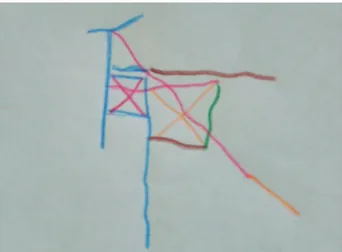
On the cognitive examination, he scored 23 points on the Mini-Mental State Examination, dropping 4 points on calculation, two on recall and one on the figure copy. He had evident dyscalculia. On the Boston Naming Test, he named only one item out of 15. In writing, he showed omissions and letter switching, phrases with isolated words without links and paragraph. On the Boston Cookie Theft, he noted only the details, but could not produce a ‘gestalt’ of the figure. He successfully per-formed the verbal fluency test (animals’ category) (14 animal names). On the Stroop Test, performance was 7SDs below on the first two cards and 2SDs below on the third card, with 16 errors, demonstrating impul-sivity and lack of inhibitory control. On Rey’s Complex Figure (Figure 1), he was unable to copy it within the five minutes available. He presented difficulty in mental control (inability to perform months backwards and also the serial sevens).
On the Trail Making Test A, he exhibited slowed information processing and on the Trail Making Test B, lack of strategy and flexibility of thought, also showing working memory impairment (requiring several repeti-tions of the rule). Despite this, he could not complete the test in 5 minutes and made many mistakes. In the labyrinths, the same process occurred, with several per-severations. On the RAVLT, memory had a lower-than-expected acquisition curve, with major difficulty after intrusion and impaired delayed recall (2SDs). He did not benefit from clues, scoring 2SDs below the expected
Figure 1. Patient’s copy of Rey Complex Figure showing lack of planning, perseveration, visuoconstructional and visuomotor difficulties.
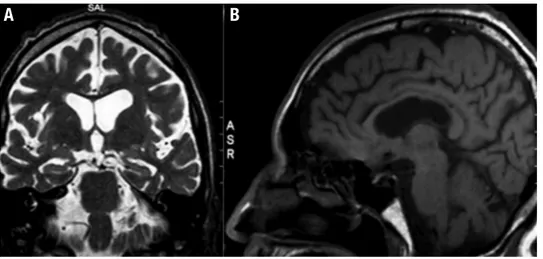
Figure 2. Brain MRI (T2-weighted axial sections) revealed: [A] moderate pre-frontal atrophy, especially in the medial and dorsolateral areas and asymmetric ventricular dilatation (greater in the left hemisphere); [B] asymmetric atrophy (greater in the left hemisphere).
score for his age, showing several intrusions and perse-verations in the attempts of the acquisition curve, as well as on the delayed recall and recognition.
The use of atypical antipsychotics for the control of delusional jealousy was attempted, but the patient had no adherence to any of the proposed treatments.
DISCUSSION
Our case meets diagnostic criteria for CTE.3 The
neuro-psychological profile of this CTE case is complex and heterogeneous, with impairments in various cognitive domains (executive functions and attention, naming, coding, recovery, praxis, visuospatial functions, and processing speed), suggesting both cortical and subcor-tical impairment in anterior and posterior brain areas, medial and lateral, in both left and right hemispheres. Other reviews on this theme also found a wide range of neuropsychological changes associated with boxing,4
thus, there is no pathognomonic cognitive profile of CTA.
The clinical picture of chronic traumatic encephalop-athy is also proteiform; therefore, in our case a broad range of differential diagnoses can be entertained:
1) Corticobasal degeneration (CBD) – The clinical symptomatology of our case resembles, in part, fea-tures of a corticobasal syndrome: asymmetric parkin-sonism (hypertonia and tremor in the right side only), asymmetric dyspraxia, bradykinesia, hypomimia, and gait disturbance.11 Neuropsychological findings
indi-cating fronto-subcortical impairment represented by executive dysfunction, anomia, and apraxia also fit the cognitive profile of CBD. Moreover, neuroimaging also corroborates this impression (asymmetric atrophy, most evident on the left side and frontal atrophy – see Figure 1). Some authors classify CBD as part of the frontotem-poral lobar degeneration group12 and thus can present
with behavioral changes. In fact, our patient has a dis-inhibition syndrome characterized by excessive verbal output, pressure of speech and lack of insight. Although
this is the most important differential diagnosis in our case, the presence of cerebellar symptoms makes this possibility less likely.
2) Frontotemporal dementia (FTD) – As in CTE (and similar to our case), symptoms usually emerge in the presenium, behavior and personality changes are early, always present and important in the clinical scenario; neuropsychological deficits are mainly related to execu-tive dysfunction and impairment of fronto-subcortical circuits. In addition, the MRI in our case showed focal frontal atrophy. FTD eventually can present with par-kinsonian symptoms and other features of subcortical pathology,13 which may produce additional similarity
between pugilistic dementia and FTD. In fact, our case has some of the clinical characteristics of FTD, but lacks core clinical features and does not meet diagnostic crite-ria for FTD. Other authors have addressed the similari-ties between FTD and CTE.14
3) Multiple System Atrophy (MSA) – Also a proteiform disease with many features that resemble CTE: a mix-ture of extrapyramidal, cerebellar, behavior and some-times, pyramidal symptoms, causing dementia only in its final stages.15 Pugilistic dementia can, therefore,
from a certain perspective, be considered a disease that affects multiple systems, akin to MSA. Interestingly, Koga16 found, in a brain bank of MSA carriers, some
cases with pathology compatible with CTE, perhaps related to a greater number of falls (and consequently head injury) experienced by MSA patients or possibly because, according to our hypothesis, MSA can actually constitute one of the possible phenotypes of CTE. Our patient also presented some symptoms of dysautonomy (sexual impotence, neurogenic bladder), besides cerebel-lar and extrapyramidal features. In spite of the simicerebel-lari- similari-ties, our patient presented no additional symptoms of dysautonomy and no marked cerebellar atrophy, as
occurs in MSA, and thus he does not meet diagnostic criteria for MSA.15
4) Neurosyphilis – Traditionally known as “the great imitator”, also a disease that can manifest with vari-ous different combinations of motor, cognitive and behavioral symptoms. It is considered an important differential diagnosis in countries where syphilis is still endemic.17 Although our case presents some symptoms
that could suggest neurosyphilis (proprioceptive and gait abnormalities, alteration of reflexes, maniform behavior), this diagnosis was ruled out by normal VDRL.
5) B12 deficiency – Vitamin B12 deficiency may mani-fest with sensory symptoms associated with myelopa-thy (altered proprioceptive sensitivity and consequent impaired static and dynamic balance with altered ten-don reflexes), as well as cognitive symptoms, mood disturbance, psychosis, and even extrapyramidal and other motor symptoms.18 Although our case has some
symptoms that might suggest B12 deficiency (cognitive changes, symptoms of depression, proprioceptive and gait changes, and reflex changes), this diagnosis was ruled out by normal vitamin B12.
6) Alzheimer’s Disease – Although our patient has memory complaints, episodic memory does not seem to be the dominant element in the reported case, as occurs in Alzheimer’s disease. Moreover, temporal mesial atro-phy (mild hippocampal atroatro-phy) present on the patient’s MRI is also described in cases of Traumatic Encephalop-athy. In other words, it is not exclusive to Alzheimer’s,
but represents an important differential diagnosis in the case. The diagnosis of Alzheimer’s disease is unlikely since the patient exhibits changes that are not usually involved in this pathology, such as parkinsonism, sub-cortical and cerebellar manifestations. On the one hand, there are alterations that are not features of Alzheimer’s disease. However, the case lacks typical manifestations, for example, significant episodic memory loss. The patient’s deficit is not as pronounced as in Alzheimer´s disease.
As a limitation of our study, we should note that the causal nexus between our patient’s current dementia and his background as a boxer several decades earlier cannot be proven conclusively. Our case does not have anatomopathological data. Nevertheless, our case fulfills clinical criteria for pugilistic dementia and we cannot identify another form of dementia that could better explain the proteiform symptoms, as well as the struc-tural alterations presented.
Sports with repetitive cranial trauma such as boxing have received increasing attention and acceptance from the public in recent years.1 We suggest that our case
pro-vides additional evidence that boxing may represent a risk factor for subsequent onset of cognitive and behav-ioral alterations, putting at risk the future generations that practice this sport modality, even as amateurs.
Author contributions. All authors drafted and critically
revised the manuscript.
REFERENCES
1. Förstl H, Haass C, Hemmer B, Meyer B, Halle M. Boxing-acute compli-cations and late sequelae: from concussion to dementia. Dtsch Arztebl Int. 2010;107(47):835-9.
2. Revista Veja. Mamãe, eu quero MMA. 2013;2323:104.
3. Montenigro PH, Baugh CM, Daneshvar DH, et al. Clinical subtypes of chronic traumatic encephalopathy: literature review and proposed research diagnostic criteria for traumatic encephalopathy syndrome. Alzheimers Res Ther. 2014;6(5):68.
4. Mendez MF. The neuropsychiatric aspects of boxing. Int J Psychiatry Med. 1995;25(3):249-62.
5. Erlanger DM, Kutner KC, Barth JT, Barnes R. Neuropsychology of sports-related head injury: Dementia Pugilistica to Post Concussion Syndrome. Clin Neuropsychol. 1999;13(2):193-209.
6. Areza-Fegyveres R, Caramelli P, Nitrini R. Encefalopatia traumática crônica do boxeador (dementia pugilistica). Rev Psiq Clin 2005;32: 17-26.
7. Jordan BD. Chronic traumatic brain injury associated with boxing. Semin Neurol. 2000;20(2):179-85.
8. Collins-Praino LE, Corrigan F. Does neuroinflammation drive the rela-tionship between tau hyperphosphorylation and dementia development following traumatic brain injury? Brain Behav Immun. 2017;60:369-82. 9. Mendez MF. What is the Relationship of Traumatic Brain Injury to
Dementia? J Alzheimers Dis. 2017;57(3):667-81.
10. Areza-Fegyveres R, Rosemberg S, Castro RM, et al. Dementia
pugi-listica with clinical features of Alzheimer’s disease. Arq Neuropsiquiatr. 2007;65(3B):830-3.
11. Parmera JB, Rodriguez RD, Studart Neto A, Nitrini R, Brucki SMD. Corti-cobasal syndrome: A diagnostic conundrum. Dement. Neuropsychol. 2016;10(4):267-75.
12. Kertesz A. Frontotemporal dementia, Pick disease, and corticobasal degeneration. One entity or 3? 1. Arch Neurol. 1997;54(11):1427-9. 13. Caixeta L, Vieira RT, Paes F, et al. Comparative study of subcortical
atrophy in patients with frontotemporal dementia and dementia with extrapyramidal signs. Clin Pract Epidemiol Ment Health. 2015;11:125-9. 14. Iverson GL, Gardner AJ, McCrory P, Zafonte R, Castellani RJ. A critical review of chronic traumatic encephalopathy. Neurosci Biobehav Rev. 2015;56:276-93.
15. Wenning GK, Colosimo C. Diagnostic criteria for multiple system atrophy and progressive supranuclear palsy. Rev Neurol (Paris). 2010;166(10):829-33.
16. Koga S, Dickson DW, Bieniek KF. Chronic Traumatic Encephalopathy Pathology in Multiple System Atrophy. J Neuropathol Exp Neurol. 2016; 75(10):963-70.
17. Caixeta L, Soares VD, Reis G, Costa, JL, Vilela, AM. Neurossífilis: uma breve revisão. Revista de Patologia Tropical 2014;43(2):121-9. 18. Dogan M, Ozdemir O, Sal EA, Dogan SZ, Ozdemir P, Cesur Y, Caksen