Rev Bras
Cineantropom
Hum
DOI: http://dx.doi.org/10.5007/1980-0037.2018v20n3p280
original article
Injury prevalence in Brazilian jiu-jitsu athletes:
comparison between different competitive
levels
Prevalência de lesões em atletas de Brazilian jiu-jitsu:
comparação entre diferentes níveis competitivos
Jorge Nelson da Silva Junior1
Rafael Lima Kons1
Rodolfo André Dellagrana1
Daniele Detanico1
Abstract – This study aimed to identify types and sites of body injury, location of injury occurrence, and the mechanism and severity of injuries in novice and advanced Brazilian jiu-jitsu (BJJ) athletes. One hundred and eight BJJ athletes took part in this study separated in two groups: advanced (n = 53) and novice (n = 55). Athletes answered a questionnaire concerning regions of injury, locality of occurrence, injury severity and mechanism. Chi square test and a logistic regression analysis were used with the level of significance set at p < 0.05. The main results showed that shoulders and knees were the most injury location reported by novice and advanced athletes. Novice athletes demonstrated higher prevalence of injuries during training sessions (54.5%), whereas advanced athletes reported more injuries during competitions (66.1%). Significant associations between novice and advanced athletes were observed for major joints (p < 0.05). The odds ratio of having injury was 70-87% less for novice versus advanced athletes for the major joints cited. We concluded that BJJ athletes demonstrate high prevalence of injury mainly at knee and shoulder. While risk of injury appeared less in novice, the advanced demonstrated higher number of injuries during competitions as a consequence of injured joint keys. By contrast, novice athletes reported higher number of injuries associated with training sessions as a consequence of overuse.
Key words: Athletic injuries; Epidemiology; Sports.
Resumo – O objetivo deste estudo foi verificar as regiões do corpo afetadas por lesões, o local de maior ocorrência de lesão, o mecanismo e a gravidade das lesões em atletas iniciantes e avançados de Brazilian jiu-jitsu (BJJ). Cento e oito atletas participaram deste estudo, separados em dois grupos: avançados (n = 53) e iniciantes (n = 55). Os atletas responderam um questionário sobre as regiões acometidas por lesões, local de ocorrência, grau de gravidade e mecanismos. O teste do Qui-Quadrado e análise de regressão logística foram utilizados com o nível de significância de p < 0,05. Os principais resultados mostraram que o ombro e o joelho foram os locais de lesão mais citados pelos atletas iniciantes e avançados; os atletas iniciantes apresentaram maior prevalência de lesões durante a sessão de treino (54,5%), enquanto os atletas avançados apresentaram mais lesões durante as competições (66,1%). Foram observadas associações significativas entre atletas iniciantes e avançados para as principais articulações (p < 0,05). A chance de ter lesão foi de 70-87% menor para iniciantes do que avançados nas principais articulações citadas. Conclu-ímos que os atletas do BJJ apresentaram alta prevalência de lesões principalmente no joelho e no ombro. A razão de chance de ter lesão foi menor para atletas iniciantes do que avançados. Atletas avançados apresentaram maior número de lesões durante as competições e o mecanismo principal foram chaves articulares. Os atletas iniciantes apresentaram maior número de lesões
1 Universidade Federal de Santa Catarina. Centro de Desportos. Labo-ratório de Biomecânica. Florianópo-lis, SC. Brasil.
Brazilian jiu-jitsu (BJJ) is a combat sport that has demonstrated an increase in popularity is recent years, which is largely attributable to its inclusion in mixed martial arts (MMA)1. The primary goal of BJJ is to apply
stran-gleholds and joint keys (e.g., wrist, elbow, knee and ankle locks) to force an opponent into submission and loss of the match2. While BJJ athletes
begin combat in the standing position, most of the combat eventually ends up taking place during groundwork.
A common characteristic of BJJ is intermittent combat3,4 (e.g.,
typi-cal matches consist of high-intensity intermittent efforts, demonstrating effort:pause ratios from 6:1 to 13:1 and effort periods of 85–290 seconds and pauses of 5–44 seconds5-7). Because of the high intensity of matches,
body strain imposed by an opponent during application of key techniques, and rapid body falls and shocks the BJJ athlete is continually exposed to increased risk for injury throughout training sessions and competitions. A recent study reported the rate of incidence associated with joint injuries is 24.9 per 1000 BJJ athlete-exposures during an official BJJ tournament8.
For example, elbows and knees followed by ankles are the most commonly injured joints in BJJ athletes8,9. While rate of injury has been reported as
more common during training sessions compared with competitions in other combat sports as karate, judo10, wrestling11, boxing12 and taekwondo13,
differences in the rate of injury incidence during training sessions compared with competition has not been explored in BJJ athletes.
Tournaments featuring BJJ consist of a spectrum of competition levels, including amateur, professional, novice, and/or advanced athletes. Sup-porting evidence suggests BJJ athlete experience (e.g.., from purple to black belts) directly relates with higher levels of muscle power in lower limbs and handgrip strength compared with novice athletes (e.g., white and blue belts)14. By contrast, any association between level of BJJ experience and
rate of injury is still unclear. A single study recently reported that during an official BJJ competition, experienced athletes demonstrated a higher risk of injuries compared with less experienced athletes8.
Increased understanding of injury prevalence associated with BJJ may aid coaches and physical trainers in identifying important informa-tion about types and locainforma-tion of common body injuries, mechanisms of prevalence (e.g., joint keys, overuse, etc.), and environmental setting where injuries occur (i.e., competition versus training sessions). Preventative care strategies tailored for each level of BJJ experience may also be devised based on an improved understanding of rate of injury incidence. Therefore, this study aimed to identify the different types of body injuries associated with BJJ, the environmental setting of highest injury incidence, and the underlying mechanisms and severity of injuries in novice compared with advanced athletes. We hypothesized, 1) elbows and knees will be the most injured joints for both novice and advanced athletes8,9, and 2) compared with
Injuries in Brazilian jiu-jitsu Silva Jr. et al.
METHODOLOGICAL PROCEDURES
Participants
The study sample consisted of adult BJJ athletes (N=260) who had partici-pated in two national tournaments that occurred in Florianópolis (Santa Catarina, Brazil) from July to December in 2016. The body injury based questionnaire used to test aims of this study was sent to all athletes, but only 108 responses were returned (41%). The necessary sample size, performed post-hoc (sample error of 5% and confidence interval of 90%), showed 133 athletes would be considered as representative of the population, which is similar to what was demonstrated in this study.
The participants were divided in two groups according to the gradua-tion level (belt color): 1) novice athletes – white and blue belt (n = 55, age 25.64 ± 6.31 years, height 176.6 ± 6.24 cm, body mass 82.83 ± 13.50 kg and time of practice 3.67 ± 2.27 years); and 2) advanced athletes – from purple to black belt (n = 53, age 31.0 ± 6.51 years, height 178.6 ± 6.19 cm, body mass 82.83 ± 8.35 kg and time of practice de 10.0 ± 5.59 years). This criterion of belt graduation was previously used by Del Vecchio et al5. Time
of experience was also considered and it was significantly higher in advanced athletes compared to with novice athletes (p < 0.01). All participants had already participated in several national and state BJJ tournaments. They had been training (technical and tactical training) 4–5 days per week, with training each session on average lasting 2 hours. Ethical approval was obtained from the local Human Research Ethics Committee (protocol number: 119.014). All aspects of this protocol were written in accordance with standards set by the Declaration of Helsinki.
Procedures and measures
A questionnaire adapted from Santos et al.15 consisting of ten questions
including athlete identification (e.g., age, body mass, height, belt color, years of experience in BJJ, and frequency of training) and injuries history (e.g., injury location, place of injury occurrence, mechanism of injury, and injury severity). Prior to answering the questionnaire, athletes were given an explanation of the procedures and objectives of the research. Question-naires were filled out under the supervision of a researcher.
For injury location, specific joints including shoulder, elbow, handle, hip, knee, ankle, and hand fingers were considered. Athletes were also asked to report if the last injury occurred in training or competition as well as what was the injury mechanism (e.g., excess of training, falls, joint keys or others). Degree of injury severity identification was described according to the international injury registry severity scale16. This scale takes into
Data were reported as mean, standard deviation and relative frequency. Chi-square tests were used to assess associations between injury location (shoulder, elbow, handle, hip, knee, ankle and hand fingers) and places of injury occurrence (training and competition) with regards to differences between novice and advanced athletes. Logistic regression was used to examine if injury location and occurrence were associated with competitive level (i.e., novice or advanced). All statistical analyses were performed using IBM SPSS Statistics for Windows, version 21.0 (IBM Corp, Armonk, NY, USA) software. To determine significance, the alpha level was set at p < 0.05.
RESULTS
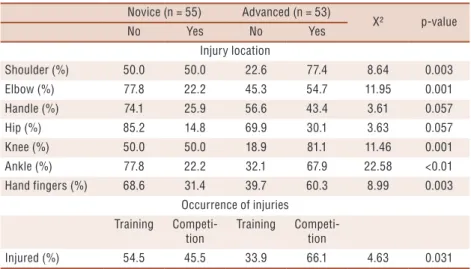
All participants in this study had previous injury history associated with BJJ practice. Shoulders and knees were the most common injury location in novice (shoulder = 50% and knee = 50%) and advanced athletes (shoulder = 77.4% and knee = 81.1%). Advance athletes also demonstrated injury to ankles (67.9%) and fingers (60.3%). Significant associations between novice and advanced athletes were observed for shoulder, elbow, knee, ankle and hand fingers (p < 0.05). Additionally, novice athletes demonstrated higher injury prevalence during training sessions (54.5%), whereas advanced ath-letes demonstrated more injuries during competitions (66.1%) (Table 1).
Table 1. Association between novice and advanced BJJ athletes for injury location and occurrence
of injury (relative frequency corresponds to total of citations by the athletes).
Novice (n = 55) Advanced (n = 53)
X² p-value
No Yes No Yes
Injury location
Shoulder (%) 50.0 50.0 22.6 77.4 8.64 0.003
Elbow (%) 77.8 22.2 45.3 54.7 11.95 0.001
Handle (%) 74.1 25.9 56.6 43.4 3.61 0.057
Hip (%) 85.2 14.8 69.9 30.1 3.63 0.057
Knee (%) 50.0 50.0 18.9 81.1 11.46 0.001
Ankle (%) 77.8 22.2 32.1 67.9 22.58 <0.01
Hand fingers (%) 68.6 31.4 39.7 60.3 8.99 0.003 Occurrence of injuries
Training Competi-tion
Training Competi-tion
Injured (%) 54.5 45.5 33.9 66.1 4.63 0.031
Injuries in Brazilian jiu-jitsu Silva Jr. et al.
Table 2. Logistic regression demonstrating relationships between competition level and injury
(location and occurrence).
Advanced (n = 53) Novice (n = 55) p-value Ref OR (CI 95%)
Injury location
Shoulder 1 0.29 (0.12-0.67) 0.004
Elbow 1 0.23 (0.10-0.54) 0.001
Handle 1 0.45 (0.02-1.03) 0.060
Hip 1 0.40 (0.15-1.04) 0.061
Knee 1 0.23 (0.09-0.55) 0.001
Ankle 1 0.13 (0.05-0.32) <0.001
Hand fingers 1 0.30 (0.13-0.66) 0.003
Occurrence of injury
Training 1 2.33 (1.07-5.07) 0.033
Competition 1 0.42 (0.19-0.93) 0.033
OR = odds ratio, CI = Confidence interval, Ref. = reference.
The main injury mechanism in novice athletes was overuse (excess of training) (66%), which was followed by joint keys (29%), falls (27%), and other (18%, sprains and beats). In contrast, the main injury mechanism in advanced athletes was joint keys (75%) followed by overuse (47%), falls (26%), and other (39%, sprains and beats) (Figure 1).
Figure 1. Frequency of mechanisms involving injuries in novice and advanced BJJ athletes.
Novice athletes demonstrated more severe (35%) and light injuries (33%), whereas advanced athletes showed more moderate to severe (31%) and severe injuries (49%) (Figure 2).
DISCUSSION
most injured regions in both novice and advanced athletes, which is consist-ent with our first hypothesis. Although athletes did not report elbows as the most frequent site of injury, prevalence at this location amounted to 54.7% and 22.2% of total citations for advanced and novice athletes, respectively.
Injuries incurred at joints of BJJ athletes may be related to techniques used in matches and training sessions. During the course of BJJ combat, athletes perform specific techniques to defend joint keys while increasing risk of injury, particularly at knees, elbows, and shoulders. Consistent with our observations, Kreiswirth et al.8 reported a high injury rate during a
BJJ World Championship in 2009, particularly at knees (19.4%), shoulders (16.1%) and elbows (19.4%). Scoggin et al.9 while analyzing data from BJJ
tournaments in Hawaii from 2005 to 2011 concluded that 19.4% of knee injuries occurred from direct pressure, particularly during passing guard (11.1%). The same authors reported shoulder injuries to be most commonly caused by the kimura technique (joint key in the shoulder).
In team sports several studies have reported that hamstrings/quadriceps and external/internal rotators ratios may be a possible mechanism underly-ing knee18,19 and shoulder20,21 injuries, respectively. This is relevant as BJJ
combat presents higher effort:pause ratio (from 6:1 to 13:1)5,7 compared
with other combat sports such as judo (2:1 to 3:1)22 and Greco-Roman
wrestling (2:1)23. Therefore, strength imbalances associated with high
Injuries in Brazilian jiu-jitsu Silva Jr. et al.
incidence of injury compared with novice wrestlers (division III)24. Yard et
al.25 also observed higher injury rates increased as competition experience
level increased for wrestlers. On the other hand, in BJJ athletes, Kreiswirth et al.8 demonstrated novice and advanced athletes have similar injury rates
(5.3 and 8.3%, respectively), suggesting cause of injury is more related to inherent technique than skill in performing submission maneuvers. Thus, we suggest higher injury rate for advanced BJJ athletes showed in this study could be related to the high technical level of opponents since matches are divided according to belt color. Also possibly contributing to injury prevalence, advanced BJJ athletes demonstrated higher frequency of practice and match competition compared with novice athletes.
Novice BJJ athletes demonstrated an odds ratio of training session injury approximately twice higher than advanced athletes. This supports our hypothesis that the majority of combat athlete injuries occur during training10,12,13 as a function of experience level in combat sports training26.
While novice athletes typically have less formal match competition during the season, the increased frequency of practices is consistent with overuse (excess of training) as the most cited injury mechanism in novice athletes compared with advanced athletes where joint keys were the most cited cause of injury.
Traditional BJJ training sessions generally consist of warm-ups (30 minutes) and combats simulations (60 minutes)27 where all athletes train
together independent of belt graduation, body weight, or experience time. In training sessions, novice athletes usually perform several matches against more experienced athletes. This leads to injury risk that is higher compared with formal competitions where matches are divided by belt color and weight28.
According to the severity scale of injury, which considers training time lost due to injury, novice athletes reported a high rate of severe and light injuries, whereas advanced athletes most frequently reported moderate to severe and severe injuries. This suggests that advanced athletes demon-strated increased training time lost due to injury as a likely consequence of falls and knocks during matches in formal competition. By contrast, injuries of novice athletes mainly caused by overuse (excess of training) resulted in no training time lost due to injury or low- to- moderate time lost (e.g., two to four weeks).
Moderate or severe injuries are common for combat sports. For exam-ple, boxing athletes presented 33 days lost per injury12 and for taekwondo
athletes 32% of injuries result in >1 week training time lost (i.e., moderate or severe)13. Considering severity of injuries, our results suggest the rate of
moderate or severe injuries on BJJ novice and advanced athletes are high. Therefore, these data provide new insight as to how one might implement injury prevention programs within the sport of BJJ.
assessment methods including Functional Movement Screening (FMS) may be applicable for physically assessing BJJ athletes29.
CONCLUSION
We concluded that BJJ athletes demonstrated high prevalence of injury primarily at knee and shoulder. While risk of injury appeared less in novice, the advanced reported higher number of injuries during competitions as a function of moderate- to- severe injury at joint keys. By contrast, novice athletes presented higher number of injuries during training sessions as a consequence of overuse, whereby the degree of severity being reported as light- to- moderate. As a next step, we suggest longitudinal studies should be performed to analyze risk of injury over the course of a season as well as separate studies performed to assess specific strength training programs useful for preventing muscle disorders and injuries. In addition, further researches should compare data obtained from questionnaires with medical reports, allowing more accurate results related to BJJ injuries.
REFERENCES
1. Andreato LV, De Moraes SM, Gomes TLM, Esteves JV, Andreato TV, Franchini E. Estimated aerobic power, muscular strength and flexibility in elite Brazilian Jiu Jitsu athletes. Sci Sports 2011;26(6):329-37.
2. James LP. An Evidenced-Based Training Plan for Brazilian Jiu-Jitsu. Strength Cond J 2014;36(4):14-22.
3. Andreato LV, Lara FJD, Andrade A, Branco BHM. Physical and physiological profiles of Brazilian jiu-jitsu athletes: a systematic review. Sports Med Open. 2017;3(1):9.
4. Andreato LV, Follmer B, Celidonio CL, Honorato AS. Brazilian Jiu-Jitsu combat among different categories: time-motion and physiology. A systematic review. Strength Cond J 2016;38(6):44–54.
5. Del Vecchio F, Biachini S, Hirata SM, Chacon-Mikahil, MPT. Análise morfo-funcional de praticantes de Brazilian jiu-jitsu e estudo da temporalidade e da quantificação das ações motoras na modalidade. Mov Percep 2007;7(10):263-81.
6. Andreato LV, Franchini E, De Moraes SM, Pastório JJ, Da Silva DF, Esteves JV, et al. Physiological and technical-tactical analysis in Brazilian jiu-jitsu competition. Asian J Sports Med 2013;4(2):137-43.
7. Andreato LV, Julio UF, Panissa VLG, Esteves JVDC, Moraes SMF, Souza CO, et al. Brazilian jiu-jitsu simulated competition. Part II: Physical performance, time-motion, technical-tatical analyses and perceptual responses. J Strength Cond Res 2015;29(7):2015-25.
8. Kreiswirth EM, Myer GD, Rauh MJ. Incidence of injury among male brazilian jiu-jitsu fighters at the world jiu-jitsu No-Gi Championship 2009. J Athl Train 2014;49(1):89-94.
Injuries in Brazilian jiu-jitsu Silva Jr. et al.
10. Kujala UM, Taimela S, Antti-Poika I, Orava S, Tuominen R, Myllynen P. Acute injuries in soccer, ice hockey, volleyball, basketball, judo, and karate: analysis of national registry data. BMJ 1995;311(7018):1465–8.
11. Pasque CB, Hewett TE. A prospective study of high school wrestling injuries. Am J Sports Med 2000;28(4):509–15.
12. Loosemore M, Lightfoot J, Palmer-Green D, Gatt I, Bilzon J, Beardsley C. Boxing injury epidemiology in the Great Britain team: a 5-year surveillance study of medi-cally diagnosed injury incidence and outcome. Br J Sports Med 2015;49(17):1100-7
13. Lystad RP, Graham PL, Poulos RG. Exposure-adjusted incidence rates and se-verity of competition injuries in Australian amateur taekwondo athletes: a 2-year prospective study. Br J Sports Med 2013;47(7):441-6
14. Diaz-Lara FJ, García JMG, Monteiro LF, Abian-Vicen J. Body composition, isometric hand grip and explosive strength leg – similarities and differences between novice and experts in an international competition of Brazilian jiu jitsu. Arch Budo 2014;10(1):211-7
15. Santos SG, Graup S, Dos Reis DC. Relação entre alterações posturais, prevalência de lesões e magnitudes de impacto nos membros inferiores em atletas de handebol. Fitness Perform J 2007;6(6):388-93.
16. Birrer RB. Trauma epidemiology in the martial arts. The results of an eighteen-year international survey. Am J Sports Med1996;24(6):72-9
17. Birrer RB, Halbrook SP. Martial arts injuries. The results of a five year national survey. Am J Sports Med 1998;16(4):408-10.
18. Croisier J-L, Forthomme B, Namurois M-H, Vanderthommen M, Crielaard J-M. Hamstring Muscle Strain Recurrence and Strength Performance Disorders. Am J Sports Med 2002;30(2):199-203
19. Croisier JL, Ganteaume S, Binet J, Genty M, Ferret JM. Strength imbalances and prevention of hamstring injury in professional soccer players: a prospective study. Am J Sports Med 2008;36(8):1469-75
20. Edouard P, Degache F, Oullion R, Plessis JY, Gleizes-Cervera S, Calmels P. Shoulder strength imbalances as injury risk in handball. Int J Sports Med 2013;34(7):654-60
21. Hadzic V, Sattler T, Veselko M, Markovic G, Dervisevic E. Strength asymmetry of the shoulders in elite volleyball players. J Athl Train 2014;49(3):338-44
22. Miarka B, Panissa V, Julio UF, Vecchio FBD, Calmet M, Franchini E. A com-parison of time-motion performance between age groups in judo matches. J Sport Sci 2012:30(9):899-905.
23. Nilsson J, Csergö S, Gullstrand L, Tveit P, Refsnes PE. Work-time profile, blood lactate concentration and rating of perceived exertion in the 1998 Greco-Roman wrestling World Championship. J Sport Sci 2002;20(11):939-45
24. Agel J, Ransone J, Dick R, Oppliger R, Marshall SW. Descriptive epidemiol-ogy of collegiate men’s wrestling injuries: National Collegiate Athletic Associa-tion Injury Surveillance System, 1988–1989 through 2003–2004. J Athl Train 2007;42(2):303–10.
25. Yard EE, Collins CL, Dick RW, Comstock RD. An epidemiologic comparison of high school and college wrestling injuries. Am J Sports Med 2008;36(1):57–64
CORRESPONDING AUTHOR
Rafael Lima Kons
Universidade Federal de Santa Catarina. Centro de Desportos. Laboratório de Biomecânica. Campus Universitário da Trindade. CEP: 88040-900 Florianópolis (SC) Brasil
E-mail: [email protected]
hormonal and perceptive responses. Arch Budo Sci Martial Arts Extrem Sports 2016;12(1)145-56.
28. International Brazilian Jiu-Jitsu Federation. Available from <http://www.ibjjf. org>. [2017July 19].