(1) Universidade Federal do Rio Grande do Norte - UFRN, Natal, Rio Grande do Norte, Brasil.
(2) Laboratório de Inovação Tecnológica em Saúde – LAIS; Universidade Federal do Rio Grande do Norte - UFRN, Natal, Rio Grande do Norte, Brasil.
Conflict of interests: Nonexistent
Facilitators and barriers for the use
of the FM System in school-age children
with hearing loss
Emanuella Silva Miranda(1)
Joseli Soares Brazorotto(2)
Received on: April 14, 2018 Approved on: August 29, 2018
Corresponding address:
Joseli Soares Brazorotto
Rua Monsenhor Severiano, 547, apto 801, Petrópolis
CEP: 59020-080 – Natal, Rio Grande do Norte, Brasil
E-mail: [email protected]
ABSTRACT
Objective: to analyze the facilitators and barriers to the use of the FM System in school-age children with hearing loss.
Methods: a cross-sectional, observational and documentary study. Data from the children’s charts and responses of their 30 teachers to a questionnaire were used in the descriptive and inferential statistical analysis. The questions were related to the use of the FM System by the child and the preparation of the teachers to use the resource. Results: out of the 30 children whose teachers answered the survey, only nine used the FM System in the classroom. Factors such as age, parents’ schooling and their participation in speech therapy, as well as the teacher’s knowledge about the FM System and their experience with hard of hearing children were shown to be facilitators for the use of the device as well as the consistent use of the hearing devices (hearing aids and/or cochlear implant).
Conclusion: the main facilitator for the use of the FM System was the teacher’s kno -wledge about it. Considering the importance of the use of this resource for the mains -tream education of children with hearing loss, a multi-centric research is desirable for the determination of protocols to follow the adaptation and training of the school community.
INTRODUCTION
The acoustic school environment can be extremely hostile, especially for children with hearing loss, causing damage to their speech perception with consequences for the academic and psychosocial development of this group1.
A few decades ago the Frequency Modulation System (FM System) has been used to improve the signal-to-noise ratio received by the hard of hearing child, being used especially in classrooms. It is considered, by several researchers, the most important and essential educational tool already developed1-3.
In Brazil, in 2013, it was published the decree that introduced the FM System in the table of procedures, medicines, orthoses, prostheses and special materials
(OPM) of the Unified Health System (SUS) - Decree No. 1.274 / GM / MS of the Ministry of Health in 2013,
characterizing an important step in the schooling of children with hearing loss, with the expectation of improvements in the inclusion process for the hard of
hearing children who use oral language, from five to
seventeen to eleven months4.
After this period, some studies were carried out in view of the need to understand the process of adaptation of the FM System in the national reality5-7.
These studies have highlighted to the use of the FM System as essential for the inclusion of hard of hearing children who use oral language, in the school environment and factors such as family participation and teacher engagement in this process are noted as important predictors for the good use of this resource1,2,5,6.
At the same time, in the official documents referring
to the accessibility of the hard of hearing children, the proposal for accessibility to content is the use of Brazilian Sign Language as a language of instruction,
without specific references, to the variability of enrolled
students8,9.
Due to the advances in science, technology and
public policies related to hearing care (PNASA, 2004),10
the detection and early intervention for babies and children with hearing loss is a reality in the national
territory and, with the significant improvement in the
coverage of neonatal screening (Law no. 12303/2010)11
and with the implementation of the Specialized Centers in Rehabilitation (RECs, Law 7,612 / 2011)12 - Unlimited Life Plan / Health of the Person with Disabilities) very
soon, a number even more expressive of preschool
Thus, an expressive number of school-age children,
users of hearing aids (HAs and / or Cochlear Implants -
CIs) will be in classrooms throughout the country, using Portuguese as communication, since early and appro-priate speech-language intervention makes possible the development of oral language13,14.
Understanding that there is a great variability of educational needs for the hard of hearing population opens up many possibilities for the learner.
Thus, in addition to the important role of the sign language interpreter, for children with hearing loss using sign language; of the teacher of sign language, to those who are in sign language acquisition; the use of subtitled or signed materials; of the specialized
teaching teacher qualified to deal with this range of particularities, there is also the need to think: “How
to enhance the mainstream education of children with hearing loss who use or who are developing oral language?”
An important resource for access to oral language in the classroom is, therefore, the FMSystem15. There is already sufficient scientific evidence, including in the
national scenario, to assert that this auxiliary resource is one of the pertinent tools for the successful inclusion of children with hearing loss 1,2,5,6.
However, adapting the FM system clinically is not a
guarantee of effective use in the school environment16
and should be accompanied by systematic guidance to the school staff (mainstream classroom teacher, support teachers, specialized teaching teacher, since, like any new technological resource, it may raise doubts
about its real benefit and also the fear of handling and
care, resulting in the non-use or partial use of this tool in school.
There is a need to systematically monitor the use of this device in the classroom from the perspective of the teacher and from the student17.
Some of the factors that may influence the good
adherence to the use of the FM System highlighted in the literature are:
• The teacher’s knowledge of the device as well as its use in the classroom17.
• The cooperation between family and school must be considered of fundamental importance during the process of (re)habilitation, facilitating children’s access to language learning procedures as well as their inclusion in school activities6,18.
the hearing devices importance that the children possess are understood by all who make the teaching process of this audience18,19.
Thus, for regular schools to play the role of appro-priate inclusion it is necessary to give children access to the perception of speech sounds and pedagogical content through curricular adaptations as well as struc-tural adaptations and use of technology to improve their accessibility6,8,13,14,16.
One of the factors that may contribute to the inclusion of these children in the classroom is the continuous training of teachers, highlighted in several studies20,21 as being of fundamental importance for the
real inclusion of students with hearing loss.
The precariousness of professional training in the care of children with special educational needs is pointed out as an important barrier in the inclusion of these students, since educators tend to underestimate
the competences of these students, making it difficult
for them to access the academic contents 20.
As the use of the FM System becomes a decisive factor to facilitate the inclusion of the child in a school environment, the socio-demographic question must also be considered and, in this sense, it is essential that surveys are carried out throughout the country to evaluate the use of this hearing device in school-age children with hearing loss.
In this perspective, the objective of this study was to investigate the facilitators and barriers for the use of the FM System in students with hearing loss.
METHODS
This study is characterized as transversal, obser-vational and documentary, approved by the Research Ethics Committee (59012-300) of the Federal University of Rio Grande do Norte, under the statement of number 1,144,295.
For the characterization of students with hearing loss, a survey of all the children attended in Program P1 (Aurioral Approach) of the SUVAG-RN Center was carried out, with 102 children being found.
From the analysis of all the medical records, observing the educational level of the children, it was
verified that 85 were in school age.
Information concerning age, gender, etiology, type and degree of hearing loss, age at diagnosis, time of
auditory sensory deprivation, thresholds in the field with
the use of hearing devices, categories of hearing and language, time of adaptation with Coclear Implant(s)
and /or Hearing Aids, level of education of the child and
the caregiver, and family income were analyzed.
The data collection of the teachers was carried out at the moments of meetings of teachers of children with hearing loss, promoted by UFRN in partnership with the SUVAG Center to which these children are users. For the enrollment, an application form was sent to the families that should be taken to the school in order to be completed by the teacher.
Within the distributed forms (70), they returned 52 registration forms, attending only 28 teachers in the
first meeting, of whom 16 accepted to participate in the
study, signing the Informed Consent Term (ICT).
The second meeting was attended by 24 teachers,
of whom 10 had already participated in the first meeting
and 14 were new participating teachers. Of these 14 novice teachers, all accepted to participate in the
research, totaling, finally, 30 teachers.
During meetings, the teachers were clarified about
the objectives and method of this research and those who agreed to participate in the study signed the ICT. The research sample was therefore obtained for convenience.
A questionnaire was applied for the teachers composed of the general data (name, age, academic background, time of profession, type of specialization)
and specific questions about their knowledge regarding
the FM System, use, to a student with a disability, the professional preparation for attending these students and their attitudes towards teaching for the hard of hearing children.
To obtain the data in relation to the family charac-terization, the Family Involvement Scale20 was collected
secondary, through the database of the Center SUVAG-RN.
This scale aims to characterize the quality of participation and family engagement in the intervention process, taking as a parameter the analysis of the child therapist on a progressive scale of 1 to 5, where 1 is characterized as limited involvement and 5 as ideal involvement. For this evaluation, aspects such as family adaptation, participation in sessions, family attitudes and behaviors, and effectiveness of communication with the child were considered21.
The arithmetic mean between the notes given by the three therapists of each of the children (individual and group therapist) was used.
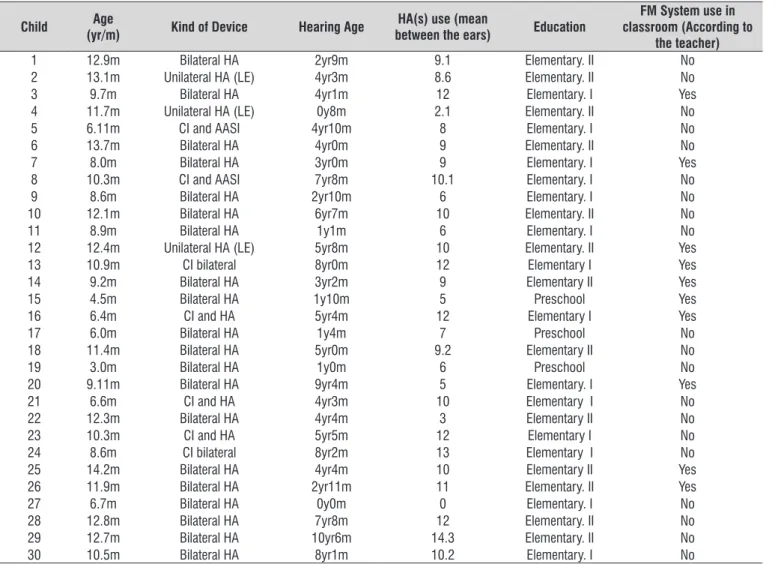
Table 1 shows the demographic distribution of the students whose teachers took part in the research in relation to age, type of hearing device, duration of use
of HAs and / or CI in years and months, the number
of hours used hearing aids per day (Data logging), to schooling and using the FM System in the classroom (according to the teacher).
and analyzed using the statistical software IBM® SPSS® Statistics 2.0 using Wilcoxon’s non-parametric test and Logistic Regression.
This method has the characteristic of comparing
events in relation to a fixed variable, which in the case
of the study was selected the “use of the FM System in the classroom”.
Table 1. Demographic distribution of the children who participated in the research
Child Age
(yr/m) Kind of Device Hearing Age
HA(s) use (mean
between the ears) Education
FM System use in classroom (According to
the teacher)
1 12.9m Bilateral HA 2yr9m 9.1 Elementary. II No
2 13.1m Unilateral HA (LE) 4yr3m 8.6 Elementary. II No
3 9.7m Bilateral HA 4yr1m 12 Elementary. I Yes
4 11.7m Unilateral HA (LE) 0y8m 2.1 Elementary. II No
5 6.11m CI and AASI 4yr10m 8 Elementary. I No
6 13.7m Bilateral HA 4yr0m 9 Elementary. II No
7 8.0m Bilateral HA 3yr0m 9 Elementary. I Yes
8 10.3m CI and AASI 7yr8m 10.1 Elementary. I No
9 8.6m Bilateral HA 2yr10m 6 Elementary. I No
10 12.1m Bilateral HA 6yr7m 10 Elementary. II No
11 8.9m Bilateral HA 1y1m 6 Elementary. I No
12 12.4m Unilateral HA (LE) 5yr8m 10 Elementary. II Yes
13 10.9m CI bilateral 8yr0m 12 Elementary I Yes
14 9.2m Bilateral HA 3yr2m 9 Elementary II Yes
15 4.5m Bilateral HA 1y10m 5 Preschool Yes
16 6.4m CI and HA 5yr4m 12 Elementary I Yes
17 6.0m Bilateral HA 1y4m 7 Preschool No
18 11.4m Bilateral HA 5yr0m 9.2 Elementary II No
19 3.0m Bilateral HA 1y0m 6 Preschool No
20 9.11m Bilateral HA 9yr4m 5 Elementary. I Yes
21 6.6m CI and HA 4yr3m 10 Elementary I No
22 12.3m Bilateral HA 4yr4m 3 Elementary II No
23 10.3m CI and HA 5yr5m 12 Elementary I No
24 8.6m CI bilateral 8yr2m 13 Elementary I No
25 14.2m Bilateral HA 4yr4m 10 Elementary II Yes
26 11.9m Bilateral HA 2yr11m 11 Elementary. II Yes
27 6.7m Bilateral HA 0y0m 0 Elementary. I No
28 12.8m Bilateral HA 7yr8m 12 Elementary. II No
29 12.7m Bilateral HA 10yr6m 14.3 Elementary. II No
30 10.5m Bilateral HA 8yr1m 10.2 Elementary. I No
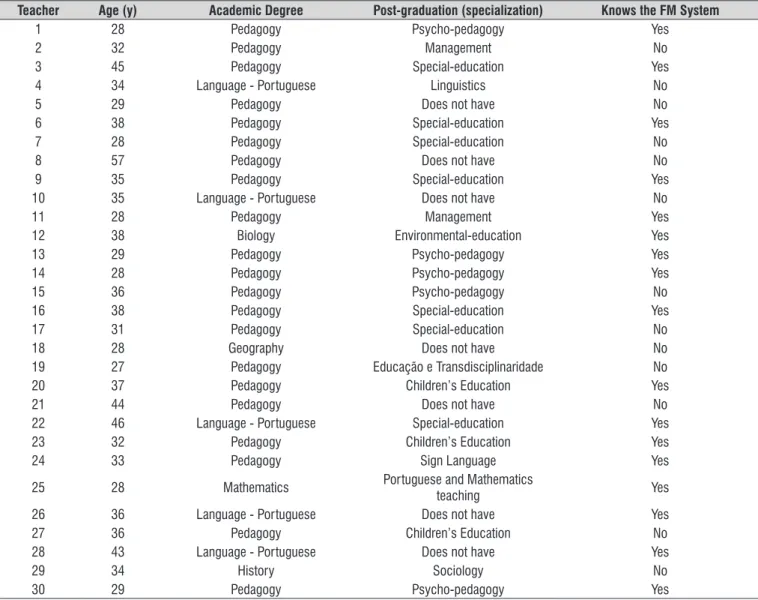
in relation to their age, academic background, post-graduation and knowledge of the FM System.
In Table 2 it is observed the demographic distri-bution of the teachers participating in the research
Table 2. Demographic distribution of the teachers who participated in the research
Teacher Age (y) Academic Degree Post-graduation (specialization) Knows the FM System
1 28 Pedagogy Psycho-pedagogy Yes
2 32 Pedagogy Management No
3 45 Pedagogy Special-education Yes
4 34 Language - Portuguese Linguistics No
5 29 Pedagogy Does not have No
6 38 Pedagogy Special-education Yes
7 28 Pedagogy Special-education No
8 57 Pedagogy Does not have No
9 35 Pedagogy Special-education Yes
10 35 Language - Portuguese Does not have No
11 28 Pedagogy Management Yes
12 38 Biology Environmental-education Yes
13 29 Pedagogy Psycho-pedagogy Yes
14 28 Pedagogy Psycho-pedagogy Yes
15 36 Pedagogy Psycho-pedagogy No
16 38 Pedagogy Special-education Yes
17 31 Pedagogy Special-education No
18 28 Geography Does not have No
19 27 Pedagogy Educação e Transdisciplinaridade No
20 37 Pedagogy Children’s Education Yes
21 44 Pedagogy Does not have No
22 46 Language - Portuguese Special-education Yes
23 32 Pedagogy Children’s Education Yes
24 33 Pedagogy Sign Language Yes
25 28 Mathematics Portuguese and Mathematics teaching Yes
26 36 Language - Portuguese Does not have Yes
27 36 Pedagogy Children’s Education No
28 43 Language - Portuguese Does not have Yes
29 34 History Sociology No
30 29 Pedagogy Psycho-pedagogy Yes
Legend: Age (y) - Age in years; FM system - frequency modulated system.
RESULTS
The results were organized in order to analyze the information collected in the records (data logging, hearing and language categories of the children, age and income of the person responsible and family engagement) and the questionnaire applied to teachers (age, academic background, specialization, experience with hard of hearing children and knowledge regarding
the FM System) and the possible associations between these variables with the use (or not) of the FM System in the classroom.
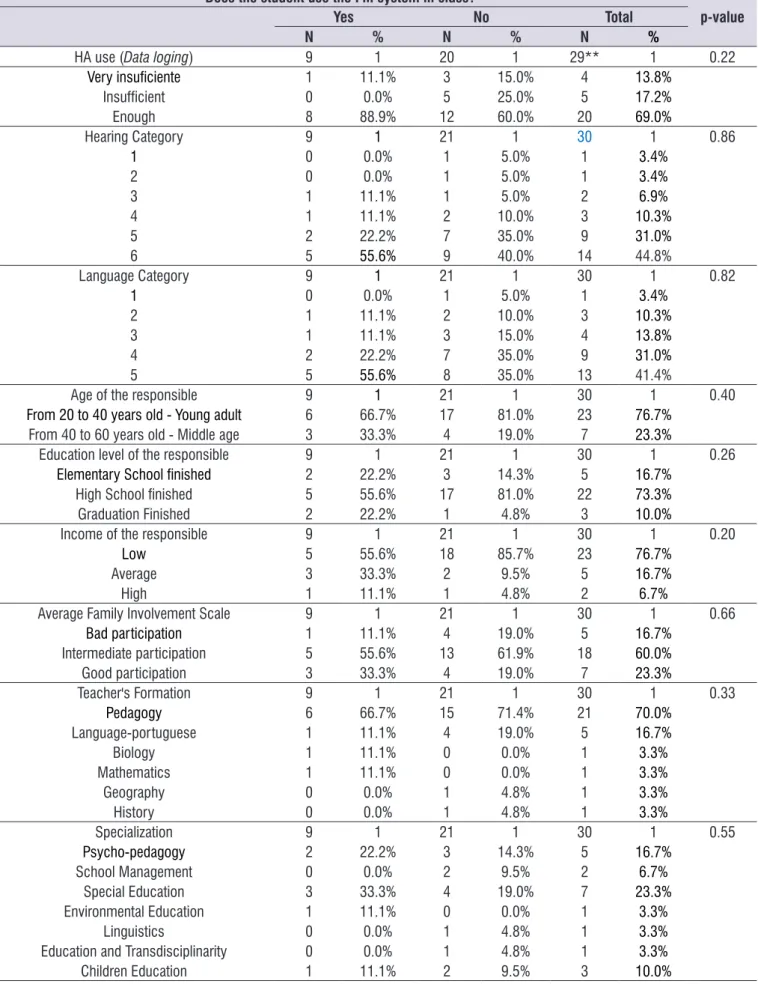
The values of p show the statistical relevance of each variable related to the use of the FM System in the classroom.
Values of p <0.05 were considered statistically
significant.
In Table 3 it is showed the values obtained through the Wilcoxon test for two samples in order to test if the distributions of one variable tend to have values greater than the other, with the respective p.
36%
7% 20%
37%
Knows how to deal with the child and with the devices.
You are afraid to break the devices.
Leave the child at ease.
Has difficulty to communicate with child.
Figure 1. Answers from the teachers’ questionnaire to the question: “How do you feel about the hearing impaired student?”
10
9
0
10
20 21
25
20
0 0
5
0 0
5 10 15 20 25 30
Was there any kind of orientation towards your hearing impaired student?
Does the teacher know how to handle the FM
System?
Does the speech therapist participate or have already participated in any
activity at school?
Does the graduation degree offer preparation
for the teaching of children with hearing
loss?
Yes No Don't Know
Table 3. Distribution of the descriptive frequencies and inferential analysis of the variables associated with the use of the Frequency
Modulation System in the classroom
Does the student use the FM system in class?
p-value
Yes No Total
N % N % N %
HA use (Data loging) 9 1 20 1 29** 1 0.22
Very insuficiente 1 11.1% 3 15.0% 4 13.8%
Insufficient 0 0.0% 5 25.0% 5 17.2%
Enough 8 88.9% 12 60.0% 20 69.0%
Hearing Category 9 1 21 1 30 1 0.86
1 0 0.0% 1 5.0% 1 3.4%
2 0 0.0% 1 5.0% 1 3.4%
3 1 11.1% 1 5.0% 2 6.9%
4 1 11.1% 2 10.0% 3 10.3%
5 2 22.2% 7 35.0% 9 31.0%
6 5 55.6% 9 40.0% 14 44.8%
Language Category 9 1 21 1 30 1 0.82
1 0 0.0% 1 5.0% 1 3.4%
2 1 11.1% 2 10.0% 3 10.3%
3 1 11.1% 3 15.0% 4 13.8%
4 2 22.2% 7 35.0% 9 31.0%
5 5 55.6% 8 35.0% 13 41.4%
Age of the responsible 9 1 21 1 30 1 0.40
From 20 to 40 years old - Young adult 6 66.7% 17 81.0% 23 76.7% From 40 to 60 years old - Middle age 3 33.3% 4 19.0% 7 23.3%
Education level of the responsible 9 1 21 1 30 1 0.26
Elementary School finished 2 22.2% 3 14.3% 5 16.7%
High School finished 5 55.6% 17 81.0% 22 73.3%
Graduation Finished 2 22.2% 1 4.8% 3 10.0%
Income of the responsible 9 1 21 1 30 1 0.20
Low 5 55.6% 18 85.7% 23 76.7%
Average 3 33.3% 2 9.5% 5 16.7%
High 1 11.1% 1 4.8% 2 6.7%
Average Family Involvement Scale 9 1 21 1 30 1 0.66
Bad participation 1 11.1% 4 19.0% 5 16.7%
Intermediate participation 5 55.6% 13 61.9% 18 60.0%
Good participation 3 33.3% 4 19.0% 7 23.3%
Teacher's Formation 9 1 21 1 30 1 0.33
Pedagogy 6 66.7% 15 71.4% 21 70.0%
Language-portuguese 1 11.1% 4 19.0% 5 16.7%
Biology 1 11.1% 0 0.0% 1 3.3%
Mathematics 1 11.1% 0 0.0% 1 3.3%
Geography 0 0.0% 1 4.8% 1 3.3%
History 0 0.0% 1 4.8% 1 3.3%
Specialization 9 1 21 1 30 1 0.55
Psycho-pedagogy 2 22.2% 3 14.3% 5 16.7%
School Management 0 0.0% 2 9.5% 2 6.7%
Special Education 3 33.3% 4 19.0% 7 23.3%
Environmental Education 1 11.1% 0 0.0% 1 3.3%
Linguistics 0 0.0% 1 4.8% 1 3.3%
Education and Transdisciplinarity 0 0.0% 1 4.8% 1 3.3%
This analysis was used with all the variables studied, however, only those that presented a chance value to “explain” the use of the FM System in the classroom were selected for discussion.
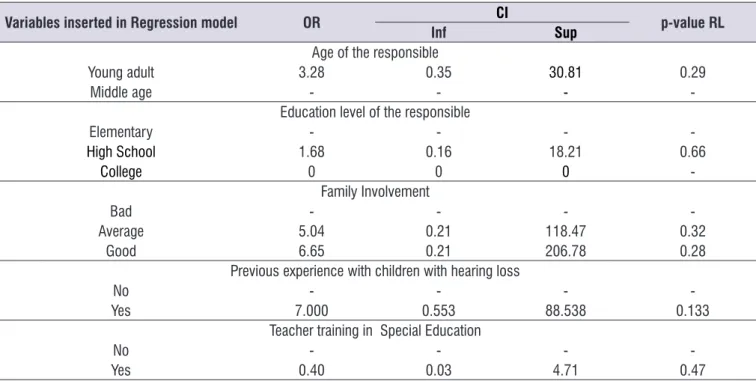
In Table 4 it is presented the Logistic Regression of the following variables: family-related - age, schooling and family participation; related to the teacher - experience with children with hearing loss and continuing education in the area of special education.
Does the student use the FM system in class?
p-value
Yes No Total
N % N % N %
Sign language 0 0.0% 1 4.8% 1 3.3%
Portuguese and Mathematics teaching 1 11.1% 0 0.0% 1 3.3%
Sociology 0 0.0% 1 4.8% 1 3.3%
Does not have 1 11.1% 6 28.6% 7 23.3%
Teacher’s age 9 1 21 1 30 1 0.59
Young adult 8 88.9% 17 81.0% 25 83.3%
Middle age 1 11.1% 4 19.0% 5 16.7%
Has already worked with children with hearing
loss 9 1 21 1 30 1 0.13
Yes 7 77.8% 10 47.6% 17 56.7%
No 2 22.2% 11 52.4% 13 43.3%
Has special education training 9 1 21 1 30 1 0.52
Yes 5 55.6% 9 42.9% 14 46.7%
No 4 44.4% 12 57.1% 16 53.3%
Knows the FM system 9 1 21 1 30 1 0.003*
Yes 9 100.0% 9 42.9% 18 60.0%
No 0 0.0% 12 57.1% 12 40.0%
* p-value with statistical significance <0.05 in the Wilcoxon test.
the context of the documents and ongoing training on how to use the equipment2.
In the analysis proposed in this research some of the above factors were observed and will be discussed below.
Among the children whose teachers reported FM users, it was noted that 88.9% (n = 8) had the data
logging measure classified as sufficient use of HAs (an
average of 14.3 hours per day), which was possibly a facilitating factor for the adhesion to the FM System in the classroom19. Gustafson et al.21 pointed out that
individuals who use hearing aids can better perform tasks related to social everyday life, including school and family tasks.
Regarding the Audition and Language categories, 55.6% (n = 5) of the children whose teachers said they use FM in the classroom are in the highest categories.
This factor can also be related to the effective use of hearing devices, and the FM System is still a tool in the access to oral language in the classroom. The positive cascade effect of the device effective use is cited in the literature as a facilitator for the inclusion of hard of hearing children who use oral language2,3,5,7,15,22,23.
Concerning the family participation in the (re)habili-tation process of the hard of hearing children, the data show that 33.3% (n = 3) of the children using the FM
DISCUSSION
Multiple studies have already proven the effec-tiveness of the Frequency Modulation system as an accessibility resource for students with hearing loss1,3,5,17.
In this research, the results revealed that of the 30 participating teachers only nine stated that their
students use FM in the classroom. This finding does not corroborate the research on the benefits and the
use of the FM System by children with hearing loss,
evidencing a mismatch between the clinical-scientific
recommendations and the school reality of these hard of hearing children who use oral language.
Some factors can be listed for the use of FM in the classroom, such as: history of previous use for
Hearing Aids or Cochlear Implant, own development
of hearing and language of the child, understanding, by the family, the real importance of the child to use the hearing device, as well as their involvement in (re) habilitation of their child, the insertion of the speech-language pathologist in the school context, technical issues such as possible breaks and defects in devices FM, the fear of families about the loss and / or breaking
of the FM in the classroom, how confident the child is to
use a new resource in the school, the information given to the teacher about this accessibility resource both in
Table 4. Odds ratio among the variables that influence the use of the Frequency Modulation System in students with hearing loss
Variables inserted in Regression model OR CI p-value RL
Inf Sup
Age of the responsible
Young adult 3.28 0.35 30.81 0.29
Middle age - - -
-Education level of the responsible
Elementary - - -
-High School 1.68 0.16 18.21 0.66
College 0 0 0
-Family Involvement
Bad - - -
-Average 5.04 0.21 118.47 0.32
Good 6.65 0.21 206.78 0.28
Previous experience with children with hearing loss
No - - -
-Yes 7.000 0.553 88.538 0.133
Teacher training in Special Education
No - - -
-Yes 0.40 0.03 4.71 0.47
Statistical Testing: Logistic Regression
Legends: OR – Odds Ratio); CI – Confidence Interval. LR – Logistic Regression
System (n = 9) had a good average of participation in therapy and 55.6% (n = 5) an intermediate participation. Only 11.1% (n = 1) of the families of children using FM
System in the classroom were identified as having a
poor participation in the (re)habilitation program.
However, a 61.9% (n = 13) share of families whose children were identified as non-users of the FM System
at school were also considered as intermediate partici-pants and 19% (n = 4) as good participartici-pants in the (re) habilitation22 program of their children.
Family involvement in (re)habilitation is evaluated by the speech therapist and other therapists of the child, being highlighted in the literature as a robust factor for the adequate development of children with hearing loss3,6,14,20.
Thus, it is questioned whether speech therapists and other therapists are aware of the use of the FM system by the children they attend and consider this question also as “family participation” in the (re)habili-tation process, since, for it is a resource for personal use, the family should be the agent responsible for presenting the FM system initially to the school and will play the role of supporting the child’s use of it in other settings as well.
In addition, it can be questioned why families considered as having intermediate participation (61.9%) and good participation (19%) of the cases, do not send their children’s FM systems to school and apparently do not make the bridge between this accessibility resource and the school, as expected for families who understand the needs of their children.
An important fact to be observed in this study is the participation of the speech therapist in the school context. According to the teachers’ responses, shown in Figure 2, speech therapist are still far from the educational reality of these hard of hearing children, and no teacher mentioned the presence of the profes-sional responsible for the therapeutic management of the child at school. It should be emphasized that the audiologist and / or the speech therapist is a decisive factor for a good participation of the family in the thera-peutic process of children with hearing loss and this orientation should include the school environment14.
Considering that the better the communication / orientation between the therapist and the family, the better the dissemination of information between family and school, the audiologist and / or speech therapist
doubts, anxieties and advances that arise both within the family and in the school environment14.
It is observed that 77.8% (n = 7) of the teachers who answered yes to the use of the system by the student with hearing loss had previous experience with these students.
This fact may be related to the continued education of teachers. Studies show that the teacher who has a challenging situation in the classroom seeks more infor-mation about the “problem” situation than those who work with situations typical of the school context18,24.
The total number of teachers who answered that students use the FM system already knew the
equipment, given statistically significant. On the other
hand, for teachers who answered that the students did not use the system, their knowledge about the system was 42.9% (n = 9) for yes (knows the system) and 57.1% (n = 12) knows the system).
This information implies that the information that the teacher has about his or her hard of hearing student is at the same time a facilitating factor in the case of well-trained teachers and a barrier if they have little or
no knowledge of their specific needs, with few contribu -tions to the successful inclusion of this student.
Regarding the variables that are associated with the use of the FM System in the classroom, evidenced through the logistic regression, although it was noticed that not all families considered good the use of the FM system in the school, it was observed that children who have parents with family engagement considered to be “good” have 6.65 times more chances of using the FM System, corroborating with studies related to family participation in the (re)habilitation process of the hearing impaired child6,14,21.
In addition, children whose parents are considered to be “young adults” are 1.68 times more likely to use the FM System in the classroom.
Regarding teachers, the regression model showed that children whose teachers have experiences with students with hearing impairment are seven times more likely to use the FM system in the classroom, since it is quite relevant, which is a potentially favorable factor for the inclusion of children with hearing loss20.
It is important to note that due to reduced n, most
of the variables did not have a statistically significant
p-value.
Frequency Modulation System on the academic perfor-mance of the hard of hearing student.
CONCLUSION
The factors identified as potential facilitators or
barriers to the use of the FM System were the teachers’ knowledge about the FM System and their experience with children with hearing loss, the use of hearing devices by the children and family engagement in the process of (re)habilitation, besides the age and schooling of those responsible for them.
Thus, family participation and continuing teacher training are important factors for the FM System appli-cation in the classroom.
The limitations of this research refer to the sampling and analysis of the local reality, besides the impos-sibility of measures of academic performance and satisfaction with the FM System with the students and information collection with the families. In the conti-nuity of this study, the children and the relatives shall be evaluated and the totality of investigations with the teachers will be searched.
It is understood that the progression of the search
for scientific evidence on the effective use of the FM
System is extremely important, in order to make the right to accessibility a reality for students with hearing loss.
ACKNOWLEDGEMENTS
To the SUVAG-RN Center, to the teachers of the children in (re) habilitation who, kindly, gave the infor-mation during the realization of this research and to the
speech therapist Ingrid Rafaella Dantas dos Santos,
for the support and organization of the logistics in the Teacher Meetings.
REFERENCES
1. Jacob RTS, Alves TKM, Moret ALM, Morettin M, Santos LG, Mondelli MFCG. Participation in regular classroom of student with hearing loss:
frequency modulation System use. CoDAS.
2014;26(4):308-14.
2. Esturaro GT, Novaes BCAC, Deperon TM, Martinez
MAN, Mendes BCA. Use of wireless transmission system and performance of hearing impaired
students from the perspective of teachers. Distúrb
Comum. 2016;28(4):730-42.
3. Barreiros AGE, Mendes BCA, Ficker LB, Novaes BCAC. Auditory rehabilitation: family’s
role in adherence to the use of wireless
transmission system in school. Distúrb Comum.
2016;28(4):718-29.
4. Brasil. Ministério da Saúde. Portaria n°. 1.274, de
25 de junho de 2013. Inclui o Procedimento de Sistema de Frequência Modulada Pessoal (FM) na Tabela de Procedimentos, Medicamentos, Órteses, Próteses e Materiais Especiais (OPM) do Sistema
Único de Saúde. Diário Oficial da União; Brasília;
2013.
5. Bertachini ALL, Pupo AC, Morettin M, Martinez MAN, Bevilacqua MC, Moret ALM et al. Frequency Modulation System and speech perception in the
classroom: a systematic literature review. CoDAS.
[Internet]. 2015 June [cited 2017 Nov 14]; 27(3):292-300. Available from: http://www.scielo. br/scielo.php?script=sci_arttext&pid=S2317-17822015000300292&lng=en
6. Rocha BS, Scharlach RC. The use of the Frequency Modulation System by hearing-impaired
children: benefits from the family’s perspective. CoDAS. [Internet]. 2017 [cited 2017 Nov 13]; 29(6). Disponível em: http://www.scielo.
br/scielo.php?script=sci_arttext&pid=S2317-17822017000600300&lng=en
7. Miguel JHS, Novaes BCAC. Hearing rehabilitation
in children: adhesion to treatment and use of hearing aids. Audiol. Commun. Res. [Internet].
2013 [cited 2017 oct 16]; 18(3):171-8. Disponível
em: http://www.scielo.br/scielo.php?script=sci_ arttext&pid=S2317-64312013000300006&lng=en
8. Brasil. Lei de Diretrizes e Bases da Educação Nacional. Lei número 9394, 20 de dezembro de
1996.
9. Brasil. Ministério da Educação. Conselho Nacional de Educação. Diretrizes Nacionais para a Educação Especial na Educação Básica. Parecer CNE/CEB n.
017/2001.
10. Brasil. Ministério da Saúde. Portaria nº 2.073/ GM, de 28 de setembro de 2004. Institui a Política Nacional de Atenção à Saúde Auditiva. Diário Oficial da República Federativa, 2004.
11. Brasil. Ministério da Saúde. Lei nº 12.303 de 2010. Dispõe sobre a obrigatoriedade do exame de Emissões Otoacústicas. DF. 2010.
12. Brasil. Ministério da Saúde. Decreto nº 7.612/2011. Institui o Plano Nacional dos Direitos da Pessoa com Deficiência. DF, 2011.
13. Bicas RS, Guijo LM, Delgado-Pinheiro EMC. Oral
impaired children and adolescents and the speech therapy rehabilitation process. Rev. CEFAC [Internet]. 2017 Aug [cited 2017 Nov 11];
19(4):465-74. Disponível em: http://www.scielo.
br/scielo.php?script=sci_arttext&pid=S1516-18462017000400465&lng=en
14. Rabelo GRG, Melo LPF. Counselling in the rehabilitating process for hearing impaired children by parents’ perspective. Rev. CEFAC [Internet]. 2016 Apr [cited 2017 Nov 19]; 11(2):362-8. Available from: http://www.scielo. br/scielo.php?script=sci_arttext&pid=S1516-18462016000200362&lng=en
15. Melo EB, Monteiro TR, Garcia VL. Oral language of hearing impaired adolescents: phonoaudiological evaluation and teachers report. Rev. CEFAC [Internet]. 2015 Aug [cited 2017 Nov 12];
17(4):1288-301. Disponível em: http://www.scielo.
br/scielo.php?script=sci_arttext&pid=S1516-18462015000401288&lng=en
16. Delgado-Pinheiro EMC, Antonio FL, Libardi
AL, Seno MP. Programa de acompanhamento fonoaudiológico de professores de alunos
deficientes auditivos que utilizam a comunicação oral. Distúrb Comum. 2009;21(1):67-77.
17. Jacob RTS, Bevilacqua MC, Molina SV, Queiroz
M, Hoshii LA, Lauris JRP et al. Frequency
modulation systems in hearing impaired children: outcome evaluation. Rev. soc. bras. fonoaudiol.
[Internet]. 2012 Dez [citado 2017 Nov 19]; 17(4):417-21. Disponível em: http://www.scielo.
br/scielo.php?script=sci_arttext&pid=S1516-8 0 3 4 2 0 1 2 0 0 0 4 0 0 0 0 9 & l n g = e n & n r m = i s o & t l ng=en.
18. Oliveira PMR, Dutra LR, Melo PPT, Rezende MB.
Facilitators and barriers in the process of school inclusion of children with special educational
needs: the perception of the educators. Rev Ter Ocup. [Internet]. 2015 may/aug [cited 2017 Nov
12]; 26(2):186-93. Disponível em: http://www.
revistas.usp.br/rto/article/view/59428.
19. Xie YU-HAN, Potměšil M, Peters B. Children who
are deaf or hard of hearing in inclusive educational settings: a literature review on interactions
with peers. Jour. of Deaf Stud. and Deaf Educ
[Internet]. 2014 [cited 2017 oct 13]; 19(4).
Disponível em: https://academic.oup.com/jdsde/
article/19/4/423/2937171
20. Mendes AQS, Figueredo F, Ribeiro AC. The inclusion of deaf students in a regular school. Rev Inic Cien Cairu. 2015;2(2):33-46.
21. Gustafson SJ, Ricketts TA, Tharpe AM. Hearing
technology use and management in school-age children: reports from data logs, parents, and teachers. J Am Acad Audiol. 2017;28(10):883-92.
22. Novaes BCAC, Ribeiro BM. Adaptado da Family Involvement Rating, em Moeller MP. “Early intervention and language development in children who are deaf and hard of hearing”. Pediatrics, 2000.
23. Figueiredo CC, Gil D. Assessment of the degree
of involvement in family therapy for children with hearing impairment. Audiol. Commun. Res. 2013;18(4):303-7.
24. Moret ALM, Bevilacqua MC, Costa OA. Cochlear implant: hearing and language in pre-lingual deaf children. Pró-Fono R. Atual. Cient. [Internet]. 2007
Sep [cited 2017 Nov 05]; 19(3):295-304. Disponível