OF CITRUS WASTE IN
BIOPRODUCTS. TECHNIQUES,
METHODOLOGIES
AND TECHNOLOGIES.
MANUAL FOR AGRICULTURAL
VET TEACHERS.
This project has been funded with support from the European Commission. This book reflects the views only of the authors, and the Commission cannot be held responsible for any use which may be of the information contained therein.
The transformation of citrus waste in bioproducts.
Techniques, methodologies and technologies.
Manual for agricultural VET teachers
CitriVET Project Consortium 2019
Title: The transformation of citrus waste in bioproducts. Techniques, methodologies and technologies. Manual for agricultural VET teachers.
Editors: José Segarra, Juan Jorro, Eva Merloni & Amílcar Duarte
Reviewers: Ana Arsénio, Emanuela D’Agostino, Enrico Balugani, José Castro & Luana Ladu Cover Design: Ludovico Silva (University of Algarve)
This book was produced under the ERASMUS project CitriVET – “Enhancing green-skills in VET through citrus waste valorization”.
Edition: CitriVET Project Consortium Low Carbon Economy Foundation (LCE)
Edifici Parking Grutas de Sant Josep, S/N, 12600 12600, La Vall d’Uixó (Spain)
http://www.lowcarboneconomy.org/ E-mail: [email protected] University of Algarve Campus da Penha, 8005-139 Faro (Portugal) www.ualg.pt E-mail: [email protected]
Escola Profissional Cândido Guerreiro
Estrada da Ponte, 8100-012 Alte (Portugal) www.epalte.pt E-mail: [email protected] EFA La Malvesia Partida el Cercat, s/n.
46195. Llombai. Valencia (Spain) www.malvesia.es
E-mail: [email protected]
Area Europa
Via Marc’Antonio Raimondi, 26 40128, Bologna (Italy) http://areaeuropa.it/en/ E-mail: [email protected] ARCES Vicolo Niscemi n.5, 90133, Palermo (Italy) www.arces.it E-mail: [email protected] ISBN: 978-989-8859-89-1
This work is licensed under a Creative Commons Attribution International License (https://creativecommons.org/licenses/by-nc/4.0/), which permits unrestricted non-commercial use, distribution, and reproduction in any medium provided the original work is properly cited.
This project has been funded with support from the European Commission. This book reflects the views only of the authors, and the Commission cannot be held responsible for any use which may be of the information contained therein.
The transformation of citrus waste in bioproducts.
Techniques, methodologies and technologies
Manual for agricultural VET teachers
MODULE 1
INTRODUCTION TO THE CITRUS WASTE VALORISATION
Amílcar Duarte University of Algarve, Portugal
1.1. TRADITIONAL CONSUMPTION AND NEW DEMANDS FOR HIGH QUALITY CITRUS PRODUCTS
The term citrus is used to denote a wide range of fruit species, among which the most important are sweet orange, mandarin, lemon and grapefruit. In addition to being used as fruit trees, some citrus species are also used as ornamental plants in public spaces, in private gardens and as indoor plants. This group of species are originated from Asia and the Malay Archipelago (Vavilov, 1926), but they found in the Mediterranean a second homeland, where their production has been going on for centuries and where the quality of the fruits reaches very high levels, even higher than in their areas of origin. Mediterranean Basin became an important citrus production zone, especially mandarins, and much of this fruit is exported as fresh fruit. Some Mediterranean countries are important citrus producers and exporters. Spain is the most important exporter of fresh citrus fruits in the world. This country exports more than one and a half million tons of oranges each year, nearly the same amount of tangerines and about six hundred thousand tons of lemons (FAO, 2019). Italy is the most important producer of blood oranges.
Some of today's citrus fruits originated in the Mediterranean through natural mutations or hybridizations. This is the case of clementines, very popular for their ease of consumption and the almost absence of seeds.
Citrus fruits have been part of the Mediterranean diet for many years, being consumed as fresh fruit, but also used to make various dishes and desserts (Duarte et al., 2016). However, in the last decades, citrus consumption has evolved considerably, following what happens with almost all kinds of food. Consumers and society demand from farmers the supply of food with guarantees of quality and with a low environmental impact. However, the prices paid to the farmers are many times a small part of the value paid by consumer in the supermarket. Packaging, marketing and transporter structures retain most of this value. These conditions bring the farmer to rationalize the resources application. In this context, the fact that production residues can be regarded as a resource potentially provides an economic advantage for farmer and has also a positive effect on society's image of citrus production.
1.2. BUSINESS MODELS IN THE CITRUS SECTOR OF THE MEDITERRANEAN COUNTRIES
In Mediterranean countries citrus trees were cultivated together with other fruit trees, in a polyculture system on familiar farms. Almost all those farms included also livestock. In these complex systems the waste of a sector was a resource to other(s). Damaged fruits were used to feed swine or other livestock species. The chickens grazing in the field took advantage of all the uncollected fruits and still controlled the weeds and some pests in the garden. Wood resulting from pruning was used as fuel in the farm itself or at the home of farmers or rural workers.
In the last decades this type of farm has been disappearing. In their place appeared specialized farms. Those engaged in citrus production usually have no other productions. Those farms achieve
Module 1. Introduction to the citrus waste valorisation 9
This project has been funded with support from the European Commission. This book reflects the views only of the authors, and the Commission cannot be held responsible for any use which may be of the information contained therein.
greater productive efficiency as a result of a greater dominance of production technology. It is easier to master the production technology from a single crop than to do so for a broad set of crops of different groups. However, these specialized farms acquire all the production factors and sell almost all production, since self-consumption has almost no expression. On these farms everything the orchard produces but is not accepted on the market is a waste and represents an additional production cost due to waste management. There are no other farm activities that can absorb/use this waste. The conversion of the farms to the monoculture leads to a reduction in the environmental sustainability of the farms themselves and of the territories in which they are located (Jacques & Jacques, 2012; Fernandes et al., 2016).
The shift from polyculture to specialized production has been accompanied by a shift from the closer marketing model to a larger scale marketing model that focuses on distant national markets and export. Marketing is now done through fruit packing plants owned by private companies, POs or Groupings that centralize production for larger markets.
1.3. AGRICULTURAL PRODUCTION MODES AND QUALITY CERTIFICATION
In recent years different farms have taken different strategies in terms of production mode. Integrated production is the minimum in terms of production sustainability that all farms had to adopt. Some have gone further and have been converting to organic farming. Some companies continue to have a strategy of intensifying production and there are even some experiences towards the establishment of super intensive orchards. The most sustainable modes of production are certified by independent certifying organizations.
1.3.1. INTEGRATED PRODUCTION
Integrated Plant Protection (IPP) has been adopted by most citrus growers for several decades. This consists of a balanced approach to managing crop production systems for the effective, economical and environmentally sound suppression of pests and diseases. IPP is not a stand-alone concept but should be integrated into the production system since many other components of tree fruit production can impact the prevalence of weeds and plant pests and diseases. The successful application of most IPP components is very dependent on the proper management of other production practices. For this reason, integrated production turned out to be the production system adopted by almost all farmers.
Integrated production is regulated in each of the countries of the European Union and in some cases, regulations may be specific to each region.
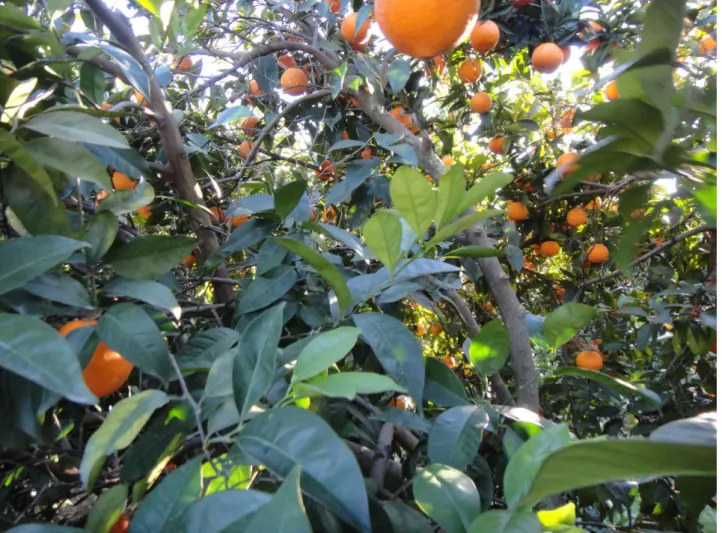
In the case of Portugal, integrated production standards are applied throughout the national territory and, as regards pruning, stipulate that pruning is advisable to be carried out after harvesting as often as is appropriate to avoid problems of alternate bearing, improve fruit quality, improve tree aeration and lighting (Fig. 1), facilitate harvesting and increase the effectiveness of
pesticide treatments (Cavaco & Calouro, 2005). About the destination to be given to pruning waste establishes that the burning of pruning residues in the parcels is prohibited. In orchards in good sanitary conditions it is advisable to incorporate pruning residues into the soil after it has been fragmented and shredded on site. In cases of doubt about sanitary conditions of the pruning waste, composting is recommended whenever possible (Cavaco & Calouro, 2005).
Figure 1 – Good fruit production inside the canopy on a ‘Washington Navel’ orange tree, pruned to improve
tree aeration and lighting.
In the case of Spain, integrated production standards for citrus fruit have been established for the different autonomous communities in which the citriculture is of major economic importance. For the Comunitat Valenciana the standards for integrated production in citrus were approved by the Regional Government [Conselleria de Agricultura, Medio Ambiente, Cambio Climático y Desarrollo Rural (CAMACCDR)]. In this region, burning of pruning waste is not completely prohibited It is only said that the burning of pruning waste is prohibited under uncontrolled conditions and when there is a risk of fire spread. In these norms it is recommended to incorporate the pruning waste by means of cutting and crushing it in situ, except in the case that they show symptoms of attack by pests or diseases (Alternaria and other fungi). In this case, pruning waste will be removed from the field and burned immediately (CAMACCDR, 2017).
Module 1. Introduction to the citrus waste valorisation 11
This project has been funded with support from the European Commission. This book reflects the views only of the authors, and the Commission cannot be held responsible for any use which may be of the information contained therein.
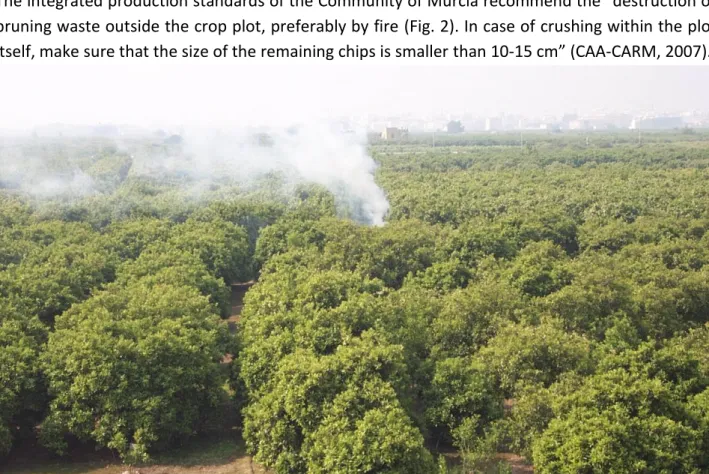
The integrated production standards of the Community of Murcia recommend the "destruction of pruning waste outside the crop plot, preferably by fire (Fig. 2). In case of crushing within the plot itself, make sure that the size of the remaining chips is smaller than 10-15 cm” (CAA-CARM, 2007).
Figure 2 - Burning pruning waste inside a citrus orchard.
The Andalusian Integrated Production Standards recommend “incorporating pruning waste into the field by cutting and crushing in situ, except in plantations affected by diseases in which pruning waste may contain the disease inoculum” (CAPDR-JA, 2015).
In Italy, Sicily and Calabria's integrated production technical standards refer to citrus pruning as an important cultural operation, but do not determine the destination of pruning waste (ARASPM-RS, 2017; DARASFR, 2018). Thus, the adoption of integrated production does not guarantee that pruning waste will be recovered in all Mediterranean countries.
1.3.2. SUPER INTENSIVE ORCHARDS
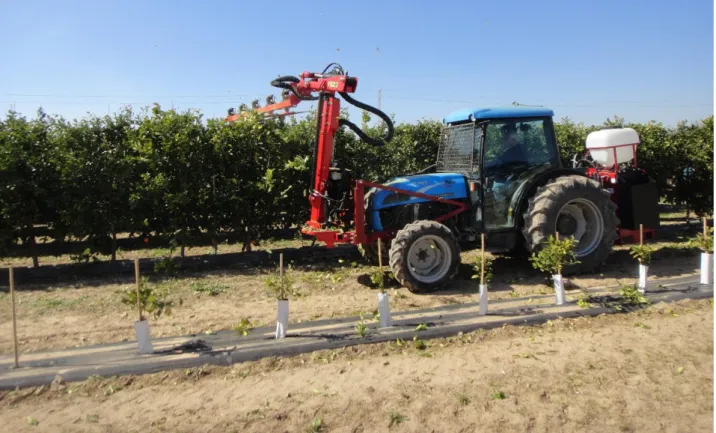
The super intensive production technology that has been developed for olive and other fruit crops is being adapted to citrus trees. But so far, this technology is limited to a few trials. This production technology is based on annual pruning with the elimination of all branches that go outside the boundaries of a hedge and topping (Fig. 3). Thus, the amount of pruning waste to be produced by this form of citrus training system will be very high. This makes the valorisation of pruning waste very important if this technology will be adopted on a large scale.
Figure 3 - Mechanical pruning of an experimental super intensive citrus orchard.
1.3.3. ORGANIC FARMING
Organic farming, also known as “agricultura ecologica” (Spain), “agricoltura biologica” (Italy) or “agricultura biológica” (Portugal), is an environmentally friendly mode of production whose importance has increased in recent decades. Organic growers are prohibited from using most synthetic pesticides and fertilizers and must take measures to protect water and soil quality. The Organic Farming logo is a guarantee that the food we are buying was produced in ways that minimize harm to our health and the environment. The organic logo can only be used on products that have been certified as organic by an authorised control agency or body. This means that they have fulfilled strict conditions on how they must be produced, processed, transported and stored. The logo can only be used on products when they contain at least 95% of organic ingredients and additionally respect further strict conditions for the remaining 5%. So, it is a high-quality fruit production for local markets and for export.
European Regulation (EU) No 848 (2018) did not lay down specific rules on pruning or pruning waste in organic farming. However, this mode of production is based on the use of local resources and the minimization of waste generation, integrating in the spirit of the circular economy. Pruning citrus grown in organic farming is important for pest and disease control. In this production mode it makes no sense to burn pruning waste. The most recommended is its incorporation in the soil, to increase its organic matter content. One of the principles of organic farming regulation is to improve or
Module 1. Introduction to the citrus waste valorisation 13
This project has been funded with support from the European Commission. This book reflects the views only of the authors, and the Commission cannot be held responsible for any use which may be of the information contained therein.
maintain soil fertility, so any operation that allows organic matter to be returned to the soil is advisable, such as shredding pruning waste and incorporating it into the soil.
1.3.4. GEOGRAPHICAL INDICATIONS
Citrus fruits produced in some regions of the Mediterranean Basin have a high quality, recognized by consumers and markets. The European Union has been recognizing the quality of these products and establishing protected names that are used to value products that go through a certification process which ensures their authenticity. At this moment there are at least 5 protected geographical indications (PGI) for citrus fruits: Citrinos do Algarve (Portugal), Cítricos Valencianos / Cítrics Valencians (Spain), Arancia Rossa di Sicilia (Italy), Arancia del Gargano (Italy), and Citron de Menton (France). There is also a protected designations of origin (PDO): Arancia di Ribera (Italy). Even when the fruit certified under these denominations does not receive the deserved price appreciation, the certification seal facilitates the marketing of the fruits.
Each geographical indication has a specification setting out the rules to be respected for fruit production. Some of the geographical indications include norms regarding the level of sustainability of production.
1.4. RELEVANT ACTORS IN THE PRODUCTION AND MARKETING OF CITRUS
Citrus production is increasingly concentrated in a small number of farmers. This process is most evident in some regions such as Andalusia in Spain or Alentejo in Portugal. These larger farmers play an important role in the dissemination of new citrus production strategies. In regions such as Valencia, Spain, or the Algarve, Portugal, rural property is more divided and citrus farms are smaller. In these regions, producer organizations, which concentrate and market the production of dozens (or hundreds) of farmers, are the most relevant actors in the production and marketing of citrus.
Changing farming practices obviously must go through changing the mindset of farmers and changing the factors that contribute to their decisions. Farmers' associations and producer organizations play a relevant role in disseminating information leading to the modernization of farms or the adoption of new production strategies. Awareness-raising campaigns on the need to make agriculture more sustainable include, in the case of citrus, recommendations for a more sustainable treatment of pruning waste. However, given farmers' short margins of profit, cultural practices change in mass only when legislation / regulation requires it or when new practices are economically viable (by changing prices or by consumer demands).
Producers organizations, cooperatives, private packinghouses and juice industries often place new demands and disseminate information that contributes to changes in agriculture. Often the certifications required by commercial chains through packinghouses and juice industries are stricter than official regulations. In this case, farmers, in order to be able to sell their produce, are obliged
to change the way they produce. For this it is also important that the certifying entities do their work well, advising and demanding compliance with the established rules.
1.5. CONCEPT OF CIRCULAR ECONOMY AND ITS APPLICATION TO CITRICULTURE
The concept of circular economy began to be developed by Kenneth Ewart Boulding in 1966, although he did not use the term "circular economy". This author created the concept of "spaceman economy" or closed economy, as an economy model that should replace the "cowboy economy" or open economy (Boulding, 1966). He called the “open economy the "cowboy economy," the cowboy being symbolic of the illimitable plains and associated with reckless, exploitative, romantic, and violent behaviour, which is characteristic of open societies” (Boulding, 1966). The closed economy was considered by Boulding as the economy of the future which he called the "spaceman" economy, “in which the earth has become a single spaceship, without unlimited reservoirs of anything, either for extraction or for pollution, and in which, therefore, man must find his place in a cyclical ecological system which is capable of continuous reproduction of material form even though it cannot escape having inputs of energy” (Boulding, 1966).
The term "circular economy" appears to be first used by Pearce & Turner (1990) as an economic model based on the principle that 'everything is an input to everything else'. Indeed, the concept is very similar to Boulding's "closed economy" concept. In recent decades, a growing body of literature has emerged that has influenced our current understanding and interpretation of the term "circular economy" (Lieder & Rashid, 2016; Rizos et al., 2017).
To understand the concept of circular economics, it is necessary to draw on the knowledge and concepts of industrial ecology that involves a holistic perspective in dealing with human economic activity and sustainability. This discipline introduces the notion that the natural ecosystem and the man-made industrial (or agricultural) system operate similarly, and both are characterized by flows of materials, energy and information (Erkman, 1997; Ehrenfeld, 2007).
Currently, there are several possible definitions for the term "circular economy". Several authors have provided resource-oriented definitions, emphasizing the need to create closed-loop material flows and reduce the consumption of virgin resources, while also mitigating the detrimental environmental impacts of their extraction. Sauvé et al. (2016), defined the circular economy as the “production and consumption of goods through closed loop material flows that internalize environmental externalities linked to virgin resource extraction and the generation of waste (including pollution)’’. For these authors, the circular economy implies above all the reduction of resource consumption, pollution and waste at each stage of the product life cycle. Keeping resources in use for as long as possible and extracting the maximum value from products and materials, using them for as long as possible and then recovering and reusing them are also important aspects of circular economy (Mitchell, 2015). Other authors stress that the transition to
Module 1. Introduction to the citrus waste valorisation 15
This project has been funded with support from the European Commission. This book reflects the views only of the authors, and the Commission cannot be held responsible for any use which may be of the information contained therein.
a circular economy requires facing the challenge of establishing a sustainable supply of energy, as well as decisive action in several other areas, such as agriculture, water, soil and biodiversity (Heck, 2006). Circular economy can also be defined as “an industrial system that is restorative or regenerative by intention and design. It replaces the ‘end-of-life’ concept with restoration, shifts towards the use of renewable energy, eliminates the use of toxic chemicals, which impair reuse, and aims for the elimination of waste through the superior design of materials, products, systems, and, within this, business models’’ (Ellen MacArthur Foundation, 2013)
Applying the circular economy principles to citriculture requires a reduction in pesticide application, an increase in the life of the orchard, the reuse of all residues resulting from the production and processing of fruits, the use of residues from other crops or other agricultural activities (for example, livestock) (Raimondo et al., 2018). The adoption of this new approach may lead to an increase in fruit quality, namely an increase in vitamin C content in the juice (Duarte et al., 2010). From a circular economy perspective, branches and leaves removed from trees during citrus pruning should not be considered as waste, but as a by-product with some use.
1.6. ENVIRONMENTAL PROBLEMS ASSOCIATED WITH THE PRODUCTION AND MARKETING OF CITRUS FRUITS.
In citrus orchards the waste produced in bigger quantity are the pruning waste (branches and leaves removed) and the fruits damaged by pests, diseases or physiological disorders.
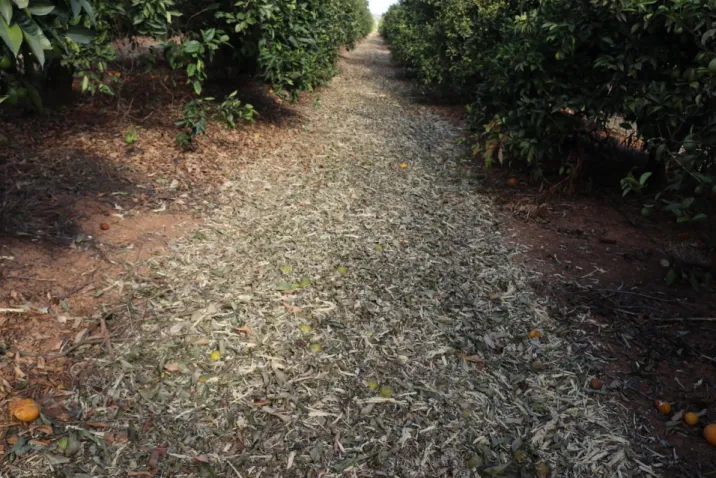
Traditionally, pruning residues were eliminated from the orchard and burned. In recent years, farmers have started grinding the pruning wood between the tree lines (Hondebrink et al., 2017). This leads to the enrichment of the soil in organic matter, creating a dead blanket on the ground (Fig. 4). This enrichment in organic matter improves soil structure, increases water infiltration, decreasing rainwater runoff (Hondebrink et al., 2017). The crushing of the pruning wood is done simultaneously with the destruction of the weeds (Duarte & Martins, 2005), which also, end up enriching the surface layer of the soil in organic matter.
Figure 4 - Crunched pruned branches between tree lines.
Compared with the burning of the pruned branches, crushing it is economically more viable and environmentally more sustainable. However, it is not yet clear what effect the existence of citrus wood chips can have on the surrounding trees. This dead wood provides the development of fungi, which can pass into the trees themselves. In cases of serious diseases, removing pruned branches from the orchard is a necessary measure.
Removing pruned branches out of the orchard and using them as a resource elsewhere may be the most sustainable solution.
As regards the marketing of citrus fruits, their packaging and transport to distant markets has a significant environmental impact.
1.7. VALORISATION OF CITRUS BY-PRODUCTS
For valorisation of citrus waste, we need to consider it as a by-product that should be of some use. The richness of citrus tree branches and leaves in essential oils and energy makes it easier to find use for these materials.
Module 1. Introduction to the citrus waste valorisation 17
This project has been funded with support from the European Commission. This book reflects the views only of the authors, and the Commission cannot be held responsible for any use which may be of the information contained therein.
The leaves of citrus fruits are rich in essential oils, widely used in the cosmetics industry, among other uses. On the other hand, the thicker branches can be used as renewable fuel. Thus, the use of the leaves of pruned branches for the manufacture of essential oils seems to be a good solution for the residue and increases the availability of essential oils on the market, which have potential for wide use, including the replacement of products from chemical industry. Unmarketable fruits can be used for extraction of essential oils or composting.
1.8. CITRUS BY-PRODUCTS AS A SOURCE OF ENERGY
Agricultural resources are important sources of energy, indispensable for further technological development, especially in rural communities (Bentsen & Felby, 2012; Berthet et al., 2016). In this regards, in the last decade, an energy strategy to mitigate climate change was discussed by the European social media emphasizing the achievement of definite environmental goals of energy strategy and advancement (Banja et al., e2017) of agriculture-based bioenergy and biofuels (Lyytimäki, 2018; Isoaho & Karhunmaa, 2019).
However, the use of biofuels also has drawbacks and, from a negative perspective, the use of agricultural areas for energy crop cultivation may decrease future availability of arable land for food production, which may result in food deficiency (Srirangan et al., 2012). Installing a biomass plant in regions producing biomass from forest or agricultural activities is a more sustainable solution. (Bonazi et al., 2018).
Considering these trade-offs, the development of new technologies for the valorisation of pruning wood as a resource and the dissemination of this technology among trainees in vocational schools are an important contribution to circular agriculture and circular economy as well as to minimise the effect of citrus production on climate changes.
In rural areas, the establishment of self-sufficient agro-energy districts is a viable alternative as long as local resources are properly harnessed (Colantoni et al., 2016a, 2016b; Zambon et al., 2016; Al-Hamamre, 2017; Carlini et al., 2017; Moulogianni & Bournaris, 2017). In these areas, the implementation of these new technologies can contribute to significant increases in the welfare of the population (Walter, 2003).
The use of waste as a source of energy is one of the elements of agricultural innovation that must be considered as a co-evolutionary process where technological, socioeconomic and institutional changes are combined (Leeuwis & Aarts, 2011; Klerkx et al., 2012). In some cases, the pruned thicker branches are separated and used in ovens (Fig. 5).
Figure 5 - After pruning, the pruned thick branches were separated for later burning in bread ovens.
References
Al-Hamamre, Z.; Saidan, M.; Hararah, M.; Rawajfeh, K.; Alkhasawneh, H. E. & Al-Shannag, M. 2017. Wastes and biomass materials as sustainable-renewable energy resources for Jordan. Renewable and Sustainable Energy Reviews, 67, 295-314.
Assessorato Regionale dell’Agricoltura, dello Sviluppo Rurale e della Pesca Mediterranea. Regione Siciliana (ARASPM-RS), 2017. Disciplinare regionale di produzione integrata: norme tecniche di difesa integrata delle colture e controllo delle infestanti. (https://winbdf.it/bdf-archivi/disciplinari/dpi_sicilia_2017.pdf).
Bentsen, N. S. & Felby, C. 2012. Biomass for energy in the European Union-a review of bioenergy resource assessments. Biotechnology for biofuels, 5(1), 25.
Berthet, E.T.; Segrestin, B. & Hickey, G.M. 2016. Considering agro-ecosystems as ecological funds for collective design: new perspectives for environmental policy. Environ. Sci. Pol., 61, 108–115.
Bonazzi, F.A.; Cividino, S.; Zambon, I.; Mosconi, E. & Poponi, S. 2018. Building Energy Opportunity with a Supply Chain Based on the Local Fuel-Producing Capacity. Sustainability, 10(7), 2140.
Boulding, K. 1966. The Economics of the Coming Spaceship Earth, in H. Jarrett (ed.), Environmental Quality in a Growing Economy, Baltimore, MD: Johns Hopkins University Press, pp. 3-14. (http://arachnid.biosci.utexas.edu/courses/THOC/Readings/Boulding_SpaceshipEarth.pdf)
Banja M., Monforti-Ferrario F., Bódis K., Kona A., Jäger-Waldau A., Taylor N. & Dallemand J.F, 2017. Mitigating Climate Change: Renewables in the EU – Cutting greenhouse gas emissions through renewables - Volume 2, EUR 28677 EN, Publications Office of the European Union, Luxembourg, 2017, ISBN 978-92-79-70479-6, doi:10.2760/6520, JRC106826
Carlini, M.; Mosconi, E.; Castellucci, S.; Villarini, M. & Colantoni, A. 2017. An economical evaluation of anaerobic digestion plants fed with organic agro-industrial waste. Energies, 10(8), 1165.
Cavaco, M. & Calouro, F. 2005. Produção Integrada da Cultura de Citrinos. Ministério da Agricultura, do Desenvilvimento Rural e das Pescas. 158 p.
Colantoni, A.; Delfanti, L.; Recanatesi, F.; Tolli, M. & Lord, R. 2016a. Land use planning for utilizing biomass residues in Tuscia Romana (central Italy): Preliminary results of a multi criteria analysis to create an agro-energy district. Land use policy, 50, 125-133.
Colantoni, A.; Evic, N.; Lord, R.; Retschitzegger, S.; Proto, A. R.; Gallucci, F. & Monarca, D. 2016b Characterization of biochars produced from pyrolysis of pelletized agricultural residues. Renewable and sustainable energy reviews, 64, 187-194.
Module 1. Introduction to the citrus waste valorisation 19
This project has been funded with support from the European Commission. This book reflects the views only of the authors, and the Commission cannot be held responsible for any use which may be of the information contained therein.
Consejería de Agricultura, Pesca y Desarrollo Rural de la Junta den Andalucía (CAPDR-JA), 2015. Reglamento Específico de Producción Integrada de Cítricos. Boletín Oficial de la Junta de Andalucía, nº 34. 19/02/2015. (https://www.juntadeandalucia.es/boja/2015/34/BOJA15-034-00028-2775-01_00064054.pdf)
Consejería de Agricultura y Agua de la Comunidad Autónoma de la Región de Murcia (CAA-CARM), 2007. Norma Tecnica para la Produccion Integrada de Citricos. BORM de 02-05-2007. (http://siam.imida.es/docs/NORMAPICITRI2007.pdf) Conselleria de Agricultura, Medio Ambiente, Cambio Climático y Desarrollo Rural (CAMACCDR), 2017. RESOLUCIÓN de 12 de marzo de 2017 del director general de Agricultura, Ganadería y Pesca, por la que se establecen las normas para la producción integrada en cítricos, en el ámbito de la Comunitat Valenciana. Diari Oficial de la Generalitat Valenciana. Num. 8046: 18275-18301.
Dipartimento n° 8 - Agricoltura e Risorse Agroalimentari Servizio Fitosanitario Regionale (DARASFR), 2018. Disciplinari di Produzione Integrata. Pratiche Agronomiche – Regione Calabria (http://www.agroservizi.regione.calabria.it/ documents/12605/0/Allegato+DISCPLINARI.pdf/2f37be9b-1612-4720-89f4-c0cbeb6f7368)
Duarte, A.; Caixeirinho, D.; Miguel, G.; Sustelo, V.; Nunes, C.; Mendes, M. & Marreiros, A. 2010. Vitamin C Content of Citrus from Conventional versus Organic Farming Systems. Acta Horticulturae 868:389-394. (http://dx.doi.org/10.17660/ActaHortic.2010.868.52)
Duarte, A.; Fernandes, J.; Bernardes, J. & Miguel, G. 2016. Citrus as a Component of the Mediterranean Diet. Journal of Spatial and Organizational Dynamics - JSOD, IV(4): 289-304.
Duarte, A.M. & Martins, A. 2005. Capítulo 95: Uso de desbrozadora como alternativa a los herbicidas en el control de malas hierbas, en naranjo ‘Rohde’. Pág. 625-629. Em: Menéndez, J.; Bastida, F.; Fernández-Quintanilla, C.; Gozález, J.L.; Recasens, J.; Royuela, M.; Verdú, A. & Zaragoza, C. (Eds.) Malherbología Ibérica y Magrebí: Soluciones comunes a problemas comunes. Universidad de Huelva, Espanha.
Fernandes, J.; Gonçalves, G. & Duarte, A. 2016. Sustentabilidade ambiental e humana da produção de alimentos: uma análise comparativa entre agricultura biológica e convencional. Actas Portuguesas de Horticultura, 25, 158-163. Ehrenfeld, J.R. 2007. Would Industrial Ecology Exist without Sustainability in the Background? Journal of Industrial
Ecology, 11 (1):73 – 84.
Ellen MacArthur Foundation. 2013. Towards the Circular Economy. Economic and Business Rationale for an Accelerated Transition. (https://tinyurl.com/hzfrxvb).
Erkman, S. 1997. Industrial ecology: an historical view. Journal of Cleaner Production, 5 (1-2): 1-10.
European Union (EU). 2018. Regulation (EU) 2018/848 of the European Parliament and of the Council of 30 May 2018 on organic production and labelling of organic products and repealing Council Regulation (EC) No 834/2007. Official Journal of the European Union L 150, 14 June 2018, pp. 1-92. (https://eur-lex.europa.eu/legal-content/EN/TXT/?uri=CELEX:02018R0848-20180614)
FAO (2019) Food and agriculture data. Acceded in 24th of july 2016, on the Web site of: Food and Agricultural Organization: http://www.fao.org/faostat/en/#home
Heck, P. 2006. Circular Economy related international practices and policy trends: Current situation and practices on sustainable production and consumption and international Circular Economy development policy summary and analysis. Institut für angewandtes Stoffstrommanagement (IfaS). Environmental Campus Birkenfeld (http://siteresources.worldbank.org/INTEAPREGTOPENVIRONMENT/Resources/CircularEconomy_Policy_FinalDraft _EN.pdf)
Hondebrink, M. A.; Cammeraat, L.H. & Cerdà, A. 2017. The impact of agricultural management on selected soil properties in citrus orchards in Eastern Spain: A comparison between conventional and organic citrus orchards with drip and flood irrigation. Science of the Total Environment 581–582, 153–160.
Isoaho, K. & Karhunmaa, K. 2019. A critical review of discursive approaches in energy transitions. Energy policy, 128, 930-942.
Jacques, P. J. & Jacques, J. R. 2012.Monocropping Cultures into Ruin: The Loss of Food Varieties and Cultural Diversity. Sustainability, 4, 2970-2997 (doi:10.3390/su4112970)
Klerkx, L.; Van Mierlo, B. & Leeuwis, C. 2012. Evolution of Systems Approaches to Agricultural Innovation: Concepts, Analysis and Interventions, Farming Systems Research into the 21st Century: The New Dynamic. Springer, pp. 457– 483,.
Leeuwis, C. & Aarts, N. 2011. Rethinking communication in innovation processes: creating space for change in complex systems. Journal of agricultural education and extension, 17(1), 21-36.
Lieder, M. & Rashid, A. 2016. Towards circular economy implementation: a comprehensive review in context of manufacturing industry. Journal of Cleaner Production: 115, 36-51.
Lyytimäki, J. 2018. Renewable energy in the news: Environmental, economic, policy and technology discussion of biogas. Sustainable Production and Consumption, 15, 65-73.
Mitchell, P. 2015. Employment and the circular economy - Job Creation through resource efficiency in London’. Report produced by WRAP for the London Sustainable Development Commission, the London Waste and Recycling Board and the Greater London Authority.
Moulogianni, C. & Bournaris, T. 2017. Biomass Production from Crops Residues: Ranking of Agro-Energy Regions. Energies, 10(7), 1061.
Raimondo, M.; Caracciolo, F.; Cembalo, L.; Chinnici, G.; Pecorino, B. & D’Amico, M. 2018. Making Virtue Out of Necessity: Managing the Citrus Waste Supply Chain for Bioeconomy Applications. Sustainability 10(12), 4821; https://doi.org/10.3390/su10124821.
Rizos, V.; Tuokko, K. & Behrens, A. 2017. The Circular Economy. A review of definitions, processes and impacts. CEPS Research Report No. 2017/09. (https://www.ceps.eu/wp-content/uploads/2017/04/RR2017-08_CircularEconomy_0.pdf)
Sauvé, S.; Bernard, S. & Sloan, P. 2016. Environmental sciences, sustainable development and circular economy: Alternative concepts for trans-disciplinary research. Environmental Development, 17: 48-56.
Srirangan, K.; Akawi, L.; Moo-Young, M. & Chou, C. P. 2012. Towards sustainable production of clean energy carriers from biomass resources. Applied energy, 100, 172-186
Vavilov, N. I. (1926) Центры происхождения культурных растений (Tsentry proiskhozhdeniya kulturnykh rastenii). Leningrad. USSR. (In Russian)
Walter, A. 2003. Fomento à geração elétrica com fontes renováveis de energia no meio rural brasileiro: barreiras, ações e perspectivas. In Proceedings of the 3. Encontro de Energia no Meio Rural, 2000, Campinas (SP, Brazil).
Zambon, I.; Colosimo, F.; Monarca, D.; Cecchini, M.; Gallucci, F.; Proto, A. & Colantoni, A. 2016. An innovative agro-forestry supply chain for residual biomass: Physicochemical characterisation of biochar from olive and hazelnut pellets. Energies, 9(7), 526.
Edition: CitriVET Project Consortium
Low Carbon Economy Foundation (LCE)
Edifici Parking Grutas de Sant Josep, S/N, 12600 12600, La Vall d’Uixó (Spain)
http://www.lowcarboneconomy.org/ E-mail: [email protected] University of Algarve Campus da Penha, 8005-139 Faro (Portugal) www.ualg.pt E-mail: [email protected]
Escola Profissional Cândido Guerreiro
Estrada da Ponte, 8100-012 Alte (Portugal) www.epalte.pt E-mail: [email protected] EFA La Malvesia Partida el Cercat, s/n.
46195. Llombai. Valencia (Spain)
www.malvesia.es
E-mail: [email protected]
Area Europa
Via Marc’Antonio Raimondi, 26 40128, Bologna (Italy) http://areaeuropa.it/en/ E-mail: [email protected] ARCES Vicolo Niscemi n.5, 90133, Palermo (Italy) www.arces.it E-mail: [email protected] ISBN: 978-989-8859-89-1
This work is licensed under a Creative Commons Attribution International License (https://creativecommons.org/licenses/by-nc/4.0/), which permits unrestricted non-commercial use, distribution, and reproduction in any medium provided the original work is properly cited.
Editors: José Segarra, Juan Jorro, Eva Merloni & Amílcar Duarte Reviewers: Ana Arsénio, Enrico Balugani, José Castro, Emanuela
D’Agostino & Luana Ladu
This book was produced under the ERASMUS project CitriVET “Enhancing green-skills in VET through citrus waste valorization”.