An evaluation of centralized provision of social
services: the case of Lisbon’s Police Department
Mestrando: Bruno Azevedo Alle
Orientador: Professor Auxiliar Convidado Pedro Veiga Vaz da Silva Goulart
DECLARATION
I, Bruno Azevedo Alle student number 205189, hereby declare that this research thesis is my own original work, that all reference sources have been accurately reported and acknowledged, and that this document has not previously, in its entirety or in part, been submitted to any University in order to obtain an academic qualification.
Bruno Azevedo Alle 205189
ACKNOWLEDGMENTS
I would like to take this opportunity to thank the following people for their contribution to the successful completion of this thesis:
Margarida for her patience, understanding and especially for putting up with my lengthy absences during the first year of our marriage.
My parents and siblings for their support (financial and otherwise) and encouragement.
My in-laws, Manoel and Teresa, for their invaluable insights, professional comments and patience to read countless versions of this thesis.
My supervisor, Pedro Goulart for his relentless belief in this project even when I had doubts and especially for his time and commitment to my success his patience, understanding and relevant advice on all aspects of the thesis.
Former director of the SSPSP and current assistant national director of the PSP superintendent José Torres for his valuable contribution and encouragement in setting the SSPSP´s centralized provision of services as the theme of my master thesis.
Superintendent Jorge Cabrita, current director of the SSPSP, for authorizing this project and for making me feel that they it was a valuable contribution on the decision making process. In addition to that, for being open to disclose the web questionnaire to all of the PSP´s active personnel through an electronic mailing list that only he, as the SSPSP director, and a selected few have access.
The SSPSP´s staff particularly Ana Paula Machado, Carla Gaspar, Isaura Barros, Maria de Fátima Ferreira, Marta Silva, Nuno Prates, Pedro Chá, Olga dos Santos, Isabel Ferreira, all of whom contributed in one form or another for this thesis.
ABSTRACT
The European crisis and the subsequent Portuguese financial bailout put social policies under heavy pressure as the current debate focus mostly on budgetary cuts. Contrasting with this tendency, the social services from the Portuguese police have been expanding its services through a centralized service provision policy, starting in Lisbon but with plans to expand it to other cities during the next five years. Whether these services should be provided centralised or decentralised is a matter to be researched as how to use the limited public resources more effectively is now more important than ever.
This thesis contributes in this direction by evaluating if there is a rationale for a centralized social policy delivery, if these services are demanded by the users themselves and what is the best alternative to follow.
We find that while its beneficiaries state their interest in this kind of service provision they do not seem to use it, which is quite puzzling. The results show that most of them are unaware of the center’s existence and even the majority that is aware does not use it. After applying a regression analysis we find that the major reasons relate to distance issues, particularly when the potential users take more than half an hour to reach it.
TABLE OF CONTENTS
ABSTRACT ... 4
CHAPTER I: INTRODUCTION ... 7
1.1 Background ... 7
1.2 Research objectives ... 8
1.3 Thesis outline ... 9
CHAPTER II: SOCIAL POLICIES IN PORTUGAL ... 10
2.1 Early attempts ... 10
2.2 Corporatism, 1933 - 1974 ... 11
2.3 Social Security for all, 1975 - 1986 ... 12
2.4 European “bliss”, boosting quantity and quality of care, 1986 – 2007/8 .. 13
2.5 Financial bailout, 2007 onwards ... 15
CHAPTER III: SOCIAL PROVISION TROUGH A CORPORATIST AGENCY,
THE SSPSP ... 17
3.1 Public Agency analysis, the SSPSP ... 17
3.2 The SSPSP through the years ... 18
3.3 Public Policy Analysis, the Centralized provision of services ... 20
CHAPTER IV: METHODOLOGY ... 21
4.1 Public Policy Evaluation ... 21
4.1.1 Programmatic evaluation through performance measurement ... 22
4.1.2 Financial impact through a cost-benefit analysis ... 23
4.1.3 Users´ Satisfaction ... 24
4.2 Data collection ... 25
4.3 Ethical considerations and research limitations ... 26
CHAPTER V: RESULTS ... 27
5.1 Programmatic evaluation ... 27
5.1.1 Input ... 27
5.1.2 Output Average Annual usage ... 28
5.1.3 Outcome ... 29
5.1.4 Summary and ratio Indicators ... 29
5.2 Financial analysis ... 30
5.2.1 SSPSP budget ... 30
5.3 Users Satisfaction ... 32
5.3.1 The Sample ... 33
5.3.2 Interest in a centralized provision of services ... 35
5.3.3 The Lisbon center ... 35
5.3.4 Regression analyses ... 37
5.3.5 Reasons for not use the centralized provision of services ... 39
5.3.6 Ideal template for service delivery ... 40
CHAPTER VI: CONCLUSION AND POLICY IMPLICATIONS ... 41
6.1 Summary ... 41
6.2 Results ... 42
6.3 Policy Implications ... 42
BIBLIOGRAPHY ... 43
APPENDIX I: SAMPLE VS UNIVERSE ... 45
1.1 Age group ... 45
1.2 Gender ... 45
1.3 Rank ... 46
APPENDIX II: QUESTIONNAIRE´S RESPONSES ... 47
Section 1: Generic Data ... 47
Section 2: Provision of Social Services ... 50
Section 3: SSPSP´s Global Performance ... 53
FIGURES INDEX ... 54
TABLES INDEX ... 55
CHAPTER I: INTRODUCTION
1.1 Background
Welfare states have been the basis of European social development answering key social needs and providing superior living conditions to its citizens. However economic growth slowdown and ageing societies have meant that the government is cutting back in expenses and that public or social policies are actually on retrenchment (Gooby & Wallace, 2009; Leibrecht & Onaran, 2011). The European credit crunch and the Portuguese financial bailout came to reinforce this need. The paradigm is now “to do more output with fewer resources” (Lane, 2005). Then, the one million dollar question is how can governments use the limited public resources more effectively?
This challenge has prompted major debates on public sector reform such as redefining the role of the state, the services provided or even the beneficiaries. In tendency, this has led to have less State has a provider (even if it continues to be the main funder), more differentiation of services according to willingness of users to pay and reduction of benefits (Pollitt & Bouckaert, 2004; Lane, 2005).
This debate has been reignited in the countries more affected by the crisis such as Portugal in view to meet the bailout arrangements. For example, recently an IMF document (2012/13) attempted to identify key areas to cut through benchmarking Portuguese expenditures with Europe. While these studies are useful, it is fundamental to zoom in each specific area for in-depth studies to fundamentally understand the issues and devise eventual solutions. This thesis contributes in this direction by evaluating a specific social policy delivery in Portugal, the social services from the Portuguese police. It builds on two prominent and related features of Portuguese public service delivery, redundancy of services and low-efficient services.
First, redundancy of services regards the delay that social services were universally implemented in Portugal. While across Europe modern welfare states were being developed, Portugal lagged behind. After earlier ambitious legislation efforts that were often not enforced,
Estado Novo promoted access to social rights through corporatist insurance bodies. This
created exclusive social services to each professional corporation, but left a majority of the population without affordable access to these types of services. The democratic revolution of April 1974 granted a set of universal social rights and institutions, formally establishing a modern welfare state, but lacked the financial and organizational resources needed to put the newly established social policies in fully practice. In spite of improvements such as in health and education, only with Portugal´s entry into the European Community in 1986 did the Portuguese government enforce a wider span of social rights through increased social expenditure. While some of the earlier arrangements disappeared as the new ones were implemented, there is yet a multiplicity and overlapping of solutions that may be considered redundant. Many of the
services provided by the analyzed social department are also provided by other public and private sector organizations and the rationale for its existence should be researched.
Second, low-efficient services are somewhat related with the overlapping of services above described. Once created, the parallel services tend to perpetuate the initial logic of functioning instead of the economic rationale of provision. Particularly, a key issue in public sector reform regards the mismatch between the type of services offered and the location these are provided: low vs. high-specialized services; decentralized vs. centralized provision. Low-specialized services that are intended to benefit everyone are cheaper to provide by decentralized territorial units close to the population. Highly-specialized services that often are intended to benefit fewer users are cheaper to provide by territorial units close to the population. Any other combination is a potential sub-optimal provision of services.
These two features help explain why there is an atomicity of social services of different public organizations that often provide similar and overlapping services. In the recent past this has led to two different trends: one is the merging of services to use economies of scale with the objective of improving the efficiency; the other is the reduction of benefits to reduce costs.
1.2 Research objectives
Contrasting with this tendency, the SSPPS (social services from the Portuguese police) has been expanding its service and it created, in 2009, a centralized provision of services in Lisbon that concentrated into one place different services such as: medical services (general practitioner, psychiatrist, psychology, paediatrics, nursing), a social worker, a leisure area, equipped with a snack-bar, games room and internet, an utilitarian area equipped with a barbershop a sewing and a laundry room.
Furthermore in its strategic plan for 2012/16 the SSPSP forecasted the creation of a centralized provision of services in Oporto in 2012 (now under review) and revealed the intention of further implanting one of this center´ s in all of the district capitals. The center has
“the purpose to contribute to the intergenerational integration of its beneficiaries by bringing together beneficiaries of all age groups. The center will contribute to the consolidation of self-esteem and the institutional identity of its beneficiaries.”
Therefore, this thesis aims to identify the optimal provision of services for the SSPSP. To fulfill this objective we draw inspiration on the public policy evaluation methodology however we consider that this methodology fails to take in consideration the clients perspective and the financial analysis. Can a public policy be considered successful if its beneficiaries is not satisfied, or if the public policy is economic feasible?
A word of clarification, the underlying principle driving this research is if it is possible to do better with less, which is radically different from simply proceeding to budget cuts. This is done by contrasting a cost-benefit analysis and a programmatic evaluation, through a performance measurement system, with the SSPSP beneficiaries’ perception of the center policy.
Particularly to answer this research question: Is the centralized provision of services for corporatist users demanded by the users themselves and by (economic) rationale?
As a final issue we will attempt to solve the puzzle in which SSPSP´s beneficiaries state their interest in the centralized provision of services yet they do not seem to use it.
1.3 Thesis outline
The study is divided into six chapters. Chapter II starts with the review of the literature concerning the evolution of the social policy provision evolution along the years in Portugal. Chapter III covers the social services from the police department and its centralized provision of services. The research methodology is described in chapter IV, while the results are presented and discussed in chapter V. Finally, chapter VI concludes and presents the possible policy implications at this stage.
CHAPTER II: SOCIAL POLICIES IN PORTUGAL
This chapter provides an overview of the evolution of the social policy implementation in Portugal, often characterized in the literatures in three stages. In the first stage, during the dictatorship of Estado Novo, professional corporations (intra-professional solidarity) guaranteed the basic social benefits. A second stage occurred after the revolution of April 25, 1974, when the restoration of democratic lead to the consolidation of social and political rights and a guaranteed universal social protection. The third phase was characterized by the Europeanization of Portuguese welfare state, where the government carried out a number of reforms that moved the country closer to the norms in EU member states and increased the public social expenditure. (Ferrera, 2005; Pereirinha, Arcanjo & Carolo 2009)
Nevertheless we argue that the financial bailout of 2011 and the subsequent recessive measures, led to a new stage of social policy implementation, characterized for a retraction in the social policy process.
2.1 Early attempts
Portuguese social security efforts lagged behind much due to its economic divergence of Europe from 77 percent of Western European GDP per capita in 1820 to 36 percent in 1913 (Goulart & Bedi, 2008).
The first legal attempt to create a comprehensive social protection system occurred during Portugal´s first republic (1910-1926): the whole of the working population, regardless of sex or occupation was to be covered, on the one condition that their wages were below a certain ceiling. Compulsory social insurance covered the risk of illness, accidents at work, old age, disability and the support of the dependents, in the case of death. In addition, social labor changes were set up to employ the jobless by providing a stimulus for public works.
These measures remained largely on paper, since they were launched with no assessment of their economic viability and no participation by employers and employees. Accordingly, the whole initiative was a complete failure as the laws were never put into practice, the task of providing security to workers and their families continued to be performed by charitable institutions and friendly societies. (Ferrera, 2005 )
Until the 1930s, there was only a rudimentary and symbolic set of welfare policies in action, some of them created exclusively for a small number of industrial workers and public servants. Mutuality associations created in the nineteenth century ran some of the schemes under its control. (Ferrera, 2005; Pereirinha & Carolo, 2009 )
2.2 Corporatism, 1933 - 1974
While all across Europe modern welfare states were being developed with the introduction of policies to respond to classical social risks such as old age, disability, sickness, maternity and unemployment, Portugal lagged behind. Nevertheless it is interesting to notice that Portugal was among the first set countries to establish family allowances even tough with extremely strong gaps in its coverage.
Table 1: A comparison on social benefit laws in Europe Country Family
allowance Maternity Sickness
Accident
Compensation Unemployment Retirement Disability
Germany 1935 1889 1889 1884 1927 1883 1883 France 1932 1930 1930 1898 1905 1910 1910 Sweden 1947 1913 1913 1901 1934 1891 1891 Italy 1937 1929 1943 1898 1919 1919 1919 Spain 1938 1929 1942 1900 1919 1919 1919 Portugal 1942 1962 1935 1913 1975 1935 1935 United Kingdom 1945 1911 1911 1911 1911 1925 1911 Denmark 1952 1892 1892 1898 1907 1891 1921
Source: Accident compensation from Huberman and Meissner (2010); other social benefit laws from Pereirinha, Arcanjo and Carolo (2009). IN Goulart and Bedi (2013)
It was not until the 1933 that the Portuguese constitution attributed “to the state the responsibility of promoting and developing solidarity, welfare, co-operation and institutions providing mutual support”. The Law 1884 of 16 March 1935, created four categories of social protection institutions: (Pereirinha & Carolo, 2009; Ferrera 2005)
The first category was comprised of the security institutions of corporate bodies. They were compulsorily financed by contribution from employers and employees and included wage earners in trade and industry, farm workers, and registered seamen.
The second category was comprised by retirement and welfare funds. It was compulsory financed by contributions from employers and employees and covered workers in a relationship of subordination in industry and in the services of certain professions or companies. These schemes corresponded to the corporative welfare founds in those companies and sectors alone. They covered the risks of sickness, invalidity and old age, as well as family benefit in the case of the insured person´s death
The third category was comprised by mutual aid associations. In these associations the membership was optional and the menu of covered risks varied according to the insurance, it was financed by members´ contribution only.
Finally the last category was comprised welfare institutions of the state servers and administrative bodies, the membership was optional, in certain cases, compulsory in others yet similarly the coverage against risks varied depended according to the institution involved.
Despite ambitious legislation, the system and its operation were still quite unsatisfactory and inefficient, since the social protection system did not cover the majority of the population and a National Health Service did not exist, and the investment in education was insignificant. The government’s responsibilities did not include running or financing any component of a public welfare system, but merely setting-up and co-ordination of institutions to attain social
policy goals. The aim was simply to create the legal framework of the system in which these institutions were to operate. (Ferrera, 2005)
2.3 Social Security for all, 1975 - 1986
With the fall of the dictatorship, the newly instituted democracy lead to the consolidation of citizenship and political rights. One of its dimensions meant the universal granting, widening and deepening social rights. (Pereirinha & Carolo, 2009)
Progress in social protection policies meant the establishment of a set of measures, such as: the national minimum wage; the implementation of a social pension for anyone above 65 years of age or to disable persons over 14 years, unemployment benefits; medical supplies for both sickness and maternity, family allowance for unemployed contributors and the creation of the national health system in 1979. (Ferrera, 2005)
This period of designing and consolidating the social protection system, culminated in the
Lei de bases da segurança social (Law of social security) of 1984, which remained in force until
2000.This law established a system that organized the existing schemes under the headings “contributory”, “non-contributory” and “social action” as illustrated in the table below. (Ferrera, 2005: 216)
Table 2: Social Security organization
Contributory regime Non-contributory regime Social Action
Target population Dependent workers Independent workers; Their relatives; Families; The disabled; The aged, when not covered by the contributory regime
The needy families and dependents;
Poor urban and rural neighborhoods;
Components General compulsory scheme Non-contributory social protection schemes
Social assistance; Household services and social equipment; National Programme to combat Poverty;
Main risks and schemes Sickness; Maternity; Occupational hazard; Unemployment; Disability; Old age; Death; Family benefits;
Child support through family benefit; Maternity and surviving dependents’ benefits; Social pension and disability benefit;
Economic and social breakdown;
Social discrimination; Social and community development; Dependent family members´ needs (long-term care)
Source: Ferrera, 2005: 216
These new measures, combined with others in the fields of labor, health and education, provoked a sharp rise in public expenditure but also produced the broad effect of redistributing income and providing universal social protection. This led to a consideration that a welfare State had been formally set up in Portugal, still with important gaps in protection, in particular in terms of safety nets. (Ferrera, 2005; Pereirinha & Carolo, 2009 ). Perhaps more importantly, the new democratic lacked the financial sustainability to match the increase in public social expenditures.
Until 1986 Portugal suffered periods of great instability and severe constraints, characterized by a sharp decrease in GDP, a chaotic productive system, a lack of the minimum financial resources to ensure the quality of the policies created, and a scarcity of institutions
resources to put them in practice. It required a stronger economic support basis but also strengthening a solidarity tax for its realization (Pereirinha & Carolo, 2009). The period saw two IMF interventions and zigzag social expenditure policies according to the financial possibilities.
2.4 European “bliss”, boosting quantity and quality of care, 1986 – 2007/8
This context would change with the adhesion to the European Union in 1986. Thereafter, economic growth marked the period from 1986 to 2001 and the GDP grew by an average of 3.4% per annum.
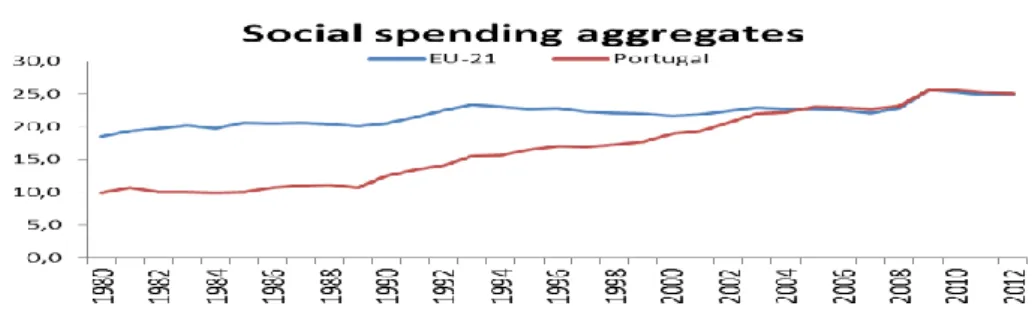
During this period, Portugal made a significant effort to catch up with its European counterparts in terms of its expenditure on social protection, regarded as the main mirror of a country´s social effort. The convergence in social expenditures with Europe is shown in Figure 1 by the comparative evolution of social spending between 1980 and 2012. The data show not only an undeniable increase in spending, but also a clear approximation of the levels of social spending in Europe.
Figure 1: Evolution of Social spending aggregates (OECD)
Source: Public social spending totals reflect detailed social expenditure programme data for 1980-2009; national aggregated for 2010-2011 and estimates for 2012, as based on national aggregates in national sources, and/or the OECD Economic Outlook, No 91, May 2012, and the European Union's Annual Macro-economic database (AMECO), as at May 2012.
This period is characterized by an Europeanization of the Portuguese welfare state, since the government carried out a number of reforms that moved the country closer to the norms in EU member states and was marked by an undeniable evolution on the social policy provision.
The amounts of benefits increased at a fast rate, the minimum pension under the contributory system rose 24.3%, the social pension under the non-contributory system increased 42%, and the average pension grew by 37% between 1995 and 2000. (Ferrera, 2005)
Between 1995 and 2000 there was a period of development known as the “new generation” of active social policies, the main lines of this reform were: The assertion of the State´s prime public responsibility to promote protection policies, especially with the most disadvantaged groups, the introduction of the principle of “positive discrimination in social protection measures” and fight against poverty, as one of the priorities. The table below shows the non-pension social benefits existent in Portugal.
Table 3: Non-pension Social Benefits
Type of Coverage Who is Eligible Source of Finance
S
ocia
l
Insura
nce
Maternity/ Paternity Cash benefits
Contributing employers, employees and self employed
Compulsory social insurance scheme (individual and employer contributions & transfer from the general budget)
Disability/ Sickness Long-term care Death grant Accident (work)
Compulsory private insurance for employers and self employed persons
Financed by the employers; self- financed for self- employed
S ocia l Insura nce : Labour Mark e t P ro gra m s
Unemployment benefit Contributing employers, employees and self employed
Compulsory social insurance scheme (individual and employer contributions & transfers from the general budget)
Social unemployment benefit
Quasi non-contributive. For unemployed with lower qualifying periods than required for
unemployment benefit or to extend the duration of benefits for unemployment benefit recipients who still remain unemployed
S ocia l A s s is ta nce Housing benefit
Non-contributive. Means tested to households below a person eligibility threshold based on income; Means-testing is less strict than RSI.
Municipal budgets
Education
Means-tested grant for tertiary level students for living expenses and tuition
Financed by transfers from the general budget
Child benefits
Non-contributive. Means-tested to families below a certain reference income; threshold is higher than that for RSI benefits.
Minimum guaranteed income (social insertion income, RSI)
Non-contributive. Means tested to households below a person eligibility threshold based on income.
Funeral allowance
Paid to a person who paid the funeral costs of any member of his family or of any other person residing in Portugal and with no right to a death grant.
Long-term care cash benefit Non-contributory means-tested Source: IMF 2013
Since 2001 different governments have shown to be worried with the fiscal sustainability of the increase of social expenditure. It is important to acknowledge that the Portuguese government introduced measures, trough the Law 4/2007, to guarantee the sustainability of the social security system. These measures included the update of the retirement age according to life expectancy, freezing or limiting the higher pensions and the promotion of protective measures and incentives for hiring and retention of jobs of older workers. However, as we have seen in the figure 1, these measures did not have the desired effect on controlling the countries´ social spending.
2.5 Financial bailout, 2007 onwards
Fiscal performance in terms of deficits and levels of public debt has deteriorated in a significant number of OECD countries and when the credit crunch hit Europe, it set in motion a rapid wave of attention to financial and economic problems.
National governments responded with large-scale bailouts, and this pushed the snowball of economic problems to the European agenda as deficits were rising rapidly and the euro, the symbol of monetary integration, came under so much pressure that experts began to predict its collapse and deficit issues came to dominate over all other topics translating itself into a crisis of public budgets. (Breuning & Busemeyer, 2012; Timmermans, 2012)
Following a financial bailout in 2011 by a troika - the European Commission, the European Central Bank and the International Monetary Fund, the Portuguese Government agreed to implement an austerity plan, but even before, in the stability program Growth Pact of 2010, the Portuguese felt the weight of the these measures, table 3.
Table 4: Austerity Measures
2010 2011 2012
Inco
m
e
-Freezing of admissions and career progressions for the public Administration;
-Taxation of capital gains fellows at a rate of 20%.
-IRS (Income tax of individuals) rate of 45% on income above 150,000 euros per year;
-Cut 3,5% to 10% for civil servants that earn more than 1500 euros per month;
-All proceeds were affected by the freezing of the specific deduction in IRS(Income tax of individuals); -All pensions were frozen;
-Tax the equivalent of 50% the Christmas bonus;
- End early retirement at age 55 from 2012 onwards;
- Confiscation of the civil servants and pensioners´ Christmas and holiday bonuses; C ost of l iv in g
- Increase in VAT from 20% to 21% (standard rate) of 12% to 13% (intermediate rate) and 5% to 6% (reduced rate).
- The standard rate of VAT increased from 21% to 23% and was extended set of assets subject to the standard rate;
- Average increase of 15% in the price of public transport;
- Increases VAT on gas and electricity (6% - 23%);
- End of the social bus passes (students and citizens over 65 years);
- 4% increase in the electricity monthly cost;
- Average increase of 5% in the price of public transport;
H e a lt h S e rv ic e
s - User fees have been updated,
-Finished exemption from user fees; - Cuts in reimbursements for users of the NHS, particularly in the transport of patients.
- The value of user fees doubled in 2012;
- Cut from 200 million euros in hospitals´ costs.
- Cut the co-transport of patients (30% less)
2010 2011 2012
Tax
e
s
- 25% taxes´ incensement on interest rates, dividends and capital gains on IRS (Income tax of individuals) and IRC (Corporate income taxes);
- Cut in the tax deductions on IRS (Health and Education)
- Cut of 33% on funeral grant; - Increases in municipal taxes, enacted in several municipalities. - Increase in the IRC (Corporate income taxes);;
- The health costs are now deductible on IRS only 10%. - The housing expenditure is deductible, not at 30% of its value, but in 15%.
-The ISV (vehicle tax) for passenger cars suffered an average increase of 6.4% in 2012. -Property Tax decreases of 0.1% for houses reassessed or traded since 2004;
Source: Author based on the newspapers Expresso and Diário de notícias
The current crisis, in Portugal, has led to a set of restrictive measures that on one hand has increased population´s need for social policies and on the other hand is characterized by a retrenchment on public spending namely in social policies. Furthermore taxes raises cut the income of workers and pensioners increases in the sales taxes as well as pay cuts for government workers, reductions in welfare entitlements and higher ticket prices on public transport.
“An enhanced fiscal austerity results in a lower budget share of public investments, however at some point governments can no longer resort to easy ways to avoid politically costly budget decisions and are then confronted with difficult political tradeoffs when deciding on the distribution of scarce public funds across different kinds of spending.” (Breuning & Busemeyer,
CHAPTER III: SOCIAL PROVISION TROUGH A
CORPORATIST AGENCY, THE SSPSP
The previous chapter attempted to summarize the evolution of the social provision in Portugal. This chapter provides an overview of a public agency, the SSPSP (Social services from the Portuguese police) that promotes social support and complementary activities for its beneficiaries, retired and active personnel of the Portugal´s Civilian Police (PSP).
After a description of the SSPSP evolution since its corporatist’s roots, the focus goes to the SSPSP´s current policy of centralized provision of services. In the light of the current crisis characterized by a context of a financial bailout and large budgetary restraint the SSPSP´s beneficiaries not only suffered a large cut on their income (through taxes raises), but also the public services and the general cost of living got higher.
Therefore Public Policies aimed at the social area are increasingly felt and on the one hand the implementation of the centralized provision of services on different cities might play an important role in the social policy provision for its beneficiaries. On the other hand the implementation of these centers will require a major financial investment that might go against the use of the limited public resources effectively.
3.1 Public Agency analysis, the SSPSP
The SSPSP is a Public agency, under the responsibility of the Ministério de Administração
Interna (Ministry of Internal Affairs), with administrative and financial autonomy legally framed by
the Decree-Law N.º 42.794 of December 31, 1959 amended by the Decree-Law n. º 43.421 of December 22, 1960 and the Decree-Law n. º 44 564 of 11 September 1962.
The SSPSP´s mission is to “promote social support and complement activities to increase
welfare and morale of its associate members, retired and active personnel of the Portuguese police. That by virtue of their status as police, are or have been subject to the risks of the profession, such as availability and mobility, as well as with regard to exceptional levels of physical and psychological, complaining why social support with different specificities that make them equally worthy exercise, independent and supportive of his duties as a public authority, contributing to self -worth and institutional identity.”
The membership is compulsory to all of the PSP´s personnel, and the SSPSP is financed by the compulsory contribution of its beneficiaries and through the services it provides.
3.2 The SSPSP through the years
True to its corporatist roots in its inception, the social services provided by the SSPSP fitted into the Social protection institutions of state services and administrative bodies. The membership was compulsory and covered the risks of the risks of sickness, invalidity and old age, as well as family benefit in the case of the insured person´s death. During this period the health and social services of the police were provided by the SSPSP. As the social environment in Portugal changed with the democratic revolution of 1974 the SSPSP abandoned the provision of health services since the state began to intervene in this field.
The turbulent first half of the 1980´s saw the SSPSP shift its focus to the provision of anti-poverty policies such as social housing and grocery stores bellow market price. During 1981 and 1985 the SSPSP were able to build 319 of residential blocks through government funds and by the cession of construction land in different capital districts. The SSPSP also provided loans to its members and had grocery stores which sold products and goods below the market price, located within or near the district commands. In its peak during the mid-1980s, the SSPSP had a total of 27 grocery stores. Nevertheless the concurrence of large retail stores, in the first half of the 90s, led to the closure of these stores.
Portugal’s entry in the European Union in 1986 and the better economic environment had an impact on the SSPSP´s beneficiaries as their economic situation improved. Therefore, the SSPSP focused its new policies on the complementary activities that can be summarized as a non-monetary support designed to increase its beneficiaries contentment. In this field SSPSP invested in the implementation of its own holiday resorts (4 Hotels and a camping resort the first implemented in 1986 and the last in 1999) and the implementation of students housing intended for the children of SSPSP´s members (two for each of this cities Lisbon, Oporto, Coimbra, Aveiro, Beja and Madeira).
Figure 2: SSPSP´s employees evolution1
Source: SSPSP 50 years, commemorative book
The SSPSP did not have the responsibility to pay its employees’ wages2 through its own budget. As result the SSPSP could use its budget entirely on the provision of its services/ social assistance. In early 2007, the SSPSP was faced with the responsibility for paying its employees´ wages, Decree-Law n. 7/2007 of 17 January, through its own budget, which
1By analyzing the figure it can be seen a sharp drop from the year 2000, the main reason for this fall in addition to the retirement of many of its employees, was the introduction of new technologies and the reorganization of services.
involved the allocation of almost 25% of its budget. As consequence and to ensure its economic viability, in 2007, the SSPSP broke provision of social services for all, because according to its former director3, it “benefits everyone regardless of their incomes, instead the social support is
now directed to those who really needed, namely for those with insufficient income or subject of various misfortunes.” Within this logic the child benefits and the student subsidies were
extinguished.
Table 5: SSPSP´s services through the years
Type of Coverage Description of the service Who is Eligible
1 9 5 9 - 1974
Health Services Medical treatments: Monetary reimbursement in medical treatments (prophylaxis, medical, surgical, nursing and clinical analysis Hematologic or other treatments).
All SSPSP´s members Financial benefits Loans: with low interest rates
Subsidies Death Grant: Payment of a death grant to the heirs of subscribers
Mother and Child Care: Aid to mothers during pregnancy, delivery, and post-delivery period, as well as the children and newborns in the first phase of childhood, through subsidies or monetary reimbursements
Complementary Services Grocery stores: Sale of products and goods below the market price, located within or near the district commands
1975
–
2006
Financial benefits Loans: with low interest rates
All SSPSP´s members Subsidies Child benefits: reimbursement in
nurseries and kindergartens.
Student subsidies: reimbursement for books, tuition and fees of the children of beneficiaries.
Complementary Services Grocery Stores: In its peek the SSPSP had 27 grocery stores. However the concurrence of large retail stores the concurrence of large retail stores, in the first half of 90s, led to the closure of these grocery stores.
Hotels: Implementation of 4 Hotels and a camping resort. the first in 1986 and the last in 1999
Student Housing: students housing intended for the children of SSPSP´s members
Housing Long Term: During 1981 and 1985 the SSPSP were able to build a very remarkable number of residential blocks through the reimbursement fund development of the finance ministry. The extinction of this fund and the reduction of state´s subsidies prevented the continuation of this dynamic.
2 0 0 7 onwa rds
Financial benefits Social Loans: to beneficiaries to meet cash flow difficulties and over-indebtedness.
Granted to beneficiaries who can no longer obtain credit in the bank, after analysis of an social worker.
Subsidies Subsidies for the disabled Beneficiaries who have children with disabilities
Death Grant: Payment of a death grant
to the heirs of subscribers Heirs of subscribers Complementary Services Centralized provision of services:
(Medical Services, Social Workers,-Leisure Area: and a Utilitarian Area)
All personnel and the retired ; Hotels: 4 hotels and a camping resort:
Student Housing: students housing intended for the children of SSPSP´s
All of the personnel´s children ;
Type of Coverage Description of the service Who is Eligible members
Housing Long Term All personnel and their family
Short Term Young police officers placed outside their area of residence;
Old age Retirement house for the elderly Retired personnel of the PSP Source: Author based on SSPSP 50 years commemorative book, SSPSP´s Activity plans and annual reports
The current economic context of Portugal not only reduced the income of the SSPSP´s beneficiaries but also increased considerably the cost of living. Since the civil servants were particularly affected by budgetary cuts on their income and the tax increase on consumption got the cost of living higher, furthermore the access to the National Health Service is nowadays more expensive. The current SSPSP´s policy of centralized provision of services might have an important role in the distribution of these services in the future and therefore mitigate the effects of the crisis.
3.3 Public Policy Analysis, the Centralized provision of services
At the end of 2011, the SSPSP had 28.557 members and as it can be seen on the figure 2 most of the SSPSP´s beneficiaries lives in Lisbon, around 47 per cent and to a minor degree in Oporto, around 16 per cent. Starting in 2009 the SSPSP developed a strategy of a centralized provision of services through the implantation of
centers. In its strategic plan for 2012/16 the center is described as a “strategic project with the purpose to
contribute to the intergenerational integration of its beneficiaries by bringing them together within all age groups. The center will contribute to the consolidation of self-esteem and the institutional identity of its beneficiaries. The SSPSP has the intention to create a centralized social center at least in all of the district
capitals.”
In October 2009, the centralized provision of services in Lisbon´s that gathered into one single place different services such as: medical services
(GP, Psychiatrist, Psychology, Pediatrics, Nursing), a leisure area, equipped with a coffee shop, games room and internet, an utilitarian area equipped with a barbershop a sewing and a laundry room and in addition to those services it also provides the service of a social worker. It is also forecasted the implementation of a centralized provision of services on Oporto, SSPSP Plan of Activities for the year 2013, along the lines of the one that currently exists in the city of Lisbon, the with an estimate cost of 225.000€.
On the one hand these two centers would be able to provide its services to around 60% of SSPSP´s beneficiaries. On the other hand the implementation of this type of services requires a high initial investment and also high maintenance costs that in the current climate of recession and public deficit control are discouraged.
Figure 3: SSPSP´s target population demographic distribution
Source: Author based on the SSPSP database
CHAPTER IV: METHODOLOGY
This chapter provides the methodology applied in this research. Utilizing the public policy evaluation methodology we attempt to evaluate the SSPSP´s policy of centralized provision of services. However we argue that the field of public policy analysis is goal oriented and does not take in consideration the economic feasibility of the project nor does it utilizes subjective data like the clients perception. As a result we present a three steps template to evaluate the centralized provision of services policy through a programmatic evaluation complete with the definition of a performance measurement system, a cost-benefit analysis and the clients´ perception through the distribution of a web questionnaire.
4.1 Public Policy Evaluation
How can a public agency be accountable for results when the expectations are often unclear and contradictory? It is one thing to account for how much money was expended or how many people were served, however it is quite another thing to account for results.
In academia, public policy analysis lacks a single disciplinary home; it draws on the fields of political science, economics, sociology, law, and many others. (Carlson, 2011) Wolman states that “evaluation in the field of public policy may be defined, in very general terms, as an
analytical tool and procedure meant to do an evaluation research or as phase of the policy cycle. The evaluation research, as an analytical tool, involves investigating a policy program to obtain all information pertinent to the assessment of its performance, both process and result. Evaluation as phase of the policy cycle more generally refers to the reporting of such information back to policy making cycle.” (Wolman cit in Fischer, Miller & Sidney, 2007: 393)
For Weimer “policy analysis defines the problem being addressed, identifies the social
values, or goals, relevant to the problem, constructs concrete policy alternatives, projects the impacts of the alternative policies in terms of the identified goals, and makes a recommendation based on an explicit assessment among goals offered by the alternatives.” (Weimer cit in
Carlson, 2011: 14)
The public policy evaluation has typically been based on objective measure, however some researchers contend that evaluation is not completed without considering client perceptions of agency performance. (Shingler, Loon, Alter & Bridger, 2008)
Often the following distinctions between types of public policy evaluation are made4: ex-ante, ongoing, monitoring, Ex-post and meta-evaluation. (Fischer, Miller & Sidney, 2007) Our study
4
The Ex-ante evaluation precedes the decision making process, is meant to anticipate and pre-assess the effects and consequences of planned or defined policies and actions in order to “feed” the information into the upcoming or ongoing decision-making process.
The ongoing evaluation has the task of identifying the (interim) effects and results of policy programs and measures while, in the policy cycle, the implementation and realization thereof is still under way. The essential function of “ongoing” evaluation is to feed relevant information back into the implementation process at a point and stage when pertinent
can be characterized as an academic research that fits into the ex-post evaluation. The ex-post evaluation or program evaluation constitutes the classical variant of evaluation to assess the goal attainment and effects of policies and measures, once they have been completed.
4.1.1 Programmatic evaluation through performance measurement
Traditional policy analysis is a systematic, multi-step process requiring a diverse set of skills and information from a wide variety of sources. While this is an inherently forward-looking endeavor, some of the most valuable evidence for informing predictions about future policy impacts comes from backward-looking policy research and evaluation. (Carlson, 2011)
The task of projecting the impact of policies in terms of various goals requires analysts to assemble all available evidence to accomplish this task it is necessary to conceptualize and define measurable indicators that will allow the measurement of the policy/program´s successfulness. A good performance indicators system, help public managers and other stakeholders keep track of how a specific program/policy is doing. (Calahan, 2007; Carlson, 2011) Evaluation research is faced with two main conceptual tasks:
First, to conceptualize the observable real world changes in terms of intended (or non-intended) consequences that policy evaluation is meant to identify and to assess (as, methodologically speaking “dependent variables). Second to find out whether and how the observed changes are casually linked to the policy and measure under consideration (as “independent” variable) (Fisher, Miller & Sidney, 2007)
Table 6: The major types of performance indicators adapted Single Indicators
Indicators on input What goes into the system? Which resources are used? Indicators on output
Report the quantity of products or units of service provided to a service population within a specified period of time
Indicators on outcomes
These measures report the results of programs and services. Outcome indicators have both quantitative and qualitative aspects. . Outcome measures typically tell how well something was done.
Ratio indicators
Efficiency Costs/output
These measures are valid only to the extent that there is a clear causal relationship
Productivity Output/input
Effectiveness Output/outcome
Cost-effectiveness Cost/outcome (intermediate or
final Source: OECD, 2009: 16 and Callahan, 2007: 74: 77
The definition of performance measures in the Public Sector represents a major difficulty as the information concerning inputs is almost the only basis to performance measurement and the
information can be used in order to adjust, correct or redirect the implementation process or even underlying key policy decisions.
The monitoring evaluation is an ongoing evaluative procedure which aims at (descriptively) identifying and, with the help of appropriate, if possible operationalized, indicators, at “measuring” the effects of ongoing activities.
The meta-evaluation is meant to analyze an already completed (primary) evaluation using a kind of secondary analysis. The meta-evaluation may review the primary evaluation as to whether it is up to methodological criteria and standards, or may have to accumulate the substantive findings and synthesize the results.
output measurement are complex, since there is rarely a market price defined for the goods and services delivered to the community. As a result the nonfinancial measures are even more prevalent in the public sector given that their objectives are defined mainly in nonfinancial terms. Public policy evaluation is usually goal oriented meaning that if the goal is reached the policy is considered successful. Performance measurement skeptics will argue that it is nearly impossible, if not downright impossible, to accurately measure what they do. The public sector, unlike the private sector, is mission driven, not profit driven, so there is no bottom line to strive for. (Calahan, 2007)
The academic literature is concerned with the evaluation and explanation of “public service improvement” generally fails to outline and discuss criteria against which success/improvement can be judge5.
4.1.2 Financial impact through a cost-benefit analysis
The cost-benefit analysis pursuit of evidence to support the one most efficient allocation of economic resources deserves critical analysis. It requires the analyst to catalog all efficiency-related impacts of each policy alternative, project these impacts, and then monetize the impacts. Projecting impacts in cost-benefit analysis involves assembling all available evidence that can usefully inform predictions about the likely effects of the policy alternatives.
Despite its straightforward, intuitive nature, cost-benefit analysis rests on difficult choices about what are costs and what are benefits. Projecting the impact of policy alternatives on various outcomes is clearly an imprecise endeavor as a result uncertainty is inherent in the practice of cost-benefit analysis.
The cost-benefit idea represents a tradeoff between efficiency and equality in social and economic affairs. Because of the central, if unwelcome, role that uncertainty occupies in cost-benefit analysis, practitioners must ensure that they adequately communicate the uncertainty associated with their estimates. (Fisher, Miller & Sidney, 2007; and Nowlin, 2011)
Different methods can be applied under the underlying theory of provision and allocation that guides cost-benefit analysis: basic economic feasibility, Pareto optimality and the Kaldor criterion.
Economic feasibility or economic efficiency exists when the benefits from a public program exceed the costs of that program. While the economic feasibility is concerned with efficiency, the Pareto criterion, named after the nineteenth-century economist, goes one step further to allow for equity. The Kaldor criterion, another method of dealing with general welfare of the population, is slightly less demanding. This method begs the question: “Should we or should we
5 Marsh and McConnel argue that there has not been a framework to properly access a public policy success. They
argue that to measure the public policy success focusing on three dimensions, operational, programmatic and Political. Operational success occurs if a policy is implemented according to objectives laid down when it was approved. A policy may also be successful, in a programmatic sense, if it benefits a particular actor, target group or interest, based on issues such as territory, race, religion and gender. ‘Political’ success is the final benchmark for policy success. In particular, from the perspective of government and the governing party, a policy may be successful if it assists their electoral prospects, reputation or overall governance project. (Marsh &McConnell, 2010)
not accept a policy if those in the community benefiting from the policy compensate those who lose by the policy?” (Fisher, Miller & Sidney, 2007: 468-470)
With cost benedict analysis at least one project needs to be studied in this case the concept is straightforward: first determine benefits and costs, then find the ratio quantified benefits, at their current value to costs at their current value. If the ratio is greater than one (1), the analysis suggests that the project should be considered for inclusion in the government budget or in this case in the public agency budget.
The method of selection of projects through cost-benefit analysis comes from the concept of investment. The investment theory utilizes policy or project comparisons between a stream of benefits and a stream of costs measured at their current value, which is discounting future value into today´s value. Generally these comparisons are made on basis of one or two calculations, net present value (NPV6) or internal rate of return (IRR)7. (Fisher, Miller & Sidney, 2007)
4.1.3 Users´ Satisfaction
Focusing only on internal performance records and other objective data fails to account for the way in which an agency´s performance is perceived by its public clients and therefore may give an inaccurate view of agency effectiveness. (Shingler, Loon, Alter & Bridger, 2008)
In order to access perception of the SSPSP´s beneficiaries of the centralized provision of services policy, we built a web questionnaire to distribute to all of the PSP´s personnel.
The questionnaire was built through the definition of dependent and independent variables, that would allow the assessment of this questions: Are the SSPS´s target pollution interested in centralized provision of services; If so, would they be interested in the Lisbon´s center template, or would they prefer another template with different kind of services; The reasons that would prevent the beneficiaries from utilizing it; Access its outcome.
The questionnaire had three sections, in the first there were questions that would latter serve, during the data analysis, as independent variables, such as: gender, age, civilian status, number of children, years of education, city of living, professional category, net monthly income and working hours.
The second section had the objective to access the respondent perception of the centralized provision of complementary and social services, through two types of questions, multiple choices and the Likert scale8.
The last section of the questionnaire does not have a direct utility in this research. However it might be useful in future studies, which focus on the SSPSP as an organization instead of its policy of centralized provision.
6
The NPV measures future streams of benefits and costs by subtracting current value costs from current value benefits. The criterion for selection is a positive number greater than unity (1).
7 The IRR involves determining the project´s internal rate of return. This calculation suggests projects with current value
benefits exceeding their current value costs by a given rate, or percentage, are better then those that do not.
8
The Likert scale is often applied in odd numbers like 5, 7, or 9. It always has a middle neutral point. This gives the respondent more room to think about which side and to what degree he would take in answering the question. For a statistical significance, the Likert scale tends to show the answer as a normal distribution toward a larger middle portion of answers. To avoid this problem we applied a 4 point Likert scale, with an “I do not Know option”.
4.2 Data collection
For this study the research was carried out through a process of document analysis and through the distribution of a web-questionnaire distributed to all of the PSP´s Personnel.
The process of document analysis focused on documents such as the SSPSP´s Activity Plan of 2013, the Annual Report from 2007 to 2011 and the Strategic Plan 2012 - 2016, these documents are public and therefore can be accessed by all citizens, Decree-Law Number 183/96 of 27 September. Furthermore we accessed the SSPSP´s accounting maps and internal documents to query the data relative to the Lisbon´s center. The access and dissemination of these data has been duly authorized by the SSPSP´s director.
The commemorative book Serviços Sociais 50 anos (SSPSP 50 years) released by the SSPSP, in 2009, to celebrate the 50th birthday of the institution, was particularly useful to the characterization of the SSPSP´s history described on chapter III.
Given the fact that the SSPSP´s beneficiaries are scattered across Portugal it was virtually unfeasible to do the questionnaire by phone or in person therefore the internet seemed the ideal template to distribute it. Furthermore all of the PSP´s personnel have a professional email that is assessable to the SSPSP through an electronic mailing list. After official authorization, the questionnaire was emailed through the SSPSP´s electronic mailing list to the entire active personnel Portuguese police amounting to around 24.670 members. The email made it very clear the data collection was for a Master thesis and their data were guaranteed anonymity.
Since it was launched in the summer and because we believe that many potential respondents could be on vacation the questionnaire was available online for a little over one month from the 21 of June of 2012 to the 24 of July of 2012.We gathered 2.654 responses9 nevertheless the majority of responses were in the first week, see figure below. Our responses correspond to a sample size of 11 per cent of the target population.
Figure 4: Questionnaire responses dates
9
In reality there was an additional 30 questionnaires from the retired personnel, which make a total of 2684. Since the retired personnel does not have a professional email, the questionnaire was sent through their known personal email, however the response rate did not represent the retired population, as result we chose to no utilize these questionnaires in our study.
4.3 Ethical considerations and research limitations
As it was stated before, the SSPSP provides its services to its beneficiaries, the retired and active personnel of the PSP. Unfortunately the retired personnel of the PSP do not have an institutional email therefore we were unable to send this survey to them. In an attempt to solve this problem, we sent the survey to the personal email of the retired personnel utilizing an internal SSPSP database, however the gathered sample was not representative of the retired population consequently we chose not to utilize their answers in our study, reducing the scope of our study to the members in active.
Consent was given by the SSPSP´s director for the entire project and specifically for the questionnaire to be distributed to the SSPSP´s beneficiaries, through the SSPSP´s electronic mailing list.
Each participant was made fully aware of the nature and purpose of this research as an academic project and they were fully aware that their anonymity would be ensured.
CHAPTER V: RESULTS
This chapter is divided into 3 main sections. The first section contains a programmatic evolution of the centralized provision of services in Lisbon through the performance measurement system defined on chapter IV. The second section is a cost-benefit analysis of the SSPSP´s centralized provision policy as a whole with cost estimates for the forecasted center in Oporto. Finally on the third section we analyze the users’ perspective through an analysis of the questionnaires´ responses.
5.1 Programmatic evaluation
Often the best predictor of the future effects of a policy is the past performance of identical or similar policies. (Carlson, 2011) We utilize the provided institutional data to conceptualize the appropriate and measurable indicators in order to make such assessments of goal attainment. In this case we are evaluating the results of the centralize provision of services in Lisbon, summarized on the table below, not the forecasted from Porto.
5.1.1 Input
The centralized provision of services in Lisbon makes its revenue from the services available at the premises. The bar/leisure area is the principal source of revenue representing in average 93%. The medical services and the utilitarian area do not have much weight in the revenue structure, since the prices of the medical services are below prevailing market furthermore clients might be exempt from paying the costs of consultation if they are referred by their district command or the social action office, SSPSP´s employees are also exempt. Furthermore the psychology services and the social action office are free of charge.
The center expenses might be organized in three categories, facilities, bar and the staff. Due to lack of SSPSP´s personnel the medical services as well as the bar and administrative staff is provided through outsourcing. The exception within this logic is the psychology office since its provided by PSP´s therefore does not have impact at the SSPSP budget. The annual costs with the staff represent 50% of the costs, while the facilities (costs electricity, rent, etc.) represent 30% of the annual expenses.
Table 7: Centralized social provision annual input
Revenue Expenses Surplus (Loss) 2010 67.314,52 € (209.074,20 €) (141.759,68 €) 2011 63.064,27 € (265.314,52 €) (202.250,25 €) 2012 65.095,50 € (239.547,50 €) (174.452,00 €) Mean 65.158,10 € (237.978,74 €) (172.820,64 €) Source: Author based on internal SSPSP accounting maps
The Lisbon´s center annual input is the result of the annual revenue minus the annual expenses, therefore it has average annual input of minus 172.820,64€, this result suggests a low self-financial sustainability.
5.1.2 Output Average Annual usage
The output reports the quantity of products or units of service provided to a service population within a specified period of time. To determine its output in Lisbon, we utilized the SSPSP´s internal data that contains the number of usages per service. These data does not comprehend the number of users, but usages, meaning that it is possible that the same person might have utilized the same service multiple times. The number of usages from the bar is unaccounted as it is quite difficult to measure due to the lack of information.
Table 8: Lisbon´s center annual usages10
Mean % 2010 2011 2012 GP 116 5% 61 159 127 Psychiatric 292 13% 247 289 339 Psychology 309 14% 261 357 308 Pediatric 29 1% N/A 26 61 Nursing 60 3% 64 74 41 Social Workers 70 3% 39 73 99 Barber Shop 392 18% 423 390 363 Laundry - - - - - Seamstress 257 12% 299 282 190 Ironing 89 4% 64 108 96 Bar - - - - - Leisure Area 548 25% 640 511 492 Total 2.161 100% 2098 2269 2116
Source: Author based on internal SSPSP´s records
The centralized provision of service in Lisbon has had an average annual usage of 2.186. Among the medical services, the psychology and psychiatric were the most utilized, as well as the barbershop and seamstress at the utilitarian area.
The medical services had a significant evolution of a 43 per cent increase in their usage as well as the social action office with an increase of 83 per cent. The main message seems that users are interested in leisure and psychiatric/psychologist versus others services with a lower usage.
10 Source: Administrative data internal Organizational records
5.1.3 Outcome
The outcome reports measures report the results of programs and services. Outcome indicators have both quantitative and qualitative aspects, and it is usually defined as the direct consequences of the output. Outcomes are the events, occurrences, or changes in conditions, behavior, or attitude that indicates progress
has been made toward the achievement of the mission. (Callahan, 2007: 74: 77)
For this research we defined the outcome as the percentage of users. As each user can utilize the services more than once, this should be distinguished from the number of
usages. Because our sample is
representative of the beneficiaries (see
sub-chapter 5.3.1), we applied the results of the question “have you ever used the center in Lisbon” to estimate the percentage of its users in Lisbon. Only 14 per cent of the potential users effectively use the services from the Lisbon´s center, for more information on the outcome see sub-chapter 5.3.2.
5.1.4 Summary and ratio Indicators
Measuring an organization’s efficiency or cost efficiency is about the relationship between the outputs it produces and the inputs it uses. An efficient organization would be one that produces the maximum possible outputs given its inputs, or one that produces a certain level of output with the minimum amount of inputs.(Calahan, 2007; Chote, Emmerson & Simpson, 2003) The Lisbon´s center has an average efficiency, cost per usage of 78,55€. On the other hand it has a cost per user, in other words a cost-effectiveness, of 106,59€. The effectiveness indicates that each user has utilized the Lisbon´s center 1,36 which seems to indicate a low frequency in its core services, the effectiveness does not take in account the usages of the bar, meaning that if we took it into consideration the effectiveness would be considerably higher. For a summary of the performance indicators see the table below.
Table 9: Performance indicators of the centralized provision in Lisbon11
Description Source Results
Input Annual expenses
minus Annual revenues
Accounting records of the
Organization (171.710,11€)
Output Average annual
usages Average annual usages 2.062
Outcome Percentage of users in
the Lisbon area Questionnaire 14%
Efficiency Input/output Ratio Indicators: These measures are valid only to the extent that there is a clear causal
relationship
78,55€
Productivity Output/input 0,01 €
Effectiveness Output/outcome 1,36
Cost effectiveness Input/outcome 106,59€
11 Source Administrative data and web-questionnaire