Pain assessment intensity and pain relief in patients
post-operative orthopedic surgery
Avaliação da intensidade da dor e analgesia em pacientes no período pós-operatório de cirurgias
ortopédicas
Evaluación de la intensidad del dolor y analgesia en pacientes sometidos a cirugía ortopédicas
Maria Helena Barbosa1
Nathália Ferreira de Araújo1
Jaciara Aparecida Jesus da Silva1
Thaís Barbosa Corrêa1
Tassiana Márcia Moreira1
Érica Vieira Andrade1
1. Universidade Federal do Triângulo Mineiro. Uberaba - MG, Brazil.
Corresponding Author:
Maria Helena Barbosa.
E-mail: [email protected]
Submited on 12/03/2012. Resubmited on 04/30/2013. Accepted on 05/24/2013.
DOI: 10.5935/1414-8145.20140021
A
bstrActObjective: To evaluate the intensity of pain in patients after orthopedic surgeries; identify possible associations between
physiological changes and postoperative pain; and describe the analgesia plan used. Methods: A prospective study was
conducted between the immediate postoperative period and the 2nd postoperative period, in a public teaching hospital. The
Statistical Package for Social Sciences (SPSS) was used for data analysis. Results: A total of 109 (81.3%) patients underwent surgical procedures in the lower limbs. Increased pain in the 2nd PO was reported by 18 (75%) patients, with a prevalence of mild
pain. There was no signiicant association between pain and physiological changes. The most common physiological change was skin pallor (IPO: 57/42, 5%; 1st PO: 22/41, 5%; and 2nd PO: 11/45, 8%). There was a predominance of the joint administration of
simple analgesics, non-steroidal anti-inlammatory drugs (NSAIDs) and opiates. Conclusion: Pain was present in most patients
with a prevalence of mild pain. Additionally, there was no association between physiological changes and postoperative pain. The analgesia plan adopted was efective to control postoperative pain.
Keywords: Pain, Postoperative; Orthopedics; Pain measurement.
r
esumoEste estudo teve como objetivo avaliar a intensidade da dor em pacientes no pós-operatório de cirurgias ortopédicas; veriicar associação entre alterações isiológicas e dor pós-operatória e descrever a analgesia utilizada. Métodos: Estudo prospectivo em um hospital público de ensino. Avaliou 134 pacientes do pós-operatório imediato ao 2º pós-operatório. Utilizou-se o programa Statistical Package for the Social Sciences (SPSS) para análise. Resultados: Dos pacientes avaliados 109 (81,3%) realizaram procedimentos cirúrgicos em membros inferiores. O relato de dor aumentou no 2º PO (18/75%), sendo a dor leve a prevalente. Não houve associação signiicativa entre dor e alterações isiológicas. A alteração isiológica mais frequente foi a palidez cutânea (POI: 57/42,5%, 1º PO: 22/41,5% e 2º PO: 11/45,8%). Houve prevalência da administração conjunta de analgésicos simples, anti-inlamatórios não esteroides e opioides. Conclusão: A dor esteve presente na maioria dos pacientes, com predomínio de dor leve, e não houve associação estatisticamente signiicativa entre alterações isiológicas e dor pós-operatória. O esquema analgésico adotado mostrou-se eicaz no controle da dor pós-operatória.
Palavras-chave: Dor pós-operatória; Ortopedia; Medição da dor.
r
esumenObjetivo: Evaluar la intensidad del dolor de pacientes en cuadro posoperatorio en cirugías ortopédicas; identiicar posibles asociaciones entre alteraciones isiológicas y el dolor pos-operatorio; y descripción de analgésicos utilizados. Métodos: Estudio prospectivo, que evaluó 134 pacientes en posoperatorio inmediato al 2º pos operatorio en un hospital público. Se utilizó Statistical Package for the Social Sciences (SPSS) para el análisis. Resultados: 109 (81,3%) realizaron procedimientos quirúrgicos en miembros inferiores. No hubo asociación signiicativa entre dolor y alteraciones isiológicas. La alteración isiológica más frecuente fue la palidez cutánea (POI: 57/42,5%, 1º PO: 22/41,5% y 2º PO: 11/45,8%). Hubo prevalencia de la administración conjunta de analgésicos simple, antiinlamatorios no esteroides y opioides. Conclusión: El dolor estuvo presente en la mayoría de los pacientes, con predominio del dolor de baja intensidad. No hubo relación signiicativa entre alteraciones isiológicas y dolor posoperatorio. El esquema analgésico adoptado se mostró eicaz en el control del dolor posoperatorio.
INTRODUCTION
Pain can be deined as a sensitive and emotional experience,
which can result from actual or potential tissue injury1. When tissues sufer any type of injury, cells release prostaglandins,
causing hypersensitivity and turning any stimulus, however small, into pain2.
When not alleviated, pain can afect the pulmonary, cardio -vascular, gastrointestinal, endocrine and immunological systems. Thus, it can be harmful to patients whose health has already been
impaired by age, disease or injury. After surgical procedures, prolonged painful stimuli cause sufering, harm to the organism
and postoperative complications, which consequently has a
negative efect on patient recovery3.
Pain can cause several physiological changes and analgesia is essential for the well-being of patients4. It reduces early walking and movements and disrupts sleeping. Additionally,
it can cause weariness, fatigue and lack of cooperation with
treatment. Systematic assessments and the use of speciic
scales to measure pain can contribute to adequate care and the reduction in the pain pattern5.
Patients undergoing orthopedic surgeries usually have musculoskeletal dysfunctions, such as unstable fractures, deformities, joint disorders, infected or necrotic tissues, traumas or tumors. The most frequent surgical procedures include open
reduction with internal ixation and closed reduction with internal ixation in fractures, arthroplasty, meniscectomy, joint repla -cement and amputation, among others. The goals of surgical
procedures are as follows: to improve patients' body functions
to recover their movement and stability, in addition to alleviating pain and incapacity6.
Lack of success in providing relief from pain in the posto
-perative period is mainly associated with health professionals'
insufficient knowledge about pain assessment, effective analgesic doses, the action time of such drugs and their adverse
efects7. Pain control in the postoperative period can include the
prescription of analgesics at set times to prevent peaks of pain, use of sophisticated technology such as epidural catheters, and even cognitive-behavioral interventions such as relaxation,
music and other educational activities. Adequate postoperative
pain treatment is not only a physiopathological issue, but also an ethical and economic one. In this way, better pain management
prevents sufering, enables greater satisfaction of patients under
care and reduces costs associated with possible complications
that lead to longer periods of hospitalization5.
Knowledge about the repercussions and magnitude of pain can certainly contribute to an increase in health professionals'
awareness of the importance of pain assessment and adequacy of analgesic treatment to the needs of each individual, especially with regard to the fact that this event has a subjective origin.
In this context, the present study aimed to assess the intensity of pain in patients during the postoperative period of orthopedic surgeries; to verify whether there is an association between physiological changes and postoperative pain; and to describe the analgesia plan and drugs used.
METHODS
The present study is part of a major research project
entitled "Assessment of Pain Intensity and Analgesia in Posto
-perative Patients of a Teaching Hospital in the State of Minas Gerais, Brazil", which was funded by the State of Minas Gerais Research Support Foundation (FAPEMIG) and approved by the
Universidade Federal do Triângulo Mineiro (UFTM) Research
Ethics Committee, under number 1367. A prospective study
with a quantitative approach was conducted in a public teaching hospital that cares for high-complexity patients. This hospital is
a referral center in the southern Triângulo Mineiro region, in the state of Minas Gerais. Data were collected in the Surgical and Orthopedic Clinics of this institution, the place of study of this
research project.
The study population was comprised of 134 patients who
had undergone orthopedic surgeries between April and Decem
-ber 2011 and who met the following inclusion criteria: to be aged
18 years or more; to be in the postoperative period of orthopedic surgeries; to be conscious; to be able to speak; to accept to
participate in the study; and to sign an Informed Consent Form.
Patients who had undergone head and neck surgeries or those performed in the nervous system and who had been under local anesthesia were excluded from this study.
Data were collected with an instrument that dealt with socio-demographic aspects, obtained through interviews with patients about the anesthetic-surgical procedure and including
pain intensity assessment, physiological changes identiied and
prescribed analgesic plan.
Scores of the pre-anesthetic clinical assessment recorded in anesthesia iles by anesthesiologists during the immediate preoperative period were obtained from the American Society of Anesthesiologists (ASA) and used in this study. These data were obtained from perioperative iles and medical prescriptions found in patients' records, as were those on the anesthetic-surgical procedure and analgesic plan used. Analgesic drugs were thus classiied: non-steroidal anti-inlammatory drugs (NSAIDs),
simple analgesics, analgesics and opiates8.
Postoperative pain assessment was performed with inter-views, when patients were asked about the presence of pain at
the moment of such assessment. Aiming to quantify this symp
-tom, the Verbal Numerical Scale was used. This scale varies
from 0 to 10, where 0 means the absence of pain and 10, the
most severe pain ever felt. Pain intensity was thus categorized: no pain (0), mild pain (1 to 4), moderate pain (5 to 7), and severe pain (8 to 10)5. Patients either showed or reported the location
of pain, which was classiied as follows: surgical incision, lower limbs, upper limbs, head, back and/or the entire body.
An interview and clinical assessment of patients were conducted to identify physiological changes (tachycardia,
tachypnea, diaphoresis, skin pallor, nausea, vomiting and
changes in body temperature), when the presence of such changes or not was veriied.
The following parameters were considered to identify
changes in blood pressure (values lower than 100 x 60 mmHg and higher than 139 x 89 mmHg), considered to be borderline
by the 6th Brazilian Directives on Arterial Hypertension (DBHA)10 and changes in body temperature (axillary temperature values < 36 ºC and ≥ 37.1 ºC)9.
The assessment of patients was performed once a day,
during each of the following three periods analyzed in this study: immediate postoperative (IPO) period - until 24 hours after
surgery; 1st postoperative period (1st PO) - from 24 to 48 hours
after surgery; and 2nd postoperative (2nd PO) period - from 48 to
72 hours after surgery. In all, 211 assessments were performed
(IPO: 134/100%, 1st PO: 53/39.5%, and 2nd PO: 24/17.9%).
Data were input into an electronic database with double data entry in the Microsoft® Excel XP® and exported to the Statistical Package for the Social Sciences (SPSS) software to be processed and analyzed. The chi-square test was
used to verify whether there was an association between the
physiological changes identiied in the patients assessed and the presence of pain. Results were signiicant when p < 0.05,
with a 95% conidence interval.
RESULTS
With regard to the socio-demographic variables analyzed, 44 (32.8%) patients were retired and 80 (59.7%) were males. Mean age was 48.25 years, varying from 18 to 93 years.
In terms of surgical procedures, 109 (81.3%) patients had lower limb surgeries; 13 (9.7%), hip surgeries; seven (5.2%), upper limb surgeries; and ive (3.7%), back surgeries, which were categorized into elective and urgent. Regarding their complexity, the majority of patients, 79 (59%), underwent medium-complexity
surgeries. There were records of intra-operative complications
in nine (6.7%) patients, of which (3%) four were cardiovascular; three (2.2%), hemodynamic; one (0.7%), change in urine output; and one (0.7%), behavioral.
With regard to pain, 88 (65.7%) patients had this symptom in the IPO, 33 (62.2%) in the 1st PO and 18 (75%) in the 2nd PO. It should be emphasized that 81 (60.4%) patients in the 1st PO and 29 (54.7%) in the 2nd PO were not assessed for having been
previously discharged during this period.
In terms of pain intensity, there was a predominance of
mild pain in the IPO and 2nd PO (35/39.7% and 10/55.5%, respectively), whereas moderate pain prevailed in the 1st PO (12/36.3%) among patients interviewed. Regarding the location
of pain, surgical incision was most frequently reported, totaling
83 (61.9%), 32 (60.3%) and 18 (75%) patients in the IPO, 1st PO
and 2nd PO, respectively. The most frequent physiological change was skin pallor (57/42.5% in the IPO; 22/41.5% in the 1st PO; and 11/45.8% in the 2nd PO), as shown in Table 1.
There were no statistically signiicant associations (p < 0.05) between pain and the presence of physiological changes in patients who participated in this study.
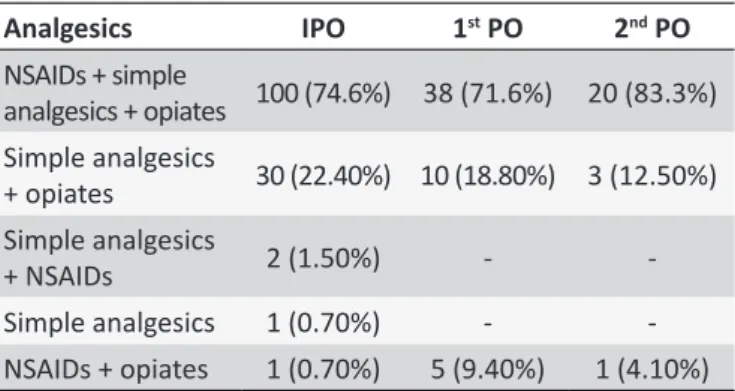
Analgesia was exclusively restricted to the administration of analgesics. In the IPO, 1 PO and 2 PO, non-steroidal anti-inlam
-matory drugs (NSAIDs), simple analgesics and opiates were the
Table 1.
Frequency of physiological changes in paients
during the postoperaive period of orthopedic surgeries,
according to postoperaive ime. City of Uberaba, MG,
Brazil, 2011-2012
Physiological changes
IPO
1
stPO
2
ndPO
Tachycardia
12 (8.9%)
9 (16.9%)
5 (20.8%)
Tachypnea
39 (29.1%) 12 (22.6%) 7 (29.1%)
Change in blood
pressure
28 (20.8%)
8 (15%)
4 (16.6%)
Change in body
temperature
18 (13.4%) 14 (26.4%)
6 (25%)
Diaphoresis
5 (3.7%)
3 (5.6%)
1 (4.1%)
Skin pallor
57 (42.5%) 22 (41.5%) 11 (45.8%)
Nausea
18 (13.4%)
8 (15%)
3 (12.5%)
Vomiing
9 (6.7%)
3 (5.6%)
1 (4.1%)
drugs most often prescribed simultaneously to 100 (74.6%), 38 (71.6%) and 20 (83.3%) patients respectively, according to the
postoperative time assessed, as shown in Table 2.
Table 2.
Analgesia used in the postoperaive period of
orthopedic surgeries, according to postoperaive ime.
City of Uberaba, MG, Brazil, 2011
Analgesics
IPO
1
stPO
2
ndPO
NSAIDs + simple
analgesics + opiates
100 (74.6%) 38 (71.6%)
20 (83.3%)
Simple analgesics
+ opiates
30 (22.40%) 10 (18.80%) 3 (12.50%)
Simple analgesics
+ NSAIDs
2 (1.50%)
-
-Simple analgesics
1 (0.70%)
-
-NSAIDs + opiates
1 (0.70%)
5 (9.40%)
1 (4.10%)
There was an increase in the simultaneous prescription of
opiates, simple analgesics and NSAIDs in the 2nd PO (20/83.3%). A total of 83(61.9%), 33(62.2%) and 15(62.5%) patients had a "set time" and "if required" analgesic plan in the IPO, 1st PO
and 2nd PO respectively. Additionally, there was a reduction in
the "set time" analgesic plan as the days passed during the postoperative period.
DISCUSSION
In view of the subjectivity and complexity of the experience
of pain, the irst challenge to control analgesia begins with its measurement. Asking questions to patients exclusively does not
contribute to adequate pain assessment, as not all of them are
able to report this in a clear and efective way2-11.
In addition to the pain reported by patients, many surgical procedures include a complex pain mechanism11,12, clearly
showing that perioperative pain control should be given greater attention and care when assessed by health professionals.
However, what is happening is that much of the literature on the topic is international and in diferent contexts, thus hindering
proper monitoring and management of patients12.
The present study revealed that there were frequent reports of pain in all periods studied, with a higher incidence in the 2nd postoperative period, when 24 (75%) patients were identiied.
The present results point out that 109 (81.3%) patients
underwent surgical interventions in the lower limbs, with a
predominance of mild pain reported by 35 (39.7%) and 10 (55.5%) patients in the immediate postoperative and 2nd posto-perative periods, respectively. Additionally, moderate pain was
only more prevalent in the 1st postoperative period, totaling 12 (36.3%) patients. These indings diverge from those of a study performed in the city of Uberlândia, MG, Southeastern Brazil,
in 2003, which assessed 40 patients and evidenced that those who had undergone orthopedic surgeries, especially the ones performed in the lower limbs, had moderate to severe pain in the postoperative period13.
In a study conducted in the university hospital of the city of
Londrina, PR, Southern Brazil, which identiied the main nursing diagnoses in patients hospitalized in an orthopedic clinic, 39 (65.0%) of the 60 patients assessed were diagnosed with acute
pain14. Another study that also identiied nursing diagnoses and which was conducted with 50 patients undergoing orthopedic
surgeries showed that all patients assessed had been diagnosed with pain15.
The results of this study evidenced reports of pain in the IPO in 88 (65.6%) patients. These results diverge from those obtained
in a study in which researchers observed that the prevalence of
postoperative pain in the irst 24 hours was 85 (46%) patients3. Of all 13 (9.7%) patients who underwent hip surgeries, three (30.7%) had moderate pain and one (7.6%) had severe
pain, which is in disagreement with a study which showed that, after undergoing total hip and knee arthroplasty, patients usually reported moderate to severe pain, caused by bone trauma and impaired muscle tissue integrity16.
With regard to possible physiological changes resulting
from pain, there was not a statistically signiicant association
between pain and these changes. This diverges from another study, which assessed 30 patients in the postoperative period of cardiac surgeries and showed that pain and physiological
changes were associated with statistical signiicance (p < 0.001) in the periods assessed4.
Analgesia only occurred through the administration of
analgesic drugs. Postoperative pain control could be performed
with the use of NSAIDs and opiates, through several ways and
methods; and the use of physical means and interventions asso-ciated with cognitive behavior, such as educational techniques, relaxation and distraction5-17.
The present study revealed that, as the postoperative period passed, there was an increase in the simultaneous prescription
of opiates, simple analgesics and NSAIDs and a reduction in the
"set time" analgesic plan.
A study conducted by the Center of Orthopedics and Trauma Studies in 2010, in association with the Sport Trauma Committee and Brazilian Orthopedics and Trauma Society of São Paulo,
evidenced that multi-modal perioperative pain management has been the most frequently recommended practice, consisting in
the use of several drugs with diferent mechanisms of action to make the analgesic efect more potent and to reduce complica
-tions. A great beneit of NSAIDs in the postoperative period of
orthopedic surgeries is that its concomitant use with other drugs requires lower doses of opiates for adequate pain control, which
is extremely beneicial for patients undergoing an analgesia
treatment plan that uses several drugs12.
In this way, efective pain analgesia can result in faster
recovery and greater cooperation with the treatment, enabling patients to have better post-surgical results5. However, the present study showed that, despite the analgesic drugs and techniques available, the prevalence of pain in the postoperative
period was high (IPO: 88/65.7%; 1st PO: 33/62.2%; and 2nd PO: 18/75%) and present in all times observed, even with the joint use of simple analgesics, opiates and NSAIDs in the majority of
patients assessed. Nurses can be aware of possible questions and resolve them, providing clients with the opportunity of dia-logue to express their concerns and feelings towards the entire surgical process18.
Despite the diiculty in treating pain, such analgesic me -thods are essential to reduce the incidence of persistent
posto-perative pain, aiming to prevent and alleviate diicult treatment
chronic pain cases in the future12.
One of the limitations of the present study was the lack of comparison between groups of patients (older and younger ones),
which is suggested for future research. Nonetheless, this limitation did not prevent the objectives proposed from being achieved.
Additionally, the complexity involved with pain intensity assess -ment should be kept in mind, considering the multi-dimensionality of this symptom. Thus, the adoption of the instruments validated, such as the ones adopted in this study, must be taken into consi-deration when using this type of assessment.
CONCLUSION
The present study revealed that the majority of patients undergoing orthopedic surgeries were males, with a mean age
of 48.25 years, of which 44 (32.8%) were retired. Most patients had lower limb surgeries (109/81.3%), with a predominance
of medium-complexity surgeries. Pain was present in all times
observed and mild pain was more frequent (IPO: 35/39.7%; and
2nd PO: 10/55.5%).
between pain and physiological changes, although these were
present in all periods analyzed. The most frequent change was skin pallor (IPO: 57/42.5%; 1st PO: 22/41.5%; and 2nd PO: 11/45.8%).
With regard to analgesia, there was a predominance of the
joint administration of simple analgesics, NSAIDs and opiates in all periods assessed. Additionally, the "set time" and "if required"
analgesic plan was more frequent.
The signiicant number of patients who reported the pre -sence of pain shows that this must be the constant focus of attention of not only nurses, but the entire multi-professional team.
Capacity-building and the development of directives are required
to help to reduce postoperative pain. This should be a norm that
can be institutionalized as routine, helping to identify and eliminate
pain and, consequently, improving the quality of care provided.
REFERENCES
1. Alves AN, Costa CMC, Siqueira JTT, Teixeira MJ. Dor: princípios e prática. Porto Alegre(RS): Artmed; 2009.
2. Fontes KB, Jaques AE. O papel da enfermagem frente ao monitoramento da dor como 5º sinal vital. Cienc. cuid. saude. 2007; 6(supl.2): 481-7. 3. Couceiro TCM, Valença MM, Lima LC, Menezes TC, Rapouso MCF.
Prevalência e Inluência do Sexo, Idade e Tipo de Operação na Dor Pós-Operatória. Rev. bras. anestesiol. 2009 maio/jun; 59(3):314-20. Disponível em http://www.scielo.br/scielo.php?pid=S0034-70942009000300006&script=sci_arttext.
4. Andrade EV, Barbosa MH, Barrichello E. Avaliação da dor em pós-operatório de cirurgia cardíaca. Acta Paul Enferm. 2010;23(2):224-9. Disponível em http://www.scielo.br/pdf/ape/v23n2/12.pdf
5. Pimenta CAM, Santos EMM, Chaves LD, Martins LM, Gutierrez BAO. Controle da dor no pós- operatório. Rev. Esc. Enferm. USP. 2001 jun; 35(2): 180-3. Disponível em: http://www.scielo.br/pdf/reeusp/v35n2/ v35n2a12.pdf.
6. Smeltzer SC, Bare BG. Brunner & Suddarth. Tratado de Enfermagem Médico-Cirúrgica. 9ª ed. Rio de Janeiro(RJ): Guanabara Koogan; 2009. p. 214-15.
7. Vila VSC, Mussi FC. O alívio da dor de pacientes no pós-operatório na perspectiva de enfermeiros de um centro de terapia intensiva. Rev. Esc. Enferm. USP. 2001 set; 35(3): 300-7. Disponível em http: http://www. scielo.br/pdf/reeusp/v35n3/v35n3a14.pdf
8. Bassanezi BSB, Oliveira Filho AG. Analgesia pós-operatória. Rev. Col. Bras. Cir. 2006 mar/abr; 33(2): 116-22. Disponível em: http://www.scielo. br/scielo.php?pid=S0100-69912006000200012&script=sci_arttext 9. Porto CC. Exame Clínico: bases para a prática médica. 5ª ed. Rio de
Janeiro(RJ): Guanabara Koogan; 2004.
10. Sociedade Brasileira de Cardiologia - SBC; Sociedade Brasileira de Hipertensão - SBH; Sociedade Brasileira de Nefrologia - SBN. V Diretrizes Brasileiras de Hipertensão Arterial. São Paulo(SP); 2006. 11. Silva BY, Pimenta MPC. Análise dos registros de enfermagem sobre dor e
analgesia em doentes hospitalizados. Rev. Esc. Enferm. USP. 2003; 37(2): 109-18. Disponível em: http://www.scielo.br/pdf/reeusp/v37n2/13.pdf 12. Silva TR, Marchetto A, Pedrinelli A, Santili C. Consenso Brasileiro sobre
Dor Perioperatória em Ortopedia e Traumatologia Desportiva. Rev. bras. ortop. 2010;45(3):2-15.
13. Fonseca NB. Analgesia pós-operatória em cirurgia ortopédica: estudo
comparativo entre o bloqueio do plexo lombar por via perivascular
inguinal (3 em 1) com ropivacaína e a analgesia subaracnóidea com morina. Rev. bras. anestesiol. 2003 abr; 53(2): 188-97.
14. Silva FS, Viana MF, Volpato MP. Diagnósticos de enfermagem em pacientes internados pela clínica ortopédica em unidade médico-cirúrgica. Rev. gauch. enferm. Porto Alegre(RS) 2008 dez; 29(4): 565-72.
15. Freitas MC, Guedes MVC, Silva LF. Diagnósticos de enfermagem em pós-operatórios de cirurgias traumato-ortopédicas. Rev. enferm. UERJ. 2003;5(2):439-48.
16. Almeida MA, Longaray VK, De Cezaro P, Barili SLS. Correspondência
entre cuidados para pacientes com problemas ortopédicos e a
classiicação das intervenções de enfermagem. Rev. gauch. enferm. 2007 dez; 28(4): 480-8.
17. Martins LM. Ações educativas no pré-operatório: impacto sobre a dor e analgesia no pós-operatório [tese] . São Paulo(SP): Escola de Enfermagem da Universidade de São Paulo; 2002.