ORIGINAL ARTICLE
Neural correlates of hallucinations in bipolar disorder
Maila de C. Neves,
1Dante G. Duarte,
1Maicon R. Albuquerque,
2Rodrigo Nicolato,
1Fernando S. Neves,
1Fa´bio L. de Souza-Duran,
3Geraldo Busatto,
4Humberto Correˆa
11Department of Mental Health, Universidade Federal de Minas Gerais (UFMG), Belo Horizonte, MG, Brazil.2Universidade Federal de Vic
¸osa (UFV), Vic¸osa, MG, Brazil.
3Laborato´rio de Neuroimagem em Psiquiatria (LIM-21), Departamento e Instituto de Psiquiatria, Faculdade de
Medicina, Universidade de Sa˜o Paulo (USP), Sa˜o Paulo, SP, Brazil.4Departamento de Psiquiatria, Faculdade de Medicina, Nu´cleo de Apoio a` Pesquisa em Neurocieˆncia Aplicada (NAPNA), USP, Sa˜o Paulo, SP, Brazil.
Objective:Approximately one-half of all patients affected by bipolar disorder present with psychotic features on at least one occasion. Several studies have found that alterations in the activity of mesolimbic and prefrontal regions are related to aberrant salience in psychotic patients. The aim of the present study was to investigate the structural correlates of a history of hallucinations in a sample of euthymic patients with bipolar I disorder (BD-I).
Methods:The sample consisted of 21 euthymic patients with BD-I and no comorbid axis I DSM-IV-TR disorders. Voxel based morphometry (VBM) was used to compare patients with and without a lifetime history of hallucinations. Preprocessing was performed using the Diffeomorphic Anatomical Registration through Exponentiated Lie Algebra (DARTEL) algorithm for VBM in SPM8. Images were processed using optimized VBM.
Results: The main finding of the present study was a reduction in gray matter volume in the right posterior insular cortex of patients with BD-I and a lifetime history of hallucinations, as compared to subjects with the same diagnosis but no history of hallucinations.
Conclusions:This finding supports the presence of abnormalities in the salience network in BD patients with a lifetime history of hallucinations. These alterations may be associated with an aberrant assignment of salience to the elements of one’s own experience, which could result in psychotic symptoms.
Keywords: Bipolar disorder; hallucinations; salience network; voxel-based morphometry
Introduction
Several morphometric magnetic resonance imaging (MRI) studies have identified structural abnormalities in the limbic-thalamic-cortical and limbic-striatal-pallidal-thala-mic-cortical circuits in bipolar disorder (BD).1-3 However, these findings have not been consistently replicated. One possible explanation for this variability in neuroimaging findings is the complexity of the BD phenotype due to its polymorphic clinical manifestations and outcome. The dissection of BD into more homogeneous subphenotypes may improve the identification of neurobiological markers.4 From this perspective, the investigation of brain changes associated with subphenotypic features such as suicidal behavior, circadian rhythm disruption, neuropsychological deficits and psychotic symptoms may contribute to more consistent findings in neuroimaging studies of BD.
Approximately one-half of all patients affected by BD present with psychotic features, as defined by the DSM-IV, on at least one occasion.5 Psychotic features in BD are usually associated with greater symptom severity and higher morbidity in the long-term.6 Some authors have found
evidence of a familial aggregation of psychotic symptoms in BD and suggested that these features may mark a valid subtype of BD for genetic and biological investigations.7
It has been hypothesized that a dysregulation of mesolimbic and prefrontal dopaminergic pathways may cause aberrant salience and contribute to the emergence of psychotic symptoms.8 Functional and structural neu-roimaging studies have found abnormalities in networks which encompass the limbic/paralimbic emotional sal-ience areas and the dorsal neocortical executive control systems to be associated with delusion in both affective disorders and schizophrenia.8-10However, no studies as yet have evaluated neural morphological abnormalities in patients with BD who experience hallucinations.
In this study, we aimed to investigate the possible neuroanatomical correlates of hallucinations in euthymic patients with type I BD (BD-I). We hypothesized that cortical gray matter volume (GMV) would differ signifi-cantly between bipolar patients with and without a lifetime history of hallucinations.
Methods
Sample and assessment schedules
A total of 43 patients with BD-I aged between 18 and 65 years were screened for eligibility, and 21 of those fulfilled inclusion criteria for the study. Patients were
Correspondence: Maila de Castro L. Neves, Department of Mental Health, Universidade Federal de Minas Gerais (UFMG), Av. Prof. Alfredo Balena, 190/2002, Santa Efigeˆnia, Belo Horizonte, MG, Brazil. E-mail: [email protected]
Submitted Dec 16 2014, accepted Feb 24 2015.
Associac¸a˜o Brasileira de Psiquiatria
recruited from the Center for Affective Disorders (a tertiary service specialized in affective disorders) at the Universi-dade Federal de Minas Gerais (UFMG) in the city of Belo Horizonte, Brazil. All patients were evaluated by a psychiatrist using the Mini International Neuropsychiatry Interview Plus (MINI-Plus), and met DSM-IV criteria for BD-I. The study was approved by the Research Ethics Committee of the UFMG, and all procedures were performed in accordance with the Helsinki Declaration of 1975. All subjects were given a complete description of the study, and asked to provide written informed consent for participation. All participants were right-handed (scores over 40 on the Edinburgh Inventory)11and euthymic, as evidenced by scores below eight on the Young Mania Rating Scale (YMRS) and on the 21-item Hamilton Depression Rating Scale (HDRS-21).12Of the 43 patients initially evaluated, 18 were excluded due to psychiatric comorbidities (10 for anxiety disorders and eight for alcohol abuse and dependence), one due to the use of a pacemaker and three for not being right-handed. The selection of right-handed, euthymic patients with BD-I and no comorbid axis I DSM-IV-TR disorders was based on evidence of the influence of psychiatric comorbidities and handedness on brain morphology.13
Patients were then divided according to their current and lifetime history of psychotic symptoms as per the MINI-Plus.
Image acquisition
Images were acquired using a 1.5 T Phillips scanner (Philips Medical Systems, Eindhoven, Netherlands) with a T1-3D SPGR sequence. Contiguous axial images across the entire brain were obtained using the following parameters: TE = 6 ms, TR = 35 ms, flip angle = 45, acquisition matrix = 288 288, and voxel size = 0.85
0.85 1 mm (190 slices).
Image processing and analysis
Voxel-based morphometry (VBM) analysis was performed using the Statistical Parametric Mapping software, version 8, running under Matlab 2009b. Briefly, all MRI datasets were first manually reoriented to the anterior commissure, at the origin of the three-dimensional Montreal Neurological Institute (MNI) coordinate system. Images were segmen-ted into grey matter (GM) and white matter using a unified segmentation procedure.14The Diffeomorphic Anatomical Registration Through Exponentiated Lie Algebra (DAR-TEL) algorithm15was then used to spatially normalize the segmented images, maximizing the sensitivity and accu-racy of localization by registering individual structural images to an asymmetric custom T1-weighted template derived from the participants’ own structural images, rather than a standard T1-weighted template.15 These fully normalized images were resliced with trilinear interpolation to a final voxel size of 1.51.51.5 mm3. An additional
modulation step was also included to ensure that the total amount of GM in each voxel was conserved before and after normalization. This was achieved by multiplying each spatially normalized GM image by its relative volume.
Finally, the resulting GM images were smoothed using an 8-mm isotropic kernel at full width half maximum, to ensure data were normally distributed and suitable for analysis by parametric methods.
Statistical analysis
Sociodemographic and clinical data were analyzed using SPSS version 18.0. Normality was confirmed by the Shapiro-Wilk test, and between-group differences were therefore analyzed using Student’sttest for independent samples. Nonparametric variables were compared using Mann-Whitney or chi-square tests. All statistical compar-isons were performed with a significance level of 5%.
Mean GMV was compared between groups using the general linear model, based on random Gaussian field theory.16Firstly, an exploratory comparison of whole-brain GMV was performed between patients with and without a lifetime history of hallucinations. Results were thresholded at the two-tailed pp0.001 level of significance, uncorrected
for multiple comparisons (z X 3.09), and displayed as statistical parametric maps (SPMs) into standard anatomical space, with a minimum cluster size of 25 voxels. The total GMV of each subject was entered as a confounder into an analysis of covariance model. For between-group compar-isons of GMV, the threshold for peak voxel significance was set at p o 0.05, corrected for family-wise error (FWE) across the entire brain.
Small volume correction (SVC) was then used to conduct a hypothesis-driven investigation of the brain regions in which abnormalities have been identified in previous neuroimaging studies of BD: the orbitofrontal cortex and ventral prefrontal areas, cingulate gyrus, fusiform gyrus, superior temporal sulcus, amygdala, insula and thalamus. These regions were defined based on the Automated Anatomical Labeling atlas. For this analysis, significance was calculated after FWE correc-tion for multiple comparisons (pFWE p 0.05) in the
predefined regions of interest (ROIs).16
Results
Clinical and sociodemographic data
The clinical and demographic characteristics of the sample are summarized in Table 1. Nine (42.8%) patients with BD-I had a lifetime history of hallucinations. However, none of the participants presented with psychotic symptoms at the time of the study. Additionally, all patients were receiving medication at the time of MRI scanning. The two patient groups did not differ in terms of their age and gender composition, although those with a history of hallucinations had fewer years of formal education than the remainder of the sample. Table 1 provides additional details regarding the clinical profile of study participants.
Comparison of GMV between patients with and without psychotic symptoms
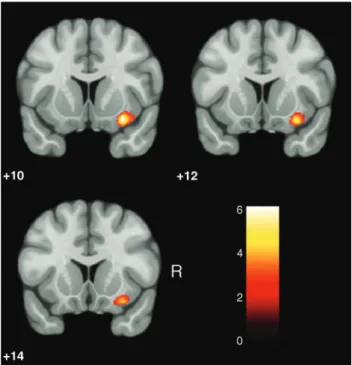
hallucinations (pFWE p 0.05, corrected for multiple comparisons). The analysis of a priori ROIs showed that patients with BD-I and a lifetime history of hallucinations showed reduced GMV in the right posterior insula (BA = 13; z score = 4.47; coordinates x, y, z = 30, 10, -13; p = 0.002) when compared to patients with BD-I and no history of hallucinations (Figure 1). Between-group differences in the right posterior insula remained statis-tically significant after controlling for the effects of age, gender and years of education (z score = 4.41, p = 0.008).
Discussion
The present results revealed that euthymic patients with BD-I, no comorbid axis I DSM-IV-TR disorders, and a lifetime history of hallucinations showed reduced GMV in the right insula. Over recent years, several neuroimaging studies have attempted to identify the specific neural circuits implicated in the emergence of psychotic symp-toms.18,19These studies have supported the notion that abnormalities in the salience network, interconnecting the anterior cingulate cortex and the insula,20-23constitute a core pathophysiological feature of psychosis.18
Salience is the state or quality by which something stands out from its surroundings. Saliency detection is considered a key attentional mechanism, which contri-butes to learning and survival.8Palaniyappan & Liddle18 introduced the concept of proximal salience, defined as follows: ‘‘an event, such as an externally or internally generated sensation attains proximal salience when it generates a momentary state of neural activity within the salience network that results in updating of expectations and, if warranted by the context, initiates or modifies action.’’
The salience network receives information about internal and external sensations, individual goals as well as stimulus-independent thoughts, all of which are used to update expectations about the internal and external milieu and, if necessary, initiate or modify action.18This neural network has been proposed to play a primary role in
resting-state brain connectivity, especially in the switch between default mode and task-related states of brain connectivity.24,25 Dysfunctions in the salience network may trigger a cascade of events which ultimately produce psychotic symptoms. Inappropriate proximal salience during self-generated action, for instance, has been found to be associated with hallucinations and passivity experiences.26-30
Evidence of structural deficits in the insula of patients who experience hallucinations has already been found in previous neuroimaging studies.18However, most of these investigations evaluated patients with schizophre-nia.26,31-33 The issue of whether morphological changes in the insula were specific to patients with schizophrenia remained a controversial one.34However, recent studies have shown a considerable degree of overlap in the regional patterns of brain abnormalities observed across psychotic disorders.8,35Our results suggest that morpho-logical changes in the insula may be a useful imaging biomarker for future investigations of the similarities and differences between the biological underpinnings of affective and nonaffective psychoses.
Our results must be interpreted in light of a few methodological limitations. Firstly, all patients in our sample were receiving treatment at the time of the study. As observed in previous studies, some medications may interfere with the findings of VBM studies in BD.36,37 Secondly, our sample size limited the interpretation of our results. Third, there was a modest but significant difference in the number of years of formal education reported by each participant group. However, it is important to note that between-group differences in the GMV of the right posterior insula retained statistical significance even after controlling for the effects of age, gender and education. It is there unlikely that our results were confounded by these demographic variables. Finally, the cross-sectional design used in this study does not allow conclusions about structural changes in the brain of patients over time. Future studies with longitudinal designs and larger samples of patients,
Table 1 Sociodemographic and clinical characteristics of the sample at the time of MRI scanning
Variables
Patients with BD-I and no lifetime history of hallucinations (n=12)
Patients with BD-I and a lifetime
history of hallucinations (n=9) p-value
Age 39.92614.99 37.66612.07 0.716
Years of education 13.4262.15 11.6661.32 0.044
Sex, female 6 (50.0) 6 (66.6) 0.528
Disease duration, years 11.9169.59 12.2268.70 0.887 Number of hospitalizations 0.8361.03 2.8862.26 0.027 Family history of major depressive disorder 6 (50.0) 5 (55.5)
-Family history of BD 6 (50.0) 3 (33.3)
-Family history of suicide 2 (16.6) 0 (0) -Medication use at the time of MRI scanning
-Antipsychotics 2 (16.6) 6 (66.6)
-Antidepressants 0 (0) 0 (0)
-Lithium 5 (41.6) 6 (66.6)
-Valproic acid 5 (41.6) 2 (22.2)
-Other mood stabilizers 2 (16.6) 3 (33.3)
-Benzodiazepines 1 (8.3) 2 (22.2)
followed from the time of disease onset, are still required to shed light on these issues. Despite these limitations, our results are in agreement with those of previous studies, and corroborate earlier findings in the literature.36 In conclusion, our findings reinforce the view that the salience network may be related to the pathophysiology of psychotic symptoms in BD. Reduced GMV in the right insula may be a candidate trait marker of psychotic features in patients with BD. Our findings also underscore the importance of assessing psychotic features in studies of BD. Hopefully, advances in neuroimaging and in the investigation of the evidence outlined in the present article will contribute to the future development of innovative forms of classifying psychotic disorders, based not only on clinical data but also on information regarding the neural underpinnings of patient symptoms.
Acknowledgements
This study received financial support from the Deanship of Research at Universidade Federal de Minas Gerais,
Conselho Nacional de Desenvolvimento Cientı´fico e Tecnolo´gico (CNPq), and Fundac¸a˜o de Amparo a`
Pes-quisa do Estado de Minas Gerais (FAPEMIG).
Disclosure
The authors report no conflicts of interest.
References
1 de Azevedo-Marques Pe´rico C, Duran FL, Zanetti MV, Santos LC, Murray RM, Scazufca M, et al. A population-based morphometric MRI study in patients with first-episode psychotic bipolar disorder: com-parison with geographically matched healthy controls and major depressive disorder subjects. Bipolar Disord. 2011;13:28-40. 2 Matsuo K, Kopecek M, Nicoletti MA, Hatch JP, Watanabe Y, Nery
FG, et al. New structural brain imaging endophenotype in bipolar disorder. Mol Psychiatry. 2012;17:412-20.
3 Adler CM, DelBello MP, Strakowski SM. Brain network dysfunction in bipolar disorder. CNS Spectr. 2006;11:312-20.
4 Schulze TG. Genetic research into bipolar disorder: the need for a research framework that integrates sophisticated molecular biology and clinically informed phenotype characterization. Psychiatr Clin North Am. 2010;33:67-82.
5 Keck PE Jr, McElroy SL, Havens JR, Altshuler LL, Nolen WA, Frye MA, et al. Psychosis in bipolar disorder: phenomenology and impact on morbidity and course of illness. Compr Psychiatry. 2003;44:263-9. 6 Coryell W, Leon AC, Turvey C, Akiskal HS, Mueller T, Endicott J. The significance of psychotic features in manic episodes: a report from the NIMH collaborative study. J Affect Disord. 2001;67:79-88.
7 Potash JB, Willour VL, Chiu YF, Simpson SG, MacKinnon DF, Pearlson GD, et al. The familial aggregation of psychotic symptoms in bipolar disorder pedigrees. Am J Psychiatry. 2001;158:1258-64. 8 Radaelli D, Poletti S, Gorni I, Locatelli C, Smeraldi E, Colombo C,
et al. Neural correlates of delusion in bipolar depression. Psychiatry Res. 2014;221:1-5.
9 Gradin VB, Waiter G, O’Connor A, Romaniuk L, Stickle C, Matthews K, et al. Salience network-midbrain dysconnectivity and blunted reward signals in schizophrenia. Psychiatry Res. 2012;211:104-11. 10 Palaniyappan L, Mallikarjun P, Joseph V, White TP, Liddle PF.
Reality distortion is related to the structure of the salience network in schizophrenia. Psychol Med. 2011;41:1701-8.
11 Oldfield RC. The assessment and analysis of handedness: the Edinburgh inventory. Neuropsychologia. 1971;9:97-113.
12 Williams JB. A structured interview guide for the Hamilton Depression Rating Scale. Arch Gen Psychiatry. 1988;45:742-7.
13 Cusi AM, Nazarov A, Holshausen K, Macqueen GM, McKinnon MC. Systematic review of the neural basis of social cognition in patients with mood disorders. J Psychiatry Neurosci. 2012;37:154-69. 14 Ashburner J, Friston KJ. Unified segmentation. Neuroimage.
2005;26:839-51.
15 Ashburner J. A fast diffeomorphic image registration algorithm. Neuroimage. 2007;38:95-113.
16 Friston KJ, Holmes AP, Worsley KJ, Poline JP, Frith CD, Frackowiak RSJ. Statistic parametric maps in functional imaging: a general linear approach. Hum Brain Mapp. 1994;2:189-210.
17 Talairach J, Tournoux P. Co-planar stereotaxic atlas of the human brain. New York: Thieme; 1988.
18 Palaniyappan L, Liddle PF. Does the salience network play a cardinal role in psychosis? An emerging hypothesis of insular dysfunction. J Psychiatry Neurosci. 2012;37:17-27.
19 Busatto GF. Structural and functional neuroimaging studies in major depressive disorder with psychotic features: a critical review. Schizophr Bull. 2013;39:776-86.
20 Taylor KS, Seminowicz DA, Davis KD. Two systems of resting state connectivity between the insula and cingulate cortex. Hum Brain Mapp. 2009;30:2731-45.
21 Van den Heuvel MP, Mandl RC, Kahn RS, Hulshoff Pol HE. Func-tionally linked resting-state networks reflect the underlying structural connectivity architecture of the human brain. Hum Brain Mapp. 2009;30:3127-41.
22 Dosenbach NU, Fair DA, Miezin FM, Cohen AL, Wenger KK, Dosenbach RA, et al. Distinct brain networks for adaptive and stable task control in humans. Proc Natl Acad Sci U S A. 2007;104:11073-8. 23 Seeley WW, Menon V, Schatzberg AF, Keller J, Glover GH, Kenna H, et al. Dissociable intrinsic connectivity networks for salience pro-cessing and executive control. J Neurosci. 2007;27:2349-56. 24 Menon V, Uddin LQ. Saliency, switching, attention and control:
a network model of insula function. Brain Struct Funct. 2010;214:655-67. 25 Sridharan D, Levitin DJ, Menon V. A critical role for the right fronto-insular cortex in switching between central-executive and default-mode networks. Proc Natl Acad Sci U S A. 2008;105:12569-74. 26 Jardri R, Pouchet A, Pins D, Thomas P. Cortical activations during
auditory verbal hallucinations in schizophrenia: a coordinate-based meta-analysis. Am J Psychiatry. 2011;168:73-81.
27 Nagai M, Kishi K, Kato S. Insular cortex and neuropsychiatric dis-orders: a review of recent literature. Eur Psychiatry. 2007;22:387-94. 28 McGuire PK, Silbersweig DA, Wright I, Murray RM, David AS, Frackowiak RS, et al. Abnormal monitoring of inner speech: a physiolo-gical basis for auditory hallucinations. Lancet. 1995;346:596-600. 29 Blakemore SJ, Smith J, Steel R, Johnstone CE, Frith CD. The
per-ception of self-produced sensory stimuli in patients with auditory hallucinations and passivity experiences: evidence for a breakdown in self-monitoring. Psychol Med. 2000;30:1131-9.
30 Karnath HO, Baier B. Right insula for our sense of limb ownership and self-awareness of actions. Brain Struct Funct. 2010;214:411-7. 31 Shapleske J, Rossell SL, Chitnis XA, Suckling J, Simmons A,
Bullmore ET, et al. A computational morphometric MRI study of schizophrenia: effects of hallucinations. Cereb Cortex. 2002;12:1331-41. 32 Palaniyappan L, Mallikarjun P, Joseph V, White TP, Liddle PF. Reality distortion is related to the structure of the salience network in schizophrenia. Psychol Med. 2011;41:1701-8.
33 Sommer IE, Diederen KM, Blom JD, Willems A, Kushan L, Slotema K, et al. Auditory verbal hallucinations predominantly activate the right inferior frontal area. Brain. 2008;131:3169-77.
34 Takahashi T, Wood SJ, Soulsby B, Tanino R, Wong MT, McGorry PD, et al. Diagnostic specificity of the insular cortex abnormalities in first-episode psychotic disorders. Prog Neuropsychopharmacol Biol Psychiatry. 2009;33:651-7.
35 Ellison-Wright I, Bullmore E. Anatomy of bipolar disorder and schi-zophrenia: a meta-analysis. Schizophr Res. 2010;117:1-12. 36 Kempton MJ, Haldane M, Jogia J, Grasby PM, Collier D, Frangou S.
Dissociable brain structural changes associated with predisposition, resilience, and disease expression in bipolar disorder. J Neurosci. 2009;29:10863-8.