ARE SOCIOECONOMIC FACTORS ASSOCIATED
WITH OVERBITE AND OVERJET? AN EVALUATION
USING DIGITAL PHOTOGRAPHS
Condições socioeconômicas estão associadas ao overbite e overjet?
Uma avaliação utilizando fotograias digitais
Rodrigo Costa Cutrim(1), Miyuki Damasceno Wada(2), Janailce de Almeida Lima(3),
Judith Rafaelle Oliveira Pinho(4), Juliana Aires Paiva de Azevedo(5), Raiza Felix Marão Martins(6),
Cristiane Barros Leal(7), Érika Bárbara Abreu Fonseca Thomaz(8)
(1) Dentist (University Center from Maranhão, São Luís, MA, Brazil).
(2) Dentist (University Center from Maranhão, São Luís, MA, Brazil).
(3) Dentist (University Center from Maranhão, São Luís, MA, Brazil).
(4) Dentist (Federal University from Maranhão, São Luís, MA, Brazil); PhD’s student in Public Health (Federal University from Maranhão, São Luís, MA, Brazil).
(5) Dentist (Federal University from Maranhão, São Luís, MA, Brazil); Master’s student in Dentistry (Federal University from Maranhão, São Luís, MA, Brazil).
(6) Dentist (Federal University from Maranhão, São Luís, MA, Brazil); Master’s student in Public Health (Federal Univer-sity from Maranhão, São Luís, MA, Brazil).
(7) Dentist (Federal University from Maranhão, São Luís, MA, Brazil); Professor (Brazilian Dental Association). Master in Health Sciences (Federal University from Maranhão, São Luís, MA, Brazil).
INTRODUCTION
Malocclusions (MOcl) include a set of anomalies characterized by gaps in the tooth arrangement and/ or the relationship between the maxillomandibular bones1. MOcl have been designated as diseases
of modern civilization that can have potential health impacts on humans today, including changes in
(8) Dentist (Federal University from Maranhão, São Luís, MA, Brazil); Professor, Department of Public Health, Federal University from Maranhão, São Luís, MA; PhD in Public Health (Public Health Institute of the Federal University from Bahia, Brazil).
Sources of support: FAPEMA BIC-00036/08; FAPEMA/Apoio a Publicação de Artigos 002/2013.
Conlict of interest: non-existent
ABSTRACT
Purpose: to estimate the association between socioeconomic factors and occlusal changes like overbite and overjet in students aged 7 to 15 years. Method: this is a cross-sectional study in 251 students of both gender regularly enrolled in the school of public and private schools in São Luís, Maranhão, Brazil. All subjects carried out the sample photos extra-oral standardized face (front
resting, smiling front and proile) and intraoral (front, right side and left side in occlusion, occlusal
upper and lower occlusal) for the diagnosis of changes. The photographs were evaluated by three observers under blind and disagreements were discussed to achieve consensus. Overbite and overjet were diagnosed according to criteria of Angle. Results: it was found that 35.4% of the children were
18.3% and overbite, overjet. There was a statistically signiicant association between family income
and overbite (p = 0.003) and overjet (p = 0.029), noting that most children who had no overbite (69.4%) were low-income families (up to 2 minimum wage). Similarly, most people with overjet were families with higher incomes, while the majority of those without overjet had low family income. For
other variables there was no statistically signiicant difference in frequency distribution of overjet and
overbite. Conclusion: the prevalence of overbite and overjet among the studied population is high, especially among those with higher family income.
mastication, speech, swallowing, muscle pain, and temporomandibular joint functions, as well as aesthetic problems, resulting in social, functional,
and psychological consequences during adult life2,3.
In 2007, Suliano reported a gradual reduction in speech, swallowing, and mastication functions as the severity of the MOcl increased4. There are even
indications that such MOcl are associated with a
decreased quality of life in human populations5.
Overbite and overjet are among the main occlusal changes that occur in Brazilian children with mixed
dentition. Overbite is deined as the overlap between
the upper and lower incisors on a vertical plane and is a characteristic of the permanent dentition of contemporary humans6. Several authors have
established normality standards for this overlap1,
but when the overbite is more pronounced than the normality standards, it is considered a type of MOcl1,6. Overjet is an extensive horizontal overlap
of the incisal ridge of the upper teeth over the lower teeth and of the buccal cusp ridges of the posterior teeth with respect to their lower counterparts. Such a change is usually associated with facial muscle imbalance problems, resulting in an anteroposterior dentoskeletal relationship7.
In a study of pronounced overjet in Brazilian children, the prevalence was 22.0%8. Another
study conducted in eighteen Brazilian states using random sampling reported an overbite prevalence of 18.09%9. Although different prevalences of
MOcl have been reported, the majority of studies are restricted to the more developed regions of Brazil, which makes constructing an
epidemio-logical proile of these public health problems in the country more dificult. Moreover, these studies
were conducted with different age groups and only
provided numerical classiication criteria, thereby
neglecting evaluations of the soft tissue, facial harmony, and patient perceptions10,11.
No consensus exists regarding the role of socioeconomic factors in the etiology of deleterious oral habits and dentofacial MOcl3,12-16. However, it
is believed that when combined with several other
factors, socioeconomic factors may inluence the
growth and development of the maxillaries, resulting
in MOcl. Nonetheless, doubts remain, speciically
about the relationship between socioeconomic factors and occlusal changes (particularly overbite and overjet) because few studies have addressed this subject, and their results are contradictory1,13.
status and deleterious oral habits, which could
inluence the rise in MOcl20.
The costs involved in curative treatments are extremely high and should also be considered. It is therefore important to adopt preventive and interceptive strategies, aiming not only to reduce
inancial costs but also to minimize the impact of
these changes on public health.
Because overbite and overjet are some of the least understood MOcl2 and because MOcl has
endemic characteristics and is currently one of the main oral health problems, it has been hypothesized that a high prevalence of these changes exists among adolescents with a poor socioeconomic status in the evaluated city. The present study might be an important tool for characterizing the
epide-miological proile of these changes in the regional
population and thus facilitate the implementation of public policies aimed at controlling the problem. Therefore, the purpose of this investigation was to estimate the association between socioeconomic factors and overbite and overjet MOcl in young students with permanent dentition.
METHOD
The present study followed the requirements
established by Resolution 196/96 of the National Health Council/Ministry of Health of Brazil and its complementary laws. The study proposal was approved by the Committee for Ethics in Research at the institution of origin on March 31, 2008, under Protocol No. 00136/2008. All of the participants’ guardians were informed about the purpose of the research and, if they agreed to participate in the study, signed an informed consent form.
This cross-sectional study was conducted using a patient sample composed of 251 students who were 7 to 15 years of age, of either gender, and enrolled in grades 1 through 8 in public or private schools in the city of São Luís, Maranhão, Brazil, between August 2008 and May 2009.
At the time of the investigation, the city of São Luís (MA) had an estimated 998,385 inhabitants21 spread
over an area of approximately 828 km²22. According
to the school census data available during this study23, there were an estimated 101,042 children
estimated that this study would require a sample
of 251 individuals, a MOcl (overbite and overjet) prevalence of 17.2%, and a sampling error of 4.5% with a 5% alpha and 80% power.
The data were collected by previously trained staff members. The evaluations were conducted using standardized procedures in a room located in the particular school. During the examination, a dental mirror and front and side lip and cheek retractors were used in addition to a digital camera for photographic documentation.
Standardized extraoral photographs (frontal
resting, frontal smiling, and proile) and intraoral
photographs (frontal, right side, and left side in occlusion, upper occlusal, and lower occlusal) were taken of all of the subjects in the sample. The pictures were taken at a single location in each school, as recommended by Siécola10, using
background lighting to ensure indirect light and thus decrease unwanted shadows in the photographs.
The framing of the photographs was performed
in a simpliied way. In the frontal view, the horizontal
markings of the camera were parallel to the ground, and the vertical markings were aligned with the midline of the face. In the lateral view, the horizontal markings were also parallel to the ground, and the vertical markings were aligned with the lateral corner of the orbit and parallel to the vertical line10.
The intraoral photographs employed a standardized distance from the teeth, such that all of the teeth could be observed using sterilized retractors that were suitable for the photographs.
The photographs were evaluated by three blinded examiners, and any disagreements were discussed until a consensus was reached.
Overbite was deined as the overlap between
the upper and lower incisors on a vertical plane3. An overbite was classiied as follows: mild, when the
incisal ridge of the lower central incisors touched the third incisal of the upper central incisors; average, when the lower incisors touched the middle third of the crown of the upper incisors; and severe, when the lower central incisors touched the cingulum of the upper incisors or gum1,6.
An overjet was deined as excessive overlap of
the incisal ridge of the upper teeth over the lower teeth and buccal cusps of the posterior teeth with respect to their lower counterparts1.
A questionnaire answered by the parents and
students was also used. The following data were collected for each student: name, date of birth to estimate the age [“7 to 11 years” or “12 to 15 years”], residential address, phone number, gender [“male” or “female”], color / ethnicity [self-described, based on the Brazilian Institute of Geography and
Statistics criteria, 2006, and classiied as “white”
or “non-white”], general data regarding the school [school name, type of school funding (“public” or “private”)], socioeconomic characteristics of the student and his/her family [education level of the head of household (categorized as “8 years or less” or “9 years or more”), family income in Reais (“<2”, “2-5” or “>5 times the minimum wage”), who is head of household (“father,” “mother,” or “other”), occupational status of the head of household (“unemployed” or “no”), presence of an indoor bathroom only at the school (“yes” or “no”), grade level, and the student ‘s history of failed grade levels (“yes” or “no”)].
The photos were archived daily on a computer, which was protected, and access was limited to the team of researchers. The program Adobe Photoshop® (San Jose, CA, United States) was
used to crop the photographs. No other changes or adjustments to the color, brightness, contrast, or proportions of the photos were made. The images were saved in a compressed format, using
sequential numbers to identify the students and
connect them to their other data.
All of the information was stored in a database that was generated using the program Microsoft
Ofice Excel for Windows® (Redmond, WA, United
States). Bivariate descriptive analyses were
subse-quently done to determine the frequency distribution
of the demographic, socioeconomic, behavioral, and biological data as a function of the presence of an overjet or overbite. At this stage, possible
differ-ences were identiied between the proportions of
students with a MOcl and their categorical variables
using Pearson’s chi-square test (X2), considering a signiicance level of 5% (α = 0.05). The software Statistica version 7.0 distributed by StatSoft Inc®
RESULTS
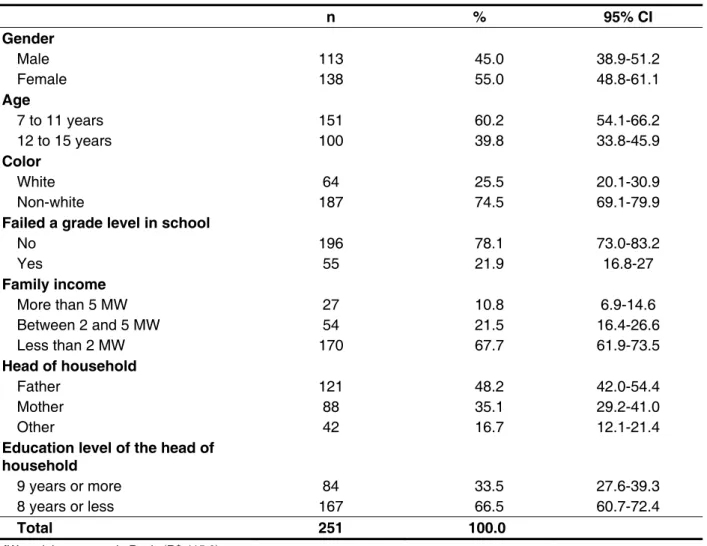
In the present study, the prevalence of an overbite in students between 7 and 15 years of age was 35.4%, and the prevalence of an overjet was 18.3%. The sociodemographic characteristics of the students are listed in Table 1.
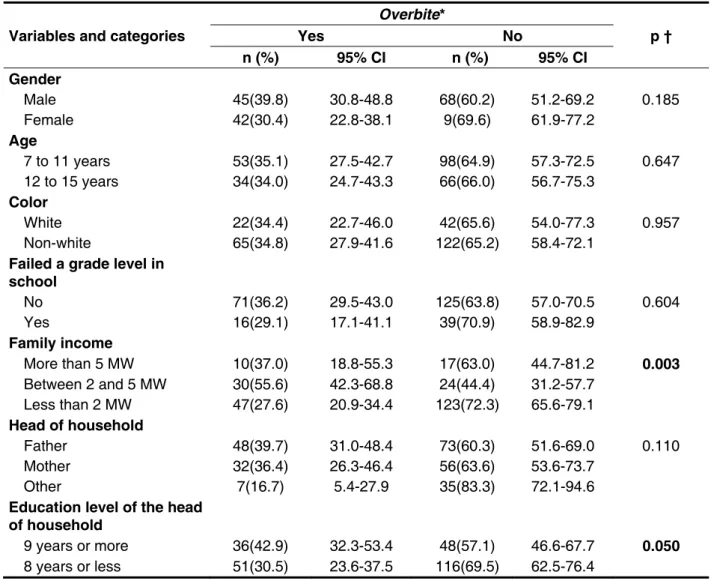
There was a statistically signiicant association
between the family income and the presence of an
overbite (p = 0.003). There was a higher prevalence of overbite among students whose families earned between 2 and 5 times the minimum wage (55.6%). Most of the students without this MOcl were from families that earned the lowest wages (2 times the minimum wage or less). There were no statistically
signiicant differences in the frequency distribution
between the other variables and the presence of an overbite (Table 2).
Table 1 – Characteristics of the 251 students between 7 and 15 years of age who were included in the study. São Luís. Maranhão, Brazil. 2008-2009
n % 95% CI
Gender
Male 113 45.0 38.9-51.2
Female 138 55.0 48.8-61.1
Age
7 to 11 years 151 60.2 54.1-66.2
12 to 15 years 100 39.8 33.8-45.9
Color
White 64 25.5 20.1-30.9
Non-white 187 74.5 69.1-79.9
Failed a grade level in school
No 196 78.1 73.0-83.2
Yes 55 21.9 16.8-27
Family income
More than 5 MW 27 10.8 6.9-14.6
Between 2 and 5 MW 54 21.5 16.4-26.6
Less than 2 MW 170 67.7 61.9-73.5
Head of household
Father 121 48.2 42.0-54.4
Mother 88 35.1 29.2-41.0
Other 42 16.7 12.1-21.4
Education level of the head of household
9 years or more 84 33.5 27.6-39.3
8 years or less 167 66.5 60.7-72.4
Total 251 100.0
MW = minimum wage in Reais (R$ 415.0).
There were also statistically signiicant differ
-ences in the frequency distribution between an
overjet and the various family-income categories (p = 0.029). Among the students who had this MOcl, the majority (29.6%) had a family income of more than 5 times the minimum wage, whereas the
majority of students (84.1%) without an overjet were from families with incomes that were 2 times the
minimum wage or less. No signiicant differences
existed between the distribution of overjet and the other investigated variables (Table 3).
Table 2 – Frequencies of overbite as a function of socio-economic and demographic variables in 251 students between 7 and 15 years of age. São Luís. Maranhão, Brazil. 2008-2009
MW = minimum wage in Reais (R$ 415.0). 95% CI = 95% Conidence Interval.
(*) Five (5) students who were not evaluated were excluded.
(†) Pearson’s chi-squared test (α = 5%). Variables and categories
Overbite*
p † Yes No
n (%) 95% CI n (%) 95% CI
Gender
Male 45(39.8) 30.8-48.8 68(60.2) 51.2-69.2 0.185
Female 42(30.4) 22.8-38.1 9(69.6) 61.9-77.2
Age
7 to 11 years 53(35.1) 27.5-42.7 98(64.9) 57.3-72.5 0.647 12 to 15 years 34(34.0) 24.7-43.3 66(66.0) 56.7-75.3
Color
White 22(34.4) 22.7-46.0 42(65.6) 54.0-77.3 0.957
Non-white 65(34.8) 27.9-41.6 122(65.2) 58.4-72.1 Failed a grade level in
school
No 71(36.2) 29.5-43.0 125(63.8) 57.0-70.5 0.604
Yes 16(29.1) 17.1-41.1 39(70.9) 58.9-82.9
Family income
More than 5 MW 10(37.0) 18.8-55.3 17(63.0) 44.7-81.2 0.003 Between 2 and 5 MW 30(55.6) 42.3-68.8 24(44.4) 31.2-57.7
Less than 2 MW 47(27.6) 20.9-34.4 123(72.3) 65.6-79.1 Head of household
Father 48(39.7) 31.0-48.4 73(60.3) 51.6-69.0 0.110
Mother 32(36.4) 26.3-46.4 56(63.6) 53.6-73.7
Other 7(16.7) 5.4-27.9 35(83.3) 72.1-94.6
Education level of the head of household
9 years or more 36(42.9) 32.3-53.4 48(57.1) 46.6-67.7 0.050 8 years or less 51(30.5) 23.6-37.5 116(69.5) 62.5-76.4
DISCUSSION
There was a high prevalence of overbite and overjet among the 251 children sampled, affecting 35.4% and 18.3% of the students, respectively. In
addition, both overbite and overjet were signiicantly
associated with the household income and the education level of the head of household, in which the highest prevalence of these MOcl occurred among the students with a higher family income and more education.
adolescents from the Peruvian Amazon who were 2-18 years of age28. The highest prevalence was
observed in a study that included 1,024 adolescents between 13 and 15 years of age from Jeddah, Saudi Arabia26. The variation between the studies may be
due to their methodological differences, especially the cutoff points used to classify the overbites, the sample size, and the study design, which were usually convenience-sampling designs. In Brazil, the prevalence of overbite was 9% in 84 soccer players who were between 13 and 20 years of age24.
Table 3 – Frequencies of overjet as a function of socioeconomic and demographic variables in 251 students between 7 and 15 years of age. São Luís. Maranhão, Brazil. 2008-2009
Variables and categories
Overjet*
p † Yes No
n (%) 95% CI n (%) 95% CI
Gender
Male 26(23.0) 15.2-30.8 87(77.0) 69.2-84.8 0.099
Female 19(13.8) 8.0-19.5 119(86.2) 80.5-92.0
Age
7 to 11 years 25(16.6) 10.6-22.5 126(83.4) 77.5-89.4 0.496 12 to 15 years 20(20.0) 12.2-27.8 80(80.0) 72.2-87.8
Color
White 17(26.6) 15.7-37.4 47(73.4) 62.6-84.3 0.112
Non-white 28(15.0) 9.9-20.1 159(85.0) 79.9-90.1 Failed a grade level in
school
No 36(18.4) 12.9-23.8 160(81.6) 76.2-87.1 0.935
Yes 9(16.4) 6.6-26.1 46(83.6) 73.9-93.4
Family income
More than 5 MW 8(29.6) 12.4-46.9 19(70.4) 60.3-84.2 0.029 Between 2 and 5 MW 15(27.8) 15.8-39.7 39(72.2) 60.3-84.2
Less than 2 MW 22(12.9) 7.9-18.0 148(87.1) 82.0-92.1 Head of household
Father 25(20.7) 13.4-27.9 96(79.3) 72.1-86.6 0.763
Mother 12(13.6) 6.5-20.8 76(86.4) 79.2-93.5
Other 8(19.1) 7.2-30.9 34(80.9) 69.1-92.8
Education level of the head of household
9 years or more 21(25.0) 15.7-34.3 63(75.0) 54.7-84.3 0.040 8 years or less 24(14.4) 9.1-21.4 143(85.6) 80.3-92.6
MW = minimum wage in Reais (R$ 415.0). 95% CI = 95% Conidence Interval.
(*) Five (5) students that were not evaluated were excluded.
The prevalence of overjet observed in the present study (18.3%) was similar to the prevalence reported in similar surveys: 15.6%7 and 16.2%27.
Data from the SB Brazil study indicated that the prevalence were 17.5% and 22.7%, respectively, in 2003 and 2010 for adolescents between 15 and 19 years of age in Brazil8. However, these data
were different from the values observed in other international studies, namely, 8.5%28, 29%29, and
31.7%25. These results may also be attributed to
the methodological differences between the inves-tigations. Some studies only analyzed children with deleterious oral habits, which contribute to the
increase in the estimated frequency of dental MOcl. Other studies used cutoffs for deining overjet that
were less than those adopted in the present inves-tigation. For example, Bhardwaj et al.29 considered
an overjet to be >2 mm in 622 adolescents between 16 and 17 years of age in the city of Shimla, India.
In this study, overjet and overbite were problems most commonly observed in students belonging to groups with higher family incomes. However,
investigations of the inluence of living conditions on
the occurrence of orthodontic problems often yield contradictory results.
Although several authors have reported that the
necessity for orthodontic treatment varies signii -cantly between different socioeconomic strata, indicating that individuals who belong to families with better indicators have less need for treatment compared with individuals from families with a low socioeconomic status13,30, other researchers are
opposed to this idea31,32.
In the present study, both income and higher education were associated with an increased
preva-lence of MOcl. It is speculated that this inding may
be related to the increased access to consumer
goods, such as paciiers and bottles, for children
whose families have higher incomes. In these families, the mother is customarily absent because of work outside the home, which would theoretically result in a reduction in the duration of breastfeeding,
a higher frequency of deleterious habits, and conse
-quently, a higher frequency of MOcl3,7,18. Another study that evaluated the contextual inluence of the
socioeconomic level on MOcl reported no associ-ation between MOcl and factors such as family income and maternal education. However, the age range of the children and the type of assessment
used to identify MOcl might have inluenced these
results. Notably, orthodontic treatment is becoming increasingly accessible to people of lower socioeco-nomic status and less purchasing power19,33, which
could obscure such associations.
Another plausible explanation for this study’s results stems from the hypothesis that early tooth loss, which is most commonly reported among the poorest individuals20, could inluence the
arrangement of the teeth, thereby increasing the free space in the arch and reducing the occurrence of overjet. By contrast, the differences may be obscured by variables not included in the analysis.
The main limitations of the present study include the cross-sectional design, which limits the infer-ences of association and potential measurement biases, especially for socioeconomic variables such as income and education, which can result in bias due to the constraint and omission of reality. Other
dificulties, especially in appropriately performing the photographic technique in a standardized manner
and the lack of cooperation from the children, made
inding information on the prevalence of overbite
and overjet more challenging. To minimize these problems, the income and education information were collected using an interval scale, while
explaining to the students the importance and coni -dentiality of the information. In addition, thorough training was implemented regarding using the data collection instruments and taking the standardized photographs, thereby achieving compliance levels exceeding 80% for the study variables. Another strategy adopted to reduce measurement bias was the use of three blinded evaluators to classify the MOcl. Finally, the random sampling also reduced potential selection biases34.
Moreover, the lack of orthodontic treatment provided by public services in the State of Maranhão (the second poorest state in the federation) and the lack of research characterizing the prevalence of these occlusal changes in students 7 to 15 years of age in São Luís, the state capital, make this study an important tool for characterizing the epidemiological
MOcl proile of the population in this region and
thus support the planning of public policies aimed at
reducing oral health inequality.
CONCLUSION
REFERENCES
1. Profit WR, Fields HW, Sarver DM. Contemporary
Orthodontics 5.ed. Canadá: Elsevier Mosby; 2013. 2. Masood Y, Masood M, Zainul NN, Araby NB, Hussain SF, Newton T. Impact of malocclusion on
oral health related quality of life in young people.
Health Qual Life Outcomes. 2013;11:25.
3. Tomita NE, Sheiham A, Bijella VT, Franco LJ. Relação entre determinantes socioeconômicos e hábitos bucais de risco para más-oclusões
em pré-escolares. Pesqui Odontol Bras.
2000;14(2):169-75.
4. Suliano AA, Rodrigues MJ, Caldas Jr AF, Fonte PP da, Porto-Carreiro CF. Maloclusão e sua associação com alterações funcionais do sistema estomatognático entre escolares. Cad Saúde Pública. 2007;23(8):1913-23.
5. Sardenberg F, Martins MT, Bendo CB, Pordeus IA, Paiva SM, Auad SM et al. Malocclusion and
oral health-related quality of life in Brazilian
schoolchildren. Angle Orthod. 2013;83(1):83-9. 6. Brito HHA, Leite HR, Machado AL. Sobremordida exagerada: diagnóstico e estratégias de tratamento.
8. Brasil. Ministério da Saúde. Projeto SB2010:
pesquisa nacional de saúde bucal: resultados
principais. Brasília, DF: Ministério da Saúde, 2011. 9. Bittencourt MAV, Machado AW. Prevalência de má oclusão em crianças entre 6 e 10 anos – um panorama brasileiro. Dental Press J Orthod. 2010;15(6):113-22.
10. Siécola GS. Prevalência de padrão facial e MO em populações de duas escolas diferentes de ensino fundamental. [Dissertação]. Bauru: Faculdade de Odontologia de Bauru, Universidade de São Paulo; 2007.
11. Reis SAB, Abrão J, Capelozza Filho L, Claro
CAA. Evaluation of the determinants of facial proile
aesthetics. Dental Press Journal of Orthodontics. 2011;16(1):57-67.
12. Reichmuth M, Greene KA, Orsini MG, Cisneros GJ, King GJ, Kiyak HA. Occlusal perceptions of children seeking orthodontic treatment: Impact of ethnicity and socioeconomic status. Am J Orthod Dentofac Orthoped. 2005;128 (5):575-82.
13. Frazão P, Narvai PC. Socio-environmental factors associated with dental occlusion in adolescents. Am J Orthod Dentofacial Orthop. RESUMO
Objetivo: estimar a associação entre fatores socioeconômicos e más oclusões do tipo overbite e
overjet em escolares em fase de dentição permanente jovem. Método: trata-se de um estudo trans-versal realizado em 251 escolares de sete a 15 anos, de ambos os sexos, regularmente matriculadas no ensino fundamental de escolas públicas e privadas do município de São Luís, Maranhão, Brasil.
Todos os sujeitos da amostra realizaram fotograias extrabucais padronizadas de face (frontal em repouso, frontal sorrindo e peril) e intrabucais (frontal, lateral direita e lateral esquerda em oclusão, oclusal superior e oclusal inferior), para o diagnóstico das alterações. As fotograias foram avaliadas
por três examinadores em regime cego e as discordâncias foram discutidas até a obtenção de con-senso. Overbite e overjet foram diagnosticados segundo critérios de Angle. Resultados: constatou-se
que 35,4% das crianças apresentaram overbite e 18,3%, overjet. Houve associação estatisticamente
signiicante entre a renda familiar com overbite (p=0.003) e com overjet (p=0.029), observando-se
que a maioria das crianças que não possuíam overbite (69,4%) era de famílias com baixa renda (até 2 salários mínimos). De modo semelhante, a maioria dos portadores de overjet era de famílias com
renda mais elevada, ao passo que a maioria daqueles sem overjet tinha renda familiar baixa. Para as demais variáveis não houve diferenças estatisticamente signiicante na distribuição de frequência de
overjet e overbite. Conclusão: a prevalência de overbite e overjet nos escolares estudados é alta,
especialmente entre aqueles com maior renda familiar.
occlusal anomalies and dental caries in 3- to 5 year-old Brazilian children. Journal of Orthodontics. 2011;38(1):8-14.
16. Piovesan C, Antunes JLF, Guedes RS, Ardenghi TM. Impact of socioeconomic and clinical factors on
child oral health-related quality of life (COHRQoL).
Qual Life Res. 2010;19(9):1359-66.
17. Ma L, Liu C, Wang Y, Li S, Zhai S, Gu X et al.
Mortality of neonatal respiratory failure related to socioeconomic factors in Hebei province of China. Neonatology. 2011;100(1):14-22.
18. Skaida V. Juggling work and motherhood:
the impact of employment and maternity leave on breastfeeding duration: a survival analysis on Growing Up in Scotland data. Matern Child Health J. 2012;16(2):519-27.
19. Bell JF, Huebner CE, Reed SC. Oral health need and access to dental services: evidence from the National Survey of Children’s Health, 2007. Matern Child Health J. 2012;16(Suppl 1):S27-34.
20. Chandrashekar BR, Reddy C, Manjunath BC, Suma S. Dental health awareness, attitude, oral health-related habits, and behaviors in relation to socio-economic factors among the municipal employees of Mysore city. Ann Trop Med Public Health. 2011;4(2):99-106.
21. Brasil. IBGE. DATASUS. Informações de Saúde.
Demográicas e Socioeconômicas. [citado em 30
Nov 2012]. Disponível em: http://www2.datasus. gov.br/DATASUS/index.php?area=0206.
22. Anuário Estatístico do Maranhão. Instituto Maranhense de Estudos Socioeconômicos e
Cartográicos. São Luís: IMESC; 2010.
23. Brasil. Instituto Nacional de Estudos e Pesquisas
(INEP). Censo Escolar 2007. [citado em 30 Nov 2008]. Disponível em: http://www.dataescolabrasil. inep.gov.br/dataEscolaBrasil/home.seam.
24. Bernabé E, de Oliveira CM, Sheiham A.
Condition-speciic sociodental impacts attributed
to different anterior occlusal traits in Brazilian adolescents. Eur J Oral Sci. 2007;115(6):473-8. 25. Borzabadi-Farahani A, Borzabadi-Farahani A, Eslamipour F. Orthodontic treatment needs in an
urban Iranian population, an epidemiological study of 11-14 year old children. Eur J Paediatr Dent. 2009;10(2):69-74.
26. Murshid ZA, Amin HE, Al-Nowaiser AM. Distribution of certain types of occlusal anomalies among Saudi Arabian adolescents in Jeddah city. Community Dent Health. 2010;27(4):238-41.
27. Perillo L, Masucci C, Ferro F, Apicella D, Baccetti T. Prevalence of orthodontic treatment need in southern Italian schoolchildren. Eur J Orthod. 2010;32(1):49-53.
28. Aliaga-Del Castillo A, Mattos-Vela MA, Aliaga-Del Castillo R, Del Castillo-Mendoza C. Malocclusions in children and adolescents from villages and native communities in the Ucayali Amazon region in Peru. Rev Peru Med Exp Salud Publica. 2011;28(1):87-91. 29. Bhardwaj VK, Veeresha KL, Sharma KR. Prevalence of malocclusion and orthodontic treatment needs among 16 and 17 year-old school-going children in Shimla city, Himachal Pradesh. Indian J Dent Res. 2011;22(4):556-60.
30. Elani HW, Harper S, Allison PJ, Bedos C,
Kaufman JS. Socio-economic inequalities and oral
health in Canada and the United States. J Dent Res. 2012;91(9):865-70.
31. Onyeaso CO. An epidemiological survey of occlusal anomalies among secondary school children in Ibadan, Nigeria. Odontostomatol Trop. 2003;26(102):9-25.
32. Peres KG, Latorre MRDO, Sheiham A, Peres MA, Victora CG, Barros FC. Social and biological
early life inluences on the prevalence of open bite
in Brazilian 6-year-olds. Int J Paediatr Dent. 2007 Jan;17(1):41-9.
33. Oliveira MSB de; Carneiro MC, Amorim TM, Maia VN, Alvarez AV, Vianna MIP et al. Contexto familiar, traumatismo dentário e oclusopatias em crianças em idade pré-escolar: ocorrência e fatores associados. Rev. Odontol. UNESP. 2010;39(2):81-8.
34. Rothman KJ, Greenland S, Lash TL. Epidemiologia Moderna. 3 ed. Porto Alegre: Artmed; 2011.
Received on: November 30, 2012 Accepted on: March 27, 2013
Mailing address:
Érika Barbara Abreu Fonseca Thomaz Rua Barão de Itapary, 155 – Centro São Luís – MA – Brasil
CEP: 65020-070