THE CUP OFFERED BY CAREGIVERS TO PREMATURE
NEWBORNS IN HOSPITAL
O copinho oferecido pelos cuidadores aos recém-nascidos
prematuros hospitalizados
Alana Débora de Castro Pereira(1), Daniele de Oliveira Brito(1),
Lidiane Cristina Barraviera Rodrigues(1), Viviane Castro de Araújo(1)
(1) Faculdade São Lucas, FSL, Porto Velho, Rondônia, Brasil.
Conlict of interest: non-existent
To efective and safe feeding is necessary not only the sucking skills to be efective, but also to present
coordination between breathing and swallowing, as
well the functional interaction among lips, mandible, tongue, palate and pharynx. Nevertheless, this coordination may not be completely developed in these children, which leads to the use of gastric
tube4,7,8.
Mothers and professionals have been using diferent instruments to feed preterm or conva
-lescent babies, such as droppers, spoons, mugs, cups, syringe and bottles9, although bottles always prevailed. Currently, due to the shape of bottle nipple and its rugose plastic material, diicult to clean10-12, the mug or cup is most used for the transition gastric
tube to oral via diet13,14.
It is believed that using the cup prevent the baby’s early contact to other nipples as a replacement for of the mother’s15, avoiding confusion and facilitating the breast feeding establishment, feeding them in the absence of the mother or supplementing the breast feeding1,2,8,10,11,16. It promotes to the preterm
INTRODUCTION
Breast feeding is the best way to feed newborns, due to its nutritional, immunological and psycho
-logical advantages, contributing globally to child’s
health1,2. The importance is even greater to preterm
newborns1,3, since it is essential to a proper motor-oral development and proper stomatognathic functions formation4,5.
It is known that sucking is a relex behavior susceptive to be intensiied or modiied by the experiences the newborn is exposed to6. Preterm newborns can spend many days hospitalized in intensive care units, often deprived from breast feeding and intimate contact with their mother. These babies frequently are not capable to suck milk right from mother’s breast due to their relex immaturity or their condition, which make their relexes week1.
ABSTRACT
Purpose: to verify that the knowledge of the technical bid of the diet by the cup, having received
training and working time inluenced the attitude of the nursing technician, the posture of the newborn and the positioning of the cup. Methods: this was an observational, descriptive, transversal, attended
by 15 professionals. Were observed nursing technicians, responsible for the administration of the diet of children at the time of the ofering of milk by the cup, in the mother’s absence. Results: only nine
individuals were trained (p = 0.273) and 11 said they had no knowledge of the technique (p = 0.011). The ofering of the diet was standing (p = 0.001), with the pouring of the milk into the mouth of the child (p = 0.010), being positioned with the occipital and cervical supported (p = 0.001). No association between knowledge of technique, receiving training, working time variables posture nursing technician, posture and positioning newborn cup. Conclusion: the posture of the power supply is held upright, no
spill of diet in the oral cavity of the baby and no inluence of the postures of the neonate, coach or cup on account of technical knowledge, conducting training and working time.
age, birth weight and weight during observation.
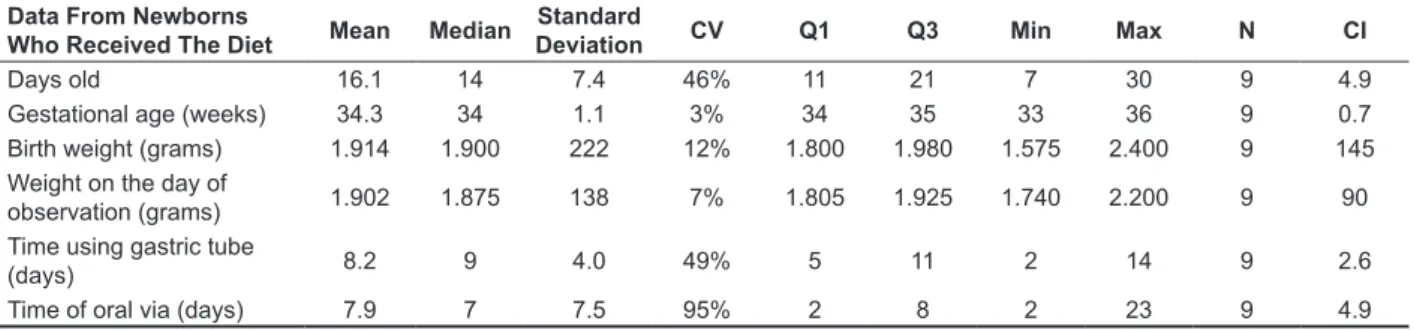
Although, the neonates presented variability in The nine newborns that were ofered the diet
were in gestational age corrected of 34 weeks and
The mothers and the nursing technicians were oriented about the procedures of the research. The mothers agreed with the participation of their son and the technicians agreed to participate by signing the Consent Form.
It was included technicians of the unit cited, who worked with preterm newborns speciically ofering the diet. The newborns must necessarily receive
diet oral via.
The neonatal unit has four inirmaries, total of 40 beds, divided according to the gravity of newborn’s condition and the assistance required. The obser
-vation was performed in the inirmary attending low risk newborns and mothers – clinically stable, composed of 14 beds.
In this unit, the nursing technician attend most of the time the hospitalized newborn and are respon
-sible for ofering the diet at mother’s absence. A total of 34 technicians are deined by scale. In the inirmary where the study was conducted, two technicians are responsible for the 14 beds during a 12-hour shift. However, not all the technicians attend all the inirmaries in the unit.
First, the sample deined 32 subjects to be observed in the unit, considering sample error of 5% and conidence level of 95%. Though, during the data collection only 18 technicians were deined to work in this unit and only 15 agreed in participate and signed the authorization.
In Table 1 is demonstrated the characteristics of technicians observed. The median of age was 40.3 years old, among 29 and 56, presenting low variability of the sample. Also, the median working time in the hospital was 10.7 years, ranging among 0.25 and 30 years, however, the analysis indicated a heterogenic sample concerning this aspect. newborn a safe method of artiicial feeding17,18 until
they are ready to perform exclusive breast feeding. The caregivers (health professionals or mothers) need to be guided in relation to the correct feeding using the cup technique. Orientations about handling the cup, milk volume and proper position of the baby to receive the diet are important and the success of the technique will depend on the information given to them19.
A study evaluated mothers handling the cup and analyzed the aspects that interfere on the technique. From a sample of 30 binomial mother/ son, chart analysis and observation of mothers ofering the diet in a cup, the results presented there is signiicant relation in baby’s posture, cup position, milk volume and health professional’s directions to mothers about using the cup. The authors conclude the cup can be handled by mothers, but they need direction about paying attention in cup position and milk volume19.
Therefore, this study aimed to verify if knowing the technique of ofering the diet in a cup, receive training and the working time of caregivers had inluence on technician posture, newborn posture and cup position.
METHODS
The research was submitted and approved by the Committee of Ethics in Research with Humans of the São Lucas School, under protocol number 262.865/2013.
It was an observational, descriptive and trans
-versal study, developed in public neonatal unit that provide interventions to high risk pregnant women, considered as reference in the ield.
Table 1 – Descriptive data from the nursing technician that ofered the diet
Nursing
Technician Data Mean Median
Standard
Deviation CV Q1 Q3 Min Max N CI
Age 40.3 37 10.5 26% 31.5 50.5 29 56 15 5.3
Working time in the
community 10.7 7 10.9 102% 3.0 15.0 0.25 30 15 5.5
Table 2 – Descriptive data from newborns who received the diet ofered by nursing technician
Data From Newborns
Who Received The Diet Mean Median
Standard
Deviation CV Q1 Q3 Min Max N CI
Days old 16.1 14 7.4 46% 11 21 7 30 9 4.9
Gestational age (weeks) 34.3 34 1.1 3% 34 35 33 36 9 0.7
Birth weight (grams) 1.914 1.900 222 12% 1.800 1.980 1.575 2.400 9 145
Weight on the day of
observation (grams) 1.902 1.875 138 7% 1.805 1.925 1.740 2.200 9 90
Time using gastric tube
(days) 8.2 9 4.0 49% 5 11 2 14 9 2.6
Time of oral via (days) 7.9 7 7.5 95% 2 8 2 23 9 4.9
Subtitle: CV = coeicient of variation; Q1 = irst quartile; Q3 = third quartile; Min = minimum value; Max = maximum value; N = number of subjects; CI = conidence interval
First, it was developed data collection from newborns’ charts, in which: gestational age, birth weight, weight during data collection and the time getting feeding oral via. Next, the technicians were questioned about the time they work in the insti
-tution, about their previous knowledge about the technique and training.
The material used was adapted from the protocol of observing the diet19, composed by three parts:
(1) newborns characteristics (birth date, correct
gestational age, birth weight, current weight, time using gastric tube and time receiving diet oral via); (2) questions to the nursing technician responsible for ofering the diet (age, working time, previous knowledge of the technique, training for executing the technique); and (3) observation of the moment of ofering the technique (place of feeding, newborn’s posture, technician posture, cup position).
The technician was only observed in the absence of the mother so the breast feeding was
not discouraged.
After collecting data, it was developed the following analysis: relation among – the technique knowledge, training and working time- to technician posture, newborn posture and cup position.
It was deined for this study the statistical signii
-cance level of 0.05 and it was applied the Equality of Two Proportions Test, Chi-Square Test and Kruskal-Wallis Test.
RESULTS
After the observation of the 15 nursing techni
-cians, it was veriied that most of them, 11 subjects, declared do not know the technique, a signiicant
diference (p=0.011). Regarding the capacitating training to proper apply this technique, nine subjects received and six was not trained (p=0.273).
It was observed three aspects: (1) technician posture (whether the diet was ofer sat down and aligned or standing); (2) cup position (placed on lower lip, milk touching lower lip, milk poured into oral cavity and leakage of milk during ofer); and (3) newborn posture (inclined in 40o on techni-cian’s arms, inclined 40o on the crib and newborns’ occipital and cervical regions supported).
The Equality of Two Proportions Test was applied to analyze the distribution to each of the three aspects cited above of the frequency relative of actions performed by subjects.
Regarding the irst aspect, it was veriied that professionals ofered the diet standing (p=0.01). There was diference between pouring milk into child’s oral cavity (n=10/66, 7%) and the cup properly positioned on lower lip (n=10/66, 7%) and milk touching lower lip (n=03/20%) (p=0,010); as between pouring milk into child’s oral cavity (n=10/66, 7%) and milk touching lower lip (n=03/20%) (p-value = 0.001). At last, newborns’ posture indicated they are positioned with occipital and cervical regions supported (n=15/100%), with signiicant diference since the inclination in technician arms at 40 degrees do not occurred (n=03/20%) (p-value = 0,001).
Table 3 presents the relation among knowing the technique, training and technician posture, newborn posture and cup position. There is no relation among the variables analyzed.
mother and baby posture and the cup position were positively inluenced by these orientation19.
It is a simple technique, easy to be executed, but it needs capacitation, since the baby is considered overall and not only the oral cavity. The child need to be organized, in correct posture, calm, in other words, there is a speciic way to ofer the cup9,19-22.
Literature brings that feeding preterm newborns
DICUSSION
The proposals of this study was to verify if knowing the technique of ofering the diet in a cup, training and the working time had inluence on nursing technician posture, newborns posture and cup position.
It was observed the most of the technician
Table 3 – Relation between technique knowledge, training developed and the nursing technician posture, newborn posture and body position
Technique Knowledge Training development
Nursing Technician posture
Yes % No % Yes % No %
Sit and aligned 1 33% 2 67% 0 0% 3 100%
Standing 3 25% 9 75% 6 50% 6 50%
Total 4 27% 11 73% 6 40% 9 60%
p Value 0.770 0.114
Newborn posture
Inclined in 40°in technician
arms 1 33% 2 67% 0 0% 3 100%
Inclined a 40° in the crib 3 25% 9 75% 6 50% 6 50%
Newborns’ occipital and
cervical regions supported 4 27% 11 73% 6 40% 9 60%
Total 8 27% 22 73% 12 40% 18 60%
p Value 0.958 0.287
Cup position
Positioned on lower lip 1 33% 2 67% 0 0% 3 100%
Milk in contact with lower lip 0 0% 2 100% 1 50% 1 50%
Milk poured in oral cavity 3 30% 7 70% 5 50% 5 50%
Leakage during ofer 2 29% 5 71% 4 57% 3 43%
Total 6 27% 16 73% 10 45% 12 55%
p Value 0.838 0.394
Statistic Test: Chi-square Test Subtitle: % = relative value p Value = 0.05
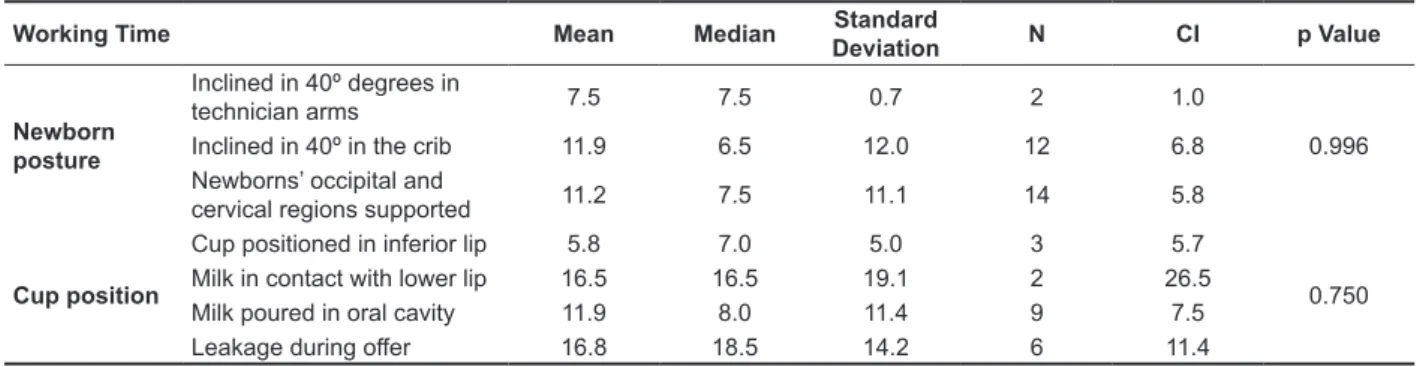
Table 4 – Relation between working time and newborn posture and body position
Working Time Mean Median Standard
Deviation N CI p Value
Newborn posture
Inclined in 40º degrees in
technician arms 7.5 7.5 0.7 2 1.0
0.996
Inclined in 40º in the crib 11.9 6.5 12.0 12 6.8
Newborns’ occipital and
cervical regions supported 11.2 7.5 11.1 14 5.8
Cup position
Cup positioned in inferior lip 5.8 7.0 5.0 3 5.7
0.750
Milk in contact with lower lip 16.5 16.5 19.1 2 26.5
Milk poured in oral cavity 11.9 8.0 11.4 9 7.5
Leakage during ofer 16.8 18.5 14.2 6 11.4
Newborn’s position was proper, in other words, professionals can realize how the child remain better organized and they have concerning in maintaining them aligned. The proper body alignment will promote child to have a better breathing rhythm, leading to coordinating functions as sucking, breathing and swallowing. Therefore, the body alignment should be the key to obtain the ideal position to feeding30.
As a result, cup handling and milk volume are essentials to succeed in the proper diet ofer, mainly regarding baby posture19.
It is not inluent actions to know the technique, training and working time. Thus, postures and cup position do no sufer inluence from professionals, as tables 3 and 4 presented.
Very often, due to the overload imposed by labor routine, the nursing team attends a mechanical and technical assistance, not relexive, forgetting to perform a humane care31. According to the Ministry of Health, humanization works as one of the principles to be followed on behalf of quality assis -tance32, since the technique itself do not guarantee cares to be well applied.
It is considered as a limitation of this study the number of professionals observed, such as the hours of observation. It is believed that a variation on the results may occur according to work hours, for example, in weekends, night shifts and end of shifts.
CONCLUSION
The results from observing the technicians conclude that the diet is ofered with the technician standing, it is poured into baby’s oral cavity and there is no inluence in newborn, technicians or the cup position from knowing the technique, training or working time.
Regarding technician posture, it was veriied the professional ofered the diet standing. It is known that milk administration in a cup should be performed as following: the caregiver should hold the baby in attention state, snuggling them with a sheet so the milk is not spread by superior limbs movement. The baby should be sat or semi sat on caregiver lap19,20,23,24.
The nursing technician position of standing in the occasion of observation is justiied by an infection outbreak in this unit. To control the infection and contamination it was suggested some standard procedures, in which ofering milk to newborns in their cribs. Thus, there was a minimization of physical contact. However, it is questionable if these procedures should be considered as labor routine.
It cannot be ignored, however, the fact that most of the health institutions do not care about the ergonomics of the installations and equipment, making the nursing labor harder and exhaustive. There are some diiculties to be deal with as inade
-quate physical and material structure to the type of service and professionals’ workload25.
In cup position the frequent observation was pouring milk into child’s oral cavity. To use this instrument, it is recommended to be place on baby’s lower lip, inclining so the milk touches their lower lips, waiting to baby suck the milk, sipping it and then swallow it. It is not necessary to pour the milk into baby’s mouth20-23. The literature refers, for the success of the diet administration in a cup, it is important the proper position, since the inadequate position of the cup can provoke alteration in the rhythm of sipping the milk, long pauses and preterm leakage of milk19,26,27.
RESUMO
Objetivo: veriicar se o conhecimento da técnica de oferta da dieta pelo copo, o recebimento de
treinamento e o tempo de trabalho inluenciam a postura do técnico de enfermagem, a postura do recém-nascido e o posicionamento do copo. Métodos: trata-se de um estudo observacional, descri
-tivo, transversal, do qual participaram 15 proissionais, técnicos de enfermagem responsáveis pela administração da dieta às crianças, no momento do oferecimento do leite pelo copo, na ausência da genitora. Foi deinido nível de signiicância estatística de 0,05. Resultados: apenas nove indivíduos
foram treinados (p=0,273) e 11 referiram não ter conhecimento da técnica (p=0,011). O oferecimento da dieta ocorreu em pé (p=0,001), com o derramamento do leite na boca da criança (p=0,010), sendo posicionada com as regiões occipital e cervical apoiadas (p-valor = 0,001). Não houve associação entre o conhecimento da técnica, recebimento de treinamento, tempo de trabalho às variáveis pos
-tura do técnico de enfermagem, pos-tura do recém-nascido e posicionamento do copo. Conclusão: a
postura de oferta da alimentação é realizada em pé, há derramamento da dieta na cavidade oral do bebê e não há inluência das posturas do neonato, do técnico ou do copo por conta do conhecimento da técnica, realização de treinamento e tempo de trabalho.
DESCRITORES: Recém-Nascido; Aleitamento Materno; Prematuro; Leite Humano; Métodos de
Alimentação
REFERENCES
1. Lima GMS. Métodos especiais de alimentação: copinho-relactação-translactação. In: Rego JD. Aleitamento materno. São Paulo: Atheneu, 2002. P.
265-78.
2. López CP, Chiari BM, Guedes ZCF, Goulart AL, Kopelman BI. A utilização do copo na complementação do aleitamento materno: considerações fonoaudiológicas. In: Hernandez AM, organizadora. Conhecimentos gerais para atender bem o neonato. São José dos Campos:
Pulso; 2003. P. 107-11.
3. Coutinho SB, Figueiredo CSM. Métodos especiais de alimentação: copinho-relactação-translactação. In: Rego JD. Aleitamento materno. São Paulo:
Atheneu, 2002. P. 205-16.
4. Medeiros AMC, Bernardi AT. Alimentação do recém-nascido pré-termo: aleitamento materno, copo e mamadeira. Rev Soc Bras Fonoaudiol.
2011;16(1):73-9.
5. Ideriha PN, Limongi SCO. Avaliação eletromiográica da sucção em bebês com síndrome de Down. Rev Soc Bras Fonoaudiol.
2007;12(3):174-83.
6. Alves AML, Silva EHAA, Oliveira AC. Desmame precoce em prematuros participantes do Método
em unidades de terapia intensiva neonatal. Rev
CEFAC. 2004;6(4):382-7.
8. Neiva FCB, Cattoni DM, Ramos JLA, Issler H. Desmame precoce: implicações para o desenvolvimento motor-oral. J Pediatr.
2003;79:7-12.
9. Gutierrez L, Delgado SE, Costa AP. Caracterização do uso da técnica do copo em UTI neonatal de um hospital público. Rev Bras Crescimento Desenvolv Hum. 2006;16(1):22-31.
10. Gamburgo LJL, Munhoz SRM, Amstalden LG. Alimentação do recém-nascido: aleitamento natural, mamadeira e copinho. Fono Atual.
2002;5(20):39-47.
11. Mascarenhas CF, Moraes LMP, Furtado Filho
JM, O conhecimento das mães acerca do uso de chupetas e mamadeiras e suas possíveis conseqüências para a saúde das crianças. Pediatria
atual. 2002;15(7):34-42.
12. Lang S, Lawrence CJ, Orme RL. Cup feeding: an alternative method of infant feeding. Arch Dis
Child. 1994;71(4):356-9.
treinamento: manual do participante. São Paulo: Secretaria do Estado da Saúde; 1990.
25. Haddad MCL. Qualidade de vida dos proissionais de enfermagem. Rev. Espaço para a Saúde. 2002;1(2):75-88.
26. Thorley V. Cup feeding: problems created by incorrect use. J Hum Lact. 1997;13(1):54-5.
27. Rocha NM, Martinez FE, Jorge SM. Cup or bottle for preterm infants: efects on oxygen saturation, weight gain, and breastfeeding. J Hum
Lact. 2002;18(2):132-8.
28. Dowling DA, Meier PP, Diiore JM, Blatz MA, Martin RJ. Cup-feeding for preterm infants: mechanics and safety. J Hum Lact. 2002;18:13-20. 29. Nascimento MBR, Issler H. Aleitamento materno em prematuros: manejo clínico hospitalar.
2004;80(5):163-72.
30. Val DC, Limongi SCO, Flabiano FC, Silva KCL. Sistema estomatognático e postura corporal na criança com alterações sensório-motoras. Pró-Fono
R Atual Cient. 2005;17(3):345-54.
31. Collet N, Rozendo CA. Humanização e trabalho na enfermagem. Rev Bras Enferm.
2003;56(2):189-92.
32. Brasil. Ministério da Saúde. Manual do Programa Nacional de Humanização da Assistência Hospitalar-PNHAH. Brasília: Ministério da Saúde;
2002.
16. Gupta A, Khanna K, Chattree S. Cup feeding: an alternative to bottle feeding in a neonatal intensive care unit. J Trop Pediatr. 1999;45(2):108-10.
17. Corrêa CRH, Franco FCP. Técnica do copinho: uma alternativa para evitar o desmame precoce [dissertação]. Curitiba (PR): Universidade Federal do Paraná; 2001.
18. Aquino RR, Osorio MM. Alimentação do recém-nascido pré-termo: Métodos alternativos de transição da gavagem para o peito materno. Rev Bras Saúde Matern Infant. 2008;8(1):11-6.
19. Lima VP, Melo AM. Uso do copinho no alojamento
canguru. Rev CEFAC. 2008;10(1):126-33.
20. Couto DE, Nemr K. Análise prática da técnica do copinho em hospitais amigos da criança nos
estados do Rio de Janeiro e São Paulo. Rev CEFAC. 2005;7(4):448-59.
21. Silva ACMG, Alencar KPC, Rodrigues LCB, Perillo VCA. Alimentação do prematuro por meio do copo. Rev Soc Bras Fonoaudiol. 2009;14(3):387-93. 22. Lima GMS. Aleitamento materno em situações especiais. In: Rego JD. Aleitamento: um guia para pais e familiares.São Paulo: Atheneu: 2002.P.
53-78.
23. Samuel P. Cup feeding: how and when to use it with term babies. Pract Midwife. 1998;1(12):33-5. 24. Word Health Organization – WHO, UNICEF. Aconselhamento em amamentação: um curso de
Received on: November 11, 2014 Accepted on: January 09, 2015
Mailing address:
Viviane Castro de Araújo
Rua Guiana, 3021, apto 303, Bairro Embratel Porto Velho – RO – Brasil
CEP: 76820-749