The Brazilian Journal of
INFECTIOUS DISEASES
w w w . e l s e v i e r . c o m / l o c a t e / b j i d
Original article
Chloroquine sensitizes biofilms of
Candida albicans
to
antifungal azoles
Ravikumar Bapurao Shinde, Jayant Shankar Raut, Nitin Mahendra Chauhan,
Sankunny Mohan Karuppayil
∗School of Life Sciences, SRTM University, Nanded, MS 431606, India
a r t i c l e
i n f o
Article history: Received 26 July 2012 Accepted 1 November 2012 Available online 18 April 2013
Keywords: Antifungal Biofilm Candida albicans Combination Chloroquine Drug resistance
a b s t r a c t
Biofilms formed byCandida albicans, a human pathogen, are known to be resistant to
differ-ent antifungal agdiffer-ents. Novel strategies to combat the biofilm associatedCandidainfections
like multiple drug therapy are being explored. In this study, potential of chloroquine to be a partner drug in combination with four antifungal agents, namely fluconazole,
voricona-zole, amphotericin B, and caspofungin, was explored against biofilms ofC. albicans. Activity
of various concentrations of chloroquine in combination with a particular antifungal drug was analyzed in a checkerboard format. Growth of biofilm in presence of drugs was analyzed by XTT-assay, in terms of relative metabolic activity compared to that of drug free control. Results obtained by XTT-metabolic assay were confirmed by scanning electron microscopy. The interactions between chloroquine and four antifungal drugs were determined by calcu-lating fractional inhibitory concentration indices. Azole resistance in biofilms was reverted
significantly (p< 0.05) in presence of 250g/mL of chloroquine, which resulted in inhibition
of biofilms at very low concentrations of antifungal drugs. No significant alteration in the sensitivity of biofilms to caspofungin and amphotericin B was evident in combination with chloroquine. This study for the first time indicates that chloroquine potentiates anti-biofilm activity of fluconazole and voriconazole.
© 2013 Elsevier Editora Ltda. All rights reserved.
Introduction
Ability ofCandida albicansto exist in sessile community form
provides tolerance to stress conditions.1Formation of
commu-nity growth is initiated by surface induced gene expression.2
Adhesion of cells to tissue surfaces or solid surface of pros-theses in the patient’s body activates cellular events leading
to formation of biofilms.3Biofilms are drug resistant growth
forms which pose a serious threat to immunocompromised
∗ Corresponding author at: School of Life Sciences, SRTM University, Nanded MS 431606, India.
E-mail address: [email protected] (S.M. Karuppayil).
patients.4,5 Resistance to various antifungal drugs showed
by C. albicans biofilms is considered as a multi-factorial
phenomenon involving different cellular mechanisms.6,7No
single antifungal antibiotic was found effective against biofilm
related C. albicans infections at low concentrations. Higher
concentrations of the antifungal drugs are not advisable
because of side effects due to toxicity;8hence there is a need
to devise novel anti-biofilm strategies.9Combination of drugs
which act on different cellular targets simultaneously may
offer increased drug efficacy and specificity.10,11Chloroquine
(CQ) has been extensively used against malaria for almost
seventy years.12 CQ is believed to target polymerization of
ferriprotoporphyrine IX (heme moiety) which creates toxic environment inside plasmodial parasite resulting into cell
death.13
Although CQ is used as a first line drug against malaria in many countries like Indonesia, India, Papua New Guinea, Myanmar, Guyana and South America its use has been
suspended due to emergence of CQ-resistant strains of
Plas-modium falciparumas well asP. vivax.14,15Emerging resistance
to CQ has posed a limitation on its antimalarial use; how-ever, efforts are being done to repurpose this molecule for novel therapeutic activities. For example, CQ has been used as an antiretroviral in clinical trials in HIV infected
patients with tumors.16 In a study by Sotelo et al., CQ
was found effective in therapeutics against glioblastoma in
HIV patients.17 CQ was found to possess antifungal
activ-ities against fungal pathogens Cryptococcus neoformans and
Histoplasma capsulatum.18,19 Surprisingly, its effects on the
most common fungal pathogen C. albicans have not been
studied. This study discusses effects of CQ on C. albicans
growth in planktonic and biofilm forms. Efficacy of CQ in combination with four important antifungal drugs, namely fluconazole, voriconazole, amphotericin B, and caspofungin, is tested against planktonic cells, biofilm development as well
as mature biofilms ofC. albicans.
Materials and methods
Cultures and antifungal agents
A standard strain of C. albicans, ATCC 90028, was obtained
from the Institute of Microbial Technology (IMTECH), Chandi-garh, India. Culture was maintained on yeast peptone dextrose
(YPD) agar slants at 4◦C (all the media components were
pur-chased from HiMedia laboratories Pvt. Ltd. Mumbai, India). Antifungal agents Fluconazole (FLC) (Forcan, Cipla Ltd., India), Voriconazole (VOR) (Vonaz, United Biotech Pvt. Ltd., India),
Caspofungin (CSP) (CancidasTM, Merck & Co. Inc., USA),
Amphotericin B (AmB) (Lyka Pharm. Pvt. Ltd., India), and
Chloroquine (CQ) (Lariago®, Ipca Laboratories Ltd., India) were
obtained from local market.
Medium and culture conditions
Activation of culture was done by inoculating a single colony from YPD agar plate into 50 mL YPD broth (yeast extract 1%, peptone 2%, and dextrose 2%) in a 250 mL conical flask. The
flasks were incubated at 30◦C at 100 rpm on an orbital shaking
incubator for 24 h. Cells were harvested by centrifugation at
2000×gand washed thrice with 0.1 M phosphate buffer saline
(PBS), pH 7.4. Final cell number was adjusted to 1×10⁷cells/mL
and used for experiments.
Susceptibility of planktonic cells to antifungal drugs
The susceptibility study was carried out by the standard broth micro dilution method as per CLSI guidelines. Var-ious concentrations of drugs were prepared; FLC was in
the range 128–0.125g/mL, while VOR was between 8g/mL
and 0.015g/mL. Range of concentrations used for CSP and
AmB were 4–0.007g/mL. The concentrations of CQ were
in the range 500–0g/mL. All the drug concentrations were
prepared in RPMI-1640 medium pH 7.0 (with l-glutamine,
without sodium bicarbonate, buffered with 165 mM MOPS; purchased from HiMedia laboratories Pvt. Ltd., Mumbai, India), in the wells of micro plates by double dilution. Wells with-out drug served as a control. Cells were added to each well
to obtain density of 1×10³cells/mL. Plates were incubated
at 35◦C for 48 h and absorbance was read at 620 nm using
a microplate reader (Multiskan EX, Thermo Electron Corp., USA). The lowest concentration of the drugs which caused fifty percentage reduction in the absorbance compared to that of control was considered as minimum inhibitory concentration
(MIC).7
Checkerboard format for determination of FICI
Dilutions of individual drugs and their different combinations were prepared in a checkerboard format. A two dimensional array of serial concentrations of test compounds was used for
preparation of dilutions of the drugs. 100L of the cell
suspen-sion was added to each well and the plates were incubated
at 35◦C. Plates were read spectrophotometrically at 620 nm,
after 48 h of incubation. The FIC Indices were calculated using
following equation:
FIC = FICA+ FICB, where FICA= (MIC ofdrug A in combination/MIC of drug A alone), FICB= (MIC of
drug B in combination/MIC of drug B alone). When the value of
FIC≤0.5 it is the synergism, and when
FIC > 4 it is knownas the antagonism. A
FIC result of >0.5 but≤4 is consideredas indifference.20,21
Biofilm formation
Biofilm formation was carried usingin vitrobiofilm model.7
Briefly, 100L of cell suspension (1×10⁷cells/mL in PBS) was
added to wells of tissue culture grade polystyrene micro plates.
Plates were incubated at 37◦C on an orbital shaker for 90 min
of adhesion phase. All the wells were washed with sterile
PBS to remove non-adhered cells. Two hundredl of
RPMI-1640 medium, pH 7.0, containing various concentrations of the drugs was added to each well. The plates were incubated
at 37◦C at 100 rpm in an orbital shaker for 48 h.
Quanti-tation of growth was done by using XTT-metabolic assay, where the colored end product was read spectrophotometri-cally.
Biofilm quantitation by XTT assay
Biofilm formation was quantitated using XTT [i.e.
2,3-bis
(2-methoxy-4-nitro-sulfophenyl)-2H-tetrazolium-5-carboxanilide] (Sigma–Aldrich, India) reduction assay.7
Briefly, XTT solution was prepared by mixing 1 mg/mL XTT
salt in PBS and stored at−20◦C. Prior to use, menadione
solu-tion prepared in acetone (Sigma–Aldrich, India) was added
to XTT to a final concentration of 4M. The wells containing
biofilms were washed with PBS to remove non-adhered cells
and 100L of XTT-menadione solution was added to it. The
Table 1 – MICs of five antifungal drugs alone and in combination with 250g/mL CQ for planktonic and biofilm growth of C. albicans.
Name of the drug Minimum inhibitory concentration (ing/mL)
Planktonic cells Biofilm development Mature biofilms
Antifungal drug
Antifungal drug + CQ
Antifungal drug
Antifungal drug + CQ
Antifungal drug
Antifungal drug + CQ
FLC 0.5 0.5 NAa(>128) 4 NAa(>128) 4
VOR 0.25 0.125 NA (>8) 0.25 NA (>8) 0.25
CSP 0.125 0.062 0.25 0.25 0.5 0.25
AmB 0.125 0.062 0.5 0.125 1 0.5
FLC, fluconazole; VOR, voriconazole; CSP, caspofungin; AmB, amphotericin B; CQ, chloroquine.
a NA, Not achieved up to highest concentration tested. Comparison of MICs of the drugs alone and in combination with CQ indicates either
indifference or synergism in the combination.
Intensity of the colored formazan end product was measured at 450 nm using a micro plate reader. Wells without biofilms served as a blank.
Microscopic analysis of biofilms
Biofilms were observed under an inverted light microscope (Metzer, India). Photographs were taken by a Labomed microphotography system (Labomed, Mumbai, India). For scanning electron microscopy (SEM), samples were fixed in 2.5% glutaraldehyde in 0.1 M phosphate buffer (pH 7.2), for
24 h at 4◦C. Samples were post-fixed in 2% aqueous solution
of osmium tetraoxide for 4 h, then dehydrated in a series of graded alcohols and finally dried to a critical drying point with a Critical Point Dryer unit. The samples were mounted over stubs, and gold coating was performed using an automated gold coater (model JOEL JFC-1600) for 3 min. Photographs were taken under a scanning electron microscope (model JOEL-JSM
5600).7
Results
Susceptibility of planktonic growth of C. albicans to various antifungal drugs and their combinations with chloroquine
Planktonic growth of C. albicans was susceptible to
differ-ent antifungal drugs at varying concdiffer-entrations. MICs of FLC,
VOR, AmB, and CSP were found at 0.5g/mL, 0.25g/mL,
0.125g/mL and 0.25g/mL, respectively (Table 1).
Chloro-quine did not show any significant effect on growth of C. albicans and MIC was observed at 1 mg/mL. No signifi-cant decrease in MICs of two azoles, FLC and VOR could be observed when cells were treated in combination with various concentrations of CQ. FIC indices for combination
of 250g/mL concentration of CQ with azole drugs were
found to be >0.5. Similar observations were noted for CQ-AmB interactions indicating no significant reduction in the MIC of AmB. Addition of CQ could not lower down the CSP
concentration required to inhibit growth of C. albicans. It
was evident with the FIC index of 0.74 for this combination (Table 1).
CQ-azole combination inhibits biofilm formation by C. albicans
FLC and VOR alone were ineffective against biofilm formation.
No significant inhibition ofC. albicansbiofilm development
could be obtained even at high concentrations of FLC and
VOR,i.e.128 and 8g/mL, respectively. This indicated
resis-tance toward the azole drugs. After combination with CQ, concentrations of FLC and VOR required to inhibit biofilms were lowered down dramatically. Various CQ-FLC combina-tions were found to effectively inhibit biofilm development in C. albicansat 2–8g/mL. For example, addition of 250g/mL of
CQ resulted in inhibition of biofilm development at 4g/mL of
FLC. Similarly, CQ-VOR was also effective and MIC of VOR for
formation ofC. albicansbiofilms was achieved at 0.25g/mL
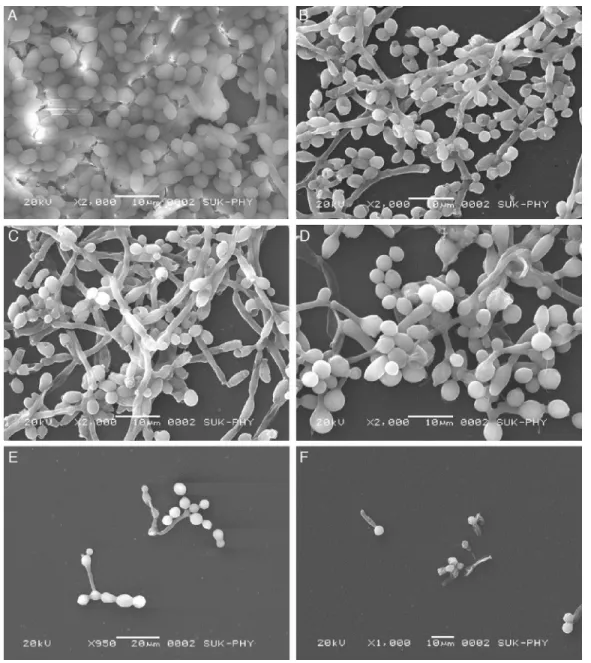
(Fig. 1A and B). FIC indices for CQ-FLC and CQ-VOR combina-tions against biofilm development were found to be 0.156 and 0.187, respectively, indicating synergistic activity. Results of biofilm inhibition analyzed by XTT metabolic assay were con-firmed by light as well as electron microscopy. Control without drug exhibited typical biofilm structure consisting of dense network of filamentous forms and yeast cells attached to the solid surface (Fig. 2A). Although cell density was less, normal biofilms were observed in presence of CQ, FLC and VOR alone (Fig. 2B, C and D, respectively). No biofilm growth was observed in presence of FLC-CQ combination (Fig. 2E). Similarly, VOR-CQ treatment resulted in inhibition of biofilms and only few yeast cells were found adhered to the surface (Fig. 2F). The
MIC of AmB for biofilm development was at 0.5g/mL, which
was fourfold more than that of planktonic MIC. When
com-bined with 250g/mL of CQ the effective AmB concentration
was 0.5g/mL. The FIC index of 1.126 for this combination
indicated indifference activity in combination. Similarly,
com-bination of CQ with CSP exhibited no change in the MIC forC.
albicansbiofilm development (Table 1). FIC index of 0.621 for CQ-CSP was indicative of additive effect.
Combination with CQ sensitizes mature biofilms of C. albicans to azole drugs
Mature biofilms of C. albicanswere highly resistant toward
activity of FLC and VOR. MICs were not achieved even at very
120
100
80
60
40
20
0 0 0.5
Conc of FLC (µg/ml)
% Biofilm formation
1 2 4 8 16 32
120
100
80
60
40
20
0
0 0.031 0.062 0.125 0.25 0.5 1 2
120
100
80
60
40
20
0 120
100
80
60
40
20
0
0 0.5 1 2 4 8 16 32 0 0.031 0.062 0.125 0.25 0.5 1 2
Conc of VOR (µg/ml)
Conc of FLC (µg/ml)
FLC alone FLC+250 µg/ml CQ
FLC+500 µg/ml CQ FLC+125 µg/ml CQ FLC alone
FLC+250 µg/ml CQ
FLC+500 µg/ml CQ FLC+125 µg/ml CQ
Conc of VOR (µg/ml)
% Biofilm % Biofilm
% Biofilm formation
A B
C D
VOR alone VOR+250 µg/ml CQ
VOR+500 µg/ml CQ VOR+125 µg/ml CQ
VOR alone VOR+250 µg/ml CQ
VOR+500 µg/ml CQ VOR+125 µg/ml CQ
Fig. 1 – Activity of FLC and VOR antifungal drugs alone and in combination with CQ, against biofilm development and mature biofilms ofC. albicans(ATCC 90028). Percentage of growth was analyzed by comparing relative metabolic activity
(RMA) obtained through XTT metabolic assay. (A) FLC-CQ against biofilm development; (B) VOR-CQ against biofilm development; (C) FLC-CQ against mature biofilms; (D) VOR-CQ against mature biofilms.
When 250g/mL of CQ was added to the mature biofilms, MIC
of FLC was obtained at 4g/mL. This indicated effective
com-bination, with FIC index of 0.25. Combination of CQ with VOR resulted in inhibition of mature biofilms at concentrations as
low as 0.25g/mL (Fig. 1C and D). The FIC index for CQ-VOR
combination was calculated to be 0.187. AlthoughC. albicans
biofilms were found sensitive to AmB and CSP, it required high concentrations. When combined with CQ, twofold decrease in the effective concentrations of AmB and CSP was observed (Table 1). The FIC indices for CQ-AmB and CQ-CSP drug com-binations were 0.496 and 0.366, which are considered to exert synergistic effect.
Discussion
Infections associated with biofilms ofC. albicansis a serious
problem in immune-compromised population.1Novel
strate-gies for prevention and treatment of drug resistant biofilms are required urgently. Various reasons have been proposed
to be responsible for the antifungal resistance ofC. albicans
biofilms.6 Factors like extracellular polymer, overexpression
of drug efflux pumps may contribute to the drug resistance.22
Combination of drugs with different mode of action may inhibit multiple cellular targets and hence would be a good strategy against biofilms. Combinatorial approach against
planktonic form of C. albicans has been studied and was
found promising; however, only limited studies are available
on biofilms.23Our study is of significance as CQ combination
with various antifungal drugs is studied in planktonic as well
as biofilm growth forms. No significant change in MICs of
anti-fungal drugs for planktonic growth ofC. albicanswas noted
in presence of CQ, suggesting no synergistic activity against planktonic growth. Biofilm formation and mature biofilms were found resistant to the azoles, FLC and VOR (Table 1). While higher concentrations of CSP and AmB were required for preventive activity against biofilms than that of plank-tonic growth. Resistance to FLC and increased tolerance to VOR exhibited by early phase biofilms was totally reverted by the addition of CQ and biofilm formation became several folds more sensitive to these drugs. Similarly, mature biofilms which were resistant to azoles were found to be susceptible to these drugs in presence of CQ. Results of the study suggest that CQ can be developed as a promising partner molecule for combination therapy against biofilm. Although very effective with FLC and VOR, presence of CQ did not have significant synergism with CSP and AmB. No alteration in the sensitiv-ity of developing as well as mature biofilms to CSP and AmB was evident in combination with CQ. Reasons behind syn-ergistic activity only with two azoles need to be elucidated. Phase specific events are reported to be responsible for azole
resistance in biofilms ofC. albicans. Activation of drug efflux
pumps in early phases and low membrane ergosterol content in mature phases of biofilms was found to play a major role
in fluconazole resistance.6Earlier workers have reported that
CQ inhibits cholesterol synthesis in Wistar rats.24 In
Fig. 2 – Scanning electron micrographs of FLC and VOR antifungal drugs alone and in combination with CQ, against biofilm development ofC. albicans(ATCC 90028). (A) Control; (B) CQ alone 250g/mL; (C) FLC alone (128g/mL); (D) VOR alone
(8g/m); (E) 4g/mL FLC + 250g/mL CQ; (F) 0.25g/mL + 250g/mL CQ.
of parasite resulting in its inhibition.24 A study of
Saccha-romyces cerevisiaeshowed that CQ inhibited the yeast growth
by iron deprivation.25Similar effects of CQ inC. albicansmay
potentiate FLC and VOR against biofilm growth form. However, the exact mechanism remains to be elucidated. In summary, thisin vitrostudy gives insight into use of CQ-azole
combi-nation against biofilms in C. albicans. The antifungal drugs
FLC and VOR are commonly prescribed against candidiasis, as such reduction in their effective dosages after combination with CQ may be of wide interest. However, to confirm the
util-ity of these drug combinations in clinics,in vivostudies are
necessary.
Conflict of interest
The authors declare to have no conflict of interest.
Acknowledgement
RBS is thankful to ICMR, New Delhi, for fellowship provided to him under ICMR-SRF program (file no. 80/607/2008/ECD-I).
r e f e r e n c e s
1. Ramage G, Martinez JP, Lopez-Ribot JL. Candida biofilms on implanted biomaterials: a clinically significant problem. FEMS Yeast Res. 2006;6:979–86.
2. Kumamoto CA, Vinces MD. AlternativeCandida albicanslife
styles: growth on surfaces. Annu Rev Microbiol. 2005;59:113–33.
Candida albicans: development, architecture and drug resistance. J Bacteriol. 2001;183:5385–94.
4. Jabra-Rizk MA, Falkler WA, Meiller TF. Fungal biofilms and drug resistance. Emerg Infect Dis. 2004;10:14–9.
5. Aparna MS, Yadav S. Biofilms: microbes and disease. Braz J Infect Dis. 2008;12:526–30.
6. Nett JE, Sanchez H, Cain MT, Andes DR. Genetic basis of Candida biofilm resistance due to drug-sequestering matrix glucan. J Infect Dis. 2010;202:171–5.
7. Shinde RB, Raut JS, Karuppayil SM. Biofilm formation by Candida albicanson various prosthetic materials and its fluconazole sensitivity: a kinetic study. Mycoscience. 2012;53:220–6.
8. Baillie GS, Douglas LJ. Matrix polymers ofCandida albicans
biofilms to antifungal agents. J Antimicrob Chemother. 2000;6:397–403.
9. Mishra NN, Prasad T, Sharma N, et al. Pathogenicity and drug
resistance inCandida albicansand other yeast species a
review. Acta Microbiol Immunol Hung. 2007;54:201–35. 10. Spitzer M, Griffiths E, Blakely KM, et al. Cross-species
discovery of syncretic drug combinations that potentiate the antifungal fluconazole. Mol Syst Biol. 2011;7:499.
11. Scheid LA, Mario DAN, Kubic¸a TF, Santurio JM, Alves SH. In vitro activities of antifungal agents alone and in combination against fluconazole-susceptible and resistant
strains ofCandida dubliniensis. Braz J Infect Dis. 2012;16:78–81.
12. Slater AFG. Chloroquine: mechanism of drug action and
resistance inPlasmodium falciparum. Pharm Ther.
1993;57:203–35.
13. Fitch CD, Chevli R, Kanjananggulpan P, Dutta P, Chevli K, Chou AC. Intracellular ferriprotoporphyrin IX is a lytic agent. Blood. 1983;62:1165–8.
14. Mwai L, Ochong E, Abdirahman A, et al. Chloroquine resistance before and after its withdrawal in Kenya. Malaria J. 2009;8:106.
15. Baird JK. Chloroquine resistance inPlasmodium vivax.
Antimicrob Agents Chemother. 2004;48:4075–83.
16. Savarino A, Lucia MB, Giordano F, Cauda R. Risks and benefits of chloroquine use in anticancer strategies. Lancet Oncol. 2006;7:792–3.
17. Sotelo J, Briceno E, Lopez-Gonzalez MA. Adding chloroquine to conventional treatment for glioblastoma multiforme; a randomized, double-blind, placebo-controlled trial. Ann Intern Med. 2006;144:337–43.
18. Weber SM, Levitz SM, Harrison TS. Chloroquine and the fungal phagosome. Curr Opin Microbiol. 2000;3:349–53. 19. Khan MA, Jabeen R, Nasti TH, Mohammad O. Enhanced
anticryptococcal activity of chloroquine in
phosphatidylserine-containing liposomes in a murine model. J Antimicrob Chemother. 2005;55:223–8.
20. Guo Q, Sun S, Yu J, Li Y, Cao L. Synergistic activity of azoles
with amiodarone against clinically resistantCandida albicans
tested by chequerboard and time-kill methods. J Med Microbiol. 2008;57:457–62.
21. Sun S, Yan L, Guo Q, Shi C, Yu J, Ma L. In vitro interactions
between tacrolimus and azoles againstCandida albicans
determined by different methods. Antimicrob Agents Chemother. 2008;52:409–17.
22. Mateus C, Crow Jr SA, Ahearn DG. Adherence ofCandida
albicansto silicone induces immediate enhanced tolerance to fluconazole. Antimicrob Agents Chemother. 2004;48: 3358–66.
23. Uppuluri P, Nett J, Heitman J, Andes D. Synergistic effect of
calcineurin inhibitors and Fluconazole againstCandida
albicansbiofilms. Antimicrob Agents Chemother. 2008;52:1127–32.
24. Achudume AC. The influence of chloroquine administration on antioxidant levels, oxidant marker and total cholesterol in Wistar rats. Biol Med. 2009;1:39–43.
25. Emerson LR, Nau ME, Martin RK, Kyle DE, Vahey M, Wirth DF. Relationship between chloroquine toxicity and iron
acquisition inSaccharomyces cerevisiae. Antimicrob Agents