Intellectual demand and formal education as
cognitive protection factors in Alzheimer’s disease
José Roberto Wajman
1, Paulo Henrique Ferreira F. Bertolucci
2Abstract – To investigate the possible association between educational level and previous professional occupation, and objective cognitive and functional evaluation in a sample of elderly patients with Alzheimer’s disease. Methods: Through retrospective analysis of medical files, 174 patients with probable Alzheimer disease were randomly selected, classified and submitted to analysis according to previous professional occupation and years of formal education. Results: Subjects with lower education and less intellectually-demanding occupations performed worse than higher educated subjects in all cognitive subtests and on the functional scale. Conclusions:
Results indicate that not only the total years of education, but also professional occupation has an impact on cognition and functioning in accordance with the hypothesis of cognitive reserve. Our findings confirmed this hypothesis, where subjects with higher education/ higher intellectual demand manifested first symptoms later than low education/ low intellectual demand subjects, with the latter group also exhibiting faster disease progression.
Key words: educational level, neuropsychological assessment, Alzheimer’s disease.
Demanda intelectual e escolaridade formal como fatores de proteção cognitiva na doença de Alzheimer Resumo – Analisar as possíveis correlações entre nível educacional e atividade profissional prévia, com dados objetivos de avaliação cognitiva e funcional em uma amostra de idosos com doença de Alzheimer. Métodos:
A partir de análise retrospectiva de prontuário médico foram selecionados aleatoriamente 174 pacientes com provável doença de Alzheimer que foram subdivididos e submetidos a análise conforme sua atividade profissional prévia e nível de escolaridade alcançado formalmente, calculado em anos. Resultados: Em praticamente todos os subtestes cognitivos, além de escala funcional, os participantes do grupo menos escolarizado e profissionais de áreas consideradas menos complexas em relação a demanda intelectual, saíram-se pior quando comparados com grupo mais escolarizados. Conclusões: Não apenas o total acumulado de anos formais concluídos, mas também a atividade profissional previamente exercida parece ter resultado sobre a cognição e funcionalidade à medida que evolui a doença crônico degenerativa, favorecendo assim o conceito de reserva intelectual. Por esta hipótese espera-se retardo no início dos sintomas da doença em pessoas com alta escolaridade/ alta demanda intelectual e, por outro lado, a baixa escolaridade/ baixa demanda intelectual profissional podem estar associadas a início precoce e progressão mais rápida, tanto do ponto de vista cognitivo como funcional.
Palavras-chave: nível educacional, avaliação neuropsicológica, doença de Alzheimer.
1Neuropsychologist, Behavioral Neurology Section. Behavioral Neurology Section, Department of Neurology asnd Neurosurgery, Escola Paulista de
Medicina, UNIFESP; 2Neurologist, Behavioral Neurology Section, Department of Neurology and Neurosurgery, Escola Paulista de Medicina, UNIFESP. José Roberto Wajman – Rua Itapeva, 518 / conj. 401-402 - 01332-000 São Paulo - SP. Brazil. E-mail: [email protected]
Disclosure: The authors report no conflicts of interest.
Received August 22, 2010. Accepted in final form October 22, 2010.
The aging of the human population is a worldwide phenomenon occurring at an ever faster pace. In 1950 there were 204 million elderly people. Five decades later, in 1998, this number had increased to 579 million, with a yearly increase of 8 million elderly. Projections estimate that by 2050 there will be 1900 million elderly, equivalent to the current world population of 14-year-olds. One explanation for this pattern is the worldwide increase since 1950 of 19
years in life expectancy at birth.1 According to forecasts,
there are 21 million elderly in Brazil. Average formal edu-cation for this group is 4.1 years, distributed as follows: no education or less than one year (32.2%); one to three years (19.5%); 4 to 8 years (31.3%); 9 years or above (17.1%).
While several investigations consider literacy (basic ability to read and write) as synonymous to education, the correlation is weak, and often there is discordance between the definition and its meanings.2,3 As an example, in an
investigation involving an elderly population, mean formal education was 12 years, but literacy level was similar to that of 5th grade students.4
“Literacy” and its antonymous “illiteracy” were coined in the thirties in United States and used in Second World War by the American Army to indicate ability to under-stand written instructions necessary to execute military tasks. These expressions have subsequently been used to indicate the pragmatic use of reading and writing in home and work daily settings, often set against academic educa-tion. In some cases, the expression “functional illiteracy” has been used to indicate a status between absolute illit-eracy and partial grasping of rudimentary abilities neces-sary for “survival in industrial societies”.5
The ample dissemination of the expression “functional illiteracy” was due basically to a Unesco action that adopted it in the definition of literacy in 1978 to set a standard for education statistics and education strategies among mem-ber countries. Unesco’s definition of literacy proposed in 1958 referred to the ability to understand written texts or to write a short and simple paragraph on a daily life subject. Twelve years after Unesco indicated another defini-tion, defining literacy as “functional’ when sufficient for adequate integration of a subject into his/her environment, integration which included doing activities for which read-ing, writing or calculation are necessary.
In parallel with these new definitions there was an in-crease in life expectancy and an inin-crease in the group of elderly people with neurological degenerative disorders with functional and cognitive decline.
The main objective of this investigation was to analyze the possible correlation between educational level and pro-fessional activity, and cognitive performance of a sample of Alzheimer disease subjects followed at a dementia out-patient clinic in the city of São Paulo.
Methods
Subjects
A systematic analysis of demographics, clinical data and neuropsychological evaluation of the medical files of 174 elderly people with a diagnosis of probable Alzheimer dis-ease was conducted in accordance with the Research Ethics Committee guidelines. Diagnosis of probable Alzheimer
disease was reached according to DSM-IV criteria.6 All
participants were on medication (class of anticholinestera-sic), without other neurological conditions, psychiatric or cerebrovascular disease history, and were followed at the Behavioral Neurology Section of the Universidade Federal de São Paulo in 2010.
Study design
Subjects included in this study were classified and di-vided into groups according to educational level in formal years and previous professional activity from which they retired and in which they worked longest. Stratification with regard to previous occupation was performed such as into farm work, for any rural activity (cattle raising or vegetable cultivation). Similarly technical jobs at the same level were included in the same group.
For statistical analysis, two groups were compared: Group I – subjects classified as commerce workers, with middle or higher (University) education; Group II – rural and construction workers, and household domestics. After recording gender, age, formal education level and estimated time of disease duration, subjects were submitted to the Clinical Dementia Rating (CDR),7 MMSE8 and specific sub
items of the neuropsychological battery9 (direct and inverse
digit span, total score for immediate recall for three trials of a 10-word list, delayed recall of the same list, naming of 15 drawings from the Boston naming test and verbal fluency for animals).
Statistical methods
Descriptive analysis of all variables was carried out. For quantitative variables this was done using lowest and highest scores, mean and standard deviation. For quali-tative variables, absolute and relative frequencies were calculated. On comparison between groups, normality of data distribution was rejected and the Mann-Whitney non-parametric test10 was therefore used. To test homogeneity
between proportions, the Chi-square test10 or Fisher exact
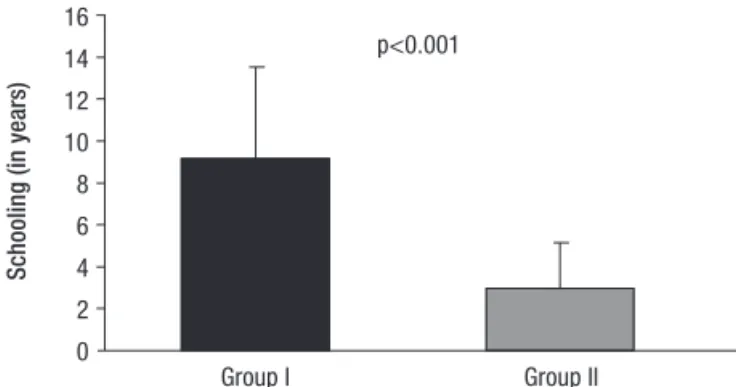
Figure 1. Educational level.
p<0.001 16
14
12
10
8
6
4
2
0
S
ch
o
o
li
n
g
(
in
y
e
a
rs
)
test10 (when expected frequencies were lower than 5) was
used. Significance level was set at 5%.
Results
No difference in age (Group I – 74.35 years; Group II – 74.46 years) was found between the two groups. Differ-ences in education between Groups I and II are shown in Figure 1 and reached significance for Group I (9.10±4.38) vs Group II (2.99±2.13). Comparing this variable with oth-ers revealed a correlation with all tests and with disease duration (Group I – 3.28±1.71; Group II – 2.52±1.35).
Table 1 shows a difference for gender in Group II,
which contained more females, while no difference was seen in Group II.
In terms of demographic and clinical data there was a higher incidence of moderate to moderately-severe disease in Group II (Figure 2). For Group I, most subjects were at an early stage of disease, while for Group II most subjects were at a moderate stage AD.
Table 1. Distribution according to gender, CDR and previous occupation.
Class
Groups
I II
N % N %
Gender F M 25 35 41.7 58.3 85 29 74.6 25.4 CDR 1 2 3 37 20 3 61.7 33.3 5.0 40 56 18 35.1 49.1 15.8 Profession Farming Building Home made House wife Graduation Technical Trading 0 0 0 0 13 15 32 0.0 0.0 0.0 0.0 21.7 25.0 53.3 14 21 22 57 0 0 0 12.3 18.4 19.3 50.0 0.0 0.0 0.0
Table 2. Age, education, disease duration and neuropsychological performance.
Group N Average sd Median Minimo Maximum
Age I II 60 114 74.35 74.46 7.64 6.78 75.00 74.50 57 60 96 94 Schooling I II 60 114 9.10 2.99 4.38 2.13 8.00 4.00 3 0 16 10 Disease duration (in years) I
II 60 114 3.28 2.52 1.71 1.35 3.00 2.00 1 1 10 8 MMSE I II 60 114 20.35 15.96 5.05 5.10 21.00 15.50 6 2 29 27
Span F I
II 60 114 5.47 4.67 1.28 1.23 6.00 5.00 3 0 8 9
Span B I
II 60 114 3.00 1.94 1.15 1.12 3.00 2.00 0 0 6 4 Total list I
II 60 114 10.23 8.00 3.58 4.10 10.00 8.00 2 0 20 17 Evocation I II 60 114 1.05 0.89 1.44 1.34 0.00 0.00 0 0 6 5 SVF I II 60 114 8.63 7.35 3.63 3.07 8.00 7.00 0 1 18 15 Boston 15 items I
II 60 114 11.35 8.89 3.07 3.29 12.00 9.00 2 0 15 15
Figure 2. Disease stage (CDR) for Groups I and II . 0% 10% 20% 30% 40% 50% 60%
70% Group I
Group II p=0.002 CDR 1 61.7% 35.1% 33.3% 49.1% 5.0% 15.8%
Raw scores presented at Table 2 show that except for immediate recall there was a significant difference for all tests, from screening (MMSE) to attention, working mem-ory, and language. Comparisons Group I subgroups (com-merce workers, technical jobs and University graduated people), using Kruskal-Wallis test, showed no difference for neuropsychological performance, CDR and disease duration (Table 3).
Discussion
The relationship between dementia and more specifical-ly, Alzheimer’s disease, and education has been investigated since last decade, with largely concordant results. In line with previous studies,11-14 the findings of this investigation
showed that low education and less cognitively-demanding activities are a significant factor for high incidence and ear-lier manifestation of this disease. By contrast, the combined accumulation of educational experience and use of tively more complex abilities might strengthen the cogni-tive reserve and preserve both cognition and functionality. There are suggestions that early intellectual demand, necessary for formal education and later for professional occupation, may be crucial in the formation of cognitive resources over the long term and these resources may per-sist even following the onset of dementia.15 Evidence
fa-voring this hypothesis is the objective demonstration, using
neuropsychological tests, that those with lower formal edu-cation have more rapid decline following the first symp-toms of dementia.16 This study revealed that, according to
educational level, individuals with more years of formal studies had a delayed onset of symptoms and that ,from diagnosis, cognitive decline was less marked in this group. Despite increasing evidence favoring this hypothesis (for a review see Paradise et al.17), not all less educated
in-dividuals or those working in less demanding activities will have an earlier death, thus indicating that survival might be related to other factors other than cognitive reserve.
Our investigation identified three classes of patients with three different levels of education and activity, that had equivalent education and activity, with regard to first symptoms of dementia and neuropsychological per-formance. However, the authors note that more data are needed to establish which factors are actually protective against early appearance and manifestation of neurode-generative disease, along with studies including specific statistical regression analysis of clinical and sociodemo-graphic variables.
References
1. Instituto Brasileiro de Geografia e Estatística – IBGE. (www. ibge.gov.br).
2. Kirsch US, Jungeblut A, Jenkins L, Kolstad A. Adult Literacy in
Table 3. Group I subgroups comparison.
Profession N Average sd Median Minimo Maximum
Disease duration (in year) Trading Graduation Technical
32 13 15
3.00 3.54 3.67
1.68 1.27 2.06
3 3 3
1 2 2
8 6 10 CDR Trading
Graduation Technical
32 13 15
1.41 1.62 1.33
0.56 0.77 0.49
1 1 1
1 1 1
3 3 2 MMSE Trading
Graduation Technical
32 13 15
20.84 19.62 19.93
5.39 4.37 5.04
21 21 21
6 14
9
29 25 28 Span B Trading
Graduation Technical
32 13 15
3.03 2.69 3.20
1.23 1.18 0.94
3 3 3
0 0 2
6 4 5 Total list Trading
Graduation Technical
32 13 15
10.75 9.46 9.80
3.90 2.73 3.53
10 10 8
2 4 7
19 14 20 SVF Trading
Graduation Technical
32 13 15
8.66 7.69 9.40
3.24 4.42 3.74
8 7 8
3 0 4
15 13 18
America. The National Adult Literacy Survey. National Center for Education Statistics, US Department of Education. Wash-ington DC: US Government Printing Office, 1993.
3. Kozol J. Illiterate America. Garden City, NY: Anchor Press/ Doubleday, 1985.
4. Weiss BD, Red RL, Kligman EK. Literacy skills and comuni-cation methods of low-income older persons. Patient Educ Counseling 1995;43:1523-1528.
5. Castell LS, MacLennan A. On defining Literacy. In. Literacy, Society and Schooling: A reader. Cambridge, Cambridge Uni-versity Press; 1986.
6. American Psychiatric Association. Diagnostic and Statistical Manual of Mental Disorders. 4th edition. Washington:
Ameri-can Psychiatric Association.
7. Hughes CP, Berg L, Danziger WL. A new clinical scale for the staging dementia. Br J Psychiatr 1982;140:566-572.
8. Bertolucci PH, Brucki SM, Campacci SR, Juliano Y. O Mini-exame do estado mental em uma população geral: impacto da escolaridade. Arq Neuropsiquiatr 1994;52:1-7.
9. Morris J, Edland S, Clark C, Galasko D, Koss E, Mohs R, van Belle G, Fillenbaum G, Heiman A. The consortium to estab-lish a registry for Alzheimer’s disease (CERAD). Part IV. Neu-rology 1993;43:2457-2465.
10. Rosner, B. Fundamentals of Biostatistics, Second edition. Bos-ton, PWS Publishers; 1986.
11. Stern Y, Gurland B, Tatemich TK, Tang MX, Wilder D, May-eux R. Influence of education and occupation on the inci-dence of Alzheimer’s disease. JAMA 1994;271:1004-1010. 12. Cobb JL, Wolf PA, Au R, White R, D’Agostino RB. The effect of
education on the incidence of dementia and Alzheimer’s dis-ease in the Framingham Study. Neurology 1995;45:1707-1712. 13. Qiu C, Backman L, Winblad B, Aguero-Torres H, Fratiglione
L. The influence of education on clinically diagnosed demen-tia incidence and mortality data from the Kungsholmen Proj-ect. Arch Neurol 2001;58:2034-2039.
14. Scarmeas N, Levy G, Tang M-x, Manly J, Stern Y. Influence of leisure activity on the incidence of Alzheimer’s disease. Neu-rology 2001;57:2236-2242.
15. Gatz M, Prescott CA, Pedersen NL. Lifestyle risk and delaying factors. Alzheimer Dis Assoc Disord 2006;20:S84-S88. 16. Hall CB, Derby C, LeValley A, Katz MJ, Verghese J, Lipton RB.
Education delays accelerated decline on a memory test in per-sons who develop dementia. Neurology 2007;69: 1657-1664. 17. Paradise M, Cooper C, Livingston G. Systematic review of