*e-mail: [email protected], [email protected]
Erosion-Oxidation Behavior of Thermal Sprayed Ni20Cr
Alloy and WC and Cr
3C
2Cermet Coatings
Clarice Terui Kunioshi*, Olandir Vercino Correa, Lalgudi Venkataraman Ramanathan*
Corrosion Laboratory, Instituto de Pesquisas Energéticas e Nucleares, IPEN/SP P.O. Box 11049, Pinheiros, 05422-970 São Paulo, Brazil
Received: November 23, 2003; Revised: February 26, 2005
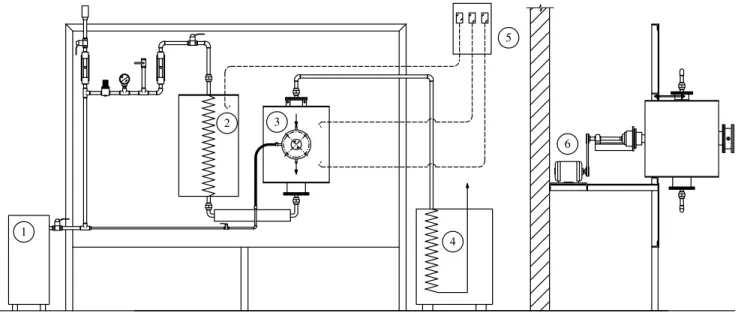
An apparatus to conduct high temperature erosion-oxidation studies up to 850 °C and with particle impact velocities up to 15 m.s-1 was designed and constructed in the Corrosion Laboratories of IPEN. The erosion-oxidation
behavior of high velocity oxy fuel (HVOF) sprayed alloy and cermet coatings of Ni20Cr, WC 20Cr7Ni and Cr3C2Ni20Cr on a steel substrate has been studied. Details of this apparatus and the erosion-oxidation behavior of these coatings are presented and discussed.
The erosion-oxidation behavior of HVOF coated Cr3C2 25(Ni20Cr) was better than that of WC 20Cr7Ni, and the erosion-oxidation regimes have been identified for these coatings at particle impact velocity of 3.5 m.s-1,
impact angle of 90° and temperatures in the range 500 to 850 °C.
Keywords:erosion, oxidation, high temperature, composite coatings, HVOF
1. Introduction
Industrial components in gas turbine engines, fluidized bed combustors and catalytic converters are often subject to the conjoint effect of erosion and high temperature oxidation processes. Adequate characterization of high temperature erosion-oxidation behavior of materials involves the reproduction of process conditions such as temperature, impacting particle parameters such as size, shape, hardness, velocity, impact angle and mechanical properties as well as physical properties of the target material. The erosion behavior of metallic materials and ceramics at room temperature has been extensively studied1-4. Nevertheless, a number of questions
regard-ing correlations between erosion properties and physical parameters of the material remain unanswered. A vast amount of information is available about the oxidation behavior of various metals and alloys at high temperatures5. However, only limited information is available
about the conjoint effect of erosion and oxidation at high temperatures. The results of some of the erosion-oxidation studies demonstrate that synergy is observed between erosion and oxidation. This indicates that the degradation caused by erosion-oxidation can be greater than the sum of the processes operating separately6-10. It has also been
mentioned that in some cases the formation of a corrosion product can inhibit erosion11; or the wastage rate under erosion-oxidation
conditions can be less than in the absence of oxidation. These contrary observations have generated much attention about erosion-oxidation processes in recent years.
Hogmark et al. first described erosion-oxidation interactions in terms of regimes in 198312. Kang et al.13 in 1985 argued that four
regimes existed, based on erosion-oxidation studies of pure metals. These regimes were termed: a) erosion of metal; b) oxidation affected erosion; c) erosion-enhanced oxidation; and d) oxide erosion.
Modifications in these regimes and other interpretations about the existence of a variety of sub erosion-oxidation regimes have been proposed14,15.
Procedures to control erosion-oxidation induced degradation are not readily available. At low temperatures, where oxidation is not a
problem, hard coatings are often used. At higher temperatures, these coatings do not usually exhibit adequate corrosion resistance. The use of ceramic coatings may help achieve both, erosion and oxidation resistance. Recently, the ‘high velocity oxy fuel’ (HVOF) process, a thermal spray deposition process, has generated a considerable amount of commercial interest as it can produce smooth, low porosity, dense and adherent coatings. In the HVOF process, metallic powders at high temperatures are sprayed at supersonic speed onto a substrate. This coating process can be used to apply Ni, Cr, Co or other alloy based metal matrix composite coatings reinforced with carbides, like WC or Cr3C2, to impart increased wear resistance to the substrates, especially at high temperatures. The HVOF process, as compared to plasma spraying, has the advantage of not altering the integrity of the carbide particles. In most high temperature coating processes, complex chemical transformations take place during the coating and cooling stages. Transformations such as, interactions between the carbide reinforcement and the matrix16-18; decarburization of WC
followed by formation of undesirable W2C (due to the high flame temperature and oxidizing atmosphere) and transformation of Cr3C2, as shown, due to the reactive atmosphere within the flame19.
Cr3C2m Cr7C3m Cr24C6 (1)
Fewer transformations take place in coatings applied by the HVOF process. The lower flame temperature (3000 °C), and higher particle velocity (~1700 m.s-1) in this process, produces dense and
relatively pore free coatings.
Alumina powder (AL-R grade 80, supplied by Elfusa Geral de Eletrofusão Ltd.) was used as the erodent, mainly because of its chemical inertness and stability below its melting point (2050 °C). Other desirable properties of alumina for use as an erodent are its high hardness (1710 HV), Young’s modulus (400 GN.m-2), fracture
Tests were also carried out at 100 °C to evaluate erosion behavior in the absence of oxidation. After the tests, the specimens were again examined in a scanning electron microscope and the surface reaction products were analyzed by both energy dispersive spectroscopy and X-ray diffraction analysis.
Figure 2. Micrograph of AL-R 80 alumina powder used as the erodent. Figure 3. Micrograph of Ni20Cr powder revealing spherical particles.
!5$)4?"!$?",/#+
!5$)4?"!$?",/#+
Figure 1. Schematic diagram of the apparatus that was designed and constructed in IPEN to conduct erosion-oxidation measurements: 1) compressor; 2)
3. Results and Discussion
The erosion-oxidation behavior of the three HVOF coatings is shown as wastage, in mg.mm-2, as a function of temperature in
Figure 12. The three coatings did not exhibit any change in
erosion-oxidation behavior at temperatures up to 500-600 °C, compared to at 100 °C. However at higher temperatures, wastage increased with temperature, reaching a maximum at 700 °C and then decreased with further increase in temperature up to 800 °C. Above 800 °C, wastage increased again. This erosion-oxidation behavior is considered to
Figure 4. Micrograph of the surface of Ni20Cr coat revealing slight
undula-tions.
Figure 5. Micrograph of Ni20Cr coat revealing uniform thickness.
Figure 6. Micrograph of Cr3C2 25(Ni20Cr) powder revealing agglomerated
particles.
Figure 7. Micrograph of the surface of Cr3C2 25(Ni20Cr) coat revealing
uniform features.
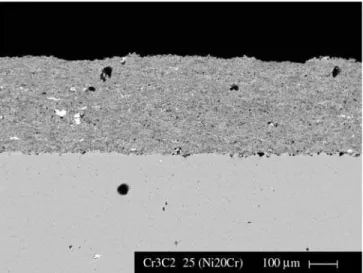
Figure 8. Micrograph across Cr3C2 25(Ni20Cr) coat revealing uniform
thickness.
Figure 9. Micrograph of WC 20Cr7Ni powder revealing agglomerated and
temperatures beyond 650 °C is due in part to the formation of NiO and NiWO4. However, the oxidation reaction leading to the forma-tion of W3O from WC, which should have started at this temperature, seems to have been affected by the erosion process. Further proof of this observation, is the total absence of scaling (spalling) of the coating. In the oxidation tests, formation of flaky, non-protective W3O layers was observed.
Above 800 °C, the wastage of all three types of coatings increased again and this is due to oxide erosion. Thus, the oxide erosion regime operates at these temperatures. The higher oxide growth rate, because of the higher temperature, makes it brittle and non-protective, even on the NiCr alloy and the Cr3C2 containing coating, where chromium or spinel oxide could form.
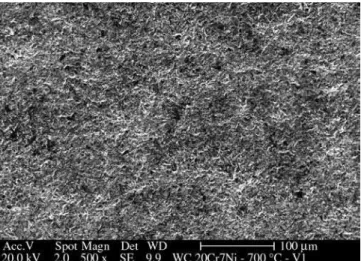
Scanning electron microscopic examination of the surfaces and cross sections of the coatings following the erosion-oxidation tests are in progress to corroborate the regimes of erosion-oxidation of the coatings as a function of the test conditions. The morphology of the WC 20Cr7Ni coated specimens that were erosion-oxidation tested at 100, 700 and 800 °C are shown in Figures 13-15, respectively. Presence of surface oxides is considered to inhibit coating wastage at temperatures up to 700 °C.
4. Conclusions
1. An apparatus to conduct high temperature erosion-oxidation studies was constructed, and this enabled the erosion-oxidation behavior of three different coatings to be characterized.
Figure 10. Micrograph of the surface of WC 20Cr7Ni coat revealing
rough-ened features.
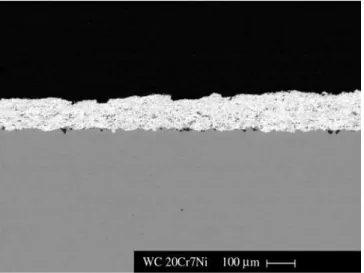
Figure 11. Micrograph across WC 20Cr7Ni coat revealing uniform
thick-ness.
Figure 12. Erosion-oxidation wastage of Ni20Cr, Cr3C2 25(Ni20Cr) and
WC 20Cr7Ni coatings obtained by the HVOF process.
Figure 13. Micrograph of WC 20Cr7Ni coating surface after
Figure 15. Micrograph of WC 20Cr7Ni coating surface after erosion-oxida-tion test at 800 °C.
2. The erosion-oxidation behavior of HVOF coated Cr3C225 (Ni20Cr) was better than that of WC 20Cr7Ni. 3. The erosion-oxidation resistance of WC 20Cr7Ni coating
was higher than its oxidation resistance without erosion. This indicated that the erosion process affects the erosion-oxidation mechanism.
4. Erosion-oxidation regimes have been identified for HVOF coatings at particle impact velocity of 3.5 m.s-1, impact angle
of 90° and temperatures in the range 500 to 850 °C. The ero-sion-oxidation regime at temperatures up to 600 °C is ‘erosion of substrate (coating)’. The regime ‘oxidation affected erosion’ has been observed in the temperature range of 600-700 °C. The behavior of the coatings at temperatures up to 700 °C corre-sponds to the ‘erosion-enhanced oxidation’ regime.
References
1. Shewmon P, Sundararajan G. The erosion of metals. Annual Review of
Materials Science. 1983; 13:301-318.
2. Finnie I. Erosion of surfaces by solid particles. Wear. 1960;
3(2):87-103.
Figure 14. Micrograph of WC 20Cr7Ni coating surface after
erosion-oxida-tion test at 700 °C.
3. Bitter JGA. A study of erosion phenomena Part II. Wear. 1963;
6(3):169-190.
4. Hutchings IM, Winter RE. Particle erosion of ductile metals – mechanism
of material removal. Wear. 1974; 27(1):121-128.
5. Winter RE, Hutchings IM. Solid particle erosion studies using single
angular particles. Wear. 1974; 29(2):181-194.
6. Bhattacharya S, Hales C, Hill V. Erosion-Corrosion of Materials in Coal
Gasifier Environments. In: Natesan K, editor. Proceedings of the Fall
Meeting of The Metallurgical Society of AIME; 1978 Oct 17-18; St. Louis, USA. New York: The Metallurgical Society of AIME; 1980. p. 244-267.
7. Wright IG, Nagarajan V, Herchenroeder RB. Some Factors Affecting
Solid Particle Erosion/Corrosion of Metals and Alloys. In: Natesan K,
editor. Proceedings of the Fall Meeting of The Metallurgical Society of
AIME; 1978 Oct 17-18; St. Louis, USA. New York: The Metallurgical
Society of AIME; 1980. p. 268-312.
8. Zambelli G, Levy AV. Particulate erosion of NiO scales. Wear. 1981;
68(3):305-331.
9. Tabakoff W. Experimental-study on the effects of specimen sizes on
erosion.Wear. 1983; 86(1):65-72.
10. Ives LK. Erosion of 310 stainless steel at 975 degrees C in combustion
gas atmospheres. Journal of Engineering Materials and Technology
- Transactions of the ASME 99 (2). 1977; 126-132.
11. Stack MM, Lekatos S, Stott FH. Erosion-corrosion regimes: number,
nomenclature and justification? Tribology International. 1995;
28(7):445-451.
12. Hogmark S, Hammarsten A, Söderberg S. On the Combined Effects of
Corrosion and Erosion. In: Cavendish Laboratory Publisher. Proceedings
of Sixth International Conference Erosion by Solid and Liquid Impact; 1983 Sept. 5-8; Cambridge, UK. Cambridge: Cavendish Laboratory - University of Cambridge; 1983. Paper 37, 8 pp.
13. Kang CT, Pettit FS, Birks N. Mechanisms in the simultaneous
erosion-oxidation attack of nickel and cobalt at high temperature. Metallurgical
Transactions A – Physical Metallurgy and Materials Science. 1987; 18(10):1785-1803.
14. Rishel DM, Pettit FS, Birks N., Some principal mechanisms in the si-multaneous erosion and corrosion attack of metals at high temperatures. Materials Science and Engineering A – Structural Materials Properties, Microstructure and Processing. 1991; 143(1-2):197-211.
15. Stephenson DJ, Nicholls JR. Modeling Erosive Wear. Corrosion Science.
1993; 35(5-8):1015-1026.
16. Karimi A, Verdon C, Barbezat G. Microstructure and hydro abrasive wear behavior of high velocity oxy-fuel thermally sprayed WC-Co(Cr)
coatings.Surface and Coatings Technology. 1993; 57(1):81-89.
17. Mohanty M, Smith RW, De Bonde M, Celis JP, Lugscheider E. Sliding
wear behavior of thermally sprayed 75/25 Cr3C2/NiCr wear resistant
coatings.Wear. 1996; 198(1-2):251-266.
18. Verdon C, Karimi A, Martin J-L. A study of high velocity oxy-fuel ther-mally sprayed tungsten carbide based coatings. Part 1: Microstructures. Materials Science and Engineering A – Structural Materials Properties Microstructures and Processing. 1998; 246(1-2):11-24.
19. Walsh PN. Erosion resistance of coatings at steam turbine temperatures.
In: ASME Publisher. Proceedings of International Joint Power Generation
Conference; 1992 Oct. 18-22; Atlanta, USA. New York: The Metallurgical Society of AIME; 1992. p. 123-128.
20. Kunioshi CT, Correa OV, Bellinati CE, Ramanathan LV. Influence of processing parameters on the microstructure and oxidation behavior of
hot pressed Ni-20Cr+WC metal matrix composites. Materials Science
Forum. 2003; 403(4):195-200.
21. Toma D, Brandl W, Marginean G. Wear and corrosion behavior of
ther-mally sprayed cermet coatings. Surface and Coatings Technology. 2001;