The effects of air pollution on
cardiovascular diseases: lag
structures
Efeitos da poluição do ar nas doenças
cardiovasculares: estruturas de
defasagem
ABSTRACT
OBJECTIVE: To assess the lag structure between air pollution exposure and elderly cardiovascular diseases hospital admissions, by gender.
METHODS: Health data of people aged 64 years or older was stratified by gender in São Paulo city, Southeastern Brazil, from 1996 to 2001. Daily levels of air pollutants (CO, PM10, O3, NO2, and SO2) , minimum temperature, and relative humidity were also analyzed. It were fitted generalized additive Poisson regressions and used constrained distributed lag models adjusted for long time trend, weekdays, weather and holidays to assess the lagged effects of air pollutants on hospital admissions up to 20 days after exposure.
RESULTS: Interquartile range increases in PM
10 (26.21 µg/m 3) and SO
2 (10.73 µg/m 3)
were associated with 3.17% (95% CI: 2.09-4.25) increase in congestive heart failure and 0.89% (95% CI: 0.18-1.61) increase in total cardiovascular diseases at lag 0, respectively. Effects were higher among female group for most of the analyzed outcomes. Effects of air pollutants for different outcomes and gender groups were predominately acute and some “harvesting” were found.
CONCLUSIONS: The results show that cardiovascular diseases in São Paulo are strongly affected by air pollution.
KEYW O RD S: Cardiovascular diseases, epidemiology. Air pollution, adverse effects. Air pollution, analysis. Gender. H ospital records. Time series studies.
RESU M O
OBJETIVO: Investigar a estrutura de defasagem entre exposição à poluição do ar e internações hospitalares por doenças cardiovasculares em idosos, separada por gênero.
MÉTODOS: Os dados de saúde de pessoas com mais de 64 anos de idade foram estratificados por gênero, na cidade de São Paulo, entre 1996 e 2001. Os níveis diários de poluentes do ar (CO, PM10, O3, NO2, SO2) e os dados de temperatura mínima e umidade relativa do ar foram também foram analisados. Foram utilizados modelos restritos de distribuição polinomial em modelos aditivos generalizados de regressão de Poisson para estimar os efeitos dos poluentes no dia da exposição e até 20 dias após, controlando-se para sazonalidades de longa e curta durações, feriados e fatores meteorológicos.
RESULTADOS: Variações interquartis de PM
10 (26,21 µg/m 3) e SO
2 (10,73 µg/m 3)
Lourdes Conceição M artinsI
Luiz A A PereiraII
Chin A LinIII
U biratan P SantosIII
Gildeoni PrioliIV
O linda do Carmo LuizI
Paulo H N SaldivaIV
Alfésio Luís Ferreira BragaIV
I Disciplina de Saúde da Coletiva.
Faculdade de Medicina do ABC. Santo André, SP, Brasil
I I Programa de Pós-graduação em Saúde
Coletiva. Universidade Católica de Santos, SP, Brasil
I I IHospital das Clínicas. Faculdade de
Medicina. Universidade de São Paulo (FMUSP). São Paulo, SP, Brasil
I V Núcleo de Estudos em Epidemiologia
Ambiental. Laboratório de Poluição Atmosférica Experimental. FMUSP. São Paulo, SP, Brasil
Correspondence:
Alfésio Luís Ferreira Braga Núcleo de Estudos em Epidemiologia Ambiental
Laboratório de Poluição Atmosférica Experimental
Departamento de Patologia - FM-USP Av. Dr. Arnaldo, 455 1º andar sala 1308 Cerqueira César
01246-903 São Paulo, SP, Brasil E-mail: [email protected]
foram associados com aumentos de 3,17% (IC 95%: 2,09-4,25) nas admissões por insuficiência cardíaca congestiva e de 0,89% (IC 95%: 0,18-1,61) para admissões por todas as doenças cardiovasculares no dia da exposição, respectivamente. Os efeitos foram predominantemente agudos e maiores para o gênero feminino. Além disso, foi observado efeito colheita.
CONCLUSÕES: Os achados mostraram que as doenças cardiovasculares em São Paulo são fortemente afetadas pela poluição do ar.
D ESCRITO RES: D oenças cardiovasculares, epidemiologia. Poluição do ar, efeitos adversos. Poluição do ar, análise. Gênero. Registros hospitalares. Estudos de séries temporais.
INTRODUCTION
The acute effects of air pollutants on respiratory and cardiovascular morbidity and mortality are well known.2,9-13 Also, although the relative effects of air
pollutants are larger for respiratory events than for cardiovascular diseases, the numbers of adverse health outcomes attributable to air pollutants are much larger for cardiovascular than for respiratory causes.1,6 For
cardiovascular diseases, the elderly people are those who present the highest susceptibility.1
The lag structure between air pollutants exposure and effects are matter of concern. Braga et al3 reported
short-term lag structures between PM10 exposure and deaths to cardiovascular diseases and myocardium infarction in 10 US cities, controlling for weather confounding. Compared to respiratory diseases, cardiovascular effects due to PM10 were found to be more acute with adverse responses seen at the same day or, at the most, on the subsequent day. Recently, investigating the effects of PM10 on cardiovascular diseases deaths in European cit-ies, Zanobetti et al16 used a longer distributed lag model,
from day zero to day 40, and showed a five-time higher effect than that estimated for the day and day after expo-sures only. It is highly relevant for estimates of air pollu-tion attributed adverse effects on health. In São Paulo, studies have focused on very short time lagged effect estimates with, at most, a week exposure time period. In a recent panel study, Santos et al14 showed acute effects
of SO2 and CO on blood pressure and heart rate variabil-ity in healthy people with a short-time lag structure.
Other issue that has been insufficiently addressed in environmental epidemiology studies of air pollution on health is the potential difference of susceptibility by gender.
The present study aimed at investigating the lag struc-ture of the effects of daily criteria air pollutants lev-els on morbidity, using the daily number of hospital
admissions due to total cardiovascular disease, ischemic heart disease and congestive heart failure.
M ETH O D S
Daily records of hospital admissions due to cardiovas-cular diseases (ICD-10: I00-I99) in people older than 64 years of age in São Paulo, Southeastern Brazil, were
obtained from the Departamento de Informação e
Informática do Sistema Único de Saúde (Datasus
-Department of Data Analysis of the Unified Health System) from June 1996 to November 2001. Three out-comes of interest were defined and stratified by gen-der: all cardiovascular diseases, congestive heart fail-ure (I50), and ischemic heart disease (I20-I25).
Daily records of carbon monoxide, particulate matter with an aerodynamic profile ≤10 µm (PM10), nitro-gen dioxide (NO2), sulfur dioxide (SO2) and ozone
(O3) were obtained from Companhia de Tecnologia
de Saneamento Ambiental de São Paulo (Cetesb
-State Sanitary Agency) for the same period. There were 14 monitoring stations spread all over the city, al-though not all of them measure all pollutants. It was adopted the average of all stations that measured each pollutant as a citywide exposure status. The measure-ment adopted for carbon monoxide was the highest 8-hour moving average in seven stations; NO2 and O3 concentrations were computed as the highest hourly average in seven and six stations, respectively; and for PM10 (14 stations) and SO2 (6 stations) were adop-ted 24-hour averages. All pollutants were measured in the period from 1:00 am to 12:00 pm.
Daily minimum temperature and daily mean of
rela-tive humidity were obtained from the Instituto de
Astronomia e Geofísica (IAG - Institute of Astronomy and Geophysics) of the Universidade de São Paulo.
car-diovascular hospital admissions in each outcome and gender subsets as the sum of smooth and linear func-tions of the predictor variables. The nonparametric function adopted was LOESS, a moving regression smoother. In order to assure convergence of its itera-tive estimation procedure providing biased estimates of regression coefficients and standard errors when
non-parametric functions are adopted,7 it was used
more stringent convergence parameters than the de-fault settings of S-Plus software. Besides, it was adopted LOESS smoother to only one parameter (time trend) which minimizes estimates errors.
Outcome and gender-specific smooth parameters for time were chosen to remove long-term trends from the data, removing seasonality, and minimizing autocorrelation of residuals. Each admission is an independent event, and autocorrelation of residuals indicates that there are omitted time-dependent covariates whose variation may confound air pollu-tion associapollu-tions. If the autocorrelapollu-tion is removed, the remaining variation from omitted covariates has no systematic temporal pattern, and hence confound-ing is less likely. When necessary, autoregressive terms were incorporated to eliminate serial correlation from the residuals.
Indicators for weekdays and holidays were included in the models. In order to reduce sensitivity to outliers in the dependent variable it was used robust regres-sion (M-estimation).
Air pollution and weather variables as temperature and humidity can induce health effects not only on the same day of the exposure but also on subse-quent days. Hence the number of admissions on a
given day will depend on the same day effect of that day’s pollution/weather, but also on the lagged ef-fect of the previous day’s pollution/weather. Differ-ent approaches have been tried in order to estimate the contribution of each day of exposure on the endpoint. The lag structures between air pollution and health have been analyzed using different ap-proaches2-5,9,16 and time lags.
An unrestricted distributed lag model shows:
Log (E(Y)) = α + covariates + β0Xt + …+ βqXt-q + εt (1)
where Y is the daily count of admissions, E(Y) is the expected value of that count, and Xt-qis the pollutant/ weather concentration q days before the admissions. In this analysis it was adopted a constrained lag struc-ture, i.e. a polynomial distributed lag model. Usually applied to social sciences studies and econometrics, the use of this approach in epidemiology has been described in air pollution time series.3,16 In this study,
it was investigated the lag structure of air pollution and weather effects on cardiovascular hospital admis-sions using a third degree polynomial with 21 days, from lag zero to lag 20, which imposes constraints, but gives enough flexibility to estimate a biologically plau-sible lag structure, and controlling multicollinearity better than an unconstrained lag model. The standard errors of the estimates for each day were adjusted for overdispersion. Air pollutants effects were presented as percentage increase in hospital admissions and 95% confidence intervals.
Co-pollutant or multi-pollutant models were not used because the inclusion of a third degree polynomial highly correlated with the others already in the model
Table 1 - Descriptive analyses of cardiovascular diseases hospital admissions, air pollutants and weather variables. São Paulo, Brazil, 1996-2001.
Variable D aily M ean SD M inimum IQ R M axi mum
Cardiovascular
Total 43.43 15.69 9 21 163
Femal e 22.04 8.77 3 11 93
M al e 21.39 8.42 3 12 72
Congestive heart failure
Total 10.46 4.28 0 6 27
Femal e 5.82 2.87 0 3 19
M al e 4.64 2.56 0 3 16
Ischemic heart disease
Total 10.57 4.71 0 7 27
Femal e 4.76 2.70 0 3 14
M al e 5.81 3.04 0 5 16
Pollutants
PM10 (µg/m3) 52.7 23.9 13.9 26.2 186.3
O3 (µg/m3) 76. 6 42.8 10.2 51.2 389.5
SO2 (µg/m3) 17.0 9.2 2.0 10.7 75.2
NO2 (µg/m3) 102.7 47.6 22.2 54.6 421.6
CO (ppm) 3.1 1.5 0.5 1.7 12.6
W eather
Temperature* (oC) 15.0 3.5 -0.0 5.4 23.2
Humidity (%) 80.5 8.3 45.7 10.4 96.6
IQR: Interquartile range
could increase multicollinearity thus distorting the estimates.
Statistical analyses were carried out using S-Plus software, version 4.5.
RESU LTS
Table 1 presents the descriptive analyses of the vari-ables used in the analyses. Ischemic heart disease and congestive heart failure were almost 50% of all car-diovascular diseases hospital admissions. Gender dis-tribution did not present a well-defined pattern.
During the period of study only PM10 (1996 and
1997) and NO2 (1996, 1997, 1998, and 2001)
pre-sented means that exceeded their respective annual air quality standards (50 µg/m3 and 100 µg/m3,
re-spectively). O3 exceeded its daily standard (160 µg/ m3) 72 times, CO (9 ppm) 16 times, NO
2 (320 µg/m
3)
seven times, and PM10 (150 µg/m3) 10 times. Except
for O3, it was observed a declining trend in air pol-lution levels along the period of study. Descriptive analyses for the whole period showed that PM10, NO2
and O3 reached maximum daily records well above
their standards. The winter of 2000 was the coldest
and the driest season during the study period. The remaining years presented very homogeneous weather records.
Table 2 presents Pearson correlation coefficients for pollutants and weather variables. Correlations be-tween PM10, CO, SO2, and NO2 were high, positive, and statistically significant, while O3 correlations with them were statistically significant but lower than those observed between primary pollutants. Minimum temperature was inversely correlated with all pollut-ants except for O3.
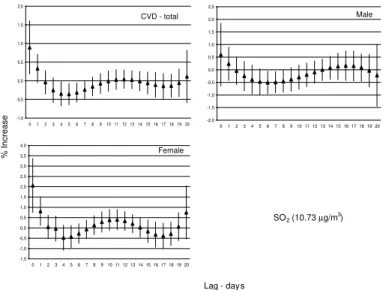
Figure 1 presents estimated lag structures for SO2 ef-fects on total cardiovascular diseases hospital admis-sions for the whole group and by gender. There is an acute effect at lag zero for whole group and at lags zero and one for the female group. No statistically significant effects were observed for the male group.
There were no long-term effects in any group. SO2
was chosen because it was the pollutant that presented the highest effects at lag zero. The pattern of distrib-uted lag effects observed for the other pollutants were similar to that presented by SO2, with “harvesting” observed four to seven days after the exposure.
For ischemic heart diseases, the estimates
with SO2 for the whole group showed a
pat-tern that is similar to that observed for total cardiovascular diseases, with lags zero and one presenting statistically significant ef-fects (Figure 2). However, in the analyses by gender it is possible to recognize two different patterns of lag structure: while for the female group the contribution of air pol-lution on ischemic heart diseases hospital admissions is relevant only at lags zero and one, the effect started at lag one and re-mained until four days after the exposure in the male group.
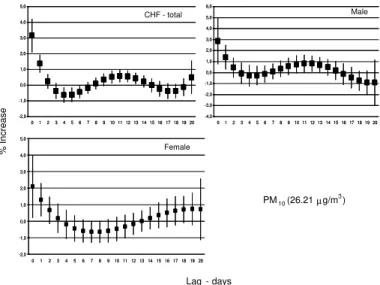
The effect of PM10 on congestive heart fail-ure hospital admissions presented a tri-phase pattern, as can be seen in Figure 3, and it is different from the other estimates previously presented. Besides the positive effects at lags
Table 2 - Pearson correlation coefficients between air pollutants and weather variables. São Paulo, Brazil,1996-2001.
Variable O3 CO NO2 SO2 PM10 Tmin H med
O3 1.00
CO -0.05* 1.00
NO2 0.32* 0.67* 1.00
SO2 0.21* 0.57* 0.70* 1.00
PM10 0.29* 0.75* 0.81* 0.77* 1.00
Tmin 0.08* -0.16* -0.20* -0.31* -0.31* 1.00
H med -0.31* -0.34* -0,36* -0.42* -0.51* 0.08* 1.00
Tmin: Minimum temperature; Hmed: Relative humidity *p<0.01
Figure 1 - Lag structure of the effects of an interquartile range increase in SO2 (10.73 µg/m3) on total, male, and female cardiovascular disease
(CVD) hospital admissions. São Paulo, Brazil, 1996-2001.
-1,0 -0,5 0,0 0,5 1,0 1,5 2,0
0 1 2 3 4 56 7 8 910 11 12 13 14 15 16 17 18 19 20 -2,0
-1,5 -1,0 -0,5 0,0 0,5 1,0 1,5 2,0 2,5
0 1 2 3 4 56 7 8 9 10 11 12 13 14 15 16 17 18 19 20
-1,5 -1,0 -0,5 0,0 0,5 1,0 1,5 2,0 2,5 3,0 3,5 4,0
0 1 23 4 56 7 89 10 11 12 13 14 15 16 17 18 19 20
Lag - days
% Increase
SO2(10.73 µg/m )3
CVD - total Male
zero and one and the “harvesting” at lags five and six, there was a 10 to 12-day lagged positive effect for the whole group. This pat-tern is clearly driven by the PM10 effect in the male group.
D ISCU SSIO N
This study was designed to assess the lag structure of air pollution on cardiovascular diseases using hospital admissions. It showed that air pollution was positively associated with cardiovascular hospital admissions and all of them presented a short-time lagged ef-fect. Effects were higher for the female group except for congestive heart failure, which PM10 presented a 10 to 12-day lagged posi-tive effects in the male group.
It was used secondary data from different hospitals in São Paulo. Specific diagnoses on cardiac diseases may be difficult to do specially in general and/or non-university hospitals. Misclassification of ische-mic heart disease cases is less likely to occur be-cause of its characteristic clinical manifestations and severity. Also, it is usual the occurrence of arrhyth-mia and congestive heart failure as consequence of ischemic events and not the inverse. In fact, conges-tive heart failure is often a consequence of other diseases and, hence, misclassification is more plau-sible but still not frequent. Eventually, congestive heart failure can induce arrhythmia which may ag-gravate congestive heart failure. In cases like that the primary diagnosis is difficult to be defined. However, even when misclassification of conges-tive heart failure or arrhythmia occurs it is
non-dif-ferential and hence not dependent on air pollution concentration.
It was adopted generalized additive models and LOESS smoother in the S-Plus software, a procedure that has been matter of discussion in the last two years. As pointed out by Dominici et al7 estimates of effects and
standard errors are affected in models using nonpara-metric functions for more than one covariate. However, in the present study, it was used LOESS smoother for controlling long-term seasonality only and it was adopted convergence parameters much more restric-tive than the S-Plus version 2000 default parameters. Moreover, studies developed by these authors’ group have showed that the effects of air pollution on cardio-vascular diseases remained the same when estimated by generalized linear or additive models.9
Lag structures were estimated using multi-variate models controlling for confounding by seasonality adjusting for overdispersion. There were included the most probable and the most commonly used confounders in the association between air pollution or weather and cardiovascular morbidity. The great number of prolonged holidays in the middle of the week required the inclusion of a spe-cific indicator. Even being unlikely, the pos-sibility of incomplete adjustment for con-founders always must be considered.
As pointed out in a previous study,9 it was
found an enhanced response of elderly to air pollutants. The study design does not allow speculations on health characteris-tics of the population analyzed in the present study but it can be assumed, due to
Figure 2 - Lag structure of the effects of an interquartile range increase in SO2 (10.73 µg/m3) on total, male, and female ischemic heart disease
(IHD) hospital admissions. São Paulo, Brazil, 1996-2001.
-2,5
0123 4 5 67 8 9 10 11 12 13 14 15 16 17 18 19 20 012345678910111213141516171819 20
0 1 2 3 4 5 6 7 8 9 10 11 12 13 14 15 16 17 18 19 20 -2,0 -1,5 -1,0 -0,5 0,0 0,5 1,0 1,5 2,0 2,5 3,0 -3,0 -2,0 -1,0 0,0 1,0 2,0 3,0 4,0 -3,0 -2,0 -1,0 0,0 1,0 2,0 3,0 4,0 5,0 6,0
0 1 2 3 4 5 6 7 8 9 10 11 12 13 14 15 16 17 18 19 20
IHD-Total Male
Female
Lag - days
% Increase
SO2 (10.73 µg/m3)
Figure 3 - Lag structure of the effects of an interquartile range increase in PM10 (26.21 µg/m3) on total, male, and female congestive heart failure
(CHF) hospital admissions. São Paulo, Brazil, 1996-2001.
-2,0 -1,0 0,0 1,0 2,0 3,0 4,0 5,0
0 1 2 3 4 5 6 7 8 910 11 12 13 14 15 16 17 18 19 20
-4,0 -3,0 -2,0 -1,0 0,0 1,0 2,0 3,0 4,0 5,0 6,0
01 2 3 4 5 6 78 910 11 12 13 14 15 16 17 18 19 20
-2,0 -1,0 0,0 1,0 2,0 3,0 4,0 5,0
0 12 3 4 56 7 8910 11 12 13 14 15 16 17 18 19 20
-2,0 -1,0 0,0 1,0 2,0 3,0 4,0 5,0
0 1 2 3 4 5 6 7 8 910 11 12 13 14 15 16 17 18 19 20
-4,0 -3,0 -2,0 -1,0 0,0 1,0 2,0 3,0 4,0 5,0 6,0
01 2 3 4 5 6 78 910 11 12 13 14 15 16 17 18 19 20
-2,0 -1,0 0,0 1,0 2,0 3,0 4,0 5,0
0 12 3 4 56 7 8910 11 12 13 14 15 16 17 18 19 20
Lag - days
% Increase
PM10 (26.21 µg/m 3)
Female
the age group used, that most of them could present cardiorespiratory diseases. This situation may ex-plain the “harvesting” pattern observed for cardio-vascular diseases and congestive heart failure. In this case, the exposure to air pollutants affected mainly a susceptible subgroup of the entire popu-lation, leading to a lack of subsets in the subse-quent days after exposure. However, studies by Schwartz15 and Zanobetti et al16 carried out with
using the same methodology are in agreement that the effects of air pollutants are not predominantly due to harvesting. They analyzed more than one city and this procedure controls better for collinearity effects on daily estimates of the ef-fects that are minimized but not eliminated using constrained polynomial distributed lag models for estimates in one city only. As pointed out by Braga et al,3 “a study in a single location risks variations
in the lag structure between air pollution and daily health events that are due to sampling variability rather than related to a causal pathway”. However, health, air pollution, and weather data are not avail-able for either most of the cities in the State of São Paulo or in Brazil. The development of a national program of surveillance in air pollution health ef-fects may provide data from different cities, which will allow estimates in more than one setting.
It is important to emphasize that acute effects were consistent across different air pollutants and diseases.
It provides evidence that the study estimates are more plausible to be true and less biased.
Differently from that reported by Koken et al,8 where
male gender was identified as risk factor for cardio-vascular diseases, there were found greater effects on congestive heart failure in the male group and on cardiovascular diseases and ischemic heart disease in the female group. The present study showed different results and reinforce the need for additional studies focusing on effect modification of air pollution health effects by gender.
In conclusion, the present study showed a significant association between cardiovascular diseases hospi-tal admissions for elderly in São Paulo, and this ef-fect varied in size by gender. The lag structure showed a very acute effect of air pollution on cardiovascular diseases and that assessing lags structures for longer periods in a single site will require additional data and statistical tools.
ACKN O W LED GM EN TS
We thank Carlos Ibsen Laçava, M.S., manager, and Massayuki Kuromoto, B.S., environment analyst, from Cetesb Data Analysis Division, who provided data on air pollution, and Sérgio Torres Salum, B.S., and Frederico Luiz Funari, M.S., from IAG-USP, for weather data.
REFEREN CES
1. Anderson HR, Atkinson RW, Bremner SA, Marston L. Particulate air pollution and hospital admissions for cardiorespiratory diseases: are the elderly at greater risk? Eur Respir J Suppl. 2003;40:39S-46.
2. Braga ALF, Saldiva PHN, Pereira LAA, M enezes JJ, Conceição GM, Lin CA, et al. Health effects of air pollution exposure on children and adolescents in São Paulo, Brazil. Pediatr Pulmonol. 2001;31:106-13. 3. Braga ALF, Zanobetti A, Schwartz J. The lag structure
between particulate air pollution and respiratory and cardiovascular deaths in 10 US cities. J Occup Environ Med. 2001;43:927-33.
4. Braga ALF, Zanobetti A, Schwartz J. The effect of weather on respiratory and cardiovascular deaths in 12 U.S. cities. Environ Health Perspect.
2002;110:859-63.
5. Cendon S, Pereira LA, Braga AL, Conceição GM, Cury Junior A, Romaldini H, et al. Air pollution effects on myocardial infarction. Rev Saúde Pública. 2006;40:414-9.
6. Dockery DW. Epidemiologic evidence of cardiovas-cular effects of particulate air pollution. Environ Health Perspect. 2001;109 Suppl 4:483-6.
7. Dominici F, McDermott A, Zeger SL, Samet JM. On the use of generalized additive models in time-series studies of air pollution and health. Am J Epidemiol. 2002;156:193-203.
8. Koken PJM, Piver WT, Ye F, Elixhauser A, Olsen LM, Portier CJ . Temperature, air pollution, and
hospitalisation for cardiovascular diseases among elderly people in Denver. Environ Health Perspect. 2003;111:1312-7.
9. Lin CA, Pereira LAA, Conceição GMS, Kishi HS, Milani Jr R, Braga ALF, et al. Association between air pollution and ischemic cardiovascular emergency room visits. Environ Res. 2003;92:57-63.
11. Martins LC, Latorre MRDO, Cardoso MRA, Gonçal-ves FLT, Saldiva PHN, Braga ALF. Poluição atmosféri-ca e atendimentos por pneumonia e gripe em São Paulo, Brasil. Rev Saúde Pública. 2002;36:88-94. 12. M artins LC, Latorre M RDO, Saldiva PHN, Braga ALF.
Air pollution and emergency room visits due to chronic lower respiratory diseases in the elderly: an ecological time-series study in São Paulo, Brazil. J Occup Environ Med. 2002;44:622-7.
13. Saldiva PHN, Lichtenfels AJFC, Paiva PSO, Barone IA, Martins MA, Massad E, et al. Association between air pollution and mortality due to respiratory diseases in children in São Paulo, Brazil: a preliminary report. Environ Res. 1994;65:218-25.
14. Santos UP, Braga AL, Giorgi DM, Pereira LA, Grupi CJ, Lin CA, et al. Effects of air pollution on blood pressure and heart rate variability: a panel study of vehicular traffic controllers in the city of São Paulo, Brazil. Eur Heart J. 2005;26:193-200.
15. Schwartz J. Is there harvesting in the association of airborne particles with daily deaths and hospital admissions? Epidemiology. 2001;12:55-61. 16. Zanobetti A, Schwartz J, Samoli E, Gryparis A,
Touloumi G, Peacock J, et al. The temporal pattern of respiratory and heart disease mortality in response to air pollution. Environ Health Perspect.
2003;111:1188-93.
This study is partially based on the doctorate thesis presented at the Faculdade de Medicina da Universidade de São Paulo in 2004.