- 344 - Original Article
EMOTIONS OF STUDENTS INVOLVED IN CASES OF BULLYING
1Julliane Messias Cordeiro Sampaio2, Gabriela Valente Santos3,Wanderlei Abadio de Oliveira4, Jorge Luiz da
Silva5, Marcelo Medeiros6, Marta Angélica Iossi Silva7
1 Research funded by the Brazilian Council for Scientiic and Technological Development (CNPq), process 482842/2010-5. 2 Doctoral student, Graduate Program in Public Health Nursing, Universidade de São Paulo at Escola de Enfermagem de Ribeirão
Preto (EERP/USP). Ribeirão Preto, São Paulo, Brazil. E-mail: [email protected]
3 Undergraduate student at EERP/USP. PIBIC/CNPq grantee. Ribeirão Preto, São Paulo, Brazil. E-mail: [email protected] 4 Doctoral student, Graduate Program in Public Health Nursing at EERP/USP. CAPES grantee. Ribeirão Preto, São Paulo,
Brazil. E-mail: [email protected]
5 Doctoral student, Graduate Program in Public Health Nursing at EERP/USP. FAPESP grantee. Ribeirão Preto, São Paulo, Brazil. E-mail: [email protected]
6 Ph.D. in Nursing. Associate Professor, Faculty of Nursing, Universidade Federal de Goiás. Goiânia, Goiás, Brazil. E-mail: marcelo@ fen.ufg.br
7 Ph.D. in Nursing and Public Health. Associate Professor, Maternal-Infant Nursing and Public Health Department at EERP/ USP, São Paulo, Brazil. E-mail: [email protected]
ABSTRACT: The objective was to estimate the prevalence of school bullying and identify the emotions of students involved. In this
cross-sectional and descriptive study, a questionnaire was applied to 232 sixth-grade students of a public school. The results show a large number of students involved in bullying (39.6%): 22.2% were victims and 17.4% were aggressors. Anger was the most frequent emotion experienced by the victims when suffering aggression, while most aggressors reported that no emotions were experienced when abusing their peers. The high prevalence of bullying, its characteristics and the negative consequences that arise make it a public health problem. This study covers the importance of identifying emotions associated with school bullying, a subject seldom explored, which can contribute to the development of integral healthcare delivered to students.
DESCRIPTORS: Violence. Bullying. School health. Intersectorial action.
PREVALÊNCIA DE BULLYING E EMOÇÕES DE ESTUDANTES
ENVOLVIDOS
RESUMO: Este artigo objetivou estimar a prevalência de bullying escolar e identiicar as emoções dos estudantes envolvidos. Trata-se de um estudo transversal e descritivo, desenvolvido mediante a aplicação de um questionário em 232 estudantes do sexto ao nono anos do ensino fundamental de uma escola pública. Dentre os resultados encontrados, destaca-se a grande quantidade de participação dos estudantes investigados em atos de bullying (39,6%), dos quais 22,2% eram vítimas e 17,4% agressores. A raiva foi a emoção prevalentemente experimentada pelas vítimas durante as agressões que sofriam. Já os agressores, em sua maioria, relataram que o fato de agredirem seus colegas não gerou emoções. A alta prevalência do bullying, suas características e as consequências negativas por ele acarretadas o coniguram em problema de saúde pública. O estudo remete à importância da identiicação das emoções associadas à ocorrência do bullying, tema ainda pouco explorado e que pode contribuir na construção do cuidado integral da saúde do escolar.
DESCRITORES: Violência. Bullying. Saúde escolar. Ação intersetorial.
EMOCIONES DE LOS ESTUDIANTES QUE PARTICIPAN EN
SITUACIONES DE ACOSO ESCOLAR
RESUMEN: Este estudio tuvo como objetivo estimar la prevalencia del acoso escolar y identiicar las emociones de los estudiantes
involucrados em su violencia. Se trata de un estudio descriptivo transversal, desarrollado con 232 estudiantes del sexto al noveno año de la escuela primaria en una escuela pública. Entre los resultados, la participación de los estudiantes en intimidación fue de 39,6%, 22,2% eran víctimas y 17,4% eran agresores. La ira es la emoción predominante experimentada por las víctimas. En cuanto a los autores, la mayoría informó que no sintió emociones mientras que la agresión hacia sus compañeros. La alta prevalencia del acoso escolar, sus características y las consecuencias negativas que conlleva lo tiene conigurarlo en un problema de salud pública. El estudio apunta a la importancia de identiicar las emociones asociadas a la ocurrencia de acoso escolar, aún no exploradas tema que puede ayudar en la construcción de la salud integral de la escuela.
INTRODUCTION
The quality of the interpersonal relationships experienced in school is an important aspect for the healthy development of children and adolescents. That is so because, besides their commitment to formal education, schools serve as contexts for socialization among peers, allowing the children and adolescents to acquire relational knowledge and perform social skills that are hard to achieve in other environments that do not offer oppor -tunities for more direct interaction with peers.1
In the interaction processes among the students, however, sometimes, situations may occur that are marked by conlict or violence. The participation in or exposure to school violence provoke emotional responses that can induce the students to ight or light behaviors, which interfere negatively in their health and in their socialization and learning processes.2
One of the most common types of violence among peers in school is bullying, which is char -acterized by repeated aggressions, unbalanced power between aggressors and victims and inten -tional actions.3 According to that deinition, ag
-gressions practiced between students with similar (physical, psychological or verbal) power, in terms of possible aggressive attacks against colleagues and/or protection against the violence suffered, do not represent bullying.
This type of violence develops in dynamic interaction contexts, in which the students play speciic roles: aggressors, victims and witnesses. The aggressions practiced are classiied in three distinct categories: physical (punches, kicks, pushes), verbal (swears, pejorative names, gossip and insults) and psychological (social exclusion/ isolation of the colleague).4-5
The occurrence of this phenomenon can be veriied in practically all schools around the world.6 A cross-cultural research developed in 35
European and North American countries identi -ied a prevalence of victimization ranging between 4.1% and 36.3%.7 In Brazil, in the National School
Health Survey (PeNSE - 2012), it was identiied that 7.2% of the investigated students afirmed that they were frequent victims and 20.8% prac -ticed some kind of bullying against colleagues.8 The high occurrence and frequency rates of bullying, associated with the different negative consequences it entails for the victims, witnesses and aggressors’ teaching-learning process, health and quality of life, contributes for bullying to be considered a public health problem.9
The scientiic literature has demonstrated that the exposure to bullying in the school context can cause different physical and mental health problems.3,5 Concerning the victims and witnesses,
they are more prone to constant fear, anxiety, negative thinking, low esteem, depression, self-punishment, psychosomatic symptoms (headaches, dizziness, stomach problems, among others) and suicidal ideas.10 The aggressors, in turn, tend to
engage in situations of domestic violence, psychoac -tive substance abuse, vandalism and infractions.11-13
The consequences of engaging in situations of bullying can accompany the students’ life and make them attribute senses, meanings and/or respond to the social relations. In addition, it is im -portant to highlight that, although chronic health conditions associated with bullying may take some time to appear, the social consequences, such as solitude, social exclusion, low school performance, repeated absences from class, drop-out, among others, occur immediate and negatively inluence the students’ quality of life and education.14
Despite the harmful effects of bullying, most victims do not denounce the aggressions to fam -ily members or teachers, either out of fear of the aggressors’ reaction, fear that the adults will not believe them or due to the perception that their situation is normal. Thus, the aggressions can go by for many years without families and school authorities’ noticing them.15 Therefore, efforts
towards the early identiication of bullying, as a sign of alert for other personal, social, school and health development problems, are fundamental for its control and eradication in the school context. As the negative effects of the aggressions do not disappear over time, it is also extremely relevant to make efforts to investigate the factors associated with their occurrence and continuity.16
In that sense, the emotions represent aspects that, from a personal perspective, can help to clarify the harmful effects of the aggressions on victims and aggressors. That is so because, in dif -ferent situations, social interaction underlie the emotional conditions, determining the occurrence of emotions, the way they will be expressed and the consequences they entail,17 as the emotional
conditions stimulate actions that determine physi -ological activity patterns that support behavior. In other words, the emotions exert a mediating effect between external and internal events, modulating the reaction and behavioral response to bullying.18
manifest the primary emotions (anger, sadness, fear, happiness, among others). On the other hand, secondary emotions are linked to social and cultural inluences (shame, guilt, pride, among others).19 With regard to victims of bullying, the study of emotions helps to understand the results of the aggressions they are victims of, the associ -ated stress, as well as the behavioral response they will issue in view of the aggressors, which can both interrupt the aggressions and aggravate their frequency and intensity. Concerning the ag -gressors, understanding the emotions related to the aggressive acts they practice can help them to develop greater self-mastery and to relate with their peers in a non-violent manner.20
In view of the above, this kind of research, aiming to know what the students involved in situations of bullying (victims and aggressors) feel is necessary not only for theoretical reasons, but also based on an applied perspective,10,21 as the
construction of knowledge on the theme can sup -port evidence-based prevention, health promotion and development practices. This knowledge can also support strategies to cope with bullying, aim -ing to promote comprehensive and intersectoral actions, especially between health and education, mainly considering that the emotions associated with episodes of bullying have been hardly inves -tigated in the literature.18 Therefore, the objectives in this study were to estimate the prevalence of school bullying and identify the emotions of the students involved.
METHOD
A cross-sectional and descriptive research was developed based on the application of a struc -tured questionnaire in a stratiied random sample, consisting of 232 students from the sixth until the ninth year of basic education at a state-owned public school in an interior city in the State of São Paulo. The school was selected by convenience, since it was serving in a research and community service project, linked to the research group the researchers are afiliated with.
It should be highlighted that students who indicated they engaged in situations of aggres-sion, threat, humiliation or social exclusion for three times or more (≥3) in the last 30 days were considered as victims of bullying.7 To calculate
the sample size, the following parameters were considered: student population at the school equal to 571 students, prevalence of the outcome (occur -rence of three or more episodes of bullying known
in the last 30 days equal to 50%), sampling error of ive percentage points and 95% conidence inter -val (α=0.05). In view of the adjustment for a inite population and adding 15% for possible losses or refusals, the inal sample consisted of 232 students. As criteria to participate in the research, irst, the student should be enrolled, attend classes, be present on the day the questionnaire was applied and present the Free and Informed Consent Form, signed by a responsible caregiver. The data were collected anonymously through the application of a self-applied questionnaire. This tool was elaborated based on scientiic evidence and other questionnaire, constructed to investigate emotions associated with bullying in the school context.22-24
After its elaboration, the questionnaire was submitted to three experts in school violence for assessment, who performed the structural and content analysis. In addition, the researchers tested the appropriateness of the questions to the under -standing of the target public (adolescents) through a pretest in a group of three students (about 10% of the sample, n=23), who were also students in basic education. These students were randomly selected from another school in the state-owned public network that possessed characteristics similar to the school where the deinitive study was undertaken.
The researchers collected the data during the students’ class time, through meetings with the selected class groups (sixth to ninth year of basic education). The researchers presented the questionnaire and then permitted its completion, taking an average 30 minutes. Throughout the procedure, the students were monitored and any doubts were clariied.
For data analysis, the participants’ answers were included in a Microsoft Excelworksheet for descriptive statistical treatment. This is basically aimed at summarizing information, so as to permit a global view of the variation in the scores. The results were organized and described in two ways: tables and descriptive measures.
The school board authorized the develop -ment of the research and the project received approval from the Institutional Review Board at the Escola de Enfermagem de Ribeirão Preto da Universidade de São Paulo - EERP-USP (Protocol 1422/2011). Before the data collection, all students received information about the research, and any -one interested in participating received the Free and Informed Consent Form, to be signed by a responsible caregiver.
RESULTS
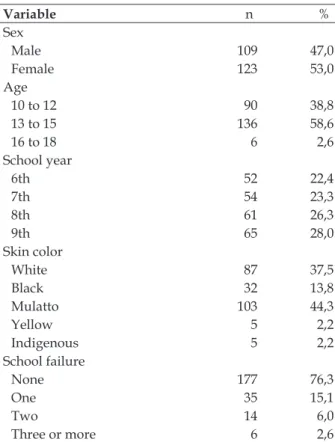
As regards the distribution of the sociode-mographic characteristics (age, school year, sex, failure and skin color), presented in table 1, the age of the students in the research sample (n=232) varied between 10 and 18 years, with a concentra -tion between 13 and 15 years (58.6%), which can be justiied by the fact that the majority was of more advanced age, i.e. the eighth and ninth years (54.3%). As regards the gender distribution, most subjects were female (53.0%). It was observed that more than three quarters of the participants indicated they had never failed any year (76.3%). Concerning the skin color, a predominance of mulatto and white participants is noted (81.8%).
Speciically concerning the involvement in situations of bullying, 22.2% of the participants it into the victim proile and 17.4% into the aggres -sor proile. The distribution of the victimization between the sexes was equivalent. As regards the victims’ age, a greater concentration was found at the age of 13 years (64.8%). For the aggressors, the percentage of boys (54.9%) was higher when compared to girls (45.1%). Most aggressors were 14 years old (46.8%).
Table 1 - Characterization of the students according to school year, sex, age range and number of failures. Ribeirão Preto-SP, 2014
Variable n %
Sex
Male 109 47,0
Female 123 53,0
Age
10 to 12 90 38,8
13 to 15 136 58,6
16 to 18 6 2,6
School year
6th 52 22,4
7th 54 23,3
8th 61 26,3
9th 65 28,0
Skin color
White 87 37,5
Black 32 13,8
Mulatto 103 44,3
Yellow 5 2,2
Indigenous 5 2,2
School failure
None 177 76,3
One 35 15,1
Two 14 6,0
Three or more 6 2,6
As regards the nature of the aggressions the victims suffered, verbal aggressions were prevalent (68.2%), particularly insults, swears and nicknames. Among the girls, the aggressions were mostly focused on personal characteristics or other situations related to the female condition, like the use of make-up for example. On the opposite, among the girls, the aggressions converged in is -sues related to the skin color. They also mentioned, to a lesser extent, the disappearance of personal objects or their handling by colleagues without permission.
On the other hand, the focus on the nature of the aggressions practiced indicates that, for the female sex, the verbal aggressions, mainly the nicknames, represent a tonic (53.8%) while, for the boys, the physical aggressions, such as punches, pushes and kicks are more common (43.6%). They also mention theft or damage to colleagues’ per -sonal objects.
- 348 - Sampaio JMC, Santos GV, Oliveira WA, Silva JL, Medeiros M, Silva MAI equally be highlighted, with higher levels for
girls. This may mean that they do not feel in the conditions needed for self-protection, which may also induce them to lose courage to study or lose classes in the attempt to escape from new aggres -sions. Sadness and shame also stood out for male and female participants. These emotions can cause a feeling of powerlessness and, thus, intensify the suffering experienced.
Table 2 - Distribution of bullying victims according to the emotion generated by the aggression suffered. Ribeirão Preto-SP, 2014
Emotions Female (n=27) Male (n=25)
n % n %
None 03 11.1 03 12.0
Fear 03 11.1 02 8.0
Discouragement 11 40.7 03 12.0
Sadness 15 55.5 07 28.0
Shame 15 55.5 06 24.0
Anger 19 70.4 13 52.0
The results revealed that the victims who mentioned feeling sad also felt embarrassed when they were assaulted. Participants who were targets of verbal aggressions manifested discouragement and lack of desire to go to school. Anger was more present for the victims involved in situations of gossip. Not feeling any emotion was a preponder -ant response in 11-year-old victims in the sixth year of basic education.
As regards the emotions the aggressors felt at the moment of the aggressions they practiced (Table 3), not feeling any emotion prevailed for both sexes, indicating the absence of identiication with victim, perhaps because they do not acknowl -edge the extent and severity of the violence for the victimized students’ physical, emotional or social wellbeing. This absence of empathy can contribute for the aggressions to gain intensity without any intervention to avoid their continuity.
The results reveal that the students who physically assessed their peers demonstrated that they felt no emotions or felt anger during the aggressions. On the other hand, students who assaulted verbally revealed more shame. Most aggressors were concentrated in the sixth school year, at the age of 11 years.
Table 3 – Distribution of aggressors of bullying according to the reported emotions produced during the aggressions. Ribeirão Preto-SP, 2014
Emotions Female (n=12) Male (n=27)
n % n %
None 03 25.0 11 40.7
Fear - - 02 7.4
Discouragement 03 25.0 01 3.7
Sadness 03 25.0 07 25.9
Shame 01 8.3 -
-Anger 02 16.7 08 29.6
DISCUSSION
In view of the study objectives, in the analyses, irst, the results regarding the students’ involvement in situations of bullying are high -lighted, with a high prevalence (39.6%), indicating a larger number of victims than aggressors. The total number of investigated students involved was higher than the result of 28.0% obtained in the National School Health Research undertaken in 2012.8 On the other hand, the frequency found in this study is in line with the results of other studies, which even concluded that the high prevalence of bullying in school contexts characterizes it as an important social and public health problem. These studies also signal that measures to prevent, cope with and control bullying in the school contexts need to be taken, considering its personal and con -textual (micro and macro) determinants, through the convergence of intersectoral efforts, with a view to addressing the problem at the complexity level it presents.3,5,15,24
The investigated students’ age, for victims as well as for aggressors, was concentrated around the age of 13-14 years, going against the consensus found in the literature which admits the existence of peaks of vulnerability to bullying at moments of transition in teaching. In the Brazilian reality, these correspond to the sixth year of basic educa-tion and the irst year of secondary educaeduca-tion, when students generally are 11 and 15 years old, respectively.3,5 This result needs to be interpreted
349 -Emotions of students involved in cases of bullying
Concerning the sex, boys demonstrated that they commit more aggressions than girls, in line with other studies.24-27
Most acts of aggression practiced in the school context under investigation were verbal, which suggests an apparent contradiction with the data related to sex, as boys are expected to engage more in physical attacks, while girls are expected to practice more verbal aggressions.28 Nevertheless, this information may be interpreted in line with the proposals put forward in another Brazilian study5, which identiied a prevalence of
verbal aggressions independently from the ag -gressors’ sex, as the school authorities generally interpret these as less serious and, therefore, less subject to severe punishment. Hence, both boys and girls can commit more verbal aggressions because these are mixed up with tricks or ordeals typical of the age.29
In view of the results found on the emotions produced in the context of bullying, the most prevailing response among the male and female victims was anger. Although the information on how the emotional conditions of children and ado -lescents in bullying situations are related to their reaction towards the aggression remain limited, it is clear that the emotions can function as catalysts of this process, stimulating more or less appropri -ate reactions to cope with the violence.10 Anger,
for example, is associated with speciic forms of action, such as ights, which can both interrupt the situation of violence and increase the number of aggressions if the victim does not have suficient physical strength for the purpose of self-defense.18
Another possibility is that the anger stimu -lates the victims to reproduce the aggressions they were victims of in other students with less conditions for self-defense, from the physical, psy -chological or social viewpoint. Thus, the violence is expanded and intensiied, generating a cycle of negative consequences for the entire school community, also considering that most of the stu -dents witness the aggressions committed against classmates.30 As perceived, social contact is school
is also inluenced by the emotions produced in the interrelations among the students. Therefore, it is fundamental to identify what emotions are preponderant in speciic interpersonal relation -ship situations, like those marked by violence, to allow the school authorities to cope with them through the elaboration of more contextualized interventions.1
Two other emotions the victims experienced more intensely were: sadness and shame. In the bullying context, the sadness may indicate to the students that they are unsettled in the school environment, which can cause a feeling of in -ability to cope with the aggressions. The sadness also provides essential information related to the student’s health and wellbeing, considering that, when experienced over extended period, it can cause physical (insomnia) and mental (depression) health problems.18 Shame, on the other hand, can induce the victims not to defend themselves out of fear of being the target of aggressions or humilia -tions repeatedly. It also discourages the request for help to classmates, teachers or family members.26
Demotivation, in turn, as a secondary emo -tion, inluenced by social and cultural character -istics, emerges as a result of the existence of other primary emotions like sadness. It can inluence the quality of the victims’ relationships with col -leagues and teachers, cause social isolation and impair the school performance.27 Fear, in turn,
stimulates the adoption of measures to guarantee the safety but, in a high concentration, are associ-ated with impotence in relation to self-defense and requests for help.
On the other hand, some victims mentioned not feeling any emotion during the aggressions they were victims of. This inding may indicate that they interpret the acts of violence as inof -fensive tricks or as “normal” behaviors they have to bear to be part of social life with their peers. This signals a naturalizing conception of violence that makes it impossible to elaborate more critical readings of the contexts, which is essential for the healthy development process and to cope with the situations of violence.
For the aggressors, the response related to not feeling any emotion while practicing ag -gressions prevailed for both sexes, signaling the absence of identiication with the victims. In these cases, the lack of empathy is related to the continu -ity of the bullying situation, as the aggressors do not understand or identify themselves with the suffering they are provoking in their classmates.10
their behavior to life in the school context. The results indicated that the female aggressors are more prone to demonstrating these emotions.
Based on the data obtained, it is observed that the aggressors also demand care, as they are subject to the consequences of the aggressions they practice. It is characteristic for them to display distancing and lack of adaptation to the school objectives, an overvaluation of violence as a way to gain power and social insertion, besides the maintenance of violent conducts in adult life.31
Some of the consequences bullying causes in the aggressors’ adult life are drugs abuse, unem -ployment, criminal involvement and diagnosed antisocial personality. The victims, on the other hand, generally present depression, panic disor-der and suicide.32 Therefore, the negative effects
of bullying cannot be ignored or underestimated, and measures to contain and present aggressive behaviors need to be prioritized in comprehensive intervention that particularly involve students, school, family, community and health services.
Hence, knowledge about the emotions as -sociated with bullying in victims and aggressors is an important starting point to support strategies to cope with this kind of violence, as it helps to understand the way the aggressions are received and the possible emotional reactions that result from them. In this respect, measures to promote the victims’ self-esteem can help to defend them -selves against the bullying. Similarly, actions that simulate greater bonding with classmates, rela -tives and teachers grant better conditions to report aggressions and request help, enabling them to break a cycle that is often perpetuated through silence. Concerning the aggressors, strategies to improve the social life, respect for difference and the encouragement of non-violent interactions are possible courses. In addition, other measures need to be implemented involving different sectors, with a view to the construction of comprehensive care practices that minimize the negative impact of bullying on the physical, emotional and school wellbeing of victims and aggressors.33
FINAL CONSIDERATIONS
The prevalence of bullying identified in this study supports the elaboration of programs to prevent or cope with this phenomenon in the context of the research reality. In addition, the identiication of the emotions associated with the occurrence of bullying among peers in the school
context contributed to understand a reality that has not been much explored yet in research on this theme. Delimiting the emotions generated in vic -tims and aggressors is fundamental to understand the way the victims experience the aggressions and the role they play in the aggressors, with a view to modulating the continuity or interruption of the violent situations they practice. This information can support the planning of interventions that are more in tune with the impact of bullying in the physical and mental health and quality of the students’ school experience. They can also rep-resent a starting point for future research on the relations between bullying and school health, as well as encourage the construction of theoretical models to clarify these issues.
As the consequences of bullying are not limited to the school period, but often entail a cascade effect, extending to the professional reality for example, help for the victims and the aggres -sors, with a view to raising their awareness on the emotions they experience, is important for them to feel capable of coping with the diverse situ -ations of violence or conlicts they are involved in. Nevertheless, it is important to highlight that, if they are circumscribed to the individual level only, these actions can lose eficacy in function of the social and institutional aspects that affect the school violence.
Thus, an approach based on public health principles needs to involve other sectors and in -clude the entire school community, through the development of interdisciplinary and intersectoral work. Examples are the activities resulting from the political initiatives to insert health profes -sionals in the school environment to develop health promotion and education strategies. These measures can provide the students with an envi -ronment that is perceived as safe and favorable to maintain their mental health and consolidate personal skills to adequately cope with conlict situations.
REFERENCES
1. Sánchez V, Ortega R, Menesini E. La competencia
emocional de agresores y víctimas de bullying. An Psicol. 2012 Jan; 28(1):71-82.
2. Wynne SL, Joo HJ. Predictors of school victimization:
individual, familial, and school factors. Crime Delinquency. 2011 Mai-Jun; 37(3):458-88.
3. Olweus D. School bullying: development and some
4. Pingoelo I, Horiguela MLM. Bullying na sala de aula.
De Jure. 2010 Jul-Dez; 15(2):145-56.
5. Silva JL, Oliveira WA, Bazon MR, Cecilio S.
Bullying na sala de aula: percepção e intervenção de professores. Arq Bras Psicol. 2013 Jan-Abr;
65(1):121-37.
6. Harel-Fisch Y, Walsh SD, Fogel-Grinvald H, Amitai
G, Pickett W, Molcho M, et al. Negative school perceptions and involvement in school bullying: a universal relationship across 40 countries. J Adolescence. 2010 Ago-Set; 34(4):639-52.
7. Due P, Merlo J, Harel-Fisch Y, Damsgaard MT,
Holstein BE, Hetland J, et al. Socioeconomic inequality in exposure to bullying during adolescence: a comparative, cross-Sectional, multilevel study in 35 countries. Am J Public Health. 2009 Mai; 99(5): 907-14.
8. Ministério da Saúde (BR). Pesquisa Nacional de Saúde do Escolar [online]. Brasilía (DF): IBGE; 2012 [acesso 2013 Out 1]. Disponível em: http:// www.ibge.gov.br/home/estatistica/populacao/ pense/2012/pense_2012.pdf
9. Kukaswadia A, Craig W, Janssen I, Pickett W. Bullying as a mediator of relationships between adiposity status and weapon carrying. Int J Public Health. 2012 Jun-Jul; 57(3):505-12.
10. Barhight LR, Hubbard JA, Hyde CT. Children’s
physiological and emotional reactions to witnessing bullying predict bystander intervention. Child Dev. 2013 Jan-Fev; 84(1):375-90.
11. Levin J, Madfis E. Mass murder at school and
cumulative strain: a sequential model. Am Behav Sci. 2009 Mai; 52(9):1227-45.
12. Lynne-Landsman SD, Graber JA, Nichols TR, Botvin
GJ. Trajectories of aggression, delinquency, and substance use across middle school among urban, minority adolescents. Aggressive Behav. 2011 Abr-Mai; 37(2):161-76.
13. Zaine I, Reis MJD, Padovani RC. Comportamentos
de bullying e conlito com a lei. Estud Psicol. 2010 Jul-Set; 27(3):375-82.
14. Popp AM. The effects of exposure, proximity,
and capable guardians on the risk of bullying victimization. Youth Violence Juveline Justice. 2012 Out-Dez; 10(4):315-32.
15. Anthony BJ, Wessler SL, Sebian JK. Commentary:
Guiding a public health approach to bullying. J Pediatr Psychol. 2010 Nov-Dec; 35(10):1113-15.
16. Sourander A, Klomek A, Kumpulainen K, Puustjärvi
A, Elonheimo H, Ristkari T, et al. Bullying at age eight and criminality in adulthood: Findings from the Finnish Nationwide 1981 Birth Cohort Study. Soc Psych Psych Epid. 2011 Dez; 46(12):1211-9.
17. Bonomo MAS, Araujo TCCF. Psicologia aplicada
à cardiologia: um estudo sobre emoções relatadas
em exame de Holter. Psic Teor Pesq. 2009 Jan-Mar;
25(1):65-74.
18. Vie TL, Glasø L, Einarsen S. How does it feel? Workplace bullying, emotions and musculoskeletal complaints. Scand J Psychol. 2012 Abr-Mai;
53(2):65-173.
19. Roazzi A, Dias MGBB, Silva JO, Santos LB, Roazzi MM. O que é emoção? Em busca da organização estrutural do conceito de emoção em crianças. Psicol Relex Crit. 2011 Jan-Mar; 24(1):51-61.
20. Pavarini G, Loureiro CP, Souza DH. Compreensão
de emoções, aceitação social e avaliação de atributos comportamentais em crianças escolares. Psicol Relex Crit. 2011 Jan-Mar; 24(1):135-43.
21. Pereira BO. Para uma escola sem violência: estudo
e prevenção das práticas agressivas entre crianças. 2ª ed. Braga (Portugal): FCT; 2008.
22. Observatório da infância [página na Internet]. Rio de
Janeiro (RJ); 2009 [acesso 2009 Mai 17]. Disponível em: www.observatoriodainfancia.com.br
23. Kidscape [página da internet]. London (UK); 2009
[acesso 2009 Mai 17]. Disponível em: http://www. kidscape.org.uk/
24. Ttoi MM, Farrington, DP. Effectiveness of
school-based programs to reduce bullying: a systematic and meta-analytic review. J Exp Criminology. 2011 Mar-Mai; 7(1):27-56.
25. Bandeira CM, Hutz CS. Bullying: prevalência,
implicações e diferenças entre os gêneros. Psicol Esc
Educ. 2010 Jan-Jun; 16(1):35-44.
26. Garner PW, Hinton TS. Emotional display rules and
emotion self-regulation: associations with bullying and victimization in community-based after school programs. J Community Appl Soc. 2010 Nov-Dez; 6(6):480-96.
27. Moura DR, Cruz ACN, Quevedo LA. Prevalência
e características de escolares vítimas de bullying. J
Pediat. 2011 Jan-Fev; 87(1):19-23.
28. Cullen FT, Unnever JD, Hartman JL, Turner MJ, Agnew R. Gender, bullying victimization, and juvenile delinquency: a test of General Strain Theory. Victims Offenders. 2008 Out-Dez; 3(4):346-64. 29. Hernandez D, Floden L, Bosworth K. How safe is a
school? An exploratory study comparing measures
and perceptions of safety. J School Violence. 2010
Out-Dez; 9(4): 357-74.
30. Janosz M, Archambault I, Pagani LS, Pascal S,
Morin AJ, Bowen F. Are there detrimental effects of witnessing school violence in early adolescence? J Adolescent Health. 2008 Dez-Jan; 43(1):600-8.
31. Bourke S, Burgman I. Coping with bullying in
32. Hertz MF, Donato I, Wright J. Bullying and suicide:
a public health approach. J Adolescent Health. 2013
Jul; 53(1Suppl):S1-3.
33. Lopes MSV, Saraiva KRO, Fernandes AFC, Ximenes
LB. Análise do conceito de promoção da saúde. Texto Contexto Enferm. 2010 Jul-Set; 19(3): 461-8.
Correspondence: Marta Angélica Iossi Silva
Departamento de Enfermagem Materno-Infantil e Saúde Pública
Avenida Bandeirantes, 3900, Sala 72 14040-902 - Ribeirão Preto, SP, Brazil E-mail: [email protected]