INDICATORS OF VIOLENCE AGAINST WOMEN ACCORDING TO THE
REPORTS OF HEALTH SERVICES IN THE STATE OF MINAS GERAIS-BRAZIL
Júlia de Oliveira Andrade1, Sybelle de Souza Castro2, Sara Franco Diniz Heitor3, Wanderson Pereira de Andrade4, Camila Cristina Atihe5
1 Undergraduate student, Medical Undergraduate Program Universidade Federal do Triângulo Mineiro (UFTM). Uberaba, Minas
Gerais, Brazil. E-mail: [email protected]
2 Ph.D. in Public Health Nursing. Professor, Departamento de Medicina Social, UFTM. Uberaba, Minas Gerais, Brazil. E-mail: sybelle@
mednet.com.br
3 Ph.D. student, Programa de Pós-Graduação em Atenção à Saúde, UFTM. Uberaba, Minas Gerais, Brazil. E-mail: [email protected] 4 Medical resident, UFTM. Uberaba, Minas Gerais, Brazil. E-mail: [email protected]
5 Medical resident, Universidade Estadual de Campinas. Campinas, São Paulo, Brazil. E-mail: [email protected]
ABSTRACT: Reports of violence against adult women in Minas Gerais, Brazil were analyzed by consulting the Notiiable Diseases Information System in order to characterize the victims and cases of abuse, calculate morbidity and mortality, and assess the quality of the information. This descriptive retrospective study realized between from 2011-2012. Most women were 20 to 29 years old, Caucasian, married, and were physically abused at home, in which physical strength was used on the head. The number of reports increased 41% between the two years under study. Mortality stood out among women aged between 30 and 39 years old, lethality was more frequent among 80 year-old or older women, and a greater incidence of physical violence was observed among women between 20 and 29 years old. Reporting forms were incomplete. The proper completion of reporting forms should be encouraged due to the importance of violence reporting in the context of integral care provided to women who are victims of violence.
DESCRIPTORS: Violence against women. Health information systems. Public health surveillance.
INDICADORES DA VIOLÊNCIA CONTRA A MULHER PROVENIENTES DAS
NOTIFICAÇÕES DOS SERVIÇOS DE SAÚDE DE MINAS GERAIS-BRASIL
RESUMO: Analisou-se os casos notiicados de violências contra a mulher adulta no Estado de Minas Gerais, Brasil, por meio do Sistema de Informação de Agravos de Notiicação, com o intuito de caracterizar as vítimas e as situações de abuso, calcular indicadores de morbimortalidade e avaliar a qualidade da informação. Estudo descritivo, retrospectivo, período 2011-2012. A maioria das mulheres era branca, 20 a 29 anos, casada, agredida isicamente na sua residência, por meio de força corporal, na cabeça. Houve aumento de 41% nas notiicações entre os dois anos analisados. A mortalidade se destacou nas vítimas com 30-39 anos, a letalidade acima de 80 anos, maior incidência para violência física, entre 20-29 anos. Houve incompletude no preenchimento das ichas de investigação. Necessita-se otimizar a completude das ichas de investigação, em razão da importância dessa notiicação no contexto da atenção integral às mulheres vítimas de violência.
DESCRITORES: Violência contra a mulher. Sistema de informação em saúde. Vigilância em saúde pública.
INDICADORES DE VIOLENCIA CONTRA LAS MUJERES PROCEDENTES DE
LAS NOTIFICACIONES DE LOS SERVICIOS DE SALUD DE MINAS
GERAIS-BRASIL
RESUMEN: Se analizaron los casos notiicados de violencia contra la mujer adulta en Minas Gerais, Brazil, a través del Sistema de Información de Agravios de Notiicación, con el in de caracterizar las víctimas y las situaciones abusivas, calcular indicadores de morbilidad y mortalidad y evaluar la calidad de la información. El estudio es descriptivo, retrospectivo y periodo 2011-2012. La mayoría de las mujeres era blanca, 20-29 años, casadas, agredidas físicamente en su residencia, por medio de fuerza corporal en la cabeza. Hubo un aumento del 41% en las notiicaciones entre los años analizados. La mortalidad se destacó en las víctimas con 30-39 años, la letalidad arriba de 80 años, y la mayor incidencia en la violencia física, entre 20-29 años. Muchas ichas de investigación quedaron incompletas. Es necesario optimizar y concientizar sobre completar la icha de investigación, debido a la importancia de esa notiicación en el contexto de atención integral a las mujeres víctimas de violencia.
INTRODUCTION
Violence against women involves various as-pects, violates human rights and harms the victims’ physical and mental health, affecting families and the society as a whole.1 This type of violence relects
“any gender-based action or behavior that causes the death or physical, sexual or psychological harm to women both in the public and private spheres”.2:19
It usually occurs in the domestic environment and often involves the use of alcohol and illegal sub-stances on the part of the offender. It tends to follow a progressive pattern, starting with psychological violence, followed by physical violence and some-times ending in sexual violence.3-4
Various factors are described as causing ten-sions that lead to aggresten-sions, such as economic and social differences between genders, the current inancial independence of women, the need for self-assertion on the part of men, and the inclusion of women in the educational system and job market.5-6
Chauvinism and patriarchy are also consid-ered frequent causes of violence against women. Chauvinism embeds the idea in the society that men are stronger and more competent than women, both physically and psychologically, while patriar-chy establishes a social organization in which men are the center and head of the family, naturalizing gender differences and the female submission in the family dynamics.7 Both can harm women’s health
and also affect children, with behavioral, psycho-logical, interpersonal, economic and professional consequences.3,6,8
Despite the enactment of the Maria da Penha Law, which helps to prevent coercion,9 and the
Política Nacional de Enfrentamento à Violência Contra a Mulher [National Policy to Cope with Violence Against Women], created by the Brazilian Federal Government to ight violence and provide quali-ied care to women through Primary Health Care,3
women are often afraid and do not seek health services when they face a situation of violence, out of fear of being re-victimized.1,3,8,10 Additionally,
there is a lack of preparation on the part of health workers regarding how to approach a victim and how to systematize care. This is mainly due to a lack of speciic protocols addressing technical and scientiic parameters to guide care delivery and re-ferrals.3,10 There is only a speciic national protocol,
related to sexual violence, but few health workers are aware of it.
In 2004, a decree established mandatory re-porting of violence against women, approving the reporting form to be used and its low.11 It is worth
noting that health workers or those responsible for providing care to patients are obliged to report violence. The reporting and data collection forms used in healthcare services and which fed the SINAN (Notiiable Diseases Information System) in the study period was the Ficha de Notiicação/ Investigação Individual de Violência Doméstica, Sexual e/ou outras Violências [Reporting Form/Individual Investigation of Domestic, Sexual and/or Types of Violence].12
Given the previous discussion, this study’s objective was to analyze reported violence against adult women in the state of Minas Gerais, Brazil, in 2011 and 2012, through SINAN, in order to charac-terize the victims and abuse, calculate morbidity and mortality rates, and assess the quality of information provided.
METHOD
This retrospective study with a territorial basis included all reporting forms concerning violence against adult women (age >19 years old)*
submit-ted in 2011 and 2012 in the state of Minas Gerais, Brazil. The database was requested in May 2014. The inclusion criteria were: reports should have been submitted in Minas Gerais and victims should reside in the state.
Population data necessary to calculate mor-bidity and mortality rates were made available by the Brazilian Institute of Geography and Statistics (IBGE) on the DATASUS (SUS Department of In-formatics) website. 2011 and 2012 were selected because population estimates by sex and age were available for these years and used in the develop-ment of indicators. Aggregated data for both years were used to characterize the cases. Otherwise, the analysis would not present signiicant differ-ences. The 2012 database was used to calculate the incidence, mortality and lethality rates because it contained a larger number of reports.
Data were analyzed in SPSS version 20.0. The indicators used in the study included accumulated incidence coeficients, mortality and lethality by age and types of violence. The coeficients of incidence and mortality were expressed as number of cases or deaths per 100,000 inhabitants/year.
The secondary database, SINAN, was pro-vided by the Minas Gerais State Department of Health, based on the standardized reporting form for the entire Brazilian territory.12 Even though each
report of violence against a woman means a hazard to health that may lead to relapse, each report was considered a new event.
The variables included in the analysis were age, race, education, whether the victim had some disability/disorders, type of violence, means of ag-gression, nature of injury, part of the body affected, type of sexual violence, type of penetration, area and place where the violence took place, referral to the health sector or others sectors, and how the case progressed.
How well the variables were completed was assessed using criteria proposed by the Economic Commission for Latin America and the Caribbean (CEPAL), according to which, when there is up to 5% of incomplete information (information that is ignored or unanswered questions), completion is considered to be excellent, from 5% to 10% of miss-ing information it is considered good, from 10% to 20% regular, poor when between 20% and 50% of information is missing, and very poor when more than 50% of information has been ignored.13-14 We
opted for analyzing data that presented 80% or more of complete information.
The project received approval from the Research Ethics Committe at the Universidade Federal do Triângulo Mineiro (Report 1880/2011). The database did not contain the victims’ personal identiication. The study complied with National Health Council Resolution 466/12.
RESULTS
Between 2011 and 2012, 19,213 cases of vio-lence against women were reported in Minas Gerais: 7,995 were reported in 2011, resulting in an inci-dence of 111.61 cases/100,000 women; and 11,218 were reported in 2012 with an incidence of 155.61 cases/100,000 women, that is, reports increased ap-proximately 41% from one year to another.
Of the 853 cities in the state of Minas Gerais, 336 (39.3%) reported violence against women in 2011, the cities presenting the highest number of reports being Viçosa (10.5%) and Belo Horizonte (5.7%). In 2012, the highest number of cases was re-ported in Belo Horizonte (8.2%), followed by Viçosa (3.8%). Additionally, 591 cities reported cases of violence against women, 56.8% more than in 2011.
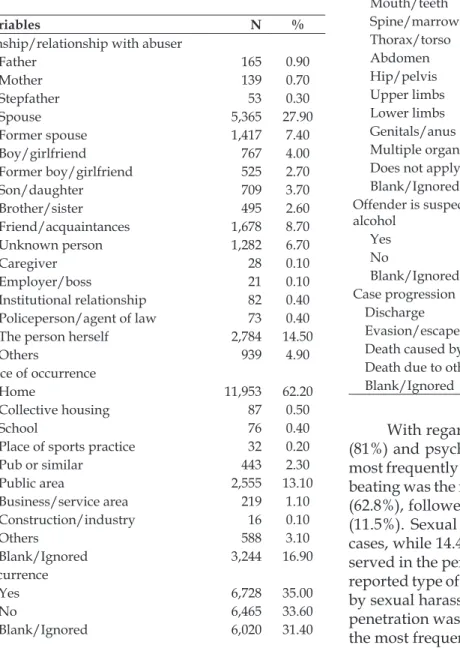
Most abused women were between 20 and 29 years old (36.9%), Caucasian (37.9%), and married (40.2%) (Table 1). The woman’s partner was the abuser most frequently reported (27.9%), followed by self-inliction (14.5%). The women’s residences were the place where aggressions took place most frequently (62.2%), the head/face was the part of the body most frequently affected (27.6%), and most cases progressed to discharge (87.1%). Note that 193 deaths caused by violence were reported in the period (Table 2).
Table 1 – Socioeconomic profile of violence against women reported to the Notiiable Diseases Information System, Minas Gerais, Brazil, 2011-2012. (N=19.213)
Variables N %
Age
19 years old 748 3.90
20 to 29 years old 7,081 36.90 30 to 39 years old 5,772 30.00 40 to 49 years old 3,176 16.50 50 to 59 years old 1,404 7.30
60 to 69 years old 589 3.10
70 to 79 years old 281 1.50
80 years old or older 162 0.80 Race
Caucasian 7,279 37.90
Afro-descendent 2,344 12.20
Asian 186 1.00
Mixed 5,753 29.90
Indigenous 126 0.70
Blank/Ignored 3,525 18.30
Education
Illiterate 321 1.70
1st to incomplete 4th grade 1,449 7.80 Complete 4th grade 957 5.00 5th to incomplete 8th grade 2,777 14.50
Complete 9th 1,234 6.40
Incomplete high school 1,156 6.00 Complete high school 2,045 10.60 Incomplete College Education 386 2.00
Bachelor’s degree 438 2.30
Does not apply 3 0.01
Blank/Ignored 8,397 43.70
Marital Status
Single 5,607 29.20
Married/ixed partner 7,716 40.20
Separated 1,459 7.60
Widowed 632 3.30
Does not apply 161 0.80
Table 2 – Epidemiological profile of violence against women reported to the Notiiable Diseases Information System, Minas Gerais, Brazil, 2011-2012. (N=19,213)
Variables N %
Kinship/relationship with abuser
Father 165 0.90
Mother 139 0.70
Stepfather 53 0.30
Spouse 5,365 27.90
Former spouse 1,417 7.40
Boy/girlfriend 767 4.00
Former boy/girlfriend 525 2.70
Son/daughter 709 3.70
Brother/sister 495 2.60
Friend/acquaintances 1,678 8.70
Unknown person 1,282 6.70
Caregiver 28 0.10
Employer/boss 21 0.10
Institutional relationship 82 0.40 Policeperson/agent of law 73 0.40 The person herself 2,784 14.50
Others 939 4.90
Place of occurrence
Home 11,953 62.20
Collective housing 87 0.50
School 76 0.40
Place of sports practice 32 0.20
Pub or similar 443 2.30
Public area 2,555 13.10
Business/service area 219 1.10 Construction/industry 16 0.10
Others 588 3.10
Blank/Ignored 3,244 16.90
Recurrence
Yes 6,728 35.00
No 6,465 33.60
Blank/Ignored 6,020 31.40
Variables N %
Body part affected
Head/face 5,311 27.60
Neck 646 3.40
Mouth/teeth 256 1.30
Spine/marrow 117 0.60
Thorax/torso 734 3.80
Abdomen 386 2.00
Hip/pelvis 91 0.50
Upper limbs 2,773 14.40
Lower limbs 805 4.20
Genitals/anus 333 1.70
Multiple organs 2,793 14.50
Does not apply 2,827 14.70
Blank/Ignored 2,141 11.10
Offender is suspected of having used alcohol
Yes 5,907 30.70
No 5,829 30.40
Blank/Ignored 7,477 38.90
Case progression
Discharge 16,738 87.10
Evasion/escape 234 1.20
Death caused by violence 193 1.00 Death due to other causes 24 0.10
Blank/Ignored 2,024 10.60
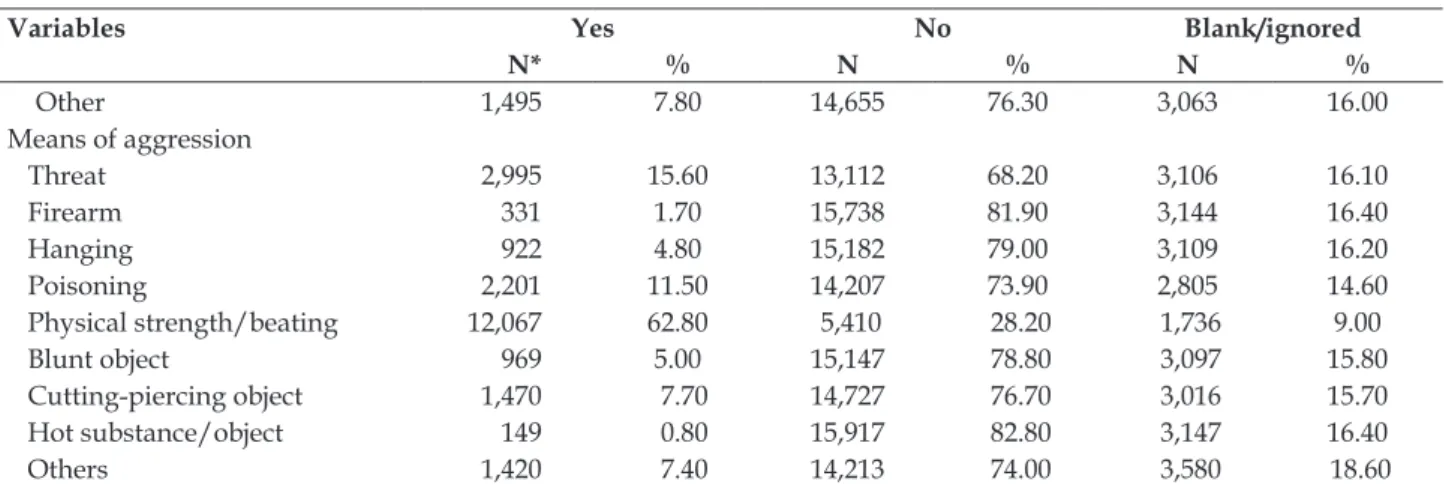
With regard to the type of violence, physical (81%) and psychological (28.2%) violence was the most frequently reported, while physical strength/ beating was the most common means of aggression (62.8%), followed by threat (15.6%) and poisoning (11.5%). Sexual violence represented 5.6% of the cases, while 14.4% of missing information was ob-served in the period (Table 3). The most frequently reported type of violence was rape (4.5%), followed by sexual harassment with 0.9%. In cases in which penetration was reported, vaginal penetration was the most frequent (4.0%).
Table 3 – Distribution of frequency of types and means of violence against women, Minas Gerais, Brazil, 2011-2012. (N=19.213)
Variables Yes No Blank/ignored
N* % N % N %
Types of violence
Financial 343 1.80 15,987 83.20 2,883 15.00
Physical 15,557 81.00 2,617 13.60 1,039 5.40
Legal intervention 51 0.30 16,211 84.40 2,951 15.40
Neglect 212 1.10 16,141 84.00 2,860 14.90
Psychological 5,423 28.20 11,169 58.10 2,621 13.60
Sexual 1,071 5.60 15,362 80.00 2,780 14.40
Torture 573 3.00 15,721 81.80 2,919 15.20
Variables Yes No Blank/ignored
N* % N % N %
Other 1,495 7.80 14,655 76.30 3,063 16.00
Means of aggression
Threat 2,995 15.60 13,112 68.20 3,106 16.10
Firearm 331 1.70 15,738 81.90 3,144 16.40
Hanging 922 4.80 15,182 79.00 3,109 16.20
Poisoning 2,201 11.50 14,207 73.90 2,805 14.60
Physical strength/beating 12,067 62.80 5,410 28.20 1,736 9.00
Blunt object 969 5.00 15,147 78.80 3,097 15.80
Cutting-piercing object 1,470 7.70 14,727 76.70 3,016 15.70
Hot substance/object 149 0.80 15,917 82.80 3,147 16.40
Others 1,420 7.40 14,213 74.00 3,580 18.60
*Some events included more than one type and means of aggression.
When types of violence were related to age, the group with the highest number of report was that of women aged from 20 to 29 years old, in which physical violence (30.3%) predominated, followed by psychological (9.9%) and sexual (2.2%) violence. The second most affected group included women aged from 30 to 39 years old, in which physical vio-lence (24.6%) was also the most common, followed
by psychological (8.7%), sexual (1.4%) violence, and torture (1.0%). A higher incidence of physical (335.7 cases/100,000 women) and psychological violence (109.6 cases/100,000 women) was observed among women aged from 20 to 29 years old, while sexual violence was the most common among 19 year-old women (38.6 cases/100,000 women) (Table 4).
Table 4 – Distribution of frequency, proportion and incidence of violence according to type of aggression and age, Minas Gerais, Brazil, 2012. (N=19.213)
Types of violence*
19 years old
20 to 29 years old
30 to 39 years old
40 to 49 years old
50 to 59 years old
60 to 69 years old
70 to 79 years old
80 years old or older
Financial N 4 83 104 54 32 31 17 18
% 0.02 0.40 0.50 0.30 0.20 0.20 0.09 0.09
I 2.30 4.80 6.70 3.79 2.78 4.40 3.90 8.10
Physical N 612 5,831 4,722 2,550 1,118 455 183 86
% 3.20 30.30 24.60 13.30 5.80 2.40 1.00 0.40
I 325.70 335.70 304.70 178.80 97.10 64.60 42.40 38.60
Legal interven-tion
N 2 15 17 9 5 3 0 0
% 0.01 0.08 0.09 0.05 0.03 0.02 0.00 0.00
I 1.20 0.90 1.10 0.60 0.40 0.4 0 0
Neglect N 6 25 24 20 15 19 50 53
% 0.03 0.10 0.10 0.10 0.08 0.10 0.30 0.30
I 3.40 1.40 1.50 1.40 1.30 2.70 11.60 23.80
Psychological N 187 1,903 1,671 908 397 209 85 63
% 0.90 9.90 8.70 4.70 2.00 1.10 0.40 0.30
I 107.70 109.60 107.80 63.70 34.50 29.60 19.70 28.30
Sexual N 67 427 275 183 68 26 13 12
% 0.40 2.20 1.40 1.00 0.30 0.10 0.07 0.06
I 38.60 24.60 17.70 12.80 5.90 3.70 3.00 5.40
Torture N 17 185 195 99 43 19 10 5
% 0.10 1.00 1.00 0.50 0.20 0.10 0.05 0.03
I 0.60 0.10 0.10 0.00 0.20 0.00 0.00 0.00
Other N 50 512 471 293 120 34 10 5
% 0.30 2.60 2.40 1.50 0.60 0.20 0.05 0.03
I 28.80 29.50 30.40 20.50 10.40 4.80 2.30 2.20
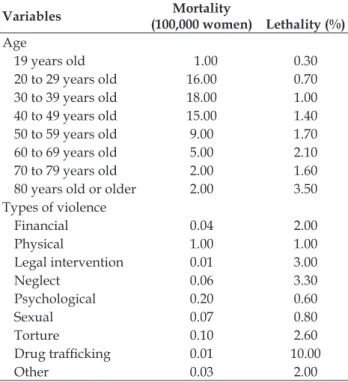
Mortality was the most frequent among wom-en aged from 30 to 39 years old (18 deaths/100,000 women) and between 20 and 29 years old (16 deaths/100,000 women). In terms of types of vio-lence, mortality was higher in cases in which physi-cal violence was involved (1 death/100,000 women). Lethality was more severe among women aged 80 years old or older (3.5%), followed by those aged between 60 and 69 years old (2.1%), and in cases in which violence was related to human traficking (10%) and neglect (3%) (Table 5).
Table 5 – Distribution of mortality and lethality rates caused by violence against women according to age and type of violence, Minas Gerais, Brazil, 2012. (N=19.213)
Variables Mortality
(100,000 women) Lethality (%) Age
19 years old 1.00 0.30
20 to 29 years old 16.00 0.70 30 to 39 years old 18.00 1.00 40 to 49 years old 15.00 1.40 50 to 59 years old 9.00 1.70 60 to 69 years old 5.00 2.10 70 to 79 years old 2.00 1.60 80 years old or older 2.00 3.50 Types of violence
Financial 0.04 2.00
Physical 1.00 1.00
Legal intervention 0.01 3.00
Neglect 0.06 3.30
Psychological 0.20 0.60
Sexual 0.07 0.80
Torture 0.10 2.60
Drug traficking 0.01 10.00
Other 0.03 2.00
Even though 22.2% of information on how the cases progressed and respective referrals was missing (data not presented in the table), more than half (52.3%) was referred to outpatient clinics and most victims were discharged (87.1%); 1.0% of these women, however, died due to the consequences of the violence.
This analysis presents some limitations, since some variables presented high levels of missing information (more than 20% of information was ignored or left blank)9 and for this reason was not
described, such as data concerning violence against pregnant women (28.0%), level of education (43.7%), and violence against women with disabilities/dis-orders (26.9%).
DISCUSSION
Increased reporting on violence against women and increased number of cities reporting such cases observed between the two years under study (2011 and 2012) is relevant and may be ex-plained by greater investment in the qualiication of healthcare workers, which improved violence reports15 and made the system more sensitive to the
identiication of cases.
Most professionals in 291 healthcare services in the State of São Paulo, Brazil reported that they complete the mandatory reporting form, though they also reported dificulties regarding work over-load and a lack of understanding, in the context of integral care, regarding the importance of such reporting. Strategies intended to encourage workers to adopt violence reporting as part of their practice are necessary, as well as the proper valuation of the care provided to these women as one of the vari-ous roles played by healthcare services.16 We can
empirically observe that nursing professionals ile reporting forms in most healthcare services and also adopt the measures required.
Among this study’s victims, most were be-tween the age of 20 and 29 years old, which is in agreement with other studies.17-19 These indings
may relect the Brazilian culture, in which men, feeling insecure in the face of a woman’s beauty at this age and by the fact she may draw attention of other men, act violently and authoritatively.17
With regard to the victims’ ethnicity, most were Caucasian, followed by mixed race, a result that is in agreement with the population; most peo-ple in the state report being Caucasian. Additionally, until recently, violence against Afro-descendent women used to be ignored and underreported.18-20
Despite the impossibility of assessing the women’s social status and education, due to missing information in the database, a low social status and low level of education may be a point in common among female victims of violence,21 though not
among all cases; violence does take place in any economic or cultural environment.19,21
In terms of marital status, an intimate re-lationship was observed between victims and offenders as most victims were married, in line with studies in which intimate partners were the offenders,8,19,22 due to relationships of dominance
being resilient for the sake of their children, who aroused a feeling of duty and responsibility for their mother role, detaching themselves from the traumatic experience.23
The domestic environment was a fertile ground for violence because it is a private place with little interference of other people.17,19,22 The Maria da
Penha Law needs to be disseminated, implemented and enforced,8,24 with the collaboration of the system
of defense, protection and assistance to female vic-tims of violence, together with healthcare services, social welfare, police, legal system, women’s police stations and others.
The types of violence most frequently re-ported were physical and psychological violence, as reported by other studies.17,19 There are, however,
studies in which this order is inverse,22,15 while
sexual violence also appears as the most frequent after psychological violence.
Physical strength/beating was the most fre-quent means of aggression: most women suffered contusions and the most affected part of the body was head/face, which is also in agreement with the reports of other authors.17,19 The head/face is a
sym-bolic region that denotes humiliation and represents an act against human dignity.17
Psychological violence is still underreported because many women do not seek help, while violence does not become physical.25 Psychological
violence may be attributed to the devaluation of women, decreasing their self-esteem and, in more severe cases, leading to suicidal thoughts.26 Types
of violence may overlap in many cases, especially psychological and physical violence.19,25
Self-inflicted violence may indicate social discomfort and suffering, as some people see them-selves as unable to solve conlicts and opt for taking drastic measures against their own health or life, for instance, intentional intoxication by medication or nonspeciic biological substances.27-28
Even though one of this study’s limitations is the secondary database used, the reporting form contains a variable that distinguishes between new cases and reoccurrences; the latter refers to 35% of the cases. Thus, one has to take into account that vio-lence can occur in different situations and be char-acterized by different types of aggression, such as sexual or physical violence, torture, or self-inlicted (suicide and suicide attempts, among others).
Sexual violence tends to go underreported because it makes women feel dirty and ashamed and feel a desire to become invisible. Sexual abuse may
lead to anxiety and depression and lead women to abuse of alcohol, drugs or the experience of eating disorders that may last one’s entire life.29
A small proportion (0.04%) of violence related to child labor was found, but it was probably due to some mistake in the completion of forms or typo, since this database includes only 19 year-old or older women.
The consumption of alcohol on the part of of-fenders was high, despite some missing information. Suspicion of alcohol abuse follows trends reported by other studies, in which the use of alcohol may trigger violent behavior,21,29 as well as the use of drugs, which
can increase the likelihood of aggression.21
The recurrence of violence in this study was two thirds lower than that found in another study.22
This difference is partly related to the fact that this variable missed information in the mandatory reporting forms from the State of Minas Gerais. The insistency of women in keeping an affective relationship, hoping the partner will have a change of behavior, as well as inancial and emotional de-pendency established with partners/spouses, may favor the repetition of aggressions.26
The repetition of this phenomenon may be an indirect indicator of how weak public policies are in terms of measures aimed to stop violence against women in the State of Minas Gerais, as well as the system that ensures the rights of people, showing that the public sector needs to implement strategies to prevent new cases and recurrences.
Slightly more than half of the reported cases were referred to outpatient clinics, as opposed to a study addressing violence reported in the prem-ises of the Hospital das Clinicas, Universidade Federal de Uberlândia, MG, Brazil, in which only 17.6% of cases had a similar outcome. This divergence may be explained by the setting where the study was conducted;17 this study refers to reports submitted
by all health services in the State of Minas Gerais. A study30 that investigated femicides in
Brazil considering all ages30 veriied, similarly to
this study, that greater mortality was observed among women aged between 30 and 39 years old and between 20 and 29 years old. Note that female homicides in Brazil represent 10% of total mortality caused by aggression.
chauvinist and patriarchal conception that rules the society, leading to violence and potentially deaths.30
Higher levels of urban violence and an increased number of events related to external causes contrib-ute to increased mortality among women.
Over the years, violence started manifesting mainly in the form of abandonment, neglect, physi-cal abuse and economic exploitation, probably due to increased longevity of elderly women.31 This
study also reveals that lethality was predominant among 80 year-old or older women, which may also be related to associated comorbidities present at this age.31 Violence against the elderly more frequently
occurs at home,32-33 which may be caused by a sense
of devaluation of seniors and when different genera-tions live together. When various family members live in the same home, conlict of generation and values may arise and be worsened by the senior’s vulnerability or frailty,34 and also exacerbated by
relationships in which inancial dependence, weak affective bonds, or the presence of any mental or psychiatric disorder exist, among others.35
CONCLUSION
Violence against adult women most frequently affected young women, between 20 and 39 years of age, Caucasian or mixed race individuals, married or with a ixed partner, while their spouses were most frequently the offenders. Violence in general took place in the victim’s household and in most cases the care provided at the health services progressed to discharge. Women were mainly victims of physical violence, that is, physical strength/beating, and were hit on their heads/faces; the second most frequent type of violence was threat. Mortality was higher among women aged between 30 and 39 years old, mainly caused by physical violence; lethality was higher among 80 year-old or older women.
Information missing in some of the ields of reporting forms shows the need to qualify profes-sionals and incorporate epidemiological surveil-lance actions to the work routine of healthcare services, as well as to disseminate the low of victims cared for in the healthcare system to improve the completion of reporting forms and grant visibility to the importance of implementing measures that ensure the rights of women experiencing violence.
REFERENCES
1. World Health Organization (WHO), London School of Hygiene and Tropical Medicine. Preventing intimate partner and sexual violence against women: taking
action and generating evidence. Geneva: WHO; 2010.
2. Secretaria de Políticas para as Mulheres (BR). Política Nacional de enfrentamento à violência contra as mulheres. Brasília: Presidência da República; 2011. 3. Osis MJD, Duarte GA, Faúndes A. Violência
entre usuárias de unidades de saúde: prevalência, perspectiva e conduta de gestores e proissionais. Rev Saúde Pública. 2012 Abr; 46(2):351-8.
4. Sánchez PM, Parra SG, Garcia OM. Violencia basada
en género en zonas urbanas y urbano-marginales de
Lima y Callao, 2007–2010. An Fac Med. 2012 Mai; 73(2):127-33.
5. Moura LBA, Gondoli L, Vasconcelos AMN, Pratesi R. Violências contra mulheres por parceiro íntimo em área urbana economicamente vulnerável. Rev Saúde Pública. 2009 Dez; 43(6):1-9.
6. Miranda MPM, Paula CS, Bordin IA. Violência conjugal física contra a mulher na vida: prevalência e impacto imediato na saúde, trabalho e família. Rev
Panam Salud Publica. 2010 Dez; 27(4):300-8.
7. Santos ACW, Moré CLOO. Repercussão da violência na mulher e suas formas de enfrentamento. Padéia.
2011 Ago; 21(49):227-35.
8. Acosta DF, Gomes VLO, Fonseca AD, Gomes GC. Violence against women commited by intimate partners:(in)visibility of the problem. Texto Contexto Enferm [Internet]. 2015 Jan-Mar [cited 2015 Jul 03]; 24(1):121-7.Available from: http://www.scielo.br/ pdf/tce/v24n1/pt_0104-0707-tce-24-01-00121.pdf 9. Brasil. Lei n. 11.340, de 07 de agosto de 2006. Lei Maria
da Penha. Regulamenta ações de enfrentamento à violência contra a mulher. Diário Oicial da União,
07 Ago 2006.
10. Kiss LB, Schraiber LB. Temas médico-sociais e a intervenção em saúde: a violência contra mulheres no discurso dos proissionais. Ciênc Saúde Coletiva.
2011 Abr; 16(3):1943-52.
11. Brasil. Portaria n. 2.406, de 5 novembro de 2004. Institui serviço de notificação compulsória de
violência contra a mulher nos serviços de saúde, e aprova instrumento e luxo para notiicação. Diário Oicial da União, 9 Nov. 2004.
12. Ministério da Saúde (BR). Secretaria de Vigilância em Saúde. Instrutivo para preenchimento da Ficha de Notiicação/Investigação Individual de Violência Doméstica, Sexual e/ou outras violências no Sistema de Informação de Agravos de Notiicação. Brasília
(DF): MS; 2011.
13. Romero DE, Cunha CB. Avaliação da qualidade das
va-riáveis sócio-econômicas e demográicas dos óbitos de
crianças menores de um ano registrados no Sistema de
Informações sobre Mortalidade do Brasil (1996/2001). Cad Saúde Pública. 2006 Mar; 22(3):673-84.
14. Oliveira MEP, Soares MRAL, Costa MCN, Mota ELA. Avaliação da completitude dos registros de febre
Serv Saúde. 2009 Set; 18(3):219-26.
15. Veloso MMX, Magalhães CMC, Dell’Aglio DD,
Cabral IR, Gomes MM. Notificação da violência como estratégia de vigilância em saúde: peril de uma metrópole do Brasil. Ciênc Saúde Coletiva. 2013;
18(5):1263-72.
16. Sousa MH, Bento SF, Osis MJD, Ribeiro MP, Faúndes.
Filling out the compulsory notification in health services that care for women who suffer from sexual violence. Rev Bras Epidemiol. 2015 Jan-Mar; 18(1):94-107.
17. Garcia MV, Ribeiro LA, Jorge MT, Pereira GR, Resende
AP. Caracterização dos casos de violência contra a mulher atendidos em três serviços na cidade de Uberlândia, Minas Gerais, Brasil. Cad Saúde Pública.
2008 Nov; 24(11):2551-63.
18. Sousa AKA, Nogueira DA, Gradim CVC. Peril da violência doméstica e familiar contra a mulher em um município de Minas Gerais, Brasil. Cad Saúde Pública.
2013 Dez; 21(4):425-31.
19. Ministério da Saúde (BR). Secretaria de Vigilância em Saúde. Departamento de Análise de Situação de Saúde. Saúde Brasil 2011: uma análise da situação de saúde e a vigilância da saúde da mulher. Brasília (DF):
MS; 2012.
20. Silva SG. Preconceito e Discriminação: As Bases da
Violência Contra a Mulher. Psicol Cienc Prof. 2010
Set; 30(3):556-71.
21. Deeke LP, Boing AF, Oliveira WF, Coelho EBS. A
dinâmica da violência doméstica: uma análise a partir
dos discursos da mulher agredida e de seu parceiro.
Saúde Soc. 2009 Jun; 18(2):248-58.
22. Vieira LJES, Ferreira RC, Moreira GAR, Gondim
APS, Araújo MAL, Silva RM. Fatores associados à sobreposição de tipos de violência contra a mulher
notificada em serviços sentinela. Rev Latino-Am Enfermagem. 2013 Ago; 21(4):8 telas .
23. Labronici LM. Resilience in women victims of domestic violence: a phenomenological view. Texto Contexto Enferm [Internet]. 2012 Set [cited 2015 Jul 03]; 21(3):625-32. Available from: http://www.scielo. br/pdf/tce/v21n3/en_v21n3a18.pdf
24. Secretaria de Enfrentamento à Violência Contra
Mulheres (SEV); Pacto Nacional pelo Enfrentamento
à violência contra mulher, 2014 [Internet]. 2011 Fev
www.spm.gov.br/subsecretaria-de-enfrentamento-a-violencia-contra-mulher
25. Schraiber LB, Latorre MRD, França IJr, Sergri NJ, D’Oliveira AFPL. Validade do instrumento WHO
VAW STUDY para estimar violência de gênero contra a mulher. Rev Saúde Pública. 2010 Ago; 44(4):658-66.
26. Zancan N, Wassermann NN V, Lima GQde. A
violência doméstica a partir do discurso de mulheres
agredidas. Pensando Fam. 2013 Set; 17(1):63-7. 27. Monteiro RA, Bahia CA, Paiva EA, de Sá NNB,
Minayo MCS. Hospitalizações relacionadas a lesões
autoprovocadas intencionalmente – Brasil, 2002 a
2013. Ciênc Saúde Coletiva. 2015 Jun; 20(3):689-99. 28. Braga LL, Dell’Aglio DD. Suicídio na Adolescência:
fatores de risco, depressão e gênero. Contextos Clínicos. 2013 Jan-Jun; 6(1):1-14.
29. Souza FBC, Drezett J, Meirelles AC, Ramos DG. Aspectos psicológicos de mulheres que sofrem
violência sexual. Reprod Clim. 2013 Mar; 7(3):98-103. 30. Meneghel SN, Hirakata VN. Femicídios: homicídios femininos no Brasil. Rev Saúde Pública. 2011 Nov;
45(3):564-74.
31. Santos AJ, Nicolau R, Fernandes AA, Gil AP.
Prevalência da violência contra as pessoas idosas: uma revisão crítica da literatura. Sociologia, Problemas e
Práticas. 2013 Abr; 72 :53-77.
32. Abath MB, Leal MCC, Melo Filho DA. Fatores
associados à violência doméstica contra a pessoa
idosa. Rev Bras Geriatr Gerontol. 2012; 15(2):305-14.
33. Valadares FC, Souza ER. Violência contra a pessoa idosa: análise de aspectos da atenção de saúde mental
em cinco capitais brasileiras. Cien Saude Colet 2010 Set; 15(6):2763-74.
34. Rabelo DF, Neri AL. Tipos de coniguração familiar e condições de saúde física e psicológica em idosos. Cad Saúde Pública. 2015 Abr; 31(44):874-84.
35. Minayo MCS, Souza ER. As múltiplas mensagens da violência contra idosos. In: Minayo MCS, Souza ER, organizadores. Violência sob o olhar da saúde: a infrapolítica da contemporaneidade brasileira. Rio de
Janeiro (RJ): Editora Fiocruz; 2003.
Correspondence:Sybelle de Souza Castro
NUVE - Hospital de Clínicas UFTM Av. Getúlio Guaritá, 330
38025-440 – Uberaba, MG, Brasil E-mail: [email protected]