Copyright © 2007 by Sociedade Brasileira de Pediatria
O
RIGINALA
RTICLERandomized clinical trial of the impact
of a nutritional supplement “multimixture”
on the nutritional status of children enrolled
at preschools
Denise P. Gigante,1 Márcia Buchweitz,2 Elizabete Helbig,3 Ângela S. Almeida,4
Cora L. Araújo,1 Nelson A. Neumann,5 Cesar Victora6
Abstract
Objective:To evaluate the effect of adding a nutritional supplement “multimixture” to school meals on the nutritional status of children enrolled at municipal preschools.
Methods:Longitudinal, controlled intervention study of 24 preschools which were compared before and after an intervention. The control and intervention groups were defined by drawing lots to choose schools that had previously been paired for nutritional status. The intervention consisted of the addition of 10 g of multimixture to the meals provided to children attending the 12 schools in the intervention group. Outcome measures include changes in z scores for the three nutritional indices and hemoglobin values over the 6-month period during which the supplement was added. A multilevel model was used for analyses.
Results:Mean z scores for weight for age at the end of follow-up were 0.40 (±1.34) and 0.31 (±1.32) for the intervention and control groups, respectively. The multilevel analysis demonstrated non-significant differences in favor of the intervention in mean z scores for weight for age (β0.05; 95%CI -0.03 to 0.12) and height for age (β0.02; 95%CI -0.06 to 0.09). Mean change in hemoglobin was against the intervention, but this was also without significance (β-0.01; 95%CI -0.36 to 0.34).
Conclusions:Supplementation with 10 g of multimixture did not have a significant effect on any of the nutritional indices or measurements of the municipal preschool pupils studied here.
J Pediatr (Rio J). 2007;83(4):363-369:Children, dietary supplements, clinical trial.
1. Doutora. Departamento de Nutrição e Programa de Pós-Graduação em Epidemiologia, Universidade Federal de Pelotas (UFPel), Pelotas, RS, Brasil. 2. Doutor. Departamento de Nutrição, UFPel, Pelotas, RS, Brasil.
3. Mestre. Departamento de Nutrição, UFPel, Pelotas, RS, Brasil. 4. Especialista. Departamento de Nutrição, UFPel, Pelotas, RS, Brasil. 5. Doutor. Pastoral da Criança, UFPel, Pelotas, RS, Brasil.
6. Doutor. Departamento de Medicina Social e Programa de Pós-Graduação em Epidemiologia, Universidade Federal de Pelotas (UFPel), Pelotas, RS, Brasil.
Financial support: Fundação de Amparo à Pesquisa do Estado do Rio Grande do Sul (FAPERGS), protocol no. 02/0827.6, and Pastoral da Criança, Universidade Federal de Pelotas (UFPel).
Suggested citation:Gigante DP, Buchweitz M, Helbig E, Almeida AS, Araújo CL, Neumann NA, et al. Randomized clinical trial of the impact of a nutritional supplement “multimixture” on the nutritional status of children enrolled at preschools. J Pediatr (Rio J). 2007;83(4):363-369.
Manuscript received Oct 30 2006, accepted for publication Apr 05 2007.
doi 10.2223/JPED.1650
Introduction
Alternative nutrition based on the powdered supplement known as “multimixture” is one of the strategies that the Pastoral da Criança has been employing to combat the nutritional problems of certain sections of the population. The theory is that the supplement increases the nutritional value of the diet, improving its quality with the addition of low cost foods that are rich in micronutrients.
The composition of the multimixture can vary depending on the produce available in each region, but the basic composition is rice or wheat bran, powdered cassava leaves, powdered egg shell and pumpkin or sunflower seeds. In general the ingredients have relatively few calories, but offer elevated concentrations de minerals, vitamins and fiber.1
Critics of the multimixture argue that interactions between certain nutrients, such as iron, zinc and calcium, could mutually interfere with each other’s bioavailability rates, which itself could be further reduced by phytates in the bran.1,2Questions have also been raised about the hygienic
and sanitary conditions of products produced at the domestic level, and especially of brans, industrial by-products that are often used in animal feeds and which may exhibit highly variable hygienic conditions.3
Although the multimixture is widely used nationwide, and is also the subject of criticism from professional associations,4,5few controlled studies could be identified in
the literature that had evaluated the impact of the multimixture.6,7It should also be pointed out that the studies
that were found were not randomized and suffer methodological limitations.
The objective of this study was to evaluate the effect of supplementing school meals with multimixture on the nutritional status of children enrolled at municipal preschools.
Methods
This was a controlled, longitudinal intervention study, in which all 24 preschools in the city of Pelotas, RS, Brazil, were allocated at random to a group that received the multimixture or a group that did not.
The intervention began in June of 2004, in the 12 chosen schools and lasted for 6 months. The other 12 schools made up the control group in which no intervention was implemented. At the intervention schools, every child older than 12 months was given 10 g of multimixture daily from Monday to Friday, added to the food provided by the school. The parcels of multimixture were prepared according to the mean number of children per school and were distributed weekly by the Education Department’s school meals service. Foodservice workers were instructed to add the multimixture to beans as a first choice, or, alternatively to soups, lentils or
any other food that can be reheated at distributed at a minimum temperature of 60 ºC.8 Before the intervention
began, all of the foodservice workers at all 24 schools were trained in food preparation hygienic and sanitary precautions. During the intervention, professors and students from the Nutrition Department of the Universidade Federal de Pelotas acted as supervisors at the intervention schools in order to support the school team to prepare and distribute the food supplemented with the multimixture.
The multimixture produced by the Pastoral da Criança in Pelotas is made up of 30% rice bran, 30% wheat bran, 10% wheat flour, 15% corn flour, 5% powdered cassava leaves, 5% powdered egg shells and 5% powdered pumpkin or sunflower seeds. In order to guarantee the hygienic and sanitary safety of the multimixture, a best manufacturing practices and hazard analysis and critical control point (HACCP) system was implemented. The system involves the team responsible for producing the multimixture in Pelotas, professors from the Nutrition Department at the Universidade Federal de Pelotas and the nutritionist responsible for school meals at the municipal preschools of Pelotas.
Outcome measures included change in weight and height by difference in z scores for height/age, weight/age and weight/height and differences in hemoglobin levels over the 6 months of the study.
Both at baseline and during follow-up, measurements of weight and height were taken according to the technique standardized by Lohmann.9 Hemoglobin was assayed in
peripheral blood using a portable hemoglobin meter, HemoCue brand. Weight and height were measured using a portable digital electronic balance, SECA brand, with a 150 kg capacity, accurate to 100 g (UNICEF, Copenhagen) and a wooden anthropometer produced locally according to the AHRTAG model (London, United Kingdom). Nutritionist and nursing technicians were hired, trained and standardized to take anthropometric measurements and blood samples, respectively. A control cuvette was used to calibrate the hemoglobin meter daily in accordance with the manufacturer's instructions and a standard weight was used weekly to calibrate the balances. The anthropometric measurements were compared to the National Center for Health Statistics (NCHS) reference values10and expressed in
z scores for weight for height, weight for age and height for age. Hemoglobin levels were expressed in g/dL and 11 g/dL was set as the cutoff point for defining anemia, as proposed by the World Health Organisation (WHO).11 The WHO
nutritional deficits definitions,12by which a z score of -2 is
A structured questionnaire was developed to pertained to obtain socio-economic information on families and previous health and nutrition history of the children. These questionnaires were applied to the mothers or guardians of the children. Data on maternal education, family income, duration of breast-feeding, previous morbidity and hospitalizations, and the use of medications and dietary supplements were analyzed.
Since the study unit was the school, the sample size was defined as the total number of schools in the city, which was 24. With 12 schools in each group and an average of 50 children per school, this sample is large enough to detect a difference between groups of around 40%. For example, a 0.05 mean gain in the z score in the control group compared to a 0.07 gain in the intervention group, or a mean gain in hemoglobin of 0.5 g/dL in the control group, but 0.7 in the intervention group. For these differences, the level of confidence is 95%, statistical power is 80% and the coefficient of variation between groups is 25%. This sample size calculated for group-randomized trials13is also sufficient
to detect a difference between groups of around 50%, assuming a statistical power of 90% or a coefficient of variation of 30%.
During April and May of 2004 a baseline study was undertaken, with anthropometric evaluation and capillary hemoglobin assay, including the children enrolled at the 24 schools. These schools are administrated by the Municipal Education Department and are located in suburban neighborhoods of the city of Pelotas. In order to select schools for the control and intervention groups, the 24 schools were paired by mean z scores for height for age, obtained during the baseline study, with one school from each pair chosen for the intervention group by lots.
It was impossible to carry out a double-blind trial because of the characteristics of the intervention and changes in the texture and, possibly, flavor of meals.
This study was approved by the Ethics Commission at the Universidade Federal de Pelotas Medical Faculty, affiliated to the National Council for Ethics in Research (Conselho Nacional de Ética em Pesquisa, CONEP), and all procedures carried out with children were done so after written informed consent was given by the child’s mother or guardian.
The intervention and control groups were compared in terms of their baseline indicators, including demographic, socioeconomic and nutritional characteristics. Later, the evolution of outcome measures were compared between the two groups. Analyses were carried out using a multilevel model. The first level comprised the schools and the next level was the children at each school. This approach allows interdependencies between children attending the same school to be considered. Data were double input, allowing for
comparison and correction of possible typing errors. Comparisons between the characteristics of the children in the two groups were carried out using SPSS 8.0, and multilevel analysis was performed with MLWin 2.0 software (Multilevel Models Project, Institute of Education, London, United Kingdom).
Results
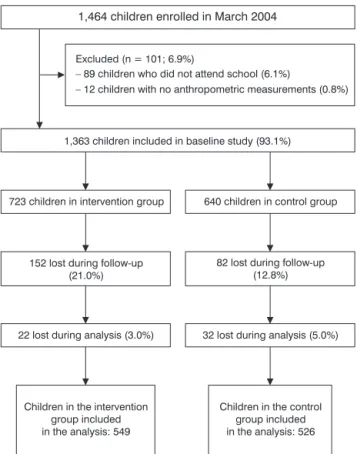
From the total number of children enrolled at the schools in March of 2004, 1,075 were effectively followed until the end of the study, comprising 78.2% of children who attended the schools during the months of April and May, when the baseline study was carried out (Figure 1).
Distribution by sex, class and school of the 1,464 children enrolled in March 2004 was similar to the distribution observed of the 1,075 who were followed-up, since no differences in terms of losses were observed between the groups. There was no difference in the mean ages of the children who were followed during the period (51.8±17.5 months; n = 1,075) and the losses (53.2±17.3 months; n = 288). All of the children attending the 24 schools in April and May 2004 were included in the analysis.
Comparison of the demographic and socioeconomic characteristics of the children included in the study demonstrated that there was no difference between the groups in terms of sex or age. Half of the children were male and 22% were aged 12 to 36 months of age, while 39% were more than 60 months old at the start of the study. A minor difference in relation to mean family income was observed: 2.0 times the minimum monthly wage in the control group and 1.8 times in the intervention group (F = 3.976; p = 0.05). In the same manner, mean level of educational was discretely higher among the mothers in the intervention group (6.9 vs. 6.6 years; F = 3.415; p = 0.07), with no difference in fathers’ education (6.4 vs. 6.2 years for the control and intervention groups, respectively; F = 1.502; p = 0.22). No significant difference was observed in the children’ attendance at school. While 30% of the students had been enrolled at school during the previous 12 months, 34% had been attending for 36 months or more.
When data on the children’s health and nutrition was analyzed, differences were only observed in relation to number of hospitalizations. While 43% of the children in the intervention group had previously been hospitalized, the proportion was 38% for the children in the control group (chi-square = 6.34; p = 0.04). In contrast, the control group had a greater proportion of children who had attended a medical consultation during the previous year, but this difference was not statistically significant (chi-square = 3.56; p = 0.17). No difference was observed in relation to the use of vitamins or dietary supplements during the previous year between the children in the two groups, and it was confirmed
that 13% of the children in both intervention and control groups had been treated with ferrous sulphate (chi-square = 0.001; p = 1.0).
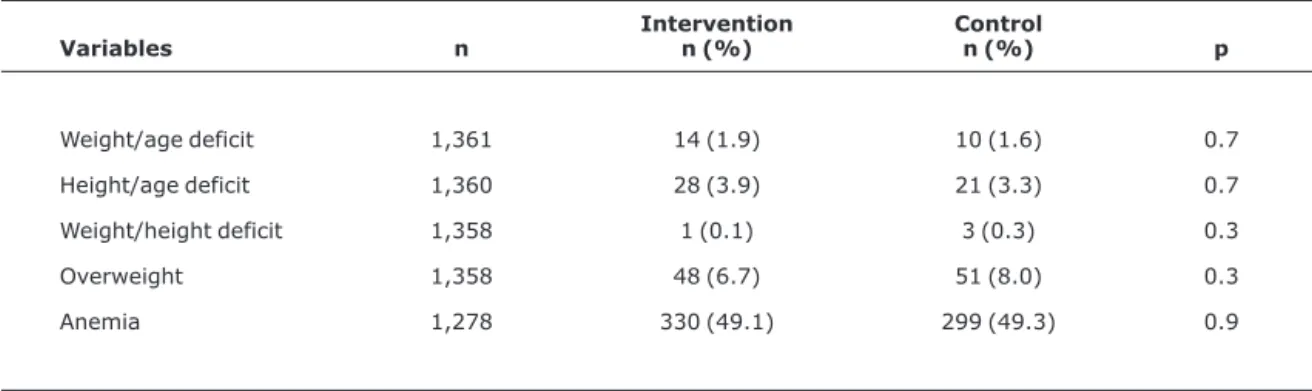
At baseline, less than 2% of the children at the preschools had a weight for age deficit (Table 1). There was no difference in this prevalence when the two groups of children were compared. Similarly, the prevalence rates of height for age deficit, overweight and anemia were similar in the control and intervention groups. While 3.6% of the children had linear growth deficit, 7.3% were classified as being overweight at the start of the study. The prevalence of anemia in both groups of children was almost 50% (Table 1).
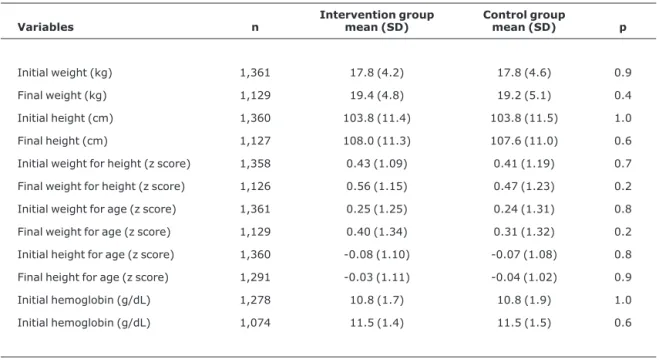
Table 2 lists the means for nutritional indices at the start and end of follow-up. No differences were observed between the two groups of children. After 6 months’ follow-up, all indices demonstrated positive changes.
Table 3 contains the results of the multilevel linear regression analysis, which takes into account both the individual variability of each child and also variability on the level of school. There were no significant differences in any of the measurements or indices studied. Neither were any differences detected in any of the nutritional indices in an analysis stratified by age (data not shown).
Discussion
Towards the end of the 1980s, institutions such as the Pastoral da Criança and o The United Nations Children’s Fund (UNICEF/Brazil) adopted and began to support alternative nutrition based on undervalued parts of foodstuffs – especially rice and wheat bran, cassava leaves and egg shells.
Table 1- Prevalence rates of nutritional disorders among children included in the baseline study (Pelotas, 2004)
Variables n
Intervention n (%)
Control
n (%) p
Weight/age deficit 1,361 14 (1.9) 10 (1.6) 0.7
Height/age deficit 1,360 28 (3.9) 21 (3.3) 0.7
Weight/height deficit 1,358 1 (0.1) 3 (0.3) 0.3
Overweight 1,358 48 (6.7) 51 (8.0) 0.3
Since that period several publications have been produced, but the use of these multimixtures for combating growth deficits still remains a controversial subject.14
In 1994, National Institute of Food and Nutrition (Instituto Nacional de Alimentação e Nutrição, INAN) began recommending that multimixture be used on a national level.15In the same year the Department of Dietary Planning
and Nutrition at UNICAMP published a technical paper16
calling attention to the possibility of interactions between nutrients, and recommended that multimixtures should not be used in food, particularly not for children, because of the non-existence of information on possible effects over the medium and long term resulting from the practice. The Federal Board of Nutritionists (Conselho Federal de Table 2- Nutritional characteristics of the children included in the baseline study (initial measurement) and followed-up (final
measurement) (Pelotas, 2004)
Variables n
Intervention group mean (SD)
Control group
mean (SD) p
Initial weight (kg) 1,361 17.8 (4.2) 17.8 (4.6) 0.9
Final weight (kg) 1,129 19.4 (4.8) 19.2 (5.1) 0.4
Initial height (cm) 1,360 103.8 (11.4) 103.8 (11.5) 1.0
Final height (cm) 1,127 108.0 (11.3) 107.6 (11.0) 0.6
Initial weight for height (z score) 1,358 0.43 (1.09) 0.41 (1.19) 0.7
Final weight for height (z score) 1,126 0.56 (1.15) 0.47 (1.23) 0.2
Initial weight for age (z score) 1,361 0.25 (1.25) 0.24 (1.31) 0.8
Final weight for age (z score) 1,129 0.40 (1.34) 0.31 (1.32) 0.2
Initial height for age (z score) 1,360 -0.08 (1.10) -0.07 (1.08) 0.8
Final height for age (z score) 1,291 -0.03 (1.11) -0.04 (1.02) 0.9
Initial hemoglobin (g/dL) 1,278 10.8 (1.7) 10.8 (1.9) 1.0
Initial hemoglobin (g/dL) 1,074 11.5 (1.4) 11.5 (1.5) 0.6
SD = standard deviation.
Table 3- Multilevel linear regression of the effect of intervention on the nutritional variables of the children followed-up (Pelotas, 2004)
Variables n β 95%CI p
Weight gain (kg) 1,075 0.13 -0.07 to 0.33 0.2
Height gain (cm) 1,072 0.08 -0.35 to 0.50 0.7
W/H z score gain 1,070 0.05 -0.04 to 0.14 0.3
W/A z score gain 1,074 0.05 -0.03 to 0.12 0.2
H/A z score gain 1,071 0.02 -0.06 to 0.09 0.7
Change in hemoglobin (g/dL) 985 - 0.01 -0.36 to 0.34 0.9
Nutricionistas) also took a position against the use of multimixtures until research has demonstrated their efficacy for combating malnutrition.4In the following year, a report
produced by a group of specialists, representatives of the scientific community, the Pastoral da Criança, UNICEF and INAN suggested that further research be undertaken to investigate three areas as a priority.15The first was to identify
and standardize procedures for preparing multimixtures in order to ensure adequate sanitary standards and the maximum biological yield of nutrients. The other two areas are evaluation of the impact of multimixtures by means of clinical trials and evaluation of effectiveness in the context of basic healthcare actions, nutrition and education, carried out by the Pastoral da Criança or other organizations that perform similar work in the community. This study has approached the first two priorities for investigation, in that the multimixture was prepared in accordance with sanitary standards and maximum biological yield of nutrients was established by the National Agency for Sanitary Vigilance (Agência National de Vigilância Sanitária, ANVISA).17Additionally, by means of the
controlled clinical trial study design, the efficacy of the multimixture was also assessed. However, the third priority area for action was not dealt with, since effectiveness was not evaluated in the context of basic healthcare actions, nutrition and education, carried out by the Pastoral da Criança.
More recently, studies have been published that attempted to demonstrate the efficacy of multimixtures for combating malnutrition.6,7These studies reported
contradic-tory results and should be treated with caution, since neither of them was randomized and the statistical tests employed compared groups of children without taking into account that the unit of analysis should have been the school. It should be pointed out that in one of these studies,6initial characteristics
of the children in the intervention and control groups are not given and the results of both studies were from raw analyses.6,7
The research described here was started in 2002, when the Municipal Education Department of Pelotas planned to include a multimixture in their School Meals Program. A team was set up of technicians and researchers from the Universidade Federal de Pelotas, the Pastoral da Criança and the Pelotas City Council and charged with seeking evidence that could justify or rule out implementation of the multimixture.
The Helsinki Declaration18 states that research is
justifiable when there is a reasonable probability that its results may bring benefits for the population being investigated. In the case of nutritional interventions, it is also important to the consider food quality standards laid out in the Codex Alimentarius.19 The multimixture used in this
intervention was developed in accordance with standards and criteria defined by the National Agency for Sanitary
Vigilance,17 and its hygienic and sanitary safety was
guaranteed by means of a best manufacturing practices and hazard analysis and critical control point system.
Another feature of note is the use of multilevel analysis, recommended for this type of study design, where the result of each individual is not independent of the results of other children at the same school. However, studies that are randomized by groups offer reduced statistical power compared with individually randomized studies of the same sample. In the analysis does not take account of grouping, results will be artificially elevated and confidence intervals will be narrower, increasing the chance of spuriously significant findings and erroneous conclusions, as may have occurred in the studies cited above.6,7Multilevel models that
take account of the hierarchical nature of the data are appropriate for analysis of studies randomized by groups.13
The lack of impact of supplementing with multimixture the diet of children who attend municipal preschools may, in part, be explained by the fact that both the children at the intervention schools and those in the control group were already receiving adequate meals for their age group daily. This food supplied around 70% of recommended daily intakes of energy and macronutrients. Furthermore, the proportion of children with weight for age deficits was lower than expected for the reference population,10 although the
prevalence of height for age deficit was discretely greater; evidence that this sample was not suffering significant anthropometric deficits. In contrast, the prevalence of anemia was elevated and the absence of impact on mean hemoglobin levels suggests that the multimixture is not effective for treating anemia. Nevertheless, it should be noted that an increase was observed in the mean hemoglobin levels of the children in both groups. The increase in age of the children, and also the regular and adequate diet provided, may have contributed to this increase in both groups.
Concluding, our results cannot be extrapolated to children whose energy-protein intake is inadequate, or who have significant nutritional deficits. In recognition of the human right to food security and nutrition, studies that include alternative foods could be carried out with more deprived populations, as long as their biological safety is guaranteed.
If our results had demonstrated benefits for the intervention group, the multimixture would have been adopted as a dietary supplement by the city’s School Meals Program. In view of the actual results observed, the municipal authorities decided not to use the supplement.
Acknowledgements
and the preschools of the Municipal Education Department of Pelotas for their support during the study.
References
1. Santana LFR, Costa NMB, Oliveira MGA, Gomes MRA. Valor nutritivo e fatores antinutricionais de multimisturas utilizadas como alternativa alimentar. Braz J Food Technol. 2000;3:129-35.
2. Cozzolino SM. Biodisponibilidade de minerais. Rev Nutr PUCCAMP. 1997;10:87-98.
3. Bittencourt SA. Uma alternativa para a política nutricional brasileira? Cad Saude Publica. 1998;14:629-36.
4. Conselho Federal de Nutricionistas. Posicionamento do Conselho Federal de Nutricionistas quanto à multimistura. Brasília: CFN; 1996.
5. Comitê de Nutrição. Alimentação alternativa: posição da Sociedade Brasileira de Pediatria. J Pediatr (Rio J). 1995;71:235-6.
6. Siqueira EMA, Azevedo IT, Arruda SF, Lima SMD, Gonçalves CA, Souza EMT. Regional low-cost diet supplement improves the nutritional status of school children in a semi-arid region of Brazil. Nutr Res. 2003;23:703-12.
7. Oliveira SMS, Costa MJC, Rivera MAA, Santos LMP, Ribeiro MLC, Soares GSF, et al. Impacto da multimistura no estado nutricional de pré-escolares matriculados em creches. Rev Nutr. 2006;19:169-76.
8. Brasil, Agência Nacional de Vigilância Sanitária. Resolução RDC nº 17, de 12 de janeiro de 2001. Diário Oficial da União 17/01/ 2001. http://www.anvisa.gov.br/e-legis/. Acesso: 04/04/ 2002.
9. Lohman TG, Roche AF, Martorell R. Anthropometric standardiza-tion reference manual. Champaign, Illinois: Human Kinetics; 1988.
10. National Center for Health Statistics, Department of Health, Education and Welfare. Growth curves for children, birth-18 year. Publication no. PHS 78-1650. Washington: NCHS; 1979.
11. World Health Organization. Iron deficiency anaemia: assess-ment, prevention, and control. A guide for programme managers. WHO/NDH/01.3; 2001. Disponível em: http:// www.who.int/reproductive-health/docs/anaemia.pdf.
12. World Health Organization. Physical status: the use and interpretation of anthropometry. Report of a WHO Expert Committee. WHO Technical Report Series No. 854. Geneva: WHO; 1995.
13. Murray DM, Varnell SP, Blitstein JL. Design and analysis of group-randomized trials: a review of recent methodological developments. Am J Public Health. 2004;94:423-32.
14. Farfan JA. Alimentação alternativa: análise crítica de uma proposta de intervenção nutricional. Cad Saude Publica. 1998;14:205-12.
15. Brasil, Instituto Nacional de Alimentação e Nutrição. Carta circular número 04/95. Brasília: INAN; 1995.
16. Torin HR, Domene SM, Amaya-Farfán J. Programas emergenciais de combate à fome e o uso de sub-produtos de alimentos. Informe técnico. Campinas: UNICAMP; 1994.
17. Brasil, Agência Nacional de Vigilância Sanitária. Resolução RDC nº 53, de 15 de junho de 2000. Diário Oficial da União 19/06/ 2000. http://www.anvisa.gov.br/e-legis/. Acesso: 04/04/ 2002.
18. Idanpaan-Heikkila JE. Ethical principles for the guidance of physicians in medical research – the Declaration of Helsinki. Bull World Health Organ. 2001;79:294.
19. Garret ES, Jahncke ML, Cole EA. Effects of Codex and GATT. Food Control. 1998;9:177-82.