Hearing Health in Agricultural Aviation Pilots
from Cindacta II Wearing Earplugs and a Helmet
Vinicius Ribas Fonseca
1,2Bianca Simone Zeigelboim
3Adriana Bender Moreira Lacerda
4Angela Ribas
3,4Guilherme Spanhol
51Department of Otorhinolaryngology, Hospital da Cruz Vermelha,
Curitiba, Paraná, Brazil
2Otorhinolaryngology Course, Universidade Positivo, Universidade
Tuiuti do Paraná, Curitiba, Paraná, Brazil
3Communication Disorders, Universidade Tuiuti do Paraná, Curitiba,
Brazil
4MSc and PhD in Communication Disorders, Universidade Tuiuti do
Paraná, Curitiba, Paraná, Brazil
5Centro de Estudos Otorrinolaringológicos Lauro Grein Filho –Hospital da Cruz Vermelha, Curitiba, Paraná, Brazil
Int Arch Otorhinolaryngol 2016;20:105–108.
Address for correspondence Vinicius Ribas Fonseca, PhD, Department of Otorhinolaryngology, Otorrinos–Hospital da Cruz Vermelha, R. Vicente Machado, 1239 UEM–Sala 11, Curitiba, Paraná 80420-011, Brazil (e-mail: [email protected]).
Introduction
Noise-induced hearing loss (NIHL) is one of the most common diseases related to the work around the world and is a grievance in various work areas, such as steel work; metal fabrication; printers; the textile, paper, and card-board industries; glazing; and air travel, among others.1It
is estimated that 25% of workers exposed to noise have
some degree of NIHL. In addition, the problem ranks second among hypoacusis, only surpassed by presbycusis.1,2The
national epidemiologic data are scarce and refer only to certain fields of activity.3This lack of data reinforces the
importance of reporting cases, which raises awareness of the problem and permits the necessary prevention and assistance.
Keywords
►
noise-induced hearing
loss
►
aviation
►
agriculture
Abstract
Introduction
Agricultural aviation pilots, exposed daily to intense vibration and noise,
are likely to develop noise-induced hearing loss (NIHL).
Objectives
The aim of this study was to investigate the presence of audiograms
consistent with NIHL in agricultural aviation pilots who use earplugs and helmets.
Methods
We conducted a cross-sectional cohort and observational study. The data
were taken from the medical records and audiograms of 94 pilots.
Results
NIHL was identi
fi
ed in 9.5% of individuals with hearing loss by audiograms at
3,000, 4,000, or 6,000 Hz. Normal audiograms were observed in 46.8% of pilots
surveyed. Bilateral hearing loss was more frequent than unilateral hearing loss,
occurring in 64.8% of cases.
Conclusion
Although there was a low incidence of audiograms compatible with NIHL
in the records of the pilots examined, the disorder still occurs despite the doubled use of
individual hearing protection equipment (helmets and earplugs) for agricultural aviation
pilots. Nevertheless, even with the use of earplugs and helmets as noise protectors, the
data showed that agricultural pilots suffer inner ear damage caused by occupational
noise. Prevention and periodic audiologic evaluations must be conducted in
noise-exposed occupational groups.
received
February 18, 2015
accepted
March 9, 2015
published online
May 7, 2015
DOI http://dx.doi.org/ 10.1055/s-0035-1549448.
ISSN 1809-9777.
Copyright © 2016 by Thieme Publicações Ltda, Rio de Janeiro, Brazil
THIEME
Risk factors for NIHL can be classified as environmental risk factors, involving chemical, biologic, and physical agents (vibration and noise); metabolic risk factors, such as diabetes mellitus, renal and thyroid dysfunction, hypercoagulation, and dyslipidemia; and medical and genetic factors.1
The diagnosis of NIHL and its differentiation from other types of hearing loss (HL) tend to be easier in situations where the physician has access to the patient’s history of exposure to noise and other ototoxic agents throughout his working life, with audiometric records of moments of normal hearing and at the start of the HL.4
Agricultural aviation pilots are exposed to noise during work that may occur for long periods, daily and weekly. The noise intensity can reach sound pressure levels above 100 dB.1This exposure, coupled with other risk factors (such as
vibration, ototoxic agents, personal bias), can cause irrepara-ble hearing damage. These risk factors could cause degenera-tion of hair cells in the organ of Corti and the recruitment phenomenon. As a result, patients exposed to these factors have a higher chance for communication impairment and NIHL.1,2
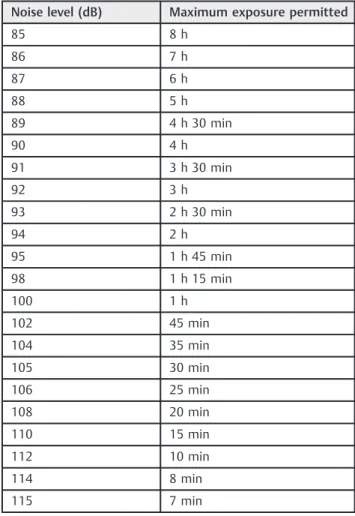
In the United States, the Occupational Safety and Health Administration creates standards and guidelines for noise exposure to protect workers. All employees who are exposed to more noise than 85 dB must participate in a program for the prevention of HL and the use of personal protection equipment. In addition, the Ministry of Health standards of Brazil limit workers’ exposure to noise as follows: if the weighted average of the noise level is 90 dB, the worker may be exposed for up to 8 hours; if the intensity is 95 dB, for only 4 hours; and at 100 dB, for only 2 hours (►Table 1).4
The objective of this study was to verify the presence of audiograms compatible with NIHL in agricultural civil avia-tion pilots from CINDACTA II who wear earplugs and helmets.
Methods
This research is a cross-sectional cohort, observational study, and the subjects of the study were agricultural aviation pilots. Charts were analyzed of 94 agricultural aircraft pilots who attended the health inspection for the renewal of their Certificate of Physical Fitness in 2010. This study was re-viewed and approved by the Research Ethics Committee, with protocol number 061/2011.
We included 94 occupational records of agricultural air-craft pilots (of the 123 records evaluated). Subjects were men, age 40 to 65, with over 2,000 hours offlight time. Exclusion criteria were those pilots with HL prior to initial audiometry and chronic diseases that potentially cause HL, pilots who were exposed to nonoccupational noise, pilots who did not wear protective equipment when handling pesticides, and pilots who did not use earplugs and helmets.
All subjects underwent 14 hours of auditory rest before performing audiometric tests. Audiograms showing a notch at 3,000, 4,000 and/or 6,000 Hz, with recovery at 8,000 Hz, were classified as suggestive of NIHL.5
The data were compared with the medical literature and analyzed statistically using the chi-square test with Yates
continuity correction. To determine the p value (and the
chi-square statistic), we used the STATISTICA system version 9.0 (Statsoft, USA).
Results
Audiometric evaluation analysis determined that hearing was within normal limits in 44 individuals (46.8%), and 50 indi-viduals (53.2%) had altered audiometry (►Table 2). Of these,
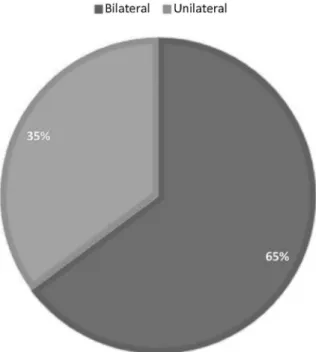
we found that the vast majority (64.8%) had bilateral HL (►Fig. 1) and that 18% had notched results in 3,000, 4,000,
and/or 6,000 Hz and 8,000 Hz in recovery (►Fig. 2), with 9.5%
of 94 audiometries assessed suggestive of NIHL (p¼0.009). Table 1 Tolerance limits for continuous or intermittent noise
Noise level (dB) Maximum exposure permitted
85 8 h
86 7 h
87 6 h
88 5 h
89 4 h 30 min
90 4 h
91 3 h 30 min
92 3 h
93 2 h 30 min
94 2 h
95 1 h 45 min
98 1 h 15 min
100 1 h
102 45 min
104 35 min
105 30 min
106 25 min
108 20 min
110 15 min
112 10 min
114 8 min
115 7 min
Source: Ministry of Health 20062.
Table 2 Total of audiograms: normal, altered, and suggestive of NIHL
Audiogram NIHL
Yes No Total
Normal 0 44 44
Altered 9 41 50
Total 9 85 94
Abbreviation: NIHL, noise-induced hearing loss.
International Archives of Otorhinolaryngology Vol. 20 No. 2/2016
The age andflight hours of patients with NIHL varied, and
no relationship was found between the two with NIHL. A minimum of three audiometries, a maximum of five, and average three were done for each pilot under evaluation. The pilots were followed for up to 5 years, with a minimum of 1.5 years and an average of 3 years.
Audiometric signs of NIHL occurred within 2 years in the pilots’charts. Other types of HL occurred after 2 years of normal audiometry. Only bilateral HL was found in the audiometries suggestive of NIHL. Seventy-three percent of the other causes of HL were bilateral.
Discussion
This study is limited by the shortage of literature and international studies related to NIHL and agricultural avia-tion. Previous studies had mixed results in the evaluation of hearing health for aircraft pilots. The range of results comes from the fact that each study used different sample sizes, evaluation techniques, and lines of work, as well as assessed exposure to noise in various types of aircraft.6–8
In addition to these limitations, retention of the pilot’s license depended on the pilot’s responses, which may have influenced the completion of the occupational health forms
related to the use of personal protective equipment such as earplugs and helmets, because every airman responded positively to the use of this equipment.
The difference in results of other studies can be explained in part by the correct use of personal hearing protection. All individuals in this research reported used protection (ear-plugs and helmet) during working hours. This shows that they are receiving adequate information and accepting the pre-ventive measures. In the study by Foltz et al, 4.9% did not use such protection. The nonuse of personal hearing protection was relevant in the study of Silva et al, in which 64.5% of subjects did not use proper hearing protection.3,7
In Brazil, Regulatory Norm number 15 (NR-15) of the Ordinance MTb 3.214/1978 establishes the limits of the continuous noise exposure, as shown in ►Table 1.2Every
case of NIHL is subject to compulsory notification by the national health system (Sistema Único de Saúde, SUS), ac-cording to the GM/MS Ordinance parameter in number 777 of 28 April 2004, in addition to requiring that occurrences be reported to Social Security, through a Job Accident Report (CAT from Portuguese).2
In the classification of audiometry, 53.2% of the individuals had some HL, a number greater than found in studies by Silva et al (38.1%), Foltz et al (31.7%), and Jaruchinda et al (32.4%).3,7,9
Per the criteria from the American College of Occupational and Environmental Medicine,5which cites thefirst NIHL sign
as being a notch on the audiogram at 3,000, 4,000, and/or 6,000 Hz and recovery at 8,000 Hz, we found that 9.5% of the study population had HL suggestive of NIHL—a smaller num-ber that that found in the study by Foltz et al, in which 29.3% of agricultural pilots showed these characteristics.7
After onset, changes in hearing thresholds have no potential for recovery. Therefore, there is not treatment yet for NIHL. Prevention and monitoring of the progression of HL through periodic hearing assessments are the strategies to be adopted. Preventive measures for airmen and crews to other activities are related to the control of noise, such as exposure control measures at the source, the area, and the individual (earplugs and helmets), with the proper selection of a hearing protector as key. In addition to these measures, there are organizational measures, such as working hour reductions, the establishment of breaks, and changes in work functions. The rate of progression of HL determines the effectiveness of the protection measures adopted and the need to apply others.2,6Once the exposure stops, there
will be no progression of HL.1
Fig. 1 Cases for unilateral or bilateral in audiograms with alterations.
Fig. 2 Cases suggestive of NIHL in audiograms with alterations.
It is important to clarify that NIHL does not cause incapacity at work; however, it can cause limitations in performing various tasks. Each case must be assessed in relation to the difficulties presented to guide the rehabilitation and address the adequacy of the work environment.2
In the present study, a large group of subjects (43.7%) had presence of HL with other audiometric characteristics (53.2%) not suggestive of NIHL. Exposure to other risk factors and the older age group (40 to 65) may explain thisfinding. Exposure to pesticides, which are causal agents that cannot generate HL, regardless of exposure to noise, can be one of these factors that interact with noise and enhance its effect on hearing,1,2,7
suggesting that these individuals may have HL due to this causative agent. This does not exclude presbycusis, organic, metabolic, pharmacologic, and/or genetic agents as potential causes of the HL presented.
In this study, there was a predominance of bilateral HL (64.8%) over unilateral (35.2%). Silva et al reported a unilateral HL prevalence.3
The age andflight hours of patients with NIHL varied, with
no relationship found between the two. However, following the natural history of the disease, pilots with longer work histories and exposure to noise demonstrated a worsening of the problem.3
With this study, we observed that agricultural aviators suffer from the effects caused by noise. Although there is full awareness by the airmen on the use of personal hearing protection, HL exists in the sample. The results suggest that these individuals have NIHL prevalence lower than rates reported in the literature.
Although the number of pilots with NIHL in the sample was not high, preventive measures such as individual hearing protection and noise exposure control should be encouraged in all exposed occupational groups, as well as the monitoring of the progression of HL through periodic hearing assessments. A survey aimed at laboratory tests and a survey of protection measures from exposure to pesticides must be performed in the present study group.
Conclusion
After this study, we can conclude that:
1. Although there were low incidences of audiograms com-patible with NIHL in the records of the pilots examined, the disorder still occurs despite the doubled use of individual hearing protection equipment (helmets and earplugs) for agricultural aviation pilots.
2. Even with the use of personal hearing protection equip-ment in agricultural aviation pilots, HL with audiometric patterns not compatible with NIHL occurred in half of the pilots’medical charts and may point to the influence of other causal factors like contact with pesticides.
References
1 Ministério da Saúde. Secretaria de Atenção à Saúde.
Departa-mento de Ações Programáticas Estratégicas. Doenças relacio-nadas ao trabalho. Brasília, Brazil: Editora do Ministério da Saúde; 2001
2 Ministério da Saúde. Secretaria de Atenção à Saúde.
Departa-mento de Ações Programáticas Estratégicas. Perda auditiva induzida por ruído (Pair). Brasília, Brazil: Editora do Ministério da Saúde; 2006
3 Silva AP, Costa EA, Rodrigues SMM, Souza HLR, Massafera VG.
Avaliação do perfil auditivo de militares de um quartel do Exército Brasileiro. Braz J Otorhinolaryngol 2004;70(3):344–350 4 Weber PC. Evaluation of hearing loss in adults. 2011. Available at:
http://www.uptodate.com/contents/evaluation-of-hearing-loss-in-adults?source=see_link. Accessed May 1, 2011
5 Acoeme Evidence Based Statement. Noise induced hearing loss.
J Occup Environ Med 2003;45(6):106–108
6 Ribeiro AMD, Câmara VdeM. Hearing loss by continuous exposure
to high sound pressure among maintenance workers at a Brazilian Air Force helicopters unity. Cad Saude Publica 2006;22(6): 1217–1224
7 Foltz L, Soares CD, Reichembach MAK. Perfil audiológico de pilotos agrícolas. Int Arch Otorhinolaryngol 2010;14(3):322–330 8 Lindgren T, Wieslander G, Dammstrom BG, Norback D. Hearing
status among commercial pilots in a Swedish airline company. Int J Audiol 2008;47(8):515–519
9 Jaruchinda P, Thongdeetae T, Panichkul S, Hanchumpol P.
Preva-lence and an analysis of noise—induced hearing loss in army helicopter pilots and aircraft mechanics. J Med Assoc Thai 2005; 88(3, Suppl 3):S232–S239
International Archives of Otorhinolaryngology Vol. 20 No. 2/2016