HGF Gene Modification in Mesenchymal
Stem Cells Reduces Radiation-Induced
Intestinal Injury by Modulating Immunity
Hua Wang1☯, Rui-Ting Sun1,2☯, Yang Li3, Yue-Feng Yang1, Feng-Jun Xiao1, Yi-Kun Zhang1,
Shao-Xia Wang3, Hui-Yan Sun1, Qun-Wei Zhang1, Chu-Tse Wu1,4*, Li-Sheng Wang1*
1Department of Experimental Hematology, Beijing Institute of Radiation Medicine, Beijing, 100850, PR China,2College of Life Science and Bioengineering, Beijing University of Technology, Beijing, 100022, PR China,3Department of Experimental Pathology, Beijing Institute of Radiation Medicine, Beijing, 100850, PR China,4Collaborative Innovation Center for Biotherapy, West China Hospital, Sichuan University, Chengdu, 610041, PR China
☯These authors contributed equally to this work. *[email protected](CW);[email protected](LW)
Abstract
Background
Effective therapeutic strategies to address intestinal complications after radiation exposure are currently lacking. Mesenchymal stem cells (MSCs), which display the ability to repair the injured intestine, have been considered as delivery vehicles for repair genes. In this study, we evaluated the therapeutic effect of hepatocyte growth factor (HGF)-gene-modified MSCs on radiation-induced intestinal injury (RIII).
Methods
Female 6- to 8-week-old mice were radiated locally at the abdomen with a single 13-Gy dose of radiation and then treated with saline control, Ad-HGF or Ad-Null-modified MSCs therapy. The transient engraftment of human MSCs was detected via real-time PCR and immunostaining. The therapeutic effects of non- and HGF-modified MSCs were evaluated via FACS to determine the lymphocyte immunophenotypes; via ELISA to measure cytokine expression; via immunostaining to determine tight junction protein expression; via PCNA staining to examine intestinal epithelial cell proliferation; and via TUNEL staining to detect intestinal epithelial cell apoptosis.
Results
The histopathological recovery of the radiation-injured intestine was significantly enhanced following non- or HGF-modified MSCs treatment. Importantly, the radiation-induced immu-nophenotypic disorders of the mesenteric lymph nodes and Peyer’s patches were attenuat-ed in both MSCs-treatattenuat-ed groups. Treatment with HGF-modifiattenuat-ed MSCs rattenuat-educattenuat-ed the
expression and secretion of inflammatory cytokines, including tumor necrosis factor alpha (TNF-α) and interferon-gamma (IFN-γ), increased the expression of the anti-inflammatory
OPEN ACCESS
Citation:Wang H, Sun R-T, Li Y, Yang Y-F, Xiao F-J, Zhang Y-K, et al. (2015) HGF Gene Modification in Mesenchymal Stem Cells Reduces Radiation-Induced Intestinal Injury by Modulating Immunity. PLoS ONE 10(5): e0124420. doi:10.1371/journal. pone.0124420
Academic Editor:Guo-Chang Fan, University of Cincinnati, College of Medicine, UNITED STATES
Received:December 17, 2014
Accepted:March 2, 2015
Published:May 1, 2015
Copyright:© 2015 Wang et al. This is an open access article distributed under the terms of the Creative Commons Attribution License, which permits unrestricted use, distribution, and reproduction in any medium, provided the original author and source are credited.
Data Availability Statement:All relevant data are within the paper and its Supporting Information files.
Funding:This work was supported by grants from the Chinese High-Tech‘863’Program
cytokine IL-10 and the tight junction protein ZO-1, and promoted the proliferation and re-duced the apoptosis of intestinal epithelial cells.
Conclusions
Treatment of RIII with HGF-gene-modified MSCs reduces local inflammation and promotes the recovery of small intestinal histopathology in a mouse model. These findings might pro-vide an effective therapeutic strategy for RIII.
Introduction
Radiation exposure may occur due to a nuclear accident or radiotherapy. The development of novel approaches that protect living tissues from radiation-induced damage is an important field in radiation biology. Intestinal mucosa injury is the major determinant of survival in pa-tients exposed to high doses of radiation [1]. However, there is currently no effective treatment against radiation-induced intestinal injury (RIII) [2].
Mesenchymal stem cells (MSCs) are pluripotent progenitor cells that contribute to the maintenance and regeneration of various connective tissues, including bone, adipose, cartilage and muscle tissue. MSCs are currently among the most advanced cell therapy tools, and many approved MSC products are available, such as Prochymal, Provacel, Chondrogen, Cuepistem, Cartistem and Hearticellgram-AMI [3–6]. Several experimental and clinical studies have re-ported the therapeutic effects of MSCs in alleviating gastrointestinal disorders in patients with severe steroid-resistant graft-versus-host disease (GVHD), and the recovery of rectovaginal and perianal fistulas in patients with Crohn’s disease [7,8]. Immunomodulatory activities, such as the suppression of T-cell proliferation and the distribution of MSCs in inflamed tissue, are considered as the central mechanisms of action of MSCs [9,10].
Hepatocyte growth factor (HGF), which was originally identified and cloned as a potent mi-togen in mature hepatocytes, displays mimi-togenic, morphogenic, and anti-apoptotic activities in a wide variety of cells, preferentially in most epithelial and endothelial cell types. HGF en-hances the regeneration of organs such as the intestine, the liver, the kidney and the lung by modulating epithelial cell proliferation and migration [11,12]. The recombinant HGF protein exerts a therapeutic effect on several animal models of inflammatory bowel disease (IBD) by modulating intestinal epithelial cell proliferation, migration and inflammation [13,14]. How-ever, the systemic administration of rh-HGF for the treatment of intestinal injury is limited due to the adverse effects caused by high serum HGF concentrations [12].
MSCs exhibit a natural tropism toward injured tissues, and this property delivers repair genes to radiation-injured intestinal tissue. In this study, we evaluated the therapeutic effects of MSC-mediated HGF gene expression on RIII using anin vivoC57BL/6 mouse model and elu-cidated the mechanisms underlying these effects.
Materials and Methods
Isolation, culture and characteristics of umbilical cord-derived MSCs
Human umbilical cords were obtained from theBeijing Hospital of Chinese Traditional and Western Medicinewith the written informed consent of parturients. Umbilical cord-derived MSCs (UC-MSCs) were isolated as described previously with minor modifications [15]. The Ethics Committee of the Beijing Institute of Radiation Medicine approved all of the Competing Interests:The authors have declared
experiments. Briefly, after the blood vessels were removed, Wharton’s jelly was minced into 1–2 mm3fragments, suspended in an animal serum-free MSC growth medium and incubated in a humidified atmosphere containing 5% CO2at 37°C. The medium was changed every 4
days, and the tissue fragments were removed after 10 days. Once 80% confluence had been reached, the cells were harvested using 0.05% trypsin-EDTA and re-seeded in new flasks at a density of 5×10⁴cells/ml. Cells at passage 3 were used for experimentation.
The immunophenotypes of MSCs were detected via flow cytometry (BD Biosciences, San Jose, CA), which showed that the MSCs were positive for CD73, CD90 and CD105 and nega-tive for CD34, CD45, and HLA-DR. The adipocytic and osteogenic differentiation capacities of UC-MSCs were also characterized (data not shown).
Adenoviral vectors (AdVs)
The AdVs used in this study were as follows: Ad-HGF, a replication-defective adenovirus ex-pressing human HGF (hHGF), and Ad-Null, a replication-defective adenovirus not carrying any exogenous genes. All AdVs were constructed using the AdEasy System (Stratagene, La Jolla, CA). The AdVs were purified via double CsCl density gradient ultracentrifugation, dis-solved in storage buffer (Hank’s buffer containing 10% glycerol) and stored at -80°C. Viral par-ticle (vp) numbers and infectious titers (infectious units (IU) per ml) were determined as previously described [16], the multiplicity of infection (MOI) was calculated from the infectious titers.
UC-MSCs were infected with 150 MOI of Ad-HGF (MSCs-HGF) or Ad-Null (MSCs-Null), and the cells were collected 48 h post-infection for RIII therapy.
Animal care
C57BL/6 mice (6–8 wk old, 18–20 g) were obtained from the Academy of Military Medical Sci-ences (Beijing, China) and were housed and cared for in a pathogen-free facility. All animal ex-periments were performed in accordance with the Guide for the Care and Use of Laboratory Animals and were approved by the Ethics Committee of the Beijing Institute of Radiation Medicine.
One hundred and twenty mice received a single 13-Gy dose of radiation that was adminis-tered locally to the abdomen using gamma rays. Then, the mice were randomized into three groups and injected intravenously via the tail vein 6 h post-radiation with saline as a control
(100μl), MSCs-Null (1×10⁶cells/100μl saline) or MSCs-HGF (1×10⁶cells/100μl saline). The
mice were sacrificed at day 1, 7, 14 or 28 after treatment. Serum was collected for the determi-nation of cytokine levels. The mesenteric lymph nodes (MLNs) and Peyer's patches (PPs) were collected to analyze the phenotype of the lymphocytes. The intestine was removed for RNA or genomic DNA isolation and histopathological analysis.
Immunophenotypic characterization of the lymphocytes from the MLN
and PP
Detection of cytokine expression via enzyme-linked immunosorbent
assay (ELISA) and real-time polymerase chain reaction (PCR)
Blood samples were obtained from the tail vein of the mice at days 1, 7, 14 and 28 post-radia-tion. The concentrations of cytokines (TNF-a, IFN-γand IL-10) were measured using murine cytokine-specific Quantikine ELISA kits (R&D Systems, Minneapolis, MN) according to the manufacturer's instructions. The optical density (OD) value was measured using Microplate Manager at a wavelength of 450 nm.
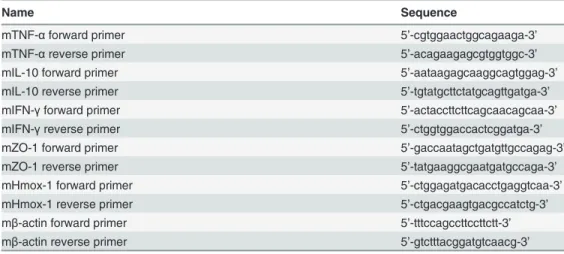
Total RNA was isolated from the intestinal tissue using TRIzol reagent (Invitrogen, Carls-bad, CA), and cDNA was synthesized using the RevertAid First Strand cDNA Synthesis Kit (Thermo Scientific, Wilmington, DE) according to the manufacturer’s instructions. The mRNA expression of cytokines (TNF-α, IFN-γ, IL-10), heme oxygenase-1 (Hmox-1) and the tight junction (TJ) gene zonula occludens 1 (ZO-1) were quantified using the 7500 Fast Real-Time PCR System (Applied Biosystems, Foster City, CA) and SYBRPremix Ex TaqII (Takara, Japan). The expression levels were normalized to those ofβ-actin. The sequences of the primers used are shown inTable 1.
Detection and quantitative analysis of engrafted hMSCs in the mouse
intestine
The biological samples were subjected DNA extraction and PCR analysis to quantify the num-bers of human cells in the recipient mice. Genomic DNA was prepared from intestinal tissues using a QIAamp DNA Mini Kit (Qiagen, Valencia, CA) for PCR analysis. The humanβ-globin gene and the endogenous mouse receptor-associated protein at the synapse (RAPSYN) gene were amplified using Premix Ex Taq (Probe qPCR) (Takara, Japan). For the humanβ-globin, the forward primer was GTGCACCTGACTCCTGAGGAGA-3’, the reverse primer was 5’-CCTTGATACCAACCTGCCCAGG-3’and the probe, which was labeled with a fluorescent re-porter and quencher, was 5’-FAM-AAGGTGAACGTGGATGAAGTTGGTGG-TAMRA-3’. For mouse RAPSYN, the forward primer was 5’-CCTTAGCCAATTGGAGAACA-3’, the re-verse primer was 5’-TTGGCCAGTTTAAAACCCAT-3’and the probe was 5’-FAM-TATCT GACCCACCCATCCTGC-TAMRA-3’.
Table 1. Primers used for the inflammatory cytokines and ZO-1.
Name Sequence
mTNF-αforward primer 5’-cgtggaactggcagaaga-3’
mTNF-αreverse primer 5’-acagaagagcgtggtggc-3’
mIL-10 forward primer 5’-aataagagcaaggcagtggag-3’
mIL-10 reverse primer 5’-tgtatgcttctatgcagttgatga-3’
mIFN-γforward primer 5’-actaccttcttcagcaacagcaa-3’
mIFN-γreverse primer 5’-ctggtggaccactcggatga-3’
mZO-1 forward primer 5’-gaccaatagctgatgttgccagag-3’
mZO-1 reverse primer 5’-tatgaaggcgaatgatgccaga-3’
mHmox-1 forward primer 5’-ctggagatgacacctgaggtcaa-3’
mHmox-1 reverse primer 5’-ctgacgaagtgacgccatctg-3’
mβ-actin forward primer 5’-tttccagccttccttctt-3’
mβ-actin reverse primer 5’-gtctttacggatgtcaacg-3’
Intestinal morphology
HE staining. Paraffin-embedded intestinal tissues were sectioned at a thickness of 5μm and stained with hematoxylin and eosin (H&E). The histopathology of this tissue was evaluated under a light microscope.
Immunohistochemistry. The paraffin-embedded intestinal tissue sections were used for immunohistochemistry. Humanβ2-microglobin, PCNA and mouse ZO-1 were detected using rabbit anti-humanβ2-microglobin (ab175031, Abcam, UK) (1:200), rabbit anti-PCNA (ab2426, Abcam, UK) (1:200) and anti-ZO-1 antibodies (ab187012, Abcam, UK) (1:500), re-spectively; then, the sections were immunostained with goat anti-rabbit IgG conjugated to HRP using a DAB kit (ZhongShan Goldenbridge, China).
For terminal deoxynucleotidyl transferase-mediated nick-end labeling (TUNEL) staining of the intestinal tissue, we used the Dead End Fluorometric TUNEL System (Promega, Madison, WI) according to the manufacturer's instructions.
The integrated OD (IOD) of ZO-1 expression was measured and analyzed using an image analysis system (CMIAS-Ⅱ, Beijing University of Aeronautics and Astronautics, China) and was normalized to the negatively stained control. The IOD was quantified as the density (mean) × area of the positively stained objects, representing all of the positive cells in the given field. Cell number quantification of the immunostained tissue sections was performed on 5 random 400× images per group.
Statistical analysis
The values are presented as means ± SD. One-way ANOVA followed by Dunnett’s post hoc test was used to compare the means from two or more experimental groups. The differences between the groups were considered to be significant at p<0.05.
Results
HGF gene transduction enhances the homing of hMSCs in the intestine
of RIII mice
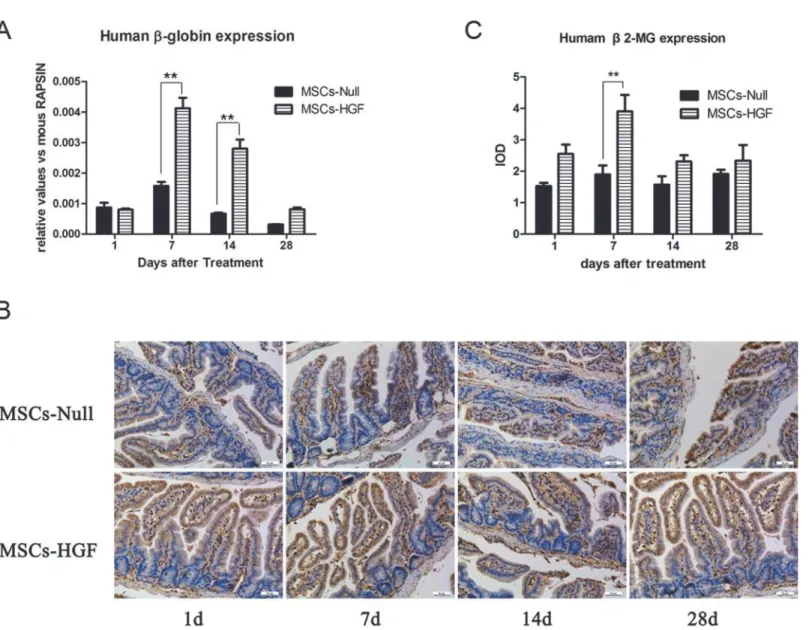
To quantitatively analyze the homing of hMSCs in the intestine of RIII mice, we evaluated the expression of the humanβ-globin gene in radiation-injured intestinal tissue via quantitative PCR at different time points after MSCs therapy. The levels of humanβ-globin expression in the MSCs-HGF group were higher than those in the MSCs-Null group (p<0.01) (Fig 1A).
Fur-thermore,β2-microglobin staining and IOD analysis showed that human MSCs (hMSCs) homed to sites of the lamina propria surrounding the small intestinal epithelial crypts (Fig 1B and 1C). These results indicated that HGF gene modification enhanced the homing of these cells to radiation injured intestine.
hMSC treatment reduces intestinal damage and restores intestinal
integrity in RIII mice
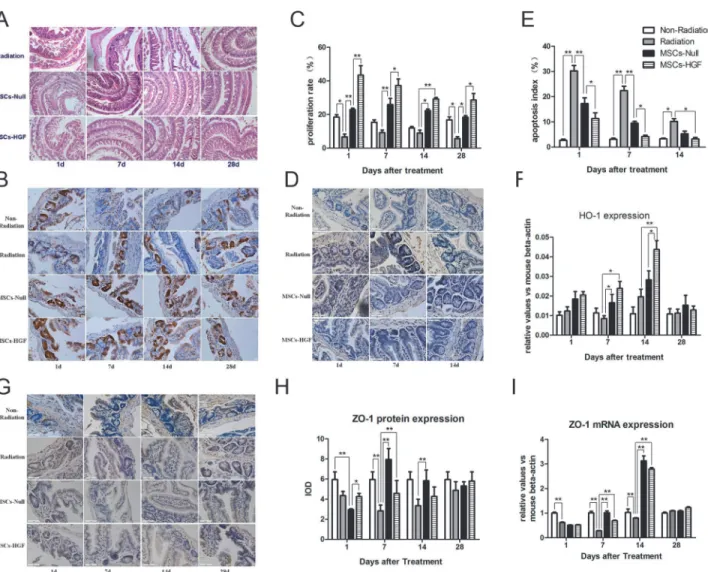
To clarify the mechanisms of the protective roles of MSCs-Null and MSCs-HGF in this RIII model, we analyzed the proliferation and apoptosis rates of intestinal epithelial cells. PCNA staining showed that MSCs-HGF or MSCs-Null significantly induced the proliferation of intes-tinal epithelial cells compared with the saline control injection in RIII mice (Fig 2B and 2C). In MSCs-HGF group, the maximal increase was observed at 1 day after treatment, and then fol-lowed by a slight decline. Apoptotic cells in the small intestinal tissue were stained with TUNEL. The results showed that most of the apoptotic cells located in the crypt and villus of the intestine. In saline treated mice, the increase of apoptotic cells reached peak at day 1, and could be detected until 14 days after treatment. However, the rate of apoptosis was significantly decreased in the MSCs-HGF- and MSCs-Null-treated mice from day 1 to 14 (Fig 2D and 2E). Fig 1. Engraftment of injected hMSCs into the intestine of RIII mouse model.To determine the engraftment of hMSCs into the intestine of RIII mice and compare the efficiency between Ad-HGF modified MSCs (MSCs-HGF) and Ad-Null modified MSCs (MSCs-Null), the expression of humanβ-globin gene and
β2-microglobin in radiation-injured intestinal tissue were detected by quantitative PCR (qPCR) and immunostaining, respectively. At 1, 7, 14 and 28 days post-transplantation, the expression of humanβ-globin gene in MSCs-Null and MSCs-HGF treated RIII mice were analyzed by qPCR and normalized to the mouse RAPSYN gene (A). To further confirm the engraftment of MSCs into the injured intestinal tissue, the expression ofβ2-microglobin was detected in MSCs-Null and MSCs-HGF treated RIII mice (B), and were quantitatively analyzed based on IOD value (C). The results are presented as the means±SD.**p<0.01 vs. the MSCs-Null group at the corresponding time point.
Heme oxygenase-1 (HO-1), an enzyme that degrades heme, plays an important role in the cel-lular protection against oxidative stress and apoptosis. qPCR revealed that HO-1 expression was up-regulated by MSCs-Null or MSCs-HGF, especially at 7 and 14 days post-treatment (Fig 2F).
The intestinal epithelial TJ is considered as an index of epithelial cell injury. And, ZO-1 is an important scaffold protein in TJs [17,18]. We detected both ZO-1 protein (Fig 2G and 2H) and mRNA expression (Fig 2I) in the intestines of RIII mice. Radiation disrupted ZO-1 expres-sion, which maximally decreased at 7 days after radiation. The administration of MSCs-Null and MSCs-HGF blocked this decrease and stimulated the expression of ZO-1, which peaked at 14 days after radiation.
Fig 2. The infusion of MSCs-Null or MSCs-HGF restores the integrity of the intestine in an RIII mouse model.Small intestinal tissue samples from radiation, MSCs-Null and MSCs-HGF groups were obtained at 1, 7, 14 and 28 days post-treatment. The morphological characteristics of small intestinal integrity were detected in radiation by hematoxylin-eosin (HE) staining (A). The proliferation of intestinal epithelial cells was tested by proliferating cell nuclear antigen (PCNA) staining. The representative images were shown in B and proliferation rate was quantified (C). The apoptosis in the crypt and villus of the intestine was analyzed by terminal deoxynucleotidyl transferase dUTP nick end labeling (TUNEL) (D), and the apoptotic index was shown in E. ZO-1, an important scaffold protein in TJs, was detected by immunostaining at protein level (G, H) and q-PCR at mRNA level (I) in the intestine. The expression of heme oxygenase-1 (HO-1), an enzyme that degrades heme and plays an important role in the cellular protection against oxidative stress and apoptosis, were also analyzed by q-PCR (F). All the data were presented as the means±SD. Comparisons between groups were analyzed via one-way ANOVA followed by
Dunnett’s post hoc test.*p<0.05,**p<0.01.
MSCs-HGF therapy reduces the inflammatory responses in RIII mice
The immunomodulatory activities of MSCs-null and MSCs-HGF were evaluated in the RIII model. The protein levels of IL-10, TNF-αand IFN-γin peripheral blood were measured via ELISA at 7, 14 and 28 days post-radiation. As shown inFig 3A and 3B, MSCs treatment re-duced the serum levels of inflammatory cytokines (TNF-α, and IFN-γ) in RIII mice. Moreover, the level of the anti-inflammatory/regulatory cytokine IL-10 in the MSCs-treated groups was significantly higher than in the saline control group (Fig 3C). Furthermore, the mRNA expres-sion levels of TNF-α, IFN-γand IL-10 in the local small intestinal tissue were detected by real-time RT-PCR. Compared with the radiation group, the MSCs-Null and MSCs-HGF groups displayed reduced mRNA expression levels of TNF-αand IFN-γ(Fig 3D and 3E) and increased expression levels of IL-10 (Fig 3F).
MSCs-HGF regulates MLN and PP lymphocytes in RIII mice
Lymphocytes from the MLN and PP in the small intestine of radiated and untreated, MSCs-Null-treated or MSCs-HGF-treated mice were stained with antibodies and analyzed via FACS. As shown inFig 4, radiation induced an increase in CD4+CD25+Foxp3+Treg cells, which persisted for approximately 14 days. Treatment with MSCs-Null or MSCs-HGF significantly reduced the percentage of CD4+CD25+Foxp3+Treg cells in RIII mice (Fig 4A–4D). The radia-tion-induced increase in the T cell to B cell ratios in the MLN and PP were also alleviated by MSCs-Null or MSCs-HGF treatment (Fig 4E–4H).
Discussion
The major pathological change caused by RIII is architectural disorganization, including in-flammatory mononuclear cell infiltration, villitis, desquamation, eosinophilic necrosis, and re-duced mucosal thickness, crypt height, and villous height [19]. Effective therapies may
accelerate the structural regeneration of the small intestine and attenuate inflammation in RIII. Both stem cell and gene therapy are promising approaches for the replenishment of the ra-diation injury-induced depletion of stem cell compartments. Studies have shown that MSCs display the capacity to engraft into the enteric mucosa in the radiated intestinal tissue of mice [20]. In this study, UC-MSCs transduced with Ad-HGF or Ad-Null was injected intravenously into RIII mice. The distribution of MSCs in the injured tissues was determined via real-time PCR. The humanβ-globin gene expression level was higher and was sustained for longer in the MSCs-HGF group than in the MSCs-Null group. It was demonstrated that MSCs characteristi-cally home to radiation-injured intestinal tissue and that HGF gene transduction enhances the transient homing of hMSCs in the intestines of RIII mice. This effect was independent of the proliferative characteristics of MSCs-HGF (S1 Fig).
immune reactions against human-derived MSCs were not detected in the mice used in this study, suggesting that hMSCs exhibit low immunogenicity (S2 Fig).
Many cytokines are involved in the repair of radiation-injured tissue. HGF, a growth factor that performs multiple functions, is involved in not only liver regeneration but also the repair of other tissues. Studies showed that HGF modulates the proliferation and migration of intesti-nal epithelial cells, leading to the acceleration of intestiintesti-nal mucosal repair and serving as a criti-cal regulator of intestinal wound healing [12,14]. The systemic administration of recombinant human HGF protein ameliorated experimental colitis. However, an increase in the serum HGF concentrations may induce systemic adverse effects. In this study, we measured the expression level of human and mouse HGF in the circulation. The results showed that the expression level of HGF in the circulation increased after radiation and MSCs treatments, but at a low level (S3 FigandS4 Fig). However, MSCs-based HGF gene therapy increases HGF expression locally in damaged tissues in RIII. Compared to the MSCs-Null group, HGF gene modification signifi-cantly enhanced the proliferation of intestinal epithelial cells. Additionally, the immunomodu-latory activities of MSCs, such as the suppression of T-cell proliferation and the secretion of inflammatory factors, were detected. The expression levels of the inflammatory cytokines TNF-αand IFN-γand the anti-inflammatory cytokine IL-10 in the peripheral blood were simi-lar between the control and MSCs-Null groups, whereas in the MSCs-HGF group, IL-10 ex-pression was significantly increased and TNF-αand IFN-γexpression was significantly decreased in local tissues at 7 days after treatment. We deduced that this HGF-enhanced anti-inflammatory effect might depend on the engraftment of MSCs into the radiation-injured intestinal tissue.
Radiation causes inflammation and dysregulation of immune homeostasis. Intestinal CD4 +T cells may influence the effectiveness of radiotherapy and impede tissue repair in RIII. Thy-mus-derived natural T regulatory cells (CD4+CD25+FoxP3+ Tregs), the predominant special-ized cell type that maintains immune tolerance, play an important role in immune regulation in the intestine. The expression pattern of Tregs is critical for their function [26]. Lymphocytes involved in the intestinal immune response are located in organized immune-inductive sites of the gut-associated lymphoid tissues (GALT), such as PPs, and in draining gut MLNs [27]. In the present study, the ratio of CD4+CD25+FoxP3+ Tregs to CD4+ cells in the MLN and PP were increased after radiation, and MSCs-Null or MSCs-HGF treatment partially ameliorated this up-regulation. Rradiation damaged the lymphoid tissues by decreasing the absolute num-ber of lymphocytes. A study by Linard [28] showed that the absolute number of CD4-T and CD8-T cells in the MLNs progressively decreased and that the CD4-T and CD8-T populations may be differentially sensitive to radiation. We observed that the increased ratio of T/B cells and CD4 T/CD8 T cells (data not shown) coincided with the decrease in the MLN volume after abdominal radiation. This result demonstrated that B cells were more sensitive to radiation than T cells and CD8-T cells were more sensitive to radiation than CD4-T cells. The mecha-nism underlying immune regulation effect of MSCs maybe include secretion of inhibiting fac-tors responsible for lymphocyte activation and expression of cell surface molecules [29]. Fig 3. The expression levels of pro-inflammatory and anti-inflammatory cytokines in peripheral blood and the intestinal tissue.The
immunomodulatory activities of MSCs-Null and MSCs-HGF were evaluated by detected the expression and secretion of pro-inflammatory cytokines TNF-α
and IFN-γ, and the anti-inflammatory cytokine IL-10. Peripheral blood samples were collected from RIII mice at 7, 14 and 28 days after treatments. The expression levels of the pro-inflammatory cytokines TNF-α(A) and IFN-γ(B) and the anti-inflammatory cytokine IL-10 (C) were measured via ELISA. On the other hand, total RNA was extracted from the intestinal tissue, and the mRNA expression levels of TNF-α(D), IFN-γ(E) and IL-10 (F) were measured by real-time RT-PCR, and normalized to the expression of mouseβ-actin. All the data are presented as the means±SD. Comparisons between groups were analyzed via one-way ANOVA followed by Dunnett’s post hoc test.*p<0.05;**p<0.01.
Previously, we found that HGF gene modification exerts beneficial effects on cell transplan-tation and tissue repair [18]. Furthermore, MSCs-based HGF gene therapy reduces inflamma-tion and inhibits lung fibrosis in a radiainflamma-tion-induced lung injury model [30]. According to previous studies on MSCs and HGF, both direct effects of homing and restoration and Fig 4. Immunophenotypic changes in MLN and PP lymphocytes after radiation.At 1, 7, 14 and 28 days after treatments, MLNs and PPs were carefully collected, and were mechanically dissociated in phosphate-buffered saline (PBS) containing 3% fetal calf serum (FCS). Lymphocytes were isolated from the MLNs and PPs and were labeled with fluorescent antibodies, and immunophenotypic differences were detected via FACS. Tregs in the MLNs (A, B) and PPs (C, D) were labeled with the regulatory T cell staining kit. The T and B lymphocytes were detected after labeled by CD3 FITC, anti-mouse CD19 PerCP-Cy5.5, anti-mouse CD4 PE, anti-mouse CD8b APC or isotype control. The ratio of T cells/B cells in the MLNs (E, F) and PPs (G, H) are shown. Representative images of FACS are shown. The results are presented as the means±SD. Comparisons between groups were analyzed via one-way ANOVA followed by Dunnett’s post hoc test. *p<0.05;**p<0.01.
secondary effects of secretion of growth factors were included in the effects of HGF-modified MSCs on RIII.
The low number of human-derived cells that were implanted into the intestinal mucosa in-dicates that the replacement of epithelial cell loss via trans-differentiation is unlikely to repre-sent the principal therapeutic mechanism [7]. Nevertheless, MSC treatment enhanced radiation-induced epithelial crypt cell proliferation and reduced radiation-induced epithelial apoptosis in the intestine. Moreover, the anti-apoptotic effect of MSCs-HGF was significantly greater than that of MSCs-Null, suggesting the synergistic function of MSCs and HGF.
Epithelial barrier function is largely determined by a multiprotein complex located at the most apical portion of the lateral membrane, which is referred to as a TJ. ZO-1 is a scaffolding protein that plays a pivotal role in the formation of TJs [17,31]. A variety of inflammatory me-diators, such as ROS and inflammatory cytokines including TNF-αand IFN-γ, disrupt the TJ barrier and alter the localization and phosphorylation status of ZO-1. In the present study, we observed that radiation decreased the expression of ZO-1 based on RT-PCR and immunostain-ing. The expression of ZO-1, which is predominantly located along the apical surface of intesti-nal villi, was reduced, indicating that the localization of ZO-1 to the TJs was disturbed. The administration of MSCs-Null or MSCs-HGF alleviated the radiation-induced decrease in ZO-1 expression, and this effect may play an important role in the maintenance of epithelial
barrier function.
Conclusion
In conclusion, the application of MSCs and HGF-modified MSCs protects the intestine from radiation-induced injury, including improving intestinal histopathology, reducing local and systemic inflammation, and increasing the proliferation and decreasing the apoptosis of intesti-nal epithelial cells. Furthermore, HGF gene modification enhances the homing of MSCs to ra-diation-injured intestinal tissue, which contributes to the improvement of tissue repair and the modulation of inflammation in the local intestine. Therefore, HGF-modified MSCs may repre-sent an effective therapeutic strategy for RIII.
Supporting Information
S1 Fig. HGF expression does not affect the proliferation of MSCs.Proliferation of MSCs was determined by using Dye eFluor 670, representative results are shown.
(TIF)
S2 Fig. Anti-Human MSC reaction in mice serum.The antibody against human MSCs was determined by using ELISA technique. Results are shown as the mean ± SD.
(TIF)
S3 Fig. Human HGF Expression in mice serum.The expression of human HGF was deter-mined by using ELISA technique. Results are shown as the mean ± SD.p<0.01, vs
MSCs-Null group at the same time point. (TIF)
S4 Fig. Mouse HGF Expression in mice serum.The expression of mouse HGF was deter-mined by using ELISA technique. Results are shown as the mean ± SD.p<0.05,p<0.01.
(TIF)
And, the antibody against MSCs also examined at 7 and 14 days post-radiation by using ELISA.
(DOCX)
Author Contributions
Conceived and designed the experiments: HW CW LW. Performed the experiments: RS YL YY FX YZ QZ HS SW. Analyzed the data: HW RS YY FX. Contributed reagents/materials/ analysis tools: QZ FX. Wrote the paper: HW RS.
References
1. Monti P, Wysocki J, van der Meeren A, Griffiths NM. The contribution of radiation-induced injury to the gastrointestinal tract in the development of multi-organ dysfunction syndrome or failure. BJR supple-ment / BIR. 2005; 27:89–94.
2. Kudo K, Liu Y, Takahashi K, Tarusawa K, Osanai M, Hu DL, et al. Transplantation of mesenchymal stem cells to prevent radiation-induced intestinal injury in mice. Journal of radiation research. 2010; 51 (1):73–9. PMID:19851042
3. Rodrigo SF, van Ramshorst J, Hoogslag GE, Boden H, Velders MA, Cannegieter SC, et al. Intramyo-cardial injection of autologous bone marrow-derived ex vivo expanded mesenchymal stem cells in acute myocardial infarction patients is feasible and safe up to 5 years of follow-up. Journal of cardiovas-cular translational research. 2013; 6(5):816–25. doi:10.1007/s12265-013-9507-7PMID:23982478
4. Galipeau J. The mesenchymal stromal cells dilemma—does a negative phase III trial of random donor mesenchymal stromal cells in steroid-resistant graft-versus-host disease represent a death knell or a bump in the road? Cytotherapy. 2013; 15(1):2–8. doi:10.1016/j.jcyt.2012.10.002PMID:23260081
5. Hernigou P, Pariat J, Queinnec S, Homma Y, Flouzat Lachaniette CH, Chevallier N, et al. Supercharg-ing irradiated allografts with mesenchymal stem cells improves acetabular bone graftSupercharg-ing in revision arthroplasty. International orthopaedics. 2014; 38(9):1913–21. doi:10.1007/s00264-014-2285-2PMID: 24509980
6. Reagan MR, Seib FP, McMillin DW, Sage EK, Mitsiades CS, Janes SM, et al. Stem Cell Implants for Cancer Therapy: TRAIL-Expressing Mesenchymal Stem Cells Target Cancer Cells In Situ. Journal of breast cancer. 2012; 15(3):273–82. doi:10.4048/jbc.2012.15.3.273PMID:23091539
7. Semont A, Mouiseddine M, Francois A, Demarquay C, Mathieu N, Chapel A, et al. Mesenchymal stem cells improve small intestinal integrity through regulation of endogenous epithelial cell homeostasis. Cell death and differentiation. 2010; 17(6):952–61. doi:10.1038/cdd.2009.187PMID:20019749
8. Garcia-Olmo D, Garcia-Arranz M, Herreros D, Pascual I, Peiro C, Rodriguez-Montes JA. A phase I clini-cal trial of the treatment of Crohn's fistula by adipose mesenchymal stem cell transplantation. Diseases of the colon and rectum. 2005; 48(7):1416–23. PMID:15933795
9. Selleri S, Dieng MM, Nicoletti S, Louis I, Beausejour C, Le Deist F, et al. Cord-blood-derived mesenchy-mal stromesenchy-mal cells downmodulate CD4+ T-cell activation by inducing IL-10-producing Th1 cells. Stem cells and development. 2013; 22(7):1063–75. doi:10.1089/scd.2012.0315PMID:23167734
10. Luz-Crawford P, Kurte M, Bravo-Alegria J, Contreras R, Nova-Lamperti E, Tejedor G, et al. Mesenchy-mal stem cells generate a CD4+CD25+Foxp3+ regulatory T cell population during the differentiation process of Th1 and Th17 cells. Stem cell research & therapy. 2013; 4(3):65.
11. Matsumoto K, Nakamura T. Hepatocyte growth factor (HGF) as a tissue organizer for organogenesis and regeneration. Biochemical and biophysical research communications. 1997; 239(3):639–44. PMID:9367820
12. Setoyama H, Ido A, Numata M, Moriuchi A, Yamaji N, Tamai T, et al. Repeated enemas with hepato-cyte growth factor selectively stimulate epithelial cell proliferation of injured mucosa in rats with experi-mental colitis. Life sciences. 2011; 89(7–8):269–75.
13. Kanayama M, Takahara T, Yata Y, Xue F, Shinno E, Nonome K, et al. Hepatocyte growth factor pro-motes colonic epithelial regeneration via Akt signaling. American journal of physiology Gastrointestinal and liver physiology. 2007; 293(1):G230–9. PMID:17412827
15. Lu LL, Liu YJ, Yang SG, Zhao QJ, Wang X, Gong W, et al. Isolation and characterization of human um-bilical cord mesenchymal stem cells with hematopoiesis-supportive function and other potentials. Hae-matologica. 2006; 91(8):1017–26. PMID:16870554
16. Hu ZB, Wu CT, Wang H, Zhang QW, Wang L, Wang RL, et al. A simplified system for generating onco-lytic adenovirus vector carrying one or two transgenes. Cancer gene therapy. 2008; 15(3):173–82. PMID:18157145
17. Hamada K, Shitara Y, Sekine S, Horie T. Zonula Occludens-1 alterations and enhanced intestinal per-meability in methotrexate-treated rats. Cancer chemotherapy and pharmacology. 2010; 66(6):1031–8. doi:10.1007/s00280-010-1253-9PMID:20119715
18. Bian L, Guo ZK, Wang HX, Wang JS, Wang H, Li QF, et al. In vitro and in vivo immunosuppressive characteristics of hepatocyte growth factor-modified murine mesenchymal stem cells. In Vivo. 2009; 23 (1):21–7. PMID:19368120
19. Onal C, Kayaselcuk F, Topkan E, Yavuz M, Bacanli D, Yavuz A. Protective effects of melatonin and octreotide against radiation-induced intestinal injury. Digestive diseases and sciences. 2011; 56 (2):359–67. doi:10.1007/s10620-010-1322-2PMID:20652743
20. Zhang J, Gong JF, Zhang W, Zhu WM, Li JS. Effects of transplanted bone marrow mesenchymal stem cells on the irradiated intestine of mice. Journal of biomedical science. 2008; 15(5):585–94. doi:10. 1007/s11373-008-9256-9PMID:18763056
21. Yang C, Chen HX, Zhou Y, Liu MX, Wang Y, Wang JX, et al. Manganese superoxide dismutase gene therapy protects against irradiation- induced intestinal injury. Current gene therapy. 2013; 13(5):305– 14. PMID:24060314
22. Tanaka F, Tominaga K, Ochi M, Tanigawa T, Watanabe T, Fujiwara Y, et al. Exogenous administration of mesenchymal stem cells ameliorates dextran sulfate sodium-induced colitis via anti-inflammatory ac-tion in damaged tissue in rats. Life sciences. 2008; 83(23–24):771–9. doi:10.1016/j.lfs.2008.09.018 PMID:18930069
23. Caplan AI, Dennis JE. Mesenchymal stem cells as trophic mediators. Journal of cellular biochemistry. 2006; 98(5):1076–84. PMID:16619257
24. Phinney DG, Prockop DJ. Concise review: mesenchymal stem/multipotent stromal cells: the state of transdifferentiation and modes of tissue repair—current views. Stem Cells. 2007; 25(11):2896–902. PMID:17901396
25. Lange C, Brunswig-Spickenheier B, Cappallo-Obermann H, Eggert K, Gehling UM, Rudolph C, et al. Radiation rescue: mesenchymal stromal cells protect from lethal irradiation. PloS one. 2011; 6(1): e14486. doi:10.1371/journal.pone.0014486PMID:21245929
26. Billiard F, Buard V, Benderitter M, Linard C. Abdominal gamma-radiation induces an accumulation of function-impaired regulatory T cells in the small intestine. International journal of radiation oncology, bi-ology, physics. 2011; 80(3):869–76. doi:10.1016/j.ijrobp.2010.12.041PMID:21345609
27. Turner JD, Jenkins GR, Hogg KG, Aynsley SA, Paveley RA, Cook PC, et al. CD4+CD25+ regulatory cells contribute to the regulation of colonic Th2 granulomatous pathology caused by schistosome infec-tion. PLoS neglected tropical diseases. 2011; 5(8):e1269. doi:10.1371/journal.pntd.0001269PMID: 21858239
28. Linard C, Billiard F, Benderitter M. Intestinal irradiation and fibrosis in a Th1-deficient environment. In-ternational journal of radiation oncology, biology, physics. 2012; 84(1):266–73. doi:10.1016/j.ijrobp. 2011.11.027PMID:22336200
29. Madrigal M, Rao KS, Riordan NH. A review of therapeutic effects of mesenchymal stem cell secretions and induction of secretory modification by different culture methods. Journal of translational medicine. 2014; 12(1):260. PMID:25304688
30. Wang H, Yang YF, Zhao L, Xiao FJ, Zhang QW, Wen ML, et al. Hepatocyte growth factor gene-modi-fied mesenchymal stem cells reduce radiation-induced lung injury. Human gene therapy. 2013; 24 (3):343–53. doi:10.1089/hum.2012.177PMID:23458413