HESSD
10, 2015–2028, 2013Relate instantaneous evaporative fraction
to daytime fluxes
J. Peng et al.
Title Page Abstract Introduction Conclusions References
Tables Figures
◭ ◮
◭ ◮
Back Close
Full Screen / Esc
Printer-friendly Version Interactive Discussion
Discussion
P
a
per
|
Dis
cussion
P
a
per
|
Discussion
P
a
per
|
Discussio
n
P
a
per
|
Hydrol. Earth Syst. Sci. Discuss., 10, 2015–2028, 2013 www.hydrol-earth-syst-sci-discuss.net/10/2015/2013/ doi:10.5194/hessd-10-2015-2013
© Author(s) 2013. CC Attribution 3.0 License.
Geoscientiic Geoscientiic
Geoscientiic Geoscientiic
Hydrology and Earth System
Sciences
Open Access
Discussions
This discussion paper is/has been under review for the journal Hydrology and Earth System Sciences (HESS). Please refer to the corresponding final paper in HESS if available.
How representative are instantaneous
evaporative fraction measurements for
daytime fluxes?
J. Peng1,2,3, M. Borsche1, Y. Liu3, and A. Loew1
1
Max-Planck-Institute for Meteorology, KlimaCampus, 20146 Hamburg, Germany 2
International Max Planck Research School on Earth System Modelling, 20146 Hamburg, Germany
3
State Key Laboratory of Lake Science and Environment, Nanjing Institute of Geography and Limnology, Chinese Academy of Sciences, Nanjing 210008, China
Received: 30 December 2012 – Accepted: 2 February 2013 – Published: 12 February 2013
Correspondence to: J. Peng ([email protected])
HESSD
10, 2015–2028, 2013Relate instantaneous evaporative fraction
to daytime fluxes
J. Peng et al.
Title Page Abstract Introduction Conclusions References
Tables Figures
◭ ◮
◭ ◮
Back Close
Full Screen / Esc
Printer-friendly Version Interactive Discussion
Discussion
P
a
per
|
Dis
cussion
P
a
per
|
Discussion
P
a
per
|
Discussio
n
P
a
per
|
Abstract
Sun synchronous optical remote sensing is a promising technique to provide instanta-neous ET (Evapotranspiration) estimates during satellite overpass. The common ap-proach to extrapolate the instantaneous estimates to values for daily or longer periods relies on the assumption that the EF (Evaporative Fraction, defined as the ratio of 5
latent heat flux to surface available energy) remains nearly constant during daytime. However, there is still no consensus on the validity of the self preservation of EF. We used FLUXNET (a global network of eddy covariance stations) measurements to ex-amine this self preservation, and the conditions under which it can hold. It is found here that the instantaneous EF could represent daytime EF under clear-sky conditions 10
especially between 11:00 and 14:00 LT for all the stations. However, the EF is more un-stable during cloudy skies. The increase in cloud cover would result in the increase in the variability of EF during daytime. Future works will focus on the evaluation of this EF constant assumption using real remote sensing data over different surface and climate conditions.
15
1 Introduction
Estimates of land surface ET (Evapotranspiration) are crucial for better understand-ing climate and hydrological interactions (Jung et al., 2010; Oki and Kanae, 2006). Over the last few decades, numerous physical and empirical remote sensing-based models that vary in complexity have been proposed to estimate ET. Most of them pro-20
vide instantaneous ET estimates at the time of satellite overpass (Kalma et al., 2008; Wang and Dickinson, 2012). In order to acquire ET values over daily or longer time periods, there is a need to extrapolate instantaneous to daily values (Ch ´avez et al., 2008). The most widely used method is the assumption of daytime self-preservation of EF (Evaporative Fraction) (Delogu et al., 2012). The EF is normally a diagnostic 25
HESSD
10, 2015–2028, 2013Relate instantaneous evaporative fraction
to daytime fluxes
J. Peng et al.
Title Page Abstract Introduction Conclusions References
Tables Figures
◭ ◮
◭ ◮
Back Close
Full Screen / Esc
Printer-friendly Version Interactive Discussion
Discussion
P
a
per
|
Dis
cussion
P
a
per
|
Discussion
P
a
per
|
Discussio
n
P
a
per
|
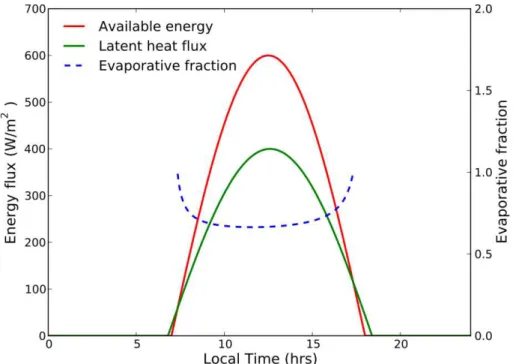
toward latent heat flux. Theoretically, the EF is supposed to isolate vegetation and soil control from other factors in the determination of surface energy balance components. Furthermore, it can remove the daily sinusoidal like variations of the latent heat flux and sensible heat flux at the land surface, and remains almost constant during daytime under clear sky conditions (Gentine et al., 2007, 2011; Li et al., 2008) (Fig. 1). Shuttle-5
worth et al. (1989), Nichols and Cuenca (1993) and Crago and Brutsaert (1996) used in situ measurements of surface energy balance components and showed that EF is nearly constant during daytime under clear sky days. Model studies by Lhomme and Elguero (1999) and Gentine et al. (2007) found that daytime self preservation of EF is only satisfied under limited environmental conditions. Hoedjes et al. (2008) found that 10
EF remains fairly constant under dry conditions and presents a pronounced concave up shape under wet conditions. However, most of the above studies are generally based on measurements from relatively short time periods and across a small range of envi-ronmental and climatological conditions. Since the daytime constant EF assumption is the basis for extrapolating instantaneous ET estimates to daily values, whether it holds 15
or not is a fundamental issue to the satellite-based temporal extrapolation applications. The objective of this paper is to further examine how representative instantaneous EF measurements are for daytime values. To address this question, long term time se-ries of data from a global network of EC (Eddy Covariance) stations (FLUXNET) were analyzed across a wide range of ecosystems and climates.
20
2 Data and methods
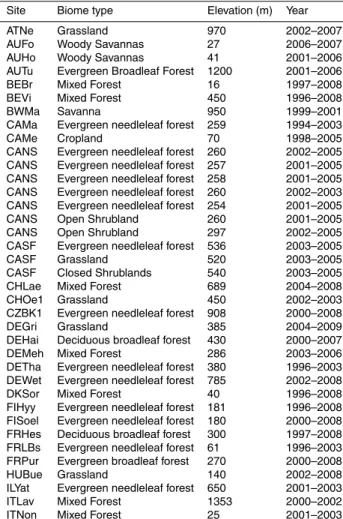
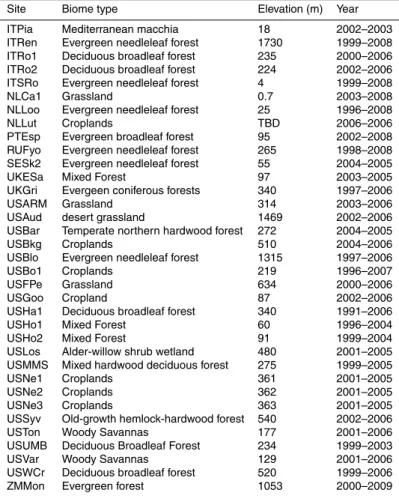
The FLUXNET methodology and review papers could be found in the work of Aubinet et al. (2000), Baldocchi et al. (2001) and Baldocchi (2008). There are a total of seventy-two FLUXNET sites over a variety of vegetation types and geographic locations used in the present study (Table 1; Fig. 1). For each site, in situ measurements of net radiation, 25
HESSD
10, 2015–2028, 2013Relate instantaneous evaporative fraction
to daytime fluxes
J. Peng et al.
Title Page Abstract Introduction Conclusions References
Tables Figures
◭ ◮
◭ ◮
Back Close
Full Screen / Esc
Printer-friendly Version Interactive Discussion
Discussion
P
a
per
|
Dis
cussion
P
a
per
|
Discussion
P
a
per
|
Discussio
n
P
a
per
|
balance closure is an important criterion for evaluating the quality of measured heat fluxes from EC systems. However, flux towers typically do not exhibit energy closure because of systematic bias in instrumentation, mismatch in source areas, neglected energy sinks, and landscape heterogeneity (Foken et al., 2011; Twine et al., 2000; Wilson et al., 2002). In this study, the Bowen ratio correction method recommended 5
by Twine et al. (2000) was used to adjust Eddy covariance measured heat fluxes to constrain energy balance closure.
The instantaneous EF (dimensionless) is then calculated from the corrected instan-taneous flux values as follows:
EF(t)= λE(t) Rn(t)−G(t) =
λE(t)
λE(t)+H(t) (1)
10
whereRnis the surface net radiation (W m−2),Gis the ground heat flux (W m−2),λE is latent heat flux (W m−2) andH the sensible heat flux (W m−2). In addition, the daytime EF is determined by the following equation:
EFdaytime=
Rt2
t1λE(t)·dt
Rt2
t
1[
Rn(t)−G(t)]·dt
=
Rt
2
t
1
λE(t)·dt
Rt2
t1[H(t)+λE(t)]·dt
(2) 15
where the time differencet2−t1refers to the time from 08:00 to 17:00 LT (local time) in the present study. In order to evaluate the relationship between instantaneous EF and daytime EF, the statistics indices ofR2(coefficient of determination) and RMSD (Root mean square difference) are chosen in this study.
20
HESSD
10, 2015–2028, 2013Relate instantaneous evaporative fraction
to daytime fluxes
J. Peng et al.
Title Page Abstract Introduction Conclusions References
Tables Figures
◭ ◮
◭ ◮
Back Close
Full Screen / Esc
Printer-friendly Version Interactive Discussion
Discussion
P
a
per
|
Dis
cussion
P
a
per
|
Discussion
P
a
per
|
Discussio
n
P
a
per
|
variations in net radiation should not affect EF significantly, whereas Crago and Brut-saert (1996) attributed variations of EF to cloudiness. In this study, the effects of diff er-ent clouds cover on EF were analyzed. The widely used clearness indexKT(the ratio of the global solar radiation measured at the surface to the total solar radiation at the top of the atmosphere) (Liu and Jordan, 1960; Okogbue et al., 2009) was used to perform 5
the sky conditions classification. In order to examine the effects of cloudiness on the EF self preservation,KT values of 0≤KT≤0.15, 0.15< KT≤0.65, 0.65< KT≤1 were used to define cloudy, partly cloudy and clear-sky conditions.
3 Results and discussion
In order to find the relationship between instantaneous EF and daytime EF under clear 10
sky conditions, statistical results between the EF in different time periods and daytime EF are illustrated in Fig. 3. These results were analyzed based on all the seventy-two FLUXNET sites to obtain more general conclusions. Figure 3a showed the box plots of R2 and RMSD, respectively for the relationships between instantaneous EF and daytime EF. In general, EF in different time periods of daytime agree well with daytime 15
EF except the period of 08:00–09:00 LT and 16:00–17:00 LT. In 11:00–14:00 LT, the minimum R2 value is higher than 0.75, and the maximum RMSD is less than 0.087. These statistics indicate that EF during these time periods is closer to daytime EF. The best correlation between instantaneous EF and daytime EF appears at midday (12:00–13:00 LT). The possible reason for such result is that energy fluxes change 20
at a slower rate compared to early morning and late afternoon. Since the analysis was based on long term FLUXNET measurements under a wide range of surface, environmental and climate condition, we conclude that the instantaneous EF could generally represent daytime EF under clear-sky conditions especially from 11:00 to 14:00 LT. This EF self preservation could also be explained from a physical perspective. 25
HESSD
10, 2015–2028, 2013Relate instantaneous evaporative fraction
to daytime fluxes
J. Peng et al.
Title Page Abstract Introduction Conclusions References
Tables Figures
◭ ◮
◭ ◮
Back Close
Full Screen / Esc
Printer-friendly Version Interactive Discussion
Discussion
P
a
per
|
Dis
cussion
P
a
per
|
Discussion
P
a
per
|
Discussio
n
P
a
per
|
them tend to vary slowly during daytime compared to other fast changing variables (e.g. surface temperature, radiation). In summary, the above results have strong implications for daily ET studies based on sun synchronous satellite observations. And the midday overpass satellites (e.g. MODIS and AVHRR) would provide better results than other overpass time platforms (e.g. Landsat).
5
Figure 3b, c displayed the performance of EF constant assumption under different cloud cover conditions. It can be seen that the stability of EF is related to cloudiness. The EF exhibited more unstable under partly cloudy situations compared with clear skies. The variability of EF increased with the increase in cloudiness. For total cloud cover theR2 values between instantaneous EF in different time periods and daytime 10
EF obviously went down as compared to clear skies. Poorer RMSD were also obtained at the same time. This is because cloudiness could induce a decrease in the available energy and the latent heat flux, which further causes the increase in both instantaneous EF and daytime EF. But these increases are probably in different degrees. Thus, the EF tends to be more unstable during cloudy skies. Nevertheless, the above results have 15
no substantial influence on the remote sensing applications, since optical satellites only provide useful data under clear sky conditions.
4 Conclusions
The commonly used method to extrapolate remote sensing-based instantaneous EF to daily values is to assume constant EF during daytime (so-called daytime self preser-20
vation). However, evidence for this constant EF approach is based on limited duration field measurements. Taking advantage of a global network of long term ground-based measurements from FLUXNET, the daytime EF constant hypothesis is examined here. It is found that the EF during daytime from 11:00 to 14:00 LT is nearly constant under clear sky conditions (R2>0.75, RMSD<0.087), and the EF in 12:00–13:00 LT is al-25
HESSD
10, 2015–2028, 2013Relate instantaneous evaporative fraction
to daytime fluxes
J. Peng et al.
Title Page Abstract Introduction Conclusions References
Tables Figures
◭ ◮
◭ ◮
Back Close
Full Screen / Esc
Printer-friendly Version Interactive Discussion
Discussion
P
a
per
|
Dis
cussion
P
a
per
|
Discussion
P
a
per
|
Discussio
n
P
a
per
|
in cloudiness. Thus the EF constant hypothesis might only be true for clear skies. Nonetheless, the above results provide a basis for remote sensing-based estimation of EF based on sun synchronous satellite observations. The midday overpass satel-lites (e.g. MODIS and AVHRR) are supposed to give better results than other overpass time platforms. The important conclusion from the present study is that the EF constant 5
assumption is valid over a wide range of ecosystems and climates. Evaluation of this EF constant method will be carried out using real remote sensing data around global FLUXNET sites in the future.
Acknowledgements. This work was partly supported by the Cluster of Excellence CliSAP (EXC177), University of Hamburg, funded through the German Science Foundation (DFG) and 10
by the CAS-MPG Doctoral Promotion Programme (DPP).
The service charges for this open access publication have been covered by the Max Planck Society.
References
15
Aubinet, M., Grelle, A., Ibrom, A., Rannik, ¨U., Moncrieff, J., Foken, T., Kowalski, A., Martin, P., Berbigier, P., and Bernhofer, C.: Estimates of the annual net carbon and water exchange of forests: the EUROFLUX methodology, Adv. Ecol. Res., 30, 113–175, 2000.
Baldocchi, D.: “Breathing” of the terrestrial biosphere: lessons learned from a global network of carbon dioxide flux measurement systems, Aust. J. Bot., 56, 1–26, 2008.
20
Baldocchi, D., Falge, E., Gu, L., Olson, R., Hollinger, D., Running, S., Anthoni, P., Bern-hofer, C., Davis, K., Evans, R., Fuentes, J., Goldstein, A., Katul, G., Law, B., Lee, X., Malhi, Y., Meyers, T., Munger, W., Oechel, W., Paw, K. T., Pilegaard, K., Schmid, H. P., Valentini, R., Verma, S., Vesala, T., Wilson, K., and Wofsy, S.: FLUXNET: a new tool to study the temporal and spatial variability of ecosystem–scale carbon dioxide, water va-25
HESSD
10, 2015–2028, 2013Relate instantaneous evaporative fraction
to daytime fluxes
J. Peng et al.
Title Page Abstract Introduction Conclusions References
Tables Figures
◭ ◮
◭ ◮
Back Close
Full Screen / Esc
Printer-friendly Version Interactive Discussion
Discussion
P
a
per
|
Dis
cussion
P
a
per
|
Discussion
P
a
per
|
Discussio
n
P
a
per
|
Ch ´avez, J., Neale, C., Prueger, J., and Kustas, W.: Daily evapotranspiration estimates from extrapolating instantaneous airborne remote sensing ET values, Irrigat. Sci., 27, 67–81, doi:10.1007/s00271-008-0122-3, 2008.
Crago, R. and Brutsaert, W.: Daytime evaporation and the self-preservation of the evaporative fraction and the Bowen ratio, J. Hydrol., 178, 241–255, doi:10.1016/0022-1694(95)02803-x, 5
1996.
Delogu, E., Boulet, G., Olioso, A., Coudert, B., Chirouze, J., Ceschia, E., Le Dantec, V., Mar-loie, O., Chehbouni, G., and Lagouarde, J.-P.: Reconstruction of temporal variations of evap-otranspiration using instantaneous estimates at the time of satellite overpass, Hydrol. Earth Syst. Sci., 16, 2995–3010, doi:10.5194/hess-16-2995-2012, 2012.
10
Foken, T., Aubinet, M., Finnigan, J. J., Leclerc, M. Y., Mauder, M., and Paw U, K. T.: Results Of A Panel Discussion About The Energy Balance Closure Correction For Trace Gases, B. Am. Meteorol. Soc., 92, ES13–ES18, doi:10.1175/2011bams3130.1, 2011.
Gentine, P., Entekhabi, D., Chehbouni, A., Boulet, G., and Duchemin, B.: Analy-sis of evaporative fraction diurnal behaviour, Agr. Forest Meteorol., 143, 13–29, 15
doi:10.1016/j.agrformet.2006.11.002, 2007.
Gentine, P., Entekhabi, D., and Polcher, J.: The diurnal behavior of evaporative fraction in the soil–vegetation–atmospheric boundary layer continuum, J. Hydrometeorol., 12, 1530–1546, doi:10.1175/2011jhm1261.1, 2011.
Hall, F. G., Huemmrich, K. F., Goetz, S. J., Sellers, P. J., and Nickeson, J. E.: Satellite remote 20
sensing of surface energy balance: success, failures, and unresolved issues in FIFE, J. Geo-phys. Res., 97, 19061–19089, doi:10.1029/92jd02189, 1992.
Hoedjes, J., Chehbouni, A., Jacob, F., Ezzahar, J., and Boulet, G.: Deriving daily evapotranspi-ration from remotely sensed instantaneous evaporative fraction over olive orchard in semi-arid Morocco, J. Hydrol., 354, 53–64, 2008.
25
Jung, M., Reichstein, M., Ciais, P., Seneviratne, S. I., Sheffield, J., Goulden, M. L., Bonan, G., Cescatti, A., Chen, J., and de Jeu, R.: Recent decline in the global land evapotranspiration trend due to limited moisture supply, Nature, 467, 951–954, 2010.
Kalma, J., McVicar, T., and McCabe, M.: Estimating land surface evaporation: a review of methods using remotely sensed surface temperature data, Surv. Geophys., 29, 421–469, 30
HESSD
10, 2015–2028, 2013Relate instantaneous evaporative fraction
to daytime fluxes
J. Peng et al.
Title Page Abstract Introduction Conclusions References
Tables Figures
◭ ◮
◭ ◮
Back Close
Full Screen / Esc
Printer-friendly Version Interactive Discussion
Discussion
P
a
per
|
Dis
cussion
P
a
per
|
Discussion
P
a
per
|
Discussio
n
P
a
per
|
Lhomme, J.-P. and Elguero, E.: Examination of evaporative fraction diurnal behaviour using a soil-vegetation model coupled with a mixed-layer model, Hydrol. Earth Syst. Sci., 3, 259– 270, doi:10.5194/hess-3-259-1999, 1999.
Li, S., Kang, S., Li, F., Zhang, L., and Zhang, B.: Vineyard evaporative fraction based on eddy covariance in an arid desert region of Northwest China, Agr. Water Manage., 95, 937–948, 5
doi:10.1016/j.agwat.2008.03.005, 2008.
Liu, B. Y. H. and Jordan, R. C.: The interrelationship and characteristic distribution of direct, diffuse and total solar radiation, Sol. Energ., 4, 1–19, doi:10.1016/0038-092x(60)90062-1, 1960.
Nichols, W. E. and Cuenca, R. H.: Evaluation of the evaporative fraction for parameterization of 10
the surface energy balance, Water Resour. Res., 29, 3681–3690, doi:10.1029/93wr01958, 1993.
Oki, T. and Kanae, S.: Global hydrological cycles and world water resources, Science, 313, 1068–1072 2006.
Okogbue, E. C., Adedokun, J. A., and Holmgren, B.: Hourly and daily clearness index 15
and diffuse fraction at a tropical station, Ile-Ife, Nigeria, Int. J. Climatol., 29, 1035–1047, doi:10.1002/joc.1849, 2009.
Shuttleworth, W., Gurney, R., Hsu, A., and Ormsby, J.: FIFE: the variation in energy partition at surface flux sites, IAHS Publ., 186, 67–74, 1989.
Twine, T. E., Kustas, W., Norman, J., Cook, D., Houser, P., Meyers, T., Prueger, J., Starks, P., 20
and Wesely, M.: Correcting eddy-covariance flux underestimates over a grassland, Agr. For-est Meteorol., 103, 279–300, 2000.
Wang, K. and Dickinson, R. E.: A review of global terrestrial evapotranspiration: ob-servation, modeling, climatology, and climatic variability, Rev. Geophys., 50, RG2005, doi:10.1029/2011rg000373, 2012.
25
HESSD
10, 2015–2028, 2013Relate instantaneous evaporative fraction
to daytime fluxes
J. Peng et al.
Title Page Abstract Introduction Conclusions References
Tables Figures
◭ ◮
◭ ◮
Back Close
Full Screen / Esc
Printer-friendly Version Interactive Discussion
Discussion
P
a
per
|
Dis
cussion
P
a
per
|
Discussion
P
a
per
|
Discussio
n
P
a
per
|
Table 1.Summary of the FLUXNET sites used in this study. More site information could be found at http://www.fluxdata.org/.
Site Biome type Elevation (m) Year
ATNe Grassland 970 2002–2007
AUFo Woody Savannas 27 2006–2007
AUHo Woody Savannas 41 2001–2006
AUTu Evergreen Broadleaf Forest 1200 2001–2006
BEBr Mixed Forest 16 1997–2008
BEVi Mixed Forest 450 1996–2008
BWMa Savanna 950 1999–2001
CAMa Evergreen needleleaf forest 259 1994–2003
CAMe Cropland 70 1998–2005
CANS Evergreen needleleaf forest 260 2002–2005 CANS Evergreen needleleaf forest 257 2001–2005 CANS Evergreen needleleaf forest 258 2001–2005 CANS Evergreen needleleaf forest 260 2002–2003 CANS Evergreen needleleaf forest 254 2001–2005
CANS Open Shrubland 260 2001–2005
CANS Open Shrubland 297 2002–2005
CASF Evergreen needleleaf forest 536 2003–2005
CASF Grassland 520 2003–2005
CASF Closed Shrublands 540 2003–2005
CHLae Mixed Forest 689 2004–2008
CHOe1 Grassland 450 2002–2003
CZBK1 Evergreen needleleaf forest 908 2000–2008
DEGri Grassland 385 2004–2009
DEHai Deciduous broadleaf forest 430 2000–2007
DEMeh Mixed Forest 286 2003–2006
DETha Evergreen needleleaf forest 380 1996–2003 DEWet Evergreen needleleaf forest 785 2002–2008
DKSor Mixed Forest 40 1996–2008
FIHyy Evergreen needleleaf forest 181 1996–2008 FISoel Evergreen needleleaf forest 180 2000–2008 FRHes Deciduous broadleaf forest 300 1997–2008 FRLBs Evergreen needleleaf forest 61 1996–2003 FRPur Evergreen broadleaf forest 270 2000–2008
HUBue Grassland 140 2002–2008
ILYat Evergreen needleleaf forest 650 2001–2003
ITLav Mixed Forest 1353 2000–2002
HESSD
10, 2015–2028, 2013Relate instantaneous evaporative fraction
to daytime fluxes
J. Peng et al.
Title Page Abstract Introduction Conclusions References
Tables Figures
◭ ◮
◭ ◮
Back Close
Full Screen / Esc
Printer-friendly Version Interactive Discussion
Discussion
P
a
per
|
Dis
cussion
P
a
per
|
Discussion
P
a
per
|
Discussio
n
P
a
per
|
Table 1.Continued.
Site Biome type Elevation (m) Year
ITPia Mediterranean macchia 18 2002–2003 ITRen Evergreen needleleaf forest 1730 1999–2008 ITRo1 Deciduous broadleaf forest 235 2000–2006 ITRo2 Deciduous broadleaf forest 224 2002–2006 ITSRo Evergreen needleleaf forest 4 1999–2008
NLCa1 Grassland 0.7 2003–2008
NLLoo Evergreen needleleaf forest 25 1996–2008
NLLut Croplands TBD 2006–2006
PTEsp Evergreen broadleaf forest 95 2002–2008 RUFyo Evergreen needleleaf forest 265 1998–2008 SESk2 Evergreen needleleaf forest 55 2004–2005
UKESa Mixed Forest 97 2003–2005
UKGri Evergeen coniferous forests 340 1997–2006
USARM Grassland 314 2003–2006
USAud desert grassland 1469 2002–2006
USBar Temperate northern hardwood forest 272 2004–2005
USBkg Croplands 510 2004–2006
USBlo Evergreen needleleaf forest 1315 1997–2006
USBo1 Croplands 219 1996–2007
USFPe Grassland 634 2000–2006
USGoo Cropland 87 2002–2006
USHa1 Deciduous broadleaf forest 340 1991–2006
USHo1 Mixed Forest 60 1996–2004
USHo2 Mixed Forest 91 1999–2004
USLos Alder-willow shrub wetland 480 2001–2005 USMMS Mixed hardwood deciduous forest 275 1999–2005
USNe1 Croplands 361 2001–2005
USNe2 Croplands 362 2001–2005
USNe3 Croplands 363 2001–2005
USSyv Old-growth hemlock-hardwood forest 540 2002–2006
USTon Woody Savannas 177 2001–2006
USUMB Deciduous Broadleaf Forest 234 1999–2003
USVar Woody Savannas 129 2001–2006
USWCr Deciduous broadleaf forest 520 1999–2006
HESSD
10, 2015–2028, 2013Relate instantaneous evaporative fraction
to daytime fluxes
J. Peng et al.
Title Page Abstract Introduction Conclusions References
Tables Figures
◭ ◮
◭ ◮
Back Close
Full Screen / Esc
Printer-friendly Version Interactive Discussion
Discussion
P
a
per
|
Dis
cussion
P
a
per
|
Discussion
P
a
per
|
Discussio
n
P
a
per
|
HESSD
10, 2015–2028, 2013Relate instantaneous evaporative fraction
to daytime fluxes
J. Peng et al.
Title Page Abstract Introduction Conclusions References
Tables Figures
◭ ◮
◭ ◮
Back Close
Full Screen / Esc
Printer-friendly Version Interactive Discussion
Discussion
P
a
per
|
Dis
cussion
P
a
per
|
Discussion
P
a
per
|
Discussio
n
P
a
per
|
HESSD
10, 2015–2028, 2013Relate instantaneous evaporative fraction
to daytime fluxes
J. Peng et al.
Title Page Abstract Introduction Conclusions References
Tables Figures
◭ ◮
◭ ◮
Back Close
Full Screen / Esc
Printer-friendly Version Interactive Discussion
Discussion
P
a
per
|
Dis
cussion
P
a
per
|
Discussion
P
a
per
|
Discussio
n
P
a
per
|
(a)
(b)
(c)