Submitted11 September 2015 Accepted 14 January 2016 Published15 February 2016
Corresponding author Suegene Noh,
Academic editor Tanja Schwander
Additional Information and Declarations can be found on page 19
DOI10.7717/peerj.1678
Copyright 2016 Noh and Marshall
Distributed under
Creative Commons CC-BY 4.0
OPEN ACCESS
Sorted gene genealogies and
species-specific nonsynonymous substitutions
point to putative postmating prezygotic
isolation genes in
Allonemobius
crickets
Suegene Noh1and Jeremy L. Marshall2
1Department of Biology, Washington University in St. Louis, St. Louis, MO, United States 2Department of Entomology, Kansas State University, Manhattan, KS, United States
ABSTRACT
In the Allonemobius socius complex of crickets, reproductive isolation is primarily
accomplished via postmating prezygotic barriers. We tested seven protein-coding genes expressed in the male ejaculate for patterns of evolution consistent with a putative role as postmating prezygotic isolation genes. Our recently diverged species generally lacked sequence variation. As a result,ω-based tests were only mildly successful. Some of our genes showed evidence of elevatedωvalues on the internal branches of gene trees. In a couple of genes, these internal branches coincided with both species branching events of the species tree, betweenA. fasciatusand the other two species, and betweenA. socius
andA. sp. nov.Tex. In comparison, more successful approaches were those that took advantage of the varying degrees of lineage sorting and allele sharing among our young species. These approaches were particularly powerful within the contact zone. Among the genes we tested we found genes with genealogies that indicated relatively advanced degrees of lineage sorting across both allopatric and contact zone alleles. Within a contact zone between two members of the species complex, only a subset of genes maintained allelic segregation despite evidence of ongoing gene flow in other genes.
The overlap in these analyses wasarginine kinase(AK) andapolipoprotein A-1 binding
protein(APBP). These genes represent two of the first examples of sperm maturation, capacitation, and motility proteins with fixed non-synonymous substitutions between species-specific alleles that may lead to postmating prezygotic isolation. Both genes express ejaculate proteins transferred to females during copulation and were previously identified through comparative proteomics. We discuss the potential function of these genes in the context of the specific postmating prezygotic isolation phenotype among our species, namely conspecific sperm precedence and the superior ability of conspecific males to induce oviposition in females.
SubjectsEntomology, Evolutionary Studies, Genetics
Keywords Positive selection, Ejaculate proteins, Haplotype networks, Lineage sorting, Postmating prezygotic isolation
INTRODUCTION
patterns of evolution compared to genes that are not directly involved in reproductive isolation when species are still undergoing lineage sorting (Wu, 2001;Feder, Egan & Nosil,
2012). Therefore, we expect to find putative speciation genes among those genes that
become fixed for alternative alleles within each incipient species early in the process of divergence, with said alleles rarely crossing the species boundary in sympatry (Ting, Tsaur & Wu, 2000;Dopman et al., 2005).
Rapidly evolving reproductive proteins that can affect fertilization success have an important role in the evolution of postmating prezygotic reproductive isolation. Many reproductive genes are known to evolve rapidly in a variety of organisms (Civetta & Singh, 1998;Swanson & Vacquier, 2002;Clark, Aagaard & Swanson, 2006;Panhuis & Swanson, 2006; Snook et al., 2009). In Drosophila, where some of the most extensive work has been done, genes that show male-biased expression evolve faster compared to female-biased and somatically expressed genes (Zhang, Hambuch & Parsch, 2004;Zhang & Parsch, 2005;Metta et al., 2006;Pröschel, Zhang & Parsch, 2006;Haerty et al., 2007). Seminal fluid
proteins in particular tend to show an excess of non-synonymous substitutions (Begun et
al., 2000;Swanson et al., 2001;Wagstaff & Begun, 2005;Almeida & DeSalle, 2008). Similar patterns have also been observed in mice and primates (Clark & Swanson, 2005;Karn et al., 2008;Ramm et al., 2008;Turner, Chuong & Hoekstra, 2008;Dean et al., 2009). Because they enable us to isolate male reproductive protein-coding genes that can directly interact with their female counterparts, proteomic analyses of insect spermatophores have proved to be particularly effective for narrowing prospects in the search for putative speciation genes (Andrés, Maroja & Harrison, 2008;Marshall et al., 2011;Andrés et al., 2013).
The male ejaculate proteome comprises sperm-expressed proteins and seminal fluid proteins. Sperm not only contribute half of the diploid genome, but are also involved in sperm-egg interactions, including egg activation and the delivery of paternal factors during fertilization (Dorus et al., 2006). The majority of seminarl fluid proteins are produced by male accessory glands. These proteins contain conserved functional classes of peptides and pro-hormones that are involved in sperm binding, proteolysis, lipid metabolism, and immune function (Mueller et al., 2004;Chapman & Davies, 2004;Poiani, 2006;Avila et al., 2011). Once transferred into the female reproductive tract, these proteins can initiate a wide-range of physiological functions, including increased egg production and oviposition, decreased receptivity, decreased lifespan, and increased feeding in females (reviewed in
Avila et al., 2011). The interacting female counterparts to these ejaculate proteins (EPs) are not as well known (Ram, Ji & Wolfner, 2005;Ram & Wolfner, 2007;Snook et al., 2009) though genomic data is proving to be invaluable for identifying candidates (Baer et al., 2009a;Findlay et al., 2014). The evolution of EPs has been hypothesized to be driven by various processes, including female sperm preference, sperm competition, and sexual conflict (Mueller et al., 2004;Snook et al., 2009).
TheAllonemobius socius complex of ground crickets,A. socius, A. fasciatus, andA. sp. nov.Tex, represents a powerful system to explore the hypothesized link between EP divergence and reproductive isolation. Members of this complex are primarily isolated from one another by two postmating, prezygotic phenotypes—conspecific sperm precedence (Gregory & Howard, 1994; Howard et al., 1998a; Howard et al., 1998b;Marshall, 2004)
and the superior ability of conspecific males to induce females to lay eggs (Gregory & Howard, 1993;Howard et al., 1998b). Two other compelling features of this study system
are species boundaries that remain intact in sympatry despite some gene flow (Howard,
1986;Howard & Waring, 1991;Traylor et al., 2008) and the very recent nature of divergence between species (i.e., within the last 30,000 years;Marshall, 2004;Marshall, 2007). Indeed, divergence is so recent that few species-specific alleles have been identified. Only 2 of
17 allozyme markers (Howard, 1983), 2 of 5,400 AFLP markers (Howard et al., 2002),
∼21 of 1,660 thorax proteins and∼33 of 922 ejaculate proteins (Marshall et al., 2011), and 1 of 16 randomly chosen reproductive genes spanning >7,500 bp of coding sequence (J Marshall, 2016, unpublished data) yield evidence of species specificity. Taken together, the above data suggest that while there is sufficient genetic divergence to produce reproductive isolation and maintain species boundaries in sympatry, the vast majority of genes show little evidence of divergence. In all, theA. sociuscomplex represents a system whereby speciation is ongoing with potentially relatively few genes contributing to postmating prezygotic reproductive isolation between species. Therefore, if we can identify those ejaculate and female reproductive tract genes that exhibit signatures of positive selection and maintain species-specificity in sympatry, we will gain insight into the postmating prezygotic isolation genes that are ultimately driving speciation in this system.
In this study, we examine EPs in theA. sociuscomplex to identify genes that show
patterns of sequence evolution and lineage sorting that are consistent with a potential contribution to postmating prezygotic isolation between species. We examined seven EP coding genes, five of which were identified in a comparative proteome study between
A. socius andA. fasciatus (Marshall et al., 2011), and two additional EP coding genes identified from unpublished EST libraries ofA. sociusaccessory glands and testes (Marshall et al., 2011). The five EP coding genes from the comparative proteome study were previously tested for evidence of positive selection with limited population sampling and sequence fragments. When testing for evidence of selection in recently diverged species, biases can arise when a supposed fixation is in fact a polymorphism, when a true fixation is an ancestral polymorphism rather than a new mutation, and because neutral and adaptive mutations fix at different rates (Keightley & Eyre-Walker, 2012). We expanded population sampling across the species ranges for the two species that were tested previously, added the
third speciesA. sp. nov.Tex, and examined longer sequence lengths to combat the biases
METHODS
Background
Striped ground crickets of theA. sociuscomplex inhabit moist grasslands across North
America and do not show significant habitat isolation (Howard, 1986). The three species
A. socius,A. fasciatus, andA. sp. nov.Tex form two contact zones, one betweenA. fasciatus
(north) andA. socius(south) from Illinois to New Jersey (Howard & Waring, 1991), and
one between A. sp. nov.Tex (west) andA. socius(east) near the Louisiana—Texas state
line (Traylor et al., 2008).A. fasciatusandA. sociusseem to have diverged from a common
ancestor approximately 30,000 years ago, andA. sp. nov.Tex seems to have subsequently
diverged fromA. sociusapproximately 24,000 years ago (Marshall, 2004;Marshall, 2007). They have previously been shown to be isolated primarily via postmating prezygotic reproductive isolation (Howard et al., 2002;Marshall, 2004;Marshall & DiRienzo, 2012).
Population and gene sampling
Crickets were collected from each population in the summer of 2010 and genotyped in the lab via allozymes (Isocytrate dehydrogenase and Hexokinase) to determine species identity (Howard, 1983;Marshall, 2004;Traylor et al., 2008). Sampling localities spanned the range
of each species. The sevenA. sociuspopulations were sampled near Texarkana, AR (AR),
Bottom, NC (Bot), Mt. Vernon, IL (IL), Pleasantville, NJ (Mi), Ruston, LA (LA), Gastonia,
NC (NC), and Ardmore, OK (OK). The threeA. fasciatuspopulations were sampled near
Akron, OH (Akn), Frankfort, IL (FF), and New Paltz, NY (NP). The threeA. sp. nov.Tex
populations were sampled near Terrell, TX (Tx20), Royse City, TX (Tx30), and Gainesville,
TX (Tx35). Contact zone populations ofA. fasciatusandA. sociuswere sampled from two
habitats at a single location in Kenna, WV.A. fasciatuswas collected from a hillside habitat,
which we call Kenna Hill (KH), andA. sociuswas collected along the base of hill near a
creek which we call Kenna Creek (KC). We did not have samples from the contact zone
betweenA. sociusandA. sp. nov.Tex. General maintenance protocols followedMarshall et
al. (2009). Briefly, juveniles were reared to maturity in population and sex-specific plastic cages. All crickets were maintained at 27◦C and 14:10 h light to dark photoperiod.
We dissected male accessory glands and testes from three individuals per allopatric population and 9 individuals per contact zone population. cDNA was synthesized from each tissue using RNA isolated via an Ambion RNAqueous-4PCR (#AM1914) kit and standard protocols for 1st strand cDNA synthesis. General PCR and sequencing procedures followed
Marshall et al. (2011). Our reagent amounts for a 25µL reactions were: 2.5 10×buffer B,
2.0 MgCl2(25 mM), 0.5 dNTP (10 mM), 0.5 for each primer (10µM), 1 U Taq (Fisher),
0.5 cDNA, 18.3 ddH2O. We used the following PCR program: 94 ◦C for 2:00 min, then
30 cycles of 94 ◦C for 30 s, annealing at 45–55 ◦C for 30 s, 72 ◦C for 1:00 min, and
final elongation at 72 ◦C for 7:00 min. Specific annealing temperatures depended on
individual primer melting temperatures (primers used are shown inTable S1). Sequencing
was done at the Kansas State University Department of Plant Pathology DNA Sequencing
and Genotyping Facility using Applied Biosystems BigDyeTM chemistry on an Applied
Biosystems 3730 DNA Analyzer.
We compared nucleotide sequences of seven EP coding genes: (1) acg69(ACG69), a novel protein of unknown function expressed in accessory glands; (2)arginine kinase(AK), a phosphagen kinase that catalyzes ATP-regeneration and energy transport in invertebrates and some protozoa (Ellington, 2001;Noguchi, Sawada & Akazawa, 2001;Uda et al., 2006); (3)apolipoprotein A-1 binding protein(APBP), a phosphoprotein expressed in sperm that is homologous to a mammalian sperm capacitation gene (Jha et al., 2008); (4)ejaculate serine protease (EJAC-SP), an abundant accessory gland-expressed serine protease previously shown to be involved in the induction of egg laying in successfully mated females (Marshall et al., 2009); (5)serine protease inhibitor (SPI), a testis-expressed serine-type
endopeptidase inhibitor; (6)aspartate aminotransferase (GOT), a
pyridoxal-phospate-dependent aminotransferase expressed in the testis that is also an allozyme historically used
to diagnose species identity among A. sociuscomplex crickets (Howard, 1983;Howard,
1986); (7) sperm-associated antigen 6 (SPAG6), homologous to a mammalian protein
important for sperm flagellar motility and the structural integrity of the central apparatus (Neilson et al., 1999; Sapiro et al., 2002). The first five genes were investigated to a
lesser extent in a comparison of male ejaculate proteome profiles in A. fasciatus and
A. socius (Marshall et al., 2011). On 2D-DIGE (differential in-gel electrophoresis) gels ACG69, EJAC-SP and SPI had non species-specific protein spots that indicate similar molecular weights, isoelectric points, and expression levels in the male ejaculate, while AK and APBP had species-specific spots that indicate differences in one or more of these proteomic traits. The latter two genes were EP coding genes present in EST libraries ofA. sociusaccessory glands and testes (Marshall et al., 2011) that were identified as potential candidates based on a review of sperm biology literature.
Sequences formatted as haplotypes are available from NCBI GenBank PopSets372477571
(ACG69),372477483(AK),372477513(APBP),372477527(EJAC-SP),372477535(GOT),
372477555(SPAG6),372477561(SPI).
Species tree-based analyses
We first applied tests of selection to the species tree of theA. sociuscomplex (A. fasciatus, (A. socius,A. sp. nov.Tex)). The ratio of non-synonymous to synonymous substitution ratesωis widely used to detect signatures of selection acting upon protein coding genes (Yang & Bielawski, 2000;Nielsen, 2001;Nielsen, 2005; Jensen, Wong & Aquadro, 2007).
Whenωis larger than 1, positive or balancing selection is inferred. Whenωis smaller
than 1, negative or purifying selection is inferred. We aligned all sequences in BioEdit
v.7.0.5.3 (Hall, 1999). We counted within species polymorphisms and between species
fixations and calculatedπs,πa, andθ=4Neµacross all populations with DnaSP v.5.10.1 (Librado & Rozas, 2009). Unless stated otherwise, the majority of the remaining analyses were carried out in HyPhy v.2.2.1 (Kosakovsky Pond, Frost & Muse, 2005) or its online
server Datamonkey (Delport et al., 2010). We selected a nucleotide substitution model
(SingleBreakpointRecomb.bf). Recombination should be ruled out or accounted for because its presence can mislead inferences of selection due to no single phylogenetic tree being able to accurately describe the evolutionary relationship of recombinant sequences (Anisimova, Nielsen & Yang, 2003;Shriner et al., 2003;Kosakovsky Pond et al., 2006). GARD tests for evidence of recombination by comparing fits of a single tree vs. segment-specific trees to alignments. Segments are potential recombinant fragments, as defined by sequence in between possible breakpoints (variable sites).
Next we fit maximum likelihood models to the species tree to estimate ω at each
branching node: the node between A. fasciatusand the other two species, and the node
betweenA. sociusandA. sp. nov.Tex. Using the codon substitution model MG94 (Muse
& Gaut, 1994) while estimating codon frequencies based on combinations of nucleotide frequencies (called 3x4 in HyPhy), we fit and optimized a maximum likelihood model on
the multiple sequence alignment for each gene, and jointly estimated bothωand their
fine asymptotic normal CI estimates from the same likelihood model. HyPhy derives CI estimates analytically from the Fisher Information Matrices of the log likelihood surface of each model parameter (Kosakovsky Pond & Muse 2005).
Finally, we compared polymorphism within species to divergence between species at
each branching node of the species tree. We comparedωfor each gene using McDonald–
Kreitman tests (McDonald & Kreitman, 1991) in DnaSP, and across all genes using a
multilocus HKA test (Hudson, Kreitman & Aguadé, 1987) with the program HKA (Wang
& Hey, 1996). The null model of the McDonald–Kreitman test is that the ratio of non-synonymous to non-synonymous intraspecific polymorphisms should be no different from the ratio of non-synonymous to synonymous fixations between species. The multilocus HKA test uses coalescent simulations to test the null model that all loci within a species will share the same effective population size, and loci between sister species will evolve under the same neutral mutation rate. The HKA program also reports an outlier observation that deviates the most from its expected value (Wang & Hey, 1996). The outlier corresponds to a specific locus and its level of polymorphism within species or fixation between species.
Gene tree-based analyses
Gene trees show the evolutionary histories of individual genes and are less likely to concur with species trees the shorter the time since divergence due to incomplete lineage sorting and introgression (Pamilo & Nei, 1988; Maddison, 1997). Because genes more directly related to reproductive isolation and speciation should show patterns of evolution more closely resembling the species tree (Wu, 2001;Feder, Egan & Nosil, 2012), comparing gene trees should inform us of, or confirm, which genes are more likely to be the key genes involved in postmating prezygotic isolation, particularly when evidence suggests the action of selection upon internal nodes that separate incipient species.
Using Neighbor-Joining gene trees built using Tamura–Nei distances (Tamura & Nei, 1993) in HyPhy, we tested for evidence of selection on specific internal branches of the gene tree that had non-zero branch length (TestBranchdNdS.bf). This method estimates the non-synonymous rate while assuming a single synonymous substitution rate across a tree,
so in effect tests for evidence of elevatedωon specific branches. We used the MG94 and
F81 (Felsenstein, 1981) substitution models and fit a single non-synonymous substitution rate across the tree with no within branch variation inκsorκa. We compared this model to
a model where the internal nodes of interest (those whose non-synonymous substitution rate’s 95% CI did not overlap with zero based on a first pass run of this method on all internal branches with non-zero branch lengths) were allowed to vary from the global
non-synonymous rate using likelihood ratio tests. We used MEGA6 (Tamura et al., 2013)
to visualize these trees.
We tested for evidence of specific sites evolving under different selection regimes using the single likelihood ancestor counting (SLAC) method (Kosakovsky Pond & Frost, 2005b). SLAC (QuickSelectionDetection.bf) tests all sites of each gene for evidence of selection
by first taking a tree and fitting a codon model (MG94×F81) to obtain a global estimate
ofω. It then reconstructs an ancestral sequence for each site across all internal nodes of the tree using joint maximum likelihood estimation, taking into account the estimate
of ωobtained in the previous step. Then for each variable site, the method compares
expected and observed numbers of synonymous and non-synonymous substitutions to detect selection.
Finally, we tested for evidence of episodic selection anywhere within each gene using a branch-site method. BUSTED (branch-site unrestricted statistical test for episodic diversification) tests whether there is evidence suggesting any single gene is under positive selection, while accounting for site-level variation in selection and variable selection on a subset of branches on a phylogenetic tree (Murrell et al., 2015). We partitioned branches into two categories: those of interest (foreground), which were the same branches from the branch method above (TestBranchdNdS) that had non-zero branch lengths, and the remainder (background). BUSTED optimizes the likelihood using a random effects likelihood framework (Kosakovsky Pond et al., 2011) and first fits an unconstrained model that proportions sites in the foreground branches into one of three variable rates including
those over ω=1. This alternative model is then compared to a null model in which all
rates are constrained toω=<1, but all sites are still fit and proportioned into three rates. These models are compared to each other using likelihood ratio tests.
Evidence from the contact zone betweenA. fasciatusandA. socius The genealogical sorting index (gsi) reflects the degree of lineage sorting of individual gene genealogies that occurs during speciation, with values ranging from zero (complete
polyphyly) to 1 (complete monophyly) (Cummings, Neel & Shaw, 2008). We calculated
gsi for each gene using the gsi web service (www.molecularevolution.org) with gene trees including both allopatric and contact zone individuals. We generated gene trees for gsi analysis with Neighbor Joining in TreeBeST v.1.9.2 (Li, 2006) using the option ntmm that calculates p-distances from codon alignments. We used this method because gsi requires a rooted tree and TreeBeST can use a species tree to root a gene tree using an algorithm (Zmasek & Eddy, 2011) that compares potential root positions on an unrooted tree and places the root where the differences between the gene tree and species tree are minimized (Li, 2006). The program permutes the labels (in our case, species identity) of the tips of
gsi value of this new tree. The permutedP-value is the probability of randomly observing a gsi value equal to or better (higher) than the gsi value observed from the data. We used MEGA6 to visualize these trees.
Finally, we constructed statistical parsimony haplotype networks (Templeton, Crandall
& Sing, 1992) of alleles from all three species to test for species-specificity of alleles. We used TCS v.1.21 (Clement, Posada & Crandall, 2000) to generate the haplotype networks using only allopatric individuals. Species-specific alleles were defined as those found only within each respective species. Common or shared alleles were those observed in more than one species. Once alleles were designated common or specific to a species, we looked at nine individuals each within the contact zone ofA. fasciatusandA. sociusand determined what types of allele these contact zone individuals possessed. As noted above, these individuals
had previously been designated as fully (homozygous)A. fasciatusorA. sociusbased on
allozymes. To compare the allelic distributions of these genes, we calculated a segregation metric, the dissimiliarity index D(Duncan & Duncan, 1955) using the R package SEG (Hong, O’Sullivan & Sadahiro, 2014). Duncan and Duncan’sDis a measure of segregation in space that ranges from 0 (complete integration) to 1 (complete segregation). For genes for which data was missing (1 individual for the gene SPAG6), we calculated the potential
range ofDdepending on the potential values for the missing observations.
RESULTS
Species tree-based analyses
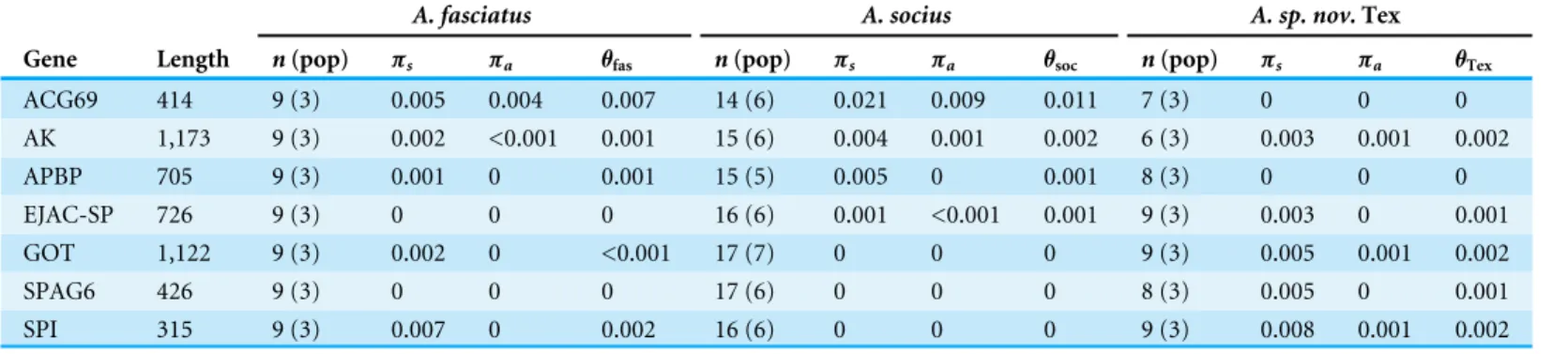
We fit the nucleotide substitution model F81 to all genes, and found no evidence of recombination in any of our genes at any of the variable sites. We found relatively low levels of both synonymous and non-synonymous nucleotide variation within and among theA. sociuscomplex species. The Watterson estimatorθ ranged from 0.001 to 0.011,κs
ranged from 0.004 to 0.054, andκa ranged from 0 to 0.009 (Tables 1 and2). Next we
estimatedω=κa/κsat each branching event of the species tree. In the older split between A. fasciatusand the other two species, the maximum likelihood estimates ofωexceeded 1, indicating evidence of positive or balancing selection in the genes AK (ω=24.841, 95
% CI [12.988–36.694]), APBP (ω=13.495, 95% CI [0–35.670]), and SPI (ω=1.356, 95
% CI [0–Inf]), while EJAC-SP approachedω=1 (ω=0.993, 95% CI [0–16.673]). In the
younger split betweenA. sociusandA. sp. nov.Tex,ωdid not exceed 1 in any of the genes (Table 2). Because of the combination of lowπs,πa, andθ and highωfor these genes, we
will henceforth interpretω >1 as evidence of positive selection as balancing selection is more likely to be accompanied by higher nucleotide diversity.
Not all genes had fixed non-synonymous substitutions between species and in these
cases we were unable to apply the McDonald–Kreitman test (Table 2). For those genes
that were testable, we did not find significant differences inDN/DScompared toPN/PS
at either branching event (Fisher’s exact test P=0.07–1). We were unable to detect a
significant departure from neutral expectations for the first branching event betweenA.
fasciatus and the two other species using the multilocus HKA test (X2P=0.916). We did detect a significant departure from neutral expectations for the second branching
Table 1 Nucleotide variation within eachA. sociuscomplex species.
A. fasciatus A. socius A. sp. nov.Tex
Gene Length n(pop) πs πa θfas n(pop) πs πa θsoc n(pop) πs πa θTex
ACG69 414 9 (3) 0.005 0.004 0.007 14 (6) 0.021 0.009 0.011 7 (3) 0 0 0 AK 1,173 9 (3) 0.002 <0.001 0.001 15 (6) 0.004 0.001 0.002 6 (3) 0.003 0.001 0.002 APBP 705 9 (3) 0.001 0 0.001 15 (5) 0.005 0 0.001 8 (3) 0 0 0 EJAC-SP 726 9 (3) 0 0 0 16 (6) 0.001 <0.001 0.001 9 (3) 0.003 0 0.001 GOT 1,122 9 (3) 0.002 0 <0.001 17 (7) 0 0 0 9 (3) 0.005 0.001 0.002
SPAG6 426 9 (3) 0 0 0 17 (6) 0 0 0 8 (3) 0.005 0 0.001
SPI 315 9 (3) 0.007 0 0.002 16 (6) 0 0 0 9 (3) 0.008 0.001 0.002
Notes.
The number of individuals sampled for each gene are shown with the number of populations they came from (n(pop)).
πs, the average number of synonymous nucleotide differences per site for any random pair of sequences;πa, the average number of non-synonymous nucleotide differences per site for any random pair of sequences;θ, a metric of the population substitution rate; all metrics were calculated across populations.
event betweenA. socius andA. sp. nov.Tex. (X2P=0.012). The outlier that diverged
most from null expectations was polymorphism in GOT inA. sp. nov.Tex., but coalescent
simulations were unable to determine that this was a significant difference (P=0.06). Both the McDonald–Kreitman and HKA tests are likely to be underpowered for our species
given the age and amount of variation present in theDrosophilasystems that both tests
were originally developed forHudson, Kreitman & Aguadé (1987 );McDonald & Kreitman (1991);Wang & Hey, (1996).
Gene tree-based analyses
We tested for evidence that any of the internal branches of each gene tree were evolving at
a higher non-synonymous rate than the other branches (Fig. 1). We found evidence
that the model in which two internal nodes in the gene tree of AK were allowed to evolve at a variable non-synonymous rate was a better fit than the single rate
class model (P=0.004). These nodes evolved at non-synonymous substitution rates
26.331 (95% CI [4.377–81.378]) and 0.147 (95% CI [0.008–0.649]), while the shared non-synonymous substitution rate was estimated to be 0. The first node (5) is the
node that separates A. fasciatus and the two other species on the AK gene tree. The
second node (43) is the node that separates A. sociusandA. sp. nov. Tex on the AK
gene tree. We also found evidence that two internal nodes in the gene tree of APBP
were evolving at a different rate compared to the background branches (P=0.015).
These nodes were evolving at rates 43.793 (95% CI [2.515–194.273]) and 19.008 (95% CI [1.088–84.035]), while the shared non-synonymous substitution rate was estimated to
be 0. The first node (11) is the node between A. fasciatusand the two other species on
the APBP gene tree. The second node (45) is the node between A. sociusandA. sp. nov.
Tex on the APBP gene tree. Despite evidence that some internal nodes were evolving at a higher rate compared to background nodes in the other genes, we did not have sufficient evidence to suggest branches in any of the other gene trees were evolving at more than one
non-synonymous rate class (ACG69 (6 tested)P=0.171, EJAC-SP (1 tested)P=0.277,
Table 2 Nucelotide variation at each branching node of theA. sociuscomplex species tree.
BetweenA. fasciatus& (A. socius+A. sp. nov.Tex) BetweenA. socius&A. sp. nov.Tex
Gene Length PN PS DN DS κs κa ω(95% CI) PN PS DN DS κs κa ω(95 % CI)
ACG69 414 7 6 0 0 0.024 0.009 0.572 (0, 1.366) 7 6 0 0 0.021 0.007 0.142 (0, 0.420) AK 1,173 3 12 2 0 0.006 0.003 24.841 (12.988, 36.694) 2 9 1 2 0.011 0.002 0.147 (0, 0.436) APBP 705 1 4 1 0 0.005 0.003 13.495 (0, 35.670) 0 3 1 0 0.007 0.002 0.285 (0, 0.843) EJAC-SP 726 1 3 0 0 0.008 0.001 0.993 (0, 16.673) 1 2 0 1 0.014 0.002 0.158 (0, 0.467) GOT 1,122 3 7 1 1 0.011 0.002 0.274 (0, 0.811) 3 4 0 2 0.011 0.001 0.136 (0, 0.402) SPAG6 426 0 1 0 2 0.029 0 0 (0, 0.001) 0 1 0 0 0.004 0 0.001 (0.001, 0.002) SPI 315 3 4 0 0 0.02 0.003 1.356 (0, inf) 1 1 2 3 0.054 0.009 0.178 (0, 0.425)
Notes.
PN, Non-synonymous polymorphisms;PS, synonymous polymorphisms;DN, Non-synonymous fixations;DS, synonymous fixations;κs, Rate of non-synonymous substitutions per non-synonymous site;κa, Rate of synonymous substitutions per synonymous site;ω=κa/κs, Estimate from maximum likelihood model fit in HyPhy, along with 95% asymptotic normal confidence intervals (CI).
N
oh
and
Mar
shall
(2016),
P
eerJ
,
DOI
10.7717/peerj.1678
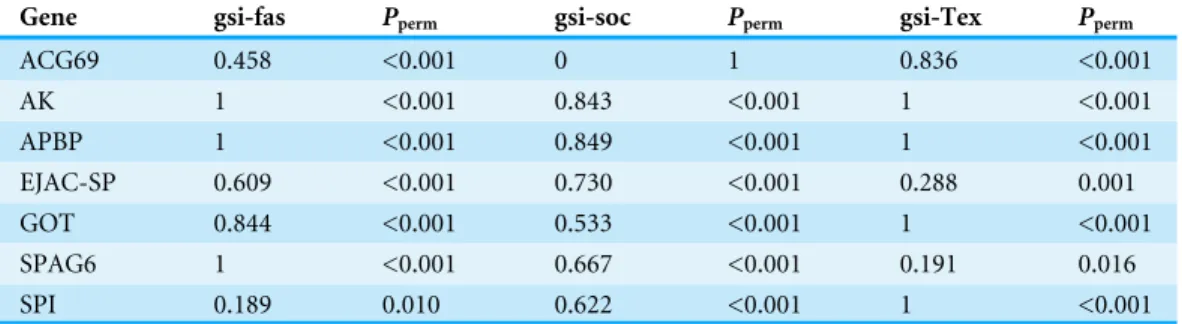
Table 3 Genealogical sorting index values based on individual rooted gene trees.Values range from zero (complete polyphyly) to one (complete monophyly).P-values are obtained from 10,000 permuta-tions that randomly reassign tip labels on the tree and represent the probability of observing a tree with a gsi value more extreme than the current toplogy.
Gene gsi-fas Pperm gsi-soc Pperm gsi-Tex Pperm
ACG69 0.458 <0.001 0 1 0.836 <0.001 AK 1 <0.001 0.843 <0.001 1 <0.001 APBP 1 <0.001 0.849 <0.001 1 <0.001 EJAC-SP 0.609 <0.001 0.730 <0.001 0.288 0.001 GOT 0.844 <0.001 0.533 <0.001 1 <0.001 SPAG6 1 <0.001 0.667 <0.001 0.191 0.016 SPI 0.189 0.010 0.622 <0.001 1 <0.001
Using SLAC and comparing model fits of nucleotide substitution models and codon models, for most genes (ACG69, AK, APBP, SPI, SPAG6) we found no evidence of any specific sites evolving under positive or negative selection. For EJAC-SP, one site (position 115) in which the amino acid serine was maintained through synonymous substitutions, showed evidence of negative selection (P=0.011). Also for GOT, one site (position 88) in which the amino acid threonine was maintained through synonymous substitutions, showed evidence of negative selection (P=0.037).
We used BUSTED to test for episodic selection anywhere in each gene. We tested
whether any sites evolved at a fasterωrate within the internal branches with non-zero
branches tested in the previous branch analysis. We found non-significant evidence of
episodic selection only in ACG69 using this method (Likelihood Ratio TestP=0.062).
The unconstrained model suggests 1.7% of foreground branch sites may be evolving
with ω=318.77 while background branch sites have a maximum ω=0.96 (100%
of the sites were partitioned into this rate class). This branch-site test is likely to be underpowered for our species given that the numbers of parameters that were estimated for the unconstrained model was upwards of 80 (depending on the number of terminal taxa for each gene), while the difference in numbers of parameters between the complex model and null model was only 1. We do not discuss results from this method further because results were non-significant across all genes.
Evidence from the contact zone betweenA. fasciatusandA. socius Comparisons of genealogical sorting index values based on gene trees including all sampled individuals, both allopatric and contact zone, indicated that lineage sorting was ongoing as gsi values ranged from 0 to 1, with a median value of 0.836. If we use the median value as a cutoff, only AK and APBP showed relatively advanced lineage sorting for all three species
while GOT showed advanced lineage sorting forA. fasciatusandA. sp. nov.Tex but not
A. socius(Table 3andFig. 2).
The statistical parsimony haplotype networks generated using allopatric individuals of all three species showed that alleles in AK, APBP, and GOT were specific to each species, while the alleles present in other genes included both species-specific alleles and alleles
Figure 3 Statistical parsimony haplotype networks including only allopatric individuals, with muta-tional steps and nonsynonymous substitutions indicated.Population abbreviations are as in the main text. Sizes of each haplotype correspond to the relative number of individuals that possessed each haplo-type.
shared between two species (Fig. 3). Within the contact zone betweenA. fasciatusand
A. socius, all genes except APBP had a mix of alleles that we had already observed in allopatric individuals as well as new alleles that were specific to the contact zone (Fig. 2). We designated these new alleles as species-specific based on their allelic distributions among contact zone individuals and calculated the degree of allelic segregation within the
contact zone. The dissimilarity indexDvalues we observed were bimodally distributed and
indicated allelic segregation was higher in the contact zone for AK, APBP, EJACSP and SPAG6 (D=0.771–1) and lower in ACG69, GOT and SPI (D=0.164–0.353) (Fig. 4).
Figure 4 Distribution of species-specific vs. common (shared) alleles within theA. fasciatusandA. so-ciuscontact zone in Kenna, WV. Nine individuals each with allozyme identities of pure (homozygous)A. fasciatusandA. sociushad varying patterns of allelic identities for the seven genes. Numbers (2–9) indicate the sampled individual and letters (A and B) indicate the alleles within each individual. The dissimilarity indexDis a metric of the degree of allelic segregation between the two contact zone populations.
DISCUSSION
Studying speciation in recently diverged species is attractive because we can potentially identify variation that is associated with divergence and not accumulated after (Andrés et al., 2013). But using within and between species patterns of sequence variation to detect adaptive evolution is particularly challenging in recently diverged species because less evolutionary time has passed to allow for fixed differences to accumulate between incipient species relative to within species polymorphism (Keightley & Eyre-Walker, 2012). We gathered data from populations across each species distribution so as to accurately differentiate between polymorphisms and fixations and detect new mutations to confirm
and expand upon previous results from more limited population sampling (Marshall et
al., 2011). Combining evidence from multiple tests allowed us to identify the most likely
putative postmating prezygotic isolation genes among our EP coding genes (Table 4).
Ultimately, the methodological approaches that we were able to apply most successfully were those that took advantage of evolutionary processes specific to young species: lineage sorting in gene trees and allele sharing in haplotype networks.
Data from the relatively recently (∼30,000 years) divergedA. sociusspecies complex
showed a general lack of both synonymous and non-synonymous nucleotide variation
within and among all investigated genes (Tables 1 and2). Our estimates of sequence
variation were also at least an order of magnitude smaller compared to other known estimates from accessory gland protein coding genes in various other species groups (Mueller et al., 2005;Wagstaff & Begun, 2005;Almeida & DeSalle, 2008), including some
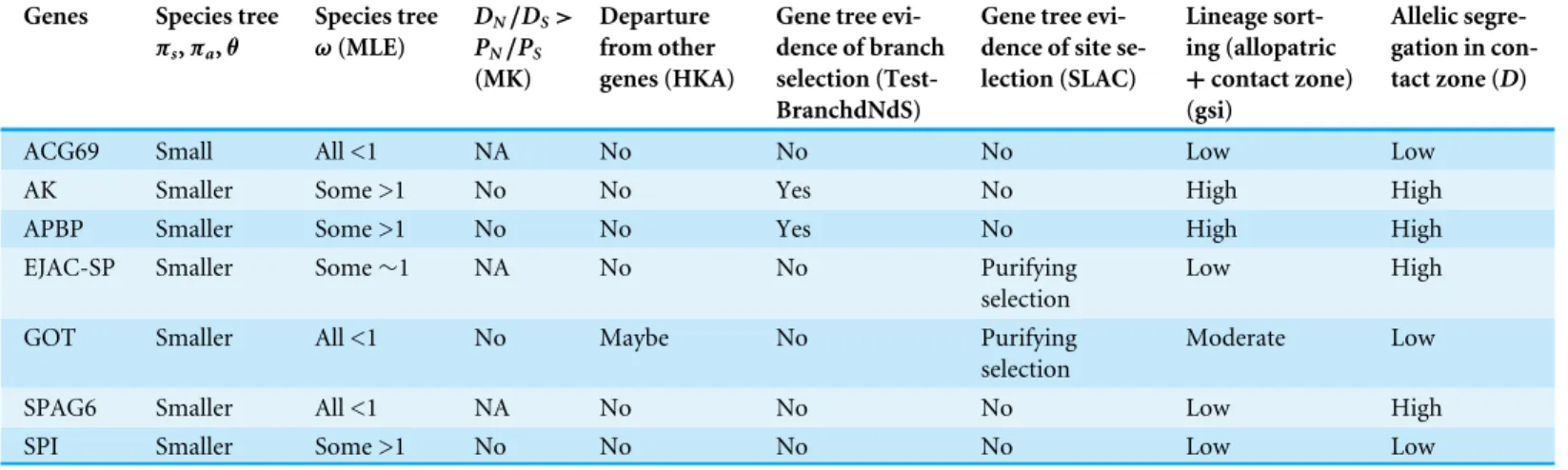
Table 4 Summary of results found testing for evidence of selection in ejaculate protein coding genes in theA. sociuscomplex.The specific method used for each result is shown in parentheses.
Genes Species tree
πs,πa,θ
Species tree
ω(MLE)
DN/DS> PN/PS
(MK)
Departure from other genes (HKA)
Gene tree evi-dence of branch selection (Test-BranchdNdS)
Gene tree evi-dence of site se-lection (SLAC)
Lineage sort-ing (allopatric +contact zone) (gsi)
Allelic segre-gation in con-tact zone (D)
ACG69 Small All <1 NA No No No Low Low
AK Smaller Some >1 No No Yes No High High
APBP Smaller Some >1 No No Yes No High High
EJAC-SP Smaller Some∼1 NA No No Purifying
selection
Low High
GOT Smaller All <1 No Maybe No Purifying selection
Moderate Low
SPAG6 Smaller All <1 NA No No No Low High
SPI Smaller Some >1 No No No No Low Low
speciation in theA. sociuscomplex is thought to coincide with glaciation history (Marshall, 2004;Marshall, 2007) population bottlenecks may have contributed to sequence variation patterns. Our results would have benefited from increased within-population sampling so that metrics such as Tajima’s or Fu and Li’sDand site frequency spectra, as well as estimates of population size and recombination rates (Nielsen, 2005) could be accurately applied. Unsurprisingly, the tests we used that relied on sequence variation on the known species tree had minor success identifying genes with evidence of positive selection based onω(Table 4). The maximum likelihood estimates ofωon the species tree indicated that AK, APBP, EJAC-SP and SPI showed evidence of positive selection at the branching event
betweenA. fasciatusand the other two species (Table 2). However, McDonald–Kreitman
tests were not applicable to several genes and HKA tests were generally inconclusive. We found approaches that used gene trees and haplotype networks were more successful at detecting evidence of positive selection, and these approaches were particularly powerful within the contact zone (Table 4). When allopatric gene trees were tested for evidence of internal branches evolving at different rates compared to the rest of the tree, we found evidence that AK and APBP both had internal branches that were evolving at higher non-synonymous substitution rates (Fig. 1). These internal branches respectively separated
A. fasciatus from the other two species, and A. sociusfromA. sp. nov. Tex. When all allopatric and contact zone individuals were examined, the genealogies of AK and APBP indicated that these genes were relatively advanced in their degrees of lineage sorting in all three species of the A. sociuscomplex compared to the other genes (Table 3andFig. 2).
GOT also showed advanced lineage sorting, but only in the two speciesA. fasciatusand
A. sp. nov.Tex. Within the contact zone ofA. fasciatusandA. socius, AK, APBP, EJAC-SP,
and SPAG6 showed highly segregated allelic distributions (Fig. 4). The two genes with
intermediate lineage sorting or allelic segregation patterns, EJAC-SP and GOT, showed evidence of purifying selection acting upon specific sites, as might be expected of most functional protein coding genes (Lawrie et al., 2013), but no evidence of positive selection.
The overlap among these results suggests AK and APBP are the most likely candidates for postmating prezygotic isolation genes (Table 4). While the remaining genes that show intermediate patterns may still contribute to reproductive isolation, they are less likely to be the major contributors to isolation barriers that act in a species-specific manner.
These patterns fit models of ongoing speciation in the face of gene flow, where incomplete lineage sorting and introgression are major confounding factors (Machado & Hey, 2003;
Broughton & Harrison, 2003;Payseur, 2010). Speciation genes are more likely to become fixed for species-specific alleles early in the process of speciation, and therefore are expected to be relatively exempt from incomplete sorting and subject to reduced introgression (Wu, 2001; Feder, Egan & Nosil, 2012). Similar patterns have been observed inDrosophila, field crickets, and moths (Ting, Tsaur & Wu, 2000;Dopman et al., 2005;Maroja, Andrés & Harrison, 2009;Andrés et al., 2013;Larson et al., 2013). It is possible that these genes are not the direct targets but rather linked to targets of divergent selection as the interaction between linkage and selection makes it challenging to distinguish between recurrent positive selection, background selection, and Hill–Robertson effects (Hill & Robertson, 1966;Charlesworth, 1994;Andolfatto, 2007;Charlesworth et al., 2009). Because both genes were identified as candidates through comparative proteomics (Marshall et al., 2011) this seems relatively unlikely, but the genomic regions around these genes should be investigated for evidence of selective sweeps to rule out this possibility.
Many studies of reproductive proteins report evidence of positive selection acting on a subset of the genes examined, in both males (Begun et al., 2000;Swanson et al., 2001;Clark & Swanson, 2005;Wagstaff & Begun, 2005;Andrés et al., 2006;Karn et al., 2008;Ramm et al., 2008;Almeida & DeSalle, 2008;Walters & Harrison, 2010) and females (Swanson et al., 2004;Panhuis & Swanson, 2006;Lawniczak & Begun, 2007;Prokupek et al., 2008;Kelleher & Markow, 2009;Kelleher, Clark & Markow, 2011). However, there are few examples of adaptive reproductive protein evolution leading to reproductive isolation outside of gamete recognition proteins (e.g.,Geyer & Palumbi, 2003;McCartney & Lessios, 2004;Springer & Crespi, 2007). Our putative postmating prezygotic isolation genes AK and APBP are two of the first examples of sperm maturation and capacitation related proteins that show evidence of fixed non-synonymous substitutions between species-specific alleles leading
to reproductive isolation (Fig. 3). We had previously observed this pattern between
A. fasciatus andA. sociusfor both AK and APBP (Marshall et al., 2011), but finding the
same pattern in the mutational steps betweenA. sociusandA. sp. nov.Tex with different
species-specific non-synonymous substitutions, with expanded population and sequence sampling, emphasizes the potential importance of these candidates.
Whether there are functional consequences to the species-specific non-synonymous substitutions in AK and APBP needs to be investigated further. Both candidates are homologous to mammalian sperm capacitation proteins. Sperm maturation and capacitation occur inside the female reproductive tract of mammals (Visconti et al., 2011). In insects and nematodes, sperm are capacitated and become motile by serine proteases present in the seminal fluid (LaFlamme & Wolfner, 2013). This process occurs within the spermatophores of Lepidoptera (Osanai & Chen, 1993;Friedländer, Jeshtadi & Reynolds,
& Chen, 1993). In either case, most insect sperm should already be mature and capacitated once spermatophores are transferred to females. Therefore the specific hypothetical function of these genes should be related to a different postcopulatory process that occurs within the female reproductive tract.
Female insects store sperm in specialized organs such as spermathecae and seminal receptacles after copulation, often for prolonged periods of time (Schnakenberg, Siegal & Bloch Qazi, 2012). Sperm lose motility within a day in flies, unless stored by females into these organs (Schnakenberg, Matias & Siegal, 2011). Conspecific sperm precedence among
Drosophilaspecies has been shown to involve post-copulatory processes that occur within the female reproductive tract that include sperm transfer, the displacement and ejection of less preferred (heterospecific) sperm, and the selective use of preferred (conspecific) sperm from different storage organs for fertilization (Manier et al., 2013a;Manier et al., 2013b). In flies, spermathecal secretory cells are intimately involved in the female driven part of these processes (Schnakenberg, Matias & Siegal, 2011). Endopeptidases produced by these secretory cells are necessary for recruiting sperm to spermathecae and also maintaining sperm motility in the seminal receptacle. The same endopeptidases also affect egg laying, so that females laid fewer eggs when their secretory cells were ablated. More recently, it was shown that the number of secretory cells that produce these endopeptidases determined whether female flies ovulated and layed eggs (Sun & Spradling, 2013). It is yet unknown whether sequence variation in these endopeptidases is related to variation in female fecundity. Other potential roles for the secretions of these cells as related to sperm precedence include a chemotactic function that would attract select sperm to different locations of the female reproductive tract (Wolfner, 2011).
The specific mechanism of conspecific sperm precedence that APBP is involved in may be related to the appropriate phosphorylation state of the phosphoprotein (APBP) depending on the female vs. male species combination. APBP becomes phosphorylated during murine sperm capacitation and co-localizes with cholesterol during this process, but its specific function is unknown (Jha et al., 2008). As noted above, insect sperm do not undergo capacitation as mammalian sperm do. As a putative binding protein with an enzymatic function, hypothetical functions of APBP in the female reproductive tract include that as a signal for sperm to be transferred to the preferred storage organ. It may also be involved in a signaling cascade that induces ovulation and oviposition in females. BetweenA. fasciatusandA. socius, when females were mated with only a single male those mated with heterospecific males laid fewer eggs but an equal proportion of fertilized eggs compared to females mated with conspecific males (Gregory & Howard, 1993).
Insects and other ecdysozoans possess AK as their sole phosphagen system for cellular energy metabolism, and accordingly, arginine phosphate and its phosphagen kinase AK are found primarily in muscles, but also in sperm and compound eyes (Strong & Ellington, 1993;Kucharski & Maleszka, 1998;Ellington, 2001). The possible roles of AK as an EP can be related to sperm motility or the acrosome reaction (Strong & Ellington, 1993;
Niksirat et al., 2015). As an energy-related phosphagen kinase, AK may confer to sperm an enhanced ability to move toward a sperm storage organ and resist displacement and ejection by females. In honeybees, AK is expressed in both male seminal fluid (Baer et al.,
2009b) and female spermathecal fluid (Baer et al., 2009a). When tested over a two-year period AK enzymatic activity decreased in mated female spermathecal fluid and sperm motility also decreased (Al-Lawati, Kamp & Bienefeld, 2009). The proteomes of freshly ejaculated vs. stored honeybee sperm are also known to differ, particularly in terms of
reduced activity of glycolytic enzymes that should be used for energy metabolism (Poland
et al., 2011). Poland and colleagues note that most of the same enzymes are also present in the spermathecal fluid (Baer et al., 2009a), suggesting female physiology has an active role in maintaining stored sperm. Two structural loops and several active sites near them are the proposed interaction interface of AK with the guanidinium groups of its substrates (Zhou et al., 1998;Pruett et al., 2003;Azzi et al., 2004;Clark, Davulcu & Chapman, 2012). As might be expected for an integral enzyme, the non-synonymous substitutions we observed do not occur at these specific sites, though they may still influence its activity.
CONCLUSIONS
A. sociuscomplex crickets provide an excellent opportunity to identify patterns of evolution in speciation genes for two major reasons: speciation is incomplete as evidenced by ongoing gene flow in the field, and isolation is through a single type of reproductive isolation barrier, i.e., postmating prezygotic phenotypes. We found that when speciation is ongoing, combining multiple approaches, particularly those that incorporate evidence from gene trees and haplotype networks, was important for identifying putative postmating prezygotic isolation genes. Both AK and APBP have fixed, or nearly fixed, non-synonymous
substitutions between bothA. fasciatusand the other two species, and betweenA. socius
andA. sp. nov.Tex. Both genes showed advanced lineage sorting across and within the contact zone, and allelic segregation within the contact zone. The next step is to determine the functional consequence of allelic variation in either EP in conspecific sperm precedence and the successful induction of female oviposition in theA. sociuscomplex.
ACKNOWLEDGEMENTS
We thank Christopher Garcia for collecting the crickets used in this study and Diana Huestis and Shanda Wheeler for their help in isolating RNA and screening individuals for species status with allozymes. We also thank Daniel J. Howard for his support throughout this work. This is contribution no. 12-015-J from the Kansas Agricultural Experiment Station.
ADDITIONAL INFORMATION AND DECLARATIONS
Funding
Grant Disclosures
The following grant information was disclosed by the authors: National Science Foundation: DEB-0746316.
Competing Interests
The authors declare there are no competing interests.
Author Contributions
• Suegene Noh performed the experiments, analyzed the data, contributed
reagents/ma-terials/analysis tools, wrote the paper, prepared figures and/or tables, reviewed drafts of the paper.
• Jeremy L. Marshall conceived and designed the experiments, analyzed the data,
contributed reagents/materials/analysis tools, wrote the paper, reviewed drafts of the paper.
DNA Deposition
The following information was supplied regarding the deposition of DNA sequences:
Sequences formatted as haplotypes are available from NCBI GenBank PopSets372477571
(ACG69),372477483(AK),372477513(APBP),372477527(EJAC-SP),372477535(GOT),
372477555(SPAG6),372477561(SPI).
Data Availability
The following information was supplied regarding data availability:
Two archives are included in the submission. The content files can be extracted using the following command in a Unix shell:
tar-xvzf archive_file_name.
Supplemental Information
Supplemental information for this article can be found online athttp://dx.doi.org/10.7717/ peerj.1678#supplemental-information.
REFERENCES
Al-Lawati H, Kamp G, Bienefeld K. 2009.Characteristics of the spermathecal contents
of old and young honeybee queens.Journal of Insect Physiology 55:116–121
DOI 10.1016/j.jinsphys.2008.10.010.
Almeida FC, DeSalle R. 2008.Evidence of adaptive evolution of accessory gland proteins in closely related species of theDrosophila repletagroup.Molecular Biology and Evolution25:2043–2053DOI 10.1093/molbev/msn155.
Andolfatto P. 2007.Hitchhiking effects of recurrent beneficial amino acid substitutions
in theDrosophila melanogastergenome.Genome Research17:1755–1762
DOI 10.1101/gr.6691007.
Andrés JA, Larson EL, Bogdanowicz SM, Harrison RG. 2013.Patterns of transcriptome divergence in the male accessory gland of two closely related species of field crickets.
Genetics193:501–513DOI 10.1534/genetics.112.142299.
Andrés JA, Maroja LS, Bogdanowicz SM, Swanson WJ, Harrison RG. 2006.Molecular evolution of seminal proteins in field crickets.Molecular Biology and Evolution
23:1574–1584DOI 10.1093/molbev/msl020.
Andrés JA, Maroja LS, Harrison RG. 2008.Searching for candidate speciation genes us-ing a proteomic approach: seminal proteins in field crickets.Proceedings of the Royal Society of London B: Biological Sciences275:1975–1983DOI 10.1098/rspb.2008.0423.
Anisimova M, Nielsen R, Yang Z. 2003.Effect of recombination on the accuracy of the likelihood method for detecting positive selection at amino acid sites.Genetics
164:1229–1236.
Avila FW, Sirot LK, LaFlamme BA, Rubinstein CD, Wolfner MF. 2011.Insect seminal fluid proteins: identification and function.Annual Review of Entomology56:21–40
DOI 10.1146/annurev-ento-120709-144823.
Azzi A, Clark SA, Ellington WR, Chapman MS. 2004.The role of phosphagen specificity loops in arginine kinase.Protein Science13:575–585DOI 10.1110/ps.03428304.
Baer B, Eubel H, Taylor NL, O’Toole N, Harvey Millar A. 2009a.Insights into female
sperm storage from the spermathecal fluid proteome of the honeybeeApis mellifera.
Genome Biology10:R67DOI 10.1186/gb-2009-10-6-r67.
Baer B, Heazlewood JL, Taylor NL, Eubel H, Harvey Millar A. 2009b.The seminal fluid proteome of the honeybeeApis mellifera.Proteomics9:2085–2097
DOI 10.1002/pmic.200800708.
Begun DJ, Whitley P, Todd BL, Waldrip-Dail HM, Clark AG. 2000.Molecular popula-tion genetics of male accessory gland proteins inDrosophila.Genetics156:1879–1888.
Broughton RE, Harrison RG. 2003.Nuclear gene genealogies reveal historical, demo-graphic and selective factors associated with speciation in field crickets.Genetics
163:1389–1401.
Chapman T, Davies SJ. 2004.Functions and analysis of the seminal fluid proteins of male
Drosophila melanogasterfruit flies.Peptides25:1477–1490 DOI 10.1016/j.peptides.2003.10.023.
Charlesworth B. 1994.The effect of background selection against deleterious mutations on weakly selected, linked variants.Genetical Research63:213–227
DOI 10.1017/S0016672300032365.
Charlesworth B, Betancourt AJ, Kaiser VB, Gordo I. 2009.Genetic recombination
and molecular evolution.Cold Spring Harbor Symposium on Quantitative Biology
74:177–186DOI 10.1101/sqb.2009.74.015.
Civetta A, Singh RS. 1998.Sex and speciation: genetic architecture and evolutionary potential of sexual versus nonsexual traits in the sibling species of theDrosophila melanogaster complex.Evolution52:1080–1092.
Clark NL, Aagaard JE, Swanson WJ. 2006.Evolution of reproductive proteins from
animals and plants.Reproduction131:11–22DOI 10.1530/rep.1.00357.
Clark SA, Davulcu O, Chapman MS. 2012.Crystal structures of arginine kinase in
complex with ADP, nitrate, and various phosphagen analogs.Biochemical and
Clark NL, Swanson WJ. 2005.Pervasive adaptive evolution in primate seminal proteins.
PLoS Genetics1:e35DOI 10.1371/journal.pgen.0010035.
Clement M, Posada D, Crandall KA. 2000.TCS: a computer program to estimate gene
genealogies.Molecular Ecology 9:1657–1659DOI 10.1046/j.1365-294x.2000.01020.x.
Cummings MP, Neel MC, Shaw KL. 2008.A genealogical approach to quantifying
lineage divergence.Evolution62:2411–2422DOI 10.1111/j.1558-5646.2008.00442.x.
Dean MD, Clark NL, Findlay GD, Karn RC, Yi X, Swanson WJ, MacCoss MJ, Nachman MW. 2009.Proteomics and comparative genomic investigations reveal heterogeneity in evolutionary rate of male reproductive proteins in mice (Mus domesticus).
Molecular Biology and Evolution26:1733–1743DOI 10.1093/molbev/msp094.
Delport W, Poon AF, Frost SD, Pond SLK. 2010.Datamonkey 2010: a suite of phy-logenetic analysis tools for evolutionary biology.Bioinformatics26:2455–2457 DOI 10.1093/bioinformatics/btq429.
Dopman EB, Pérez L, Bogdanowicz SM, Harrison RG. 2005.Consequences of reproduc-tive barriers for genealogical discordance in the European corn borer.Proceedings of the National Academy of Sciences of the United States of America102:14706–14711
DOI 10.1073/pnas.0502054102.
Dorus S, Busby SA, Gerike U, Shabanowitz J, Hunt DF, Karr TL. 2006.Genomic
and functional evolution of theDrosophila melanogastersperm proteome.Nature
Genetics38:1440–1445DOI 10.1038/ng1915.
Duncan OD, Duncan B. 1955.A methodological analysis of segregation indexes.
American Sociological Review 20:210–217DOI 10.2307/2088328.
Ellington WR. 2001.Evolution and the physiological roles of phosphagen systems.
Annual Review of Physiology 63:289–325DOI 10.1146/annurev.physiol.63.1.289.
Feder JL, Egan SP, Nosil P. 2012.The genomics of speciation-with-gene-flow.Trends in Genetics28:342–350DOI 10.1016/j.tig.2012.03.009.
Felsenstein J. 1981.Evolutionary trees from DNA-sequences: a maximum-likelihood
approach.Journal of Molecular Evolution17:368–376DOI 10.1007/BF01734359.
Findlay GD, Sitnik JL, Wang W, Aquadro CF, Clark NL, Wolfner MF. 2014. Evolu-tionary rate covariation identifies new members of a protein network required for
Drosophila melanogasterfemale post-mating responses.PLoS Genetics10:e1004108 DOI 10.1371/journal.pgen.1004108.
Friedländer M, Jeshtadi A, Reynolds S. 2001.The structural mechanism of trypsin-induced intrinsic motility inManduca sextaspermatozoain vitro.Journal of Insect Physiology47:245–255DOI 10.1016/S0022-1910(00)00109-8.
Geyer LB, Palumbi SR. 2003.Reproductive character displacement and the genetics of gamete recognition in tropical sea urchins.Evolution57:1049–1060
DOI 10.1111/j.0014-3820.2003.tb00315.x.
Gregory PJ, Howard DJ. 1993.Laboratory hybridization studies ofAllonemobius fasciatus
andA. socius(Orthoptera: Gryllidae).Annals of the Entomological Society of America
86:694–701DOI 10.1093/aesa/86.6.694.
Gregory PJ, Howard DJ. 1994.A post-insemination barrier to fertilization isolates two
closely related ground crickets.Evolution48:705–710DOI 10.2307/2410480.
Haerty W, Jagadeeshan S, Kulathinal RJ, Wong A, Ram KR, Sirot LK, Levesque L, Artieri CG, Wolfner MF, Civetta A, Singh RS. 2007.Evolution in the fast lane: rapidly evolving sex-related genes inDrosophila.Genetics177:1321–1335 DOI 10.1534/genetics.107.078865.
Hall TA. 1999.BioEdit: a user-friendly biological sequence alignment editor and analysis
program for Windows 95/98/NT.Nucleic Acids Symposium Series41:95–98.
Hill WG, Robertson A. 1966.The effect of linkage on limits to artificial selection.
Genetical Research8:269–294 DOI 10.1017/S0016672300010156.
Hong S-Y, O’Sullivan D, Sadahiro Y. 2014.Implementing spatial segregation reasures in R.PLoS ONE9:e113767DOI 10.1371/journal.pone.0113767.
Howard DJ. 1983.Electrophoretic survey of eastern North American Allonemo-bius(Orthoptera: Gryllidae): evolutionary relationships and the discovery of three new species.Annals of the Entomological Society of America76:1014–1021 DOI 10.1093/aesa/76.6.1014.
Howard DJ. 1986.A zone of overlap and hybridization between two ground cricket species.Evolution40:34–43.
Howard DJ, Gregory PJ, Chu J, Cain ML. 1998a.Conspecific sperm precedence is an effective barrier to hybridization between closely related species.Evolution
52:511–516DOI 10.2307/2411086.
Howard DJ, Marshall JL, Hampton DD, Britch SC, Draney ML, Chu J, Cantrell RG. 2002.The genetics of reproductive isolation: a retrospective and prospective look
with comments on ground crickets.American Naturalist159:S8–S21.
Howard DJ, Reece PG, Gregory PJ, Chu J, Cain ML. 1998b. The evolution of barriers to fertilization between closely related organisms. In: Howard DJ, Berlocher SH, eds.
Endless forms: species and speciation. New York: Oxford University Press, 279–288.
Howard DJ, Waring GL. 1991.Topographic diversity, zone width, and the strength of re-productive isolation in a zone of overlap and hybridization.Evolution45:1120–1135.
Hudson RR, Kreitman M, Aguadé M. 1987.A test of neutral molecular evolution based on nucleotide data.Genetics116:153–159.
Jensen JD, Wong A, Aquadro CF. 2007.Approaches for identifying targets of positive selection.Trends in Genetics23:568–577DOI 10.1016/j.tig.2007.08.009.
Jha KN, Shumilin IA, Digilio LC, Chertihin O, Zheng H, Schmitz G, Visconti PE, Flickinger CJ, Minor W, Herr JC. 2008.Biochemical and structural characterization of apolipoprotein AI binding protein, a novel phosphoprotein with a potential role
in sperm capacitation.Endocrinology 149:2108–2120DOI 10.1210/en.2007-0582.
Karn RC, Clark NL, Nguyen ED, Swanson WJ. 2008.Adaptive evolution in rodent seminal vesicle secretion proteins.Molecular Biology and Evolution25:2301–2310
DOI 10.1093/molbev/msn182.
Kelleher ES, Clark NL, Markow TA. 2011.Diversity-enhancing selection acts on a female reproductive protease family in four subspecies ofDrosophila mojavensis.Genetics
187:865–876DOI 10.1534/genetics.110.124743.
Kelleher ES, Markow TA. 2009.Duplication, selection and gene conversion in a
Drosophila mojavensisfemale reproductive protein family.Genetics181:1451–1465 DOI 10.1534/genetics.108.099044.
Kosakovsky Pond SL, Frost SDW. 2005a.A simple hierarchical approach to modeling distributions of substitution rates.Molecular Biology and Evolution22:223–234.
Kosakovsky Pond SL, Frost SDW. 2005b.Not so different after all: a comparison of
methods for detecting amino-acid sites under selection.Molecular Biology and
Evolution22:1208–1222DOI 10.1093/molbev/msi105.
Kosakovsky Pond SL, Frost SDW, Muse SV. 2005.HyPhy: hypothesis testing using
phylogenies.Bioinformatics21:676–679DOI 10.1093/bioinformatics/bti079.
Kosakovsky Pond SLK, Murrell B, Fourment M, Frost SDW, Delport W, Scheffler K. 2011.A random effects branch-site model for detecting episodic diversifying
selec-tion.Molecular Biology and Evolution28:3033–3043DOI 10.1093/molbev/msr125.
Kosakovsky Pond SL, Muse SV. 2005. HyPhy: hypothesis testing using phylogenies. In: Nielsen R, ed.Statistical methods for molecular evolution. Statistics for biology and health, New York: Springer, 125–181.
Kosakovsky Pond SL, Posada D, Gravenor MB, Woelk CH, Frost SDW. 2006.GARD:
a genetic algorithm for recombination detection.Bioinformatics22:3096–3098
DOI 10.1093/bioinformatics/btl474.
Kucharski R, Maleszka R. 1998.Arginine kinase is highly expressed in the compound eye of the honey-bee,Apis mellifera.Gene211:343–349
DOI 10.1016/S0378-1119(98)00114-0.
LaFlamme BA, Wolfner MF. 2013.Identification and function of proteolysis
regulators in seminal fluid.Molecular Reproductive Development 80:80–101
DOI 10.1002/mrd.22130.
Larson EL, Andrés JA, Bogdanowicz SM, Harrison RG. 2013.Differential introgression in a mosaic hybrid zone reveals candidate barrier genes.Evolution; International Journal of Organic Evolution67:3653–3661DOI 10.1111/evo.12205.
Lawniczak MK, Begun DJ. 2007.Molecular population genetics of female-expressed
mating-induced serine proteases inDrosophila melanogaster.Molecular Biology and
Evolution24:1944–1951DOI 10.1093/molbev/msm122.
Lawrie DS, Messer PW, Hershberg R, Petrov DA. 2013.Strong purifying selection at synonymous sites inD. melanogaster.PLoS Genetics9:e1003527 DOI 10.1371/journal.pgen.1003527.
Li H. 2006.Constructing the TreeFam database. PhD thesis, Institute of Theoretical Physics, Chinese Academy of Science.
Librado P, Rozas J. 2009.DnaSP v5: a software for comprehensive analysis of DNA
poly-morphism data.Bioinformatics25:1451–1452DOI 10.1093/bioinformatics/btp187.
Machado CA, Hey J. 2003.The causes of phylogenetic conflict in a classicDrosophila
species group.Proceedings of the Royal Society of London B: Biological Sciences
270:1193–1202DOI 10.1098/rspb.2003.2333.
Maddison WP. 1997.Gene trees in species trees.Systematic Biology 46:523–536 DOI 10.1093/sysbio/46.3.523.
Manier MK, Belote JM, Lüpold S, Berben KS, Ala-Honkola O, Collins WF, Pitnick S. 2013b.Rapid diversification of sperm precedence traits and processes among three siblingDrosophilaspecies.Evolution67:2348–2362DOI 10.1111/evo.12117.
Manier MK, Lüpold S, Belote JM, Starmer WT, Berben KS, Ala-Honkola O, Collins WF, Pitnick S. 2013a.Postcopulatory sexual selection generates speciation pheno-types inDrosophila.Current Biology23:1853–1862DOI 10.1016/j.cub.2013.07.086.
Maroja LS, Andrés JA, Harrison RG. 2009.Genealogical discordance and patterns of introgression and selection across a cricket hybrid zone.Evolution63:2999–3015 DOI 10.1111/j.1558-5646.2009.00767.x.
Marshall JL. 2004.TheAllonemobius-Wolbachiahost-endosymbiont system: evidence for rapid speciation and against reproductive isolation driven by cytoplasmic
incompatibility.Evolution58:2409–2425DOI 10.1111/j.0014-3820.2004.tb00871.x.
Marshall JL. 2007.Rapid evolution of spermathecal duct length in theAllonemobius sociuscomplex of crickets: species, population andWolbachiaeffects.PLoS ONE
2:e720DOI 10.1371/journal.pone.0000720.
Marshall JL, DiRienzo N. 2012.Noncompetitive gametic isolation between sibling species of a cricket: a hypothesized link between within-population incompatibility and reproductive isolation between species.International Journal of Evolutionary Biology2012: 593438DOI 10.1155/2012/593438.
Marshall JL, Huestis DL, Garcia C, Hiromasa Y, Wheeler S, Noh S, Tomich JM, Howard DJ. 2011.Comparative proteomics uncovers the signature of natural selection acting on the ejaculate proteomes of two cricket species isolated by
postmating, prezygotic phenotypes.Molecular Biology and Evolution28:423–435
DOI 10.1093/molbev/msq230.
Marshall JL, Huestis DL, Hiromasa Y, Wheeler S, Oppert C, Marshall SA, Tomich JM, Oppert B. 2009.Identification, RNAi knockdown, and functional analysis of an ejaculate protein that mediates a postmating, prezygotic phenotype in a cricket.PLoS
ONE4:e7537–e7546DOI 10.1371/journal.pone.0007537.
McCartney MA, Lessios HA. 2004.Adaptive evolution of sperm bindin tracks egg incompatibility in neotropical sea urchins of the genusEchinometra.Molecular Biology and Evolution21:732–745DOI 10.1093/molbev/msh071.
McDonald JH, Kreitman M. 1991.Adaptive protein evolution at theAdhlocus in
Drosophila.Nature351:652–654DOI 10.1038/351652a0.
Metta M, Gudavalli R, Gibert J-M, Schlötterer C. 2006.No accelerated rate of protein
evolution in male-biasedDrosophila pseudoobscuragenes.Genetics174:411–420