INTRODUCTION
Crohn’s disease (CD) and ulcerative colitis (UC) are the two ma-jor inlammatory bowel diseases (IBDs) that affect 1 in 200 people in developed countries, where they present an increasing incidence and prevalence. In European countries, at least a ive-fold increase in the incidence of IBD in the last 30 years has been estimated(5,15).
IBD generally causes debilitating symptoms such as urgent diarrhea, rectal bleeding, vomiting, and anorexia, which often have an adverse effect on the social, professional, academic, family relationships, and sexual activity of patients(3,5,14,15).
UC, which involves only the rectum and colon, usually de-velops in the rectum (proctitis) and may extend proximally to the sigmoid and descending colon (left sided colitis) or the entire colon (pancolitis). The location and disease activity index determine the therapeutic approach(2).
CD may affect the gastrointestinal tract anywhere between the mouth and the anus; inflammation occurs intermittently, with spots caused by the disease in areas of healthy mucosa. CD may be classiied as inlammatory, stenotic, or penetrating. The genetic component is more prevalent in CD than in UC. Other rheumatologic, dermatologic, ophthalmologic, hepatobiliary, and extraintestinal diseases may occur concomitantly(2).
Among the various classiications proposed for UC and CD, the Montreal classiication is the most commonly used as it distinguishes clinical subphenotypes of CD according to location, behavior, and age at symptom onset, and those of ulcerative colitis according to
Inflammatory bowel disease: outpatient
treatment profile
Rachael Miranda dos
SANTOS
1,2, Ana Teresa Pugas
CARVALHO
1, Kelly dos Santos
SILVA
1,
Selma Petra Chaves
SÁ
2, Aparecida Helena dos
SANTOS
2and Millene Ramos
SANDINHA
1Received 23/8/2016 Accepted 12/12/2016
ABSTRACT – Background – Crohn’s disease and ulcerative colitis are the two major forms of inlammatory bowel disease. The incidence and prevalence
of both conditions have increased and are progressively increasing. These diseases are frequently recurrent and clinically highly severe. In Brazil, the lack of epidemiological data related to such diseases has left these patients in a vulnerable state and contributed to increased morbidity. Objective – To
describe the proiles of patients with inlammatory bowel disease treated in an outpatient service in Brazil. Methods – This descriptive, exploratory, and
retrospective documentary study with a quantitative approach was performed in an outpatient treatment service for inlammatory bowel disease, at a university polyclinic located in Rio de Janeiro, Brazil, from May to July 2016. The study included 556 patients and was approved by the research ethics committee of the institution (CAAE no. 55179316.6.0000.5259/2016). Results – The data showed a high prevalence of inlammatory bowel disease
in white female patients. Crohn’s disease was diagnosed in more patients than was ulcerative colitis; the ileocolon was the most commonly affected location in patients with Crohn’s disease. The stenotic phenotype was prevalent in patients with Crohn’s disease. Conclusion – The prevalence of the
stenotic phenotype in Crohn’s disease in relation to others demonstrates the need for further investigations in this ield of study in Brazil. In conclu-sion, the data showed that the epidemiologic proile of the study population is similar to that published in the national and international literature.
HEADINGS – Inlammatory bowel diseases. Crohn disease. Ulcerative colitis. Epidemiology.
Declared conflict of interest of all authors: none Disclosure of funding: no funding received
1 Ambulatório de Doenças Inflamatórias Intestinais, Disciplina de Gastroenterologia, Policlínica Piquet Carneiro, Universidade do Estado do Rio de Janeiro, Rio de Janeiro, RJ, Brasil. 2 Programa de Mestrado Profissional em Enfermagem Assistencial, Escola de Enfermagem Aurora Afonso Costa, Universidade Federal Fluminense, Niterói, RJ, Brasil.
Correspondence: Rachael Miranda dos Santos. Serviço Ambulatorial de Gastroenterologia, Policlínica Piquet Carneiro, Universidade do Estado do Rio de Janeiro. CEP: 20950-003 – Rio de Janeiro, RJ, Brasil. E-mail: [email protected]
the extent of the disease and age at symptom onset. Such a classi-ication is desirable for correlating speciic disease phenotypes with possible clinical outcomes and prognosis to select a better therapeutic approach and a more appropriate follow-up for each patient(4,5).
Reference centers responsible for treating patients with IBD are often required to justify their need for resources in order to provide appropriate treatments for patients. Studies have shown that the costs related to treating patients with IBD are nearly 2.2 billion dollars per year in the United States(15).
In Brazil, patients with CD and UC are not necessarily reported resulting in a lack of epidemiologic data with respect to these disea-ses. This situation places patients in a vulnerable state, as incipient studies and the poor publication records on this group of diseases contribute to their late diagnosis and increased morbidity(3,4,6,8,9,14).
It is dificult to determine the epidemiologic data of IBD in Brazil and all developing countries owing to deiciencies in data recording systems and the inability to access data other than those in the public health system. Given this reality, specialty pharmacies and reference centers for the treatment of IBD are favorable places for performing IBD-related studies(6,8,9,14).
The outpatient follow-up of patients with IBD aims to control symptoms and induce disease remission, adapt patients to their chronic condition and improve their quality of life, minimize toxicity and monitor the adverse effects of prescribed drugs, and postpone or reduce the incidence of relapse(1).
METHODS
This retrospective, documentary, and descriptive quantitative study was performed in an outpatient treatment service for IBD of a University Polyclinic located in Rio de Janeiro. The study was performed between May and July 2016, and included 556 patients. This investigation followed the ethical guidelines recommended by the Brazilian National Committee for Ethics in Research of the Brazilian National Health Council, and was approved by the Research Ethics Committee of the Institution (CAAE no. 55179316.6.0000.5259/2016).
The inclusion criteria were patients with IBD registered in the outpatient service for IBD treatment and undergoing outpatient treatment during the data collection period. Patients who had undergone treatment for <3 months were excluded from the study owing to the lack of necessary data for surveying their full proile.
The variables studied were sex, age, demographic data, diagno-sis, disease location, intestinal CD phenotype, effective treatment, previous surgeries, and the occurrence of perianal disease.
The data were retrieved from medical records by using an ap-propriate data collection tool that enabled the collection of the socio-demographic, clinical, endoscopic, radiologic, and imaging proiles of each study participant.
Age was analyzed as a continuous variable, whereas the average and minimum and maximum values were retrieved and analyzed by using a line chart to ind the prevalence peaks ac-cording to age.
The Montreal classiication, which subdivides the disease ac-cording to three main phenotypic characteristics, i.e. age at diag-nosis (A, “age”), topographic location (L, “location”), and clinical behavior (B, “behavior”), was used to categorize the CD location. The location is deined as the point of the maximum anatomical extent of the disease at any time. There were four possible classiica-tions according to location: terminal ileal (L1, limited to the lower third of the small intestine, with or without cecal involvement), colonic (L2, anywhere between the cecum and the rectum without involvement of the upper digestive tract), ileocolonic (L3, terminal ileum and anywhere between the ascending colon and rectum), and isolated to the upper gastrointestinal tract (L4, anywhere above the terminal ileum, except the mouth). If there is a simultaneous proximal (L4) and distal (L1–L3) involvement, an L4 category should be added as a modiier; if no distal involvement was found, L4 was considered to be of the exclusive form. This resulted in seven possible classiications according to location: L1, L2, L3, L4, L1+L4, L2+L4, and L3+L4(4,10).
Concerning the clinical behavior of CD, three classiications were used: nonstenotic and nonpenetrating/inlammatory (B1), stenotic (B2), and penetrating/istulizing (B3). Nonstenotic and nonpenetrating/inlammatory clinical behavior (B1) occurs in the presence of inlammation without any stenotic or istulizing evidence. On the other hand, stenotic behavior (B2) is deined by a narrowing of the intestinal lumen. Penetrating behavior (B3) is deined when abdominal istulae or inlammatory masses and/or abscess occur at any period during the progression of disease(4,10,12,15).
To ensure correct classification and differentiation of the clinical behavior of CD, data from enterography reports obtained from magnetic resonance imaging or computed tomography scans were used preferentially, as well as endoscopic reports of the study patients when appropriate.
The extent of UC was classiied as follows: ulcerative proctitis (E1), involvement limited to the rectum; left colitis (E2), involve-ment extending to the splenic lexure; and extensive colitis (E3), involvement extending beyond the splenic lexure(3,5).
The data were processed, stored, and analyzed by using Mi-crosoft Excel 2010 and the Statistical Package for Social Sciences version 20.0. For characterization of the sample and descriptive analysis of the variables, the data were summarized by using descriptive statistics in frequency distribution tables. The results were discussed and compared with the data of currently available relevant studies.
RESULTS
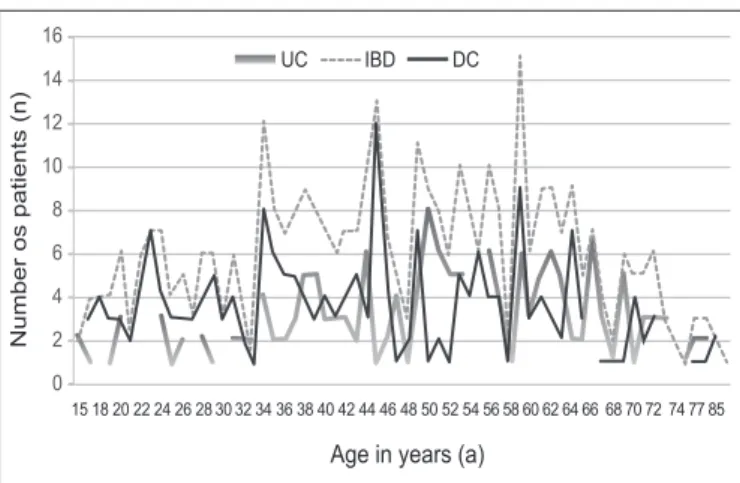
Among the 556 patients with IBD who participated in the study, 331 (59.3%) were women and 225 (40.7%) were men. The median age of the 432 participants was 49.7 years ,range, 15–86 years (Figure 1).
The data relative to the places of residence of the participants showed that most of the patients treated at the outpatient service lived in the same municipality (53.70%; n=290), whereas those from the other 33 neighboring municipalities in the city of Rio de Janeiro were also identiied. The patient with the farthest residence was living 344 km away from the reference center. Considering the regional distribution in the state, most of the treated patients were living in the metropolitan region (94.32%; n=382), followed by those who were living in the Coastal Lowlands region (2.72%; n=11), Northern Rio de Janeiro (1.23%; n=5), Costa Verde (0.74%; n=3), and Middle Paraíba and Central-South Rio de Janeiro (0.25%; n=1 each). The other patients (0.49%; n=2) were living in other states of the southeastern region of Brazil.
Concerning race/self-reported color, the data of 431 patients were surveyed: 47.80% (n=206) self-reported as white, 38.52% (n=166) as dark skinned, and 13.69% (n=59) as black.
The medical diagnoses included the data of 447 patients. CD was found in 56.38% (n=252) and UC was found in 38.26% (n=171), whereas 5.37% (n=24) of patients were lacking a diagnosis.
The most common types of UC according to inlammatory location were extensive colitis (E3) 35.67%, (n=61) and proctitis (E1) 30.99%, (n=53) (Figure 2).
The data from 88 patients with CD were surveyed according to the Montreal classiication; the most prevalent type of CD accor-ding to location was ileocolonic (L3) (57.95%, n=51), followed by colonic (L2) (18.18%, n=16), ileal (L1) (11.63%, n=10), pancolonic (L2+L4) (10.23%, n=9), and jejunoileal (L1+L4) (2.33%, n=2).
According to the phenotypic classiication of CD, the stenotic phenotype (B2) was the most prevalent (35.23%; n=31), followed by the nonstenotic and nonpenetrating/inlammatory (B1) (25%; n=22) and penetrating/istulizing (B3) (23.86%; n=21). However, 15.91% (n=14) of patients were lacking a classiication (Table 1).
Of the 252 patients with CD, 17.46% (n=44) had some type of perianal disease and 12.69% (n=32) had undergone a surgical procedure owing to disease complications (Figure 3).
TABLE 1. Number and proportion of patients with Crohn’s disease accor-ding to location and phenotype. May to July 2016, Rio de Janeiro, Brazil
Variables
n %
Localization Intestinal phenotype
Ileocolonic (L3) Stenotic (B2) Inlammatory (B1) Penetrating (B3) 19 7 19 21.59 7.95 21.59 Colonic (L2) Stenotic (B2) Inlammatory (B1) Penetrating (B3) 5 7 1 5.68 7.95 1.14 Ileal (L1) Stenotic (B2) Inlammatory (B1) Penetrating (B3) 5 3 1 5.68 3.41 1.14
Pancolonic (L2+L4) Stenotic (B2) Inlammatory (B1) 2 3 2.27 3.41 Jejunoileal (L1+L4) Inlammatory (B1) Penetrating (B3) Not identiied 1 1 14 1.14 1.14 15.91
Total 88 100%
DISCUSSION
The results of this study showed a predominance of female patients, thus corroborating other studies performed in Brazil. The data released in April 2016 by the department of pharmaceutical care and strategic inputs of the state of Rio de Janeiro are consis-tent with those obtained in the outpatient service. That publica-tion indicated that 58.92% of patients with IBD were women and 41.08% were men(3,4,8,14). In contrast, most European studies showed a higher prevalence of IBD among men; in European countries, women primarily develop CD and men develop UC(2,12).
Young adults are commonly diagnosed as having both CD and UC. Most new diagnoses were in the age group of between 15 and 40 years, whereas another peak of incidence was between 50 and 80 years(4,11,15). Concerning the age group of the patients included in this study, most cases of IBD occurred at age between 30 and 45 years, whereas another peak of incidence occurred around age 60 years. The results found in this study contradict those found in the international literature. Most studies indicated a higher prevalence of IBD in white patients, followed by dark-skinned, black, and yellow patients, which was conirmed in this study population with a higher prevalence of IBD in white women(2,3,14,15).
The demographic proile of patients showed a similarity to other Brazilian reference centers that offer health care to patients living in neighboring regions. It is noteworthy that patients usual-ly travel great distances to seek specialized medical services. This indicates the need for expanding the coverage of more complex services to ensure access and proper use for all patients who need such services. Although telehealth deined as health-care services provided to people separated by distance and time is available by using technologies such as telephones, computers, or interactive video streaming, these resources are underutilized in South America for improving patient assistance programs despite the widespread use of both landlines and cell phones by these populations(13).
FIGURE 3. Distribution of occurrence numbers for perianal disease. Rio de Janeiro, Brazil, 2016.
FIGURE 2. Number of patients with ulcerative colitis according to inlammatory location. Rio de Janeiro, Brazil, 2016.
No speciied
Left colitis (E2)
Proctitis (E1)
Extensive colitis (E3)
19
38
53
61
0 10 20 30 40 50 60 70
Similar to the epidemiological studies on the proile of patients with IBD conducted by Kleinubing-Júnior et al. and Barros et al., the extent of involvement of UC in this study showed a prevalence of extensive colitis (E3) and rectitis/proctitis (E1)(3,8).
The Montreal classiication, owing to its diagnostic and thera-peutic implications, has been increasingly used in patients with CD. In most studies related to classiication according to location, the ileocolonic type was the most frequent, followed by the ileal and colonic types(2–6,8–10,12,14). In this study, patients with CD showed a higher prevalence of the ileocolonic type (L3), corroborating the results of recent multicenter studies that included countries in Europe, North America, and Oceania(2).
However, the data found in this study showed a greater preva-lence of patients with CD in the colonic region (L3) than in the ileal region (L1). Multicenter and review studies have pointed out that the nonstenotic and nonpenetrating/inlammatory phenotype (B1) is the most frequent(2,5). Considering the phenotypic classiication of CD, the patients evaluated in this study were not predominantly found as having an inlammatory phenotype, as described in the literature. Most patients showed a penetrating phenotype, followed by the stenotic and inlammatory phenotype, respectively, with a slightly different percentage, which may be because of the low number of participants assessed with this classiication.
The natural history and clinical progression of IBD are rather heterogeneous: up to 20% of patients with ulcerative colitis need to undergo a colectomy owing to the complications of the disease, whereas >50% of patients with CD require surgery within 10 years after the diagnosis. On the other hand, up to 50% of patients with ulcerative colitis and 30% with CD tend to show a relatively pas-sive disease progression without the need for immunosuppression or surgery(13).
Therefore, the indings in the literature are in contrast to the results of this study, which showed that patients with CD needed more surgical procedures than those with IURC. Surgical ap-proaches were performed in 12.69%, that is, <20% of patients with
CD(5,13). Perianal disease affects approximately 33% of patients
with CD after 10 years of disease progression and presents a high morbidity, mainly due to pain and drainage in the area, which may lead to complications such as dermatitis and pruritus.
The most frequent types of injury are perianal istula, abscess, issure, plicoma, and stenosis, as conirmed by a Brazilian meta-analysis of 67 articles in 2012. Some studies found perianal involve-ment in approximately 26% of patients with CD(4,7,13).
This study found a lower prevalence of perianal disease than did other available studies. The most frequent type of injury was perianal istula, followed by abscess, issure, plicoma, and stenosis. In this manner, the occurrence of perianal disease and the percent-age of surgical approaches described in this study did not exceed those described in domestic and international studies(4,5).
CONCLUSION
The data from the analysis of the epidemiologic proiles of patients with IBD in this reference center in Rio de Janeiro showed great similarity with the proiles found in national studies; however, in general, nationwide studies to verify possible regional variations in the epidemiologic proile have not been performed throughout the country.
The demographic data of patients demonstrated the need for expanding specialized medical services and the use of strategies supporting distance interventions that provide comprehensive health care for patients.
The phenotypic classiication of patients with CD did not show a prevalence of the inlammatory phenotype, as described in the literature. The observed high prevalence of the stenotic phenotype indicates the need for further investigations in this ield of study in Brazil.
In conclusion, the other results of this study agree with those in the international literature. This study is expected to be useful for other researchers and may serve as a basis for welfare policies for patients with CD and UC in Brazil, leading to a more effective and safe therapy for these patients.
Authors’ contributions
Santos RM, Carvalho ATP, Silva KS, Sá SPC, Santos AH, Sandinha MR participated in the planning, investigation, prepara-tion of the manuscript, approval, and inal submission to Arquivos de Gastroenterologia.
Santos RM, Carvalho ATP, Silva KS, Sá SPC, Santos AH, Sandinha MR. Doença inlamatória intestinal: peril do paciente em tratamento ambulatorial. Arq Gastroenterol. 2017;54(2):96-100.
RESUMO – Contexto – A Doença de Crohn e a retocolite ulcerativa idiopática são as duas principais formas de doença inlamatória intestinal e possuem crescente incidência e prevalência, tendem a ser progressivas, cursam com recidivas frequentes e assumem formas clínicas de alta gravidade. No Brasil a escassez de dados epidemiológicos relacionados a tais agravos deixa essas pessoas em estado de vulnerabilidade e contribui para o aumento da mor-bidade. Objetivo – Descrever o peril dos pacientes portadores de doença inlamatória intestinal atendidos em um ambulatório de doenças inlamatórias
intestinais do estado do Rio de Janeiro. Métodos – Trata-se de uma pesquisa documental retrospectiva, exploratória, descritiva em abordagem quan-titativa, realizada de maio a julho de 2016, em uma policlínica universitária, localizada no Rio de Janeiro, em ambulatório de tratamento de doenças inlamatórias intestinais. O estudo foi aprovado pelo Comitê de Ética em Pesquisa da instituição CAAE: 55179316.6.0000.5259 /2016, e contou com 556 participantes. Resultados – Os dados revelam um predomínio das doenças inlamatórias intestinais, nos pacientes do sexo feminino, de cor branca. A
doença de Crohn foi diagnosticada em um maior número de indivíduos em relação a retocolite ulcerativa idiopática. Os dados do peril de localização intestinal mostram a região ileocolônica como mais afetada na doença de Crohn. Foi evidenciado predomínio do fenótipo estenosante na doença de Crohn. Conclusão – O predomínio do fenótipo estenosante na doença de Crohn, evidencia a necessidade de estudos aprofundados sobre a temática no
Brasil. No mais, os dados obtidos demonstram um peril epidemiológico da população semelhante ao divulgado em estudos nacionais e internacionais.
REFERENCES
1. Amo L, Gonzalez-Lama Y, Suarez C, Blazquez I, Matallana V, Calvo M, et al. Impact of the incorporation of a nurse in an inlammatory bowel disease unit. Gastroenterol Hepatol. 2016;39:318–23.
2. Bardhan KD, Simmonds N, Royston C, Dhar A, Edwards CM; on behalf of the Rotherham IBD Database Users Group. J Crohns Colitis. 2010;4:405–12. 3. Barros PAC, Silva AMR, Neto MAFL. The epidemiological proile of
inlamma-tory bowel disease patients on biologic therapy at a public hospital in Alagoas. J Coloproctol (Rio J). 2014;34:131–5.
4. Bechara CDS, Lacerda Filho A, Ferrari MDLA, Andrade DAR, Luz MMPD, Sil-va RGd. Montreal classiication of patient operated for Crohn’s disease and iden-tiication of surgical recurrence predictors. Rev Col Bras Cirurg. 2015;42:97–104. 5. Cleynen I, Boucher G, Jostins L, Schumm LP, Zeissig S, Ahmad T, et al. Inher-ited determinants of Crohn’s disease and ulcerative colitis phenotypes: a genetic association study. Lancet. 2016;387:156–67.
6. da Rosa JR, da Silva Júnior JF, da Rosa MI. Peril epidemiológico de portadores de doença inlamatória intestinal Arq Catarin Med. 2014;43:53–8.
7. Eglinton TW, Barclay ML, Gearry RB, Frizelle FA. The spectrum of perianal Crohn’s disease in a population-based cohort. Dis Colon Rectum. 2012;55:773–7. 8. Kleinubing-Júnior H, Pinho MSL, Ferreira LC, Bachtold GA, Merki A. Peril dos pacientes ambulatoriais com doenças inlamatórias intestinais. ABCD, Arq Bras Cir Dig. 2011;24:200–3.
9. Oliveira FM, Emerick APC, Soares EG. Aspectos epidemiológicos das doenças intestinais inlamatórias na macrorregião de saúde leste do Estado de Minas Gerais. Ciênc Saúde Coletiva. 2010;15(Suppl 1).
10. Rebelo A, Rosa B, Moreira MJ, Cotter J. Da Classiicação de Viena para a Nova Classiicação de Montreal: Caracterização Fenotípica e Evolução Clínica da Doença de Crohn. J Portug Gastrenterol. 2011;18:99–100.
11. Ricci Jr JER. Segurança e riscos do tratamento da doença inlamatória intestinal durante gravidez e aleitamento. HU rev.2011;37(3),set.
12. Shirazi KM, Somi MH, Bafandeh Y, Saremi F, Mylanchy N, Rezaeifar P, et al. Epidemiological and clinical characteristics of inlammatory bowel disease in patients from northwestern Iran. Middle East J Dig Dis. 2013;5:86–92. 13. Solberg IC, Lygren I, Jahnsen J, Aadland E, Høie O, Cvancarova M, et al.
Clinical course during the irst 10 years of ulcerative colitis: results from a population-based inception cohort (IBSEN Study). Scand J Gastroenterol. 2009;44:431–40.
14. Souza MM, Belasco AGS, Aguilar-Nascimento JE. Peril Epidemiológico dos Pacientes Portadores de Doença Inlamatória Intestinal do Estado de Mato Grosso. Rev Bras Coloproct. 2008;28:324–8.