INTRODUCTION
Small intestine bacterial overgrowth (SIBO) is a heterogeneous syndrome, which can be characterized by an increase in the number and/or presence of an atypical microbiota in the small intestine(5,15). It is known that although the gold standard for the diagnosis of overgrowth is still the presence of 1 x 10⁵ to 106 colony forming units/mL (cfu/mL) in the jejunal aspirate, this deinition has been challenged in the present scenario(2,5). Khoshini and collaborators suggest that healthy individuals rarely have higher bacterial counts than 1 x 10³ cfu/mL, which should be the new threshold for deini-tion of the syndrome(8).
The real prevalence of this syndrome is not well known due to dificulties in deining and thus the very detection of SIBO(2). However, studies suggest that SIBO is a very common clinical condition, especially in patients with impaired gastrointestinal motility or anatomical abnormalities in the digestive tract(5). Thus, a high prevalence of overgrowth was observed in patients with functional gastrointestinal disorders, inlammatory bowel disease,
Prevalence of small intestine bacterial
overgrowth in patients with gastrointestinal
symptoms
Carolina Piedade
MARTINS
1, Caio Henrique Amorim
CHAVES
1, Maurício Gustavo Bravim de
CASTRO
2,
Isabel Cristina
GOMES
3and Maria do Carmo Friche
PASSOS
3Received 22/10/2016 Accepted 21/12/2016
ABSTRACT – Background – Small intestine bacterial overgrowth is a heterogeneous syndrome characterized by an increase in the number and/or the presence of atypical microbiota in the small intestine. The symptoms of small intestine bacterial overgrowth are unspeciic, encompassing abdominal pain/distension, diarrhea and latulence. Due to the increased cost and complexity for carrying out the jejunal aspirate, the gold standard for diag-nosis of the syndrome, routinely the hydrogen (H2) breath test has been used, utilizing glucose or lactulose as substrate, which is able to determine, in the exhaled air, the H2 concentration produced from the intestinal bacterial metabolism. However, due to a number of individuals presenting a methanogenic microbiota, which does not produce H2, the testing on devices capable of detecting, concurrently, the concentration of exhaled H2 and methane (CH4) is justiied. Objective – This study aimed to determine the prevalence of small intestine bacterial overgrowth in patients with digestive symptoms, through a comparative analysis of breath tests of H2 or H2 and CH4 associated, using glucose as substrate. Methods – A total of 200 pa-tients of both sexes without age limitation were evaluated, being directed to a Breath Test Laboratory for performing the H2 test (100 patients) and of exhaled H2 and CH4 (100 patients) due to gastrointestinal complaints, most of them patients with gastrointestinal functional disorders. Results – The results indicated a signiicant prevalence of small intestine bacterial overgrowth in the H2 test and in the test of exhaled H2 and CH4 (56% and 64% respectively) in patients with gastrointestinal symptoms, and higher prevalence in females. It found further that methane gas was alone responsible for positivity in 18% of patients. Conclusion – The data found in this study is consistent with the indings of the current literature and underscores the need for using devices capable of capturing the two gases (exhaled H2 and CH4) to improve the sensitivity and hence the accuracy of small intestine bacterial overgrowth diagnosis in daily medical practice.
HEADINGS – Bacterial growth. Small intestine. Breath tests. Hydrogen. Methane.
Declared conflict of interest of all authors: none Disclosure of funding: no funding received
1 Programa de Graduação, Faculdade de Ciências Médicas de Minas Gerais, MG, Brasil; 2 Clínica CEMAD, Belo Horizonte, MG, Brasil; 3 Programa de Pós-Graduação, Faculdade de Ciências
Médicas de Minas Gerais, e da Faculdade de Medicina da Universidade Federal de Minas Gerais, MG, Brasil.
Correspondence: Carolina Piedade Martins. Rua Padre Severino, 174 – CEP: 30330-150 – Belo Horizonte, MG, Brasil. E-mail: [email protected]
a substrate, is able to determine in the exhaled breath, the concen-tration of H2 produced from the intestinal bacterial metabolism. However, approximately 8 to 27% of individuals do not produce H2, due to the presence of methanogenic microbiota, which results in a signiicant percentage of false negative results(1,7,18). For this reason, there has been a recommendation to perform the test in modern equipment capable of detecting, concomitantly, the concentration of exhaled H2 and methane (CH4), making it more sensitive and more acurate(5,15,21). Most studies point out that the diagnostic ac-curacy of the breath test using glucose is higher compared to that using lactulose(20).
Breath tests capable of identifying exhaled gases begin with acquiring the jejunal sample (baseline) for the measurement of H2 and/or CH4 in the exhaled air(6). After determining the baseline value, which is generally less than 10 parts per million (ppm), the patient ingests the carbohydrate that will be tested on the recom-mended dose (20 grams of lactulose in 250 ml of water and 25 to 50 g glucose in 250 mg of water)(21). The test will be considered normal if a signiicant increase in H2 and/or CH4 concentration does not occur in the expired air (less than 12 ppm increase over the baseline value). It is important to observe and analyze possible symptoms that patients may present during the test(5,21).
SIBO treatment is empirical, recommending the use of broad spectrum antibiotics for 10 to 14 days (quinolone, metronidazole, Amoxycillin, tetracycline). The antibiotic of choice considered is rifaximin, which has low systemic absorption and minimal col-lateral effects(13,16,17). This drug has been shown to be more effec-tive and safer in many studies, but is not yet available in Brazil(12). Thus, it is recognized that, currently, the emerging need to develop a systematic and consensual approach to the diagnosis and treat-ment of SIBO(16,19).
This study aimed to determine the prevalence of SIBO in patients with digestive symptoms, through a comparative analysis of breath tests using H2 or H2 and CH4. It is intended to infer whether, in fact, the tests on devices able to detect both gases in exhaled air (H2 and CH4) are cost-effective and necessary for the diagnosis of SIBO.
METHODS
A retrospective observational study was made, that evaluated the data and the results of breath tests using H2 or H2 and CH4 performed in a Breath Test Laboratory in Belo Horizonte (Cemad). This is the only service that has the breath test device able to detect exhaled H2 and CH4 in this city (GastroCH4ECK™). The project was approved by the Ethics Committee of the Medical Sciences Faculty Research in the resolution number 46290015.9.0000.5134.
The patients who underwent these tests and from which will be made the interpretation of the results, were sent to the labora-tory due to presenting gastrointestinal symptoms and clinical suspicion of SIBO. Spreadsheets were constructed detailing the results of breath tests using only H2 and the H2 and CH4. The results conirmed or disproved the SIBO diagnostic through a quantitative assessment of the exhaled gases (value described in ppm, i.e. parts per million) and also through the evaluation of the presence or absence of symptoms reported by patients during the course of the respective tests. Such symptoms, properly described in the analyzed results of the tests were stratiied as mild (only one reported symptom), moderate (two symptoms reported) and severe (three or more symptoms reported).
We evaluated the results of the breath tests from patients of both sexes without age limitation, referred to conduct such tests because of gastrointestinal complaints such as abdominal pain and/ or discomfort, latulence, bloating, diarrhea, intestinal constipation, among others. A convenience sample which included all the results of the exhaled H2 and CH4 test held since the implementation of this breath test at the clinic for a year and a half (100 patients) was used. Similarly, the same number of patient test results that only performed the exhaled H2 test during that same period, selected consecutively and randomly (100 patients) was also evaluated. For greater uniformity in the interpretation of the results, we included only the results of patients who underwent the test using glucose as a substrate, excluding the results of those who took the test with lactulose as substrate.
The results were reviewed and analyzed by the interpretation of the igures obtained from the excretion of H2 and/or H2 and CH4 during the 2 hours that the test was performed. The patient results of H2 breath tests considered positive were those who had an increase in excretion of H2 in at least 12 ppm relative to the baseline value, obtained before the substrate intake (glucose). Correspondingly, the patient results of H2 and CH4 breath tests considered positive were those who had increase in excretion of H2 or CH4 or both gases in at least 12 ppm relative to the baseline value. Furthermore, an analysis was done of the symptoms de-scription reported by patients during the whole period in which the tests were performed, in addition to the proper stratiication as previously mentioned.
The data is presented by absolute and relative frequencies. The association between the results of breath tests in relation to gender and the occurrence of symptoms was assessed by Fisher’s exact test. Statistical analyzes were carried out in the free software R version 3.1.3 and P values less than 0.05 were considered signiicant (5%
signiicance level).
RESULTS
The sample consisted of 200 consecutive results of breath tests of patients with clinical suspicion of SIBO. We selected 100 results of patient tests who only performed the exhaled H2 test and 100 patient results who underwent the exhaled H2 and CH4 test in the same period.
We found that the H2 and the H2 and CH4 exhalation tests were performed predominantly in women, accounting for 66% and 72% of samples, respectively.
It was observed that 56 results (56%) of exhaled H2 breath tests were positive for SIBO. In addition, 63% of them had reported intestinal symptoms during the tests, with 16% classiied as severe symptoms, 12% classiied as moderate and 35% as mild symptoms. The time required for the test to became positive ranged from 15 to 120 minutes between the analyzed results. We also observed the difference of the baseline value and the maximum peak of exhaled H2 which ranged between 12-85 ppm in these analyzed results.
the baseline and the maximum peak obtained from exhaled gases ranged between 12-144 ppm (H2) and 14-50 ppm (CH4).
Table 1 shows the gender distribution and the occurrence of symptoms resulting from the H2 test. The occurrence of symptoms during the test was signiicantly associated with the test result (P
-value 0.000), indicating that, among patients with a positive result, the proportion of those with symptoms (80.4%) was signiicantly higher than among patients with negative results (40.9%)
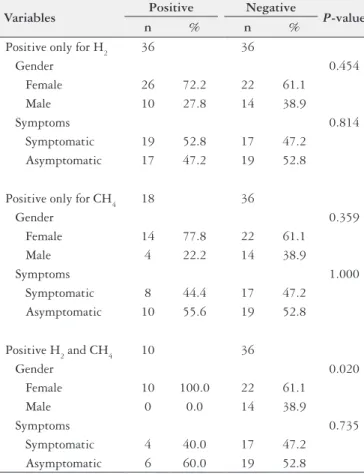
higher than among patients with negative results (61.1%). The isolated afirmation of exhaled H2 was not signiicantly associated with gender (p-value 0.454) or with the occurrence of symptoms (P-value 0.814). Similarly, the isolated afirmation of methane was
not signiicantly associated with gender (P-value 0.359) nor the
occurrence of symptoms (P-value 1.000). In cases of simultaneous afirmation of H2 and CH4, there was also no signiicant association with the symptoms (P-value 0.735).
DISCUSSION
There is a misconception that SIBO is a rare clinical condi-tion that occurs only in a small number of patients with anatomic abnormalities of the proximal digestive tract or severe digestive motility disorders(18). Recent studies show that an excessive number of bacteria is found in several gastrointestinal disorders, surviving especially in patients with celiac disease, inlammatory bowel dis-ease, chronic liver diseases and gastrointestinal functional disorders, especially in the irritable bowel syndrome(4,14).
It is known that the prevalence of SIBO in healthy volunteers is lower when compared to symptomatic patients, especially those patients with inlammatory bowel disease, irritable bowel syndrome and abdominal(7,11) distension syndrome. The presence of overgrowth, as detected by the exhaled H2 test has been described in 0-12.5% in the asymptomatic(20) volunteer group. However, it is important to note that the actual prevalence of the syndrome is not well known due to remaining dificulties for its diagnosis in daily practice(2).
In the present study, we observed a higher prevalence of females in patients with intestinal symptoms in the two analyzed tests. However, a study by Erdogan et al.(15) demonstrated that gender does not inluence the presence of overgrowth, not corroborating with our results. What probably differs from our results is that most patients referred to such tests were suffering from gastrointestinal functional disorders, especially irritable bowel syndrome, known to be more prevalent in women, at a ratio of 4:1(10,11).
The study from Erdogan et al. also showed that the prevalence of bacterial overgrowth in patients with intestinal symptoms (diar-rhea and latulence, without changes in digestive endoscopy) was only 27.3% when using the H2 and CH4 test(6). However, when the duodenal culture (gold standard for the diagnosis of SIBO) was also performed this prevalence increased to 44.6%. These authors con-cluded in the end that 65.5% of patients reporting gastrointestinal symptoms during the test had an overgrowth of microorganisms in the small intestine. In our study, we found a prevalence of 64% positivity overgrowth, a very similar rate to that acquired by North American researchers(18).
We observed in this study that the presence or absence of digestive symptoms while performing both tests shows a direct correlation with the result thereof. In patients who tested positive for SIBO, symptom reporting was signiicantly more frequent than in those with negative results.
Given that the H2 and CH4 are produced in the intestine by microorganisms that degrade carbohydrates, the breath test which detects these gases is carried out in order to evaluate the presence of bacterial overgrowth(18,22). Thus, the use of the test that identi-ies the production of both gases is essential for greater accuracy in the diagnosis of the syndrome. The addition of methane to the exhaled H2 test increases the sensitivity for the diagnosis of SIBO, allowing detection of the syndrome in a subgroup of individuals that do not produce H2, but produce CH4 as a major byproduct
TABLE 2. Gender distribution and symptoms occurrence for test result of H2 and CH4 exhale test employing glucose as a substrate
Variables Positive Negative P-value
n % n %
Positive only for H2 36 36
Gender 0.454
Female 26 72.2 22 61.1
Male 10 27.8 14 38.9
Symptoms 0.814
Symptomatic 19 52.8 17 47.2
Asymptomatic 17 47.2 19 52.8
Positive only for CH4 18 36
Gender 0.359
Female 14 77.8 22 61.1
Male 4 22.2 14 38.9
Symptoms 1.000
Symptomatic 8 44.4 17 47.2
Asymptomatic 10 55.6 19 52.8
Positive H2 and CH4 10 36
Gender 0.020
Female 10 100.0 22 61.1
Male 0 0.0 14 38.9
Symptoms 0.735
Symptomatic 4 40.0 17 47.2
Asymptomatic 6 60.0 19 52.8
TABLE 1. Gender distribution and symptoms occurrence for test result of H2 exhale test employing glucose as a substrate
Variables Positive (n=56) Negative (n=44) P-value
n % n %
Gender 1.000
Female 37 66.1 29 65.9
Male 19 33.9 15 34.1
Symptoms 0.000
Symptomatic 45 80.4 18 40.9
Asymptomatic 11 19.6 26 59.1
Table 2 shows the distribution of gender and occurrence of symptoms resulting from the H2 and CH4 test. There was a signii-cant association between the afirmation of both gases (H2 and CH4) and gender (P-value 0.020), indicating that the proportion
of carbohydratefermentation(16). According to numerous studies that identiied CH4 exhaled in breath tests, it is estimated that 30%-62% of healthy individuals excreting this Gas(6,22). As about 15% of humans do not produce H2, devices capable of detecting both gases, greatly increase the sensitivity of the test, reducing false negative results.
In this study the data analyzed was from two breath tests using different samples. SIBO prevalence was 56% in the tests conducted in apparatus that detects only expired H2 and 64% in those performed in another apparatus capable of detecting both exhaled H2 and CH4. In this last test, it was found that methane was solely responsible for positivity in 18% of patients, while the H2 was solely responsible for 36% of this total. Together, these gasses were responsible for the positivity in 10% of the sample.
Our results show that approximately 20% of patients identiied with SIBO only got their SIBO diagnosis by methane identiication in the exhaled gas, which is consistent with the results found in the literature(6,16,20). Thus, it is essential that the breath tests to diagnose SIBO be performed on devices capable of identifying the exhaled H2 and CH4, in order to increase sensitivity and diagnostic accuracy.
CONCLUSION
The data obtained in our study are consistent with those of the most recent literature on this topic. We proved the importance of utilizing the breath test that identiies the exhaled H2 and CH4 in order to increase the diagnostic accuracy of small intestine
bacterial overgrowth. Our results conirm previous indings that showed that 15% to 20% of individuals do not produce hydrogen gas in their intestine.
It was also possible to observe a high prevalence of SIBO in patients with digestive symptoms during the two hours that the test is performed. Furthermore, we found that the presence and severity of symptoms during the making thereof is more frequent in patients with a positive result, correlating directly with the di-agnosis of bacterial overgrowth.
Our study reinforces the need for routine introduction, in our midst, of devices able to detect both gases (H2 and CH4) for the most accurate diagnosis of SIBO, increasing thus the sensitivity and reliability of this test, with a signiicant reduction of false negative results.
Authors’ contributions
Martins CP participated in the study design, data interpreta-tion, manuscript writing, revised the inal version of the manuscript to be published; participated in the protocol/project development, data collection and manuscript writing/editing; Chaves CHA participated in the protocol/project development, data collection and manuscript writing/editing; Castro MGB participated in the study design and performing the tests; Gomes IC participated in the statistical analysis; Passos MCF was a coordinator, participated in the study design, data interpretation, manuscript writing, and she revised the inal version of the manuscript to be published. Study supervision: Passos MCF.
Martins CP, Chaves CHA, Castro MGB, Gomes IC, Passos MCF. Prevalência de supercrescimento bacteriano do intestino delgado em pacientes com sintomas intestinais funcionais. Arq Gastroenterol. 2017;54(2):91-5.
RESUMO – Contexto – O supercrescimento bacteriano do intestino delgado é uma síndrome heterogênea, caracterizada pelo aumento no número e/ ou presença de uma microbiota atípica no intestino delgado. Os sintomas do supercrescimento bacteriano do intestino delgado são inespecíicos englobando quadro de dor/distensão abdominal, diarreia e latulência. Devido ao maior custo e complexidade para a realização do aspirado jejunal, padrão ouro para o diagnóstico da síndrome, tem sido utilizado rotineiramente o teste do hidrogênio (H2) expirado, utilizando glicose ou lactulose como substrato, que é capaz de determinar, no ar expirado, a concentração de H2 produzida a partir do metabolismo bacteriano intestinal. Entretanto, em decorrência de uma parcela de indivíduos apresentar uma microbiota metanogênica, não produtora de H2, justiica-se a realização do teste em aparelhos capazes de detectar, concomitantemente, a concentração de H2 e metano (CH4) expirados. Objetivo – O presente estudo teve como objetivo determinar a prevalência de supercrescimento bacteriano do intestino delgado em pacientes com sintomas digestivos, através de uma análise compar-ativa dos testes respiratórios empregando H2 ou H2 e CH4 associados, utilizando a glicose como substrato. Métodos – Foram avaliados 200 pacientes de ambos os sexos, sem limitação de idade, encaminhados a um Laboratório de Teste Respiratório para realização do teste de H2 (100 pacientes) e de H2 e CH4 expirados (100 pacientes) devido a queixas gastrointestinais, a maioria deles portadores de distúrbios funcionais gastrointestinais. Resulta-dos – Os resultados obtidos indicaram uma signiicativa prevalência do supercrescimento bacteriano do intestino delgado no teste do H2 e no teste do H2 e CH4 expirados (56% e 64%, respectivamente) em pacientes com sintomas gastrointestinais, além de maior predominância no sexo feminino. Constatou-se ainda, que o gás metano foi isoladamente responsável pela positividade em 18% do total de pacientes. Conclusão – Os dados encontrados no presente estudo demonstram condizentes com os achados da literatura atual e reforçam a necessidade da utilização de aparelhos capazes de captar os dois gases (H2 e CH4 expirados) para melhorar a sensibilidade e, consequentemente, a acurácia do diagnóstico de supercrescimento bacteriano do intestino delgado na prática médica diária.
REFERENCES
1. Attaluri A, Jackson M, Valestin J, Rao SS. Methanogenic lora is associated with altered colonic transit but not stool characteristics in constipation without IBS. Am J Gastroenterol. 2010;105:1407-11.
2. Cole C, Ziegler T. Small Bowel bacterial overgrowth: a negative factor in gut adaptation in pediatric SBS. Curr Gastroenterol Rep. 2007;9:456-62.
3. Costa MBG, Azeredo Jr. IL, Marciano RD, Caldeira LM, Bafutto M. Evaluation of small intestine bacterial overgrowth in patients with functional dyspepsia through H2 breath test. Arq Gastroenterol. 2012;49:279-83.
4. Costello BPJ, Ledochowski M.; Ratcliffe NM. The importance of methane breath testing: a review. J Breath Res. 2013; 7:7-16.
5. Dukowicz AC, Lacy BE, Levine GM. Small Intestinal Bacterial Overgrowth: A Comprehensive Review. Gastroenterol Hepatol (N Y). 2007;3:112-22. 6. Erdogan A, Rao SSC, Gulley D, Jacobs C, Lee YY, Badger C. Small intestinal
bacterial overgrowth: duodenal aspiration vs glucose breath test.
Neurogastro-enterol Motil. 2015;27:481-9.
7. Gasbarrini A, Corazza GR, Gasbarrini G, Montalto M, Di Stefano M, Basilisco G, et al. Methodology and indications of H2-breath testing in gastrointestinal dis-eases: the Rome Consensus Conference. Aliment Pharmacol Ther. 2009;29:1-49. 8. Khoshini R, Dai SC, Lezcano S, Pimentel M. A systematic review of diagnostic
tests for small intestinal bacterial overgrowth. Dig Dis Sci. 2008;53:1443-54. 9. Lacy LB, Mearin F, Chang L, Chey WD, Lembo AJ, Simren M, et al. Rome IV:
Bowel Disorders. Gastroenterology. 2016;150:1393-1407e5.
10. Lovell RM, Ford AC. Global prevalence of and risk factors for irritable bowel syndrome: a meta-analysis. Clin Gastroenterol Hepatol. 2012;10:712-21.e4. 11. Mitsui T, Kagami H, Kinomoto H, Ito A, Kondo T, Shimaoka K. Small bowel
bacterial overgrowth and rice malabsorption in healthy and physically disabled older adults. J Hum Nutr Diet. 2003;16:119-22.
12. Passos MCF, Ramos AFP. Supercrescimento Bacteriano do Intestino Delgado. Rio de Janeiro: Editora Grafito; 2014, p.79-90.
13. Pimentel M. Review article: potential mechanisms of action of rifaximin in the management of irritable bowel syndrome with diarrhea. Aliment Pharmacol Ther. 2016;43:37-49.
14. Quera RP, Quigley EMM, Madrid AMS. Small intestinal bacterial overgrowth. An update. Rev Méd Chile. 2005;133:1361-70. Available from: http://www.scielo. cl/scielo.php?script=sci_arttext&pid=S0034-98872005001100013&lng=es 15. Quigley EM. Small intestinal bacterial overgrowth: what it is and what it is not.
Curr Opin Gastroenterol. 2014;30:141-6.
16. Rezaie A, Pimentel M, Rao SS. How to Test and Treat Small Intestinal Bacterial Overgrowth: an Evidence-Based Approach. Curr Gastroenterol Rep. 2016;18:8. 17. Rivkin A, Rybalov S. Update on the Management of Diarrhea-Predominant Irritable Bowel Syndrome: Focus on Rifaximin and Eluxadoline. Pharmaco-therapy. 2016;36:300-16.
18. Saad RJ, Chey WD. Breath testing for small intestinal bacterial overgrowth: maximizing test accuracy. Clin Gastroenterol Hepatol. 2014;12:1964-72. 19. Sachdev AH, Pimentel M. Gastrointestinal bacterial overgrowth: pathogenesis
and clinical signiicance. Ther Adv Chronic Dis. 2013;4:223-31.
20. Shimura S, Ishimura N, Mikami H, Okimoto E, Uno G, Tamagawa Y, et al. Small Intestinal Bacterial Overgrowth in Patients with Refractory Functional Gastrointestinal Disorders. J Neurogastroenterol Motil. 2016;22:60-8. 21. Siddiqui I, Ahmed S, Abid S. Update on diagnostic value of breath test in
gastro-intestinal and liver diseases. World J Gastrointest Pathophysiol. 2016;7:256-65. 22. Triantafyllou K, Chang C, Pimentel M. Methanogens, methane and