361
Article
ISSN 0102-695X doi: 10.1590/S0102-695X2011005000062 Received 24 Dec 2010 Accepted 28 Jan 2011 Available online 20 Apr 2011 Revista Brasileira de Farmacognosia Brazilian Journal of Pharmacognosy 21(2): 361-364, Mar./Apr. 2011
Cultivation of algae in photobioreator and
obtention of biodiesel
Cristiane B. Hobuss,
1Pauline F. Rosales,
1Dalila Venzke,
1Pris-cila O. Souza,
1Priscilla C. Gobbi,
1Lidiane P. Gouvea,
1Marco
A. Z. Santos,
1Ernani Pinto,
2Eduardo Jacob-Lopes,
3Claudio
M. P. Pereira
*,11Laboratório de Heterociclos Bioativos e Química Sustentável, Universidade Federal
de Pelotas, Brazil,
2Departamento de Análises Clínicas e Toxicológicas, Faculdade de Ciências
Farmacêuticas, Universidade de São Paulo, Brazil,
3Departamento de Tecnologia e Ciência de Alimentos, Universidade Federal de Santa
Maria, Brasil.
Abstract: In this work we described the cultivation of Chlorella vulgaris in a photobioreactor to algal biomass production. The dried biomass was used as feedstock for biodiesel production, it presented 26% lipids and via sonocatalysis stage of the methodology resulted in 60% of fatty acid methyl esters (FAME). The FAME content was confirmed by Gas Chromatography (GC).
Keywords:
algal biomass feedstock biodiesel FAME ultrasound irradiation
Chlorella vulgaris
Introduction
Chlorella vulgaris is a green algae found in most bodies of fresh water, have industrial uses for producing energy and making processed foods more visually appealing. Also, C. vulgaris shows promises as a biomass fuel and as a natural food coloring agent (Lourenço, 2007; Terãn, 1989; Rocha et al., 2007). Because algae grows rapidly in light and dark places with a minimum of nutrients, large amounts of flammable when dried C. vulgaris can be produced at low cost (Johnson et al., 2009). Another property of C. vulgaris its ability to produce natural colorants and fatty acids (Lourenço, 2007). In this connection, the employ of Chlorella vulgaris biomass for the production of biodiesel (fatty acid methyl esters FAME) (Jacob-Lopes et al., 2009) has been described by various authors as one of the most promising biomass feedstocks with the potential to meet fossil diesel replacement targets without encroaching on arable land suitable for food production. In Chisti et al. (2007), particular microalgae as compared to terrestrial plants have high oil content and biomass productivity. In recent years the use of microalgae to biofuel has gained renewed interest with increase in demand for use of renewable energy sources as well as due to rocketing energy prices all over the world (Fulke et al., 2010). Illman et al. (2000) have run a diesel engine with a high proportion
of powdered cellulose (85% cellulose/15% diesel) and dried powdered Chlorella sp. Chlorella sp. was chosen as it has been cultured extensively, does not aggregate and has a mean diameter of 5-10 mm similar to that of powdered coal and cellulose.
The main contribution to the calorific value of cells is from their carbohydrate, protein and lipid content, which it will be necessary for the microalgae to have a high calorific value if they are to be used as a diesel replacement. It is envisaged that the microalgal fuel would be used for the generation of electricity using static diesel engines (Scragg et al., 2002). Thus, due to the environmental benefits, including the carbon dioxide sequestration, and a resource from a renewable source, biodiesel has become increasingly attractive (Francisco et al., 2010).
Material and Methods
Apparatus and analysis
Cultivation of algae in photobioreator and obtention of biodiesel Cristiane B. Hobuss et al.
Rev. Bras. Farmacogn. Braz. J. Pharmacogn. 21(2): Mar./Apr. 2011 362
equipped with a Rtx-Wax polyethylene glycol capillary column (0.32 mm × 30 m). Nitrogen was used as carrier gas, the initial column temperature was set at 170 ºC, which was later increased to 230 ºC at rate 1 °C min-1.
The gun was kept as 250 °C with an injection volume of 2 L in splitless mode. The FID temperature was set at 270 ºC. FAME were identified by chromatographic comparison with authentic standards (Sigma). The amounts of each FAME were calculated from the peak areas of the chromatogram using heptadecanoic acid as internal standard.
Direct transesterification in Ultrasound Irradiation
The dried algal biomass (2 g) was placed in a glass test tube and mixed with 7 mL of methanol, 1 mL of sulfuric acid and 4 mL of chloroform. The reaction mixture was in ultrasound probe for 30 min. After the reaction was completed, the tubes were allowed to cool to room temperature. Then, 10 mL of a solution Na2SO4 was added to the tube and mixed for 50 s. The tubes were allowed to separate into two phases. The tubes were centrifuged for 30 min to accelerate phase separation. The solvent layer that contained biodiesel (FAME) was collected and transferred to a preweighed glass vial. The solvent was evaporated using N2. The FAME determination by Gas Chromatography. Lipid content was determined by the method described by Bligh & Dyer (Bligh & Dyer, 1959).
Microorganism and culture conditions
Chlorella vulgaris (CPCC90), obtained from the Canadian Phycological Culture Centre, was used in the experiments. The stock cultures were propagated and maintained on synthetic BGN medium (Rippka et. al, 1979) with the following composition (g/L): K2HPO4.3H2O (0.040), MgSO4.7H2O (0.075), EDTA (0.001), H3BO3 (2.860), MnCl2.4H2O (1.810), ZnSO4.7H2O (0.222), Na2MoO4.2H2O (0.390), CuSO4.5H2O (0.079), CaCl2.6H2O (0.040), NaNO3 (150) C6H8O7.H2O (0.006), ammonium iron citrate (0.006), pH 8.0. The incubation conditions used were 25 ºC, photon flux density of 15 µmol.m-2.s-1 and a
photoperiod of 10:14 h (day:night).
Photobioreactor
Measurements were made in a bubble column photobioreactor (Figure 1). The system was built in 4 mm thick glass, had an internal diameter of 7.5 cm, a height of 75 cm, and a nominal working volume of 2 L. The dispersion system for the reactor consisted of a 1.5 cm in diameter air diffuser located in the centre of the column. The reactor was continuously illuminated with
sixteen 20 W fluorescent lamps, connected in parallel, located in a photoperiod chamber. The duration of light cycles was controlled by a timer. Airflow into the photobioreactor was provided via filtered air and pure CO2 cylinders through Teflon tubing. The CO2/air mixture was adjusted to achieve the desired concentration of carbon dioxide in the airstream through three rotameters that measured the flow rates of the carbon dioxide, the air, and the mixture of gases, respectively.
Figure 1. Schematic diagram of the photobioreactor.
Biomass production
The experiments were carried out in bioreactors operating in intermittent regime, fed with 2 L of BGN medium. The experimental conditions were as follows: initial cell concentration of 0.1 g.L-1, isothermal
reactor operating at a temperature of 25 ºC, photon flux density of 150 µmol.m-2.s-1, and continuous aeration
of 1 VVM with the injection of air enriched with 8% carbon dioxide. The light cycles evaluated were 24:0 (day:night), respectively. The cell density, pH dynamics and lipid content of the biomass were monitored every 12 h during the growth phase of the microorganism. The tests were carried out in duplicate and the kinetic data referred to the mean of four repetitions. Biomass data were used to calculate the biomass productivity (Px, g/L.day), the maximum specific growth rate (µmax, day-1), the generation time (tg, day-1) and the lipid
productivity (PL, g/L.day).
Harvesting and drying
Gas inlet
Gas outlet
liquid sampler Gas mixer
Valve Gas flow meter
CO2 Air
Cultivation of algae in photobioreator and obtention of biodiesel Cristiane B. Hobuss et al.
Rev. Bras. Farmacogn. Braz. J. Pharmacogn. 21(2): Mar./Apr. 2011 363 The biomass was separated from the culture
medium by decantation and centrifugation. It was then freeze dried in conditions of temperature of -40 ºC and pressure of 50 µHg.
Results
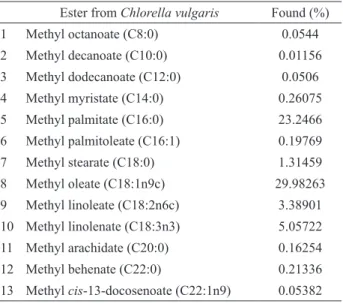
We have prepared several classes of organic compounds by sonocatalysis (Pizzuti et al., 2009; Pizzuti et al., 2010; Silva et al., 2009; Venzke et al., 2011). In particular, the beneficial effects of ultrasonic irradiation are playing an increasing role in chemical processes, especially in cases where classical methods require drastic conditions or prolonged reaction times, as biodiesel synthesis. Thus, ultrasound is considered to be an important tool for green chemistry in terms of waste minimization and energy conservation (Venzke et al., 2011). Recently it has been reported the preparation of biodiesel from vegetable oils, with good results. Here is reported a preliminary study to obtention of biodiesel from microalgae. The reaction was performed in one pot from biomass dried of Chlorella vulgaris, and methanol as solvent at room temperature under ultrasonic irradiation, furnishing the biodiesel in significantly shorter time. The FAME (Table 1) content was confirmed by Gas Chromatography (GC) (Figure 2).
The biomass and lipid production potential of the Chlorella vulgaris (CTCC90) were monitored in batch
photobioreactors (Table 2). The microalgae growth proile
showed a maximum cell density of 2.01 g/L, a maximum
speciic growth rate of 0.24 day-1, a generation time of
2.88 day, a biomass productivity of 0.19 g/L.day, a lipid content of 26.0% and a lipid productivity of 0.05 g/L.day.
A positive growing proile of pH was veriied, reaching
a maximum value of 10.5. Lipid productivity (PL) is the main criterion for selection of the operational conditions
in bioreactors for microalgae oil production that relects
a combination between biomass productivity and lipid content. Comparatively the PL result obtained in this study
is in accordance with the inventory of Grifiths & Harrison
(2009), who evaluated lipid productivities for 25 species of microalgae in photosynthetic cultivations and found average values of 0.05 g/L.day.
Table 1. Esters from Chlorella vulgaris.
Ester from Chlorella vulgaris Found (%)
1 Methyl octanoate (C8:0) 0.0544
2 Methyl decanoate (C10:0) 0.01156
3 Methyl dodecanoate (C12:0) 0.0506
4 Methyl myristate (C14:0) 0.26075
5 Methyl palmitate (C16:0) 23.2466
6 Methyl palmitoleate (C16:1) 0.19769
7 Methyl stearate (C18:0) 1.31459
8 Methyl oleate (C18:1n9c) 29.98263
9 Methyl linoleate (C18:2n6c) 3.38901
10 Methyl linolenate (C18:3n3) 5.05722
11 Methyl arachidate (C20:0) 0.16254
12 Methyl behenate (C22:0) 0.21336
13 Methyl cis-13-docosenoate (C22:1n9) 0.05382
Table 2. Biomass production parameters.
Parameter Value
Xmax (g/L) 2.01
µmax (day-1) 0.24
tg (day) 2.88
PX (g/L.day) 0.19
Lipid content (%) 26.0
PL (g/L.day) 0.05
pHmax 10.5
Cultivation of algae in photobioreator and obtention of biodiesel Cristiane B. Hobuss et al.
Rev. Bras. Farmacogn. Braz. J. Pharmacogn. 21(2): Mar./Apr. 2011 364
Acknowledgements
The authors are grateful to CNPq
(574732/2008-0), FAPERGS and CAPES for inancial
support.
References
Bligh EG, Dyer WJ 1959. A rapid method of total lipid extraction
and puriication. Can J Biochem 37: 911-917.
Chisti Y 2007. Biodiesel from microalgae. Biotechnol Adv 25: 294-306.
Francisco EC, Neves DB, Jacob-Lopes E, Franco TT 2010. Microalgae as feedstock for biodiesel production: Carbon dioxide sequestration, lipid production and biofuel quality. J Chem Technol Biotechnol 85: 395-403.
Fulke AB, Mudliar SN, Yadav R, Shekh A, Srinivasan N, Ramanan R, Krishnamurthi K, Devi SS, Chakrabarti T 2010. Bio-mitigation of CO2, calcite formation and simultaneous biodiesel precursors production using
Chlorella sp. Bioresour Technol 101: 8473-8476.
Grifiths, MJ, Harrison, STL, 2009. Lipid productivity as a key
characteristic for choosing algal species for biodiesel production. J Appl Phycol 21: 493-507.
Illman AM, Scragg AH, Shales SW 2000. Increase in Chlorella
strains caloriic values when grown in low nitrogen
medium. Enzyme Microb Technol 27: 631-635.
Jacob-Lopes E, Revah S, Hernández S, Shirai K, Franco TT 2009. Development of operational strategies to remove carbon dioxide in photobioreactors. Chem Eng J 153: 120-126. Johnson MB, Wen Z 2009. Production of biodiesel fuel from
the microalga Schizochytrium limacinum by direct
transesteriication of algal biomass. Energy Fuels 23: 5179-5183.
Lourenço SO 2007. Cultivo de microalgas marinhas - Princípios e aplicações. São Paulo: RIMA.
Pizzuti L, Piovesan LA, Flores AFC, Quina FH, Pereira CMP
2009. Environmentally friendly sonocatalysis promoted preparation of 1-thiocarbamoyl-3,5-diaryl-4,5-dihydro-1H-pyrazoles.Ultrason Sonochem 16: 728-731.
Pizzuti L, Martins PLG, Ribeiro BA, Quina FH, Pinto E,
Flores AFC, Venzke D, Pereira CMP 2010. Eficient
sonochemical synthesis of novel 3,5-diaryl-4,5-dihydro-1H-pyrazole-1-carboximidamides. Ultrason Sonochem 17: 34-37.
Rippka R, Deruelles J, Waterbury JB, Herdman M, Stanier RY 1979. Generic assignments strain histories and properties of pure cultures of Cyanobacteria. J Gen Microbiol 111: 1-61.
Rocha FD, Pereira RC, Kaplan MAC, Teixeira VL 2007. Produtos naturais de algas marinhas e seu potencial antioxidante.
Rev Bras Farmacogn 17: 631-639.
Scragg AH, Illman AM, Carden A, Shales SW 2002. Growth of
microalgae with increased caloriic values in a tubular
bioreactor. Biomass Bioenergy 23: 67-73.
Silva FN, Baltazar M, Pizzuti L, Gressler V, Rivelli DP, Barros SBM, Pereira CMP 2009. Ultrasound irradiation promoted large-scale preparation in aqueous media an antioxidant activity of azoles. Lett Drug Des Discov 6: 323-326.
Terãn E 1989. A espirulina: um novo modismo brasileiro. Rev Bras Farmacogn 2-3-4: 197-207.
Venzke D, Flores AFC, Quina FH, Pizzuti L, Pereira CMP 2011. Ultrasound promoted greener synthesis of 2-(3,5-diaryl-4,5-dihydro-1H-pyrazol-1-yl)-4-phenylthiazoles.
Ultrason Sonochem 18: 370-374.
*Correspondence
Claudio M. P. Pereira
Laboratório de Heterociclos Bioativos e Química Sustentável, Universidade Federal de Pelotas
Campus Universitário s/n, Caixa-Postal 354, 96010-900 Pelotas-RS, Brazil