of Chemical
Engineering
www.scielo.br/bjcePrinted in BrazilVol. 35, No. 01, pp. 147 – 154, January – March, 2018
*Corresponding author: Zhi Yun. E-mail: [email protected] dx.doi.org/10.1590/0104-6632.20180351s20160504
CE/KAOLIN CLAY AS AN ACTIVE CATALYST FOR
FATTY ACID METHYL ESTERS PRODUCTION
FROM COTTONSEED OIL IN A NEW INTEGRATED
APPARATUS
Junwei Liu
1, Zhi Yun
1,*and Xia Gui
11 College of Chemistry and Chemical Engineering, Nanjing Tech University, Nanjing 210009, P. R. China
(Submitted: August 23, 2016; Revised: October 5, 2016; Accepted: October 10, 2016)
Abstract – An efficient solid acid catalyst (Ce/Kaolin clay) was prepared and investigated for transesterification of cottonseed oil to fatty acid methyl esters (FAME). The catalysts were characterized by XRD, BET, and NH3-TPD measurements. A new integrated apparatus for extraction and transesterification of cottonseed oil was developed. The effects of cerium loading, catalyst calcination temperature, methanol flow rate, reaction temperature, reaction time, and catalyst amount were also investigated. The results indicated that the Ce/Kaolin clay showed high catalytic activity under the calcination temperature of 700 oC and cerium loading of 0.05 g/g. The optimum transesterification reaction conditions were as follows: methanol flow rate 4.0 mL/min, reaction temperature 60 oC,reaction time 3 h, and catalyst amount 15 g. Under these conditions, the yield of FAME was up to 91%.The catalytic activity of Ce/Kaolin clay still remained high after 4 times of repeated use. The results indicated that the Ce/Kaolin clay catalysts had a good potential for use in the large-scale production of FAME.
Keywords: Ce/Kaolin clay, integrated apparatus, transesterification, fatty acid methyl esters, cottonseed oil
INTRODUCTION
Due to the limited fossil fuel resources and increasing
environmental problems, great efforts have been dedicated
to developing renewable biomass and biofuels. In this
context, fatty acid methyl esters (FAME) are considered
as a promising substitute to traditional fossil fuels due to their renewable, environmentally benign, and carbon
neutral characteristics (Kumar and Ali, 2014). FAME are
generally produced from vegetable oils or animal fats. In the
industrial transesterification process, base or acid catalysts such as sodium hydroxide (NaOH) (Semwal et al., 2011) and sulfuric acid (H2SO4) (Moradi et al., 2013) are used as the catalysts. The advantage of this technology is that high FAME yield can be obtained under moderate reaction conditions. However, homogeneous catalysts show many
drawbacks, such as difficulty to be reused, complicated
process of post treatment, and serious environmental
problems (Guo et al., 2013).
In contrast, heterogeneous catalysts exhibit many advantages, such as environmentally friendly, easy separation, and simple post treatments. The
transesterification reaction can be conducted over solid acid or base catalyst. Although the transesterification rate
over the base catalysts is faster, the activity of base sites is reduced after neutralization with fatty acid during the
alkaline-metal-hydroxide-catalyzed transesterification.
Furthermore, the water and the fatty acids can form soap.
Therefore, we investigated the transesterification reaction
of cottonseed oil over solid acid catalysts.
been used successfully in the synthesis of mesoporous
aluminosilicates (Liu et al., 2004) and various microporous zeolite frameworks (Belviso et al., 2013; Holmes et al., 2012; Holmes et al., 2011; Kovo et al., 2009; Shen et al., 2009). However, raw Kaolin clay has almost no acidity. To
improve the acidity of the bare Kaolin clay, adding some elements into its framework is essential. Many researchers
have reported that modified Kaolin clay catalysts can
catalyze vegetable oils with methanol to produce FAME
(Dang et al., 2013). To the best of our knowledge, no scientific papers have been published on the use of Ce/
Kaolin clay as catalyst for the production of FAME.
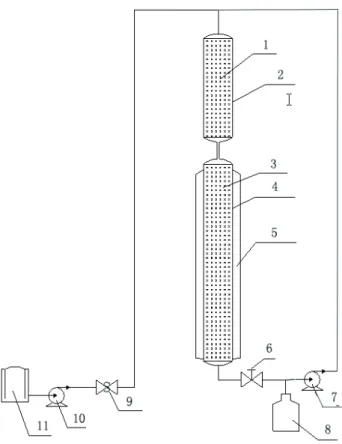
A new integrated apparatus for extraction and
transesterification of cottonseed oil was developed to produce FAME (Figure 1 and 2). The experiment was
performed in a tower reactor equipped with a water-cooled condenser. A certain amount of cottonseed kernel powder was loaded in the accumulator tank at the top of the tower,
and the catalysts supported on theta (θ) packing rings (ϕ
3×3 were loaded in the tower body. The catalyst amounts were varied by changing the tower section numbers. Then, desired amount of methanol was pumped to the top of the tower and the cottonseed oil was successfully extracted from the cottonseed kernel powder. It should be noted that
the separation and purification process was not conducted
after the extraction process. The excess extraction solvent
and cottonseed oil flowed into the transesterification
reactor. In that case, the methanol acted as reactant in
the transesterification reaction. Finally, the FAME can
be collected from the outlet of the reaction device. The
extraction and transesterification of cottonseed oil were
both performed in this integrated apparatus, which can
simplify the process and decrease costs significantly.
This paper represents an extension of our previous research and provides a new synthetic route of
cottonseed-based FAME (Qian et al., 2010; Cao et al., 2014; Zhu et al., 2014; Gui et al., 2016; Gui et al., 2016). In this study,
we introduced cerium on the Kaolin clay to improve the catalyst acidity, and studied its catalytic performance for
the transesterification of cottonseed oil to FAME in a new
integrated apparatus. The catalysts were characterized by XRD, BET and NH3-TPD measurements. The effects of cerium loading, catalyst calcination temperature, methanol
flow rate, reaction temperature, reaction time, and catalyst
amount were also examined.
MATERIALS AND METHODS Materials
Cottonseeds were obtained from Huaian (Jiangsu, China). Methanol (Aladdin, 99.9%), Kaolin clay, Ce(SO4)2.4H2O (Aladdin, 99%), and H2SO4 (Aladdin,
37%) were purchased from Nanjing Wanqing Chemical Co., Ltd. (Nanjing, China). All of the chemicals used in
this work were of analytical reagent grade.
Methods
The industrial grade cottonseeds were dried at 110 oC
for 24 h, then milled into a fine powder using an electric
grinder and sifted through a 60-mesh screen sieve.
Figure 1. Preparation of the catalyst supported on θ packing rings.
Figure 2. Scheme of the integrated apparatus for FAME production.
According to the ISO 659-1988 and GB/T 14489.1-2008/ ISO 665:2000 standards, the oil, moisture and free gossypol
contents of the milled cottonseed were 35.4 g/g (wet basis),
6.9 g/g and 0.309 g/g, respectively.
The Ce/Kaolin clay catalysts were prepared by a
conventional wet impregnation method (Alves et al., 2014).
First, 10 g of Kaolin clay was added into 20 mL of distilled water under stirring. Afterwards, sulfuric acid was added dropwise until the pH reached 3 with constant magnetic stirring at room temperature. Meanwhile, a certain amount
of Ce(SO4)2.4H2O was dissolved in the resultant slurry at room temperature for 24 h. Then, the mixture slurry was supported on the packing ring, dried at 110oC for 12 h, and
finally calcined in air for 3h. The modified Kaolin clay samples were denoted as xCe/Kaolin clay (x = 0-10 mass% (g/100 g) of Ce loading). The as-prepared catalysts were
stored in a desiccators before catalytic tests.
First, 200 g of cottonseed kernel powder was loaded in the accumulator tank at the top of the tower. Next 15
g of catalysts (including the theta packing rings) were
preheated in a mixing column with random packing in the tower body. The reaction temperature was controlled at 60 oC by a water bath. Then, 200 mL of methanol was pumped into the top of the tower from the methanol tank and the cottonseed oil was successfully extracted from the cottonseed kernel powder. Afterwards, the excess
extraction solvent and cottonseed oil flowed into the transesterification reactor. In that case, the methanol acted as reactant in the transesterification reaction. When the
methanol was exhausted, the check valve 7 was opened, then the unreacted methanol and cottonseed oil was continually pumped into the reaction system for circular reaction. Therefore, both the utilization of methanol and the conversion of cottonseed oil were increased. Finally, the FAME can be collected from the outlet of the reaction device.
The procedure was conducted under different reaction conditions: reaction time (1-10 h), reaction temperature (40-80oC), methanol flow rate (2-5 mL/min), and catalyst
amount (5-20 g). The obtained reaction mixture was kept
in the separating funnel for 12h to separate the glycerol. After that, the excess methanol was removed from the reaction products using a rotary evaporator. To ensure the complete removal of the methanol, the evaporation process was conducted until the weight of samples remained
unchanged (Kuk et al., 2005). The products were analyzed by gas chromatography (GC) following the previous literature (Molina Mayo et al., 2015).
Catalyst Characterization
The powder X-ray diffractions (XRD) were conducted on a Shimadzu XRD-6000 powder diffractometer with Cu Kα-ray radiation (λ = 0.154 nm)(40 kV, 40 mA). The diffraction patterns of the samples were recorded from 2θ = 10-90o at a scanning speed of 20o/min.
Temperature programmed desorption of ammonia
(NH3-TPD) was used to test the acidity of the samples. 0.1
g catalyst was pretreated in He (40 mL/min) at 500 oC for 1h, and the sample was treated with ammonia after cooling down to 100 oC. Then, the catalyst was purged with He. Finally, NH3-TPD experiments were conducted in He from 100 to 700 oC at a heating rate of 20oC/min, then the NH
3 -TPD data could be collected.
Brunauer-Emmett-Teller (BET) surface area analysis was conducted to characterize the specific surface area
and pore size distribution of the samples. Analysis was
conducted using a Quantachrome Autosorb-1 with nitrogen
adsorption-desorption at –196oC. The degasification was performed under vacuum at 200 oC for 2 h before the adsorption measurements.
The reaction products were analyzed using a
GC-6890 gas chromatograph equipped with a flame ionization detector (FID) and AT.SE-30 capillary column (50 m × 0.53 mm × 3 μm). Methyl salicylate was used as an
internal standard and n-hexane as solvent. 1 mL of product was dissolved in 0.2 mL of methyl salicylate and 8 mL of
n-hexane with vigorous stirring. 1 μL of the mixture was
injected into the GC. The column temperature was 180 °C, the temperature of injector and detector were 260 °C. The
flow rates of hydrogen, nitrogen, and air were 40, 19, and
300 mL/min, respectively.
In the chromatographic operation conditions, a typical chromatogram is shown in Figure 3. According to Figure 3, the order of peaks corresponds to the solvent n-hexane, methyl salicylate, methyl palmitate, methyl oleate, and linoleic acid methyl ester, respectively.
The yield of FAME was calculated as follows:
where: m1 is the mass of FAME, m2 is the mass of internal standard added to the sample, S1 is the peak area of internal standard, S2 is the peak area of FAME, ƒ’ is the correction factor.
RESULTS AND DISCUSSION Catalyst Characterization
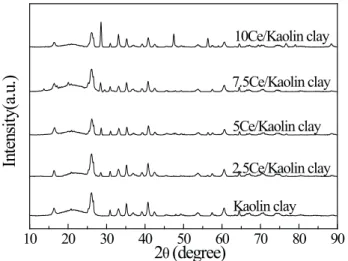
The XRD patterns of the Ce/Kaolin clay catalysts calcined at 700 oC with different Ce loadings are shown in Figure 4. It is obvious that all samples show a very strong
peak at about 2θ=26.08o, which is commonly attributed to the formation of amorphous phase of SiO2. Moreover,
three weak peaks are also observed at 2θ=16.34o, 35.20o and 40.82o. These peaks confirm the triclinic structure which is the typical characteristic of Kaolin clay materials.
In addition, the peak at 2θ = 28.52o is obviously observed on the Ce/Kaolin clay catalysts, which corresponds to
( )
2 , 21 1
%
S
f
m
100
B
S
m
×
×
=
×
the indexed CeO2 cubic system, unit cell and cubic face
centered space group (Nascimento et al., 2015; Nascimento et al., 2014). The results indicate that Ce is successfully
incorporated into the Kaolin clay support. It is worth noting that the intensity of the peak increases gradually when the cerium loading increases from 0.025 to 0.1 g/g, which is due to a large amount of Ce on the support. Moreover, when the cerium loading is up to 0.1 g/g, a strong peak is
observed at 2θ=47.48o, suggesting that part of the cerium crystal structure is changed.
The physical properties of the catalysts play an
important role during the transesterification reaction (Dang et al., 2013). The specific surface area, pore
volume and pore size of the samples were examined, and the results are shown in Table 1. The surface area of the raw Kaolin clay is 8.91 m2/g, and the surface areas of the 2.5Ce-Kaolin clay, 5Ce-Kaolin clay, 7.5Ce-Kaolin
clay and 10Ce-Kaolin clay are 8.70 m2/g, 8.13 m2/g, 7.27 m2/g, and 5.38 m2/g, respectively. It is observed that the surface area of the catalysts decreases with increasing cerium loadings, which is due to the fact that the cerium is deposited on the Kaolin clay support. Furthermore, it can be seen that the pore volume decreases and the pore diameter increases with increasing cerium loadings. In fact, the size of triglycerides is estimated at around 3-5
nm, which is much smaller than that of the modified Kaolin clay catalysts (López Granados et al., 2007). Therefore, the diffusion restriction of triglyceride molecules into pores and cages of the modified Kaolin
clay catalysts can be avoided. Certainly, larger pore size
is beneficial for reactant/product molecules to diffuse to
the active sites, thus improving the catalytic activity of
the catalysts (Wong et al., 2015).
The NH3-TPD profiles of the modified Kaolin clay catalysts are shown in Figure 5. It is obvious that the catalysts exhibit a weak peak from 150 oC to about 350 oC and a strong peak from 550 oC to about 700 oC, suggesting that the catalysts have weak and strong acid sites. With the increase of the cerium loading from 0 to 0.05 g/g, the intensities of the corresponding peaks increase, indicating that the acidity of the catalysts increases gradually.The increased acidity is due to dispersed cerium on Kaolin clay and the acidity can
be adjusted by loading different amounts of cerium.
In addition, the result also shows that the maximum acidity is achieved when the cerium loading is 0.05 g/g. However, the acidity of the catalysts decreases when the cerium loading is over 0.05 g/g, which is due to active sites of the catalysts being covered with excess cerium. It is noteworthy that the acidity of the catalysts has a great impact on the catalytic activity during the
transesterification reaction.
Figure 3. Chromatogram of the product.
10 20 30 40 50 60 70 80 90
5Ce/Kaolin clay
Kaolin clay 2.5Ce/Kaolin clay 7.5Ce/Kaolin clay
2θ
(
degree
)
In
te
ns
it
y
(
a.
u.
)
10Ce/Kaolin clay
Figure 4. X-ray diffraction patterns of Ce/Kaolin clay with different
Effect of Cerium Loading on FAME Yield
The FAME yields over the modified Kaolin clay
catalysts were investigated by adjusting the cerium loading. The cerium loading ranging from 0 to 0.1 g/g has
a significant effect on the catalytic activity. The catalytic
results are shown in Figure 4. It can be seen that bare
Kaolin clay catalyst show low FAME yield (35%). This is
likely due to the fact that bare Kaolin clay show low acidity
which can be seen in Figure 6; thus, the transesterification
reaction cannot be achieved. Surprisingly, it is obvious
that the modified Kaolin clay catalysts are more active.
As the cerium loading increases, the acidity of the catalyst
enhances, thus the FAME yield is increased significantly.
In addition, the results also show that the maximum FAME
yield (88%) is obtained with 0.05g/g cerium loading, since
the 5Ce/Kaolin clay has more acidity compared to the other catalysts. However, when the cerium loading increased further, the FAME yield droped rapidly. This might be
because the specific surface area, pore volume and acidity
of the catalysts decrease when the cerium loading is over
0.05 g/g. Thus, the cerium loading was fixed at 0.05 g/g.
Effect of Catalyst Calcination Temperature on FAME Yield
The influence of the calcination temperature ranging
from 500 oC to 900 oC for the transesterification of cottonseed oil over 5Ce/Kaolin clay was investigated,
as shown in Figure 7. It is obvious that the catalytic activity of the 5Ce/Kaolin clay is related to the catalyst calcination temperature. When the catalyst calcination temperature increases from 500 to 700 oC, the FAME yield shows a rapid increase from 60 to 90%. However, the yield of FAME decreases upon increasing the calcination temperature further, which may indicate that the Ce/ Kaolin clay catalyst tends to decompose when calcined at high temperature. Therefore, 700 oC is the most suitable calcination temperature for Ce/Kaolin clay for the
transesterification reaction.
Effect of Dosage of Methanol on Cottonseed Oil
Extraction
It is well known that commercial methanol is an
efficient solvent for extracting oil from oilseeds. The
dosage of methanol used is an important parameter during the extraction of cottonseed oil. The dosage of the methanol
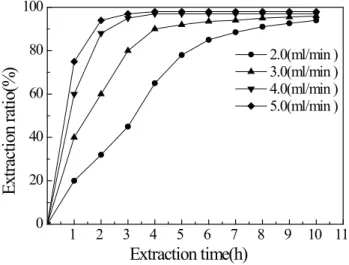
is controlled by adjusting the flow rate of methanol. The flow rate of methanol from 2.0 to 5.0 mL/min was studied,
and the results are shown in Figure 8. The extraction rate of cottonseed oil increases with the increase of the dosage of methanol from 2.0 to 4.0 mL/min, and the extraction time Table 1. Surface Characteristics of Raw and Modified Kaolin Clay Catalysts.
Catalyst Surfacearea (m2/g) Porevolume (cm3/g) Poresize(nm)
Kaolin clay 8.91 0.043 19.24
2.5Ce/Kaolin clay 8.70 0.040 19.82
5Ce/Kaolin clay 8.13 0.033 21.53
7.5Ce/Kaolin clay 7.27 0.025 26.94
10Ce/Kaolin clay 5.38 0.018 35.66
100 200 300 400 500 600 700
10 Ce/Kaolin clay
Kaolin clay 2.5Ce/Kaolin clay 5Ce/Kaolin clay 7.5Ce/Kaolin clay
Temperature
(
°C
)
NH
3
de
sor
pt
ion(
a.u.
)
Figure 5. NH3-TPD spectra of raw and modified Kaolin clay catalysts.
0.000 0.025 0.050 0.075 0.100 20
30 40 50 60 70 80 90 100
FA
M
E
yi
eld(
%
)
Ce loading
(
g/g
)
Figure 6. Influence of cerium loading on FAME yield. Reaction
reduces with the increasing dosage of methanol. When the
flow rate of methanol reaches 4.0 mL/min, the extraction
rate of cottonseed oil is 96.3% after 3 h of extraction. It is evident from Figure 8 that the excess methanol added to
the reaction has a slight effect on the yield of cottonseed oil. Thus, the optimum methanol flow rate is 4.0 mL/min
and the extraction time is 3 h.
Effect of Dosage of Methanol on FAME Yield
In order to study the optimum methanol dosage for the
transesterification reaction, the effect of different molar ratio of the alcohol to oil by adjusting the flow rate of
methanol from 2.0 to 5.0 mL/min over 5Ce/Kaolin clay was investigated, as shown in Figure 9. From the results, the FAME yield enhances gradually upon increasing the
methanol flow rate from 2.0 to 4.0 mL/min. It can be seen
that no obvious increase of FAME yield is observed upon
increasing the methanol flow rate to 5.0 mL/min. Therefore, the optimum methanol flow rate is 4.0 mL/min in this transesterification reaction. Moreover, the excess alcohol during the transesterification reaction was recovered by
distillation and reused in the next reaction cycle.
Effect of Reaction Temperature on FAME Yield
The reaction temperature is found to have a
considerable influence on the yield of FAME (Demirbas, 2009).To investigate the optimum temperature for the transesterification reaction, a series of reactions over 5Ce/
Kaolin clay were performed by changing the temperature from 40 to 70 oC (Figure 10). From Figure 10, it is clearly seen that the yield of FAME noticeably increases with the reaction temperature increase from 40 to 70 oC. However,
when the reaction temperature reached 70 oC, the reaction temperature is close to the boiling point of methanol, which leads to the vaporization of a large amount of methanol. Furthermore, unexpected and uncontrollable liquid
back-up flooding was also observed (Gui et al., 2016). So the optimum reaction temperature for the transesterification
reaction is 60 oC.
Effect of Catalyst Amount on FAME Yield
The effect of the amount of 5Ce/Kaolin clay, ranging
from 5 to 20 g, on the FAME yield was studied for the
transesterification reaction (Figure 11). According to
the previous literature, a higher amount of the catalyst is
essential to increase the FAME yield (Yee et al., 2011).
Figure 9 shows that the yield of FAME increases with increasing catalyst amount from 5 to 15 g, but only a slight increase of the FAME yield is observed with further increase in the catalyst amount. So 15 g of 5Ce/Kaolin clay catalyst was chosen as the optimum catalyst amount for the
transesterification reaction.
Reusability of the Catalyst
Reusability is regarded as the fundamental condition for manufacturing as it decreases the production cost of
FAME (Alhassan et al., 2015). In order to investigate
the reusability of the Ce/Kaolin clay catalyst, the
transesterification of cottonseed oil was performed with
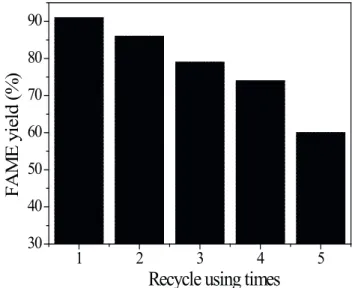
methanol under optimized reaction conditions. The reusability results are presented in Figure12. As shown in Figure 10, when Ce/Kaolin clay is recycled 1, 2, 3, and 4 times, the FAME yield is 91%, 86%, 79%, and 74%, respectively. On increasing the number of cycles,
500 600 700 800 900 20
30 40 50 60 70 80 90 100
FA
M
E
yi
el
d(
%
)
Calcination temperature
(
°C
)
Figure 7. Influence of catalyst calcination temperature on FAME
yield. Reaction conditions: 200 g of cottonseed kernel powder, 15 g of catalyst, 5 mL/min methanol phase rate, and reaction temperature = 50 oC.
1 2 3 4 5 6 7 8 9 10 11
0 20 40 60 80 100
2.0(ml/min ) 3.0(ml/min ) 4.0(ml/min ) 5.0(ml/min )
Ex
tra
cti
on
ra
tio
(%
)
Extraction time(h)
Figure 8. Influence of dosage of methanol on cottonseed oil
part of the catalysts was desquamated from the theta (θ)
packing rings and the catalytic performance decreased
noticeably. When the catalyst was used for five times, the
FAME yield reduced to 60%. The results show that the
catalyst can be recycled four times without significant
loss of activity.
CONCLUSIONS
An efficient solid acid catalyst (Ce/Kaolin clay)
was synthesized and investigated for the extraction
and transesterification of cottonseed oil to FAME in a
new integrated apparatus. The results showed that the
Ce/Kaolin clay catalysts could effectively catalyze
cottonseed oil to produce FAME. The maximum FAME
yield (91%) was achieved under the optimal conditions
of 700 oC catalyst calcination temperature, 0.05 g/g
cerium loading, 4.0 mL/min methanol flow rate, 60
oC reaction temperature, 3 h reaction time, and 15 g
catalyst. The results also indicated that Ce/Kaolin clay showed an excellent catalytic stability with the yield of FAME as high as 74% after recycling for 4 times. The highest FAME yield was slightly higher than the
reported literature (Silva et al., 2014) which used KF/
Clay as catalyst for FAME preparation at a yield of
89.2%.These results showed that the modified Kaolin clay is a promising catalyst for the transesterification of
cottonseed oil with methanol to produce FAME.
2.0 2.5 3.0 3.5 4.0 4.5 5.0 40
50 60 70 80 90 100
FA
M
E
yi
el
d
(%
)
Methanol flow rate (mL/min)
Figure 9. Influence of dosage of methanol on FAME yield. Reaction
conditions: 200 g of cottonseed kernel powder, 15 g of catalyst, reaction temperature = 50 oC, and 3 h reaction time.
40 45 50 55 60 65 70 75
50 55 60 65 70 75 80 85 90 95 100
FA
M
E
yie
ld
(%
)
Temperature
(
°C
)
Figure 10. Influence of reaction temperature on FAME yield.
Reaction conditions: 200 g of cottonseed kernel powder, 15 g of catalyst, 4.0 mL/minmethanol phase rate, and 3 h reaction time.
5.0 7.5 10.0 12.5 15.0 17.5 20.0 20
30 40 50 60 70 80 90 100
FA
M
E
yi
eld
(%
)
Catalyst amount (g)
Figure 11. Influence of catalyst mass amount on FAME yield.
Reaction conditions: 200 g of cottonseed kernel powder, 15 g of catalyst, 4.0 mL/minmethanol phase rate, reaction temperature = 60
oC, and 3 h reaction time.
1
2
3
4
5
30
40
50
60
70
80
90
FA
M
E
yi
el
d
(%
)
Recycle using times
Figure 12. Reusability of the catalysts. Reaction conditions: 200 g
REFERENCES
Alhassan, F. H., Rashid, U., Taufiq-Yap, Y. H., Synthesis of Waste Cooking Oil Based Biodiesel via Ferric-Manganese Promoted Molybdenum Oxide/Zirconia Nanoparticle Solid acid Catalyst: Influence of Ferric and Manganese Dopants. J Oleo Sci., 64(5), 505-514 (2015).
Alves, H. J., da Rocha, A. M., Monteiro, M. R., Moretti, C., Cabrelon, M. D., Schwengber, C. A., Milinsk, M. C., Treatment of clay with KF: New solid catalyst for biodiesel production. Appl. Clay Sci., 91, 98-104 (2014).
Belviso, C., Cavalcante, F., Lettino, A., Fiore, S., A and X-type zeolites synthesised from kaolinite at low temperature. Clay Sci.,80, 162-168 (2013).
Cao, J. J., Wang, F., Fan, H., Yun, Z., Combined Production of Biodiesel and Nontoxic Cottonseed Meal Using Two-Step Two-Phase Solvent Extraction. Chem. Eng. Technol., 37(6), 1030-1036 (2014).
Dang, T. H., Chen, B. H., Lee, D. J., Application of kaolin-based catalysts in biodiesel production via transesterification of vegetable oils in excess methanol. Bioresource Technol, 145, 175-181 (2013).
Demirbas, A., Progress and recent trends in biodiesel fuels. Energy Convers Manage, 50(1), 14-34 (2009).
Gui, X., Chen, S. C.,Yun, Z., Continuous production of biodiesel from cottonseed oil and methanol using a column reactor packed with calcined sodium silicate base catalyst. Chinese J. Chem. Eng., 24(4), 499-505 (2016).
Gui, X., Ding, Y., Yun, Z., Preparation of cottonseed-based epoxy fatty acid methyl esters by an integrated approach. Can. J. Chem. Eng., 94(3), 424-429 (2016).
Guo, P. M., Zheng, C., Zheng, M. M., Huang, F. H., Li, W. L., Huang, Q. D., Solid base catalysts for production of fatty acid methyl esters. Renewable Energy, 53,377-383 (2013).
Holmes, S. H., Alomair, A. A., Kovo, A. S., The direct synthesis of pure zeolite-A using ‘virgin’ Kaolin. RSC Adv., 2(30),11491-11494 (2012).
Holmes, S. H., Khoo, S. H.,Kovo, A. S.,The direct conversion of impure natural kaolin into pure zeolite catalysts. Green Chem., 13(5),1152-1154 (2011).
Kovo, A. S., Hernandez, O., Holmes, S. H., Mater, J.,Synthesis and characterization of zeolite Y and ZSM-5 from Nigerian Ahoko Kaolin using a novel, lower temperature, metakaolinization technique. Chem.,19(34), 6207-6212 (2009).
Kuk, M. S., Tetlow, R.,Dowd, M. K., Cottonseed extraction with mixtures of acetone and hexane. J Am Oil ChemSoc, 82(8), 609-612 (2005).
Kumar, D., and Ali, A., Potassium Ion Impregnated Calcium Oxide as a Nanocrystalline Solid Catalyst for Biodiesel Production from Waste Cotton Seed Oil. Energ Source Par, 36(10), 1093-1102 (2014).
Liu, Y., Pinnavaia, T. J., Mater, J., Metakaolin as a reagent for the assembly of mesoporousaluminosilicates with hexagonal, cubic and wormhole framework structures from proto-faujasitic nanoclusters. Chem., 14(23), 3416-3420 (2004). López Granados, M., ZafraPoves, M. D., Martín Alonso, D.,
Biodiesel from sunflower oil by using activated calcium oxide. Appl. Catal. B-Environ., 73(3-4),317-326 (2007).
Molina Mayo, C., Brito Alayon, A. Molina Mayo, C., Brito Alayon, A., Green chromatography determination of fatty acid methyl esters in biodiesel. Environ. Sci. Technol., 36(15), 1933-1942 (2015).
Moradi, G. R., Arjmandzadeh, E., Ghanei, R., Single-Stage Biodiesel Production from Used Soybean Oil by using a Sulfuric-Acid Catalyst. Energy Technol., 1(4), 226-232 (2013).
Nascimento do, A. R., Leal Reis Alves, J. A. B., Freitas Melo de, M. A., Effect of the Acid Treatment of Montmorillonite Clay in the Oleic Acid Esterification Reaction. Mater. Res.-Ibero-Am . 18(2), 283-287 (2015).
Nascimento, L. F., Martins, R. F., Silva, R. F., Catalytic combustion of soot over ceria-zinc mixed oxides catalysts supported onto cordierite. J. Environ. Sci.-China,26(3), 694-701 (2014).
Qian, J. F., Yun, Z., Shi, H. X., Cogeneration of biodiesel and nontoxic cottonseed meal from cottonseed processed by two-phase solvent extraction. Energ. Convers. Manage., 51(12), 2750-2756 (2010).
Semwal, S., Arora, A. K., Badoni, R. P., Tuli, D. K., Biodiesel production using heterogeneous catalysts. Bioresour. Technol., 102(3), 2151-2161 (2011).
Shen, B., Wang, P., Yi, Z., Zhang, W., Tong, X., Liu, Y., Guo, Q., Gao, J., Xu, C., Synthesis of Zeolite beta from Kaolin and Its Catalytic Performance For FCC Naphtha Aromatization. Energy & Fuels, 23(1),60-64 (2009).
Silva, L. C. A., Silva, E. A., Monteiro, M. R., Silva, C., Teleken, J.G., Alves, H.J., Effect of the chemical composition of smectites used in KF/Clay catalysts on soybean oil transesterification into methyl esters. Applied Clay Science 102, 121-127 (2014).
Wong, Y. C., Tan, Y. P., Taufiq-Yap, Y. H., Ramli, I., Tee, H. S., Biodiesel production via transesterification of palm oil by using CaO-CeO2 mixed oxide catalysts. Fuel, 162, 288-293 (2015).
Yee, K. F., Lee, K. T., Ceccato, R., Production of biodiesel from Jatropha curcas L. oil catalyzed by SO42-/ZrO
2 catalyst: effect of interaction between process variables. Bioresource Technol., 102(5), 4285-4289 (2011).