- 390 - Original Article
WORKING AND HEALTH CONDITIONS REPORTED BY INFORMAL
COMMERCE WORKERS
Marcela Andrade Rios1, Adriana Alves Nery2
1 Master in Nursing and Health. Professor of the Department of Education of the Universidade do Estado da Bahia. Guanambi, Bahia, Brazil. E-mail: [email protected]
2 Ph.D. in Nursing Professor of the de Department of Health and of the Graduate Nursing and Health Program of the Universidade Estadual do Sudoeste da Bahia. Jequié, Bahia, Brazil. E-mail: [email protected]
ABSTRACT: This study had the objective of describing the socio-demographic and professional proile, as well as the working and health conditions of informal workers in the commerce of the municipality of Jequié, Bahia. It is an epidemiological, cross-sectional study, conducted with 434 informal commerce workers at the Supply Center of Jequié. The data were analyzed descriptively using SPSS 15.0. It was found that 54.6% were male, mean age was 42.7 years, 50.9% were married/in a stable relationship, and 44.6% had an incomplete irst grade as education. The professional aspects showed that the dificulty in inding employment was also the most reported reason that led individuals to the performance of informal activities (39.9%). There was wide variation in average monthly income and working hours. According to the demand-control model analysis, most workers were deined as high-strain (28.1%). Low back pain and hypertension were the most self-reported morbidities. One hundred and forty individuals (32.3%) had suffered accidents. We suggest the strengthening of public occupational health policies aimed at informal workers.
DESCRIPTORS: Occupational health. Working conditions. Accidents, occupational. Commerce.
CONDIÇÕES LABORAIS E DE SAÚDE REFERIDAS POR
TRABALHADORES INFORMAIS DO COMÉRCIO
RESUMO: Objetivou-se descrever o peril sociodemográico e ocupacional e as condições de trabalho e de saúde de trabalhadores informais do comércio do município de Jequié, Bahia. Estudo epidemiológico, de corte transversal, realizado com 434 trabalhadores informais do comércio do Centro de Abastecimento de Jequié. Os dados foram analisados descritivamente com a utilização do SPSS 15.0. Veriicou-se que 54,6% dos trabalhadores eram do sexo masculino, idade média de 42,7 anos, 50,9% casados/união estável, e 44,6% com escolaridade de 1º grau incompleto. Os aspectos ocupacionais mostraram que a diiculdade em conseguir emprego foi o motivo mais relatado que levou os indivíduos ao desenvolvimento de atividades informais (39,9%). Houve variação na renda média mensal e na jornada de trabalho. De acordo com a análise do modelo demanda-controle, a maior parte dos trabalhadores foi enquadrada como alta exigência (28,1%). A lombalgia e a hipertensão arterial foram as morbidades mais autorreferidas. Sofreram acidentes de trabalho 140 indivíduos (32,3%). Sugere-se o fortalecimento das políticas públicas em saúde do trabalhador voltadas aos trabalhadores informais. DESCRITORES: Saúde do trabalhador. Condições de trabalho. Acidentes de trabalho. Comércio.
CONDICIONES DE TRABAJO Y SE REFIERE A LOS TRABAJADORES DE
LA SALUD EN EL COMERCIO INFORMAL
RESUMEN: Objetivo describir las características sociodemográicas y laborales y las condiciones de trabajo y salud de los trabajadores del comercio informal en el municipio de Jequie, Bahia. Estudio epidemiológico, un estudio transversal llevó a cabo con 434 trabajadores informales Trade Center Supply Jequie. Los datos se analizaron de forma descriptiva con SPSS 15.0. Se encontró que 54,6% eran varones, con una edad media 42,7 años, 50,9 % estaban casadas, el 44,6 con 1% de grado de la educación incompleta. Las características ocupacionales mostraron que la diicultad en conseguir un trabajo era la razón más informado que llevó a las personas al desarrollo de las actividades informales (39,9 %). Hubo variación en el ingreso promedio mensual y horas de trabajo. De acuerdo con el análisis del modelo de control de la demanda, la mayoría de los trabajadores se enmarcó como alta tensión (28,1 %). El dolor lumbar y la hipertensión fueron los más morbilidades auto-reporte. Sufrieron accidentes en el trabajo 140 personas (32,3%). Se sugiere fortalecer las políticas públicas en materia de salud ocupacional dirigidas a trabajadores informales.
DESCRIPTORES: Salud laboral. Condiciones de trabajo. Accidentes de trabajo. Chinches.
INTRODUCTION
Employment has an important role in peo-ple’s lives, because in addition to being a source of
income, it is where the individual can feel useful, productive, and treasured, which elevates
self-esteem.1 Favorable conditions for work processes
that are linked to the use of workers’ abilities and to work management have been identiied as im
-portant requirements for work to become a source of pleasure, well-being, and health.2 In this sense,
the type of organization and the type of work are fundamental to evaluating the processes of work -ers’ health hazards.3
Beginning especially in the 1990s, the
eco-nomic market in Brazil underwent significant
changes. These changes resulted in a decrease in job openings and in types of employment
contracts, which generated an expansion in the
informal sector of the economy. This economic
restructuring process was the result of the pressure
generated by the economic opening of the country
and by privatizations, which not only affected the
level of employment, but also its quality, resulting
in more lexible relationships and regimes.4
The informal sector is a grouping of low pro -ductivity activities constituted, in most cases, by
workers who were not absorbed by the economy’s
formal sector.5 In this context, commerce that is
carried out without legal protection for workers
constitutes a large subdivision of the activities that
make up the informal sector. It is an activity that tries to combat unemployment and low salaries, which are increasingly present in many countries.
The presence of a large number of people
working in informal activities is noticeable in Brazilian cities. These are people who are distant
from any formal employment relationships or
workers’ rights. The practice of informal commerce
activities is included in this scope. The public space
where these relationships can be detected to a high degree and variety is the street market.6
Although the reality of informal, precarious
work is nothing new, few studies have approached the working and health conditions of informal merchants. Oficial statistics regarding workers’
health in Brazil are limited because of the high
level of underreporting of fatal and non-fatal work accidents, as well as of work-related diseases, especially for informal workers.7
Comprehending working conditions is a dia -lectical challenge, materially necessary to qualify
the events that are hazardous to workers’ health,
characterizing them as elements that are part of the reproductive logic of the capitalist system.8
It is important to know the characteristics of the workers who are part of the informal sector of the economy, as well as the aspects related to the development of work, making it possible to know this part of the economy, which is still un
-derstudied in Brazil. It is also important to verify
the occurrence of events and hazards in this part
of the working population.
In the municipality of Jequié, state of Bahia, according to data from the Ministry of Work and
Employment (Ministério do Trabalho e Emprego),
as of the end of December 2010 there were 19,055 individuals in formal work positions. According to
estimates from the same organization, that number
represents less than half of the number of workers,9
conirming that many individuals are unemployed
or involved in the informal sector.
A characteristic that is part of the spatial organization of Jequié is the existence of an
emerg-ing area where the main commercial and service activities are located, as well as the interurban transportation stations and the few lines of intra-urban transportation. This area, known as the cen -tral area, or simply “the Center,” is a result of the process of service and commerce centralization.10
In that context, this study has as its objective to
describe the socio-demographic and employment
proile, as well as working and health conditions, of informal workers in the commerce of the mu -nicipality of Jequié, state of Bahia.
MATERIAL AND METHODS
An epidemiological, cross-sectional study
was carried out in the Vicente Grilo Supply Cen -ter (Centro de Abastecimento Vicente Grilo CAVG), Jequié, a medium-sized municipality in the coun-tryside of the state of Bahia.
Most formal commercial enterprises, as well as the majority of informal workers, are located
in the center of the city of Jequié. The CAVG is in this area, a place that gathers a large proportion
of informal workers from different economic tiers. Its space is divided into pavilions, blocks, low-cost shopping centers, stands, and street vendors, with
1,404 commercial units, according to a general report made available by the CAVG’s administra-tion in 2012.
Because there is no estimation of the
was carried out through all 1,404 commercial units that make up this important informal commercial space in the city. The survey result was 1,304 in
-formal workers with ages starting at 14 who work off the books at the CAVG.
The study’s population was comprised of workers who conduct professional activities in the
commercial units registered at the CAVG,
accord-ing to the followaccord-ing inclusion criteria: age equal to
or over 14 years, and performance of professional activities at the CAVG that are not registered in professional employment papers for such activi-ties. All subjects signed free and informed consent forms.
Sample calculus was performed through the software EpiInfo®, version 6.04 (Center for Disease
Control and Prevention, Atlanta, USA), reaching a total of 485 workers. The parameters that were used were: level of conidence of 95%; margin of error of 2%; proportion of incidence of work ac
-cidents of 6.5%;11 and an addition of 20% to the resulting value, considering possible losses in the
study. The study’s subjects were chosen through
systematic random sampling. The next survey on
the list substituted workers who were not found after three visits in different days. Workers who refused to participate in the study were considered
“losses.”
Data were gathered between the months of January and March 2013 by applying a form with ive blocks of variables: questions about
socio-demographic characteristics (age, gender, marital
status, education, income, skin color, place of
birth); professional characteristics (type of goods
sold, time at work, working hours, monthly in -come, property in goods sold, other paid activities,
interest in leaving informality); working condi -tions (self-reported morbidity, search for health care services, and perception of health); and
oc-currence of work accidents in the last 12 months. Psychosocial aspects of work were evalu -ated through the JCQ, an instrument developed
by Karasek.12 JCQ is based on the propositions of
the demand-control model, which emphasizes control over one’s own work and the psychological
demands involved in its performance, such as the
structuring characteristics of work organization. From this concept, a model for analysis of work
situation, based on the simultaneous evaluation of control and demand levels, is proposed.
Therefore, the demand-control model
es-tablishes four work situations: low-strain work
(which involves low psychological demand and high control); passive work (with low psychologi
-cal demand and low control); active work (high
psychological demand and high control); and
high-strain work (high psychological demand and low control). This model supports the hypothesis that work performed in a high-strain situation represents the condition with the highest exposure and health risks.13
To build the database, the forms were typed into electronic spreadsheets in the software Mi -crosoft Excel, and analyzed through the statistical
software Statistical Package for The Social Sciences (SPSS); Version 15.0.
The study was sent for appreciation by the Research Ethics Committee of the State Uni
-versity of Southwest Bahia, Campus of Jequié,
being approved under the CAAE number
04755112.3.0000.0055.
RESULTS AND DISCUSSION
Socio-demographic and professional proile
Of the 485 workers that were randomly drawn, 434 (89.5%) accepted to be part of the study. The socio-demographic proile of these workers shows that 54.6% of them were males, with a minimum age of 14 and a maximum of 88 years, and a mean age of 42.7 years (standard deviation = 16.4). There was a predominance of workers who were married/in a stable relation
-ship (50.9%), with education up to incomplete irst grade (44.6%) and self-reported as brown (48.2%), as seen in table 1. Most workers were born in the municipality of Jequié, where they work as street vendors (64.7%).
Brazilian studies and those from other
coun-tries show low education for informal workers, in addition to a higher number of black and brown individuals in the informal market, which shows
racial inequality.7,14-18 Low education reinforces
the hypothesis that many workers in informal commerce lack the necessary preparation to ob -tain formal employment; thus they search for this
area in the informal commerce, which is deined as precarious work. Decent work, the opposite of precarious work, would be a fundamental
Table 1 – Distribution of socio-demographic characteristics of informal workers in the Vicente Grilo Supply Center. Jequié, Bahia, Brazil, 2013
Socio-demographic Characteristics n %
Gender
Male 237 54,6
Female 197 45,4
Age group (years)
Under 30 years 60 13,8
30-60 265 61,1
60 and over 109 25,1
Marital status
Single 175 40,4
Married/stable relationship 221 50,9
Divorced/Separated 21 4,8
Widower 16 3,7
Not informed 1 0,2
Education
Illiterate 62 14,3
Incomplete elementary/middle school 193 44,5
Complete elementary/middle school 30 6,9
Incomplete high school 43 9,9
Complete high school 98 22,6
Incomplete third level education 3 0,7
Complete third level education 5 1,1
Ethnicity/color
White 75 17,3
Yellow 11 2,5
Brown 209 48,2
Native Indian 31 7,1
Black 97 22,4
Does not know/did not inform 11 2,5
As for characteristics related to work, the main goods sold were fruits and vegetables (n=171; 39.4%), followed by ready meals and bev
-erages (n=99; 22.8%), and meats and chicken (n=54; 12.4%). There was less frequency for reports of miscellaneous goods (n=43; 9.9%), clothing (n=34; 7.8%), electronics (n=17; 3.9%), and medicinal herbs (n=16; 3.7%). This demonstrates that most informal work in CAVG’s commerce sector is di
-rected at the street market, with fruit and vegetable stands, restaurants, and snack stands.
Dificulty in attaining formal employment was the most common reason that made individu
-als seek the informal commerce sector, as reported by 173 workers (39.9%). Other reported reasons were: to follow family tradition (n=106; 24.4%); in -formal employment favors autonomy and freedom
(n=88; 20.3%); the possibility of higher income (n=37; 8.5%); and other (n=30; 6.9%).
After considering this result in conjunction
with education level and ethnicity/color, it can be
observed that these characteristics may affect the adoption of informality, since they obstruct access
to the formal labor market. When discussing the reasons that lead workers to the informal sector,
Chilean researchers, for example, inferred that many individuals are in this sector for various
rea-sons, such as low education and few educational opportunities, racial and/or social segregation
caused by physical limitations, or perhaps the
simple reason that they have low-paying formal jobs, which makes them look into increasing their
income through informality.20 Other reasons
re-ported in the literature are linked to the excessive bureaucracy required to formalize their work when
it has the potential to be legal, or the alternative of easy money, as is the case of drug distributors.21
This dificulty in entering the formal sector
may also be explained through analysis of the
workers’ answers regarding their previous history of employment on the books. Among the workers researched, 286 (61.9%) had never worked on the books in their entire working lives, and 165 individ
-uals (38.1%) reported having some kind of record
of employment papers at some point in their lives.
When questioned about how long they
had been conducting informal activities in com-merce, reports varied from less than a year to up
to 60 years, with an average of 11.7 years of work (standard deviation = 11.6). The number of weekly working days varied from one to seven, with six being the most frequent, which was reported by 213 workers (42.6%). Weekly working hours var
-ied from ive to 105 hours, with an average of 48.5
hours (standard deviation=21.5).
The average weekly working hours were higher than what is established for formal work
-ers under the Brazilian Consolidation of Labor Laws (Consolidação de Leis Trabalhistas, [CLT]) where, according to the 1988 Federal Constitution (Constituição Federal de 1988), Article 7th,
subpara-graph XIII and CLT, Article 58, it is determined that working hours should not exceed eight daily hours and 44 weekly hours.22
The average monthly income received by the
-comes were found among workers who sold elec
-tronic products (R$1,280.93), followed by meats and chicken (R$1,053.45). On the other hand, those who sold ready meals and fruits and vegetables had the lowest average monthly incomes, R$413.77 and R$420.00, respectively. For 64.5% of workers,
informal commerce constituted the families’ main source of income.
It was noticed that activities more closely related to the street market, such as restaurants, snack stands, and fruit and vegetable stands had the lowest average incomes. These areas are pre
-cisely those with individuals who have the lowest education levels, and who generally come from rural areas. This appears to conirm the proposi -tion that educa-tion level has an effect on income
level in the labor market.4
Proile of working conditions
Working conditions obtained through the
JCQ instrument are presented in table 2. We
veri-ied that more than half of the workers agree or strongly agree that work in informal commerce is repetitive, requires creativity, and a high skill level; allows their own decision-making, development of special skills, and learning new things; that work
is not excessive; that they have enough time to
perform their work activities; and that the work is free of conlicting demands. This shows that workers have a certain control over their work, which is conirmed by the 45.6% frequency of workers with a high degree of control over their work, which involves abilities and the power to make decisions.
As for the physical aspects, most agreed that
work demands high physical effort and quick and
continuous physical activity, and that they have
to keep their bodies in physically uncomfortable positions. As time goes on, such indings may lead workers to develop a process of physical deteriora
-tion. Almost all of them agree that their coworkers
at the supply center are friendly, collaborative, and respectful.
Table 2 – Description of work content of informal merchants of Jequié, Bahia, Brazil, 2013
Work content Disagree* Agree†
n % n %
Control
Learn new things 108 24.9 326 75.1
Repetitive work 66 15.2 368 84.8
Requires creativity 64 14.7 370 85.3
Requires high level of skill 72 16.6 362 83.4
Enables learning new things 208 47.9 226 52.1
Develop new abilities 143 33 290 67
What they say is considered 91 21 342 79
Allows own decision-making 75 17.3 358 82.7
Decide how to do their own tasks 314 72.4 120 27.6
Psychological demands
Hard work 247 56.9 187 43.1
Accelerated work 222 51.2 212 48.8
Work is not excessive 186 42.9 248 57.1
Enough time 50 11.5 383 88.5
Is free of conlicting demands 190 43.8 244 56.2
Physical demands
High physical effort 172 39.6 262 60.4
Quick and continuous physical activity 208 47.9 226 52
Keep body in physically uncomfortable positions 173 39.9 261 60.1
Keep head and arm in uncomfortable positions 239 55.1 195 44.9
Social support from coworkers
Are friendly 37 8.5 397 91.5
Are collaborative 63 14.5 370 85.5
Respectful 15 3.5 419 96.5
Other aspects
Work content Disagree* Agree†
n % n %
Work demanded more as years went on 170 39.2 264 60.8
Time pressure because of heavy load of work 276 63.6 158 36.4
Low work stability 216 49.8 28 50.2
Stiled by time pressure 276 63.6 158 36.4
* Disagree or strongly disagree; † Agree or strongly agree.
The JCQ answers were analyzed together and the dimensions of control over work and psychological demand were calculated, according
to table 3.
Table 3 – Distribution of categories from the demand-control model for informal workers in the commerce of Jequié, Bahia, Brazil, 2013
Categories n %
Control
High 198 45.6
Low 236 54.4
Psychological demand
High 213 49.1
Low 221 50.9
Demand-control model
Active work (high demand and low control) 91 21
Passive work (low demand and low control) 114 26.3 High-strain (high demand and low control) 122 28.1 Low-strain (low demand and high control) 107 24.6
It is possible to observe that there were no
large variations found in the frequencies of the scales of the demand-control model. High-strain
work was the most frequent, followed by passive work. Studies involving different professions note that workers under high strain present many dif -ferent reactions to psychological tension (fatigue,
anxiety, depression, and physical illnesses). If the
length of exposure is short, the organism promptly
recovers itself. If, on the contrary, it is long, dam
-age is accumulated, which can lead the individual
to develop psychological or physical illnesses.3,23-25
As for the low-demand conditions associated with low levels of control, they promote demoti
-vation for work, leading to a decrease in learning and to gradual loss of previously acquired skills.
Low-strain work is, theoretically, ideal for health. At present, low demand in work environ -ments mean an absence of excessive demand.
Working on activities with low demand may put employment at risk and compromise the worker’s
social engagement.23-24 The worker feels a state of
apathy, either because of the absence of signiicant
challenges and permission for more energetic per-formance or because of the systematic rejection of
his or her work initiatives. This is the second worst
exposure for health.
Further on working conditions, 328 work
-ers (75.6%) perceived some risk factors for their health when performing their work at informal commerce and 24.4% answered that they felt no risk factors.
The perceptions of risk are directly linked to how individuals think, represent, classify, or
analyze the many forms of threat that are present in their lives. They are constructed from experi-ences lived by social actors, based on the
develop-ment of daily practices in the work environdevelop-ment, and more or less inluenced by discourses and practices produced in the environment, as well
as the political-ideological factors of the subjects
who visualize, perceive, and receive information regarding what may constitute health risks in the work process.25 In this sense, what may represent
health risks for one worker may not do the same for another person, because of the inluence of
aspects that are either cultural, social, economic,
political, ideological, or symbolic that each worker possesses. It is important to note, in this aspect, that knowing the risks to which one is exposed
may more effectively establish measures of pre-vention of diseases and hazards.
The risk factors most frequently reported by the 328 workers were related to biological aspects (n=177; 53.9%); followed by physical (n=98; 29.9%); chemical (n=57; 17.4%), mechanic (n=53; 16.1%); and ergonomic (n=39; 11.9%). Some workers men
-tioned macro aspects that are risk factors for work performance, such as violence (n=35; 10.7%), and macrostructural risks related to the organization and structure of the supply center (n=36; 11%).
Among the interviewees, 384 workers (88.5%) were satisied or very satisied with their work and 50 (11.5%) were dissatisied or very dissatisied.
- 396 - Rios MA, Nery AA
some kind of work accident when performing their activities in commerce. Of those, 114 (81.4%) were typical accidents, especially due to knife cuts (n=58; 50.9%) and lesions caused by some part of the stands’ structure (n=22; 19.3%). Twenty-six events of commuting accidents (18.6%) were reported. The main type reported by the workers was motorcycle accident (n=16; 61.3%).
When informal workers suffer accidents and
need health care or temporary health leave from their activities, their income often decreases, since there is no social protection for this, causing these
workers to perform their work activities even
under impaired health conditions.
Work accidents involving informal work
-ers are not well documented in Brazil because a large part of available data refer to formal work
-ers linked to Social Security (Previdência Social).7
Health proile
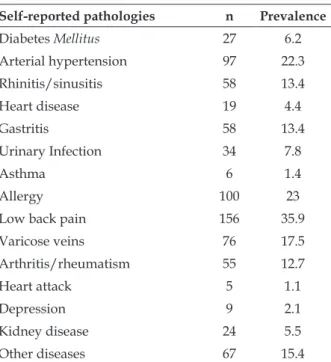
Among the workers, 315 (72.6%) mentioned morbidities. Of those, 102 (23.5%) reported having at least one diagnosis and 213 (49.1%) reported having two or more. The most frequently reported diseases, according to Table 4, were low back pain (35.9%) and arterial hypertension (22.3%).
Table 4 – Morbidity reported by informal workers in the commerce of Jequié, Bahia, Brazil, 2013
Self-reported pathologies n Prevalence
Diabetes Mellitus 27 6.2
Arterial hypertension 97 22.3
Rhinitis/sinusitis 58 13.4
Heart disease 19 4.4
Gastritis 58 13.4
Urinary Infection 34 7.8
Asthma 6 1.4
Allergy 100 23
Low back pain 156 35.9
Varicose veins 76 17.5
Arthritis/rheumatism 55 12.7
Heart attack 5 1.1
Depression 9 2.1
Kidney disease 24 5.5
Other diseases 67 15.4
Sixty-four percent of workers rated their health as good or very good. This inding con
-licts with results found in studies where health perceptions of formal and informal workers were
compared.15,26 However, it is necessary to take into consideration the fact that this study focused on a
small part of the informal sector, vendors, which may inluence results.
Regarding the search for health care services
in the last 12 months, 63.8% of workers answered the question positively. Studies show that the
search for health care services is higher among
formal workers than among informal workers.15,26 The strengthening of the workers’ health through
primary care actions may be a route to decrease inequality in the search for health care services
between formal and informal workers.27
CONCLUSION
The results found by this study showed a socio-demographic and occupational proile in which most informal workers were male, with ages from 14 through 88, with low levels of edu
-cation, who self-reported as brown, as merchants of fruits and vegetables, with an average of 48.5 hours worked weekly, and who are part of the economy’s informal sector due to dificulties in entering formal services. There was a large dis -persion in relation to average monthly income in informal commerce.
High-strain work in the demand-control model was predominant in the study’s popula
-tion. It was observed that some of the workers reported not perceiving health risks in their work processes. A high incidence of work accidents was estimated, with a prevalence of those considered typical. Most workers reported some morbidity,
especially arterial hypertension.
In this context, we call attention to the rel
-evance of knowing which are the main events and hazards that affect the informal worker population, as well as their socio-demographic and
professional characteristics, so that measures for promotion and prevention may be implemented through effective public policies.
Because of the fact that there is no national health information system that includes all events
and hazards that affect informal workers, studies based on population and speciic spaces are neces
397 -Working and health conditions reported by informal commerce...
Despite the limitations in this study, it
al-lowed an instant view of the conclusion and ex -position because of its cross-sectional nature. This,
however, makes it impossible to understand the
relationship among causes and effects in
chrono-logical terms. Nevertheless, it was relevant to
evaluate the characteristics of informal commerce
workers and their working conditions and to de
-scribe the work accidents they suffered, as well as
self-reported morbidity.
REFERENCES
1. Campos Junior AP, Reis DS, Sato EG. A dor física relacionada ao ambiente ocupacional. Interdisciplinar: Rev Eletrônica da Univar. 2011 [acesso 2013 Ago 01]; 6: 22-6. Disponível em: http://www.univar.edu.br/revista/downloads/ dorisicaambienterelacional.pdf
2. Delcor NS et al. Condições de trabalho e saúde dos professores da rede particular de ensino de Vitória da Conquista, Bahia, Brasil. Cad Saúde Pública. 2004 Jan-Fev; 20(1):187-96.
3. Ferreira DK, Bonim C, Augusto LGS. Condições de trabalho e morbidade referida de policiais militares, Recife-PE, Brasil. Saúde Soc. 2012; 21(4):989-1000. 4. Costa MS. Trabalho informal: um problema
estrutural básico no entendimento das desigualdades na sociedade brasileira. Cad CRH. 2010 Abr; 23(58):171-90.
5. Duailibe MD. A informalidade das relações de emprego e a atuação da inspeção do trabalho: uma análise para o Maranhão contemporâneo [dissertação]. São Luís (MA): Universidade Federal do Maranhão, Programa de Pós-Graduação em Políticas Públicas; 2010.
6. Alves AESA, Almeida JRM. Trabalho informal em tempos “globalizacionistas.” Rev HISTEDBR On-line. 2009 Mai [acesso 2013 Ago 08]; 9(Esp):238-50. Disponível em: http://www.histedbr.fae.unicamp. br/revista/edicoes/33e/art15_33esp.pdf
7. Dias EC. Employment conditions and health
inequities: a case study of Brazil. Cad Saúde Pública. 2011 Dez; 27(2):2452-60.
8. Lourenço EAS, Bertani IF. Saúde do trabalhador no SUS: desaios e perspectivas frente à precarização do trabalho. Rev Bras Saúde Ocup 2007; 32(115):121-34. 9. Ministério do Trabalho e Emprego (BR). Peril do
município. 2011 [acesso 2012 Dez 08]. Disponível em: http://perfildomunicipio.caged.gov.br/ seleciona_uf_consulta.asp?uf=ba
10. Torreão Sá TRB, Torreão Sá M. Os processos espaciais presentes no espaço urbano de Jequié – Bahia. Estud Geográicos. 2004 Jun; 2(1):1-13. 11. Soares JFS. Incidência cumulativa anual de acidentes
de trabalho não fatais - estimativas nacionais para o
Brasil [tese]. Salvador (BA): Universidade Federal da Bahia, Instituto de Saúde Coletiva; 2012.
12. Karasek RA. Job content questionnaire and user’s guide. Lowell (U): University of Massachussets; 1985.
13. Gomes DJ, Araújo TM, Santos KOB. Condições de trabalho e de saúde de trabalhadores em saúde mental em Feira de Santana, Bahia. Rev Baiana Saúde Pública. 2011 Jan-Jun; 35(supl 1):211-30. 14. OIT. International Labour Organization; World
Trade Organization. Globalization and informal jobs in developing countries. Geneva (CH): World Trade Organization; 2009.
15. Giatti L, Barreto SM. Situação do indivíduo no mercado de trabalho e iniqüidade em saúde no Brasil. Rev Saúde Pública. 2006 Fev; 40(1):99-106. 16. Kim MH, Kim CY, Park JK. Is precarious employment
damaging to self-rated health? Results of propensity score matching methods, using longitudinal data in South Korea. Soc Sci Med 2008; 67(12):1982-94. 17. Quesnel-Vallée A, DeHaney S, Ciampi A. Temporary
work and depressive symptoms: A propensity score analysis. Soc Sci Med. 2010; 70(12):1982-7.
18. Vasconcelos L. Realidade em preto e branco. Rev Desaios do Desenvolvimento. 2005 Mar [acesso 2012 Dez 08]; 17(2):1-8. Disponível em: http://www. ipea.gov.br/desafios/index.php?option=com_ content&view=article&id=956:reportagens-materias&Itemid=39
19. Ministério do Trabalho e Empreo (BR). Plano Nacional de Emprego e Trabalho Decente. Brasília (DF): TEM; 2010.
20. Diaz EM, Guevara RC, Lizana J. Trabajo informal: motivos, bienestar subjetivo, salud, y felicidad en vendedores ambulantes. Psicol Estud. 2008 Out-Dez [acesso 2013 Mar 18]; 13(4):693-701. Disponível em: http://www.scielo.br/pdf/pe/v13n4/v13n4a07. pdf
21. Ocasio G. The formal problem of the informal economy. Caribbean Business. 2005 Jan; 33(2):12. 22. Martins SP. Direito do Trabalho. 14ª ed. São Paulo
(SP): Atlas; 2001.
23. Araújo TM, Graça CC, Araújo E. Estresse ocupacional e saúde: contribuições do modelo demanda-controle. Ciênc Saúde Coletiva. 2003; 8(4):991-1003.
24. Cardoso JP, Araújo TM, Carvalho FM, Oliveira NF, Reis EJFB. Aspectos psicossociais do trabalho e dor musculoesquelética em professores. Cad Saúde Pública. 2011 Ago; 27(8):1498-506.
25. Souza SF, Carvalho FM, Araújo TM, Porto LA. Fatores psicossociais do trabalho e transtornos mentais comuns em eletricitários. Rev Saúde Pública. 2010 Ago; 44(4):710-7.
assessments of psycosocial job characteristics. J Occup Health Psycol. 1998 Oct; 3(4):322-55.
27. Miliquin IOC, Marín-León L, Monteiro MI, Correa Filho HR. Desigualdades no acesso e uso dos
serviços de saúde entre trabalhadores informais e desempregados: análise da PNAD 2008, Brasil. Cad Saúde Pública. 2013 Jul; 29(7):1392-406.
Correspondence: Marcela Andrade Rios Rua Otacílio Pereira Donato, 461
46430-000 - Vomitamel, Guanambi, BA, Brasil E-mail: [email protected]