Original article (short paper)
The motor deicits caused by Parkinson’s disease
are not able to block adjustments for a safe
strategy during obstacle crossing in individuals
with moderate disease
Vinícius Alota Ignácio Pereira
Universidade Estadual Paulista, Rio Claro, Brazil
Fabio Augusto Barbieri
Universidade Estadual Paulista, Bauru, Brazil
Rodrigo Vitório
Lucas Simieli Ellen Lirani-Silva
Diego Orcioli-Silva
Lilian Teresa Bucken Gobbi
Universidade Estadual Paulista, Rio Claro, Brazil
Abstract––The aim of this study was to verify whether patients with Parkinson’s disease (PD) are able to adjust their motor behavior according to restrictions imposed by the task instruction during walking with obstacle crossing. Eighteen elderly people (moderate motor compromise) with a diagnosis of PD walked on a pathway and cross an obstacle according to the following conditions: walking at preferred velocity; walking at maximum vertical elevation of the feet to cross the obstacle; walking at maximum step length to cross the obstacle; walking at maximum velocity. The modulations were directly related to the instructions provided to patients with PD before performing each task, which seems to indicate that
attentional cues can inluence and beneit strategies during obstacle crossing. In conclusion, patients with PD are able to
adjust walking during obstacle crossing according to instructions given to them, which increases their safety.
Keywords: Parkinson’s disease, gait, movement, time and motion studies, spatial behavior
Resumo––“O déicit motor causado pela doença de Parkinson não é capaz de bloquear os ajustes para uma estratégia segura
durante a travessia de obstáculos em indivíduos com doença moderada.” O objetivo deste estudo foi veriicar se pacientes com doença de Parkinson (DP) são capazes de modular o comportamento motor de acordo com restrições impostas pela instrução na tarefa de ultrapassagem de obstáculo. Dezoito idosos com diagnóstico de DP (comprometimento motor moderado) andaram sobre uma passarela e ultrapassaram um obstáculo de acordo com as seguintes instruções: velocidade preferida; elevação máxima do pé para ultrapassagem do obstáculo; máximo comprimento do passo de ultrapassagem; ultrapassagem em máxima velocidade. As modulações realizadas estão diretamente relacionadas às instruções dadas aos pacientes antes da realização de cada tarefa, o que indica que dicas auditivas podem inluenciar e beneiciar as estratégias utilizadas. Através deste estudo é possível concluir que pacientes com DP são capazes de modular a ultrapassagem de obstáculo de acordo com a instrução que lhes é dada, o que aumenta a segurança na tarefa.
Palavras-chave: doença de Parkinson, marcha, movimento, estudos de tempo e movimento comportamento espacial
Resumen––“El déicit motor causados por la enfermedad de Parkinson no es capaces de bloquear los ajustes para una
estrategia de seguridad durante la travesía del obstáculo en individuos con enfermedad moderada.” El objetivo de este estudio fue veriicar se los pacientes con enfermedad de Parkinson (EP) son capaces de modular el comportamiento motor de acuerdo con restricciones impuestas por la instrucción en la tarea de sobrepasar un obstáculo. Dieciocho adultos mayores con diagnóstico de EP (con deiciencia motora moderada) caminaran sobre una pasarela e sobrepasaran un obstáculo de acuerdo con las siguientes instrucciones: velocidad preferida; elevación máxima del pie para sobrepasar el
obstáculo, máxima distancia del paso para sobrepasar el obstáculo; sobre pasada máxima velocidad. Las modulaciones
Introduction
Parkinson’s disease (PD) is the second most common neuro-degenerative disorder in the elderly and affects approximately 3.3% of the elderly in Brazil (Barbosa et al., 2006). Patients with PD demonstrate some signals and motors symptoms, such as hypometria (reduced range of motion), bradykinesia (slow-ness of movement execution) and muscle stiff(slow-ness of the lower
limbs, which inluence daily activities, predominantly walking (Dias, Fraga, Cacho, & Oberg, 2005; Fernández-del Olmo, Arias, & Cudeiro, 2004; Goulart, Santos, Teixeira-Salmela, & Cardos, 2004; Morris & Iansek, 1996; Reisis, 2004; Teixeira & Alouche, 2007). Recent research has conirmed the effects
of motor symptoms on the gait of patients with PD, primarily during obstacle crossing (Adkin, Bloem, & Allum, 2005; Galna, Murphy, & Morris, 2010; Latt, Menz, Fung, & Lord, 2009; Pieruccini-Faria et al., 2006; Stegemöller, 2012; Vitório, Pieruccini-Faria, Stella, Gobbi, & Gobbi, 2010). The gait of this population is characterized by reduced velocity, shortened step length and larger step width (Galna et al., 2010; Pieruccini-Faria
et al., 2006; Stegemöller, 2012; Vitório et al., 2010), which is a more conservative strategy during obstacle crossing than in healthy individuals (Galna et al., 2010; Pieruccini-Faria et al., 2006; Stegemöller, 2012). Despite this conservative strategy, tripping during obstacle crossing is one of the major causes of falls in this population (Stolze et al., 2004), representing 60% of falls (Balash et al., 2005).
To avoid contact with the obstacle and improve safety during walking with obstacle crossing, adjustments to walking param-eters are necessary. The literature indicates that increases in stride length, walking speed, foot placement before the obstacle and toe-clearance are the main strategies for avoiding foot-ob-stacle contact during obfoot-ob-stacle crossing (Chou & Draganich, 1998; Pieruccini-Faria et al., 2006; Vitório et al., 2010). These safety strategies are directly associated with the motor signals/
symptoms of PD: i) Hypometria of the horizontal and vertical
trajectory of the foot during obstacle crossing, which is re-lated to stride length, foot placement before the obstacle and toe-clearance, increases the risk of tripping (Galna et al., 2010); ii) Bradykinesia, which is related to walking speed, increases postural instability during walking since the individuals spend more time on a single support due to slowness during obstacle
crossing, which is the most unstable phase of walking (Vitório, 2014a). Therefore, as a result of the motor limitations caused by
the disease, patients with PD have impairments in their ability to perform adjustments when walking to safely cross obstacles (Galna et al., 2010). However, patients with PD seem to be
able to walk with more safety when external cues are provided (Picelli, 2010; Spaulding, 2013).
In this context, it is important to understand the strategies used by patients with PD during walking with obstacle crossing after an instruction to perform the task and, also, whether they are able to overcome the motor impairment of the disease during the task. Findings in this context may aid the design of intervention programs aiming to reduce the occurrence of falls in patients with PD. Therefore, the aim of this study was to verify whether patients with PD are able to adjust their motor behavior according to restrictions imposed by the task instructions during walking with obstacle crossing. We hypothesized that patients with PD would be able to adjust their motor behavior according to task instructions during obstacle crossing. The hypothesis was support-ed by past studies, which suggest that patients with PD are able to modulate gait in accordance with environmental restrictions
(Vitório et al., 2010), auditory cues (Picelli, 2010; Spaulding, 2013) and visual cues (Azulay et al., 1999; Morris & Iansek, 1996; Morris, Iansek, Matyas, & Summers, 2005). Focusing on the instruction could favor a change from automatic movement control (subcortical) to directed control with a goal (cortical). In this way, the cortex would assume the main role, reducing the actions of neural circuits compromised by DP (Beeler, Petzinger, & Jakowec, 2013; Petzinger et al., 2013; Redgrave et al., 2010).
Method
All the procedures were realized in Posture and Gait Studies
Lab (LEPLO), in São Paulo State University (UNESP) at
Rio Claro, Institute of Biosciences, Department of Physical Education. Eighteen elderly individuals with idiopathic PD (ten
women and eight men), between stages I and III on the Hoehn & Yahr rating scale (H&Y; Hoehn & Yahr, 1967), participated
in this study (Table 1). We selected the participants from the
Physical Activity Program for Patients with PD (PROPARKI Group - UNESP – Rio Claro – Brazil) database (more than one
hundred individuals), which has been developed in operation
since 2004. The patients were required to be able to walk in -dependently (walking without devices, such as cane, crutch or walkers, or helping another person), and regularly use PD med-ication. Exclusion criteria were musculoskeletal, orthopedic, or neurological disorders other than PD that affect walking. Just
participants who it themselves to the inclusion criteria, and
have no exclusion criteria, were recruited for this study. All participants signed a consent form, submitted to and approved
by the local Ethics Committee (#4891/2012).
Table 1. Means and standard deviations of characteristics of patients with PD. UPDRS III: motor component of the Uniied Parkinson’s Disease Rating Scale; MMSE: Mini-Mental State Examination; H&Y: Hoehn&Yahr.
All the procedures were realized in ON medications state.
Initially, the patients with PD answered a full anamnesis in-cluding disease injuries and current medication, in addition to other information relevant to verify the inclusion criteria, during
the anamnesis we identiied all patients were right-footed. This
procedure was performed accompanied by the caregiver of the patients. Subsequently, patients were evaluated through the
H&Y scale, the motor component of the Uniied Parkinson’s
Disease Rating Scale (Fahn & Elton, 1987) and the Mini-Mental
State Examination (Folstein, Folstein, & McHugh, 1975).
For the experimental tasks, the patients were instructed
to walk on a pathway (8m long by 1.4m wide), step overran
obstacle, and keep walking until the end of the pathway. The patients were instructed to avoid contact with the obstacle, which was positioned in the middle of the pathway. The starting
position was modiied for each patient to ensure a comfortable crossing with the dominant limb (nearly 4 m from the starting
point). The obstacle height was adjusted to half the knee height (from 20 to 25 cm) for each patient. The obstacle (width=50 cm; depth=2 cm) was made of wood and was collapsible when
contacted for safety. The participants were evaluated in ON
(optimal) medication state.
Four experimental conditions were performed:
a) Preferred velocity to cross the obstacle: The participants were instructed to walk at a self-selected velocity and step length when crossing the obstacle;
b) Maximum elevation of the feet to cross the obstacle: The participants were instructed to walk at a self-selected velocity and step length and to increase their feet-obstacle vertical distance (foot clearance) as much as possible when crossing the obstacle;
c) Maximum step length to cross the obstacle: The partic-ipants were instructed to walk at a self-selected velocity and perform maximum step length when crossing the obstacle;
d) Maximum velocity to cross the obstacle: The participants were instructed to walk and cross the obstacle at the highest walking velocity possible without running.
Each participant performed, in blocks, three trials in each condition. Initially, each participant performed the preferred velocity condition. The other experimental conditions were randomized between the participants by drawing lots.
For the spatial-temporal parameters, a digital camera
(Samsung, model SC-D364) was positioned in the sagittal
right plane of the participant to view all markers. Four passive markers (15-mm diameter) were attached to the following an-atomical landmarks: (a) 5th right and 1st left metatarsal joints and (b) lateral face of the right calcaneus and medial face of
the left calcaneus. One passive marker was also ixed at the
obstacle top for calculation of the dependent variables related to obstacle distance.
The images were recorded at 60 Hz and captured using
a video card (Pinnacle, model Studio DV, version 1.05.307) coupled to a microcomputer and compressed using a
loga-rithmic compression (Ligos Indeo 5.10). For better relection
and visualization of the markers two spotlights with halogen lamps of 500W were positioned to the side of the camera. The calibration of the two-dimensional experimental set was per-formed through plumb lines with markers with known distances between them (3m X 1.7m). The markers were digitized auto-matically on Digital Video for Windows software (Dvideow®).
The Matlab®(The Math Works, Natick, MA, USA, version 6.5)
algorithm was used to calculate the dependent variables. The
data were iltered with a ifth-order Butterworth low-pass ilter with a cutoff frequency of 6 Hz.
The cycle analyzed was the obstacle crossing stride (Figure 1). In each trial, stride length, stride duration, stride velocity and double support duration (percentage of stride duration) were measured. In addition; the toe clearance of the leading and trailing limbs (vertical distance from foot to obstacle); the horizontal distance from the leading limb to the obstacle before and after obstacle crossing and the horizontal distance from trailing limb to the obstacle before obstacle crossing were
measured. Furthermore, we quantiied the number of contacts
Spatial and temporal parameters were statistically analyzed using SPSS 15.0 for Windows® software. The Shapiro-Wilk and
Levene tests were employed to check the normal distribution
of data and homogeneity of variances, respectively. One-way ANOVA with factor for experimental condition (preferred ve -locity x maximum elevation of the feet x maximum step length x maximum velocity), with repeated measures, was performed to compare experimental conditions. When univariate analysis revealed a main effect of conditions, Tukey post hoc tests were used to localize the differences between experimental conditions (p-adjusted < .0083).
Results
None of the patients with PD contacted the obstacle during
obstacle avoidance in any of the tasks.
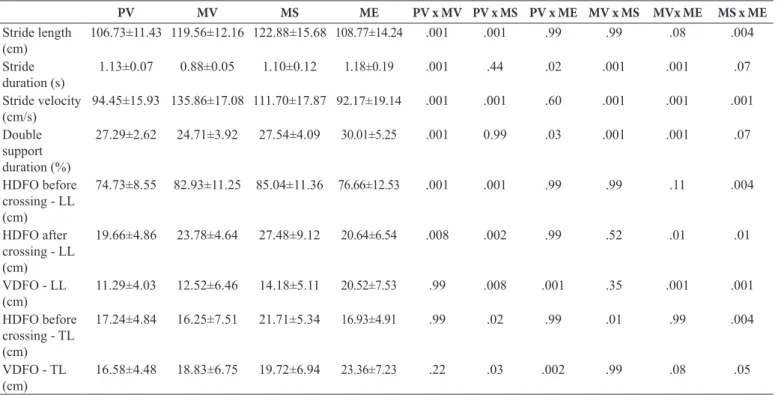
The ANOVA showed a main effect of condition for stride
length (F3,51=11.68, p < .001), stride duration (F3,51=38.86, p < .001), stride velocity (F3,51=47.83, p < .001) and double sup-port duration (F3,51=7.31, p < .001) (Table 2). The post hoc test indicated greater stride length for the maximum velocity and maximum step conditions compared to the preferred velocity condition and the maximum step condition compared to the maximum elevation condition. Moreover, post hoc indicated that the maximum step, maximum elevation and preferred ve-locity conditions presented higher stride duration and slower stride velocity than the maximum velocity condition and the maximum step condition showed greater stride velocity than the preferred velocity and maximum elevation conditions. For
the double support duration, the preferred velocity, maximum elevation and maximum step conditions showed higher values than the maximum velocity condition.
For the horizontal and vertical distance from foot to obstacle
(Table 2), the ANOVA also indicated a main effect for condi -tions of all parameters: horizontal distance from the foot to the obstacle before and after obstacle crossing for the leading limb (F3,51=11.87, p<.001 and F3,51=10.47, p < .001, respectively); horizontal distance from the foot to the obstacle before the crossing for the trailing limb (F3,51=7.69, p < .001); vertical distance from the foot to the obstacle during the crossing for the leading limb(F3,51=9.81, p < .001) and trailing limb (F3,51=26.88,
p < .001). For the leading limb, the post hoc indicated greater horizontal distance from the foot to the obstacle before and after obstacle crossing in the maximum velocity and maximum step conditions in comparison to the preferred velocity condition. In addition, the maximum step condition showed greater horizontal distance from the foot to the obstacle before obstacle crossing compared to the maximum elevation condition. Furthermore, for vertical distance from the foot to the obstacle, the maximum elevation condition showed greater distance compared to the preferred velocity, maximum velocity and maximum step conditions, and the maximum step condition showed greater distance than the preferred velocity condition. Regarding the trailing limb, the horizontal distance from foot to obstacle before obstacle crossing in the maximum step condition was greater than the maximum elevation condition. Finally, the post hoc indicated that the maximum elevation condition showed greater vertical distance from the foot to the obstacle compared to the preferred velocity condition
Table 2.Means and standard deviations of spatial-temporal parameters for each experimental condition. HDFO: horizontal distance from the foot to the obstacle; VDFO: vertical distance from the foot to the obstacle; LL: leading limb; TL: trailing limb. PV: Preferred velocity to cross the obstacle; MV: Maximum velocity to cross the obstacle; MS: Maximum step length to cross the obstacle; ME: Maximum elevation of the feet to cross the obstacle.
PV MV MS ME PV x MV PV x MS PV x ME MV x MS MVx ME MS x ME
Stride length (cm)
106.73±11.43 119.56±12.16 122.88±15.68 108.77±14.24 .001 .001 .99 .99 .08 .004
Stride duration (s)
1.13±0.07 0.88±0.05 1.10±0.12 1.18±0.19 .001 .44 .02 .001 .001 .07
Stride velocity (cm/s)
94.45±15.93 135.86±17.08 111.70±17.87 92.17±19.14 .001 .001 .60 .001 .001 .001
Double support duration (%)
27.29±2.62 24.71±3.92 27.54±4.09 30.01±5.25 .001 0.99 .03 .001 .001 .07
HDFO before crossing - LL (cm)
74.73±8.55 82.93±11.25 85.04±11.36 76.66±12.53 .001 .001 .99 .99 .11 .004
HDFO after crossing - LL (cm)
19.66±4.86 23.78±4.64 27.48±9.12 20.64±6.54 .008 .002 .99 .52 .01 .01
VDFO - LL (cm)
11.29±4.03 12.52±6.46 14.18±5.11 20.52±7.53 .99 .008 .001 .35 .001 .001
HDFO before crossing - TL (cm)
17.24±4.84 16.25±7.51 21.71±5.34 16.93±4.91 .99 .02 .99 .01 .99 .004
VDFO - TL (cm)
Discussion
This study investigated whether patients with PD are able to adapt their walking pattern according to restrictions imposed
by task instructions during obstacle crossing. The indings conirmed the study hypothesis, indicating that PD patients are
able to adapt their walking pattern according to instructions. For example, when the patients with PD were instructed to el-evate their foot as much as possible to avoid the obstacle, they increased the margin of safety (toe clearance) from the foot to the obstacle (vertical distance from the foot to the obstacle). Therefore, patients with PD were able to adapt their walking pat-tern, overcoming the main limitations of the disease (hypometria and bradykinesia). The modulations were directly related to the instructions provided to patients with PD before performing each
task, which seems to indicate that attentional cues can inluence and beneit strategies during obstacle crossing.
The instructions apparently increased the attention levels of the patients to the task, which could have changed the automatic control (subcortical) of gait to a control directed to the objective (cortical). Thus, the cortex may have assumed the main role, reducing the action of the neural circuits compromised by PD (Beeler et al., 2013; Vitório et al., 2014b). In addition, it is possible to suggest that the strategies used after the instructions were safer for the obstacle crossing than self-selected walking, decreasing the chance of obstacle stumbling.
Patients with PD seem to have the capacity to overcome
the motor deicits of the disease during obstacle crossing. PD
causes the signals/symptoms of hypokinesia, bradykinesia and muscular rigidity, which affect the locomotion of patients, for example decreasing gait velocity, step length and range of movement, in environments both with and without an obstacle (Dias et al., 2005; Fernández-del Olmo et al., 2004; Goulart
et al., 2004; Morris & Iansek, 1996; Reisis, 2004; Teixeira
& Alouche, 2007). Until now, interpretation of the literature as to whether these motor limitations could be overcome or
modulated by this population has been dificult. Based on our
results, we suggest that patients with PD can adapt their obsta-cle crossing parameters, using a safer strategy for crossing the obstacle. These adjustments seem to indicate that the effects of PD are not able to block modulations for a safe strategy during
obstacle crossing. However, the question remaining after this
study is why patients with PD do not use this safe strategy in trials performed at their self-selected pattern.
From the indings of the study, we suggest an intervention
that incorporates attentional cues for the population with PD. Attentional tips could help patients with PD to increase walking velocity and stride length of their self-selected walking pace, which is performed daily. Patients with PD were shown to have the capacity to adapt their walking in opposition to the effects of PD and improve their strategies for crossing obstacles, possibly reducing the number of falls.
There are some limitations to this study despite its important
indings. First, it is the lack of a control group to compare the
effects of instructions on healthy elderly individuals. Second,
whether patients with PD are able to adjust their motor behavior according to restrictions imposed by the task instructions given, which was little affect for this restriction. We recommend that future studies include patients with severe motor impairment to analyze the effects of these instructions in this group of patients and control group to distingue the effects of aging and PD in the motor behavior.
Conclusion
Patients with PD are able to adjust walking during ob-stacle crossing according to instructions given to them. The
speciic instructions possibly directed more attention to the
task execution, changing the control of the movement. After determining that patients with PD are able to modulate the crossing of obstacles, we suggest that future studies investi-gate the effects of motor interventions in order to incorporate a safe strategy during obstacle crossing. Furthermore, we suggest the inclusion of a control group (matched healthy
individuals) for further clariication of the deicits generated
by the disease.
References
Adkin, A.L., Bloem, B.R., & Allum, J.H.J. (2005). Trunk sway mea -surements during stance and gait tasks in Parkinson’s disease. Gait &Posture, 22, 240–249.
Azulay, J.P., Mesure, S., Amblard, B., Blin, O., Sangla, I. & Pouget, J. (1999).Visual control of locomotion in Parkinson’s disease. Brain: a journal of neurology, 122, 111-120.
Balash, Y., Peretz, C., Leibovich, G., Herman, T., Hausdorff, J.M., & Giladi, N. (2005). Falls in outpatients with Parkinson’s disease: frequency, impact and identifying factors. Journal of Neurology, 252, 310-1315,
Barbosa, M.T., Caramelli, P., Maia, D.P., Cunningham, M.C., Guerra, H.L., Lima-Costa, M.F., & Cardoso, F. (2006). Parkinsonism and Parkinson’s disease in the elderly: A community-based survey in Brazil (the Bambuí Study). Movement Disorders, 21, 800-808. Beeler, J.A., Petzinger, G., & Jakowec, M.W. (2013). The enemy
within: propagation of aberrant corticostriatal learning to cortical function in Parkinson’s disease. Frontiers in Neurology, 4, 134. Chou, L.S., & Draganich, L.F. (1998). Placing the trailing foot closer to
an obstacle reduces lexion of the hip, knee, and ankle to increase the risk of tripping. Journal of Biomechanics, 31, 685-691. Dias, N.P., Fraga, D.A., Cacho, E.W.A., & Oberg, T.D. (2005).Treino
de marcha com pistas visuais no paciente com doença de Parkinson (Gait training with visual cues in patients with Parkinson’s disease). Fisioterapia em Movimento, 18, 43-51.
de Parkinson.(Facilitation of motor activity by sensory stimuli in Parkinson’s disease). Revista de Neurologia, 39, 841-847. Folstein , M.F., Folstein, S.E., & McHugh, P.R. (1975). “Mini-Mental
State:” A practical method for grading the cognitive state of patients for the clinician. Journal of Psychiatric Research, 12, 189-198.
Galna, B., Murphy, A.T., & Morris, M.E. (2010). Obstacle crossing in people with Parkinson’s disease: Foot clearance and spatiotemporal deicits. Human Movement Science, 29, 843-852.
Goulart, F., Santos, C.C., Teixeira-Salmela, L.F., & Cardos, F. (2004). Análise do desempenho funcional em pacientes portadores de doença de Parkinson(Analysis of functional performance in pa-tients with Parkinson’s disease). Acta Fisiátrica, 11, 12-16. Hoehn, M.M., &Yahr, M.D. (1967). Parkinsonism: onset, progression
and mortality. Neurology, 17, 427-442.
Latt, M.D., Menz, H.B., Fung. V.S., & Lord, S.R. (2009). Acceleration patterns of the head and pelvis during gait in older people with Parkinson’s disease: a comparison offallers and nonfallers. Journals of Gerontology Series A Biological Sciences and Medical Sciences, 64, 700–706.
Morris, M.E., & Iansek, R. (1996). Characteristics of motor disturbance in Parkinson’s disease and strategies for movement rehabilitation. Human Movement Science, 15, 649-669.
Morris, M.E., Iansek, R., Matyas, T.A., & Summers, J.J. (2005). Stride length regulation in Parkinson’s disease. Normalization strategies and underlying mechanisms. Brain: a journal of neurology, 119, 551-568.
Petzinger, G.M., Fisher, B.E., McEwen, S., Beeler, J.A., Walsh, J.P., & Jakowec, M.W. (2013). Exercise-enhanced neuroplasticity tar-geting motor and cognitive circuitry in Parkinson’s disease. Lancet Neurology,12,716–726.
Picelli, A., Camin, M., Tinazzi, M., Vangelista, A., Cosentino, A., Fiaschi, A., & Smania, N. (2010). Three-dimensional motion analysis of the effects of auditory cueing on gait pattern in patients with Parkinson’s disease: a preliminary investigation. Neurological Sciences, 31, 423-430.
Pieruccini-Faria, F., Menuchi, M.R.T.P., Vitório, R., Gobbi, L.T.B., Stella, F., & Gobbi, S. (2006). Parâmetros cinemáticos da marcha com obstáculos em idosos com doença de Parkinson, com e sem efeito da Levodopa: um estudo piloto (Kinematic parameters of gait with obstacles among elderly patients with Parkinson’s disease, with and without the effect of levodopa: a pilot study). Revista Brasileira de Fisioterapia,10, 243-249.
Redgrave, P., Rodriguez, M., Smith, Y., Rodriguez-Oroz, M.C., Lehericy, S., Bergman, H., … Obeso, J.A. (2010) Goal-directed and habitual control in the basal ganglia: implications for Parkinson’s disease. Nature Review Neurosciences,11,760–772.
Reisis, T. (2004). Doença de Parkinson: pacientes, familiares e cuidadores (Parkinson’s disease: patients, families and caregivers). Porto Alegre: Pallotti.
Spaulding, S.J., Barbeiro, B., Colby, M., Cormack, B., Mick, T., & Jenkins, M.E. (2013). Cueing and gait improvement among people with Parkinson’s disease: a meta-analysis. Archives of physical medicine and rehabilitation, 94, 562-570.
Stegemöller, E.L. (2012). Postural instability and gait impairment during obstacle crossing in Parkinson’s Disease. Archives of Physical Medicine and Rehabilitation, 93, 703-709.
Stolze, H., Klebe, S., Zechlin, C., Baecker, C., Friege, L., & Deuschl, G. (2004). Falls in frequent neurological diseases prevalence, risk factors and aetiology. Journal of Neurology, 251, 79-84.
Teixeira, N.B., & Alouche, S.R. (2007). O desempenho da dupla tarefa na Doença de Parkinson (The performance of dual tasks in Parkinson’s disease). Revista Brasileira de Fisioterapia, 11, 127-132.
Vitório, R., Pieruccini-Faria, F., Stella, F., Gobbi, S., & Gobbi, L.T.B. (2010). Effects of obstacle height on obstacle crossing in mild Parkinson’s disease. Gait & Posture, 31, 143–46.
Vitório, R., Lirani-Silva, E., Baptista, A.M., Barbieri, F.A., Dos Santos, P.C., Teixeira-Arroyo, C., & Gobbi, L.T.B. (2014a). Disease se -verity affects obstacle crossing in people with Parkinson’s disease. Gait & Posture, 40, 266-269.
Vitório, R., Lirani-Silva, E., Pieruccini-Faria, F., Moraes, R.,Gobbi, L.T., & Almeida Q.J. (2014b). Visual cues and gait improvement in Parkinson’s disease: Which piece of information is really im-portant? Neuroscience,277, 273-280.
Authors’ note
Vinícius Alota Ignácio Pereira, Rodrigo Vitório, Lucas Simieli, Ellen Lirani-Silva, Diego Orcioli-Silva and Lilian Teresa Bucken Gobbi are with the Gait and Posture Studies Laboratory (LEPLO), Department of Physical Education, UniversidadeEstadualPaulista, Rio Claro, Brazil.
Fabio Augusto Barbieri is with Vision and Action Laboratory (LIVIA); Human Movement Research Laboratory (MOVI-LAB) , Department of Physical Education, Universidade Estadual Paulista, Bauru, Brazil.
Corresponding author
Vinicius Alota Ignacio Pereira
Universidade Estadual Paulista – UNESP – IB – Rio Claro
Laboratório de Estudos da Postura e da Locomoção - Departamento de Educação Física
Avenida 24-A, 1515 - Bela Vista–CEP: 13.506-900- Rio Claro/São Paulo/Brasil
Phone: + 55 19 3526-4365 Fax: + 55 17 991576103 e-mail: [email protected]
Acknowledgments
The authors acknowledge all the members of the PROPARKI Group (Physical Activity Program for patients with Parkinson’s disease). The authors also thank for the inancial support from PROEX.
Manuscript received on December 1, 2014 Manuscript accepted on October 10, 2015