DOI: http://dx.doi.org/10.5007/1980-0037.2014v16n1p86
original article
Licence Creative Commom CC
RBCDH
1 Universidade Estadual de Marin-gá. Programa de Pós-Graduação Associado em Educação Física. Pesquisador do Grupo de Pesquisa Pró-Esporte. Maringá, PR. Brasil.
2 Universidade Estadual de Marin-gá. Departamento de Educação Física. Maringá, PR. Brasil Received: 19 March 2013 Accepted: 31 July 2013
Sport context and the motor development
of children
O contexto esportivo no desenvolvimento motor de
crianças
Patrik Felipe Nazario1 José Luiz Lopes Vieira2
Abstract– Over the last 30 years there has been a considerable increase of research in the ield of motor development. Although the irst reports were based on biological factors, current discussions include the role of the environment in the process of motor develop-ment. he aim of this study was to compare the motor performance of children enrolled in sports centers to that of children only attending physical education classes. Eighty-seven children aged 8 to 10 years enrolled in centers ofering training in rhythmic gymnastics (n=20), handball (n=26) and indoor soccer (n=16) and children attending only physi-cal education classes (n=25) participated in the study. Data were analyzed by inferential statistics using the Kruskal-Wallis test, Mann-Whitney U test and discriminant analysis, adopting a level of signiicance of α=0.05. he results showed diferences between groups (p<0.001). Children attending only physical education classes showed lower performance, whereas children enrolled in sports centers performed better in the motor skills related to the requirements of each discipline. he statistical model also discriminated and classiied correctly 79.3% of the children participating or not in some sports discipline. Finally, it is possible to conclude that the sport context inluences the level of motor performance and motor skills according to the requirements of the sport practiced.
Key words: Child; Motor development; Motor skills
Since the beginning of the last century, the search for a better understand-ing of the factors involved in the process of motor development has been contemplated in the literature. However, it can be seen that children show individual variations in the onset of new behaviors and levels of motor performance which cannot be explained only by genetic inluences or maturation rate.
Over the last few years, several studies1-5 have restructured the theo-retical basis of motor behavior and motor development is now accepted as the product of a dynamic process. By interpreting this motor develop-ment from the viewpoint of the bioecological theory6, it can be seen that personal characteristics, processes, contexts and time directly inluence
the process of human development. From this perspective, Newell5
de-veloped a theoretical restriction model that explains motor development and considers the restrictions of the person, the task and the environment.
According to this model5, the motor proiciency of children is inluenced
by restrictions related to the task, the individual and the context. On this basis, each sport context has particular demands and requires speciic characteristics and skills, which delimit the motor behavior of a child. In addition, the demands of the environment (context) tend to delineate the motor repertoire and act on the level of performance of each motor skill (task). he characteristics of the child (individual) can be of a structural (e.g., weight and height) and functional (e.g., motivation and maturation of the nervous system) nature. he environment, in turn, is related to physical structures or sociocultural factors and the task may be linked to the objective (e.g., recreational or competitive)5.
In agreement with these theoretical precepts, Krebs7 stated that the multiple contexts in which a child is engaged may somehow interfere with the process of his motor development. hus, it becomes essential to understand the intervening role of contexts in the process of child motor
development. To this end, studies have been conducted in school8,5 and
sports9,10 contexts in order to better understand the relation between mo-tor development and context. However, there still is a gap of knowledge regarding the area of motor development concerning the role of the context in the motor proiciency of children.
Sport context and motor development Nazario & Vieira
involved in a sport context may show better levels of motor development than children only attending physical education classes, and 2) the de-mands of the context may inluence the motor proile and level of motor proiciency of children.
METHODOLOGICAL PROCEDURES
Participants
Eighty-seven children of both sexes aged 8 to 10 years (9.0±1.0) were selected intentionally at two schools in the city of Florianópolis, Santa Catarina. he children were supposed to be regularly enrolled and frequenting their classes. he sample consisted of children attending centers of rhythmic gymnastics (n=20), handball (n=26), and indoor soccer (n=16) twice a week for about 90 minutes and of children only attending regular physical education classes in school (n=25). All children participated in physical education classes in their respective schools twice a week for 50 minutes. he children involved in sports initiation were additionally enrolled in centers that provided training in their own schools and had been practising for at least 6 months. Children who participated in more than one program of sports initiation were excluded. All persons responsible for the children gave written informed consent for their participation in the study.
Instruments and Measures
Motor development was assessed using the TGMD-2 test battery o (Test
of Gross Motor Development – Second Edition) proposed by Ulrich11. he
TGMD-2 consists of 12 fundamental motor skills, six of them involving locomotion and six involving object control.
Study Procedures
he study was approved by the Research Ethics Committee of the State University of Santa Catarina (Protocol No. 0031/2011). A time table for data collection was scheduled with the schools and the parents or persons received the free informed consent for together with the authorization for ilming. Each child was evaluated individually for a period of approximately 25 minutes according to the test protocol12.
Statistical Analysis
the level of signiicance adopted, considering the degrees of freedom of the model (d.f. = 11). Finally, leave-one-out cross-validation was per-formed in order to determine the classifying capacity of the developed model in new cases, available in the statistical package. he SPSS 16.0 sotware was used for statistical analysis, with the level of signiicance set at α = 0.05.
RESULTS
he values of the motor skills of each group (mean ± SD) are shown in Table 1. As can be seen, children involved in sport contexts showed bet-ter levels of motor performance than children only attending physical education classes.
Table 1. Age, motor performance according to motor skills and motor quotient of the children of each group (mean ± SD).
TGMD-2 Physical education
(n=25)
Rhythmic gymnastics (n=20)
Handball (n=26)
Indoor soccer (n=16)
Age 9.4 ± 0.1 8.94 ± 0.1 10.1 ± 0.7 8.4 ± 0.1
Locomotion Run 5.7 ± 1.3 7.0 ± 1.2 7.5 ± 0.9 8.0 ± 0.0
Gallop 4.3 ± 1.8 6.0 ± 0.0 6.4 ± 1.3 7.1 ± 1.5
Hop 5.6 ± 1.8 8.2 ± 1.5 9.5 ± 0.7 7.5 ± 1.5
Leap 2.5 ± 0.8 4.0 ± 0.6 4.8 ± 0.8 4.4 ± 0.6
Horizontal jump 4.2 ± 1.5 5.3 ± 0.9 5.3 ± 1.5 5.8 ± 1.3
Slide 5.8 ± 0.8 7.1 ± 1.0 6.1 ± 0.6 7.5 ± 1.0
Object control Two-hand strike 4.0 ± 1.9 5.3 ± 1.5 8.0 ± 1.9 8.6 ± 1.1
Stationary Bounce 7.1 ± 1.2 7.3 ± 1.1 6.8 ± 1.0 6.7 ± 1.4
Catch 2.8 ± 0.8 4.0 ± 0.9 4.6 ± 1.3 5.4 ± 0.9
Kick 4.8 ± 2.0 6.2 ± 1.0 7.2 ± 1.2 7.8 ± 0.4
Overhand Throw 3.4 ± 1.5 3.5 ± 1.7 6.0 ± 1.7 6.0 ± 1.1
Underhand roll 5.3 ± 1.0 5.6 ± 1.2 6.4 ± 1.1 7.0 ± 0.7
Motor quotient 62.8 ± 7.2 80.2 ± 6.9 89.0 ± 11.9 90.8 ± 6.7
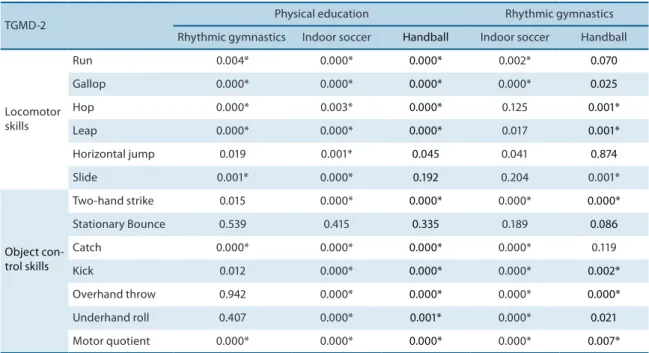
he Kruskal-Wallis test revealed signiicant diferences between groups regarding the motor quotient (H(3) = 48.91, p<0.001) and all 12 motor skills evaluated (p<0.001), except for bouncing ability (p=0.336). hus, the Mann-Whitney U test was used to determine where the diferences lay and Bonferroni correction was applied to minimize type I statistical errors, with the level of signiicance for these comparisons being set at α = 0.008. he results of these group comparisons are shown in Table 2.
Sport context and motor development Nazario & Vieira
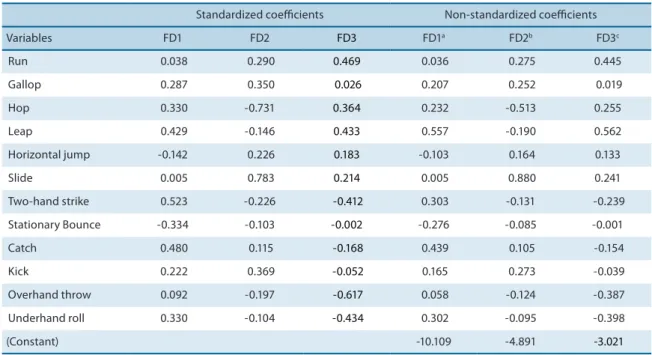
Discriminant statistical analysis was performed in order to identify and quantitate the contribution of each fundamental motor skill ac-cording to the context in which each child was enrolled. To this end, the assumption of equality of the dispersion matrices of the data was determined by the Box’s M test, with the option of using the variance matrix of separate groups in order to increase the accuracy of the dis-criminant statistical model (F ≈ 0.880, p>0.05). Ater this procedure, the model demonstrated three signiicant functions (Wilks’ lambda <0.001), as shown in Table 3.
Based on Wilks’ lambda values, the discriminant function (FD2) explains 77.5% of the variance, while the discriminant functions 2 (FD2) and 3 (FD3) explain 14.4% and 8.1% of the remaining variance among groups, respectively. Standardized coeicients identify and quantitate the potential of each variable for discriminating the children according to whether or not they are enrolled in a sports center. As demonstrated in Figure 1, the distance from group centroids, especially for FD1, represents the diferences in motor performance between the children attending only physical education classes and the children enrolled in the sports centers. he skills with a greater impact on this diference were returning, receiv-ing and forward pass.
FD2 represents the diference between children practicing handball and indoor soccer. he skills primarily accounting for this diference were lateral running and skipping on one foot. FD3 explains less properly the diference between practicing rhythmic gymnastics and those practicing indoor soccer and handball. he skills that discriminate this diference are: throwing over, running, rolling, forward pass, and returning. Table 4 shows
Table 2. Level of signiicance of the comparisons between groups regarding fundamental motor skills and motor quotient.
TGMD-2 Physical education Rhythmic gymnastics
Rhythmic gymnastics Indoor soccer Handball Indoor soccer Handball
Locomotor skills
Run 0.004* 0.000* 0.000* 0.002* 0.070
Gallop 0.000* 0.000* 0.000* 0.000* 0.025
Hop 0.000* 0.003* 0.000* 0.125 0.001*
Leap 0.000* 0.000* 0.000* 0.017 0.001*
Horizontal jump 0.019 0.001* 0.045 0.041 0.874
Slide 0.001* 0.000* 0.192 0.204 0.001*
Object con-trol skills
Two-hand strike 0.015 0.000* 0.000* 0.000* 0.000*
Stationary Bounce 0.539 0.415 0.335 0.189 0.086
Catch 0.000* 0.000* 0.000* 0.000* 0.119
Kick 0.012 0.000* 0.000* 0.000* 0.002*
Overhand throw 0.942 0.000* 0.000* 0.000* 0.000*
Underhand roll 0.407 0.000* 0.001* 0.000* 0.021
Motor quotient 0.000* 0.000* 0.000* 0.000* 0.007*
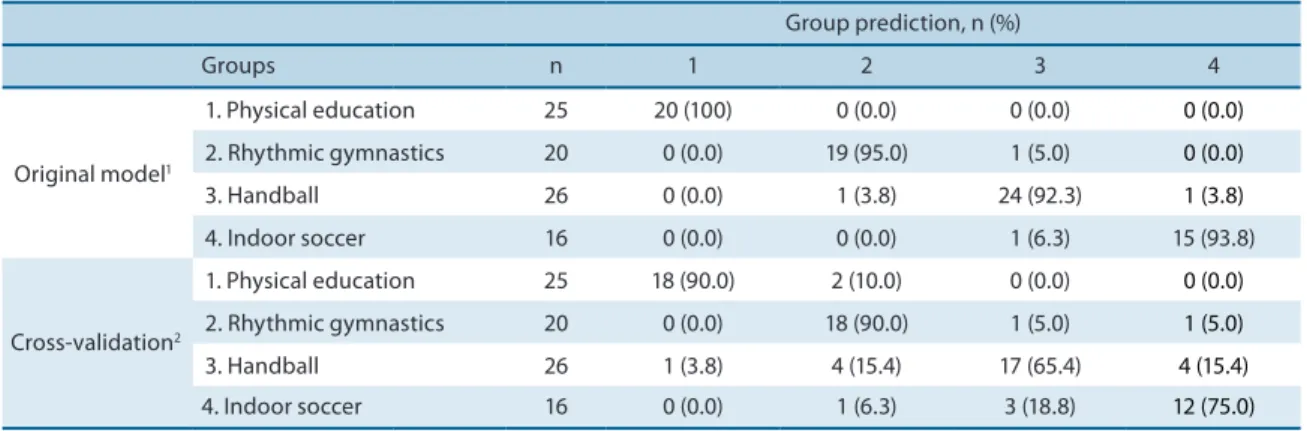
sports centers or those who only attend physical education classes. Ater model validation, 79.3% of the children were classiied correctly according to their performance in fundamental motor skills.
Table 3. Statistically signiicant functions and standardized and non-standardized coeicients for the three discriminant functions (FD1, FD2, FD3).
Standardized coeicients Non-standardized coeicients
Variables FD1 FD2 FD3 FD1a FD2b FD3c
Run 0.038 0.290 0.469 0.036 0.275 0.445
Gallop 0.287 0.350 0.026 0.207 0.252 0.019
Hop 0.330 -0.731 0.364 0.232 -0.513 0.255
Leap 0.429 -0.146 0.433 0.557 -0.190 0.562
Horizontal jump -0.142 0.226 0.183 -0.103 0.164 0.133
Slide 0.005 0.783 0.214 0.005 0.880 0.241
Two-hand strike 0.523 -0.226 -0.412 0.303 -0.131 -0.239
Stationary Bounce -0.334 -0.103 -0.002 -0.276 -0.085 -0.001
Catch 0.480 0.115 -0.168 0.439 0.105 -0.154
Kick 0.222 0.369 -0.052 0.165 0.273 -0.039
Overhand throw 0.092 -0.197 -0.617 0.058 -0.124 -0.387
Underhand roll 0.330 -0.104 -0.434 0.302 -0.095 -0.398
(Constant) -10.109 -4.891 -3.021
a FD1: eigenvalue of the function (
V = 227,1, d.f. = 36, p<0.001). b FD2: (
V1 = 87,5, d.f. = 22, p<0.001). c FD3: (
V2 = 37,3, d.f. = 10, p<0.001). All functions
are signiicant since the eigenvalue of the function, the irst residue (V1) and the second residue (V2) are all signiicant at p<0.05. d.f.: degrees of freedom,
V: residue.
Sport context and motor development Nazario & Vieira
DISCUSSION
By about 7 years of age, a child should be able to execute the fundamental motor skills in an adequate manner, before starting the process of move-ment specialization13,14. However, the motor performance of the children studied here who only attend physical education classes was classiied as “very poor”, below the level expected for age according to the criteria of the test12 (Table 1). On the other hand, the children enrolled in the rhythmic gymnastics and handball centers were classiied as “below average” and those enrolled in the indoor soccer center were classiied as “average”.
In a study15 conducted in Porto Alegre, RS, on 1248 children aged 3 to 10 years, the authors observed that the scores were below the normative values of the test for age for 69% of the boys and 82% of the girls. Similarly, in a study16 conducted in Florianópolis, SC, on children aged 5 to 10 years, 73% of the subjects were classiied as “below average”. From another perspective, a study9 on children aged 4 to 6 years demonstrated superiority of those who practiced systematic physical activity compared to those who only attended physical education classes. In a study10 conducted in the state of Paraná comparing the motor development of children with a mean age of 9 years who practiced mini-volleyball (n=50) and children only attending physical education classes (n=50), the children practicing mini-volleyball were classiied as “average”, while the others were classiied as “below aver-age”. he results agree with the evidence obtained here, since the present children enrolled in systematic sports practice showed better levels of motor development than children only attending physical education classes. his inding also satisies the irst conceptual hypothesis of the present study.
In this respect, it is possible to observe variations in the levels of motor performance of children that cannot be explained only by genetic inlu-ences or by maturation rate. On this basis and according to ecological ap-proaches5,6,17, the hypothesis that the sport context plays an intervening role in the process of motor development was conirmed by the present results. Regarding the motor skill showing the best performance in each con-text, the results also conirm the second conceptual hypothesis raised in
Table 4. Classiication of all signiicant discriminant functions after validation
Group prediction, n (%)
Groups n 1 2 3 4
Original model1
1. Physical education 25 20 (100) 0 (0.0) 0 (0.0) 0 (0.0)
2. Rhythmic gymnastics 20 0 (0.0) 19 (95.0) 1 (5.0) 0 (0.0)
3. Handball 26 0 (0.0) 1 (3.8) 24 (92.3) 1 (3.8)
4. Indoor soccer 16 0 (0.0) 0 (0.0) 1 (6.3) 15 (93.8)
Cross-validation2
1. Physical education 25 18 (90.0) 2 (10.0) 0 (0.0) 0 (0.0)
2. Rhythmic gymnastics 20 0 (0.0) 18 (90.0) 1 (5.0) 1 (5.0)
3. Handball 26 1 (3.8) 4 (15.4) 17 (65.4) 4 (15.4)
formance in the motor skill “kicking”, for example, compared to children practicing rhythmic gymnastics and handball. Again, children enrolled in indoor soccer showed better performance in the “lateral running” skill than children practicing handball. In turn, children practicing handball showed better performance in the “skipping on one foot” skill than all others and a better performance in the “throwing over” skill than children practicing rhythmic gymnastics. In addition to supporting the hypothesis of the present study, the sport context seems to direct the motor task ac-cording to the requirements of the modality, facilitating motor proiciency in speciic skills of the sport.
he requirements and demands of the context (e.g., type of sport), the characteristics of the children (inborn and acquired) and time (e.g., amount of practice, experience) may also limit or facilitate motor devel-opment (process) in some skills at the expense of others, as suggested by Krebs7 and by the bioecological theory6. his agrees with the theoretical models5,13,17 related to motor development that were created based on an ecological approach, which emphasize the need to observe the phenomenon, motor development, based on the characteristics of the person, context, task, and time.
he statistical discriminant model created was able to classify correctly 79.3% of the cases ater validation (Table 4). In other words, it is possible to classify each child according to his motor performance in each skill in the sports centers investigated. hese results suggest that each sport context analyzed has its own characteristics regarding the motor proile required and mainly point out the diference in motor performance between chil-dren enrolled in sport contexts and chilchil-dren who only attend physical education classes. his evidence agrees with a study18 of the environmental inluences on the throwing over pattern of 20 children aged 10 to 12 years, in which the authors demonstrated that environmental changes provoke changes in this pattern even though they do not lead to reorganization of movement as a whole. Finally, these indings agree with the concepts of Newell5 and of the bioecological theory6, since the context of sports centers has an impact on the performance in fundamental motor skills required by each discipline.
Sport context and motor development Nazario & Vieira
CONCLUSION
he results obtained permit the conclusion that children enrolled in sports centers have better levels of motor performance than children who only at-tend physical education classes. he children also showed variations in the level of performance in fundamental motor skills according to the speciic requirements of each context, in agreement with the theoretical basis for the study. hus, we believe that enrollment in sports centers may positively or negatively inluence the motor development of children. It was also possible to identify and quantitate the contribution of each fundamental motor skill in each context. Finally, it is inconsistent to attribute variations in the level of motor development only to genetic and maturation factors. On this basis, we conclude that the use of research models that take into consideration the characteristics of a person, the context and the time is more eicient for the study of motor development.
REFERENCES
1. helen E. Motor development: a new synthesis. Am Psychol 1995;50(2):79-95. 2. Barela JA. Aquisição de habilidades motoras: do inexperiente ao habilidoso. Motriz
1999;5(1):53-57.
3. Clark J. On the problem of motor skill development. Journal of Physical Education, Recreation and Dance 2007;78(5):39-45.
4. Cotrim JR, Lemos AG, Júnior JEN, Barela JA. Desenvolvimento de habilidades motoras fundamentais em crianças com diferentes contextos escolares. Rev Educ Fis/UEM 2011;22(4):523-533.
5. Newell KM. Constraints on the development of coordination. In: Wade MG, Whit-ing HTA, organizadores. Motor Development in children: Aspects of coordination and control. Boston: Ed. Martinus Nijhof; 1986. p. 341-360.
6. Bronfenbrenner U. Making human being human: Bioecological perspectives on 7. human development. housand Oaks: Sage Publications; 2005.
8. Krebs RJ. A teoria dos sistemas ecológicos: um paradigma para a educação infantil. Santa Maria: Editora da Universidade Federal de Santa Maria; 1997.
9. Krebs RJ, Duarte MG, Nobre GC, Nazario PF, Santos JOL. Relação entre escores de desempenho motor e aptidão física em crianças com idades entre 07 e 08 anos. Rev Bras Cineantropom Desempenho Hum 2011;13(2):94-99.
10. Palma MS, Camargo VA, Pontes MFP. Efeitos da atividade física sistemática sobre o desempenho motor de crianças pré-escolares. Rev Educ Fis/UEM 2012;23(3):53-63. 11. Ripka WL, Mascarenhas LPG, Hreczuck DV, Luz TGR, Afondo CA. Estudo com-parativo da performance motora entre crianças praticantes e não praticantes de minivoleibol. Fit Perf J 2009;8(6):412-416.
12. Ulrich DA. Test of gross motor development – second edition: examiner´s manual. Austin: Pro. Ed; 2000.
13. Ulrich, DA. he Test of Gross Motor Development-2nd Edition: Uses, Adminis-tration, and Applications. Revista da Sociedade Brasileira de Atividade Motora Adaptada 2005;10(1):13-5.
14. Gallahue D, Ozmun J, Goodway J. Understanding motor development: infants, children, adolescents, adults (7th ed.). Boston: McGraw-Hill; 2011.
Corresponding author
Patrik Felipe Nazario
Rua Quintino Bocaiúva 763, apto. 104 – Zona 7.
CEP: 87020-160 – Maringá, PR. Brasil E-mail: [email protected]
2012;182(1):1-8.
17. Marramarco CA, Krebs RJ, Valentini NC, Ramalho MHS, Santos JOL, Nobre GC. Crianças desnutridas pregressas, com sobrepeso e obesas apresentam desempenho motor pobre. Rev Educ Fis/UEM 2012; 23(2):175-82.
18. Bronfenbrenner U. he Ecology of Human Development: experiments by nature and design. Cambridge: Harvard University Press; 1979.