DOI: http://dx.doi.org/10.5007/1980-0037.2014v16n1p1
original article
RBCDH
Licence Creative Commom
CC
1 Universidade Federal de Santa Catarina. Centro de Desportos. Departamento de Educação Física. Florianópolis, SC. Brasil
2 Universidade do Estado de Santa Catarina. Centro de Ciências da Saúde e do Esporte. Florianópolis, SC. Brasil
3 Universidade Federal de Santa Catarina. Centro de Ciências da Saúde. Departamento de Enferma-gem. Florianópolis, SC. Brasil
Received: 02 August 2012 Accepted: 06 June 2013
Adaptation of the AAHPERD test battery for
institutionalized older adults
Bateria de testes da AAHPERD: adaptação para idosos
institucionalizados
Tânia R. Bertoldo Benedetti1
Giovana Zarpellon Mazo2
Lucia Hisako Takase Gonçalves3
Abstract– he American Alliance for Health, Physical Education, Recreation and Dance (AAHPERD) test battery assesses the functional itness of older adults in ive motor itness tests. he objective of this study was to adapt and test the AAHPERD in institutionalized older adults and to deine normative values of functional itness for this population. A pilot test was conducted on older adults living in nursing homes, which conirmed the need to adapt the lexibility and aerobic endurance tests. he irst test was redesigned so that the elderly person did not have to sit on the loor. he second test was changed from a half-mile to a 6-minute walk. he tests were adapted and tested in a sample of 92 older adults from six long-term care homes. he successful application of the AAHPERD adapted for older adults living in nursing homes permitted the establishment of normative values for the ive motor tests. he adapted version of the AAHPERD is an easily applied, low-cost tool of low risk since it was adapted to the physical and functional conditions of institutionalized older adults. his physical test battery will contribute to the evaluation of older adults and exercise prescription.
Key words: Functional itness; Institutionalized older adults; Nursing home.
INTRODUCTION
he process of aging itself can compromise the functional capacity of older adults, but physical inactivity is without doubt the factor that accelerates and aggravates the loss of functional itness1. Physical inactivity is a major
problem in nursing homes which rapidly leads to a state of dependency of older adults2. herefore, careful assessment of functional itness in
insti-tutionalized older adults using adequate tools is an essential requisite to implement group programs and to prescribe personalized physical activity at nursing home. Such assessment should prevent or delay the development of dependency among institutionalized older adults.
he American Alliance for Health, Physical Education, Recreation and Dance (AAHPERD) functional itness assessment3 is an older test battery
developed for the older adults, which is an easily applied, low-cost tool of low risk since the tests resemble activities of daily living2. his battery of
functional itness assessment consists of ive motor itness tests: agility/dy-namic balance, coordination, strength, lexibility, and aerobic endurance3.
he validity (content, criterion, discrimination) and reliability (internal consistency) of the instrument have been conirmed in several studies. Shaulis et al.4 evaluated the reliability of the instrument by applying the
ive tests three times over a period of 2 weeks to men and women aged 60 to 81 years. Good intraclass correlations were obtained for men and women, respectively: 0.97 and 0.98 for lexibility; 0.98 and 0.96 for agility; 0.89 and 0.71 for coordination; 0.94 and 0.81 for strength, and 0.99 and 0.96 for aerobic endurance3.
Zago and Gobbi5, Brazilian researchers, translated the AAHPERD to
Portuguese and performed a transcultural adaptation6, revalidating the
instrument for application to active Brazilian adults. hese authors also reported normative values that were not available for the original battery and that permitted the classiication of older adults according to functional capacity and overall functional itness index.
On the basis of the results reported by Zago and Gobbi5 and of a
multicenter project supported by CNPq that involved seven Brazilian universities (UFSC/UDESC, FURG, PUCRS, UPF/DE, EERP/USP, UESB/ DS), whose main objective was the functional itness assessment of low-income older adults living in LTCHs in order to develop a proposal for a basic multidimensional care model, the authors of the present study applied the AAHPERD5 to institutionalized older adults and observed that they
congruent with the true needs of each elderly person and the feasibility within the environmental and sociocultural context of each care facility.
herefore, the objective of the present study was to adapt and test the AAHPERD test battery in older adults living in LTCHs and to deine normative values of functional itness for this population.
METHODOLOGICAL PROCEDURES
he following steps of the methodological approach were used to adapt the AAHPERD translated to Portuguese and revalidated for application to active older adult5 for institutionalized older adults7: pilot study
apply-ing the Brazilian version of the AAHPERD functional itness assessment to a sample of institutionalized older adults; identiication/conirmation of components of the test battery that are diicult to apply or inapplica-ble; idealization/creation of the adaptation and redrating of the battery components to be adapted; submission of the adapted version to a panel of experts; application of the adapted battery to a sample that should be as heterogenous as possible in terms of geographic and cultural aspects (selection of subjects from six LTCHs located in the southern, southeast-ern, and northern parts of the country); analysis of the results obtained for the sample and statistical analysis of normative values for the battery tests applied to older adults living in LTCHs.
he study was conducted in accordance with Resolution 196/96 of the National Health Council. he general project to which this study belongs was approved by the Ethics Committee of UFSC (Permit No. 013/07). he
older adults participating in the study signed a free informed consent form.
Pilot study
Application of the Brazilian version of the AAHPERD functional itness assessment to a sample of 10 institutionalized older adults conirmed that the lexibility and aerobic endurance tests were not adequate for elderly people living in LTCHs, a fact already observed in daily practice at these facilities.
Adaptation of the lexibility and aerobic endurance tests
he lexibility test was modiied in such a way that the subject did not have to sit on the loor since osteoarticular disorders are frequent in the elderly, impairing certain movements and body positions. For this purpose, a wooden plank was itted on two chairs and the subject sat on one chair, extending the legs at 180 degrees on the plank for the test (Figure 1). he aerobic endurance and half-mile walking ability test was replaced with the 6-minute walk test considering the diiculty of older adults to walk 804.67 m (half a mile) and also the lack of physical space in many LTCHs8,9.
he adapted version of the AAHPERD battery (Appendix 1) was then applied to a sample of 92 older adults living in six LTCHs located in difer-ent geographic and cultural regions of Brazil: Florianópolis, Rio Grande, Porto Alegre, Passo Fundo, Ribeirão Preto, and Jequié.
Figure 1. Flexibility test adapted for older adults living in long-term care homes.
An intentional sample was obtained since the number of subjects de-pended on the total number of older adults living in each facility who met the inclusion criteria at the time of the study (2008/2): ability to understand and meet the requirements of the test battery, no visual deiciency, not bedridden or a wheelchair user, and not classiied as grade III dependency according to Resolution 283/05 (requiring assistance for all self-care tasks and activities of daily living). However, the sample was predicted to be as heterogenous as possible since it was selected in diferent contexts, a con-dition necessary for studies developing measurement instruments10. he
sample consisted of 92 older adults, 39 men and 53 women with a mean age of 78 years (SD=7.9) who were living in six LTCHs: 11 de Florianópolis-SC (n=11), Porto Alegre-RS (n=36), Rio Grande-RS 9n=9), Passo Fundo-RS (n=8), Ribeirão Preto-SP (n=11), and Jequié-BA (n=17).
Data collection
RESULTS
Applicability of the adapted AAHPERD test battery to institutionalized
older adults
he Brazilian version of the AAHPERD test battery5 for active elderly was
adapted in the present study for application to institutionalized older adults, modifying the lexibility and aerobic endurance tests. When the protocol shown in Appendix 1 was applied to a sample of 92 older adults living in LTCHs, 78 were able to perform all tests, 87 performed the lexibility, coordination and strength tests, 86 performed the agility and dynamic bal-ance test, and 85 performed the aerobic endurbal-ance test. Some older adults could not complete one test or the other because of physical problems or diseases. Taken together, the results showed that this instrument is useful for the evaluation of functional itness in active institutionalized older adults who have diiculties sitting on the loor or walking long distances.
With respect to the application of the AAHPERD test battery, the local research teams reported no diiculties in understanding the instrument and its application was easy and quick, suggesting that any adequately trained healthcare professional or student can apply the AAHPERD test battery as long as they understand the functioning of an LTCH.
Normative values of functional itness for institutionalized older adults
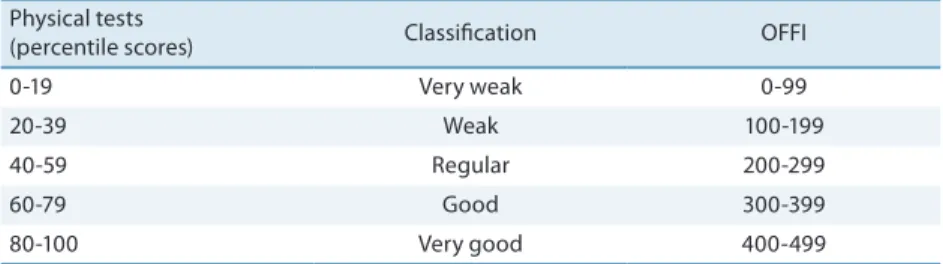
he adaptation of the AAHPERD test battery for institutionalized older adults required the development of normative values of the diferent physical tests and of an overall functional itness index (OFFI), which is the sum of percen-tile values. Normative values were obtained for the sample by calculating the percentages for each physical test (lexibility, coordination, strength, agility and dynamic balance, and aerobic endurance), resulting in a percentile score for each test. he OFFI corresponds to the sum of the scores of the ive tests. he percentile scores of the physical tests and OFFI were classiied into ive levels, ranging from very weak to very good (Table 1). he OFFI was calculated based on the 78 subjects who performed all tests of the battery. he same scores were also subdivided into three levels: weak, regular, and good (Table 2).
Table 1. Classiication of the percentile scores obtained in each test of the AAHPERD battery and overall functional itness index for institutionalized older adults.
Physical tests
(percentile scores) Classiication OFFI
0-19 Very weak 0-99
20-39 Weak 100-199
40-59 Regular 200-299
60-79 Good 300-399
80-100 Very good 400-499
OFFI: overall functional itness index (sum of percentiles of each test).
Table 2. Classiication of the percentile scores obtained in each test of the AAHPERD battery and overall functional itness index for institutionalized older adults.
Physical tests (percentile scores) Classiication OFFI
0-33 Weak 0-166
34-67 Regular 167-332
68-100 Good 333-500
OFFI: overall functional itness index (sum of percentiles of each test).
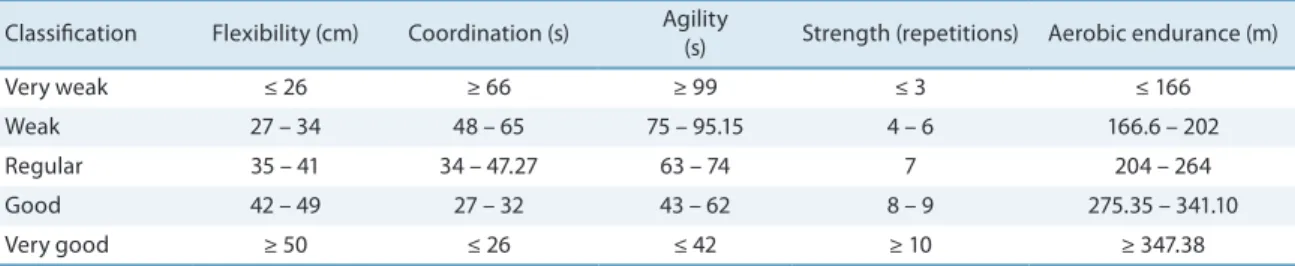
Table 3. Cut-of values obtained in the lexibility, coordination, agility and dynamic balance, strength and overall aerobic endurance tests according to the classiication into ive levels.
Classiication Flexibility (cm) Coordination (s) Agility
(s) Strength (repetitions) Aerobic endurance (m)
Very weak ≤ 26 ≥ 66 ≥ 99 ≤ 3 ≤ 166
Weak 27 – 34 48 – 65 75 – 95.15 4 – 6 166.6 – 202 Regular 35 – 41 34 – 47.27 63 – 74 7 204 – 264 Good 42 – 49 27 – 32 43 – 62 8 – 9 275.35 – 341.10
Very good ≥ 50 ≤ 26 ≤ 42 ≥ 10 ≥ 347.38
Table 4. Cut-of values obtained in the lexibility, coordination, agility and dynamic balance, strength and overall aerobic endurance tests according to the classiication into three levels.
Classiication Flexibility (cm) Coordination (s) Agility
(s) Strength (repetitions) Aerobic endurance (m)
Weak ≤ 33 ≥ 61 ≥ 86.08 ≤ 4 ≤ 193
Regular 34 – 45 58 – 34.89 85.9 – 63 5 – 7 197.5 – 290
Good ≥ 47 ≤ 34.29 ≤ 62 ≥ 8 ≥ 297.6
he classiication obtained with the physical tests and OFFI for the sample selected for this study, which is represented by a small number of older adults from three regions of Brazil, imposes limitations on the gener-alization of the results. However, the applicability of the adapted version of the AAHPERD test battery to institutionalized older adults demonstrated in this study suggests its continuous testing in diferent regional contexts so that it can be validated in Brazil for geriatric research and practice.
DISCUSSION
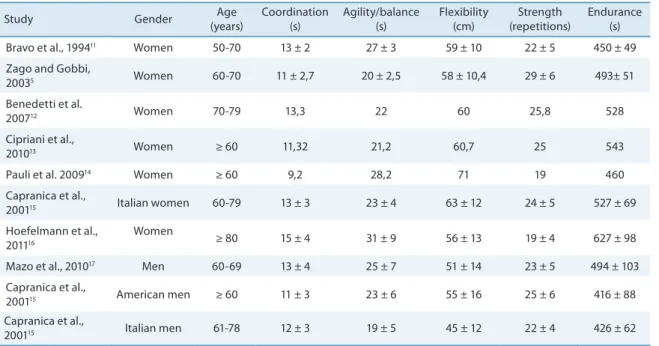
Table 5 lists international and Brazilian studies using the original ver-sion5,13-18 of the AAHPERD that reported results similar to those obtained
in the present investigation.
However, these studies did not investigate older adults living in nurs-ing homes. Most of these studies involved women aged 60 years or older. Only the study of Mazo et al.18 investigated older men. Furthermore, all
participants in those studies performed physical activity. Four of the studies reported reference values of the battery tests for older adults and two were descriptive studies.
results. Older adults living in nursing homes are more debilitated and do not achieve the same time, distance or repetitions in the tests. he present study therefore highlights the importance to develop normative values that classify older adults based on the reality of nursing homes. his is the irst step to establish reference values for nursing homes that would permit the comparison of diferent nursing homes in Brazil, even with limitations. We believe that it is better to compare the results between Brazilian nursing homes than to compare data of older adults from other countries.
Table 5. Results of studies using the original version of the AAHPERD test battery.
Study Gender Age (years)
Coordination (s)
Agility/balance (s)
Flexibility (cm)
Strength (repetitions)
Endurance (s) Bravo et al., 199411 Women 50-70 13 ± 2 27 ± 3 59 ± 10 22 ± 5 450 ± 49
Zago and Gobbi,
20035 Women 60-70 11 ± 2,7 20 ± 2,5 58 ± 10,4 29 ± 6 493± 51
Benedetti et al.
200712 Women 70-79 13,3 22 60 25,8 528
Cipriani et al.,
201013 Women ≥ 60 11,32 21,2 60,7 25 543
Pauli et al. 200914 Women ≥ 60 9,2 28,2 71 19 460
Capranica et al.,
200115 Italian women 60-79 13 ± 3 23 ± 4 63 ± 12 24 ± 5 527 ± 69
Hoefelmann et al., 201116
Women
≥ 80 15 ± 4 31 ± 9 56 ± 13 19 ± 4 627 ± 98
Mazo et al., 201017 Men 60-69 13 ± 4 25 ± 7 51 ± 14 23 ± 5 494 ± 103
Capranica et al.,
200115 American men ≥ 60 11 ± 3 23 ± 6 55 ± 16 25 ± 6 416 ± 88
Capranica et al.,
200115 Italian men 61-78 12 ± 3 19 ± 5 45 ± 12 22 ± 4 426 ± 62
here are no studies applying the original version of the AAHPERD test battery to institutionalized older adults or residents of nursing homes. he present study represents a progress in this respect by adapting and testing this battery in institutionalized older adults and deining normative or reference values of functional itness for this population.
Physical inactivity is an important factor in nursing homes and most older adults present low functional itness due to diseases combined with their routine in the facility20. With few exceptions, older adults do not
perform occupational activities and prefer activities that require less efort, leading to rapid debilitation20 and consequent physical and functional
limitations.
the evaluation of their physical condition permits to identify risks for the occurrence of dependency.
A study conducted in the United States on 64 institutionalized older adults (45 women and 19 men) with a mean age of 84 years demonstrated the usefulness of the AHHPERD functional itness test battery to evalu-ate a physical activity program (strength training or walking twice a week for 4 months). he authors observed improvement in strength (33%), co-ordination (18%), balance and agility (14%), lexibility (10%), and aerobic endurance (7%). At the same time, 61% of the subjects presented a decline in the number of falls11.
Most of the physical abilities evaluated by the test battery adapted here are based on scientiic evidence as reported in a review article by the American College of Sports Medicine which analyzed more than 250 studies19. An overview of this study is given below.
Coordination was not studied by the group and there seems to be no strong evidence of health beneits, although coordination is known to be afected by aging and reduces the occurrence of falls19. In contrast,
agil-ity and dynamic balance are directly related to falls. Despite the medium evidence reported in that study, these physical abilities should be developed mainly to prevent falls19. Flexibility is a physical ability with low evidence
of health beneits. Individuals who perform stretching exercises usually try to improve lexibility and report to feel better. Muscle strength was the most important physical ability during aging in the studies analyzed and there is strong evidence that improvement of muscle strength permits the maintenance of an independent life19. It is therefore necessary to preserve
this physical ability. Aerobic endurance is another physical ability with strong evidence of preserving independence for a longer period of time19.
As reported in another study by our group, physical inactivity is a major factor in nursing homes whose residents show low functional itness because of their routine in the facility20. With few exceptions, older adults
living in nursing homes do not perform occupational activities and prefer activities that require less efort, leading to rapid debilitation20.
he evaluation of functional itness in older adults is an essential req-uisite for the implementation of physical activity intervention programs in nursing homes. his assessment permits to determine the degree of physi-cal function in older adults and which components of functional itness need to be exercised and/or improved in order to preserve an autonomous and independent life in the nursing home. herefore, the adoption of the adapted AAHPERD test battery by nursing homes will permit the regular evaluation of functional itness in their residents and provide technical data to design and implement geriatric programs that promote an active life.
Acknowledgements
and the scientiic initiation students of the participating universities who helped with the data collection.
REFERENCES
1. Caldas PC. Envelhecimento com dependência: responsabilidades e demandas da família. Cad Saúde Pública 2003; 19(3):733-81.
2. Benedetti TRB, Mazo GZ, Schimitz LTM. Instituições geriátricas da grande Flo-rianópolis. Arq Geriatr Gerontol 2000; 4(2):57-61.
3. Osness WH, Adrian M, Clark B, Hoeger W, Raab D, Wiswell R. Functional Fitness Assessment for Adults Over 60 Years. he American Alliance for Health, Physical Education, Recreation and Dance (AAHPERD). Association for Research, Ad-ministration, Professional Councils, and Societies. Council on Aging and Adult Development.1990.
4. Shaulis D, Golding LA, Tandy RD. Reliability of the AAHPERD functional itness assessment across multiple practice sessions in older men and women. J Aging Phys Activ 1994; 2(3):273-9.
5. Zago AS, Gobbi S. Valores normativos da aptidão funcional de mulheres de 60 a 70 anos. R Bras Ci Mov 2003; 11(2):77-86.
6. Beaton D, Bombardier C, Guillemin F, Ferraz MB. Recommendations for the cross-cultural adaptations of health status measures. New York: American Academy of Orthopaedic Surgeons, 2002.
7. Polit D, Hungler B, Beck CT. Fundamentos de pesquisa em enfermagem. 5 ed. Porto Alegre: Artmed, 2004.
8. Enright PL. he six-minute walk test. Resp Care 2003; 48(8):783-5.
9. Enright PL, McBurnie MA, Bittner V, Tracy RP, McNamara R, Arnold A, Newman AB. he 6-min walk test: a quick measure of functional status in elderly adults. Chest 2003; 123(2):387-398.
10. Pasquali L. Psicometria: Teoria dos testes na psicologia e educação. Petrópolis: Vozes, 2003.
11. Simons R. Grow Strong, Live Long Fitness Study with Elderly Retirement Home Independent Living Residents. Saint Petersburg: 2006. Available from: <http:// www.ifpa-itness.com/Resources_Articles_GrowStrong3.aspx> [June 15, 2006]. 12. Bravo G, Gauthier P, Roy PM, Tessier D, Gaulin P, Dubois MF, et al. he functional
itness assessment battery: Reliability and validity data for elderly women. J Aging Phys Activ. 1994;2(1):67-79.
13. Benedetti TRB, Mazo GZ, Gobbi S, Amorim M, Gobbi LTB, Ferreira L, et al. Valores normativos de aptidão funcional em mulheres de 70 a 79 anos. Rev Bras Cineantropom Desempenho Hum 2007;9(1):28-36.
14. Cipriani NCS, Meurer ST, Benedetti TRB, Lopes MA. Aptidão funcional de idosas praticantes de atividades físicas. Revista Brasileira de Cineantropometria e Desem-penho Humano 2010;12(2):106-11.
15. Pauli J R, Souza L S, Zago A S, Gobbi S. Inluência de 12 anos de prática de atividade física regular em programa supervisionado para idosos. Rev Bras Cineantropom Desempenho Hum 2009;11(3):255-60.
16. Capranica L, Tiberi M, Figura F, Osness WH. Comparison between American and Italian older adult performances on the AAHPERD functional itness test battery. J Aging Phys Activ 2001;9(1):11-8.
17. Hoefelmann CP, Benedetti TRB, Antes DL, Lopes MA, Mazo GZ, Korn S. Aptidão funcional de mulheres idosas ativas com 80 anos ou mais. Motriz 2011;17(1):19-25. 18. Mazo GZ, Benedetti TRB, Gobbi S, Ferreira L, Lopes MA. Valores normativos e
Corresponding author
Tânia R. Bertoldo Benedetti Rua: Mediterrâneo, 204, apto 202. Córrego Grande.
CEP: 88037-610 – Florianópolis, SC. Brasil
E-mail: [email protected] 19. Chodzko-Zajko WJ, Proctor DN, Fiatarone Singh MA, Minson CT, Nigg CR, Salem
GJ, Skinner JS. American College of Sports Medicine. Position Stand: exercise and psysical activity for older adults. Med Sci Sports Exerc 2009;47(7):1510-30. 20. Souza PD, Benedetti TRB, Borges LJ, Mazo GZ, Gonçalves LHT. Aptidão funcional
APPENDIX 1
he American Alliance for Health, Physical Education, Recreation and Dance (AAHPERD) protocol developed by Osness et al. (1990) and adapted for institutionalized older adults.
Agility and dynamic balance test
• Equipment required: a chair with armrests, a measuring tape, two
marker cones, and a stopwatch.
• Organization of the test: the chair is placed at a marked position,
permitting the feet to touch the loor. Two cones positioned 1.50 m behind the chair and 1.80 m on each side (Figure 2).
• Position of the subject: the subject sits on the chair with the feet (heels)
touching the loor.
• Position of the examiner: the examiner stands close to the subject.
• Procedure: on the signal “Go”, the subject rises from the chair, walks around
the cone to the right, returns to the chair, and sits down, slightly liting the feet. he subject then immediately rises from the chair, walks around the cone to the let, returns to the chair, and sits down. his corresponds to one circuit. he subject should complete a course of two complete circuits.
• Observation: demonstrating the test and the subject should repeat it
without counting the time (walking as fast as possible). Two attempts are made and the best (lowest) time is recorded in seconds as the inal result.
Adaptation of the test with assistance
• Procedure: the examiner assists with the execution of the test, holding
the subject’s arm and allowing the subject to perform the test at his/ her own pace. During the test, the examiner verbally informs the steps of the test: walk around the cone, sit in the chair, and lit your feet.
Figure 2. Schematic drawing of the agility and dynamic balance test (Zago and Gobbi, 2003).
Coordination test
• Equipment required: adhesive tape, a table, a chair, and three full
soda cans.
• Organization of the test: a 76.2-cm strip of adhesive tape is ixed to a
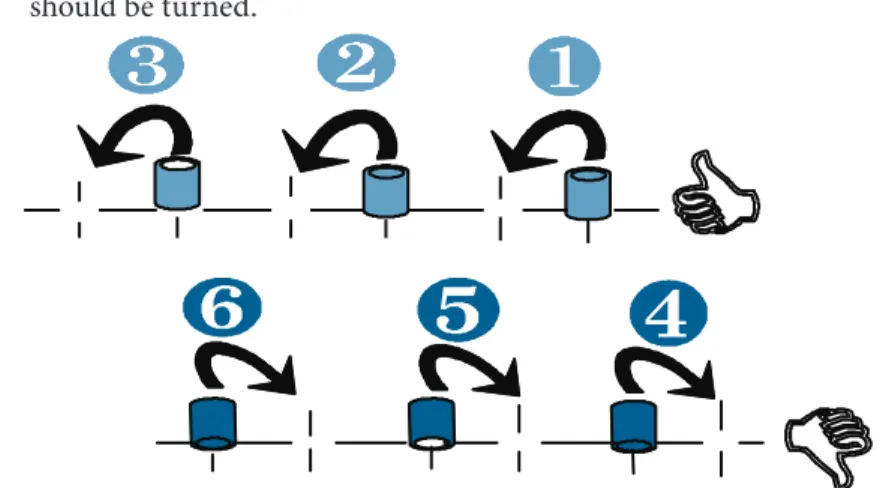
Perpendicularly to the tape, another strip of adhesive tape (7.6 cm long) is ixed to each mark (Figure 3). If the right hand is the dominant hand, the irst soda can is placed at position 1, the second can at position 3, and the third can at position 5. he right hand is then placed on can 1, thumb up, and the elbow is bent at an angle of 100 to 120 degrees.
• Position of the subject: the subject is seated at the table and uses the
dominant hand for the test.
• Position of the examiner: the examiner is standing close to the subject
holding the stopwatch.
• Procedure: on the signal “Go”, the stopwatch is started and the
partici-pant turns the can upside down, placing can 1 at position 2, can 2 at position 4, and can 3 at position 6. he participant, with thumb down, then returns immediately to the irst can, turning it upside down and replacing it in the original position, and proceeds the same way placing can 2 at position 3 and can 3 at position 5, thus completing one circuit. his procedure is repeated twice without interruptions, corresponding to one trial. If the participant is let-handed, the same procedure is adopted, except that the position of the soda cans is inverted, starting from the let side. Each participant performs two practice trials, followed by two valid trials for evaluation. he time of the last two trials is recorded to the nearest tenth of a second and the lowest time is used as the inal result.
• Observation: the position of the cans is inverted if the subject is
let-handed.
Adaptation of the test
• Procedure: the examiner indicates with the inger where the cans
should be turned.
Figure 3. Schematic drawing of the coordination test (Zago and Gobbi, 2003).
Flexibility test
• Equipment required: adhesive tape and a metal ruler longer than 63 cm.
• Organization of the test: a 50.8-cm long tape is ixed on the loor and a
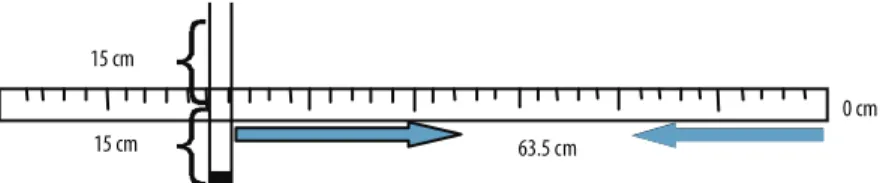
• Position of the subject: he participant sits without shoes on the loor, with the legs stretched out, the feet spaced 30.4 cm apart, the toes point-ing up, and the heels centered on the marks made on the adhesive tape. he zero of the measuring tape points to the participant.
• Position of the examiner: he examiner sits on the side, holding down
the subject’s knees.
• Procedure: With the hands on top of each other, the participant slowly
slides the hands along the measuring tape as far as possible and holds the inal position for at least 2 seconds. Two practice trials are allowed, followed by two test trials. he best distance of the two trials is recorded as the inal result.
Adaptation of the test with assistance:
A wooden plank for support is it between two chairs so that the participant could perform the lexibility test sitting on a chair.
• Equipment required: wooden plank with a drawn measuring line. Two
chairs of the same height without armrests.
• Organization of the equipment: one chair is placed in front of the
other and the wooden plank is it on the two chairs.
• Position of the subject: the participant sits without shoes on one of the
chairs, with the legs stretched out at an angle of 180 degrees, the feet spaced 30.4 cm apart, the toes pointing up, and the heels centered on the marks made on the plank. he zero of the measuring line points to the participant.
• Position of the examiner: the examiner places the wooden plank on
the chair seat under the thighs of the subjects and on the seat of the other chair. he examiner assists the participant in extending the legs on the plank in the adequate position, holding down the subject’s knees.
• Procedure: with the hands on top of each other, the participant slowly
slides the hands along the measuring line drawn on the wooden plank as far as possible and holds the inal position for at least 2 seconds. Two practice trials are performed, followed by two test trials. he best distance of the two trials is recorded as the inal result.
Figure 4. Schematic drawing of the lexibility test (Zago and Gobbi, 2003).
Upper limb strength and endurance test
• Equipment required: 1.8-kg weight for women and 3.6-kg weight for
men, a chair without armrests.
• Organization of the test: the chair is placed in a comfortable room
and the weights close to the chair.
of the chair with the trunk erect and looking straight ahead, with the sole of the feet completely touching the loor. he dominant arm should remain relaxed and extended along the body (hand turned towards the body), whereas the non-dominant hand lies on the thigh. he weight should be parallel to the ground, with one end facing forward.
• Position of the examiner: two examiners. he irst examiner stands
on the side of the subjects and puts one hand on the biceps and the other on the triceps. he other examiner holds the weight placed in the dominant hand of the participant and a stopwatch.
• Procedure: the second examiner responsible for the stopwatch starts
the test and the subject contracts the biceps, lexing the elbow until the forearm touches the hand of the irst examiner placed on the sub-ject’s biceps. When the trial is completed, the weight is placed on the loor and the subject is allowed to rest for 1 minute. Ater this period, the test is repeated, but this time the subject performs the maximum number of repetitions over a period of 30 seconds, which is recorded as the inal result of the test.
Adaptation of the test
• Procedure: there was no adaptation of the test. Weights of 2 kg for
women and of 4 kg for men were used.
Overall aerobic endurance and walking ability test
• Equipment required: marked athletic track and a stopwatch.
• Organization of the test: performed on a running track.
• Position of the subject: the participant stands at the start line.
• Position of the examiner: the examiner stands close to the subject
holding the stopwatch.
• Procedure: on the signal “Go”, the subject starts walking as fast as possible
(not running) 804.67 m on the 400-m track. he time spent for this task is recorded in minutes and seconds and then transformed into seconds.
Adaptation of the test
his test was changed to a 6-minute walk test to be more speciic for fragile older adults.
• Objective: To evaluate aerobic endurance.
• Equipment required: a stopwatch, a measuring tape, cones, sticks,
a piece of chalk, and a marker. For safety reasons, chairs should be placed at various points outside the circuit. 50 m, at intervals of 5 m.
• Position of the subject: the subject stands at the start line.
• Position of the examiner: the examiner stands at the start line holding
the stopwatch.
• Procedure: the examiner assists with the execution of the test, holding