Radiol Bras. 2016 Jan/Fev;49(1):43–48 43
Hyperechoic breast lesions: anatomopathological correlation
and differential sonographic diagnosis
*
Lesões hiperecogênicas na mama: correlação anatomopatológica e diagnósticos diferenciais à ultrassonografia
Medeiros MM, Graziano L, Souza JA, Guatelli CS, Poli MRB, Yoshitake R. Hyperechoic breast lesions: anatomopathological correlation and differential sonographic diagnosis. Radiol Bras. 2016 Jan/Fev;49(1):43–48.
Abstract
R e s u m o
Hyperechoic lesions are not a frequent finding at breasts ultrasonography, and most of times are associated with benign pathologies that do not require further evaluation. However, some neoplasms such as invasive breast carcinomas and metastases may present with hyperechogenicity. Thus, the knowledge about differential diagnoses and identification of signs of lesion aggressiveness are of great relevance to avoid unnecessary procedures or underdiagnosis, and to support the correct clinical/surgical approach. On the basis of such concepts, the present essay describes and illustrates the main features of hyperechoic lesions at breast ultrasonography in different cases, with anatomopathological correlation.
Keywords: Hyperechoic breast lesions; Ultrasonography; Breast neoplasms; Differential diagnosis.
As lesões hiperecogênicas constituem um achado com baixa prevalência nos exames ultrassonográficos das mamas, em sua maior parte associado a doenças benignas que não necessitam de avaliação adicional. Porém, algumas neoplasias, como o carcinoma inva-sivo da mama e as metástases, podem apresentar-se desta forma. Assim, o conhecimento dos diagnósticos diferenciais e a identifica-ção dos sinais de agressividade das lesões são de grande relevância, a fim de evitar procedimentos desnecessários ou o subdiagnóstico, e apoiar a conduta clínica/cirúrgica correta. Com base nestes conceitos, este artigo descreve e ilustra os principais aspectos das lesões hiperecogênicas presentes no exame ultrassonográfico das mamas, por meio de diferentes casos, e sua correlação anatomopatológica.
Unitermos: Lesões mamárias hiperecogênicas; Ultrassonografia; Neoplasias mamárias; Diagnósticos diferenciais.
* Study developed at Department of Radiology and Imaging Diagnosis – A.C.Camargo Cancer Center, São Paulo, SP, Brazil.
1. MD, Resident in Radiology, Department of Radiology and Imaging Diagnosis – A.C.Camargo Cancer Center, São Paulo, SP, Brazil.
2. Physicians, Department of Radiology and Imaging Diagnosis – A.C.Camargo Cancer Center, São Paulo, SP, Brazil.
Mailing Address: Dra. Luciana Graziano. Rua Taquari, 956, ap. 152, Moóca. São Paulo, SP, Brasil, 03166-001. E-mail: [email protected].
Received April 19, 2014. Accepted after revision December 11, 2014.
Marcelo Menezes Medeiros1, Luciana Graziano2, Juliana Alves de Souza2, Camila Souza Guatelli2,
Miriam Rosalina B. Poli2, Rafael Yoshitake2
INTRODUCTION
Hyperechoic breast lesions are uncommon findings(1),
corresponding to 5.6% of alterations identified at ultrasonog-raphy (US), with high predictive value for benignity. Such lesions correspond to 0.6% of all biopsied lesions and only 0.4% of all malignant lesions(2).
Breast nodules with fatty or fibrous contents, either of vascular origin or with high cellularity may present increased echogenicity at US (Table 1). The knowledge of the char-acteristics of the main hyperechoic lesions, as well as the recognition of characteristics suggestive of malignancy to avoid late diagnosis might avoid many unnecessary invasive procedures(3). In most cases, hyperechoic lesions are detected
for being palpable or for presenting suspicious findings at mammography or magnetic resonance imaging (MRI)(2,4).
The analysis of sonographic characteristics has shown that non parallel orientation and non circumscribed margins are more frequently found in malignant hyperechoic nod-ules than in benign ones. Such results suggest that the same sonographic characteristics utilized to evaluate hypo- or isoechoic nodules (such as spiculated margins, association with microcalcifications) should be applied in cases of hyperechoic nodules to differentiate between malignant and benign lesions(4,5). Additionally, the presence of focal
hypoechoic areas within hyperechoic findings increases the risk of malignancy(2).
In the present study, the authors describe cases of hyperechoic breast lesions observed at US, with emphasis on the relevance of possible differential diagnoses for the correct clinical approach.
BENIGN LESIONS Adenosis
architectural distortion and be associated with proliferative lesions such as intraductal papilloma, fibroadenomas, and coexist with invasive carcinomas in situ(6,7).
Hamartomas
Hamartomas are constituted of glandular, fatty and fibrous tissues, with estimated incidence of 0.1–0.7%. In most cases, they present as a mobile, barely painful nodule in middle-aged women. At US, they are nodules with circumscribed margins, peripheral halo and compressible by the transducer (Figure 2). They may be hyperechoic in 12–43% of cases, or even heterogeneous, hypoechoic and isoechoic(8).
Steatonecrosis
It is a common entity that may result from trauma, but in most cases it occurs after surgery or radiotherapy. Its
ap-Table 1—Types of hyperechogenic breast lesions at ultrasonography. Cause of the hyperechogenicity
Lesions with fatty contents
Lesions with fibrous contents
Vascular lesions
High-cellularity lesions
Benign lesions
Hamartoma Lipoma Angiolipoma Steatonecrosis
Hamartoma Focal fibrosis
Pseudoangiomatous stromal hyperplasia
Angiomyolipoma Hemangioma
Flogosis (rare) Infection (rare)
Malignant lesions
Liposarcoma
Invasive ductal carcinoma Invasive lobular carcinoma
Angiosarcoma
Invasive ductal carcinoma and ductal carcinoma in situ Carcinoma lobular invasivo
Lymphoma Metastasis
Table adapted from Linda et al.(1).
Figure 2. Hamartoma. Ultrasonography showing heterogeneous, ovoid, predomi-nantly hyperechoic nodule with circumscribed margins, largest axis parallel to the skin, and subtle posterior acoustic shadowing.
pearance depends upon the presence of histiocytic infiltrate, hemorrhage, fibrosis or calcification(4). At US it presents with
varied aspects, as a focal hyperechoic subcutaneous area, anechoic mass with posterior acoustic shadowing, solid or cystic mass with internal echoes, or a cystic mass with mu-ral nodules (Figure 3)(4).
Fibroadenoma
Fibroadenoma is the third most common cause of bi-opsy in cases of benign breast conditions. The maximum in-cidence occurs at the third decade of life, with a second peak at the fifth decade. At US, it presents with an elliptical or slightly lobulated shape, and the axis with orientation paral-lel to the skin, isoechoic or slightly hypoechoic echogenicity, a fine, mobile and slightly compressible echogenic capsule. In 3.1% of cases, fibroadenomas are remarkably hypoechoic,
and in 0.9%, either completely or partially hyperechoic (Fig-ure 4). This is due to the presence of either smaller or greater proportions of epithelial and stromal elements(9). As it
de-generates, internal, gross (popcorn) or peripheral (halo sign) calcifications are observed(8,9).
Phyllodes tumor
It is responsible for 0.3–1.0% of breast tumors, affect-ing women aged between 35 and 55 years, as a fast-grow-ing, palpable mass. At US it presents as a hypoechoic and
less frequently hyperechoic, solid, well delimited lesion with lobulated margins, occasionally with cystic components, and related to the degree of necrosis and fibrosis (Figure 5)(8,10).
Hemangioma
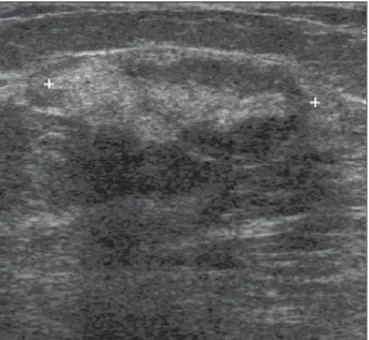
A superficial vascular lesion located in the dermis or in the subcutaneous layer, rarely affecting the breast, with higher incidence in middle-aged women. At US, hemangiomas present with a lobulated or ovoid shape, with well circum-scribed margins. Most hemangiomas are either hypoechoic or isoechoic, and may be complex. However, in 33% of cases, they appear as hypoechoic lesions with distal attenua-tion (Figure 6)(11).
Figure 3. Steatonecrosis. On A,ultrasonography showing hyperechoic, ovoid nodule with indistinct margins and posterior acoustic shadowing. On B, correlation with mammographic study – focal asymmetry is observed in the posterior third of the breast.
A B
Figure 4. Fibroadenoma. Follow-up ultrasonography showing hyperechoic, ovoid nodule with circumscribed margins and largest axis parallel to the skin.
Figure 5. Malignant phyllodes tumor. Ultrasonography showing ovoid, echogenic mass with circumscribed and heterogeneous margins, with a central cystic com-ponent and posterior acoustic enhancement.
Intraductal papilloma
Intraductal papillomas are polypoid lesions within the breast duct. Generally, they affect perimenopausal women, and the most frequent symptoms are sanguinolent, serous or serosanguinolent discharge. At US, intraductal papillo-mas are seen as a hypoechoic, solid, round or lobulated nodule, but its echogenicity may be variable. In cases of ductal obstruction, the papilloma may be surrounded by fluid, mimicking a mural nodule within a cyst (Figure 7)(8,12).
Myofibroblastoma
It is a rare benign, mesenchymal, spindle cell tumor with varied histological aspect and cellularity, representing dif-ferential diagnosis of sarcomatous tumor. This tumor is
pre-dominantly reported in men as a circumscribed nodule, gen-erally smaller than 3 cm(11). The radiological characteristics are variable, and, at US. It presents as a solid, well delimited mass that may be hypoechoic, isoechogenic or hyperechoic, depending on the fatty component (Figure 8)(13).
Pseudoangiomatous stromal hyperplasia
It is a mesenchymal tumor commonly found in peri-menopausal women or those undergoing hormone replace-ment therapy, representing 0.4% of breast lesions. Clinically, it may present as either a palpable nodule or as a diffuse in-volvement of the breast. At US, they appear as ovoid, het-erogeneous and occasionally hyperechogenic lesions (Fig-ure 9)(5,11).
Figure 6. Hemangioma. Ultrasonography showing subcutaneous, palpable, hyperechoic nodule with microlobulated contours.
Figure 7. Intraductal papiloma. Ultrasonography showing irregular nodule with orientation perpendicular to the skin, and posterior acoustic shadowing.
Figure 9. Pseudoangiomatous stromal hyperplasia. Ultrasonography demonstrat-ing heterogeneous, predominantly hyperechogenic, ovoid nodule with indistinct posterior margin and subtle posterior acoustic shadowing.
MALIGNANT LESIONS Ductal carcinoma in situ
The hyperechogenic presentation at US is uncommon, and is reported in less than 0.8% of cases. Certain histologi-cal patterns, such as cribriform carcinoma and solid subtypes, together with tumor heterogeneity, are associated with the lesion hyperechogenicity(13). Thus, despite the high negative
predictive value for malignancy of hyperechogenic nodules, the lesions should be carefully evaluated as regards shape, margin and hypervascularization, indicating histological evalu-ation in the presence of suspicious findings (Figure 10)(13).
sonographic characteristics should be taken into consider-ation(16). A full appreciation of the most suspicious imaging
findings such as non-circumscribed margins and posterior acoustic shadowing, together with appropriate mammo-graphic correlation and clinical context, contribute to de-termine the most appropriate clinical/surgical approach(17).
REFERENCES
1. Linda A, Zuiani C, Lorenzon M, et al. The wide spectrum of hyperechoic lesions of the breast. Clin Radiol. 2011;66:559–65. Figure 10. Ductal carcinoma in situ in a patient with Paget disease.
Ultrasonog-raphy showing heterogeneous, irregular area with subtle parenchymal disorgani-zation associated with intermingled microcysts.
Figure 12. Invasive ductal carcinoma. Ultrasonography showing hyperechoic, rounded nodule with indistinct posterior margin.
Lymphoma
It corresponds to 0.1–0.5% of malignant breast lesions. Clinically, it may manifest as a palpable mass. At US, it presents as a hypoechogenic mass with well defined or ir-regular margins, but the pattern may be heterogeneous with a hyperechogenic halo (Figure 11)(12).
Invasive ductal carcinoma
It represents 75% of invasive breast tumors. At US it presents as a hypoechogenic image with non-circumscribed margins, and in 2% of cases it may be hyperechogenic. Prob-ably, the hyperechogenicity is due to reflective interfaces caused by growth and infiltration of the cellular component, and fatty inclusions involving a poorly perceptible hypoecho-genic, hyalinized center (Figure 12)(4,14).
Metastases
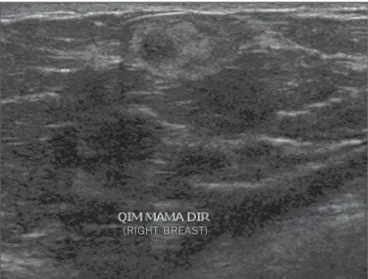
Metastases represent 0.5–2% of malignant breast nod-ules. The most common primary tumors are lymphoma, melanoma and rhabdomyosarcoma. At US, they present as bilateral, fast-growing, palpable, painless, hypoechogenic nodules with irregular margins (Figure 13)(11,15).
CONCLUSION
Hyperechogenic breast nodules are uncommon and, despite the high predictive value for benignity, all the
2. Linda A, Zuiani C, Lorenzon M, et al. Hyperechoic lesions of the breast: not always benign. AJR Am J Roentgenol. 2011;196:1219– 24.
3. Barra FR, Barra RR, Barra Sobrinho A. Novel functional methods in the evaluation of breast lesions. Radiol Bras. 2012;45:340–4. 4. Gao Y, Slanetz PJ, Eisenberg RL. Echogenic breast masses at US:
to biopsy or not to biopsy? Radiographics. 2013;33:419–34. 5. Badan GM, Roveda Júnior D, Ferreira CAP, et al. Positive
predic-tive values of Breast Imaging Reporting and Data System (BI-RADS®) categories 3, 4 and 5 in breast lesions submitted to percu-taneous biopsy. Radiol Bras. 2013;46:209–13.
6. Gill HK, Ioffe OB, Berg WA. When is a diagnosis of sclerosing adenosis acceptable at core biopsy? Radiology. 2003;228:50–7.
7. Melhado VC, Alvares BR, Almeida OJ. Radiological and histologi-cal correlation of non-palpable breast lesions in patients submitted to preoperative marking according to BI-RADS classification. Radiol Bras. 2007;40:9–11.
8. Stavros AT. Ultrassonografia da mama. 1ª ed. Rio de Janeiro, RJ: Guanabara Koogan; 2005.
9. Goel NB, Knight TE, Pandey S, et al. Fibrous lesions of the breast: imaging-pathologic correlation. Radiographics. 2005;25:1547–59. 10. Yabuuchi H, Soeda H, Matsuo Y, et al. Phyllodes tumor of the breast: correlation between MR findings and histologic grade. Radiology. 2006;241:702–9.
11. Chung EM, Cube R, Hall GJ, et al. From the archives of the AFIP: breast masses in children and adolescents: radiologic-pathologic correlation. Radiographics. 2009;29:907–31.
12. Da Costa D, Taddese A, Cure ML, et al. Common and unusual disease of the nipple-areolar complex. Radiographics. 2007;27 Suppl 1:S65–77.
13. Adrada B, Wu Y, Yang W. Hyperechoic lesions of the breast: radio-logic-histopathologic correlation. AJR Am J Roentgenol. 2013;200: W518–30.
14. Coeli GNM, Reis HF, Bertinetti DR, et al. Mucinous carcinoma of the breast: iconographic essay with histopathological correlation. Radiol Bras. 2013;46:242–6.
15. Moreira BL, Lima ENP, Bitencourt AGV, et al. Breast metastasis from ovarian carcinoma: a case report and literature review. Radiol Bras. 2012;45:123–5.
16. Roveda Junior D, Piato S, Oliveira VM, et al. Predictive values of BI-RADS categories 3, 4 and 5 in non-palpable breast masses evalu-ated by mammography, ultrasound and magnetic resonance imag-ing. Radiol Bras. 2007;40:93–8.
17. Pardal RC, Abrantes AFL, Ribeiro LPV, et al. Screening of breast lesions: a comparative study between mammography, B-mode ul-trasonography, sonoelastography and histological results. Radiol Bras. 2013;46:214–20.
Figure 13. Metastasis from leiomyosarcoma. Ultrasonography identifying hetero-geneous, palpable nodule with microlobulated margins.