0103 - 5053 $6.00+0.00
A
r
ti
c
le
* e-mail: [email protected]
Determination of Vitamin B
6(Pyridoxine) in Pharmaceutical Preparations by Cyclic
Voltammetry at a Copper(II) Hexacyanoferrate(III) Modified Carbon Paste Electrode
Marcos F. S. Teixeiraa, Aline Segninia, Fernando C. Moraesb, Luiz H. Marcolino-Júniorb, Orlando Fatibello-Filhob and Éder T. G. Cavalheiro*,a
a
Instituto de Química de São Carlos, Universidade de São Paulo, CP 780, 13.566-590 São Carlos - SP, Brazil
b
Departamento de Química, Universidade Federal de São Carlos, CP 676, 13.560-970 São Carlos - SP, Brazil
Um eletrodo de pasta de carbono modificado com o complexo de hexacianoferrato(III) de cobre(II) (CuHCF) foi utilizado na determinação eletroanalítica de piridoxina (vitamina B6) em formulações farmacêuticas usando voltametria cíclica. Diversos parâmetros, tais como: composição do eletrodo, melhor solução eletrolítica, efeito do pH, velocidade de varredura de potenciais e interferentes sobre a resposta do eletrodo modificado, foram estudados. As melhores condições foram encontrados para uma composição de eletrodo de 20% de CuHCF (m/m), 55% de grafite (m/m)
e 25% óleo mineral (m/
m) em tampão acetato (pH 5,5) contendo 0,05 mol L-1 de NaCl. O intervalo de
concentração para determinação de piridoxina foi 1,2 x 10⁻⁶ a 6,9 x 10⁻⁴ mol L-1. O procedimento foi
aplicado na determinação de vitamina B6 em formulações farmacêuticas e os resultados obtidos com
o eletrodo de pasta de carbono modificado com CuHCF foram comparados com os de espectrofotometria.
A copper(II) hexacyanoferrate(III) (CuHCF) modified carbon paste electrode was used for the electroanalytical determination of pyridoxine (vitamin B6) in pharmaceutical preparations, using cyclic voltammetry. Diverse parameters were investigated for the optimization of the sensor response, such as composition of the electrode, electrolytic solution, effect of pH, scan rate of potential and interferences. The optimum conditions were found at an electrode composition of 20% CuHCF, 55% graphite and 25% mineral oil (m/m) in an acetate buffer (pH 5.5) containing 0.05 mol L-1 of NaCl. The range of
determination of pyridoxine was from 1.2 x 10⁻⁶ to 6.9 x 10⁻⁴ mol L-1. The procedure was successfully
applied to the determination of vitamin B6 in formulation preparations. The CuHCF modified carbon paste electrode gave results comparable to those obtained using spectrophotometry.
Keywords: modified carbon paste electrode, copper(II) hexacyanoferrate(III), voltammetric determination, pharmaceutical preparations
Introduction
In recent years the construction and application of modified electrodes have received great attention in relation to the enhancement of sensitivity and selectivity of electrochemical techniques. The use of metal hexacyanoferrates in the construction of modified electrodes has been extensively studied.1-3 Shankaran and
Narayanan4,5 studied the mechanical immobilization of
copper hexacyanoferrate (CuHCF) on a graphite electrode for the amperometric determination of sulfur dioxide and ascorbic acid. These methods were based on the electrocatalytic oxidation of compounds by the modified electrode. Despite several works found in the literature on
the use of metal hexacyanoferrate modified electrode,6-9
modification of the electrode surface by these compounds occurs mainly by electrochemical deposition.
Vitamins are biologically active organic compounds with a diverse chemical nature. They enter in the human organism with food, in small amounts, and play a major role as biocatalysts in metabolism. Both a lack and an excess of certain vitamins in an organism may cause significant disturbances of various functions of the organism, resulting in serious diseases.10 The vitamins of the B
6 group are
isolated vitamin B6 and it is essential in the diet for the metabolism of amino acids and the maintenance of body cells.11 Several spectrophotometric procedures for the
determination of pyridoxine have been described in the literature, including flow injection systems,12-16 high
performance thin layer chromatography17 and liquid
chromatography with electrochemical detection.18 Hashmi19
has reviewed some methods for the determination of vitamin B6 in pharmaceutical formulations.
A few papers on the determination of pyridoxine in pharmaceutical formulations have used voltammetry techniques. Söderhjelm and Lindquist20 were the first to
study the voltammetric determination of vitamin B6 using a carbon paste electrode. The oxidation of pyridoxine and related compounds in ammonia buffer was evaluated by cyclic voltammetry. The determination of vitamin B6 in pharmaceutical preparations and food by chromatography21
and electrophoresis22 with amperometric electrochemical
detection has also been proposed, using a carbon disk electrode as an electrochemical detector. Recently, the voltammetric response of a carbon paste electrode modified with N,N’-ethylenebis(salicylideneiminato) oxovanadium(IV) complex ([VIVO(Salen)]) for the
deter-mination of pyridoxine was examined.23 A sensitive linear
voltammetric response for vitamin B6 was obtained in the concentration range 4.5 x 10⁻⁴ mol L-1 to 3.3 x 10⁻³ mol L-1
with a slope of 42.5 µA mmol-1 L.
In the present work, the preparation, properties and application of a carbon paste electrode, modified with CuHCF, for the determination of vitamin B6 in pharma-ceutical formulations is described. The influence of several parameters (electrode composition, pH of the electrolyte solution, scan rate of potential and interferences), as well as their behavior in various alkali metal electrolytes, was studied by cyclic voltammetry.
Experimental
Reagents and solutions
All solutions were prepared using Millipore Milli-Q water. All chemicals were analytical reagent grade and were used without further purification.
The supporting electrolyte used for all experiments was a 0.05 mol L-1 acetate buffer solution containing
0.05 mol L-1 alkali metal chloride. A 1.0 x 10⁻³ mol L-1
pyridoxine solution was prepared daily by dissolving pyridoxine (Aldrich) in 100 mL of acetate buffer.
Graphite powder (1-2 µm particle size – Aldrich) and mineral oil (Aldrich) of high purity were used in the preparation of the carbon paste.
Apparatus
All voltammetric measurements were carried out in a 30 mL thermostated glass cell at 25 °C with three-electrodes, using the modified carbon paste electrode as a working electrode and saturated calomel reference (SCE) and platinum auxiliary electrodes. During the measurements, the solution in the cell was not stirred and the acetate buffer solution (pH 5.5) has been desaerated. Cyclic voltammetric measurements were performed with an AUTOLAB PGSTAT-30 (Ecochemie) connected to a microcomputer for data acquisition and experiment control.
Preparation of Cu
3[Fe(CN)6]2
A method previously reported in the literature24 for the
preparation of CuHCF was adopted. This compound was prepared by precipitation by mixing a 0.125 mol L-1
potassium hexacyanoferrate(III) solution and a 0.375 mol L-1 copper(II) sulfate solution with an atomic
Cu/Fe ratio of 3. The precipitate obtained was filtered in a sintered glass Gooch filter, washed with distilled water several times and dried at 25 °C for 4 days.
Carbon paste electrode preparation
The modified carbon paste electrode was prepared by carefully mixing the dispersed graphite powder with CuHCF at varying ratios and subsequently adding 0.250 g of mineral oil (25% m/
m). These mixtures were mixed
by magnetic stirring in a beaker (50 mL) containing 20 mL of hexane. The final paste was obtained by the evaporation of the solvent. The modified carbon paste was packed into an electrode body, consisting of a plastic cylindrical tube (o.d. 8 mm, i.d. 6 mm) equipped with a stainless steel shaft serving as an external electrical contact. Appropriate packing was achieved by pressing the electrode surface against a filter paper.
Preparation and analysis of pharmaceutical samples
Solid samples (Profol® - MEDLEY e Dramin B 6
® - BYK)
containing pyridoxine hydrochloride were ground in an agate mortar and a known amount of powder was dissolved in 0.05 mol L-1 acetate buffer solution by sonication for 20
min. Insoluble excipient was removed with a filter paper. The filtrate was transferred to a 100.0 mL volumetric flask and this volume was completed with acetate buffer solution. One of the solid samples (Esclerovitan® Plus - MERCK)
was treated by solvent extraction, since the concomitant vitamins A and E are insoluble in water. An aliquot of 20 mL hexane was transferred to a 50 mL beaker containing a known amount of powder and later 20 mL of 0.05 mol L-1
acetate buffer solution was added. The mixture was magnetically stirred for 20 min and transferred to a separatory funnel for extraction of the aqueous phase, which was transferred to a 100.0 mL volumetric flask and the volume was completed with acetate buffer.
The cyclic voltammograms were recorded by cycling the potential between -0.4 and +1.2 V at a scan rate of 10 mV s-1. The percent content of pyridoxine in these
samples was determined by the standard addition method and compared with an official method.25
Results and Discussion
Effect of supporting electrolyte
Figure 2 shows the voltammetric behavior of the CuHCF modified carbon paste electrode in 0.05 mol L-1 acetate
buffer, pH 5.0, containing 0.05 mol L-1 of alkali metal cations
(Li+, Na+, K+ and Cs+). The anodic and cathodic peaks
observed with the modified electrode in the electrolyte solution containing the alkali cations decrease with the increase of their ionic radii, demonstrating that the counter-ions influence the voltammetric behavior of the electrode.
The potential shift induced by the replacement of alkali metal cations in the electrolytes were also observed for other metal hexacyanoferrates.26-28 Although several papers suggest
the use of potassium ions in the supporting electrolyte,29-31
Na+ ion was chosen due to its better voltammetric profile
and to the shift of the redox peak to more negative potentials than in a potassium containing medium. This fact should be related with the method chosen for the CuHCF prepa-ration, which lead to a non well formed crystalline material. The voltammetric response of the carbon paste electrode modified with CuHCF was also affected by the concentration of the sodium ions in the supporting electrolyte. An acetate buffer containing 0.05 mol L-1 of
sodium ions was used in further experiments.
Electrode composition effect
The amount of CuHFC in the carbon paste presented a significant influence on the voltammetric response of the modified electrode. The peak currents increased with increasing amount of CuHFC up to 20% (m/
m). For CuHFC
amounts higher than 25% (m/
m) the peak currents decreased
significantly. This occurs due to a decrease in the graphite content in the paste and, consequent reduction of the conductive electrode area. The same behavior was observed in an earlier work.32 The best carbon paste composition
was found for an electrode composition of 20% (m/ m)
CuHCF, 55% (m/
m) graphite and 25% (m/m) mineral oil.
Voltammetric determination of pyridoxine
Figure 3 shows the cyclic voltammograms of the carbon paste electrode modified with CuHCF in the absence (I) and
Figure 2. Cyclic voltammograms of a carbon paste electrode modi-fied with CuHCF in 0.05 mol L-1 acetate buffer solution (pH 5.0)
containing 0.05 mol L-1 (a) LiCl; (b) NaCl; (c) KCl; and (d) CsCl as
supporting electrolytes at a scan rate of 20 mV s-1.
Figure 3. Voltammetric determination of pyridoxine in acetate buffer (pH 5.0) containing 0.05 mol L-1 sodium ions, at a scan rate 10 mV
s-1 and 25 °C. (I) absence and (II) presence of 9.9 x 10⁻⁶ mol L-1
presence (II) of 9.9 x 10⁻⁶ mol L-1 pyridoxine. With the
addi-tion of pyridoxine, the anodic peak current increased sig-nificantly, when compared with that obtained at the modi-fied carbon paste electrode in the absence of vitamin B6. The mechanism of the voltammetric response of the modi-fied electrode can be proposed as represented in Scheme 1. The anodic peak at 0.69 V (peak A) and the cathodic peak (peak B) at 0.26 V corresponds to the [Fe(CN)6]3-/
[Fe(CN)6]4- redox couple. The electrochemical behavior
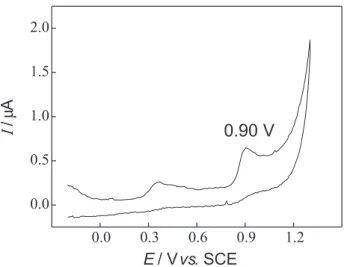
of pyridoxine (9.9 x 10⁻⁶ mol L-1) at the unmodified carbon
paste electrode (Figure 4) presents an oxidation peak at 0.90 V (vs. SCE). This behavior is in agreement with Söderhjelm and Lindquist.20 Other authors have observed
the same electrochemical behavior of pyridoxine using carbon electrodes.21,22
The contribution of the unmodified carbon paste for the overall response of pyridoxine is much smaller than that obtained for the CuHCF modified electrode, according to Figures 3 and 4.
The effect of the scan rate on the voltammetric response of the carbon paste electrode modified with CuHCF in a solution containing 1.3 x 10⁻³ mol L-1 vitamin B
6 was also
studied. The cyclic voltammograms recorded revealed that the anodic peak current increases and the peak potential
shifts as the scan rate increases. For scan rates higher than 100 mV s-1, the voltammetric profiles become distorted,
which can be associated with a slow electrons-transfer rate between the graphite and CuHFC in the paste.32 When the
peak current values were plotted against v1/2 the following
linear relationship was obtained:
Ipa (µA) = -0.3 + 141.1 v1/2 (mV1/2 s-1/2) r = 0.9994 (1)
These results allow to conclude that the reaction is mass transfer controlled (diffusion behavior).33 From these
results, a scan rate of 10 mV s-1 was chosen for further
studies.
Effect of pH
The electrochemical behavior of the carbon paste electrode modified with CuHCF (20% m/
m) was studied
over a wide pH range, between 3 and 9, in a solution containing 1.0 x 10⁻⁵ mol L-1 pyridoxine. Figure 5 shows
the effect of pH on the anodic peak current of the modified electrode. The result indicates that the optimum pH is 5.5.
Figure 5. Influence of pH on the voltammetric response of the modified carbon paste electrode with 20% (m/m) CuHCF in an acetate
buffer solution containing 1.0 x 10⁻⁵ mol L-1 pyridoxine, at a 10 mV
s-1 scan rate and 25 °C. The anodic peak current (∆I/µA) was
ob-tained by the difference of the currents in the presence and absence of pyridoxine
Figure 4. The electrochemical behavior of pyridoxine (9.9 x 10⁻⁶
mol L-1) at the unmodified carbon paste electrode, at a 10 mV s-1
scan rate and 25 °C.
The anodic peak current (∆I/µA) was obtained by the difference of the currents in the presence and absence of pyridoxine. A decrease in anodic peak current above pH 7.5 is observed, which may be due to hydroxylation of the CuHCF. It was observed that the anodic peak current decreased gradually with the decrease of the pH, starting at 5.0, which is probably due to the influence of H+ on the
kinetic reaction between pyridoxine and CuHCF on the electrode surface (see Scheme 1 - chemical reaction), since, for pH lower than 3.0, pyridinic nitrogen protonation takes place. However, change in the potential was not observed as a function of the pH. Therefore, a 0.05 mol L-1 acetate
buffer solution containing 0.05 mol L-1 of sodium ions at
pH 5.5 was used in further studies.
Study of interference
The effect of several species, such as sodium citrate, sodium benzoate, caffeine, saccharine, fructose, L-tryptophan, L-lysine hydrochloride, dimenhydrinate, mannitol, ascorbic acid, thiamine hydrochloride (vitamin B1) and cyanocobalamin (vitamin B12) in 0.05 mol L-1
acetate buffer, pH 5.5, on the anodic peak current at the modified electrode was evaluated. Among these tested substances, only ascorbic acid (vitamin C) and vitamin B1 caused a positive interference on the electrode response. Retinol palmitate (vitamin A) and tocopherol acetate (vitamin E) were not studied, since they are not soluble in water.
Analytical curve and repeatability
Under the optimized conditions of 20% (modifier, m/ m)
electrode composition, pH 5.5, and scan rate of 10 mV, the anodic peak current of the carbon paste electrode modified with CuHCF was rectilinear with vitamin B6 concentration, from 1.2 x 10⁻⁶ mol L-1 to 6.9 x 10⁻⁴ mol L-1 of pyridoxine;
(Ipa (µA) = 284.2 + 44 log[pyridoxine] (mol L-1); r = 0.9999).
The signal-to-noise characteristic (three times the signal
blank/slope) indicated an estimated detection limit of 4.1 x 10⁻⁷ mol L-1 pyridoxine.
A series of eight successive measurements of 1.5 x 10⁻⁵ mol L-1 pyridoxine were performed in order to evaluate
the repeatability of the electrode response. Between each voltammetric measurement, the surface of the electrode was not renewed. A mean peak response of 339.5 µA, with a range of 334.9-340.0 µA and a relative standard deviation of 2%, was observed.
Analysis of pharmaceutical preparation
The proposed method was applied to the determination of pyridoxine in three pharmaceutical formulations. Table 1 presents the results obtained using an official spectrophotometric procedure25 and the proposed
voltammetric method, as well as the composition of the samples analyzed. The statistical calculations for the assay results showed good precision the method. According to the t-test, there were no significant differences between the calculated and comparative values at a agree 95% confidence level, and within an acceptable range of error, indicating that the carbon paste electrode modified with CuHCF can be used for the determination of pyridoxine in these samples.
It is important to note that all three samples contain concomitants that did not interfered in the determination of pyridoxine, using the proposed method. Vitamin complexes containing ascorbic acid and vitamin B1 were avoided in this paper. Considering the set of possible interference species investigated and reported above that did not influenced the response of the proposed electrode to pyridoxine, is possible to consider that the method is useful for several samples.
Conclusions
The carbon paste electrode modified with copper(II) hexacyanoferrate(III) was prepared and applied to the
Table 1. Determination of pyridoxine in pharmaceutical samples using a carbon paste electrode modified with CuHCF, compared with spectrophotometry25
Pyridoxinea (mg/tablets or capsule)
Sample Label value (mg) Spectrophotometry Voltammetry Er %
Esclerovitanâ Plus (capsule)b 100 101.4 ± 0.9 100.5 ± 2.3 -0.9
Dramin B6â (tablets)c 1 0 10.3 ± 0.4 10.1 ± 0.6 -1.9
Profolâ (tablets)d 2 0 16.9 ± 0.1 17.3 ± 0.1 +2.4
Er = relative error = voltammetric method versus spectrophotometric method.
a n = 3; b Esclerovitan Plus composition: Vitamins B
6, A and E;
c Dramin B 6
: Vitamin B
6, dimenidrate, glycose, D-fructose;
voltammetric determination of pyridoxine in pharma-ceutical preparations containing vitamins and other concomitants with good sensitivity and selectivity. It is simple and quick to prepare. The cyclic voltammograms of the modified electrode show the presence of a well-defined redox peaks. Its voltammetric response is affected by the type and concentration of the supporting electrolyte. The optimum conditions for the analysis of epinephrine were as follows: composition of the electrode: 20% (m/
m)
CuHCF; acetate buffer containing 0.05 mol L-1 sodium
ions; pH 5.5; and scan rate of 10 mV s-1. The linear range
for the determination of pyridoxine is from 1.2 x 10⁻⁷ mol L-1
to 6.9 x 10⁻⁴ mol L-1 and the detection limit is 4.1 x 10⁻⁷
mol L-1. The method may be adapted for measurement
using flow injection systems.
Acknowledgments
Financial support from FAPESP (Process 99/03280-5) and for a fellowship to MFST (00/02997-2) are gratefully acknowledged.
References
1. Mortimer, R.J.; Barbeira, P.J.S.; Sene, A.F.B.; Stradiotto N.R.; Talanta 1999, 49, 271.
2. Garjonyte, R.; Malinauskas, A.; Sensors Actuators B 1998, 46, 236.
3. Golab,i S.M.; Noor-Mohammadi, F.; J. Solid State Electrochem. 1998, 2, 30.
4. Shankaran, D.R.; Narayanan, S.S.; Sensors Actuators B 1999,
55, 119.
5. Shankaran, D.R.; Narayanan, S.S.; Fresenius J. Anal. Chem.
1999, 364, 686.
6. Chen, S.M.; J. Electroanal. Chem. 1996, 471, 145. 7. Zhou, D.M.; Ju, H.X.; Chen, H.Y.; J. Electroanal. Chem. 1996,
408, 219.
8. Mattos, I.L.; Gorton, L.; Ruzgas, T.; Karyakin, A.A.; Anal. Sci. 2000, 16, 795.
9. Cai, C.X.; Xue, K.H.; Xu, S.M.; J. Electroanal. Chem. 2000,
486, 111.
10. Melentyeva, G.; Antonova, L.; Pharmaceutical Chemistry, Mir Publishers: Moscow, 1988, pp.375-393.
11. Kaplan, L. A.; Pesce, A. J.; Clinical Chemistry, C. V. Mosby: St. Louis, 1989, p. 555.
12. Cañada, M. J. A.; Reguera, M. I. P.; Molina, Díaz A.; Int. J. Pharm. 2000, 202, 113.
13. Aniceto, C.; Fatibello-Filho, O.; Quim. Nova 1999, 22, 805. 14. Alwarthan, A. A.; Aly, F. A.; Talanta 1998, 45, 1131. 15. Jiménez-Prieto, R.; Silva, M.; Pérez-Bendito D.; Talanta 1997,
44, 1463.
16. Lima, J. L. F. C.; Montenegro, M. C. B. S. M.; Silva, A. M. R.; J. Pharm. Biomed. Anal. 1991, 9, 1041.
17. Argekar, A. P.; Kunjir, S. S.; J. Planar Chromatogr. Mod. TLC
1995,9, 390.
18. Hou, W.; Ji, H.; Wang, E.; Anal. Chim. Acta 1990, 230, 207. 19. Hashmi, M. V. H.; Assay of Vitamins in Pharmaceutical
Prepa-rations, Wiley: London, 1973, pp. 188-212. 20. Söderhjelm, P.; Lindquist, J.; Analyst 1975, 100, 349. 21. Hu, Q.; Zhou, T.; Zhang, L.; Li, H.; Fang, Y.; Anal. Chim. Acta
2001, 437, 123.
22. Chen, G.; Ding, X.; Cao, Z.; Ye, J.; Anal. Chim. Acta 2000, 408, 249.
23. Teixeira, M.F.S.; Dockal, E.R.; Cavalheiro, E.T.G.; Anal. Chim. Acta , 2003, in press.
24. Ayrault, S.; Jimenez, B.; Granier, E.; Fedoroff, M.; Jones, D.J.; Loos-Neskovic, C.; J. Solid State Chem. 1998, 141, 475. 25. Willians, S. ed.; Official Methods of Analysis , 14th ed., AOAC:
Arlington, 1984.
26. Kulesza, P.J.; Malik, M.A.; Berrettoni, M.; Giorgetti, M.; Zamponi, S.; Schimidt, R.; Marassi, R.; J. Phys. Chem. B 1998,
102, 1870.
27. Kulesza, P.J.; Malik, M.A.; Schimidt, R.; Smolinska, A.; Miecznikowski, K.; Zamponi, S.; Czerwinski, A.; Berrettoni, M.; Marassi, R.; J. Electroanal. Chem. 2000, 487, 57. 28. Vittal, R.; Gomathi, H.; Rao, G.P.; Electrochim. Acta 2000, 45,
2083.
29. Wang, P.; Jing, X.; Zhang, W.; Zhu, G.; J. Solid State Electrochem. 2001, 5, 369.
30. Cui, X.; Hong, L.; Lin, X.; J. Electroanal. Chem. 2002, 526, 115.
31. García-Jareño, J.J.; Sanmatías, A.; Benito, D.; Navarro-Laboulais, J.; Vicente, F.; Int. J. Inorg. Mat. 1999, 1, 343. 32. Teixeira, M.F.S.; Moraes, F.C.; Fatibello-Filho, O.; Bocchi,
N.; Anal. Chim. Acta 2001, 443, 249.
33. Bard, A. J.; Faulkner, L. R.; Electrochemical Methods: Fun-damentals and Applications, John Willey: New York, 1980, p. 224.
Received: October 19, 2002
Published on the web: March 28, 2003