A preoperative checklist in esthetic plastic surgery
Um checklist pré-operatório em cirurgia plástica estética
ABSTRACT
The authors present a checklist to be used at the last stage of a preoperative visit for esthetic plastic surgery composed of 29 yes/no questions, four blank spaces for entering data, and one question for ranking the level of risk of deep vein thrombosis. The criteria are divided into three tables relating to three areas: anesthesia, psychological aspects, and clinical risk factors. The answers are framed in four colors that identify the level of risk and suggest the degree of attention warranted. A fourth aggregate table contains reference sources which can be easily accessed during a medical visit via the Internet or a portable device equipped with a medical database software. The purpose of the checklist is to reduce the possibility of adverse events involving the surgical process by identifying the risk level of each item reviewed.
Keywords: Checklist. Plastic surgery. Preoperative care. Intraoperative complications/ prevention & control. Postoperative complications/prevention & control.
RESUMO
Os autores apresentam um checklist para ser utilizado na última etapa da consulta pré-operatória de cirurgias plásticas estéticas, composto de 29 perguntas, com respostas do tipo
sim e não, quatro espaços para inserção de dados e uma questão para classiicação do nível
de risco em trombose venosa profunda. Os quesitos são divididos em três tabelas relativas
a três áreas: anestesia, aspectos psicológicos e riscos clínicos. As respostas são enquadradas em quatro cores, que identiicam o nível de risco e sugerem o grau de atenção. Uma quarta
tabela agregada contém fontes de referência de fácil acesso durante a consulta médica, pela Internet ou por aparelhos portáteis que contenham programas de dados que forneçam
infor-mações sobre medicações ou afecções. A inalidade do checklist é diminuir a possibilidade
de ocorrências indesejáveis que envolvam o processo cirúrgico, pela identiicação do nível
de risco de cada item revisto.
Descritores: Lista de checagem. Cirurgia plástica. Cuidados pré-operatórios. Complicações intra-operatórias/prevenção & controle. Complicações pós-operatórias/prevenção & controle.
Study conducted at Hospital Israelita Albert Einstein, São Paulo, SP, Brazil.
Submitted to SGP (Sistema de Gestão de Publicações/Manager Publications System) of RBCP (Revista Brasileira de Cirurgia Plástica/Brazilian Journal of Plastic Surgery).
Received: January 13, 2011 Accepted: February 21, 2011
1. Plastic surgeon at Hospital Israelita Albert Einstein and Instituto Dante Pazzanese de Cardiologia, São Paulo, SP, Brazil. 2. Plastic surgeon at Hospital Israelita Albert Einstein, São Paulo, SP, Brazil.
3. Cardiologist at Hospital Israelita Albert Einstein, São Paulo, SP, Brazil. 4. Anesthesiologist at Hospital Israelita Albert Einstein, São Paulo, SP, Brazil.
JAIME ANGER1
NELSON LETIZIO2
MAURÍCIO OREL2
JOSÉ LEÃO DE SOUZA JUNIOR3
MÁRCIO MARTINESDOS
SANTOS4
INTRODUCTION
In recent years, technological and scientific advances, especially advances in the media for information delivery, have enabled the accumulation of vast stores of medical information. The training of physicians has become longer and more intense. In esthetic plastic surgery, the proliferation of scientific discoveries and the exchange of knowledge have led to advances in surgical technique and greater specialization amongst physicians. As esthetic
surgical procedures have grown more popular and more accessible to patients, more plastic surgeries are being performed. Though this situation has contributed to the emergence of a number of professionals with extraordi-nary ability, undesirable outcomes, some of them infuria-ting and demoralizing, persist.
period, based on a set of simple checklists to be used at various stages of surgery, significantly reduced the rate of complications1.
This paper reports the creation of a preoperative checklist for application in esthetic plastic surgeries.
METHODS
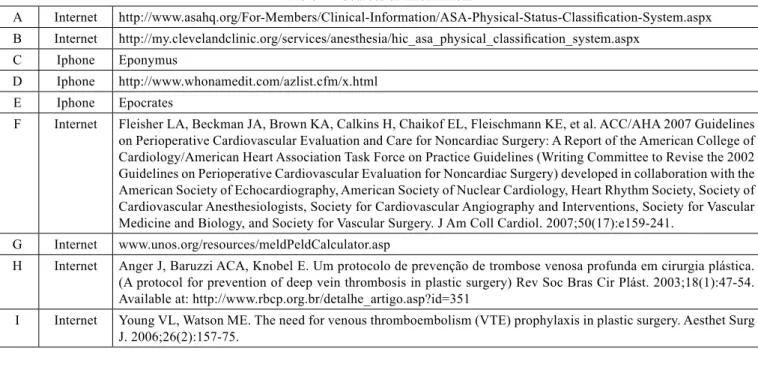
This checklist consists of 29 yes/no questions, one question ranking the risk of deep vein thrombosis, and four blank spaces to be filled in with specific information. The checklist is divided into three areas: anesthesia, psycho-logical aspects, and clinical risk factors (Tables 1 to 3). There is also a list of information sources that are quickly and easily accessible by the physician via the Internet or by portable electronic devices such as the Iphone® or Ipad® (Table 4).
The answers are framed with colors that correspond to the level of surgical risk: green, irrelevant risk; blue, low risk; yellow, medium risk; and red, high risk (Table 5). These
classiications were based on published scientiic reports that
identify risks and complications. This checklist is intended
to be applied as the last step of the inal preoperative visit.
DISCUSSION
The use of checklists has become increasingly common in different areas such as construction, gastronomy, avia-tion, and even finance. Especially in aviaavia-tion, the use of checklists has been proven to be of extreme importance, and it is now an essential, mandatory procedure before flight commencement2. Experience with the use of checklists in
medicine is recent, and the preoperative stage checklist is the sole high-profile example. A simple list of questions
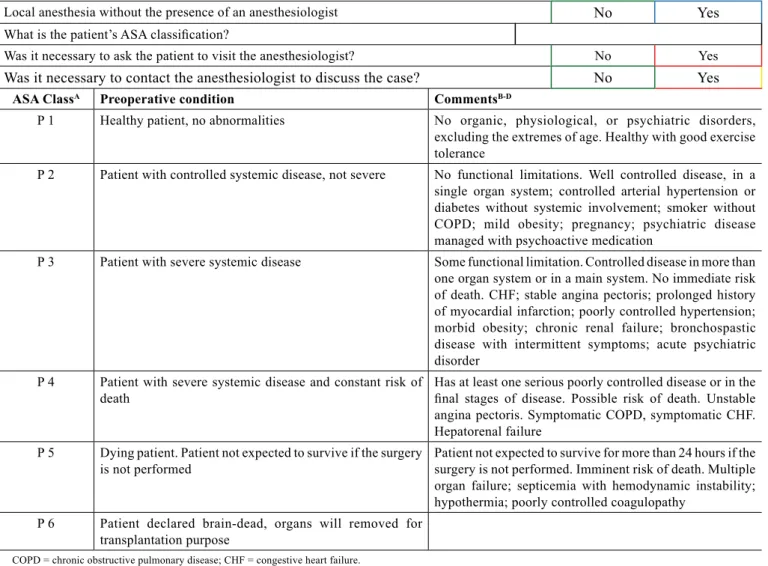
ASA ClassA Preoperative condition CommentsB-D
P 1 Healthy patient, no abnormalities No organic, physiological, or psychiatric disorders,
excluding the extremes of age. Healthy with good exercise tolerance
P 2 Patient with controlled systemic disease, not severe No functional limitations. Well controlled disease, in a single organ system; controlled arterial hypertension or diabetes without systemic involvement; smoker without COPD; mild obesity; pregnancy; psychiatric disease managed with psychoactive medication
P 3 Patient with severe systemic disease Some functional limitation. Controlled disease in more than
one organ system or in a main system. No immediate risk of death. CHF; stable angina pectoris; prolonged history of myocardial infarction; poorly controlled hypertension; morbid obesity; chronic renal failure; bronchospastic disease with intermittent symptoms; acute psychiatric disorder
P 4 Patient with severe systemic disease and constant risk of death
Has at least one serious poorly controlled disease or in the
inal stages of disease. Possible risk of death. Unstable
angina pectoris. Symptomatic COPD, symptomatic CHF. Hepatorenal failure
P 5 Dying patient. Patient not expected to survive if the surgery is not performed
Patient not expected to survive for more than 24 hours if the surgery is not performed. Imminent risk of death. Multiple organ failure; septicemia with hemodynamic instability; hypothermia; poorly controlled coagulopathy
P 6 Patient declared brain-dead, organs will removed for transplantation purpose
COPD = chronic obstructive pulmonary disease; CHF = congestive heart failure.
Table 1 – Anesthetic procedure.
Local anesthesia without the presence of an anesthesiologist No Yes
What is the patient’s ASA classiication?
Was it necessary to ask the patient to visit the anesthesiologist? No Yes
regarding how to identify the side of the body where the surgery will be performed resulted in a significant decrease in error rate1,2.
This paper presents a checklist to be used as a final review process after all routine aspects of surgical patient
care have been completed. The physician answers the checklist questions and enters the appropriate data at the end of the last visit in order to identify possible oversights and reinforce the need to implement previously considered safety measures. The checklist items were chosen based on
Table 2 – Psychological aspects.
Has the patient visited a psychiatrist or psychologist? No Yes
Is the patient currently under psychiatric treatment? No Yes
Has the patient received psychiatric treatment? No Yes
Has the patient undergone psychotherapy? No Yes
Is the patient currently receiving psychotherapy? No Yes
Is the patient taking psychoactive medications? No Yes
If yes, name the medications
Could the medication used interfere in the surgery/anesthesiaE? No Yes
Was it necessary to discuss the case with the psychiatrist? No Yes
Was it necessary to request the psychiatrist’s report? No Yes
Has the patient attended the medical visit alone? No Yes
Was it necessary to ask the patient to return for an additional visit with a companion? No Yes
Is this the patient’s irst esthetic surgery? No Yes
Has the patient had four (or more) visits with different plastic surgeons for the same surgery? No Yes
Has the patient undergone other esthetic surgeries with other doctors? No Yes
Does the patient consume alcohol (more than two glasses per day for men; one glass a day for women)? No Yes
Does the patient use psychoactive drugs? No Yes
Table 3 – Clinical risk factorsF.
Age > 70 years old No Yes
Low functional capability (≤4 METS: able to walk <2 blocks without stopping or has dificulty climbing a light of stairs)
No Yes
Systemic arterial hypertension without ventricular hypertrophy No Yes
Insulin dependent diabetes mellitus No Yes
COPD or PO2 <60 mmHg or PCO2 >50 mmHg No Yes
Renal failure (creatinine ≥2.3 mg/dl) No Yes
Liver disease with MELD score >14G No Yes
Active heart disease; valvular disease (mitral or aortic stenosis); arrhythmia; acute myocardial infarction within
<6 months; heart failure; acute pulmonary edema within <1 month No Yes
Smoker No Yes
Risk of deep vein thrombosis Low Medium High
Is the patient taking medication that interferes with the surgery/anesthesia? No Yes If yes, name the medication
Allergy to medication or material (sutures or dressings) No Yes
If yes, provide more details
Table 4 – Sources of information.
A Internet http://www.asahq.org/For-Members/Clinical-Information/ASA-Physical-Status-Classiication-System.aspx
B Internet http://my.clevelandclinic.org/services/anesthesia/hic_asa_physical_classiication_system.aspx
C Iphone Eponymus
D Iphone http://www.whonamedit.com/azlist.cfm/x.html
E Iphone Epocrates
F Internet Fleisher LA, Beckman JA, Brown KA, Calkins H, Chaikof EL, Fleischmann KE, et al. ACC/AHA 2007 Guidelines on Perioperative Cardiovascular Evaluation and Care for Noncardiac Surgery: A Report of the American College of Cardiology/American Heart Association Task Force on Practice Guidelines (Writing Committee to Revise the 2002 Guidelines on Perioperative Cardiovascular Evaluation for Noncardiac Surgery) developed in collaboration with the American Society of Echocardiography, American Society of Nuclear Cardiology, Heart Rhythm Society, Society of Cardiovascular Anesthesiologists, Society for Cardiovascular Angiography and Interventions, Society for Vascular Medicine and Biology, and Society for Vascular Surgery. J Am Coll Cardiol. 2007;50(17):e159-241.
G Internet www.unos.org/resources/meldPeldCalculator.asp
H Internet Anger J, Baruzzi ACA, Knobel E. Um protocolo de prevenção de trombose venosa profunda em cirurgia plástica. (A protocol for prevention of deep vein thrombosis in plastic surgery) Rev Soc Bras Cir Plást. 2003;18(1):47-54.
Available at: http://www.rbcp.org.br/detalhe_artigo.asp?id=351
I Internet Young VL, Watson ME. The need for venous thromboembolism (VTE) prophylaxis in plastic surgery. Aesthet Surg J. 2006;26(2):157-75.
Table 5 – Attention criteria.
Criteria for attention: color
Irrelevant risk green
Low risk blue
Medium risk yellow
High risk red
adverse event reports and accumulated clinical and anes-thetic experience.
The surgeon should assess and classify the risks surroun-ding the administration of anesthesia accorsurroun-ding to the criteria of the American Society for Anesthesiology (ASA) during the visiting process. This step is just a form of screening, since the
inal assessment of anesthetic risk will be performed by the
anesthesiologist. In situations where the ranking is not ASA 1 or if questions about medications or allergies arise, preliminary assessment may ensure greater interaction with the anesthesio-logist, either through oral communication or in person during the patient’s pre-operative meeting with the anesthesiologist.
ASA ranking is limited to the contents of the column “Preoperative condition” in Table 1. To illustrate and
facili-tate the classiication, the “comments” column was inserted
for each level, based on the Cleveland Clinic report
(Cleve-land, OH, USA), with the addition of an item in the cate -gory ASA 2, which asks about active psychiatric treatment with psychopharmacological drugs. Psychiatric instability is considered an active disease3,4.
The questions contained in the section on psychological aspects are based on published articles. In 1998, Sarwer et al.5, prospectively analyzed 100 patients undergoing
esthetic surgery and detected body dysmorphophobia in 7% of these individuals, a rate significantly higher than the 2% found by Andreasen and Bardach6 in a similar
popula-tion. Hodgkinson7 stated that patients with previous plastic
surgeries who are especially unhappy with the results may be suffering from body dysmorphophobia. The presence of a companion in the visit was considered necessary, since the patient often does not retain the information and explanations given by the physician8.
Current anesthetic techniques and clinical assessments enable the performance of surgeries with relative safety, so patients classified as ASA 2 can undergo surgeries considered of esthetic purpose. Table 3, which includes clinical risk factors, may be useful for the final review of these patients. Risk classification of deep vein thrombosis was based on a study by Anger et al.9 published in 2003.
Correspondence to: Jaime Anger
Av. Brigadeiro Luiz Antonio, 3.889 – Jardim Paulista – São Paulo, SP, Brazil – CEP 01401-001 E-mail: [email protected]
medication used by patients, such as psychoactive drugs. Because of the increasing use of psychopharmacological drugs that can alter the administration of anesthesia or increase the risk of deep vein thrombosis, it is important for the physician to have current information about these medications.
Ranking answers by color corresponding to levels of risk aims to draw the surgeon’s attention during the final assessment of each patient. Risk classification was based on medical literature data. We did not propose to quantify the risk associated with the resulting colors for each patient.
It has been well demonstrated in aviation that follo-wing a rigid checklist increases safety levels2. Obviously,
accidents may still occur, and the introduction of new technologies and the evolution of older technologies necessitate constant reworking of the aviation checklist. Similarly, the preoperative checklistis flexible and can be adapted as practices change. The use of our checklist in a large series of patients should enable quantification and qualification of preventable failures.
REFERENCES
1. Haynes AB, Weiser TG, Berry WR, Lipsitz SR, Breizat AH, Dellinger EP, et al. Safe surgery saves lives study group. A surgical safety checklist to reduce morbidity and mortality in a global population. N Engl J Med. 2009;360(5):491-9.
2. Gawande A. The checklist manifesto: how to get things right. New York: Metropolitan Books; 2009.
3. American Society of Anesthesiologists. ASA Physical Status Classiica -tion System. Available at:
http://www.asahq.org/For-Members/Clinical-Information/ASA-Physical-Status-Classiication-System.aspx. Access on:
1/11/2011.
4. Cleveland Clinic. ASA Physical Classiication System. Available at: http://
my.clevelandclinic.org/services/anesthesia/hic_asa_physical_classifica-tion_system.aspx. Access on: 1/11/2011.
5. Sarwer DB, Wadden TA, Pertschuk MJ, Whitaker LA. Body image dissa-tisfaction and body dysmorphic disorder in 100 cosmetic surgery patients. Plast Reconstr Surg. 1998;101(6):1644-9.
6. Andreasen NC, Bardach J. Dysmorphophobia: symptom or disease? Am J
Psychiatry. 1977;134(6):673-6.
7. Hodgkinson DJ. Identifying the body-dysmorphic patient in aesthetic sur-gery. Aesthetic Plast Surg. 2005;29(6):503-9.
8. Godwin Y. Do they listen? A review of information retained by patients follo -wing consent for reduction mammaplasty. Br J Plast Surg. 2000;53(2):121-5.
9. Anger J, Baruzzi ACA, Knobel E. Um protocolo de prevenção de trombose