Protocol for production of a chewable
material for masticatory function tests
(Optocal – Brazilian version)
Abstract: The present article aimed to present a standardized protocol for the production of a chewable test material that has been used in mas-ticatory eficiency and performance studies. This chewable material has advantages in respect to its physical properties when compared to other artiicial and natural test foods. It is constituted by mixing condensation silicon (58.3% by weight), common plaster (10.2% by weight), alginate (12.5% by weight), solid vaseline (11.5% by weight), tooth paste (7.5% by weight), and catalyst paste (20.8 mg/g), adding also three drops of mint essence. The mixed material is then inserted into an acrylic mould with perforations of 12 mm in diameter and 5 mm in height to produce rounded tablets with those measures after polymerization. It was named “Optocal - Brazilian version”. A volume of 3 cm³ is indicated for a chew-ing test, which corresponds to 12 tablets uschew-ing the present methodology. The present protocol can make the production of this chewable material easier, helping in its standardization for studies on masticatory function.
Descriptors: Mastication; Dental materials; Recovery of function. Rafael de Liz Pocztaruk(a)
Luis Carlos da Fontoura Frasca(b)
Elken Gomes Rivaldo(b)
Eduardo de Lima Fernandes(a)
Maria Beatriz Duarte Gavião(c)
(a) Assistant Professors, Department of
Prosthetic Dentistry, School of Dentistry, Lutheran University of Brazil (Brazilian Society of Dentists, Sobracid), Porto Alegre, RS, Brazil.
(b) Professors, Department of Prosthetic
Dentistry, School of Dentistry, Lutheran University of Brazil, Canoas, RS, Brazil.
(c) Professor, Department of Pediatric Dentistry,
Piracicaba Dental School, State University of Campinas, Piracicaba, SP, Brazil.
Corresponding author:
Maria Beatriz Duarte Gavião
Faculdade de Odontologia de Piracicaba - UNICAMP
Departamento de Odontologia Infantil Área de Odontopediatria
Av. Limeira, 901 Piracicaba - SP - Brazil CEP: 13414-903
E-mail: [email protected]
Introduction
Mastication is a process in which pieces of food are ground into a ine state, mixed with sa-liva, and brought to approximately body tempera-ture in readiness for the digestion.1 Pulverization
of food is the main function of mastication, but it also imparts enjoyable sensations that ill a ba-sic human need.1 Nonetheless, many studies have
been conducted to investigate masticatory function objectively (masticatory performance), using artii-cial and nonfood test materials instead of natural foods,2 taking into account that no instrumental
food hardness characterization can simulate the oral process during mastication.3 Natural foods
that are most preferred by the authors are: peanuts, almonds, cocoa, carrots, jelly, hazelnuts, decaf-feinated coffee beans and nuts.2,4-7 The
mechani-cal properties of natural food could change even within the irst 0.2–0.3 s of the irst chew as an effect of the oral environment.8 Masticatory
per-formance can determine an individual’s capacity to grind or pulverize a chewable test material, artii-cial or natural, and results from a complex inter-play of direct and indirect effects, as the number of functional tooth units, muscle (bite),9 and by the
size of the area and the occlusal surface of these teeth. Therefore, masticatory function is reduced in people who have lost post-canine teeth4,10 and in
those who wear removable dentures.5,11-13
Condensation silicone has been used in mas-ticatory tests with excellent results.4,14-18 The
sili-cone samples fulill all the criteria of a test mate-rial. Namely, it is stable, accurate, reproducible, and has mechanical properties that are comparable with those of natural food substances.14,15 The test
mate-rials do not dissolve in water or saliva and can be broken down during mastication. They do not break along predetermined fault lines and have no taste. They are standardized and can be stored without losing their properties. The only constraint to their use is that the polymers cannot be digested and must not be swallowed. Therefore they cannot be used in studies of the entire mastication process from incis-ing to swallowincis-ing. Otherwise, silicone samples may be masticated in a way which is similar to how a natural food is maticated.14,15
Optosil has been largely applied, but it is a ma-terial with a fracture strength that is too high in comparison to the maximum bite force of subjects with compromised oral conditions, such as denture wearers. Consequently, an experimental chewable material (Optocal), having Optosil NF as a base and mixed with other components was developed and its force-deformation properties were compared with those of Optosil.13,19 Optocal appeared to be
much weaker, less elastic and less resistant to defor-mation. It appears to be well suited for measuring masticatory performance in complete denture wear-ers as well as in dentate subjects. In the experience of complete denture wearers, Optocal was much easier to chew than Optosil and they judged its texture to be comparable with that of natural foods they nor-mally consumed.13,17 Nowadays, a new, improved
version of this chewable material has been used.11,20
Masticatory eficiency and performance tests are important for the evaluation of prosthetic rehabili-tation success and patient satisfaction in respect to their masticatory functions.12,16
Considering the increase in Brazilian objective studies on masticatory function, the aim of the pres-ent study was to prespres-ent a standardized laboratory production protocol for producing a chewable test material, based on previous studies11,14,20, using
com-ponents easily found in the Brazilian marketplace.
Material and Methods
Chewable test material preparation
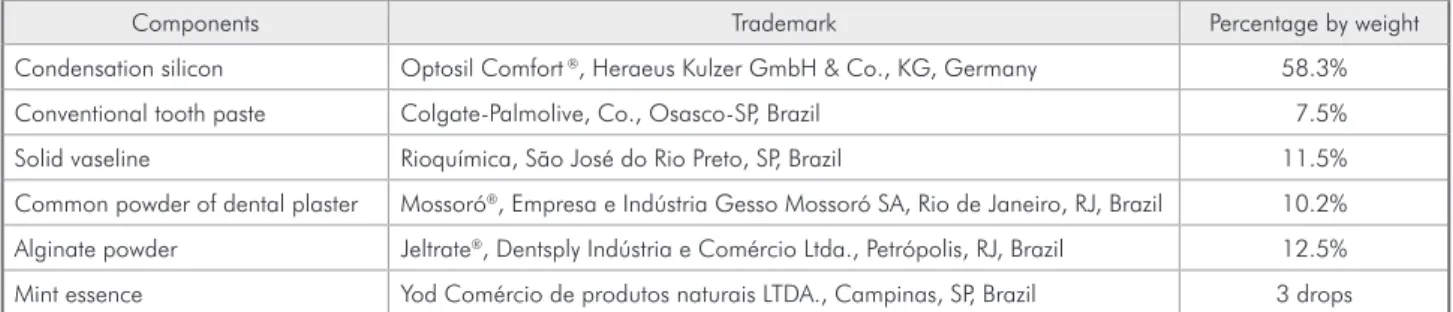
The proposed Brazilian version of the chewable test material, using a condensation silicon as a base, consists of a mixture of dental materials supplied in the Brazilian marketplace, using the same propor-tions of the current version of Optocal Plus,20 as
demonstrated in Chart 1 and Figure 1.
Each material should be separately weighed in an analytical scale with a 10–4 precision (Adventure Ohaus, Ohaus Corporation, Pine Brook, NJ, USA) at the exact proportion for the total desired amount of each components, so that the established propor-tions are not altered.11,20
exceeded at the moment of preparation due to the dificulty in achieving a complete homogenization of the used products as well as to the quick setting time of Optosil after mixture with the catalyst paste. The products are dispensed onto a ceramics mortar in the following order: solid vaseline, tooth paste, common plaster, alginate powder, Optosil,
and, lastly, the catalyst paste. This order makes the mixing of the materials easier, yielding a more ho-mogenous mixture. Three drops of mint essence were added to each 10 g of the prepared chewable test material, intending to make it more pleasant to be chewed. Optosil was rigorously prepared ac-cording to the manufacturer’s recommendations.14
a b c
d e f
Chart 1 - Components, trademarks, and percentages by weight of the silicon-based chewable test material of the present study.
Components Trademark Percentage by weight Condensation silicon Optosil Comfort, Heraeus Kulzer GmbH & Co., KG, Germany 58.3%
Conventional tooth paste Colgate-Palmolive, Co., Osasco-SP, Brazil 7.5% Solid vaseline Rioquímica, São José do Rio Preto, SP, Brazil 11.5% Common powder of dental plaster Mossoró, Empresa e Indústria Gesso Mossoró SA, Rio de Janeiro, RJ, Brazil 10.2%
Alginate powder Jeltrate, Dentsply Indústria e Comércio Ltda., Petrópolis, RJ, Brazil 12.5%
Mint essence Yod Comércio de produtos naturais LTDA., Campinas, SP, Brazil 3 drops
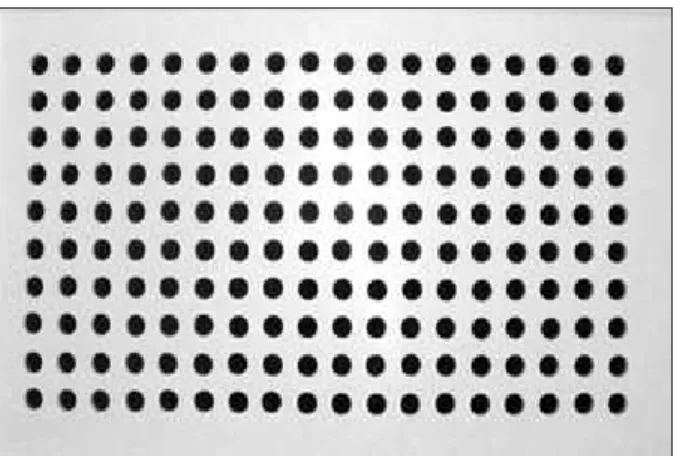
An acrylic resin matrix was selected, having 600 holes perforated in the shape of little cylinders, with 12 mm in diameter and 5 mm in height (Figure 2). This matrix is called encapsulator number zero (Central Laboratory of the Lutheran University of Brazil, Canoas, RS, Brazil) (Figure 2), and it func-tions as a standardized mold for the confection of tablets measuring 12 mm in diameter and 5 mm in height (Figure 3).
After homogenization of the dental materials, in-sertion of the mixed components is initiated into the matrix perforations. Due to the quick polymeriza-tion of Optosil, which happens a few minutes after mixing with the catalyst paste, it is recommended that only 10 g of the mixed components be prepared
each time, which represent approximately 34 tablets. Nonetheless, to retard the polymerization, Optosil can be stored in a refrigerator during 6 hours before use. After material insertion, excess material must be removed with a plastic spatula, and 15 minutes must be waited before removing the tablets from the encapsulator, in order to guarantee the polym-erization and prevent any deformation.14 With the
aid of a glass stick, compatible with the diameter of the perforations, the samples are removed from the tray and taken directly to an oven during 16 hours at 65°C to allow a complete polymerization cycle.19
Results
After the procedures described above, the ar-tiicial chewable test material is ready to be used (Figure 3), and it was named “Optocal - Brazilian version”. It is recommended that any functional test be performed up to 7 days after polymerization to guarantee dimensional stability of the condensation silicon.
Evaluation of masticatory performance was car-ried out as reported by Pocztaruk12 (2006), using
12 tablets corresponding to 3 cm³, a volume that an individual would normally be able to chew.16-18,20,21
Thus, considering the tablet measurements in this protocol , 12 tablets of Optocal - Brazilian version are recommended for masticatory tests. The tablets should be chewed for a determined number of cycles or during a speciied time, depending on the aim of the study, and then spat out. The resulting particles and the degree of material breakdown can be deter-mined by sieving or by optical methods [for more details see Gambareli et al.2 (2007); Albert et al.14
(2003); van der Bilt, Fontijn-Tekamp21 (2004)].
Discussion
There are several methods for the evaluation of masticatory eficiency and performance.15 Some tests
described in the literature use natural foods as a ma-terial test, using one or more bolters for measuring the comminution power of that patient.4,5 Physical
properties of natural foods vary and are dificult to standardize. There are variations in food shape, size, and hardness, which produce differences in the tests, thus inluencing the inal results.17 Besides,
Figure 3 - Tablets: 12 mm in diameter and 5 mm in height (12 tablets, 3 cm³).
they vary in consistency, due to water incorpora-tion from saliva, making the standardizaincorpora-tion for the accomplishment of masticatory tests dificult.14
For this reason, use of a condensation silicon was proposed15 as an artiicial chewable test material for
evaluation of masticatory function. Optosil, or oth-er condensation silicon trademark,14 has the quality
of being almost odorless and tasteless, not incorpo-rating water, and being able to be kept for up to 7 days without suffering any important dimensional alterations. Samples of this elastomeric material can be easily standardized and assessed after chew-ing, allowing weight and size control, thus reducing variability during production and during masticato-ry tests. However, it has been observed that patients wearing full dentures, who are already impaired in terms of bite strength,4,22 present chewing
dificul-ties when the test material is solely based on Op-tosil due to its hardness.14 Such patients eventually
strain their masticatory muscles in an effort to chew it.13 This test food, which possesses a much higher
resistance against fracture than the maximum bite strength capacity of the patients themselves, would impair the reliability of the quantiication of masti-catory eficiency and performance. For this reason, other dental materials have been added to Optosil, allowing a decrease in consistency, making it easier to be chewed. With this purpose, Optocal was de-veloped.13 It was later improved by using Optosil
plus (Bayer Dental, Leverkusen, Germany, version 1997) and by changing the component proportions (Optocal plus).11,20
Association to other dental components makes the initial test material less resistant to fracture and easier to be comminuted by wearers of remov-able partial prostheses and conventional full
den-tures, as well as by those with implants and over-dentures.18,20 In terms of consistency, it is similar to
natural foods.19 Therefore, considering the reliable
results found in the literature,11,12,18-21 it seems to
be appropriate for the accomplishment of masti-catory tests with more trustworthy results in the distribution of the amount of comminuted mate-rial. The dificulty in obtaining an adequate arti-icial chewable test material by using the materials available in the Brazilian dental marketplace and the observed increase in studies on masticatory function in Brazil (personal observation) led us to put forward this procedure for the production of Optocal - Brazilian version. Its advantages may be attributed to easiness of production, low cost, resemblance to natural foods,13 and mainly to the
comfort that it represents for individuals that have been submitted to masticatory performance test-ing.12 On the other hand, advances in the
develop-ment of dental materials and marketplace changes related to the withdrawal and introduction of new products must be taken in consideration when a chewable material is produced. The physical prop-erties of the new components must be similar to those of the original ones,13,14,20 which have given
reliable results, as mentioned above, regardless of the tablet formats.10,11,13,15,18
Conclusions
The production of Optocal – Brazilian version was considered simple and adequate due to the use of Brazilian dental materials, low cost, and simple equipment requirements. It was considered adequate for the standardization of a test material for studies on the masticatory function in healthy individuals as well as in prosthodontic patients.
References
1. Bourne MC. Relation between texture and mastication. J Texture Stud. 2004;35(2):125-43.
2. Gambareli FR, Serra MD, Pereira LJ, Gaviao MB. Influence of measurement technique, test food, teeth and muscle force interactions in masticatory performance evaluation. Review Article. J Texture Stud. 2007;38(1):2-20.
3. Heath MR, Lucas PW. Mastication: the need for collaborative research. J Texture Stud. 1987;18(2):111-23.
4. Helkimo E, Carlsson GE, Helkimo M. Chewing efficiency and state of dentition. A methodologic study. Acta Odontol Scand. 1978;36(1):33-41.
5. Kapur KK, Soman SD. Masticatory performance and efficien-cy in denture wearers. 1964. J Prosthet Dent. 2006;95(6):407-11.
implant-assisted overdentures. Int J Oral Maxillofac Implants. 2003;18(4):523-30.
7. Schneider G, Senger B. Clinical relevance of a simple fragmen-tation model to evaluate human masticatory performance. J Oral Rehabil. 2002;29(8):731-6.
8. Kohyama K, Nishi M. Direct measurement of biting pressures for crackers using a multiple-point sheet sensor. J Texture Stud. 1997;28(6):605-17.
9. Hatch JP, Shinkai RS, Sakai S, Rugh JD, Paunovich ED. De-terminants of masticatory performance in dentate adults. Arch Oral Biol. 2001;46(7):641-8.
10. van der Bilt A, Olthoff LW, Bosman F, Oosterhaven SP. The effect of missing postcanine teeth on chewing performance in man. Arch Oral Biol. 1993;38(5):423-9.
11. Fontijn-Tekamp FA, Slagter AP, van der Bilt A, van’t Hof MA, Witter DJ, Kalk W et al. Biting and chewing in over-dentures, full over-dentures, and natural dentitions. J Dent Res. 2000;79(7):1519-24.
12. Pocztaruk RL. Avaliação do nível de satisfação, da capacidade, eficiência e performance mastigatória em pacientes reabilitados com próteses totais convencionais e sobre implantes [Disser-tação de Mestrado]. Canoas: Faculdade de Odontologia da Universidade Luterana do Brasil; 2006.
13. Slagter AP, Bosman F, Van der Bilt A. Comminution of two artificial test foods by dentate and edentulous subjects. J Oral Rehabil. 1993;20(2):159-76.
14. Albert TE, Buschang PH, Throckmorton GS. Masticatory performance: a protocol for standardized production of an artificial test food. J Oral Rehabil. 2003;30(7):720-2. 15. Edlund J, Lamm CJ. Masticatory efficiency. J Oral Rehabil.
1980;7(2):123-30.
16. Pera P, Bassi F, Schierano G, Appendino P, Preti G. Implant anchored complete mandibular denture: evaluation of mas-ticatory efficiency, oral function and degree of satisfaction. J Oral Rehabil. 1998;25(6):462-7.
17. Slagter AP, Olthoff LW, Steen WH, Bosman F. Commi-nution of food by complete-denture wearers. J Dent Res. 1992;71(2):380-6.
18. van Kampen FM, van der Bilt A, Cune MS, Fontijn-Tekamp FA, Bosman F. Masticatory function with implant-supported overdentures. J Dent Res. 2004;83(9):708-11.
19. Slagter AP, van der Glas HW, Bosman F, Olthoff LW. Force-deformation properties of artificial and natural foods for test-ing chewtest-ing efficiency. J Prosthet Dent. 1992;68(5):790-9. 20. Fontijn-Tekamp FA, Slagter AP, van der Bilt A, Van’t Hof MA,
Kalk W, Jansen JA. Swallowing thresholds of mandibular implant-retained overdentures with variable portion sizes. Clin Oral Implants Res. 2004;15(3):375-80.
21. van der Bilt A, Fontijn-Tekamp FA. Comparison of single and multiple sieve methods for the determination of masticatory performance. Arch Oral Biol. 2004;49(2):155-60.