Carlos Henrique Thiesen(a) Rubens Rodrigues Filho(a) Luiz Henrique Maykot Prates(a) Neimar Sartori(b)
(a) Department of Dentistry, School of
Dentistry, Universidade Federal de Santa Catarina - UFSC, Florianópolis, SC, Brazil.
(b) Division of Restorative Sciences, Ostrow
School of Dentistry, University of Southern California - USC, Los Angeles, CA, USA.
Corresponding Author: Carlos Henrique Thiesen E-mail: [email protected]
The influence of desensitizing
dentifrices on pain induced by in-office
bleaching
Abstract: The purpose of this study was to evaluate whether the use of
desensitizing dentifrices used 15 days prior to and after in-ofice tooth bleaching could eliminate or reduce tooth sensitivity. After institutional review board approval and informed consent, 45 subjects were selected and divided into 3 groups according to the dentifrice selected: Colgate Total (CT), Colgate Sensitive Pro-Relief (CS) or Sensodyne ProNamel (SP). The subjects used toothpaste and a toothbrush provided to them for 15 days prior to bleaching. They were then submitted to two in-ofice bleaching sessions (Whiteness HP Blue Calcium). Their tooth sensitiv-ity was assessed using the Visual Analog Scale (VAS) for a week after each session. Their tooth shade alteration was measured with a Vitapan Classical shade guide to determine if the dentifrices could inluence the effectiveness of the bleaching agent. The data were submitted to Wil-coxon, Kruskal-Wallis and Mann-Whitney tests (α = 0.05). The use of desensitizing dentifrices did not affect the bleaching eficacy. In regard to tooth sensitivity, there was a statistically signiicant difference between the results of the Control Group and Group T2 after the irst session (p = 0.048). There was no statistically signiicant difference in the results for the other groups after the irst session. In regard to the second ses-sion, there was no statistically signiicant difference in the results for all the groups. The use of a desensitizing dentifrice containing nitrate potas-sium reduced tooth sensitivity during the bleaching regimen. Dentifrices containing arginine and calcium carbonate did not reduce tooth sensitiv-ity. Color change was not inluenced by the dentifrices used.
Descriptors: Tooth Bleaching; Dentin Sensitivity; Toothpastes.
Introduction
Tooth color is deined as a combination of intrinsic and extrinsic staining. The main intrinsic causes of discoloration are aging and pulp necrosis, whereas the most common extrinsic causes are coffee, tea, red wine, and tobacco.1-3 Vital teeth whitening is a solution for discolored
teeth, because of its conservative approach and high success rate.1,4-6
It has been theorized that the tooth bleaching mechanism is based on hydrogen peroxide (H2O2) penetration through the tooth structure due
to its low molecular weight. Free radicals, such as perhydroxyl (HO2−),
are able to oxidize chromophores and break them down into less com-plex molecules that relect more light.5,7-9
Declaration of Interests: The authors certify that they have no commercial or associative interest that represents a conflict of interest in connection with the manuscript.
Submitted: Feb 19, 2013
Accepted for publication: Jul 31, 2013 Last revision: Aug 20, 2013
Whitening products of high hydrogen-peroxide concentration usually offer the best results in a short period of time, associated with mild and transient collateral effects,1-4,8,10-12 such as tooth sensitivity
and gingival irritation.8,13
Brännström’s hydrodynamic theory is the most accepted explanation for tooth sensitivity and posits that it is caused by luid movement inside the dentin-al tubules.1 Recently, it has been hypothesized that
sensitivity after bleaching differs from tooth sensi-tivity to cold and tactile stimuli, which are usually associated with root dentin exposure.14 Sensitivity
after whitening probably occurs as a consequence of the functional properties of a chemosensitive ion channel called TRPA1 (transient receptor potential cation channel with ankyrin domain-type 1). This ion channel is associated with the pain caused by oxidants, including hydrogen peroxide. Since the af-ferent ibers of primary dental pulp contain TRPA1, it is possible that direct TRPA1 activation of nerve ibers is involved in the pain caused by tooth bleach-ing.14
The mechanisms responsible for tooth sensitivity after bleaching have not been fully elucidated; how-ever, some inlammatory mediators may play an im-portant role.1,15 These effects have commonly been
reported in association with bleaching techniques and different peroxide concentrations, although in-ofice whitening products cause greater sensitivity than at-home bleaching gels.8
Several approaches to reducing sensitivity after dental bleaching have been suggested. The use of luoride2,4,16 and treatment with nonsteroidal
anti-inlammatory drugs (NSAIDs) lead to a signiicant reduction in post-operative sensitivity.1
Anti-sensitivity dentifrices are another option for reducing the adverse effects of bleaching agents.17
These products act by:
1. reduction in the excitability of nerve ibers pres-ent in the pulp, and
2. obliteration of dentinal tubules.18
A reduction in the excitability of nerve ibers could occur due to the diffusion of potassium salt through the enamel and dentine. These salts can reach the nerve terminations, affect nerve impulse
transmission2,10,19 and result in a reduction or
dele-tion of pain.20 The obliteration of dentinal tubules
after using strontium chloride results in a reduction in dentin permeability and blocks the hydrodynamic mechanism.20
Several years ago, products containing luoride and potassium nitrate were launched on the market as desensitizers for professional use, dentifrices, or even associated with bleaching gels.10 More recently,
products containing calcium carbonate and arginine have been marketed with the intent of providing a barrier and preventing luid movement inside the dentinal tubules, aiming at reducing tooth sensitivity.
Considering that sensitivity is the main adverse effect of tooth whitening and that information on the effects of dentifrices as desensitizing agents is scarce, the aim of this study was to evaluate the ef-iciency of different desensitizing agents (potassium nitrate and arginine / calcium carbonate), contained in two dentifrices, in reducing tooth sensitivity in patients submitted to an in-ofice bleaching proto-col. In addition, the inluence on tooth color was evaluated.
Methodology
This research was approved by the Ethics Com-mittee on Human Research of the Universidade
Federal de Santa Catarina - UFSC (process number
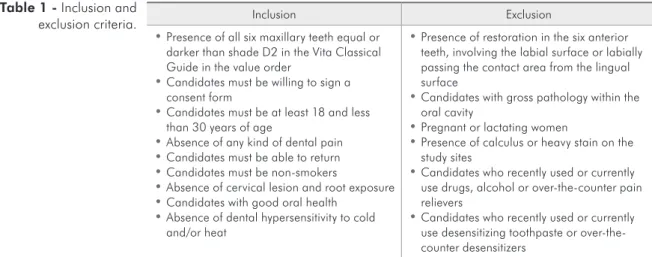
1171 FR: 390769). All patients were selected ac-cording to inclusion and exclusion criteria (Table 1).1,3,4,21-23
Day 1
Tooth sensitivity was veriied using a syringe with air spray positioned 2 millimeters from the buccal surfaces of the upper anterior teeth for 2 sec-onds. Patients who reported tooth sensitivity were excluded from the research.8 The patients who
ful-illed all the prerequisites were given details of the bleaching procedure and were included in the re-search.
Selected patients were randomly divided into three groups (n = 15), each of which was assigned a dentifrice (Table 2).
scale is well-known and used as an instrument to measure a characteristic or an attitude, and is based on continuous values that cannot be measured
ob-jectively. During this period the patients continued to use the toothpaste assigned to their group.
Day 22
Seven days after the irst bleaching session, the patients returned for a second session, which in-volved the same procedures. The sensitivity contin-ued to be noted by the patients.
Day 29
One week after the second bleaching session, the “sensitivity diary” was returned by the patients and a new color evaluation was performed. The whiten-ing procedure may lead to dehydration of the teeth, and consequently induce a false, lighter aspect im-mediately after the end of the session.26 For this
rea-son, an interval of one week was considered neces-supply of the toothpaste type assigned to the group.
There were no labels or other types of identiication on the toothpaste tubes, only a code for later analy-sis; both the patient and the operator were blinded. The toothbrush and toothpaste were used by the pa-tients for 15 days before the irst bleaching session.2
Day 15
Fifteen days after the patients began using the assigned toothpaste, each patient received a prophy-laxis in a prophylactic paste without oil (Prophylac-tic paste Villevie, Dentalville of Brazil Ltda., Join-ville, Brazil) for the removal of extrinsic stains. The tooth color of the upper right canine was evaluated by two operators, and, in the case of disagreement, a third individual was called. The Vitapan Classi-cal guide (Vita Zahnfabrik RauterGmbH H. & Co, BädSackingen, Germany) was organized according to a scale of values numbered 1–16.3,4,24,25 The irst
in-ofice bleaching session was performed in the maxillary arch.3,24 A resin barrier (Top Dam, FGM,
Joinville, Brazil) and a lingual / lip retractor (Arclex, FGM, Joinville, Brazil) were used. The whitening gel (35% HP Whiteness HP Blue Calcium, FGM,
Joinville, Brazil) was applied on the buccal surfaces of the right second premolar through to the left sec-ond premolar, and left for 40 minutes. Each patient received a “sensitivity diary” to keep daily notes on tooth sensitivity for a period of one week, using an analogue visual scale that ranged from 0 to 10 (0 = no sensitivity / 10 = maximum sensitivity). This
Inclusion Exclusion
• Presence of all six maxillary teeth equal or darker than shade D2 in the Vita Classical Guide in the value order
• Candidates must be willing to sign a consent form
• Candidates must be at least 18 and less than 30 years of age
• Absence of any kind of dental pain • Candidates must be able to return • Candidates must be non-smokers
• Absence of cervical lesion and root exposure • Candidates with good oral health
• Absence of dental hypersensitivity to cold and/or heat
• Presence of restoration in the six anterior teeth, involving the labial surface or labially passing the contact area from the lingual surface
• Candidates with gross pathology within the oral cavity
• Pregnant or lactating women
• Presence of calculus or heavy stain on the study sites
• Candidates who recently used or currently use drugs, alcohol or over-the-counter pain relievers
• Candidates who recently used or currently use desensitizing toothpaste or over-the-counter desensitizers
Table 1 - Inclusion and exclusion criteria.
Table 2 - Groups.
CT CS SP
Colgate Total (Colgate-Palmolive, São Paulo, Brazil) 1450 ppm of fluoride
Colgate Sensitive Pro-Relief
(Colgate-Palmolive, Sao Paulo, Brazil) containing arginine and calcium carbonate (1450 ppm of fluoride)
sary before performing the new evaluation, since most of the color variation due to the rebound effect occurs in the irst week after bleaching.24
Values ranging from 1 (B1) to 16 (C4) were de-termined for each Vitapan Classical Guide shade, and the color change was assessed based on the dif-ference between the initial and inal colors.25
A statistical analysis was performed to deter-mine the sensitivity reported by the patients, and the color changes were analyzed subjectively based on the Vitapan scale. The results were analyzed ap-plying the Shapiro-Wilk, Wilcoxon, Kruskal-Wallis and Mann-Whitney tests at a signiicance level of
α = 0.05. The analysis was performed on Microsoft
Excel 2008 (Microsoft Ofice system 2008, Red-mond, USA) and SPSS 19 (SPSS Inc., Chicago, USA).
Results
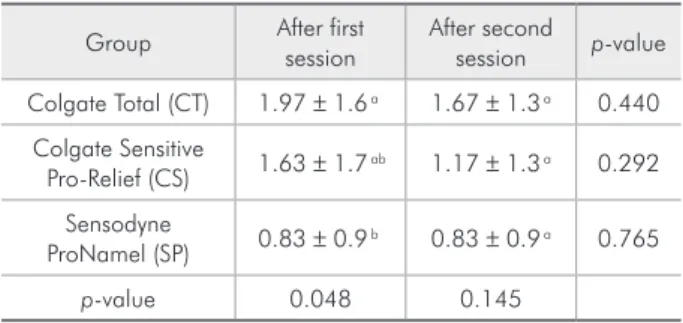
Tooth sensitivityThe results showed a statistically signiicant dif-ference between groups CT and SP only in the irst week of evaluation. When comparing the two evalu-ations (irst and second) for any same group, no sta-tistically signiicant difference was observed (Table 3 and Figure 1).
Color
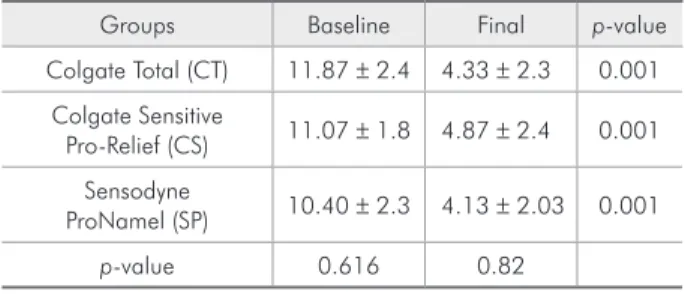
Tooth Color changes were observed through vi-sual analysis based on a scale. Table 4 and Figure 2 present the initial and inal values for the three
experimental groups. There was no statistically sig-niicant difference between one group and the other. However, there was a statistically signiicant differ-ence in color change for all groups before and after the bleaching session.
Discussion
The results of this study show that in-ofice bleaching is an effective procedure. Considering that no signiicant difference was observed in col-or change between the groups evaluated, it can be assumed that the dentifrices did not inluence the
Table 3 - Mean, standard deviation and statistical results for comparison of dental pain sensitivity between the groups in the two periods evaluated.
Group After first session
After second
session p-value
Colgate Total (CT) 1.97 ± 1.6 a 1.67 ± 1.3 a 0.440
Colgate Sensitive
Pro-Relief (CS) 1.63 ± 1.7
ab 1.17 ± 1.3 a 0.292
Sensodyne
ProNamel (SP) 0.83 ± 0.9 b 0.83 ± 0.9 a 0.765
p-value 0.048 0.145
Means with same lower-case letters, in the same column (for each criteria), are not statistically different.
bleaching results. It was expected that the dentifrice containing calcium carbonate and arginine would inluence bleaching gel diffusion because of its mechanism of action, which is similar to that of lu-oride. Fluoride action involves dentinal tubule oblit-eration and modiication of enamel permeability.27
However, the peroxide molecule is very small and can penetrate the interstitial spaces between enamel pores. This probably explains the similar bleaching results obtained for the different groups. A study using bleaching with 35% hydrogen peroxide and
color evaluation using the Vita Classical shade guide showed a color change (6.15 units)4 similar to that
of our research results (6.3 units). In another study a variation of 2.1 to 3.7 units was noted after each in-ofice whitening session.11
The shade guide scale for color change
evalu-ation is known as a quick, easy, reliable and valid method.11,12,28,29 It is noteworthy to mention that this
research aimed at assessing the inluence of denti-frices on bleaching results, and not to compare the total color variation with that of other studies.
Although the sensitivity after dental bleaching is usually mild, some patients report higher levels and abandon the treatment. Considering these dificul-ties and the lack of studies that have evaluated the effect of desensitizing dentifrices on in-ofice bleach-ing, the aim of this research work was to examine ways of reducing or preventing tooth sensitivity dur-ing and after bleachdur-ing procedures.
Two approaches are currently used for prevent-ing tooth sensitivity. The irst is based on the hy-drodynamic theory and aims at reducing tooth per-meability. The second strategy uses substances to diminish the excitability of nerve ibers in the dental pulp.18 Therefore, dentifrices with these two
mecha-nisms of action were selected for the study, in addi-tion to the control group.
Compared with the control group, the group of patients who used the dentifrice containing potas-sium nitrate showed a statistically signiicant reduc-tion in tooth sensitivity during the irst week after the irst bleaching session. In the literature, two studies on dentifrices containing potassium nitrate to evaluate at-home bleaching have been reported. It
Table 4 - Means, standard deviations and statistical results for comparison of tooth whitening among the groups.
Groups Baseline Final p-value
Colgate Total (CT) 11.87 ± 2.4 4.33 ± 2.3 0.001
Colgate Sensitive
Pro-Relief (CS) 11.07 ± 1.8 4.87 ± 2.4 0.001
Sensodyne
ProNamel (SP) 10.40 ± 2.3 4.13 ± 2.03 0.001
p-value 0.616 0.82
was observed that most of the patients (58%) did not
report tooth sensitivity during the seven days after bleaching. Additionally, the groups of patients who used this dentifrice reported a longer period without experiencing sensitivity (10.1 days) than the control group (8.6 days).30 In the second similar study
ex-amined, although there was no signiicant difference in terms of color change, a greater percentage of pa-tients who used the dentifrice were satisied with the level of tooth sensitivity.17 In another study, a
desen-sitizing gel containing potassium nitrate was applied on the teeth before the in-ofice bleaching session. The occurrence and/or intensity of sensitivity were signiicantly reduced for the experimental group compared with the control (46.7% versus 86.7%).4
This effect may be explained by the following theory: The functional properties of the TRPA1 ion channel are associated with the pain caused by oxidants. This includes hydrogen peroxide through direct activation of dental innervation, and is not re-lated to the hydrodynamic mechanism as reported by Markowitz.14 Furthermore, this theory could
ex-plain why the pain after bleaching differs from nor-mal tooth sensitivity, as reported by patients who described this pain as sensations that resembled “needles” or were “shock-like,” and that were not triggered by thermal stimuli. It has been suggested that potassium salts are more effective than other treatments in reducing the sensitivity caused by
tooth whitening.14 Another research study has
dem-onstrated that the use of potassium nitrate might be more effective than luoride in decreasing tooth sen-sitivity after at-home bleaching.16 These studies
cor-roborate the results found in this research.
The use of dentifrice containing calcium carbon-ate and arginine did not lead to a signiicant reduction in tooth sensitivity, probably because patients with root exposure were not included in this research. The main mechanism of action of this dentifrice involves the obliteration of exposed root dentin tubules, but this condition was not observed in the patients.
The reduction of tooth sensitivity during a pe-riod of dental bleaching is beneicial because it im-proves the patient’s comfort and commitment to the treatment. The lack of statistically signiicant differ-ences among the groups in the second week might be explained by the high standard deviation.
Conclusions
1. The use of dentifrice containing 5% potassium
nitrate for 14 days (before and during dental bleaching treatment) reduced tooth sensitivity during the irst week.
2. The dentifrices indicated for sensitive teeth, used in this study, did not affect the effectiveness of in-ofice bleaching with 35% hydrogen peroxide,
when compared with the control group, which used traditional dentifrice.
References
1. Charakorn P, Cabanilla LL, Wagner WC, Foong W-C, Sha-heen J, Pregitzer R, et al. The effect of preoperative ibuprofen on tooth sensitivity caused by in-office bleaching. Oper Dent. 2009 Mar-Apr;34(2):131-5.
2. Haywood VB. Treating sensitivity during tooth whitening. Compend Contin Educ Dent. 2005 Sep;26(9 Suppl 3):11-20. 3. Costa JB, McPharlin R, Paravina RD, Ferracane JL. Compari-son of at-home and in-office tooth whitening using a novel shade guide. Oper Dent. 2010 Jul-Aug;35(4):381-8.
4. Tay LY, Kose C, Loguercio AD, Reis A. Assessing the effect of a desensitizing agent used before in-office tooth bleaching. J Am Dent Assoc. 2009 Oct;140(10):1245-51.
5. Araujo FO, Baratieri LN, Araújo E. In situ study of in-office bleaching procedures using light sources on human enamel microhardness. Oper Dent. 2010 Mar-Apr;35(2):139-46.
6. Goldberg M, Grootveld M, Lynch E. Undesirable and adverse effects of tooth-whitening products: a review. Clin Oral Invest-ing. 2010 Feb;14(1):1-10.
7. Joiner A. The bleaching of teeth: a review of the literature. J Dent. 2006 Aug;34(7):412-9.
8. Ziebolz D, Helms K, Hannig C, Attin T. Efficacy and oral side effects of two highly concentrated tray-based bleaching systems. Clin Oral Investing. 2007 Sep;11(3):267-75. 9. Markovic L, Fotouhi K, Lorenz H, Jordan RA, Gaengler P,
Zimmer S. Effects of bleaching agents on human enamel light reflectance. Oper Dent. 2010 Jul-Aug;35(4):405-11. 10. Tam L. Effect of potassium nitrate and fluoride on
11. de Silva Gottardi M, Brackett MG, Haywood VB. Number of in-office light-activated bleaching treatments needed to achieve patient satisfaction. Quintessence Int. 2006 Feb;37(2):115-20. 12. Zekonis R, Matis BA, Cochran MA, Al Shetri SE, Eckert
GJ, Carlson TJ. Clinical evaluation of in-office and at-home bleaching treatments. Oper Dent. 2003 Mar-Apr;28(2):114-21. 13. Bernardon JK, Sartori N, Ballarin A, Perdigão J, Lopes GC,
Baratieri LN. Clinical performance of vital bleaching tech-niques. Oper Dent. 2010 Jan-Feb;35(1):3-10.
14. Markowitz K. Pretty painful: why does tooth bleaching hurt?. Med Hypotheses. 2010 May;74(5):835-40.
15. Costa CA, Riehl H, Kina JF, Sacono NT, Hebling J. Human pulp responses to in-office tooth bleaching. Oral Surg Oral Med Oral Pathol Oral Radiol Endod. 2010 Apr;109(4):e59-64. 16. Armênio RV, Fitarelli F, Armênio MF, Demarco FF, Reis A,
Loguercio AD. The effect of fluoride gel use on bleaching sensitivity: a double-blind randomized controlled clinical trial. J Am Dent Assoc. 2008 May;139(5):592-7; quiz 626-7. 17. Browning WD, Haywood VB, Hughes N, Cordero R.
Pre-brushing with a Potassium Nitrate dentifrice to reduce tooth sensitivity during bleaching evaluated in a practice-based set-ting. Compend Contin Educ Dent. 2010 Apr;31(3):220-5. 18. Sowinski J, Ayad F, Petrone M, DeVizio W, Volpe A,
Ell-wood R, et al. Comparative investigations of the desensitis-ing efficacy of a new dentifrice. J Clin Periodontol. 2001 Nov;28(11):1032-6.
19. Ajcharanukul O, Kraivaphan P, Wanachantararak S, Vong-savan N, Matthews B. Effects of potassium ions on dentine sensitivity in man. Arch Oral Biol. 2007 Jul;52(7):632-9. 20. Cummins D. The efficacy of a new dentifrice containing 8.0%
arginine, calcium carbonate, and 1450 ppm fluoride in deliver-ing instant and lastdeliver-ing relief of dentin hypersensitivity. J Clin Dent. 2009;20(Spec No 4):109-14.
21. Marson FC, Sensi LG, Vieira LCC, Araújo É. Clinical evalu-ation of in-office dental bleaching treatments with and with-out the use of light-activation sources. Oper Dent. 2008 Jan-Feb;33(1):15-22.
22. Leonard RH, Smith LR, Garland GE, Caplan DJ. Desensitiz-ing agent efficacy durDesensitiz-ing whitenDesensitiz-ing in an at-risk population. J Esthet Restor Dent. 2004;16(1):49-55.
23. Matis BA, Cochran MA, Franco M, Al-Ammar W, Eckert GJ, Stropes M. Eight in-office tooth whitening systems evaluated in vivo: a pilot study. Oper Dent. 2007 Jul-Aug;32(4):322-7. 24. Matis BA, Cochran MA, Wang G, Eckert GJ. A clinical evalu-ation of two in-office bleaching regimens with and without tray bleaching. Oper Dent. 2009 Mar-Apr;34(2):142-9. 25. Browning WD, Chan DC, Myers ML, Brackett WW, Brackett
MG, Pashley DH. Comparison of traditional and low sensitiv-ity whiteners. Oper Dent. 2008 Jul-Aug;33(4):379-85. 26. Polydorou O, Hellwig E, Hahn P. The efficacy of three
dif-ferent in-office bleaching systems and their effect on enamel microhardness. Oper Dent. 2008 Sep-Oct;33(5):579-86. 27. Basting RT, Rodrigues Jr AL, Serra MC. The effects of seven
carbamide peroxide bleaching agents on enamel microhard-ness over time. J Am Dent Assoc. 2003 Oct;134(10):1335-42. 28. Sulieman M, Addy M, MacDonald E, Rees JS. The effect of
hydrogen peroxide concentration on the outcome of tooth whitening: an in vitro study. J Dent. 2004 May;32(4):295-9. 29. Auschill TM, Hellwig E, Schmidale S, Sculean A, Arweiler
NB. Efficacy, side-effects and patients’ acceptance of different bleaching techniques (OTC, in-office, at-home). Oper Dent. 2005 Mar-Apr;30(2):156-63.