ABSTRACT
Effectiveness of different carbamide peroxide
concentrations used for tooth bleaching: an
in
vitro
study
Sônia Saeger MEIRELES1, Silvia Terra FONTES2, Luiz Antônio Afonso COIMBRA3, Álvaro DELLA BONA4, Flávio
Fernando DEMARCO5
1- DDS, PhD, Adjunct Professor, Department of Operative Dentistry, Federal University of Paraíba , João Pessoa, PB, Brazil. 2- DDS, MS, PhD student in Operative Dentistry, Federal University of Pelotas, Pelotas, RS, Brazil.
3- Undergraduate student in Dentistry, Federal University of Pelotas, Pelotas, RS, Brazil.
4- DDS, MMedSci, PhD, Professor, School of Dentistry, University of Passo Fundo, Passo Fundo, RS, Brazil.
5- DDS, PhD, Associate Professor, Department of Operative Dentistry, Federal University of Pelotas, Pelotas, RS, Brazil.
Corresponding address: Sônia Saeger Meireles - UFPB, Campus I, CCS, Depto de Odontologia Restauradora - Castelo Branco - 58051-900 - João Pessoa - PB - Brazil - Phone: + 83 3216 7250 - e-mail: [email protected]
5HFHLYHG-XQH0RGL¿FDWLRQ-XQH$FFHSWHG-XO\
O
bjectives: This in vitro study evaluated the effectiveness of three carbamide peroxide concentrations used for tooth bleaching treatments. Material and Methods: Sixty bovine staining (baseline) and randomized into four groups (n=15), according to the bleaching agent concentration: distilled water (control), 10% (CP10), 16% (CP16) or 37% (CP37) carbamide peroxide. CP10 and CP16 were covered with 0.2 mL of the respective bleaching gels, which were applied on enamel surface for 4 h/day during two weeks. Samples of CP37 were covered with 0.2 mL of the bleaching gel for 20 min. The gel was light activated by two 40-s applications spaced by 10-min intervals. The gel was renewed and applied 3 times per clinical session. This cycle was repeated at 3 sessions with 5 days of interval between them. Tooth shade evaluations were done with a digital spectrophotometer at T0 (baseline), T1 (after 1-week of treatment) and T2 (1-week post-bleaching). Tooth shade means were statistically analyzed by Kruskal-Wallis and Friedman’s tests and color parameters were analyzed by two-way ANOVA and Tukey’s test (p<0.05). Results: At T1 and T2 evaluations, !"""#"$&'&&* $&'&&*' CP37 group showed lower shade mean change than CP10 and CP16 at T1 (p<0.01), but +89&'&;'> ?@B the end of the treatment, all carbamide peroxide concentrations tested produced similar tooth color improvement.Key words: Tooth bleaching. Peroxides. In vitro.
INTRODUCTION
Tooth color is an important issue for esthetic dentistry professionals and for patients that wish to enhance the appearance of their smiles. Nowadays, at-home vital tooth bleaching with custom trays is well accepted as a safe, conservative, low cost and effective esthetic procedure for treatment of
discolored teeth10. Considering the active products
available for vital tooth bleaching, carbamide and hydrogen peroxide are the most commonly used
agents for different bleaching modalities4,9,10, which
vary according to peroxide concentration, mode of
application and time of exposure6,16.
The whitening products available for vital tooth bleaching can be applied on tooth surface at the
the dentist’s supervision4. The only concentration
trays2'IJ J
and safety of this bleaching gel concentration18,20.
However, randomized clinical trials showed that the increase of the carbamide peroxide concentration H
longevity of the tooth whitening effect20,21.
Manufacturers have introduced many different bleaching agents’ concentrations and methods with
the premise of “improving” the whitening effect10.
X JH available in the market, which usually uses high hydrogen (15 to 40%) or carbamide (30 to 37%) peroxide concentrations combined or not with a supplementary light source (i.e. laser, LED, halogen
lamp or plasma arc)7,16. Despite the method of
activation of these agents, the data available in Y' Z have reported that the use of light sources can
enhance the whitening effect13,22, others have
HJH tooth bleaching did not affect the outcome of 35%
hydrogen peroxide treatment1,14,15.
Considering the peroxide concentration and its time of application as the main factors that can affect the effectiveness of tooth whitening, the aim of the present study was to evaluate the effectiveness of three carbamide peroxide concentrations used in tooth bleaching treatments. The null hypothesis for this study was that the high-concentration carbamide peroxide gel evaluated is not more effective than the low-concentration carbamide peroxide bleaching agents.
MATERIAL AND METHODS
Specimen preparation
Sixty recently extracted bovine incisors without B [& were used in this study. The roots were cut with a water-cooled low-speed diamond saw (Isomet 1000, Buehler, Lake Bluff, IL, USA) and, the pulp tissue was removed. Then, teeth were stored in 0.5% chloramine-T solution for one week.
After disinfection, each crown was sectioned in both buccolingual and mesiodistal directions to obtain one enamel-dentin slab (6x6x3 mm), which were measured with a digital caliper (DC 500, Mitutoyo, Suzano, SP, Brazil). Each slab was individually embedded in self-curing acrylic resin in a ring model and then, enamel surfaces were Y &&H *8&&H H paper under water cooling to create a standardized
buccal enamel surface. Samples were washed and
stored in distilled water at 37°C for 1 week until
starting the experimental procedures.
Staining procedure
In an attempt to standardize the tooth shade, out following the method proposed by Sulieman,
et al.24 (2003).Enamel surfaces were etched with
35% phosphoric acid gel for 60 s and rinsed with distilled water for 30 s. Specimens were immersed daily over a 1-week period in a standardized coffee
solution at room temperature (25±2°C) in screw
capped plastic universal containers. The daily renewed coffee solution was produced by boiling 12 g of coffee (Melitta, Avaré, SP, Brazil) in 200 mL ; coffee maker (Melitta). After the immersion period, the specimens were washed and stored in distilled water at room temperature.
Tooth shade measurement
Tooth shades of the stained specimens were assessed with a digital spectrophotometer (Vita Easyshade, Vita Zahnfabrik, Bad Sackingen, Germany) after 1, 3 and 7 days of immersion in coffee solution (baseline). Three measurements were done with the active point of the spectrophotometer in the center of each sample. The instrument automatically averaged the three readings for each sample, which were use for overall data analysis. The digital spectrophotometer measures the tooth shade based on two methods: by grouping shades according to the 16 shade tabs in the guide (Vitapan Classical, Vita Zahnfabrik), which were numbered from 1 (highest value – B1) to 16 (lowest
value – C4) (Figure 1)19>q#!"""
q Commission on Illumination. In the CIELAB color !" J B " J " J " " J " J "' + between the color coordinates was calculated as:
#"{|!"2}"2}"2]1/2 8.
The same protocol used to determine the tooth shade at baseline (T0) was used in all other periods evaluated: after 1 week of treatment (T1) and 1 week post-bleaching (T2). All teeth shades measurements were performed objectively by an experienced examiner, which was blinded to the agent concentration.
Vitapan shade guide B1 A1 B2 D2 A2 C1 C2 D4 A3 D3 B3 A3,5 B4 C3 A4 C4
Scores 1 2 3 4 5 6 7 8 9 10 11 12 13 14 15 16
Bleaching procedure
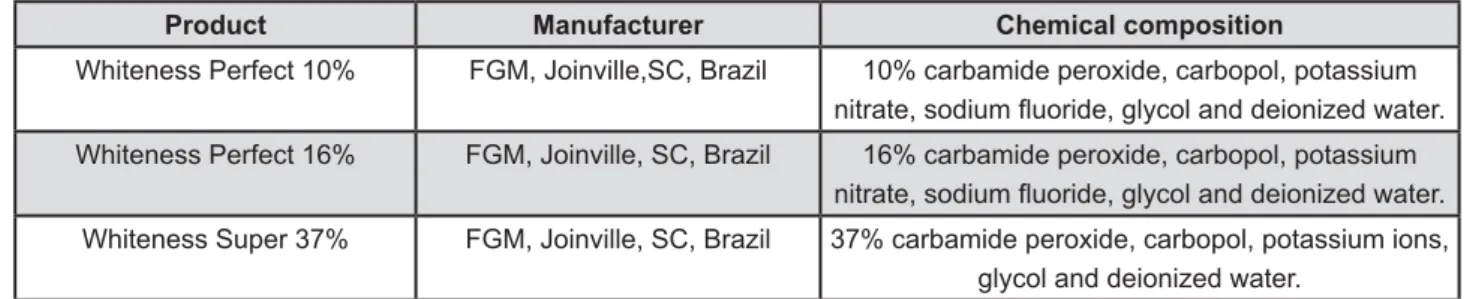
The same examiner responsible for the staining procedure carried out all bleaching treatments. The coffee-stained samples were randomly allocated into four groups (n=15), according to the bleaching agent concentration: distilled water (control group), 10% (CP10), 16% (CP16) or 37% (CP37) carbamide peroxide. The manufacturer and chemical composition of each bleaching agent used in this study are listed in Figure 2.
The control group was stored in distilled water
at 37°C, which was daily renewed during 2 weeks.
Samples of CP10 and CP16 groups were covered with 0.2 mL of the respective bleaching gels, which were applied on enamel surface for 4 h/ day during 2 weeks. Samples of CP37 group were covered with 0.2 mL of the bleaching gel for 20 min. The gel was light activated by two 40-s applications (LED Radii, SDI, Bayswater, Victoria, Australia) spaced by 10-min intervals. The gel was renewed and applied 3
times per clinical session. This cycle was repeated
at 3 sessions with 5 days of interval between them. After bleaching treatments, the gels were carefully removed with sterile gauze and tap water and then
the samples were stored in distilled water at 37oC
until the next application.
Statistical analysis
Tooth shade means were analyzed statistically by Kruskal-Wallis and Friedman’s tests and color parameters were analyzed by two-way analysis of variance (ANOVA) and Tukey’s test. The factors
investigated were treatment group and evaluation '+J
D=0.05.
RESULTS
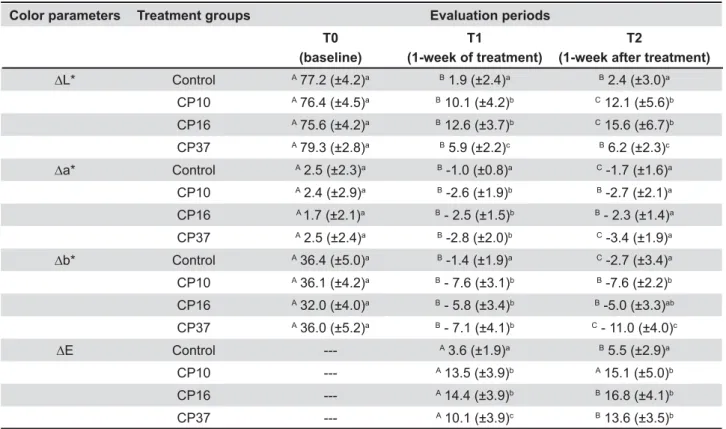
Tooth shade means and tooth color parameters !" " " #" at the different evaluation periods are presented in Tables 1 and 2, respectively. At T1 and T2 evaluations, CP10, CP16 and CP37 groups showed means when compared with baseline and control group (p<0.001). At T1, the group treated with CP37 presented lower tooth shade means than the other bleaching treatments tested in the same period (p<0.01). However, the tooth shade means resulting from the 1-week post-bleaching procedures (T2) were not statistically different >I*&>I*>I 9&'&;'
Considering tooth color parameters at T1 and T2, all treatment groups showed an increasing of !" " " (p<0.001). However, the increasing of the lightness !" >I than CP10 and CP16 at both evaluations periods $&'&&*' X " J treatment groups, at T2, there was no statistically difference among CP10, CP16, CP37 and control 9&'&'+ "J >I
Product Manufacturer Chemical composition
FGM, Joinville,SC, Brazil
!
" FGM, Joinville, SC, Brazil "
!
# $% FGM, Joinville, SC, Brazil $%
glycol and deionized water.
Figure 2- Description of the bleaching agents used in this study
Treatment groups Evaluation periods
T0 (baseline)
T1
(1-week of treatment)
T2
(1-week after treatment)
Control A12.9 (±1.7)a A12.4 (±1.3)a A 12.5 (±0.7)a
CP10 A12.7 (±2.6)a B4.4 (±2.1)b C2.9 (±0.7)b
CP16 A12.7 (±1.8)a B4.1 (±2.2)b C2.3 (±1.3)b
CP37 A11.8 (±2.5)a B7.0 (±3.2)c C2.4 (±0.6)b
Table 1- Tooth shade means and standard deviations (±SD) for the different treatment groups according to the evaluation periods
$&'&&*' #"J no difference among the treatment groups at the 9&'*'
DISCUSSION
Previous studies have suggested that the two main factors that determine the tooth whitening
of application11,16. There is a belief that the increase
of the bleaching agent concentration can produce a higher and faster whitening effect compared with whitening products with low-concentration bleaching agents. However, this study showed that after the B *& * effective than the 37% concentration. From this study, it appears that the factor contact time of bleaching agent was more important than the concentration of gels. Although this result might seem surprising, similar effects in tooth shade improvement were achieved with longer treatment times, independently of the peroxide concentration used16,17. A review that compared 9 clinical trials and the effectiveness of 25 tooth whitening products showed that tooth whitening is more effective when
the bleaching agent is placed in trays16.
As the present in vitro study followed the
manufacturers’ recommendations in order to evaluate the effectiveness of carbamide JH or home-use (10 and 16%), the mode and duration of applications were different among the groups. Certainly, these different characteristics of application for each bleaching agent might have
Y 9,12,23.
A clinical trial that evaluated the effectiveness of H J the contact time between bleaching gel and tooth surface is an important factor that can improve the
outcome of the bleaching treatment17.
The necessity of light-activation of peroxide-based gels has already been questioned by some
authors7,13,15,22.Even though the use of light
in bleaching procedures has been considered
unnecessary1,14 because of the presence of other
agents (i.e., carbopol) that assure the catalyze
of peroxides, light-activation of 37% carbamide peroxide was performed in our study to accelerate the whitening process, following the manufacturer’s instructions.
Despite the subjectivity of visual tooth color assessment, it has been well documented that the tooth color changes can be successfully
Color parameters Treatment groups Evaluation periods
T0 (baseline)
T1
(1-week of treatment)
T2
(1-week after treatment)
=>? Control A 77.2 (±4.2)a B 1.9 (±2.4)a B 2.4 (±3.0)a
CP10 A 76.4 (±4.5)a B 10.1 (±4.2)b C 12.1 (±5.6)b
CP16 A 75.6 (±4.2)a B 12.6 (±3.7)b C 15.6 (±6.7)b
CP37 A 79.3 (±2.8)a B 5.9 (±2.2)c B 6.2 (±2.3)c
=? Control A 2.5 (±2.3)a B -1.0 (±0.8)a C -1.7 (±1.6)a
CP10 A 2.4 (±2.9)a B -2.6 (±1.9)b B -2.7 (±2.1)a
CP16 A 1.7 (±2.1)a B - 2.5 (±1.5)b B - 2.3 (±1.4)a
CP37 A 2.5 (±2.4)a B -2.8 (±2.0)b C -3.4 (±1.9)a
=? Control A 36.4 (±5.0)a B -1.4 (±1.9)a C -2.7 (±3.4)a
CP10 A 36.1 (±4.2)a B - 7.6 (±3.1)b B -7.6 (±2.2)b
CP16 A 32.0 (±4.0)a B - 5.8 (±3.4)b B -5.0 (±3.3)ab
CP37 A 36.0 (±5.2)a B - 7.1 (±4.1)b C - 11.0 (±4.0)c
=E Control --- A 3.6 (±1.9)a B 5.5 (±2.9)a
CP10 --- A 13.5 (±3.9)b A 15.1 (±5.0)b
CP16 --- A 14.4 (±3.9)b B 16.8 (±4.1)b
CP37 --- A 10.1 (±3.9)c B 13.6 (±3.5)b
Table 2- Tooth color parameter means and standard deviations (±SD) for the different treatment groups according to the evaluation periods
assessed using both shade guides and digital
spectrophotometry3,19. Nevertheless, when
employing an objective method for measuring the tooth color changes, it is also possible to J !""" on the CIELAB system, an three-dimensional color
space8. According to spectrophotometer data, the
whitening improvement occurs mainly by increasing !"
" "3. At 1 week
post-bleaching, all treatment groups showed an !" " " '+
in comparing in vitro results with clinical studies
!""" interpreted with caution. Nevertheless, the color
parameters data of this in vitro study is in agreement
with the results of clinical trials, indicating that lower concentrations of tooth bleaching gels are as
effective as higher concentrations5,17,20,21.
The control group showed an increase of the !" " " ' These changes in the parameters are probably due to the removal of tooth surface pigments, as a consequence of the coffee staining procedure.
+ J #" J often used in tooth whitening studies in order to indicate the perceptible tooth color changes
after treatment3,11. At 1 week post-bleaching, all
#"J *'&' > that the lower concentration of peroxide-based gels would achieve the same perceptible results as the 37% carbamide peroxide, frequently used for H' J have stated that color reversal after bleaching BH
home tray-based bleaching agents16,17,25.
Considering that all carbamide peroxide gels evaluated in this study resulted in a similar tooth shade improvement, it could be suggested the use of low carbamide peroxide concentrations for vital tooth bleaching, in accordance with the American Dental Association guidelines, which only assures using trays with 10%±1% carbamide peroxide
application2.
The null hypothesis for this study was accepted as the high-concentration carbamide peroxide produced similar tooth color improvement than the bleaching agents containing low carbamide peroxide concentration. Further studies and clinical trials are needed to determine if the same color improvement HH peroxide bleaching agents.
CONCLUSIONS
Within the limitations of this study, it may be concluded that at-home (10 or 16% carbamide H bleaching agents produced a similar color improvement after the end of the treatment.
Clinical relevance
Tooth bleaching with high or low concentrated carbamide peroxide agents were similarly effective after treatment period. Practitioners must be informed about bleaching techniques in order to provide an evidence-based choice for their patients.
REFERENCES
*HX##'XH dental bleaching with or without light activation. J Contemp Dent Pract. 2010;11:E017-24.
2- American Dental Association. Accepted over-the-counter products [online]. [cited 2011 Apr 1st]. Available from: http://
www.ada.org/ada/seal/shoppinglist.aspx.
3- American Dental Association. Dentist-dispensed home-use tooth bleaching products [online]. 2006. [cited 2007 May 15th]. Available
from: http://www.ada.org/sections/scienceAndResearch/pdfs/ guide_home_bleach.pdf
4- Association Dentaire Française. Tooth bleaching treatments – a review [online]. 2007. [cited 2010 Feb 9th]. Available from: http://
www.adf.asso.fr/pdf/DossiersADF_EN/TOOTH-BLEACHING.pdf. 5- Bizhang M, Chun YH, Damerau K, Singh P, Raab WH, Zimmer S. Comparative clinical study of the effectiveness of three different bleaching methods. Oper Dent. 2009;34:635-41.
6- Braun A, Jepsen S, Krause F. Spectrophotometric and visual evaluation of vital tooth bleaching employing different carbamide peroxide concentrations. Dent Mater. 2007;23:165-9.
7- Buchalla W, Attin T. External bleaching therapy with activation by heat, light or laser: a systematic review. Dent Mater. 2007;23:586-96.
8- Commission Internationale De L’Eclairage. Recommendations on uniform colour spaces, colour difference equations and psychometric colour terms. Paris: Bureau Central de la CIE; 1978. H>>X> H ! X Fröner IC, Palma-Dibb RG. Effectiveness of home bleaching agents Y 'X Oral Sci. 2009;17:284-8.
10- Demarco FF, Meireles SS, Masotti AS. Over-the-counter whitening agents: a concise review. Braz Oral Res. 2009;23:64-70. 11- Joiner A. The bleaching of teeth: a review of the literature. J Dent. 2006;34:412-9.
12- Joiner A. Tooth colour: a review of the literature. J Dent. 2004;32:3-12.
13- Kugel G, Ferreira S, Sharma S, Barker ML, Gerlach RW. Clinical H' Esthet Restor Dent. 2009;21:336-47.
14- Kugel G, Papathanasiou A, Williams AJ 3rd, Anderson C,
Ferreira S. Clinical evaluation of chemical and light-activated tooth whitening systems. Compend Contin Educ Dent. 2006;27:54-62. 15- Marson FC, Sensi LG, Vieira LC, Araújo E. Clinical evaluation H of light-activation sources. Oper Dent. 2008;33:15-22.
16- Matis BA, Cochran MA, Eckert G. Review of the effectiveness of various tooth whitening systems. Oper Dent. 2009;34:230-5. 17- Matis BA, Cochran MA, Franco M, Al-Ammar W, Eckert GJ,
'#H Jin
18- Matis BA, Wang Y, Eckert GJ, Cochran MA, Jiang T. Extended bleaching of tetracycline-stained teeth: a 5-year study. Oper Dent. 2006;31:643-51.
19- Meireles SS, Demarco FF, Santos IS, Dumith SC, Della Bona A. Validation and reliability of visual assessment with a shade H '@'8&&?**H88' 20- Meireles SS, Heckmann SS, Leida FL, Santos Ida S, Della Bona X'# *&* peroxide tooth-whitening gels: a randomized clinical trial. Oper Dent. 2008;33:606-12.
21- Meireles SS, Santos IS, Della Bona A, Demarco FF. A double-blind randomized clinical trial of two carbamide peroxide tooth bleaching agents: 2-year follow-up. J Dent. 2010;38:956-63.
22- Ontiveros JC, Paravina RD. Color change of vital teeth exposed to bleaching performed with and without supplementary light. J Dent. 2009;37:840-7.
23- Sulieman M, Addy M, MacDonald E, Rees JS. The effect of hydrogen peroxide concentration on the outcome of tooth whitening: an in vitro study. J Dent. 2004;32:295-9.
24- Sulieman M, Addy M, Rees JS. Development and evaluation of a method in vitro to study the effectiveness of tooth bleaching. J Dent. 2003;31:415-22.