Detection of cytotoxic activity on Vero
cells in clinical isolates of
Serratia
marcescens
1Instituto de Ciências Biomédicas II, Universidade de São Paulo, São Paulo, SP, Brasil Departamentos de 2Medicina Veterinária Preventiva and 3Patologia Geral,
Universidade Estadual de Londrina, Londrina, PR, Brasil
4Laboratório de Microbiologia, Hospital das Clínicas, Faculdade de Medicina de Ribeirão Preto, Universidade de São Paulo, Ribeirão Preto, SP, Brasil
5Departamento de Análises Clínicas, Toxicológicas e Bromatológicas,
Faculdade de Ciências Farmacêuticas de Ribeirão Preto, Universidade de São Paulo, Ribeirão Preto, SP, Brasil
G.V. Carbonell1, A.F. Alfieri2, A.A.Alfieri2, M.C. Vidotto3, C.E. Levy4, A.L.C. Darini5 and R.M. Yanaguita1
Abstract
Cytotoxin production was studied in 60 Serratia marcescens strains isolated from hospitalized patients. Association of cytotoxic activity with serotype, source of isolation and presence of plasmids was also evaluated. Thirteen of the 60 S. marcescens strains produced a cyto-toxic effect on Vero cells. These strains were isolated from distinct clinical sources and classified into seven different serotypes (O1:H7; O4:NM; O10:NT; O19:NM; O6,14:H4; O6,14:NM and O6,14:H1). No relationship was observed between cytotoxic activity and clinical source or serotypes of the strains. Plasmids from five cytotoxin-producing S. marcescens strains were transferred to E. coli K12/711. The transconjugants did not exhibit cytotoxicity, indicating that the cytotoxic effect is not plasmid-mediated among these strains. Al-though a cytotoxic activity was demonstrated in filtrates of some S. marcescens strains, further studies should be performed to assess the role of this toxin in pathogenesis.
Correspondence
A.L.C. Darini
Departamento de Análises Clínicas, Toxicológicas e Bromatológicas FCFRP, USP
Av. do Café, s/n
14040-903 Ribeirão Preto, SP Brasil
Fax: 55 (016) 633-1092 E-mail: [email protected]
Research supported by CNPq. Publication supported by FAPESP.
Received October 22, 1996 Accepted September 10, 1997
Key words
•Cytotoxin production
•Nosocomial infections
•Plasmids
•Serratia marcescens
•Virulence factors
Introduction
Serratia marcescens has been recognized as an important nosocomial pathogen caus-ing respiratory and urinary tract infections (1), bacteremia (2), meningitis (3,4), perito-nitis (5), and other disorders (6,7). This bac-terium has been considered to be an impor-tant agent of nosocomial infections, particu-larly among newborns and patients submit-ted to invasive procedures at the University Hospital of the School of Medicine of Ribeirão Preto, SP, Brazil.
Reports in the literature regarding
viru-lence of this bacterium have shown charac-teristics such as resistance to serum bacteri-cidal activity (8), cell-bound hemolysin (9,10), presence of fimbriae and adherence to uroepithelial cells (11,12), and produc-tion of extracellular proteases (13) and nu-cleases (14). Cytotoxin production has been considered to be an important virulence fac-tor shown by several bacteria (15-18), but as far as we know there are no data on cytotoxin production by S. marcescens strains.
morphological changes are defined as cyto-pathic effects and can be useful to classify a cytotoxin. Most bacterial toxins cause ini-tially cytopathic effects but only those de-nominated cytotoxin lead to death of cul-tured cells (19). In addition, viability of the cell monolayer treated with a cytotoxin can be determined using the neutral red assay (20,21).
The purpose of the present study was to investigate the ability of clinical isolates of
S. marcescens to produce cytotoxin. The correlation of cytotoxin production with clini-cal source, serotype of strains and presence of plasmids was studied. Characteristics of the cytotoxic activity such as heat stability and the type of cytopathic effect were also evaluated.
Material and Methods
Bacterial strains
A total of 60 S. marcescens strains sup-plied by the Microbiology Laboratory of the University Hospital of the School of Medi-cine of Ribeirão Preto, University of São Paulo, Brazil, were studied. The strains were isolated from surgical wounds (11 isolates), urinary infections (12 isolates), respiratory tract (4 isolates), catheter (3 isolates), ab-scesses (3 isolates), ocular secretions (4 iso-lates), bacteremias (7 isolates) and others. E. coli H30 (serogroup O26), which produces verocytotoxin, was used as a positive control in cytotoxicity assays and E. coli K12/711 (nontoxigenic) was used as a negative con-trol and as a plasmid recipient in conjugation experiments.
Characterization of Serratia marcescens
The strains were serotyped at Instituto Adolfo Lutz, SP, Brazil, according to stan-dard methods (22). Resistance to 10 antimi-crobial agents (amikacin, ampicillin, chlor-amphenicol, gentamicin, kanamycin,
nali-dixic acid, tetracycline, sulfamethoxazole-trimethoprim, carbenicillin and streptomy-cin) was determined by the method of Bauer et al. (23).
Clinical data
The clinical records of all patients were reviewed. Only those patients who became infected 48 h after admission to the hospital were considered to have nosocomial infec-tions. Colonization is defined as the situa-tion where isolasitua-tion of S. marcescens oc-curred without evidence of overt disease.
Bacterial filtrates
The strains were cultured in 10 ml of Trypticase Soy Broth (TSB, Difco Lab., De-troit, MI) at 37oC for 18 h, with shaking. Bacterial culture filtrates were obtained by centrifugation (15,000 rpm for 10 min at 4oC) and the supernatants were sterilized by filtration through 0.2-µm filters (Millipore).
Cytotoxicity assay
The cytotoxicity assay was performed as described by Konowalchuk et al. (24). Vero (African green monkey kidney) cells were cultivated in tissue culture flasks with Eagle’s modified essential medium (MEM; Gibco, Grand Island, NY), supplemented with 10% fetal calf serum, 0.75 mM L-glutamine, 40 µg/ml gentamicin and 1 µg/ml amphotericin B. Confluent monolayers were removed with trypsin EDTA, resuspended to approximately 4 x 10⁵ cells/ml in MEM and 0.1-ml samples were pipetted into each well of a 96-well microtiter plate. After incubation at 37oC in 5% CO2 for 72 h, the medium was replaced with 180 µl MEM and 20 µl of the bacterial filtrate was added to each well. As negative controls, some wells received only MEM, TSB or E. coli K12/711 filtrates and E. coli
monolayer morphology was observed under the inverted microscope and checked for cytotoxic effect for five days.
Neutral red assay
Cell viability was quantified by the neu-tral red cytotoxicity assay (20). Briefly, after the cytotoxicity assay (incubation with fil-trates for 24-96 h), the medium containing the bacterial culture filtrates was removed and the cultures were washed with phos-phate-buffered saline, pH 7.4. Two hundred µl MEM containing 50 µg/ml neutral red was added to each well and the plate was incubated for 3 h at 37oC. The media con-taining the dye were removed and each well was washed for 2-3 min with formol-cal-cium (40% formaldehyde, 10% anhydrous calcium chloride) to remove non-incorpo-rated neutral red. Finally, 0.2 ml of an acetic acid-ethanol mixture (1.0 ml glacial acetic acid in 100 ml 50% ethanol) was added to each well and the plate was kept for 15 min at room temperature in order to remove the dye from the viable cells. Plates were trans-ferred to a spectrophotometer (Titertek Multiskan model 340) and read with a 540-nm filter. Two wells on the first row received medium without neutral red and served as blanks. Control cultures, 8 wells located in different areas of the plate, received normal medium without test filtrates. Cell viability was determined by comparison to the ab-sorbance values obtained for control wells (without toxin), which were taken as 100% cell viability. The cytotoxicity assay and the quantitative colorimetric assay were carried out on the same cell culture plate.
Heat stability
Filtrates that induced morphological changes in Vero cells were tested for heat stability. One-ml samples of bacterial
cul-ture filtrates were incubated for 30 min in sealed tubes in a thermostatically controlled water bath at 40, 50, 60, 70, 80 or 90oC, prior to the cytotoxicity assay. The cytotoxic ac-tivity of the filtrates was determined by cell viability measured by the neutral red assay, as described above.
Plasmid isolation and conjugation
The cytotoxin-producing S. marcescens
Results
Cytotoxicity of the Serratia marcescens
strains
Cytopathic effects were observed in 13 culture filtrates of S. marcescens strains. After incubation with culture filtrates there was a change from spindle-shaped cells
char-acteristic of normal Vero cells to round and shriveled cells, and these changes were fol-lowed by gradual destruction of the mono-layer (Figure 1).
Determination of cell viability
Cell viability was determined for all S. marcescens strains and the results obtained were closely similar. Figure 2 illustrates the results obtained for three S. marcescens
strains, Serratia 1 (serotype O19:NM, iso-lated from urinary infection), Serratia 4 (se-rotype O6,14:H4, isolated from the respira-tory tract) and Serratia 5 (serotype O1:H7, isolated from a surgical wound), and the negative control E. coli K12.
Heat stability
Tests for heat stability showed that the cell monolayer lost approximately 30% cell viability when the bacterial filtrates were heated to 60oC, and no cytopathic effect was observed at 70oC, as shown by maintenance of the viability of Vero cells (Figure 3).
Clinical data
The clinical data correlating the patients and the cytotoxin-producing S. marcescens
strains are shown in Table 1. The strains were obtained from ocular infection (2 strains), pneumonia (2 strains), urinary in-fection (3 strains), abscess (1 strain), surgi-cal wound (3 strains) and catheter (2 strains). The majority of these infections (92%) were considered to be nosocomially acquired, and one was only colonization. The age of pa-tients ranged from newborn to 72 years.
Serotyping
The serotypes of the S. marcescens iso-lates are shown in Table 2. Bacterial strains that showed untyped flagellar antigen or that were non-motile are referred to as NT and 100
80
60
40
20
0
Cell viability (%)
24 48 72 96
Incubation time (h)
Serratia 1
Serratia 4 Serratia 5
E. coli K12
Figure 1 - Cytopathic effect of S. marcescens filtrates on Vero cells. A, Negative control (E. coli K12); B, cytopathic effect after 24 h. Magnification: 100X.
NM, respectively. The cytotoxin-producing strains were classified into 7 different sero-types: O6,14:H4 (7 strains), O1:H7 (1 strain), O4:NM (1 strain), O10:NT (1 strain), O19:NM(1 strain), O6,14:NM (1 strain) and O6,14:H1 (1 strain).
Plasmids and transconjugants
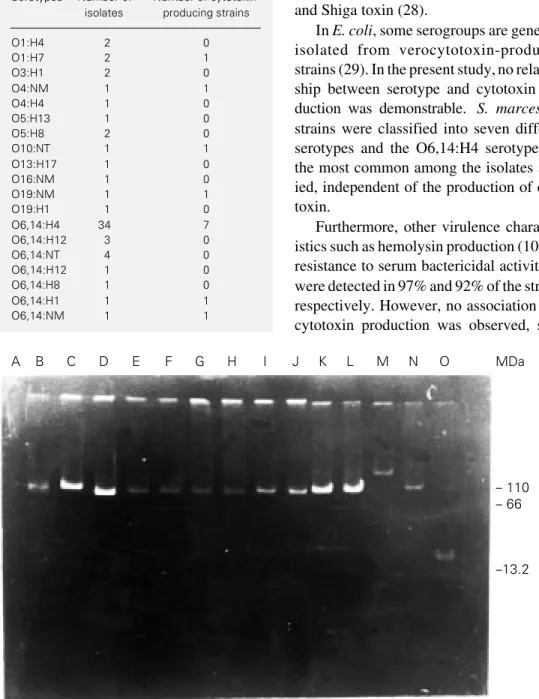
Plasmids were found in 8 cytotoxin-pro-ducing S. marcescens strains, but only 5 of these strains transferred plasmids to E. coli
K12/711 (Figure 4). Serratia isolates num-bers 15, 20 and 27 showed the same antibi-otic resistance pattern. These isolates were resistant to ampicillin, carbenicillin, gen-tamicin, streptomycin, sulfamethoxazole-trimethoprim, kanamycin and tobramycin and all transferred one plasmid (~60 MDa) that carries resistance to carbenicillin, ampicil-lin, streptomycin and tobramycin. Strain num-ber 45 was resistant to ampicillin, carbeni-cillin, gentamicin, streptomycin, sulfameth-oxazole-trimethoprim, kanamycin, tobramy-cin and chloramphenicol and transferred an-other plasmid of ~66 MDa that showed re-sistance to ampicillin, carbenicillin, kana-mycin, streptokana-mycin, and sulfamethoxazole-trimethoprim. Strain number 1 showed a resistance pattern similar to that of number 45, with the addition of tetracycline. Only this isolate transferred two plasmids to E. coli K12/711: one plasmid (~54 MDa) that carries resistance to tetracycline and chlor-amphenicol and another (~66 MDa) carry-ing resistance to ampicillin, carbenicillin, streptomycin, kanamycin and sulfamethox-azole-trimethoprim. Transconjugants are re-ported as donor number/recipient number. Culture filtrates obtained from transconju-gants did not produce morphological changes of Vero cells and cell viability always reached 100%.
Discussion
In the present study, 13 culture filtrates
of 60 (21.7%) Serratia marcescens strains showed cytotoxic activity on Vero cells. These strains were isolated from various clinical sources, and from patients of differ-ent ages. Although no association between cytotoxic activity and isolation source was observed, most cytotoxin-producing strains (92%) were isolated from nosocomial infec-tions.
The cytopathic effects of the S. marces-cens isolates on Vero cells were character-ized by cell rounding and detachment. Cell rounding without swelling can occur when
100
80
60
40
20
0
Cell viability (%)
40 50 60 70
Temperature (oC) Serratia 1
Serratia 2 Serratia 3 Serratia 4
80 90
Figure 3 - Effect of heat treatment of Serratia marcescens cytotoxin. The filtrates were submitted to different temperatures and tested on Vero cells. The viability of the cell culture was determined by the neutral red assay.
Table 1 - Clinical data of patients with cytotoxin-producing S. marcescens and sero-types of the strains.
HI = Hospital infection; CO = colonization; NT = untyped flagellar antigen; NM = non-motile.
Strain (number) Clinical source Patient age (years) Type Serotype
1 urinary tract 72 HI O19:NM
4 respiratory tract 34 HI O6,14:H4
5 surgical wound 47 HI O1:H7
6 surgical wound 35 HI O6,14:H4
13 umbilical catheter newborn HI O6,14:H4
14 subclavian catheter 21 HI O6,14:H4
15 ocular secretion newborn HI O6,14:H4
20 ocular secretion newborn HI O6,14:H4
27 urinary tract 35 HI O4:NM
45 urinary tract 61 HI O10:NT
47 subphrenic abscess 20 HI O6,14:H4
52 surgical wound 34 HI O6,14:NT
injury was the loss of cell culture viability measured by the neutral red assay. The re-sults showed that the monolayer of Vero cells treated with S. marcescens culture fil-trates was completely damaged after 72-96 h, causing the death of the cell culture, when compared to the negative control.
The cytotoxic activity of the S. marces-cens culture filtrates was inactivated at 70oC, a result similar to that reported for some E. coli cytotoxins such as verocytotoxins (27) and Shiga toxin (28).
In E. coli, some serogroups are generally isolated from verocytotoxin-producing strains (29). In the present study,no relation-ship between serotype and cytotoxin pro-duction was demonstrable. S. marcescens
strains were classified into seven different serotypes and the O6,14:H4 serotype was the most common among the isolates stud-ied, independent of the production of cyto-toxin.
Furthermore, other virulence character-istics such as hemolysin production (10) and resistance to serum bactericidal activity (8) were detected in 97% and 92% of the strains, respectively. However, no association with cytotoxin production was observed, since Table 2 - Serotypes and cytotoxin production of
the Serratia marcescens strains studied.
NT = Untyped flagellar antigen; NM = non-motile.
Serotypes Number of Number of cytotoxin-isolates producing strains
O1:H4 2 0
O1:H7 2 1
O3:H1 2 0
O4:NM 1 1
O4:H4 1 0
O5:H13 1 0
O5:H8 2 0
O10:NT 1 1
O13:H17 1 0
O16:NM 1 0
O19:NM 1 1
O19:H1 1 0
O6,14:H4 34 7
O6,14:H12 3 0
O6,14:NT 4 0
O6,14:H12 1 0
O6,14:H8 1 0
O6,14:H1 1 1
O6,14:NM 1 1
A B C D E F G H I J K L M N O MDa
- 110 - 66
-13.2
Figure 4 - Agarose gel electro-phoresis of plasmids from cyto-toxin-producing Serratia marces-cens transferred to E. coli K12/ 711. A, E. coli K12/711 (recipi-ent); B, Serratia 1 (donor); C, 711/ 1a (transconjugant); D, 711/1b; E, Serratia 15; F, 711/15; G, Ser-ratia 20; H, 711/20; I, Serratia 27; J, 711/27; K, Serratia 45; L, 711/ 45; M, pR27; N, pJPN11; O, pRK. pR27, pJPN11 and pRK are mo-lecular mass standards.
the cytoskeleton is altered in the absence of plasma membrane damage. Toxins that pro-duce this effect are classified as cytoskel-eton-altering toxins (18).
these characteristics were also found in most of the non-producing strains.
Five cytotoxin-producing strains trans-ferred plasmids to E. coli K12/711. The transconjugants received plasmids carrying antibiotic resistance but they did not pro-duce cytotoxins, suggesting that the genetic information for this activity is not carried on these plasmids.
Although most bacterial toxins seem to be located on the chromosome, toxins such as CNF2 and heat-labile (LT) and heat-stable (ST) enterotoxins of E. coli (17,30,31) have been associated with plasmid presence. How-ever, the controlling genes for verocytotoxin production are phage-encoded in several E. coli strains (32).
Some cytotoxins are homologous between different bacterial species, as observed for Shiga-like toxins produced by E. coli and Shiga toxin (33), or for Shiga-like toxin
II-related toxins produced by Citrobacter freundii (34). Thus, characteristics such as source of isolation, heat stability and type of cytopathic effect are preliminary tests that can be useful for differentiation of a cyto-toxin.
In conclusion, the present results describe a cytotoxic activity on Vero cells induced by clinical isolates of S. marcescens, and may provide impetus for subsequent work on the characterization of this cytotoxin.
Acknowledgments
We are grateful to the personnel of the Laboratory of Microbiology, School of Medi-cine of Ribeirão Preto (USP), who provided the bacterial strains, to Rosa H.A.R. Gironi for technical assistance, and also to the Instituto Adolfo Lutz, SP, Brazil, for serotyping the isolates.
References
1. Okuda T, Endo N & Osada Y (1981). Out-break of nosocomial urinary tract infec-tions caused by Serratia marcescens. Journal of Clinical Microbiology, 20: 691-695.
2. Volkow-Fernandez P, Ponce de Léon-Rosales S, Sifuentes-Orsonio J, Calva-Mercado JJ, Ruiz-Palacios GM & Cerbon MA (1993). Epidemia de bacteremias primarias por una cepa endémica de Ser-ratia marcescens en una unidad de terapia intensiva. Salud Pública de México, 35: 440-447.
3. Zaidi M, Sifuentes-Orsonio J, Bobadilha M, Moncada D & Ponce de Léon S (1989). Epidemic of Serratia marcescens bacter-emia and meningitis in a neonatal unit in Mexico City. Infection Control and Hospi-tal Epidemiology, 10: 14-20.
4. Campbell JR, Diacovo T & Baker CJ (1992). Serratia marcescens meningitis in neonates. Pediatric Infectious Disease Journal, 11: 381-386.
5. Bizette GA, Lindberg JS & Figueroa JE (1995). Serratia marcescens peritonitis in a patient receiving chronic ambulatory peritoneal dialysis complicated by osteo-myelitis. Journal of the Louisiana State Medical Society, 147: 64-67.
6. Pagani L, Luzzaro F, Ronza P, Rossi A, Micheletti P, Porta F & Romero E (1994). Outbreak of extended-spectrum beta-lactamase producing Serratia marcescens in an intensive care unit. FEMS Immunol-ogy and MedicalMicrobiology, 10: 39-46. 7. Stephen M & Lalitha MK (1993). An out-break of Serratia marcescens infection among obstetric patients. Indian Journal of Medical Research, 97: 202-205. 8. Carbonell GV, Levy CE & Vidotto MC
(1992). Virulence factors in Serratia marcescens: human serum resistance, serogroup and pathogenicity for mice. Revista de Microbiologia, 23: 72-75. 9. Ruan Y & Braun V (1990). Hemolysin as a
marker for Serratia. Archives of Microbiol-ogy, 154: 221-225.
10. Carbonell GV & Vidotto MC (1992). Viru-lence factors in Serratia marcescens: cell-bound hemolysin and aerobactin. Brazil-ian Journal of Medical and Biological Re-search, 25: 1-8.
11. Yamamoto T, Ariyoshi A & Amako K (1985). Fimbria-mediated adherence of Serratiamarcescens US5 strain to human urinary bladder surface. Microbiology and Immunology, 29: 677-681.
12. Parment PA, Svanborg-Edén C, Chaknis MJ, Sawant AD, Hadberg L, Wilson LA & Ahearn DG (1992). Hemagglutination (fim-briae) and hydrophobicity in adherence of Serratia marcescens to urinary tract epi-thelium and contact lenses. Current Mi-crobiology, 25: 113-118.
13. Matsumoto K, Maeda H, Takata K, Kamata R & Okamura R (1984). Purification and characterization of four proteases from a clinical isolate of Serratia marcescens. Journal of Bacteriology, 157: 225-232. 14. Hines DA, Saurugger PN, Ihler GM &
Benedik MJ (1988). Genetic analysis of extracellular proteins of Serratia marces-cens. Journal of Bacteriology, 170: 4141-4146.
15. O’Brien AD & Holmes RK (1987). Shiga and Shiga-like toxins. Microbiological Re-views, 51: 206-220.
16. Finlay BB & Falkow S (1989). Common themes in microbial pathogenicity. Micro-biological Reviews, 53: 210-230. 17. De Rycke J (1991). Les colibacilles
18. Sears CL & Kaper JB (1996). Enteric bac-terial toxins: mechanisms of action and linkage to intestinal secretion. Microbio-logical Reviews, 60: 167-215.
19. Thelestam M & Florin I (1994). Assay of cytopathogenic toxins in cultured cells. Methods in Enzymology, 235: 679-690. 20. Borenfreund E & Puerner JA (1984). A
simple quantitative procedure using monolayer cultures for cytotoxicity as-says. Journal of Tissue Culture Methods, 9: 7-9.
21. Repetto G & Sanz P (1993). Neutral red uptake, cellular growth and lysosomal function; in vitro effects of 24 metals. Alternative to Laboratory Animals, 21: 501-507.
22. Traub WH & Kleber I (1977). Serotyping of Serratia marcescens: evaluation of Le Minor’s H-immobilization test and descrip-tion of three new flagellar H antigens. Journal of Clinical Microbiology, 5: 115-121.
23. Bauer AW, Kirby WMM, Sherris JC & Turck M (1966). Antibiotic susceptibility testing by standardized single disk method. American Journal ofClinical Pa-thology, 45: 493-496.
24. Konowalchuk J, Speirs JI & Stravic S (1977). Vero response to a cytotoxin of Escherichia coli. Infection and Immunity, 18: 775-779.
25. Kado CI & Liu ST (1981). Rapid procedure for the detection and isolation of large and small plasmids. Journal of Bacteriol-ogy, 145: 1365-1373.
26. Hedges RW, Rodriguez-Lemoine V & Datta N (1975). R factors from Serratia marcescens.Journal of General Microbi-ology, 86: 88-92.
27. Konowalchuk J, Dickie N & Stravic S (1978). Comparative studies of five heat-labile toxic products of Escherichia coli. Infection and Immunity, 22: 644-648. 28. Eiklid K & Olsnes S (1983). Animal toxicity
of Shigella dysenteriae cytotoxin: evi-dence that the neurotoxic and cytotoxic activities are due to one toxin. Journal of Immunology, 130: 380-384.
29. Thomas A, Chart H, Cheasty T, Smith HR, Frost JA & Rowe B (1993). Vero cyto-toxin-producing Escherichia coli, particu-larly serogroup O157, associated with hu-man infections in United Kingdom: 1989-91. Epidemiology and Infection, 110: 591-600.
30. Silva RM, Giraldi R, Keller R, Campos LC & Guth BEC (1996). Diffuse adherence, ST-I enterotoxin and CFA/IV colonization factor are encoded by the same plasmid in Escherichia coli O29:H21 strain. Brazil-ian Journal of Medical andBiological Re-search, 29: 969-976.
31. Echeverria P & Murphy JR (1980). En-terotoxigenic Escherichia coli carrying plasmids coding for antibiotic resistance and enterotoxin production. Journal of In-fectious Diseases, 142: 273-278. 32. Smith H, Green P & Parseli Z (1983). Vero
cell toxins in Escherichia coli and related bacteria: transfer by phage and conjuga-tion and toxic acconjuga-tion in laboratory animals, chickens and pigs. Journal of General Mi-crobiology, 129: 3121-3127.
33. Gyles CL (1992). Escherichia coli cytotox-ins and enterotoxcytotox-ins. Canadian Journal of Microbiology, 38: 734-746.