INTRODUCTION
In Drosophila melanogaster, P element transpo-sition leads to a syndrome of aberrant genetic traits known as P-M hybrid dysgenesis (Kidwell et al., 1977; Bingham
et al., 1982; Sved, 1987). Early investigations identified two alternative states, or cytotypes, which are determined by a combination of chromosomal and cytoplasmic fac-tors that allow or repress transposition (Engels and Preston, 1979; Engels, 1983). The M cytotype is permis-sive and is characteristic of D. melanogaster strains that are completely devoid of P elements, i.e., M strains. The P cytotype is non-permissive, and is characteristic of P strains, i.e., those carrying many copies of autonomous
P elements. More recent studies have revealed consider-able variation in the inheritance of these regulatory states (Kidwell, 1985; Simmons et al., 1987, 1990). Since these states are tissue-specific, they are confined to the germline of the progeny produced by certain interstrain crosses. Dysgenic traits include temperature-sensitive sterility and reduced viability and fecundity, which in turn lead to a reduction in organism fitness.
In addition to the P-M system, other families of transposal elements are capable of promoting hybrid dys-genesis. Of these, I-R (Bucheton et al., 1976, 1984, 1986) and H-E (Blackman et al., 1987; Yannopoulos et al., 1987) have been particularly well studied. Lozovskaya et al.
(1990) also demonstrated the occurrence of hybrid dys-genesis syndrome in D. virilis when the male parent came from a long-established laboratory strain. This hybrid dys-genesis system was attributed to the Ulysses transposable
element and, more recently, to at least four transposable elements (Petrov et al., 1995). A similar situation, charac-terized by gonadal dysgenesis and the presence of chro-mosomal aberrations, was also recently reported by Torti
et al. (1994) for the medfly Ceratitis capitata.
Drosophila willistoni is a Neotropical species con-sidered a paradigm for evolutionary studies (Dobzhansky and Powell, 1975; Ehrman and Powell, 1982; Cordeiro and Winge, 1995). Over the last decade, we have studied this species us-ing genetic, ecological and evolutionary approaches (Valente and Araújo, 1985, 1986a,b, 1991; Valente et al., 1993).
In an effort to identify the causal agents of the re-duced viability of hybrid strains prore-duced by crossing labo-ratory and natural populations of D. willistoni, and to ana-lyze chromosomal inversions, we examined a series of traits that resembled previously studied gonadal dysgenesis syn-dromes (Kidwell et al., 1977; Blackman et al., 1987; Lozovskaya et al., 1990). In this paper, we report the oc-currence and some characteristics of a dysgenesis-like phenomenon in D. willistoni.
MATERIAL AND METHODS
Fly stocks and culture conditions
Two stocks of D. willistoni (WIP-11A and 17A2) were used. 17A2 was a wild-derived D. willistoni stock that had been in the laboratory since 1991 and was estab-lished from a natural population collected in a wilderness area (Eldorado do Sul, southern Brazil, 30o05’S-51o39’W). WIP-11A was a subculture of an old laboratory stock (WIP-4), originally collected in the “caatinga” desert near the city of Salvador (12o54’S-38o19’W), in northeastern Bra-zil and had been kept in the laboratory for 30 years. All cultures were maintained by mass matings on standard
Drosophila culture media (Marques et al., 1966).
Gonadal sterility tests
Gonadal sterility was scored in the F1 progeny of inter- and intrastrain crosses involving WIP-11A and 17A2 flies. Each cross was performed by mass mating 30 virgin
TEMPERATURE-DEPENDENT GONADAL HYBRID DYSGENESIS IN Drosophila willistoni
Luciana P. Regner1, Eliana Abdelhay2, Cláudia Rohde1, Jaqueline J.S. Rodrigues3 and Vera Lucia S. Valente1
A
BSTRACTTemperature-dependent gonadal dysgenesis was shown to occur in the progeny of both inter- and intrastrain crosses involv-ing two populations of Drosophila willistoni, one of which was an old laboratory stock, and the other, freshly collected from a natural population. We propose that the phenomenon observed was caused by the mobilization of transposable elements, as occurs in several other Drosophila species.
1Departamento de Genética, Instituto de Biociências, Universidade Federal
do Rio Grande do Sul, Caixa Postal 15053, 91501-970 Porto Alegre, RS, Brasil. Send correspondence to V.L.S.V. E-mail: [email protected]
2Laboratório de Biologia Molecular Maury Miranda, Instituto de Biofísica
Carlos Chagas Filho, Universidade Federal do Rio de Janeiro, Centro de Ciências da Saúde, Bloco G, Ilha Universitária, 21949-900 Rio de Janeiro, RJ, Brasil.
3Departamento de Biotecnologia, Instituto de Biociências, Universidade
females with 30 virgin males at 18o, 25o and 29 + 1oC. At the onset of eclosion, F1 progeny was transferred to fresh culture vials and aged for five days at 25 + 1oC. F1 males and females were then dissected in a drop of Ephrussi and Beadle (1936) saline solution. The frequency of gonadal sterility was calculated by dividing the number of dysgenic gonads by the total number of gonads.
Chi-square test was performed to assess the statis-tical significance of the differences among the crosses, sexes and temperatures, relative to the number of dysgenic gonads observed in the F1.
RESULTS
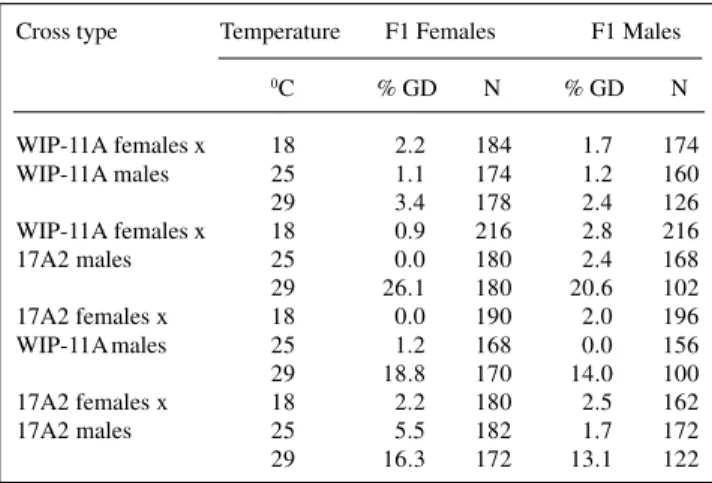
An elevation in environment temperature during mating increased the levels of gonadal dysgenesis in D. willistoni hybrid progenies. Dissection of the reproduc-tive tract of both male and female F1 progeny from the four possible crosses involving WIP-11A and 17A2 re-vealed gonadal underdevelopment in several cases (Fig-ure 1 and Table I). Although not shown, unilaterally dys-genic gonads were also observed.
In addition to complete ovarian reduction in the F1 progeny, some intermediate forms consisting of partially reduced ovaries containing only one or a few ovarioles were also detected. However, these intermediate pheno-types were excluded from the calculations of ovarian dys-genesis so as to avoid superestimation of the phenomenon as a result of the possible loss of parts of these soft, small structures during handling. Significant gonadal dysgen-esis occurred at 29oC in all the crosses performed, with exception of the WIP-11A intrastrain cross. In this case, the levels of gonadal dysgenesis were trivial, occurring at nearly equal frequencies at all three temperatures at which the flies were mated and the F1 progeny developed. The statistical significance of the differences in gonadal dys-genesis levels is summarized in Table II.
The percentages of F1 dysgenic gonads were con-siderably higher in the second and third crosses (Table I) at 29oC. At 18o and 25oC, the levels of sterility in these crosses were very similar to those observed in the WIP-11A intrastrain cross. Considering all crosses, males and females were not equally affected. At 29oC, male descen-dants of the three last crosses showed similar proportions
Figure 1 - Extreme phenotypes suggestive of gonadal dysgenesis in D. willistoni. A) Normal ovaries; (B) Bilaterally dysgenic ovaries; (C) Normal testes; (D) Bilaterally dysgenic testes.
A
C
of gonadal dysgenesis, whereas the females tended to have slightly higher sterility rates compared with males in the second and fourth crosses.
These results (Table I) suggest that gonadal steril-ity in D. willistoni is a temperature-dependent phenom-enon, but different from the P-induced response in D. melanogaster. However, temperature alone did not induce the gonadal alterations observed since WIP-11A flies had similar levels of dysgenesis at all developmental tempera-tures and F1 female descendants of the cross of 17A2 males and females reared at 25°C also had an elevated frequency of dysgenic gonads. Thus, D. willistoni hybrid sterility is not independent of the cross direction (Table I).
In addition to gonadal dysgenesis, certain altered
phenotypes were also observed in the offspring of WIP-11A and 17A2 crosses kept at 29oC. These were similar to those of certain P-induced D. melanogaster mutants de-scribed by Lindsley and Zimm (1990). In our case, the low viability of the individuals affected meant that it was impossible to maintain them long enough to carry out crosses to differentiate these phenotypes from microorgan-ism-promoted aberrant phenotypes and/or heat-induced phenocopies. However, we think that such phenotypes deserve attention because of their similarity to P-induced mutants. Specifically, they were similar to i) Beadex, based on their diminished 5th wing vein and/or the presence of “bubbles” or excisions at their edges (Figure 2B,C,E), ii)
held-up, based on the vertical position of the wing inser-tion (Figure 2I), iii) Notch, based on shrinkage of the 5th wing vein or on the enlarged veins, with deltae in the extremities, and/or in the serrated edges. Sparse thoracic hairs with irregular distribution (Figure 3B), the pres-ence of an intermediate thoracic furrow (Figure 3D) and some changes in the color, size, shape and arrangement of the eye ommatidia were also observed (Figure 4B,C and D), and iv) extra-eye, based on the duplication of head structures, that in extreme cases seemed to form su-pernumerary eyes (Figure 3D).
DISCUSSION
This study is the first report of gonadal dysgenesis in D. willistoni, although no causal relationship between the observed gonadal dysgenesisand transposon-homolo-gous sequence was established. The alterations observed in the reproductive tract of D. willistoni and the external phenotypes were morphologically similar to those of
P-induced traits in D. melanogaster.
The P-related gonadal dysgenesis in D. melano-gaster and the phenomenon observed in D. willistoni were also similar in that both were triggered by high tempera-tures, although this temperature was higher in D. willistoni
(>25oC) than in D. melanogaster (23oC) (Kidwell, 1983). While this phenomenon may have been caused by trans-posable elements, it may also be related to the hotter habi-tat (hot, humid Neotropical forests) of D. willistoni, in which case the higher triggering temperature may be a species adaptation to avoid high gonadal sterility rates. Females and males were both affected, although females tended to have slightly higher sterility rates at 29oC.
Contrary to P-hybrid dysgenesis in D. melanogaster,
the percentage of gonadal dysgenesis varied in the prog-eny of WIP-11A females x 17A2 males, 17A2 females x 17A2 males and 17A2 females x WIP-11A males. In the first two crosses, the male parents were from the same population (17A2) and would therefore be expected to contribute approximately to the same conditions for es-tablishing gonadal dysgenesis.
Both D. willistoni strains studied have DNA sequences homologous to complete P-elements in D. melanogaster, as
Table I - Gonadal dysgenesis (GD) sterility in female and male F1 progeny of D. willistoni at different temperatures. Cross type Temperature F1 Females F1 Males
0C % GD N % GD N
WIP-11A females x 18 2.2 184 1.7 174
WIP-11A males 25 1.1 174 1.2 160
29 3.4 178 2.4 126
WIP-11A females x 18 0.9 216 2.8 216
17A2 males 25 0.0 180 2.4 168
29 26.1 180 20.6 102
17A2 females x 18 0.0 190 2.0 196
WIP-11Amales 25 1.2 168 0.0 156
29 18.8 170 14.0 100
17A2 females x 18 2.2 180 2.5 162
17A2 males 25 5.5 182 1.7 172
29 16.3 172 13.1 122
N = Number of ovaries (females) or testes (males) analyzed.
Table II - Contingency table for testing the effects of female and male gonadal dysgenesis (GD) at 29ºC.
Cross type F1 Females F1 Males
GD NG GD NG
WIP-11A females x 6* 172 3* 123
WIP-11A males
WIP-11A females x 47** 133 21** 81
17A2 males
17A2 females x 32 138 14 86
WIP-11Amales
17A2 females x 28 144 16 106
17A2 males
χ2 = 35.567, P = 0.001 (significant heterogeneity among females of the four
crosses). χ2 = 18.687, P = 0.001 (significant heterogeneity among males of
the four crosses). * Residual analysis indicating a lack of GD. ** Residual analysis indicating an excess of GD. χ2 = 5.651, P = 0.059 (nonsignificant
variation in female GD among the last three crosses). χ2 = 2.670, P = 0.263
Figure 2 - Altered wing phenotypes encountered in the progeny of a WIP-11A x 17A2 cross of D. willistoni at 29oC. (A) Wild wing; (B-E) irregular or incomplete
vein formation; (E-G) incompletely expanded wings; (C, H) border of wings with reentrances; (I) abnormal wing position; (J) fly with different size wings.
A B C D E
F G H I J
Figure 3 - Altered thorax and bristle phenotypes in the progeny of a WIP-11A x 17A2 cross of D. willistoni at 29oC. (A) Wild
phenotype; (B) abnormal bristles; (C) duplication of bristles (arrow); (D) altered bristles and thorax with a furrow (arrow).
A
B
C
revealed by Southern blots (Regner et al., 1996), although their genomic positions differ sharply. In situ hybridiza-tion has shown that while 17A2 has several hybridizahybridiza-tion signals in the euchromatic arms, the signals in WIP-11A are concentrated mainly in the chromocenter.
Further studies on the regulation of P transposi-tion need to be performed in species other than D. melano-gaster before concluding whether this element is involved in the phenomenon described here.
In D. nebulosa, a close relative of D. willistoni, the
P insertion site appears to be a complex sequence that is repeated three times in this species’ centromeric hetero-chromatin (Lansman et al., 1987). This finding led these authors to suggest that some species have P element inser-tional “hotspots” in their heterochromatic DNA such that capture in the heterochromatin of the chromocenter could prevent the mobilization of several transposons. Transpos-able element invasions and re-invasions would then result in periods of dysgenic effects related to the amount of com-plete elements present in the genome, followed by the
ac-cumulation of mobile sequences in heterochromatic hotspots and a reduction in dysgenic traits. Genomic loca-tion is possibly a strategy developed to control the effects of putative transposable element activity.
Clark et al. (1995) recently reported four major P
element subfamilies in the D. willistoni and D. saltans
species groups, indicating that the coexistence of more than one member of these subfamilies in the same genome is possible. The implications of such differences on the cross-ability of different populations remain unknown.
One additional feature that deserves mention is the continuum of phenotypes observed between the two ex-tremes (normal and dysgenic) at 29oC. These intermediate phenotypes were very rare in D. melanogaster (their oc-currence was limited to crosses performed at temperatures below 25oC) but frequent in D. simulans (Daniels et al., 1989), and have also been reported for D. mauritiana
(Montchamp-Moreau et al., 1991). However, D. simulans
and D. mauritiana do not bear P elements under natural conditions; P elements were introduced into each either
Figure 4 - Altered head and eye phenotypes in the progeny of a WIP-11A x 17A2 cross of D. willistoni at 29oC. (A) Wild phenotype; (B) abnormal
ommatidia (arrow); (C) different colored eyes; (D) unilateral duplication of head structures, including an extra eye and antenna (arrows).
A C
by genetic transformation experiments or by interspecific crosses. Daniels et al. (1989) suggested that the expres-sion of sterility in D. simulans tended to be more depressed at lower temperatures than D. melanogaster in similar con-ditions. Considering the results for D. willistoni, we sug-gest that a similar phenomenon promoted by the putative transposable element involved may occur in the latter spe-cies.
Previous studies on the origin of P elements sug-gested that these sequences are a new acquisition of D. melanogaster, but were harbored for a longer time in D. willistoni (Kidwell, 1983; Daniels and Strausbaugh, 1986; Daniels etal., 1990a; Houck et al., 1991). The latter spe-cies may have had to deal with P activity for a longer pe-riod than D. melanogaster which may not have had enough time to adapt to the effects of this elemental system. In-deed, Daniels et al. (1990a) suggested that hybrid dysgen-esis may be different in these two species. Although our results do not constitute a thorough investigation of hy-brid dysgenesis in D. willistoni, the results of gonadal ste-rility tests showed common basic features, suggesting that the differences between these two species may be more of a quantitative than a qualitative nature. Several types of evidence have led some to the conclusion that P element expression is influenced by certain host properties (Rio et al., 1986; O’Brochta and Handler, 1988; Rio and Rubin, 1988; Rio, 1990). These properties, however, do not seem to differ much between D. willistoni and D. melanogaster, since a complete P element from D. willistoni can pro-mote transposition in D. melanogaster (Daniels et al., 1990a), and a complete P element of D. melanogaster can be excised from D. willistoni (O’Brochta and Handler, 1988).
Other transposable element families, such as hobo, are also able to promote gonadal dysgenesis similar to the
P element in Drosophila (Blackman et al., 1987). How-ever, D. willistoni has been reported to be devoid of hobo
(Daniels et al., 1990b), thus weakening the possible in-volvement of hobo in the phenomenon we observed. How-ever, we have recently reported weak hobo hybridization signals in the genome of some D. willistoni strains (in-cluding those here studied) (Loreto et al., 1998), that de-serve future study.
It is possible that an unknown element harbored exclusively by some natural populations of D. willistoni, and/or that several unrelated transposable elements, as found in D. virilis (Petrov et al., 1995), could be respon-sible for the generation of phenomena such as those de-scribed here.
Other conditions, such as the presence of endocy-tobionts like the rickettsia Wolbachia, can promote in-traspecific reproductive incompatibility. When this mi-croorganism is present in one population and not in an-other, either no hybrids or fewer progeny are produced. This phenomenon affects females from one reciprocal cross, but not those from the other (for a review, see Hoy,
1994). This possibility is unlikely to explain the data re-ported here.
Considering this scenario, and the possible evolu-tionary consequences of the intraspecific incompatibility described here as well as the fact that environmental stress is capable of promoting transposon mobilization (Jouan-Dofournel et al., 1996), we believe that exploration of the role of transposable elements as a source of genetic vari-ability in natural populations of Neotropical Drosophila
species has only just begun.
ACKNOWLEDGMENTS
This research was supported by grants and fellowships from Conselho Nacional de Desenvolvimento Científico e Tecnológico (CNPq), Fundação de Amparo à Pesquisa do Estado do Rio Grande do Sul (FAPERGS), Financiadora de Estudos e Projetos (FINEP), Pró-Reitoria de Pesquisa e Pós-Graduação da Universidade Federal do Rio Grande do Sul and Fundação de Amparo à Pesquisa do Estado do Rio de Janeiro (FAPERJ).
RESUMO
Disgenesia gonadal dependente de temperatura foi encontrada na prole tanto de cruzamentos intra como interlinha-gens, envolvendo duas populações de Drosophila willistoni. Uma delas é derivada de um velho estoque de laboratório e a outra, de uma amostra recentemente coletada de uma população natural. Tal fenômeno não havia ainda sido descrito em D. willistoni e nós sugerimos que a disgenesia gonadal encontrada seja causada por elementos transponíveis, como ocorre em muitas outras espécies de Drosophila.
REFERENCES
Bingham, P.M., Kidwell, M.G. and Rubin, G.M. (1982). The molecular basis of P-M hybrid dysgenesis: the role of the P element, a P -strain-specific transposon family. Cell 29: 995-1004.
Blackman, R., Grimaila, R., Koehler, M. and Gelbart, W. (1987). Mobi-lization of hobo elements residing within the decapentaplegic gene complex: suggestion of a new hybrid dysgenesis system in Droso-phila melanogaster. Cell 49: 497-505.
Bucheton, A., Lavige, J.M., Picard, G. and Heritier P. (1976). Non- Men-delian female sterility in Drosophila melanogaster: quantitative varia-tion in the efficiency of inducer and reactive strains. Heredity 36: 305-314.
Bucheton, A., Paro, R., Sang, H.M., Pelisson, A. and Finnegan, D.J.
(1984). The molecular basis of I-R hybrid dysgenesis: identification, cloning and properties of the I factor. Cell 38: 153-163.
Bucheton, A., Simonelig, M., Vaury, C. and Crozatier, M. (1986). Se-quences similar to the I transposable element involved in I-R hybrid dysgenesis occur in other Drosophila species. Nature 322: 650-652.
Clark, J.B., Altheide, T.K., Schlosser, M.J. and Kidwell, M.G. (1995). Molecular evolution of P transposable elements in the genus Droso-phila. I. The saltans and the willistoni groups. Mol. Biol. Evol. 12:
902-913.
Cordeiro, A.R. and Winge, H. (1995). Levels of evolutionary divergence of Drosophila willistoni sibling species. In: Genetics of Natural Populations. The Continuing Importance of Theodosius Dobzhansky
(Levine, L., ed.). Columbia University Press, New York, pp. 262-280.
J. Mol. Evol. 23: 138-148.
Daniels, S.B., Chovnick, A. and Kidwell, M. (1989). Hybrid dysgenesis in
Drosophila simulans lines transformed with P elements. Genetics 121: 281-291.
Daniels, S.B., Chovnick, A. and Boussy, I.A. (1990a). Distribution of hobo
transposable elements in the genus Drosophila. Mol. Biol. Evol. 7: 589-606.
Daniels, S.B., Peterson, K.R., Strausbaugh, L.D., Kidwell, M.G. and
Chovnick, A. (1990b). Evidence of horizontal transmission of the P
transposable element between Drosophila species. Genetics 124: 339-355.
Dobzhansky, T. and Powell, J.R. (1975). The willistoni group of sibling species of Drosophila. In: Handbook of Genetics (King, R.C., ed.). Vol. 3. Plenum Publ. Corp., New York, pp. 589-622.
Ehrman, L. and Powell, J.R. (1982). The Drosophila willistoni species group. In: The Genetics and Biology ofDrosophila (Ashburner, M., Carson, H.L. and Thompson Jr, J.N., eds.). Vol. 3b. Academic Press, New York, pp. 193-225.
Engels, W.R. (1983). The P family of transposable elements in Drosophila. Annu. Rev. Genet. 17: 315-344.
Engels, W.R. and Preston, C.R. (1979). Hybrid dysgenesis in Drosophila melanogaster: nature and inheritance of P element regulation. Ge-netics 92: 161-175.
Ephrussi, B. and Beadle, G.W. (1936). A technique of transplantation for
Drosophila melanogaster. Am. Nat. 70: 218-225.
Houck, M.A., Clark, J.B., Peterson, K.R. and Kidwell, M.G. (1991). Possible horizontal transfer of Drosophila genes by the mite
Proctolaelaps regalis. Science 25: 1125-1128.
Hoy, M.A. (Ed.) (1994). Genes, genome organization, and development in insects. In: Insect Molecular Genetics. An Introduction to Principles and Applications. Academic Press, San Diego, pp. 69-125.
Jouan-Dufournel, I., Cosset, F., Contamine, D., Verdier, G. and Biémont, C. (1996). Transposable element behavior following viral stress in
Drosophila melanogaster inbred line. J. Mol. Evol. 43: 19-27.
Kidwell, M.G. (1983). Evolution of hybrid dysgenesis determinants in
Drosophila melanogaster. Proc. Natl. Acad. Sci USA 80: 1655-1659.
Kidwell, M.G. (1985). Hybrid dysgenesis in Drosophila melanogaster: na-ture and inheritance of P element regulation. Genetics 111: 337-350.
Kidwell, M.G., Kidwell, J.F. and Sved, J.A. (1977). Hybrid dysgenesis in
Drosophila melanogaster: a syndrome of aberrant traits including mutation, sterility, and male recombination. Genetics 36: 813-833.
Lansman, R.A., Shade, R.O., Grigliatti, T.A. and Brock, H.W. (1987). Evolution of P transposable elements: sequences of Drosophila nebulosa P elements. Proc. Natl. Acad. Sci. USA84: 6491-6495.
Lindsley, D.L. and Zimm, G.G. (1990). The Genome of Drosophila melanogaster. Academic Press, San Diego.
Loreto, E.L.S., Basso da Silva, L., Zaha, A. and Valente, V.L.S. (1998). Distribution of transposable elements in Neotropical species of Droso-phila. Genetica 101: 153-165.
Lozovskaya, E.R., Scheinker, V.S. and Evgen’ev, M. (1990). A hybrid dysgenesis syndrome in Drosophila virilis. Genetics 126: 619-623.
Marques, E.K., Napp, M., Winge, H. and Cordeiro, A.R. (1966). A corn meal, soybean flour, wheat germ medium for Drosophila. Droso-phila Inf. Serv. 41: 187.
Montchamp-Moreau, C., Periquet, G. and Anxolabéhère, D. (1991). In-terspecific transfer of P elements by crosses between Drosophila
simulans and Drosophila mauritiana. J. Evol. Biol. 4: 131-140.
O’Brochta, D.A. and Handler, A.M. (1988). Mobility of P elements in drosophilids and nondrosophilids. Proc. Natl. Acad. Sci. USA 85: 6052-6056.
Petrov, D.A, Schutzman, J.L., Hartl, D. and Lozovskaya, E.R. (1995). Diverse transposable elements are mobilized in hybrid dysgenesis in
Drosophila virilis. Proc. Natl. Acad. Sci. USA 92: 8050-8054.
Regner, L.P., Pereira, M.S.O., Alonso, C.E.V., Abdelhay, E. and Valente, V.L.S. (1996). Genomic distribution of P elements in Drosophila willistoni and a search for their relationship with chromosomal in-versions. J. Hered. 87: 190-211.
Rio, D.C. (1990). Molecular mechanisms regulating Drosophila P element transposition. Annu. Rev. Genet. 24: 543-578.
Rio, D.C. and Rubin, G.M. (1988). Identification and purification of a
Drosophila protein that binds to the terminal 31-base-pair inverted repeats of the P transposable element. Proc. Natl. Acad. Sci. USA 85: 8929-8933.
Rio, D.C., Laski, F.A. and Rubin, G.M. (1986). Identification and immu-nochemical analysis of biologically active Drosophila P element transposase. Cell 44: 21-32.
Simmons, J.M., Raymond, J.D., Boedigheimer, M.J. and Zunt, J.R.
(1987). The influence of non-autonomous P elements on hybrid dys-genesis in Drosophila melanogaster. Genetics 117: 671-685.
Simmons, J.M., Raymond, J.D., Rasmusson, K.E., Miller, L.M., Mc-Larnon, C.F. and Zunt, J.R. (1990). Repression of P element-me-diated hybrid dysgenesis in Drosophila melanogaster. Genetics 124: 663-676.
Sved, J.A. (1987). Hybrid dysgenesis in Drosophila melanogaster, evidence from sterility and Southern hybridization tests that P cytotype is not maintained in the absence of chromosomal P factors. Genetics 115: 121-127.
Torti, C., Malacrida, A.R., Yannopoulos, G., Louis, G. and Gasperi, G.
(1994). Hybrid dysgenesis-like phenomena in the medfly, Ceratitis capitata (Diptera, Tephritidae). J. Hered. 85: 92-99.
Valente, V.L.S. and Araújo, A.M. (1985). Observations on the chromo-somal polymorphism of natural populations of Drosophila willistoni
and its association with the choice of feeding and breeding sites.
Rev. Bras. Genét. 8: 271-284.
Valente, V.L.S. and Araújo, A.M. (1986a). Chromosomal polymorphism, climatic factors and variation in population size of Drosophila willistoni. Heredity 57: 149-159.
Valente, V.L.S. and Araújo, A.M. (1986b). Comments on breeding sites of
Drosophila willistoni Sturtevant (Diptera, Drosophilidae). Rev. Bras. Ent. 30: 281-286.
Valente, V.L.S. and Araújo, A.M. (1991). Ecological aspects of Droso-phila species inhabiting wild environments in Southern Brazil (Diptera: Drosophilidae). Rev. Bras. Ent. 35: 237-253.
Valente, V.L.S., Ruszczyk, A. and Santos, R.A. (1993). Chromosomal poly-morphism in urban Drosophila willistoni. Rev. Bras. Genét. 16: 307-319.
Yannopoulos, G., Stamatis, N., Monastirioti, M., Hatzopoulos, P. and
Louis, C. (1987). Hobo is responsible for the induction of hybrid dysgenesis by strains of Drosophila melanogaster bearing the male recombination factor 23.5. MRF. Cell 48: 487-495.