Mutations in
SRY
and
WT1
genes
required for gonadal development
are not responsible for XY partial
gonadal dysgenesis
1Centro de Biologia Molecular e Engenharia Genética (CBMEG),
2Grupo Interdisciplinar de Estudos da Determinação e Diferenciação do Sexo
(GIEDDS), and Departamentos de 3Genética Médica, and 4Pediatria, Faculdade de Ciências Médicas, Universidade Estadual de Campinas, Campinas, SP, Brasil
E.B. Tagliarini1, J.G. Assumpção1, M.R. Scolfaro2, M.P. de Mello1,2, A.T. Maciel-Guerra2,3, G. Guerra Júnior2,4 and C. Hackel1,2,3
Abstract
The WT1 transcription factor regulates SRY expression during the
initial steps of the sex determination process in humans, activating a gene cascade leading to testis differentiation. In addition to causing Wilms’ tumor, mutations in WT1 are often responsible for urogenital
defects in men, while SRY mutations are mainly related to 46,XY pure
gonadal dysgenesis. In order to evaluate their role in abnormal testicu-lar organogenesis, we screened for SRY and WT1 gene mutations in 10
children with XY partial gonadal dysgenesis, 2 of whom with a history of Wilms’ tumor. The open reading frame and 360 bp of the 5' flanking sequence of the SRY gene, and the ten exons and intron boundaries of
the WT1 gene were amplified by PCR of genomic DNA. Single-strand
conformation polymorphism was initially used for WT1 mutation
screening. Since shifts in fragment migration were only observed for intron/exon 4, the ten WT1 exons from all patients were sequenced
manually. No mutations were detected in the SRY 5' untranslated
region or within SRY open-reading frame sequences. WT1 sequencing
revealed one missense mutation (D396N) in the ninth exon of a patient who also had Wilms’ tumor. In addition, two silent point mutations were found in the first exon including one described here for the first time. Some non-coding sequence variations were detected, represent-ing one new (IVS4+85A>G) and two already described (-7ATG T>G, IVS9-49 T>C) single nucleotide polymorphisms. Therefore, muta-tions in two major genes required for gonadal development, SRYand WT1, are not responsible for XY partial gonadal dysgenesis.
Correspondence
C. Hackel
Departamento de Genética Médica Faculdade de Ciências Médicas UNICAMP
Rua Tessália Vieira de Camargo, 126 Caixa Postal 6111
13084-971 Campinas, SP Brasil
Fax: +55-19-3788-8909 E-mail: [email protected]
Research supported by grants to C. Hackel from the Fundo de Apoio ao Ensino e à Pesquisa da UNICAMP (FAEP-UNICAMP). E.B. Tagliarini and J.G. Assumpção were recipients of postgraduate fellowships from CAPES and CNPq, respectively.
Publication supported by FAPESP.
Received April 5, 2004 Accepted November 23, 2004
Key words
•XY partial gonadal
dysgenesis
•SRY open reading frame •SRY 5' untranslated region •WT1 exons
Introduction
XY gonadal dysgenesis is a disorder of sexual determination and differentiation that includes a complete (pure) and a partial form. Patients with a 46,XY karyotype and pure gonadal dysgenesis have a female pheno-type with full development of unambiguous female genitalia, well-developed Müllerian structures and streak gonads. In contrast, patients with 46,XY partial gonadal dysgen-esis are characterized by partial testicular differentiation, low levels of testosterone, ambiguous genitalia, and persistence of Müllerian structures. Patients with both forms are at increased risk for gonadal neoplastic transformation (1). Depending on the sever-ity of testicular dysgenesis, anti-Müllerian hormone levels may be low or undetectable in patients with abnormal testicular determi-nation (2,3). Gonadal histology is typically characterized by poorly developed seminif-erous tubules surrounded by wavy ovarian stroma, but may range from apparently nor-mally differentiated testes to streak gonads. According to Berkovitz et al. (4), patients with 46,XY partial gonadal dysgenesis may present a wide range of characteristics de-pending on the extent of testicular develop-ment and they may have either bilateral dysgenetic testes or one dysgenetic testis and one streak gonad. Scolfaro et al. (5) described this histological variability in a series of 13 children with partial gonadal dysgenesis.
Sex-determining genes direct the fate of the bipotential gonad to either testis or ovary. They can be categorized into transcription factors involved throughout gonadal mor-phogenesis (e.g., SF1, WT1), inducers of
testicular development (SRY, SOX9), and
“anti-testis” genes and potential promoters of ovarian development (DAX1, WNT4). All
of these genes are expressed in the develop-ing genital ridges, and their products interact with each other as part of a complex genetic pathway leading to gonadal differentiation
into one sex or the other (6).
Mutations in or abnormal expression of any of such genes will impair the formation of testes in an XY background or the forma-tion of ovaries in an XX background (6). Indeed, mutations in the SRY (sex
determin-ing region on the Y chromosome), the major gene required for male sex determination, have been reported to account for 20 to 67% of cases of 46,XY pure gonadal dysgenesis (7). In most cases the mutations are located within the high mobility group box, which is a DNA-binding domain essential for SRY function as a transcriptional regulator. Only seven SRY mutations of the 44 described so
far are found outside this domain (8). Nucleo-tide changes in the 5' untranslated region (UTR) flanking sequence of the SRY gene
seem not to be a major cause of disturbance in the male differentiation pathway but a few mutations that might affect SRY expression
have been reported in XY females (9).
WT1 (Wilms’ tumor gene 1) encodes a
transcription factor containing four “zinc-finger” motifs which binds to and acts syner-gistically with SRY to activate transcription from promoters containing SRY-binding sites (10), being also required for the normal de-velopment and function of the urogenital tract (11,12). The complexity of WT1 action is reflected at the molecular level, since up to 24 different isoforms may result from a com-bination of alternative translational sites, al-ternative RNA splicing and RNA editing (13). Constitutional mutations are associ-ated with familial Wilms’ tumor and syn-dromes such as Denys-Drash syndrome char-acterized by nephropathy, genital anomalies and often a predisposition to Wilms’ tumor (12). Transcripts of the WT1 gene are
de-tected in the gonadal ridge as early as 6 weeks postconception in human embryos, before testis determination (14). According to Fuqua et al. (15), mutations in the WT1
the gonadal ridge after testis determination (14), defects in WT1 may also delay the
differentiation after SRY expression. In this report, we present the data ob-tained for 10 patients with a diagnosis of partial gonadal dysgenesis who were inves-tigated for mutations in the SRY and WT1
coding and non-coding sequences.
Patients and Methods
The series consisted of 10 patients with a diagnosis of partial gonadal dysgenesis and a 46,XY karyotype. They were examined by the members of the Grupo Interdisciplinar de Estudos da Determinação e Diferenciação do Sexo at Hospital das Clínicas, Universi-dade Estadual de Campinas (UNICAMP), Campinas, SP, Brazil. The protocol was ap-proved by the Ethics Committee of Faculda-de Faculda-de Ciências Médicas, UNICAMP. In-formed consent was obtained from the par-ents of the children included in the study.
The diagnosis of XY partial gonadal dys-genesis was based onfindings of ambiguous genitalia and bilateral cryptorchidism, low levels of testosterone and anti-Müllerian
hormone (Table 1). All patients showed ev-idence of Müllerian duct derivatives, which was confirmed by laparoscopy.
Patients 9 and 10 had a personal history of unilateral Wilms’ tumor. Patient 10 also had progressive renal failure and died at 13 months of age; at autopsy, kidney evaluation revealed diffuse mesangial sclerosis. This patient had a Denys-Drash syndrome pheno-type. No patient had a family history of intersex.
The diagnosis of gonadal dysgenesis was confirmed by a careful histologic and mor-phometric evaluation of the gonads based on the following criteria: gonadal position, mean tubular diameter, number of germ cells, num-ber of Sertoli cells, and presence or absence of Müllerian and Wolffian duct derivatives. These results were published in a report by Scolfaro et al. (5), in which the present
pa-tients 1 to 9 were papa-tients 2, 3, 4, 6, 7, 8, 9, 13, and 12, respectively. At autopsy, bilat-eral streak gonads were found in patient 10. Genomic DNA was extracted from pe-ripheral blood leukocytes by standard tech-niques (17). The SRY open reading frame
(ORF) was amplified with primers XES10
Table 1. Genital phenotype and hormonal data of 10 children with 46,XY partial gonadal dysgenesis who participated in the study.
Patient Age External Gonadal position AMH (normal values T FSH LH
(months) genitalia1 (right/left) for age) (pmol/l) (nmol/l)2 (IU/l)3 (IU/l)4
1 108 2 A/A (left = streak) 114 (234-438) 0.7 5.4 0.9
2 30 2 I/I 52 (360-638) <0.3 1.2 0.6
3 0.5 3 I/I 98 (251-679) 1.75 3.9 0.8
4 92 2 I/A (left = streak) 113 (234-438) <0.3 5.8 0.8
5 78 2 I/- 73 (309-566) 1.0 6.3 1.0
6 13 2 I/I 107 (360-638) <0.3 1.0 0.5
7 20 4 I/A (left = streak) 11 (360-638) <0.3 1.5 1.1
8 44 3 I/A (left = streak) 71 (360-638) <0.3 0.9 0.9
9# 29 3 A/A 116 (360-638) 3.1 0.7 0.3
10# 12 2 I/A NP <0.3 7.8 3.4
AMH = anti-Müllerian hormone (2); T = total testosterone; FSH = follicle-stimulating hormone; LH = luteinizing hormone; A = abdominal; I = inguinal canal; -, not found; NP = not performed.
1According to the classification of Quigley et al. (16). 2Total testosterone level after the human chorionic
gonadotropin stimulation test (normal value: above 1.4 nmol/l). 3Normal values of prepubertal FSH: 0.1-1.4
IU/l. 4Normal values of prepubertal LH: 0.1-1.0 IU/l. 5Basal total testosterone level. #Patient with a past
and XES11 described by Hawkins et al. (18). PCR amplifications were performed by the method of Assumpção et al. (8). For the amplification of the 360-bp SRY 5' flanking
sequence, encompassing the SRY putative
core promoter, we used the primers and PCR conditions described by Schmitt-Ney et al. (19). Five microliters of PCR amplification products were submitted to direct sequenc-ing with the Thermo-sequenase radiolabeled terminator cycle sequencing kit (Amersham-Pharmacia Biotech, Uppsala, Sweden). Se-quencing was carried out twice with prod-ucts from different PCR procedures and with both sense and antisense primers to confirm the results.
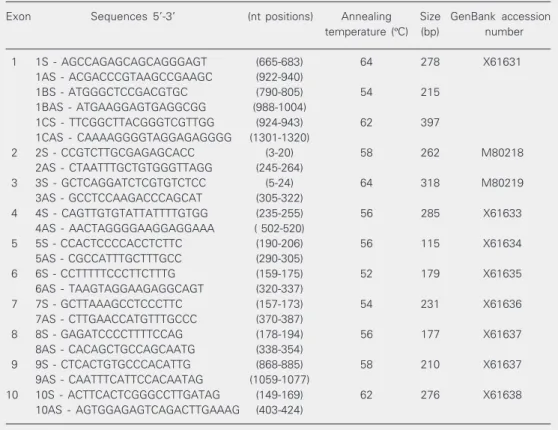
The 10 exons and their flanking regions of the WT1 gene were amplified by PCR
from genomic DNA with primers described in Table 2. Due to its long size and some difficulties in fragment amplification, 3
dif-ferent primer pairs were used for exon 1. The PCR amplifications were performed as de-scribed before for SRY (8), except that DMSO
was omitted. After a first denaturation step (10 min, 95ºC), the cycling profile was: 95ºC, 1 min; 54-64ºC, 1 min; 72ºC, 1 min (30 cycles), followed by 10 min at 72ºC (final extension). The PCR products were ana-lyzed in 1% ethidium bromide-stained aga-rose gels to determine the size of the frag-ments. Amplified products were screened for sequence variations by non-radioactive single-strand conformation polymorphism (SSCP) analysis. Electrophoresis was per-formed with the PhastSystem™ (Pharmacia
Biotech) using 12.5 and 20% non-denatur-ing polyacrylamide homogeneous Phastgel with PhastGel SDS and native buffer strips and the gels were silver stained. Direct se-quencing of PCR products was carried out in two separate reactions using sense and
anti-Table 2. Primers designed for WT1 amplification.
Exon Sequences 5'-3’ (nt positions) Annealing Size GenBank accession
temperature (ºC) (bp) number
1 1S - AGCCAGAGCAGCAGGGAGT (665-683) 64 278 X61631
1AS - ACGACCCGTAAGCCGAAGC (922-940)
1BS - ATGGGCTCCGACGTGC (790-805) 54 215
1BAS - ATGAAGGAGTGAGGCGG (988-1004)
1CS - TTCGGCTTACGGGTCGTTGG (924-943) 62 397
1CAS - CAAAAGGGGTAGGAGAGGGG (1301-1320)
2 2S - CCGTCTTGCGAGAGCACC (3-20) 58 262 M80218
2AS - CTAATTTGCTGTGGGTTAGG (245-264)
3 3S - GCTCAGGATCTCGTGTCTCC (5-24) 64 318 M80219
3AS - GCCTCCAAGACCCAGCAT (305-322)
4 4S - CAGTTGTGTATTATTTTGTGG (235-255) 56 285 X61633
4AS - AACTAGGGGAAGGAGGAAA ( 502-520)
5 5S - CCACTCCCCACCTCTTC (190-206) 56 115 X61634
5AS - CGCCATTTGCTTTGCC (290-305)
6 6S - CCTTTTTCCCTTCTTTG (159-175) 52 179 X61635
6AS - TAAGTAGGAAGAGGCAGT (320-337)
7 7S - GCTTAAAGCCTCCCTTC (157-173) 54 231 X61636
7AS - CTTGAACCATGTTTGCCC (370-387)
8 8S - GAGATCCCCTTTTCCAG (178-194) 56 177 X61637
8AS - CACAGCTGCCAGCAATG (338-354)
9 9S - CTCACTGTGCCCACATTG (868-885) 58 210 X61637
9AS - CAATTTCATTCCACAATAG (1059-1077)
10 10S - ACTTCACTCGGGCCTTGATAG (149-169) 62 276 X61638
10AS - AGTGGAGAGTCAGACTTGAAAG (403-424)
sense primers as described above.
Results
The patients with 46,XY partial gonadal dysgenesis did not present any mutation within the SRY 5' UTR or the SRY ORF
sequence, whereas SSCP analysis of the WT1
gene revealed shifts only for the fragments obtained with primers 4S and 4AS. After sequencing, it was concluded that the shifts observed in the SSCP gels arose as a result of a non-described nucleotide variation in the 3' flanking region of the fourth exon, located within intron 4 (IVS4+85A>G). Since the SSCP technique was unable to detect se-quence variations in the majority of ampli-fied fragments, sequencing of the whole
WT1 coding region was performed. This
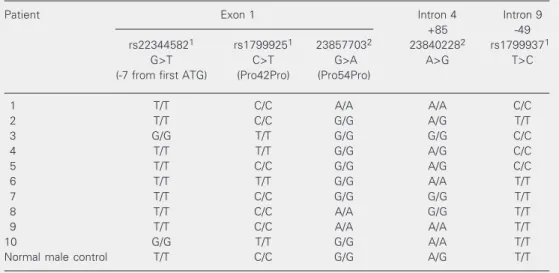
pro-cedure revealed three single nucleotide polymorphisms (SNPs) already described in normal populations (20) (rs22344582, rs1799925 and rs1799937 according to the Single Nucleotide Polymorphism Database) and a new 163G>A silent point mutation at codon 54 (Pro54Pro; patients 3, 5 and 8). Table 3 shows the patients’ genotypes for
these polymorphic sites. The only patho-genic mutation in this study was a nucleotide change (1186G>A), which was found in het-erozygous condition in patient No. 10. This transition is located within the ninth exon and causes a missense mutation which changes the predicted aspartic acid in codon 396 to asparagine (D396N).
Discussion
The absence of SRY mutations observed
in the present study reinforces previous lit-erature data which suggest that SRY
muta-tions in patients with partial gonadal dysgen-esis are much less frequent than in XY pure gonadal dysgenesis (22). Among the 44 dif-ferent SRY ORF mutations reported to date,
only three were associated with XY partial gonadal dysgenesis (reviewed by Assumpção et al.,8). One of them was a variant sequence
(S18N) also found in normal relatives of the patient (23). The second (R30I) was found in affected and non-affected members of a fam-ily, including the father, two siblings with partial gonadal dysgenesis, a phenotypic fe-male with pure gonadal dysgenesis, and three
Table 3. WT1 single nucleotide polymorphism genotypes in 10 children with partial gonadal dysgenesis.
Patient Exon 1 Intron 4 Intron 9
+85 -49
rs223445821 rs17999251 238577032 238402282 rs17999371
G>T C>T G>A A>G T>C
(-7 from first ATG) (Pro42Pro) (Pro54Pro)
1 T/T C/C A/A A/A C/C
2 T/T C/C G/G A/G T/T
3 G/G T/T G/G G/G C/C
4 T/T T/T G/G A/G C/C
5 T/T C/C G/G A/G C/C
6 T/T T/T G/G A/A T/T
7 T/T C/C G/G G/G T/T
8 T/T C/C A/A G/G T/T
9 T/T C/C A/A A/A T/T
10 G/G T/T G/G A/A T/T
Normal male control T/T C/C G/G A/G T/T
1rs = reference sequence number according to http://www.ncbi.nlm.nih.gov/SNP (20). 2Numbering
non-affected male siblings (8). Both muta-tions are located in the non-high motility group box, while the third one (Y129N) is located at C-terminal of the high motility group box sequence (24). In vitro studies
revealed that R30I mutant protein was poorly phosphorylated and showed reduced DNA-binding capacity (7), while the Y129N mu-tant exhibited altered protein-protein inter-actions (24). In addition, a case of XY partial gonadal dysgenesis with a de novo
intersti-tial deletion at the 3' end of the SRY ORF was
reported by McElreavey et al. (25), who proposed that this deletion could be respon-sible for the abnormal gonadal development by diminishing SRY expression.
To date, no nucleotide changes in the 5' UTR flanking sequence of the SRY gene
have been reported in XY partial gonadal dysgenesis. A paternally inherited 3-bp dele-tion in the SRY 5’UTR Sp1 binding site has
been demonstrated in a 46,XY female with pure gonadal dysgenesis (Assumpção JG, Maciel-Guerra AT, Marques-de-Faria AP, Guerra Jr G, Scolfaro MR and De Mello MP, unpublished data). The patient’s father had surgically corrected hypospadias and peno-scrotal fusion as a child and other affected relatives with genital ambiguity have been reported in this family. These findings sug-gest that, although rare, SRY mutations should
be screened in cases of partial gonadal dys-genesis, especially if familial recurrence of genital ambiguity is reported.
In the present study, analysis of the WT1
gene revealed the D396N deleterious muta-tion in one of the patients with unilateral Wilms’ tumor (patient No. 10). This muta-tion had already been described in patients with Denys-Drash syndrome (26,27), being the third most frequent mutation reported in the Universal WT1 mutation database (28).
According to Little and Wells (29), the Denys-Drash phenotype often arises from the alter-ation of one allele by a missense point muta-tion, usually in the zinc finger binding do-main of WT1. The second and third zinc
finger regions, encoded by exons 8 and 9, are considered to be hot spots for mutations in patients with typical Denys-Drash nephrop-athy (30). Based on experimental evidence, some investigators have claimed that the Denys-Drash syndrome mutations behave in a dominant-negative fashion (27,31,32), while others have proposed that heterozy-gous point mutations cause functional loss of one WT1 allele; therefore,
haploinsuffi-ciency may be responsible for the phenotype (33).
The constitutional heterozygous missense D396N, identified in patient 10 described here, affects the third zinc finger region of the protein. It has been shown that D396N has a slightly reduced binding affinity for selected DNA sequences when compared with the wild-type WT1 (34). Thus, the clini-cal phenotype of Denys-Drash syndrome in our patient may be associated with a modest reduction in the DNA binding affinity of WT1, either in a near-haploinsufficiency condition or in a dominant-negative fashion. Moreover, the persistence of the Müllerian ducts in this patient may indicate a MIS gene
deregulation, since WT1 is an essential fac-tor for the transactivation of MIS promoter
(35). Indeed, co-transfection experiments with several zinc finger mutant WT1s (D396N
included) with either SOX9 or SF1 failed to
activate synergistically reporter constructs containing the MIS promoter (36). WT1 is
also considered a key regulator of the vis-ceral epithelial cells (podocytes) of the ma-ture glomerulus function, by repressing or activating PAX2 expression (37,38) and
WT1 gene-related disorders, Auber et al.
(30) reported that in Denys-Drash syndrome patients, proteinuria occurred very early and diffuse mesangial sclerosis or mesangial hy-perplasia was the cause of end-stage renal disease, in the presence of missense point mutations affecting the third zinc finger.
We were unable to demonstrate any path-ogenic mutation after sequencing the 10 ex-ons and the corresponding flanking regiex-ons of the WT1 gene of patient 9 described in this
paper, who also had a Wilms’ tumor at age four but remained free of renal disease after 5 years of follow-up. However, neither a
WT1 intragenic deletion nor mutations in the
promoter region that could significantly af-fect the transcription rate were excluded in the present case. Baird et al. (27) reported a similar case of an atypical XY Denys-Drash syndrome female patient with Wilms’ tumor and ambiguous genitalia, but no nephropa-thy or WT1 gene mutations, arguing that
such cases raise the possibility of the exist-ence of other genes which may also predis-pose to this clinical condition.
No WT1 mutations were detected in
pa-tients with partial gonadal dysgenesis with-out renal abnormalities or Wilms’ tumor manifestations (patients 1 to 8). Among the five SNP identified in some of these patients, three can be found in the SNP database, with allelic frequencies obtained from samples of 90 individuals (20). For the WT1 SNP
lo-cated at -7 from the first ATG (G>T), the “G” and “T” allele frequencies are of 0.722 and 0.278, respectively. An inverted rate was found for our patients, with the “T”
allele being the most frequent one (0.8) but the small size of our sample precludes any conclusion. The “C” and “T” allelic frequen-cies reported for the WT1 SNP located at
exon 1 are 0.711 and 0.289, respectively. In our sample, the frequencies were of 0.6 and 0.4 for the “C” and “T” alleles, respectively. The third SNP (IVS9-49 T>C) has frequen-cies of 0.55 and 0.45 reported for the “T” and “C” alleles, respectively. The “T” and “C” allelic frequencies in our patients were of 0.6 and 0.4, respectively. Two not yet described sequence variations were identi-fied in the present study, possibly represent-ing new polymorphisms if we take into ac-count the genotypic variation observed in the patient sample. Although the pathogenic significance of WT1 SNPs is largely
un-known, it is possible to propose that some haplotypes could play a role in the efficiency of mRNA processing or translation due to secondary structures.
Our results suggest that WT1 gene
muta-tions are not a common cause of 46,XY partial gonadal dysgenesis in the absence of renal abnormalities or Wilms’ tumor mani-festations. In conclusion, although mutations in the two major genes required for male gonadal development account for a minority of cases of XY partial gonadal dysgenesis, genetic analysis of the WT1 gene should be
performed in these patients looking for Wilms’ tumor or nephropathy risk factor. This clearly indicates that mutations at other chromosomal loci should be investigated in order to elucidate these complex clinical situations.
References
1. Robboy SJ, Miller T, Donahoe PR, Jahre C, Welch WR, Haseltine FP, Miller WA, Atkins L & Crawford JD (1982). Dysgenesis of testicular and streak gonads in the syndrome of mixed gonadal dysgenesis: perspective derived from clinicopathologic analysis of twenty-one cases. Human Pathology, 13: 700-716.
2. Rey RA, Belville C, Nihoul-Fekete C et al. (1999). Evaluation of gonadal function in 107 intersex patients by means of serum
antimullerian hormone measurement. Journal of Clinical Endocri-nology andMetabolism, 84: 627-631.
4. Berkovitz GD, Fechener MD, Zacur HW, Rock JÁ, Snyder III MD, Migeon CJ & Perlman EJ (1991). Clinical and pathologic spectrum of 46,XY gonadal dysgenesis: its relevance to the understanding of sex differentiation. Medicine, 10: 375-383.
5. Scolfaro MR, Cardinalli IA, Gabas Stuchi-Perez E, De Mello MP, Assumpção JG, Baptista MTM, Silva JMB, Maciel-Guerra AT & Guerra Jr G (2001). Morphometry and histology of gonads from 13 children with dysgenetic male pseudohermaphroditism. Archives of Pathologyand Laboratory Medicine, 125: 652-656.
6. MacLaughlin DT & Donahoe PK (2004). Sex determination and differentiation. New England Journal of Medicine, 350: 367-378. 7. Uehara S, Hashiyada M, Sato K, Nata M, Funato T & Okamura K
(2002). Complete XY gonadal dysgenesis and aspects of the SRY genotype and gonadal tumor formation. Human Genetics, 47: 279-284.
8. Assumpção JG, Benedetti CE, Maciel-Guerra AT, Guerra Jr G, Baptista MTM, Scolfaro MR & De Mello MP (2002). Novel muta-tions affecting SRY DNA-binding activity: the HMG box N65H asso-ciated with 46,XY pure gonadal dysgenesis and the familial non-HMG box R30I associated with variable phenotypes. Journal of Molecular Medicine, 80: 782-790.
9. Poulat F, Desclozeaux M, Tuffery S, Jay P, Boizet B & Berta P (1998). Mutation in the 5' noncoding region of the SRY gene in an XY sex-reversed patient. Human Mutation, 1 (Suppl 1): S192-S194. 10. Matsuzawa-Watanabe Y, Inoue J & Semba K (2003). Transcriptional activity of testis-determining factor SRY is modulated by the Wilms’ tumor 1 gene product, WT1. Oncogene, 22: 5956-5960.
11. Shimamura R, Fraizer GC, Trapman J, Lau IC & Saunders GF (1997). The Wilms’ tumor gene WT1 can regulate genes involved in sex determination and differentiation: SRY, Müllerian-inhibiting sub-stance, and the androgen receptor. Clinical Cancer Research, 3: 2571-2580.
12. Heathcott RW, Morison IM, Gubler MC, Corbett R & Reeve AE (2002). A review of the phenotypic variation due to the Denys-Drash syndrome-associated germline WT1 mutation R362X. Human Mu-tation, 19: 462.
13. Wagner KD, Wagner N & Schedl A (2003). The complex life of WT1. Journal ofCell Science, 116: 1653-1658.
14. Pritchard-Jones K, Fleming S, Davidson D et al. (1990). The candi-date Wilms’ tumour gene is involved in genitourinary development. Nature, 346: 194-197.
15. Fuqua JS, Sher ES, Perlman EJ, Urban MD, Ghahremani M, Pelletier J, Migeon CJ, Brown TR & Berkovitz GD (1996). Abnormal gonadal differentiation in two subjects with ambiguous genitalia, Müllerian structures, and normally developed testes: evidence for a defect in gonadal ridge development. HumanGenetics, 97: 506-511. 16. Quigley CA, De Bellis A, Marschke KB, el-Awady MK, Wilson EMD
& French FS (1995). Androgen receptor defects: historical, clinical, and molecular perspectives. Endocrine Reviews, 16: 271-321. 17. Sambrook J, Fristsch EF & Maniatis TE (1989). Molecular Cloning: A
Laboratory Manual. Cold Spring Harbor Press, Cold Spring Harbor, NY, USA.
18. Hawkins JR, Taylor A, Berta P, Levilliers J, Van der Auwera B & Goodfellow PN (1992). Mutational analysis of SRY: nonsense and missense mutations in XY sex reversal. Human Genetics, 88: 471-474.
19. Schmitt-Ney M, Thiele H, Kaltwasser P, Bardoni B, Cisternino M & Scherer G (1995). Two novel SRY missense mutations reducing DNA binding identified in XY females and their mosaic fathers. American Journal of Human Genetics, 56: 862-869.
20. Single Nucleotide Polymorphism Database - dbSNP. http://
www.ncbi.nlm.nih.gov/SNP/index.html. Accessed November 28, 2003.
21. National Center for Biotechnology Information Nucleotide Data-base. http://www.ncbi.nlm.nih.gov/. Accessed September 12, 2003. 22. Hawkins JR, Taylor A, Goodfellow PN, Migeon CJ, Smith KD & Berkovitz GD (1992). Evidence for increased prevalence of SRY mutations in XY females with complete rather than partial gonadal dysgenesis. American Journal of Human Genetics, 51: 979-984. 23. Domenice S, Nishi MY, Billerbeck AEC et al. (1998). A novel
mis-sense mutation (S18N) in the 5' non-HMG box region of the SRY gene in a patient with partial gonadal dysgenesis and his normal male relatives. Human Genetics, 102: 213-215.
24. Baud S, Margeat E, Lumbroso S, Paris F, Sultan C, Royer C & Poujol N (2002). Equilibrium binding assays reveal the elevated stoichiom-etry and salt dependence of the interaction between full-length human sex-determining region on the Y chromosome (SRY) and DNA. Journal of Biological Chemistry, 277: 18404-18410. 25. McElreavey K, Vilain E, Barbaux S et al. (1996). Loss of sequences
3' to the testis-determining gene, SRY, including the Y pseudoauto-somal boundary associated with partial testicular determination. Proceedings of the National Academy of Sciences, USA, 93: 8590-8594.
26. Pelletier J, Bruening W, Kashtan CE et al. (1991). Germline muta-tions in the Wilms’ tumor suppressor gene are associated with abnormal urogenital development in Denys-Drash syndrome. Cell, 67: 437-447.
27. Baird PN, Santos A, Groves N, Jadresic L & Cowell JK (1992). Constitutional mutations in the WT1 gene in patients with Denys-Drash syndrome. HumanMolecular Genetics, 1: 301-305. 28. Jeanpierre C, Béroud C, Niaudet P & Junien C (1998). Software and
database for the analysis of mutations in the human WT1 gene. Nucleic Acids Research, 26: 271-274.
29. Little M & Wells C (1997). A clinical overview of WT1 gene muta-tions. HumanMutation, 9: 209-225.
30. Auber F, Lortat-Jacob S, Sarnacki S, Jaubert F, Salomon R, Thibaud E, Jeanpierre C & Cihoul-Fékété C (2003). Surgical management and genotype/phenotype correlations in WT1 gene-related diseases (Drash, Frasier syndromes). Journal of Pediatric Surgery, 38: 124-129.
31. Bardeesy N, Zabel B, Schmitt K & Pelletier J (1994). WT1 mutations associated with incomplete Denys-Drash syndrome define a do-main predicted to behave in a dominant-negative fashion. Genom-ics, 21: 663-665.
32. Moffet P, Bruening W, Nakagama H, Bardeesy N, Housman D, Housman DE & Pelletier J (1995). Antagonism of WT1 activity by protein self-association. Proceedings of the National Academy of Sciences, USA, 92: 11105-11109.
33. Hossain A & Saunders GF (2001). The human sex-determining gene SRY is a direct target of WT1. Journal of Biological Chemistry, 18: 16817-16823.
34. Borel F, Barilla KC, Hamilton TB, Iskandar M & Romaniuk PJ (1996). Effects of Denys-Drash syndrome point mutations on the DNA binding activity of the Wilms’ tumor suppressor protein WT1. Bio-chemistry, 35: 12070-12076.
35. Nachtigal MW, Hirokawa Y, Enyeart-VanHouten DL, Flanagan JN, Hammer GD & Ingraham H (1998). Wilms’ tumor 1 and Dax-1 modulate the orphan nuclear receptor SF-1 in sex-specific gene expression. Cell, 93: 445-454.
37. Favor J, Sandulache R, Neuhauser KA et al. (1996). The mouse Pax2 (1Neu) mutation is identical to a human PAX2 mutation in a family with renal-coloboma syndrome and results in developmental de-fects of the brain, ear, eye and kidney. Proceedings of the National Academy of Sciences, USA, 93: 13870-13875.
38. Ryan G, Steele Perkins V, Morris JR, Rauscher FJ & Dressler GR (1995). Repression of Pax-2 by WT1 during normal kidney develop-ment. Development, 121: 867-875.
39. Palmer RE, Kotsianti A, Cadman B, Boyd T, Gerald W & Haber DA
(2001). WT1 regulates the expression of the major glomerular podocyte membrane protein Podocalyxin. Current Biology, 11: 1805-1809.