Habituation of enterotoxigenic
Staphylococcus aureus
to
Origanum vulgare
L. essential oil does not induce direct-tolerance
and cross-tolerance to salts and organic acids
Adassa Gama Tavares
1, Daniel Farias Marinho do Monte
1,
Allan dos Reis Albuquerque
2, Fábio Correia Sampaio
2, Marciane Magnani
3,
José Pinto de Siqueira Júnior
4, Evandro Leite de Souza
11
Departamento de Nutrição, Universidade Federal da Paraíba, PB, Brazil. 2
Laboratório de Biologia Oral, Universidade Federal da Paraíba, PB, Brazil. 3
Departamento de Engenharia de Alimentos, Universidade Federal da Paraíba, PB, Brazil. 4
Departamento de Biologia Molecular, Universidade Federal da Paraíba, PB, Brazil.
Submitted: April 29, 2014; Approved: December 19, 2014.
Abstract
EnterotoxigenicStaphylococcus aureusstrains that were isolated from foods were investigated for their ability to develop direct-tolerance and cross-tolerance to sodium chloride (NaCl), potassium chloride (KCl), lactic acid (LA) and acetic acid (AA) after habituation in sublethal amounts (1/2 of the minimum inhibitory concentration 1/2 MIC and 1/4 of the minimum inhibitory concentration -1/4 MIC) ofOriganum vulgareL. essential oil (OVEO). The habituation ofS. aureusto 1/2 MIC and 1/4 MIC of OVEO did not induce direct-tolerance or cross-tolerance in the tested strains, as assessed by modulation of MIC values. Otherwise, exposing the strains to OVEO at sublethal concentrations maintained or increased the sensitivity of the cells to the tested stressing agents because the MIC val-ues of OVEO, NaCl, KCl, LA and AA against the cells that were previously habituated to OVEO re-mained the same or decreased when compared with non-habituated cells. These data indicate that OVEO does not have an inductive effect on the acquisition of direct-tolerance or cross-tolerance in the tested enterotoxigenic strains ofS. aureusto antimicrobial agents that are typically used in food preservation.
Key words:Staphylococcus, adaptation, essential oil, oregano.
Introduction
Food processing exposes spoilage and pathogenic food-related bacteria to various stress-inducing conditions, including low pH, salts or treatments with cleaners and dis-infecting agents (Cebriánet al., 2010). However, the use of stressing factors in food processing can cause sublethal damage to bacterial cells, and during the injury repair pro-cess, these cells could acquire new abilities to adapt to these stress-inducing agents (direct-tolerance), leading to im-pacts on food safety and preservation (Silva-Anguloet al., 2014). These responses can also activate the intrinsic resis-tance mechanisms that concomitantly decrease the suscep-tibility of cells to other unrelated antimicrobial compounds
or procedures (cross-tolerance), meaning major implications for food processing in which multiple stresses are often applied to control microbial growth and survival (Greenacre and Brocklehurst, 2006).
Staphylococcus aureusis one of the most common causes of foodborne diseases worldwide, causing a typical intoxication through the ingestion of enterotoxins that have been pre-formed in foods by enterotoxigenic strains (Wang
et al., 2013). Previous studies have shown thatS. aureusis capable of developing tolerance to heat, acidic pH and salts when exposed to sublethal stress conditions (Bikels-Goshenet al., 2010; Cebriánet al., 2010). The tolerance acquired byS. aureusto many procedures used by the food
DOI: http://dx.doi.org/10.1590/S1517-838246320140355
Send correspondence to E.L. Souza. Departamento de Nutrição, Centro de Ciências da Saúde, Universidade Federal da Paraíba, Campus I, 58051-900 Cidade Universitária, João Pessoa, PB, Brasil. E-mail: [email protected].
industry to control bacterial growth and survival has moti-vated the research and development of novel techniques to control this bacterium in foods (Gomes Netoet al., 2012; Luzet al., 2013).
In this context, essential oils and their active compo-nents have received attention as alternative anti-S. aureus
compounds to use in foods (Bakkaliet al., 2008). Earlier in-vestigations revealed thatOriganum vulgare L. essential oil (OVEO) possesses broad-spectrum antimicrobial activ-ity even at low concentration, with interesting results in in-hibiting the growth of a variety of bacteria and food-related fungi when assayed alone (Nostroet al., 2004;Sousaet al., 2013; Souzaet al., 2009; Gomes Netoet al., 2012) or in combination with other antimicrobial compounds or proce-dures used by food industry (Barroset al., 2009b; Oliveira
et al., 2010). Studies have also revealed that OVEO pos-sesses a strong capacity to inhibitS. aureus in synthetic, food based-broth and in food models, besides to suppress the action of some related virulence factors, including enterotoxin, biofilm production and synthesis of the en-zymes lipase, protease and coagulase (Nostroet al., 2007; Barroset al., 2009a). Although the anti-S. aureusactivity of OVEO has already been reported, little attention has been paid to the response of this bacterium when exposed to sublethal amounts of this substance.
The aim of this study was to assess the effects of ex-posing enterotoxigenicS. aureusstrains that were isolated from foods to sublethal OVEO concentrations for different time points on the development of bacterial direct-tolerance and cross-direct-tolerance to salts and organic acids typ-ically used by the food industry. To the best of our knowl-edge, this is the first study on the induction of direc-tolerance or cross-direc-tolerance in enterotoxigenicS. aureus
strains from foods in which the strains were subjected to OVEO habituation and further assessed for modulation of the Minimum Inhibitory Concentration (MIC) values.
Materials and Methods
Antimicrobial agents
The antimicrobial agents used in this study were OVEO (Laszlo Aromaterapia Indústria e Comércio Ltda., Minas Gerais, Brazil), sodium chloride (NaCl P.A.), potas-sium chloride (KCl), glacial acetic acid (AA) and lactic acid 85% (LA). The NaCl, KCl, AA and LA were obtained from Vetec Química Fina Ltda. (Rio de Janeiro, Brazil). The OVEO assayed in this study present carvacrol as the most prevalent compound (66.1 g/100 mL), followed for
p-cymene (12.4 g/100g) andg-terpinene (8.3 g/100g), ac-cording to the technical report presented by the supplier.
OVEO solutions (40-0.3mL mL-1) were prepared in sterile brain heart infusion (BHI) broth (Himedia, India) with Tween 80 (1%) (Sigma Aldrich, USA) as an emulsi-fier. Preliminary test to ensure that the antibacterial activity was due to the OVEO and not to Tween 80 was performed,
and the results demonstrated that Tween 80 at the given concentration (1%) did not inhibit the growth of the as-sayed bacterial strains cultivated in BHI broth. Solutions of NaCl (600-50 mg mL-1), KCl (600-50 mg mL-1), AA (160-1.25mL mL-1) and LA (160-1.25mL mL-1) were prepared in sterile BHI broth.
Bacterial strains
The test organisms used in this study included entero-toxigenic S. aureus strains isolated from foods (S. aureus
FRI-S-6, producing staphylococcal enterotoxins (SE) A and B, which were isolated from frozen shrimp;S. aureus
FRI-196-E, producing SEA and D, which were isolated from an unknown food; andS. aureusFRI-326, producing SEE, which was isolated from a chicken-based meal) (Bergdollet al., 1971; Wu and Bergdoll, 1971) and were generously provided by Food Research Institute (Madison, Wisconsin, USA). A standard type strain (S. aureusATCC 13565, producing SEA, isolated from ham) (Johnsonet al., 1991) was also used as a test strain. Stock cultures were kept at 4 °C, and prior to being used in the assay, each strain was grown in BHI broth at 37 °C for 18 h (later exponential growth phase), harvested by centrifugation (4500 g, 15 min, 4 °C), washed twice in sterile saline solution (NaCl, 0.85%) and resuspended in sterile saline solution to obtain standard cell suspensions at which the OD reading at 660 nm (OD660) was 0.1 (c.a. 107cfu mL-1) (McMahonet al., 2008).
Determining the Minimum Inhibitory Concentration (MIC)
A modified microtiter plate assay was used to deter-mine the MIC of OVEO, NaCl, KCl, acetic acid (AA) and lactic acid (LA) (17). The 96-well plates were prepared by dispensing 90 mL of OVEO (40 to 0.3 mL mL-1), salt (600-50 mg mL-1) or acid (160 to 1.25 mL mL-1) solutions into 90mL of doubly concentrated BHI broth in each well. Finally, 10mL of a bacterial suspension (c.a. 107cfu mL-1) was added to each well. The microplate was wrapped loosely with cling film to ensure the bacteria would not be-come dehydrated and the OVEO would not volatilize. Each plate included a set of controls without the antimicrobial test agents. The plates were prepared in triplicate, and they were incubated statically at 37 °C for 24 h in a microplate incubator/reader (EON model, Biotek Inc., USA). After the incubation period, MIC values were confirmed as the low-est concentrations of OVEO, NaCl, KCl, AA or LA at which the OD660was < 0.01 (McMahonet al., 2008).
Assaying the induction of direct-tolerance
bacterial suspension (c.a. 107cfu mL-1); thus, OVEO was added at the appropriate amount to obtain the desired final concentration (1/2 MIC or 1/4 MIC), followed by static in-cubation at 37 °C. An aliquot of each system was taken af-ter 24, 48 and 72 h of incubation (and standardized again to OD660values of 0.1, c.a. 107cfu mL-1of habituated cells) and used as inoculum (10mL) to determine the MIC of OVEO by using the same microtiter plate assay before de-scribed (McMahonet al., 2008). The induction of direct tol-erance in the bacteria was assessed by comparing the MIC of OVEO against those of the tested strains before and after the habituation treatment with the same stressing agent. Control systems without exposure to OVEO were assayed similarly (by non-habituation treatment).
Assaying the induction of cross-tolerance
The induction of bacterial cross-tolerance was per-formed by exposing the test strains to sublethal amounts of OVEO in broth for different time intervals, followed by de-termination of MIC values of the assayed heterologous stressing agents (NaCl, KCl, AA and LA). For this assess-ment, 4 mL of BHI broth was inoculated with 1 mL of bac-terial suspension (c.a. 107cfu mL-1); thus, the OVEO was added at an appropriate amount to obtain the desired final concentration (1/2 MIC or 1/4 MIC), followed by static in-cubation at 37 °C. After 24, 48 and 72 h of inin-cubation, an aliquot of each system was taken (standardized again to OD660values of 0.1, c.a. 107cfu mL-1of habituated cells) and used as an inoculum (10mL) to determine the MIC of the NaCl, KCl, AA and LA by using the same microtiter plate assay before described (McMahonet al., 2008). The induction of bacterial cross-tolerance was assessed by com-paring the MIC values of NaCl, KCl, AA and LA against the tested strains before and after the habituation treatment with sublethal amounts of OVEO. Control systems without OVEO exposure were assayed similarly (non-habituation treatment).
The assays were performed in triplicate on three sepa-rate experiments, and the results were expressed as modal or median values; where the values were the same, only the modal values were presented (McMahonet al., 2008).
Results and Discussion
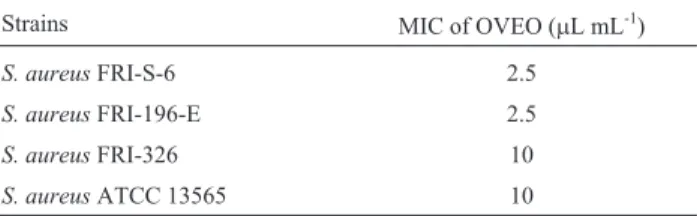
The habituation effects of some enterotoxigenic S. aureus strains on the development of bacterial direct-tolerance and cross-direct-tolerance after different intervals of ex-posure to sublethal concentrations of OVEO with regards to the modulation of MIC values were assessed in this study. The MIC values of OVEO against the test strains ranged from 2.5 to 10mL mL-1(Table 1). NaCl, KCl, AA and LA yielded MIC values of 200 mg mL-1, 300 mg mL-1, 2.5mL mL-1and 10mL mL-1, respectively, against all the assayed strains.
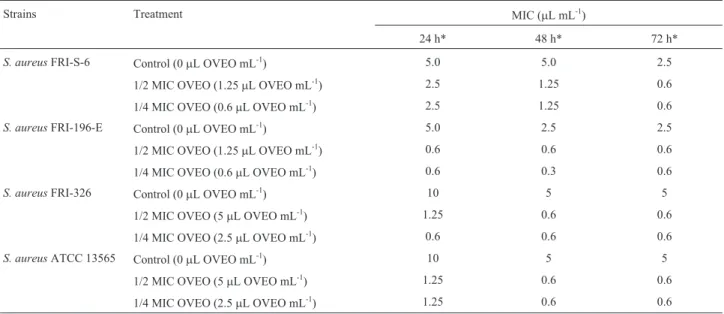
The OVEO MIC values against the habituated cells were maintained or decreased up to five-fold when com-pared with the previously determined MIC values (10mL mL-1to 0.6mL mL-1) (Table 2), indicating that there was no induction of direct-tolerance in these cells following OVEO habituation up to 72 h. The decreased MIC of OVEO against habituated enterotoxigenicS. aureus cells was related to time of exposure to the sublethal concentra-tions of this substance because the smaller MIC values were generally found against cells that were pre-exposed to OVEO for 72 h, when compared with non-habituated cells (control assay). During all of the assessed time intervals, the MIC values of OVEO against non-habituated cells ranged from 5 to 10mL mL-1.
This lack of direct-tolerance induction in the test strains following different OVEO habituation times is in-teresting; previous studies showed thatS. aureuswas able to develop tolerance after being exposed to other sublethal environmental conditions. The habituation of S. aureus
CECT 4459 from 5 min to 2 h to stress conditions caused by acid (hydrochloric acid pH 2.5), alkali (sodium hydrox-ide pH 12.0), hydrogen peroxhydrox-ide (50 mM) and heat (58 °C) in tryptone soy broth resulted in increased direct-tolerance to all tested antimicrobial agents when the survivor/death curves (viable cell counts) were observed. The develop-ment of bacterial cross-tolerance to hydrogen peroxide and acid after submitting the cells to heat shock, in addition to their increased tolerance to heat and hydrogen peroxide af-ter acid shock, was already reported (Cebriánet al., 2010).
Existing literature on the development of tolerance by
S. aureuswhen exposed to sublethal amounts of essential oils regarding the modulation of MIC values is scarce, mak-ing any extensive comparative discussion of the results dif-ficult. The susceptibility of methicillin-resistant/-sensitive
S. aureusisolates to tea tree (Melaleuca alternifolia) essen-tial oil (TTEO) and to antibiotic were determined by modu-lating the MIC values following a 72 h habituation to sublethal TTEO concentrations in Luria-Bertani broth. This habituation led to stress-hardening with a subsequent increase in the MIC values (³2-fold increase) of TTEO and of different clinically important antibiotics (mupirocin, chloramphenicol, linezolid and vancomycin) (McMahonet
Table 1- The minimum inhibitory concentration of the essential oil from
O. vulgareL. against different enterotoxigenic strains ofS. aureusthat
were isolated from foods.
Strains MIC of OVEO (mL mL-1)
S. aureusFRI-S-6 2.5
S. aureusFRI-196-E 2.5
S. aureusFRI-326 10
S. aureusATCC 13565 10
MIC: Minimum Inhibitory Concentration; OVEO:Origanum vulgareL.
al., 2008). Another study assessed the increased resistance (by employing viable cell counts) of four enterotoxigenic strains ofS. aureus(CECT 976, CECT 4459, CECT 4465 and CECT 4466 that produced SEA, B, C and D, respec-tively) after habituating to a high temperature (58 °C) in McIlvaine citrate phosphate buffer, and the development of heat tolerance was observed upon the entry of cells into the stationary phase of growth (Cebriánet al., 2007).
In accordance with the direct-tolerance results, the MIC values for NaCl, KCl, AA and LA against the OVEO-habituated cells were the same or decreased (two- to six-fold) in each assessed exposure time interval when com-pared with MIC values against non-habituated cells (con-trol cells) (Table 3). However, for most of the assessed time intervals, the MIC values remained the same. There was no clear effect of the time-of-habituation with OVEO in rela-tion to the sensitivity of habituated cells to NaCl, KCl and LA. Otherwise, the decrease in the MIC values of AA against habituated-cells always occurred after 48 h (S. aureusATCC 13565) or 72 h (S. aureusFRI-S-6) of expo-sure to sublethal amounts of OVEO.
The overnight cultivation ofS. aureusATCC 6538 in meat broth containing the essential oil from Rosmarinus officinalis L. (ROEO), and its majority compound 1,8-cineole (CIN), at sublethal amounts (ROEO 10 and 5mL mL-1; CIN 20 and 10mL mL-1), induced no direct-tolerance or cross-tolerance (NaCl 100 g l-1; lactic acid pH 5.2; high temperature 45 °C) in the tested bacte-ria when assessed by viable cell count and growth/sur-vival behavior. The cells subjected to pre-habituation with ROEO or CIN revealed an increased sensitivity to LA, high temperature and NaCl when compared with the non-habituated cells. The repeated
exposure ofS. aureuscells to amounts of essential oils (or related compounds) lower than their MICs could cause an imbalance between the anabolism and catabolism that was sufficient to stop growth and cause the cells to be unable to maintain their viability (Gomes Netoet al., 2010).
The sublethal injury caused by phenolic compounds in essential oils, such as the carvacrol or thymol present in OVEO (Barroset al., 2009a; Luzet al., 2013), can result in a damaged bacterial cell membrane, with changes in its structure and permeability (Espinaet al., 2013). Further-more, an injury of the microbial cell membrane provided by sublethal concentrations of antimicrobial compounds may affect the ability of the membrane to osmoregulate the cell adequately or to exclude toxic materials (Carson et al., 2002), and consequently, the decreased tolerance to salts or acids caused by OVEO may be related to membrane dam-age in sublethally injured bacteria. The cultivation ofS. aureusstrains isolated from foods in nutrient broth contain-ing sublethal concentrations of OVEO (0.3 and 0.15 mL mL-1) for 24 h interfered with the metabolic activity of the assayed strains, inhibiting the activity of the enzymes lipase and coagulase and enterotoxin production (Barros et al., 2009b). The ability of OVEO to suppress enzyme synthesis and/or activity inS. aureusresult in blocked protein synthe-sis (Nostroet al., 2001; Oliveiraet al., 2010; Gomes Netoet al., 2012), and this action could also be related to the diffi-culty of the different enterotoxigenic strains ofS. aureusin developing direct-tolerance or cross-tolerance under the conditions used in this study.
The results from this study confirm that OVEO is an effective anti-staphylococcal substance because exposing enterotoxigenicS. aureus strains to sublethal amounts of Table 2- The minimum inhibitory concentration of the essential oil fromO. vulgareL. against different enterotoxigenic strains ofS. aureusthat were iso-lated from foods, with or without habituation to the same stressing agent up to 72 h.
Strains Treatment MIC (mL mL-1)
24 h* 48 h* 72 h*
S. aureusFRI-S-6 Control (0mL OVEO mL-1) 5.0 5.0 2.5
1/2 MIC OVEO (1.25mL OVEO mL-1) 2.5 1.25 0.6
1/4 MIC OVEO (0.6mL OVEO mL-1) 2.5 1.25 0.6
S. aureusFRI-196-E Control (0mL OVEO mL-1) 5.0 2.5 2.5
1/2 MIC OVEO (1.25mL OVEO mL-1) 0.6 0.6 0.6
1/4 MIC OVEO (0.6mL OVEO mL-1) 0.6 0.3 0.6
S. aureusFRI-326 Control (0mL OVEO mL-1) 10 5 5
1/2 MIC OVEO (5mL OVEO mL-1) 1.25 0.6 0.6
1/4 MIC OVEO (2.5mL OVEO mL-1) 0.6 0.6 0.6
S. aureusATCC 13565 Control (0mL OVEO mL-1) 10 5 5
1/2 MIC OVEO (5mL OVEO mL-1) 1.25 0.6 0.6
1/4 MIC OVEO (2.5mL OVEO mL-1) 1.25 0.6 0.6
*hours of previous habituation or not in the assayed sublethal concentrations ofO. vulgareL. essential oil; MIC: Minimum Inhibitory Concentration;
OVEO caused no direct-tolerance and cross-tolerance in-duction to stressing agents, such as NaCl, KCl, LA an AA. Exposing the test strains to sublethal concentrations of OVEO maintained or increased susceptibility to the same stressing agent and to the assayed heterologous stressing agents, suggesting that OVEO had no impact on the induc-tion of tolerance in enterotoxigenic strains ofS. aureusas assessed by the modulation of MIC values.These findings reinforce the possible rational use of OVEO by food indus-try to control the growth and survival of enterotoxigenicS. aureusin foods when considered their efficacy to inhibit the growth of this bacterium besides the low capacity to in-duce bacterial tolerance.
References
Bakkali F, Averbeck S, Averbeck Det al.(2008) Biological
ef-fects of essential oils-A review. Food Chem Toxicol 46:446-475.
Barros JC, Conceição ML, Gomes Neto NJet al.(2009b)
Interfer-ence ofOriganum vulgareL. essential oil on the growth and
some physiological characteristics ofStaphylococcusaureus
strains isolated from foods. LWT - Food Sci Technol 42:1139-1143.
Barros JC, Gomes Neto NJ, Costa ACVet al.(2009a) Combined
application ofOriganum vulgareL. essential oil and acetic
acid for controlling the growth ofStaphylococcus aureusin
foods. Braz J Microbiol 40:386-392.
Bergdoll MS, Borja CR, Robbins RNet al.(1971) Identification
of Enterotoxin E. Infect Immun 4:593-595.
Bikels-Goshen T, Landau E, Saguy Set al.(2010) Staphylococcal
strains adapted to epigallocathechin gallate (EGCG) show reduced susceptibility to vancomycin, oxacillin and ampi-cillin, increased heat tolerance, and altered cell morphology. Int J Food Microbiol 138:26-31.
Carson CF, Mee BJ, Riley TV (2002) Mechanism of action of
Melaleuca alternifolia (tea tree) oil on Staphylococcus aureusdetermined by time-kill, lysis, leakage, and salt toler-ance assay and electron microscopy. Antimicrob Agents Chemother 46:1914-1920.
Cebrián G, Sagarzazu N, Pagán Ret al.(2010) Development of
stress resistance inStaphylococcus aureusafter exposure to
sublethal environmental conditions. Int J Food Microbiol 140:26-33.
Cebrián G, Sagarzazu N, Pagán Ret al.(2007) Heat and pulsed
electric field resistance of pigmented and non-pigmented
enterotoxigenic strains ofStaphylococcus aureusin
expo-nential and stationary phase of growth. Int J Food Microbiol 118:304-311.
Espina L, García-Gonzalo D, Laglaoui Aet al.(2013) Synergistic
combinations of high hydrostatic pressure and essential oils or their constituents and their use in preservation of fruit juices. Int J Food Microbiol 161:23-30.
Gomes Neto NJ, Luz IS, Tavares AGet al.(2012)Rosmarinus
officinalisL. essential oil and its majority compound 1,8-ci-neole at sublethal amounts induce no direct and cross
protec-tion in Staphylococcus aureus ATCC 6538. Foodborne
Pathog Dis 9:1071-1076.
Greenacre EJ, Brocklehurst TF (2006) The acetic acid tolerance
response induces cross-protection to salt stress in
Salmo-nellaTyphimurium. Int J Food Microbiol 112:62-65
Johnson WM, Tyler SD, Ewan EPet al.(1991) Detection of genes
for enterotoxins, exfoliative toxins, and toxic shock
syn-drome toxin 1 inStaphylococcus aureusby the polymerase
chain reaction. J Clin Microbiol 29:426-430.
Luz, IS, Gomes Neto NJ, Tavares AGet al.(2013) Lack of,
induc-tion of direct protecinduc-tion or cross-protecinduc-tion in
Staphylococ-cus aureusby sublethal concentrations ofOriganum vulgare
L. essential oil and carvacrol in a meat-based medium. Arch Microbiol 195:587-593.
McMahon MAS, Tunney MM, Moore JEet al.(2008) Changes in
antibiotic susceptibility in staphylococci habituated to
sub-lethal concentrations of tea tree oil (Melaleuca alternifolia).
Lett Appl Microbiol 47:263-268.
Nostro A, Bisignano G, Cannatelli MAet al.(2001) Effects of
Helichrysum italicumextract on growth and enzymatic
ac-tivity of Staphylococcus aureus. Int J Antimicrob Agents
17:517-520.
Nostro A, Blanco AR, Cannatelli MAet al.(2004) Susceptibility
of methicillin-resistant staphylococci to oregano essential oil, carvacrol and thymol. FEMS Microbiol Lett 230:191-195.
Nostro A, Sudano Roccaro A, Bisignano Get al.(2007) Effects of
oregano, carvacrol and thymol on Staphylococcus aureus
and Staphylococcus epidermidis biofilms. J Med Microbiol 56:519-523.
Oliveira CEV, Stamford TLM, Gomes Neto NJet al.(2010)
Inhi-bition ofStaphylococcus aureusin broth and meat broth
us-ing synergies of phenolics and organic acids. Int J Food Microbiol 137:312-316.
Silva-Angulo AB, Zanini SF, Rodrigo Det al.(2014) Growth
ki-netics ofListeria innocuaandListeria monocytogenesunder
exposure to carvacrol and the occurrence of sublethal dam-age. Food Control 37:336-342.
Sousa LL, Andrade SCA, Athayde AJAAet al.(2013) Efficacy of
Origanum vulgareL. andRosmarinus officinalisL. essential oils in combination to control postharvest pathogenic
Aspergilli and autochthonous mycoflora inVitis labruscaL.
(table grapes). Int J Food Microbiol 165:312-318.
Souza EL, Barros JC, Gomes Neto NJet al.(2009) Combined
ap-plication ofOriganum vulgare L. essential oil and acetic
acid for controlling the growth ofStaphylococcus aureusin
foods. Braz J Microbiol 40:386-392.
Wang X, Tao X, Xia Xet al.(2013)Staphylococcus aureusand
methicillin-resistant Staphylococcus aureus in retail raw
chicken in China. Food Control 29:103-106.
Wu CH, Bergdoll MS (1971) Stimulation of enterotoxin B pro-duction. Infect Immun 3:777-783.
Associate Editor: Elaine Cristina Pereira De Martinis